




Abstract
Abstract
Electrokinetic transport processes have been shown to have potential for effective removal of heavy metals from soils. However, pH changes near the anode and cathode limit their widespread application in remediation of contaminated soils. Permeable reactive composite electrodes (PRCEs) were constructed by attaching reactive materials such as Fe(0) and zeolite to electrodes, and effects of composite electrodes on pH control, chromium (Cr) removal efficiency, and adjustment of speciation of Cr were studied in the electrokinetic remediation of Cr(VI)-spiked soil. Composite electrodes consisting of permeable reactive materials gave better pH control and Cr removal efficiency compared to application of traditional electrodes, and a reactive layer of Fe(0) and zeolite in the anode exhibited the best performance compared to zeolite or Fe(0) alone. After 5 d of electrokinetic remediation with a DC voltage of 2.0 V/cm, the Fe(0)+zeolite reactive layer buffered pH fluctuation, maintained soil pH in the range of 5.5–8.5, and increased Cr(VI) remediation efficiency up to 97% in each section of soil. Additionally, it resulted in lower Cr(III) residues, enhancement of the amount of Cr retention up to 8× and 1.8×, respectively, and transformation of 98% of the Cr(VI) to lower toxicity Cr(III). After remediation, heavy metal ions were removed from the remediation system simply by unplugging the composite electrodes, which theoretically needed no further treatment—a major advantage over traditional electrokinetic remediation methods. This study provides a theoretical basis for exploitation of PRCEs, which is a practical option for future applications.
Introduction
The migration of chromium (Cr) in soils during electrokinetics is quite complex. The complexity of Cr removal arises due to its existence in two different chemical forms, namely hexavalent chromium [Cr(VI)] and trivalent chromium [Cr(III)]. Cr(VI) exists as oxyanions, specifically hydrochromate (
Permeable reactive composite electrodes (PRCEs) made by attaching reactive materials to traditional electrodes are a novel solution to the above problems, and have the potential to increase pollutant removal efficiency. PRCEs can buffer the pH changes during electrokinetic remediation of contaminated soils and capture the heavy metal ions moving to the electrodes. After the remediation, the heavy metal ions are removed easily from the remediation system simply by unplugging the electrodes, which theoretically needs no further treatment.
Fe(0) is widely known as a strong chemical reducing agent and can react with the majority of main pollutants in groundwater, including heavy metals (Cantrell et al., 1995), arsenite (Lien and Wilkin, 2005), and organic compounds (Schafer et al., 2003). At present, Fe(0) has been widely used in groundwater in situ remediation (Weisener et al., 2005). Weng et al. (2007) and Yuan and Chiang (2007) tried the application of Fe(0)-based permeable reactive layers (PRLs) in electrokinetics to treat Cr(VI)- and arsenic-contaminated clay and soil, and the practicability of Fe(0)-PRLs was proven. Cang et al. (2009) evaluated the performance of electrokinetics coupled with Fe(0)-PRLs loaded in different locations of the soil column for remediating a Cr-contaminated site, and results showed that different locations of Fe(0)-PRLs strongly affected the remediation performance. Fe(0)-based electrokinetic technology has unique advantages: on one hand, the electrical fields move and concentrate heavy metal ions (such as Cu2+, Zn2+, or Cr3+) to the cathode, and transport anions (such as
Zeolite, a natural and synthetic crystalline aluminosilicate with molecular sieve structure, has been widely applied in the field of environmental protection because of its good adsorption performance and low cost (Shevade and Ford, 2004; Ruggieri et al., 2008). Alkaline synthetic zeolite can be employed as a solid base to neutralize H+ produced by water electrolysis and reduce the pH fluctuation of the anode section, while acidified synthetic zeolite can be applied as solid acids that can neutralize OH− produced at the cathode and reduce the pH fluctuation of the cathode section.
The present study was therefore carried out to investigate the effects of Fe(0)- and zeolite-based PRCEs at the cathode and anode on remediation efficiency and mechanisms of spiked Cr(VI) in the electrokinetic remediation process, to extend its practical application in soil remediation engineering.
Materials and Methods
Sample collection and preparation
Soil samples from the topsoil layer were taken from farmland near Dianshan Lake in Qingpu District, Shanghai, east China. The samples were then mixed thoroughly in a polyethylene bag to provide a composite sample. The soil composite samples were taken to the laboratory, air-dried, and thoroughly mixed and were then passed through a 100-mesh (0.15-mm) sieve to remove coarse material. Selected properties, namely pH, organic matter content, and particle size distribution, were also measured by standard methods (Lu, 2000). The pH value (1:2.5 H2O) of the soil was 6.78; organic matter content was 34.3 g/kg. Percentage of clay (<0.002 mm), silt (0.002–0.02 mm), and sand (0.02–2 mm) particles were 13%, 52%, and 29%, respectively.
The soil was then spiked with Cr(VI) by adding potassium dichromate solution into the soil, which was mixed thoroughly, placed in a ceramic plate, and maintained for 30 days at room temperature. The Cr(VI) concentration in the spiked soil sample was around 500 mg/kg. The spiked soil sample was then air-dried and passed through a 20-mesh (0.85-mm) sieve.
Preparation of permeable reactive materials
Zero-valent iron powder (300 mesh) and alkaline synthetic zeolite (20 mesh) were bought from China National Medicines Corporation Ltd. Zeolite had an initial pH of 12.06 and a specific surface area of 634.8 m2/g. Iron powder and alkaline synthetic zeolite were attached to the anode as the permeable reactive materials. Acidified synthetic zeolite was obtained from alkaline synthetic zeolite, which was soaked with 10% H3PO4 for 3 h with continuous stirring and washed with deionized water three times before drying. The acidified synthetic zeolite was also attached to the cathode as the permeable reactive material.
Test equipment
The experimental apparatus for electrokinetic remediation consisted of four main parts: an organic glass cell (10 cm×5 cm×5 cm), anode compartment, cathode compartment, and a DC power supply (Fig. 1). In the anode and cathode compartments, composite electrodes consisted of plate electrodes made of high-purity graphite (10 cm×5 cm×0.5 cm) and PRLs on the anode and cathode. The composite electrodes were separated from the soil in the cell by a gauze screen and a piece of filter paper on it, and the electrodes could be conveniently removed and renewed because of the apparatus structure.
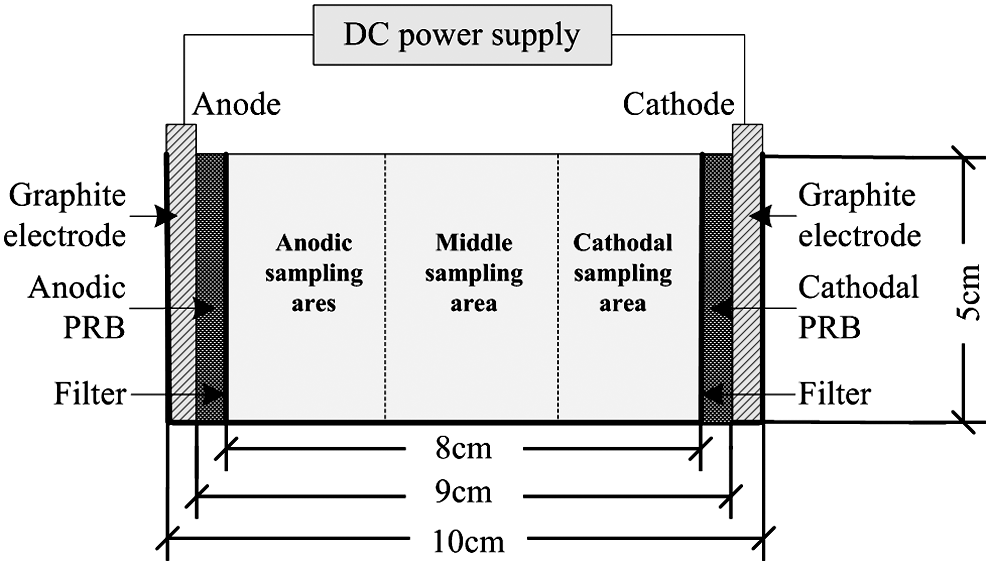
Schematic diagram of the electrokinetic remediation cell.
Testing procedures
The electrokinetic apparatus was vertically placed on the table, and a plate graphite electrode was inserted at the bottom with the upper surface covered smoothly by a 0.5-cm layer of active material, and subsequently a gauze screen and a piece of filter paper. About 80 mL of distilled water was added into 210 g (dry weight) of the spiked soil, and the mixture was adequately mixed, which was tamped into the soil cell in vertical layers to almost one-third of the cell length, and the soil was compacted with a pressure of 0.3 kPa to minimize its void space. The apparatus was then placed bottom up, and the other composite electrode was installed in the same way. The whole cell was subsequently filled by soil.
Four experiments were performed as shown in Table 1. In test 2 and test 3, plate graphite electrodes were covered by zeolite or Fe(0) before placement of a gauze screen and a piece of filter paper, which was then compacted with a pressure of 0.2 kPa. In test 4, zeolite or Fe(0) was initially mixed thoroughly before being attached to the electrode, which was then compacted with a pressure of 0.2 kPa. No PRLs applied in test 1, and a piece of filter paper was placed tightly on the plate graphite electrode, and the voltage was correspondingly adjusted to a voltage gradient of 2.0 V/cm.
Treatment time=120 h.
PRL, permeable reactive layer.
The anode and cathode were therefore connected with the positive and negative phase of the power to supply a DC voltage of 2.0 V/cm. The electrokinetic remediation was run for 5 days, and distilled water was added to the soil to balance the water losses due to evaporation and electrolysis during remediation.
Three sections of soil sample were horizontally partitioned equally along the cell to give separate anodic, middle, and cathodic sampling areas. After testing, the composite soil samples were collected separately from each section of the cell, and three composite soil samples were taken altogether for analysis.
Soil subsample analysis
Soil moisture content was determined by oven drying at 105°C to constant weight. The pH of soil subsamples before and after electrokinetic treatments was measured by preparing a slurry of 1:2.5 ratio fresh soil to water and using a pH meter.
Total concentrations of Cr in different soil sections were extracted by performing acid digestion in accordance with USEPA Procedure 3052. Alkaline digestion was performed in soil sections in accordance with USEPA Procedure 3060A, which extracted only Cr(VI) into the solution. The Cr(VI) concentration in the extracts was then analyzed by UV-VIS spectrophotometry.
Cr(III) concentrations were calculated by subtracting Cr(VI) concentrations from the total Cr concentrations determined.
Results and Discussion
Mass balance of total Cr
Mass balance of the total Cr and its removal efficiency of tests 1–4 are summarized in Table 2. Total recovery efficiency of total Cr was between 93% and 97%.
Changes in soil pH
The soil pH of the different sections of the reactor after the electrokinetic remediation is shown in Fig. 2. The soil pH near the anode decreased to 2.0 in those treatments without PRLs while the pH was ∼3.0 when the anode was fitted with alkaline zeolite (test 2). Compared to the control test (test 1), the smaller decrease in soil pH might be due to the fact that the OH− on the surface of alkaline zeolite played a neutralizing role for the H+ produced by water electrolysis. When Fe(0) was attached to the anode (test 3), the soil pH was ∼4.5. The rise in soil pH near the anode might be attributed to consumption of the H+ by Fe(0):
Effects of permeable reactive layers (PRLs) on soil pH.
A portion of H+ was consumed, and then less H+ entered into the anodic region and less decline in soil pH. In addition, Fe(0), Fe2+, and Cr(VI) in the anodic PRLs participated in the following reactions, which also consumed some of the H+:
As for the Fe(0)+zeolite PRL (test 4), both Fe(0) and alkaline zeolite consumed the H+ produced by water electrolysis. Besides, in the Fe(0)+zeolite PRL, the zeolite acted as a support medium and separated the Fe(0) particles thoroughly to avoid ineffective inner areas in Fe(0) aggregates, and consequently increased the contact area where H+ and Fe(0) reacted. The soil pH near the anode was ∼5.5 after the electrokinetic remediation.
In summary, compared to individual zeolite or Fe(0) PRL, the Fe(0)+zeolite PRLs lowered the fluctuations in soil pH near the anode to the maximum extent in the electrokinetic remediation of Cr(VI) polluted soil.
With the sole exception of the control test (test 1), the cathode was fitted with acidic zeolite in the other three tests. The soil pH near the cathode was ∼8.5 after the electrokinetic remediation, while the pH of the control test increased to 11, which indicated that the acidified zeolite neutralized the OH− produced by water electrolysis.
Prohibition or elimination of pH fluctuation exerted essential effects on remediation of Cr(VI) in the electrokinetic remediation. Chen et al. (2007) studied the major factors influencing remediation of hexavalent Cr-polluted kaolin by an orthogonal experiment, and four factors were investigated at laboratory scale, namely applied voltage, treatment time, soil moisture, OH− produced at the cathode, and its control. The experiment results showed that OH− produced at the cathode has the most crucial effects on the remediation efficiencies of Cr, and it was found that some Cr(VI) was converted into Cr(III) in remediation, and this Cr(III) would migrate toward the cathode, and then formed insoluble Cr(III) hydroxide with the OH− near cathode when the pH value was relatively high, and this influenced the remediation efficiency significantly. Furthermore, extremely low pH values near the anode are not favorable to Cr(VI) remediation, since soils with lower pH values would absorb Cr(VI) oxyanions more tightly (Reddy and Chinthamreddy, 2003b). Results in Table 1 also indicated that countermeasures of pH control would give some positive effects on remediation of Cr(VI).
Remediation of Cr(VI)
The residual Cr(VI) in different sections of the reactors after the electrokinetic remediation is shown in Fig. 3. In the control test (test 1), the average remediation efficiency of Cr(VI) in the anode, middle, and cathode section was 36%, 68%, and 91%, respectively, showing a declining trend of Cr(VI) remediation efficiency from the anode to the cathode. As mentioned above, Cr(VI) existed as oxyanions in soil, which migrated to the anode in the electrokinetic remediation process, and this might be the main explanation to this effect. In test 2, in which the anode was amended with alkaline zeolite, the Cr(VI) remediation efficiency in the anode, middle, and cathode sections increased to 57%, 82%, and 91%, respectively. The higher pH near the anode would be favorable to Cr(VI) mobility, and moreover zeolite could adsorb Cr(VI), since it is a molecular sieve with a very large surface area, and the decrease in the Cr(VI) near the anode would result in a concentration gradient that would be helpful for its further migration. In test 3, where the anode was amended with Fe(0), more than 92% of the Cr(VI) was removed from each section of the soil, and the highest value of 97% was found near the anode. The high Cr(VI) remediation efficiency might thank to the reduction caused by Fe(0) and Fe2+ as shown in reactions 2 and 3. Using the Fe(0)+zeolite PRL, test 4 had a Cr(VI) remediation efficiency over 97% in each section of the soil.
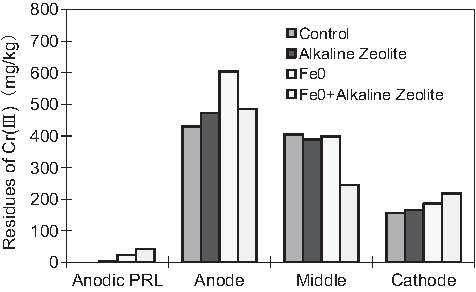
Residue of hexavalent chromium [Cr(VI)] in different sections of the reactor.
Removal of Cr(III)
Reddy and Chinthamreddy (1999) investigated the migration of Cr(VI) in clay soil that contained different reducing agents under an induced electric potential. Three reducing agents, namely humic acid, ferrous iron, and sulfide, were studied. Results indicated that all three reducing agents had the potential to transform Cr(VI) into Cr(III), and the maximum reduction occurred in the presence of sulfides while the minimum reduction occurred in the presence of humic acid.
The residual Cr(III) in different sections of the reactors after electrokinetic remediation is shown in Fig. 4. Cr(III) existed in the soil after all four treatments, indicating that reductants in soil such as ferrous iron, sulfide, and humic acid promoted the transformation of Cr(VI) to Cr(III). It seems reasonable to conclude that reduction of Cr(VI) to Cr(III) in soil was an ubiquitous process in electrokinetic remediation, which might be the main explanation to the low total Cr removal efficiencies in Table 2.
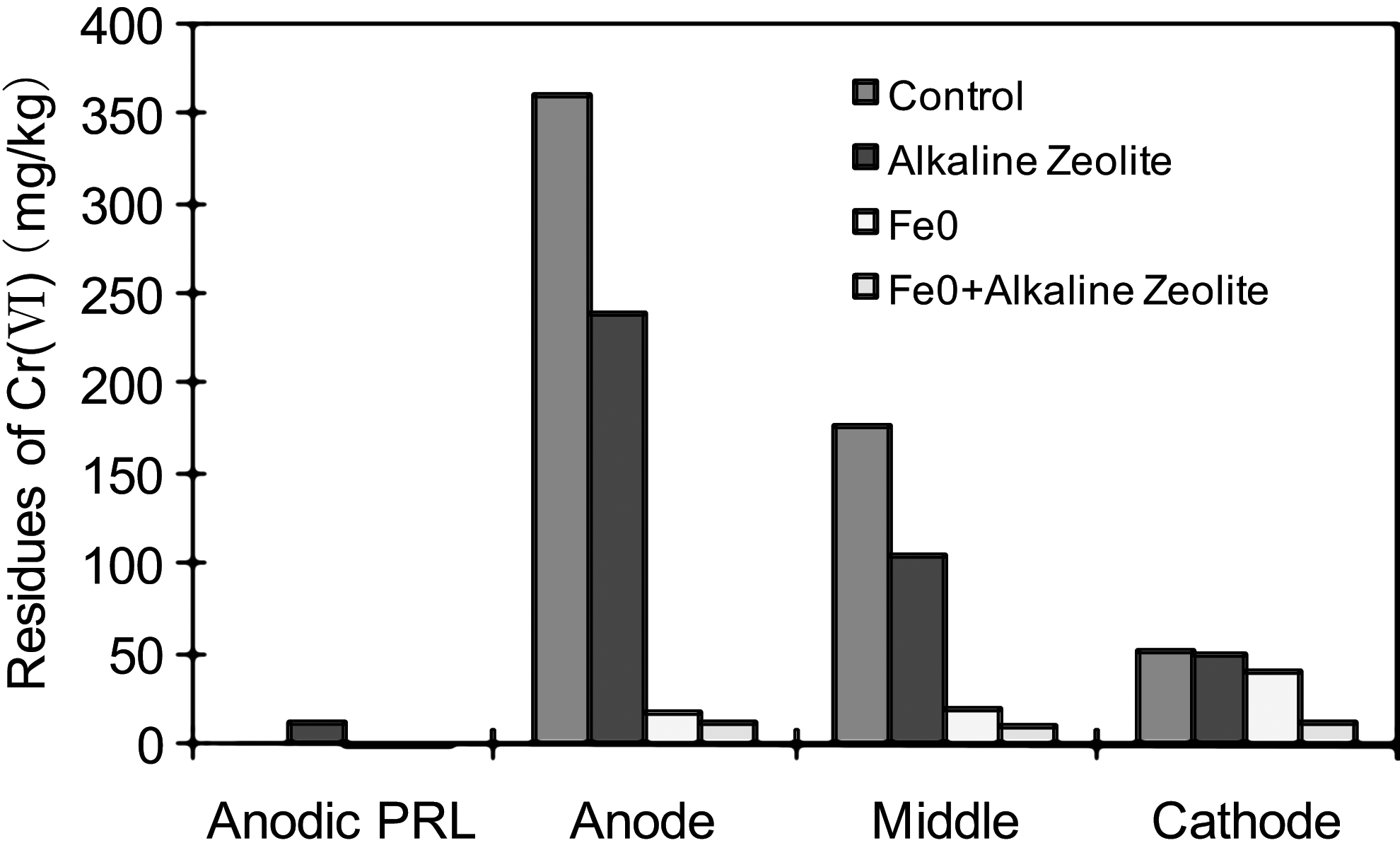
Residue of trivalent chromium [Cr(III)] in different sections of the reactor.
In any given treatment, the residual Cr(III) in soil were ranked in the following order: soil near anode>soil in the middle>soil near cathode; this was consistent with the spatial distribution of Cr(VI). Higher concentrations of Cr(VI) provided sufficient reactant for the reduction, and it was difficult for the Cr(III) generated in the treatment to migrate to the cathode area due to high soil pH value and adsorption capacity, which might be the two main explanations for the above observations. Those treatments with PRLs had lower Cr(III) residue in the soil than those without PRLs. Test 4, in which the anode PRL consisted of Fe(0) and alkaline zeolite, tended to have lower Cr(III) concentrations remaining in the soil than test 2 or 3, indicating that a mixture of Fe(0) and alkaline zeolite was more effective than individual additives.
The residual Cr(III) in soil would be affected by a number of factors. First, the higher content of reducing agent in the soil would promote the generation of Cr(III).Also, the higher Cr(VI) residue in the soil and lower remediation efficiency would provide more opportunities for the reduction and the generation of Cr(III).In addition, soil pH exerted effects on Cr(III) generated by multiple means. A higher soil pH was favorable for Cr(VI) migration out of the soil, which was shown to be the main mechanism to decrease total Cr concentration in the soil, and this was the explanation to the H+ generated at the anode by electrolysis of water being neutralized by Fe(0) or alkaline zeolite to obtain a high remediation efficiency. Furthermore, lower residual Cr(VI) would consequently tend to decrease the possibility of reduction; on the contrary, a lower soil pH would promote the mobility of Cr(III) cations out of the soil, and may explain how acidic zeolite was added to the cathode, but the effects of pH was almost negligible when compared with the former reaction, since Cr(III) was the reaction product of Cr(VI), and its concentration in soil would depend on residual Cr(VI) in the soil. Finally, constituents of anode PRLs would exert some effects on soil pH and subsequently on Cr(VI) remediation and Cr(III) generation.
In general, PRLs consisting of Fe(0) and alkaline zeolite had better buffering properties on soil pH and promoted Cr(VI) remediation from the contaminated soil. When migrating into the PRLs near the anode, Cr(VI) would react with the Fe(0) there and consequently be transformed into Cr(III). Therefore, Fe(0)+zeolite PRL raised the remediation efficiency of soil Cr(VI) and lowered the residual Cr(III) in the soil.
Residues of Cr in anodic PRLs
The residues of total Cr, Cr(VI), and Cr(III) in different anodic PRLs after electrokinetic remediation are illustrated in Fig. 5. The residual total Cr and Cr(III) in the PRLs were ranked in the following order: test 4 (Fe(0)+zeolite)>test 3 (Fe(0))>test 2 (zeolite), while the sequence of the residual Cr(VI) followed the opposite trend. Compared to the zeolite-based PRL, Fe(0)-based PRL (test 3) had lower Cr(VI) and higher Cr(III) contents, and the ratio of residual Cr(VI) to total residual Cr was as low as 2.5%, possibly due to the redox reactions between Fe(0) and Cr(VI):
Residue of total Cr, Cr(VI), and Cr(III) in different PRLs near the anode.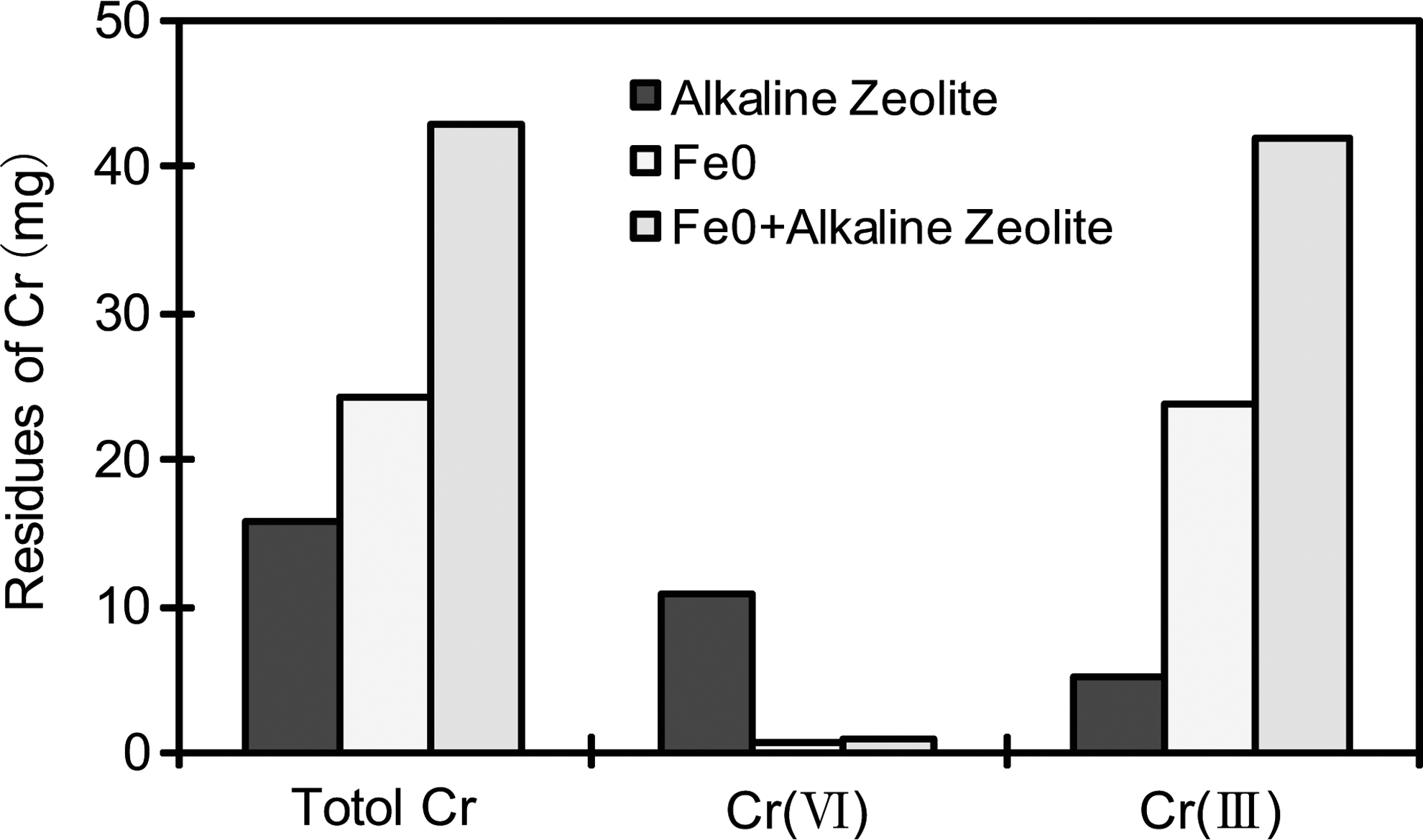
Cr(VI) migrated to PRL under the DC electric field and was reduced to the less-toxic Cr(III) by Fe(0) there. Moreover, the concentration gradient of Cr(VI) generated promoted the migration of Cr(VI) from the soil to the PRL near the anode, and this would be beneficial to the remediation of Cr(VI) and total Cr, and this deduction was consistent with the results in Table 2 and Fig. 3.
In Fe(0)+zeolite PRL (test 4), the ratio of residual Cr(VI) to total residual Cr was only 1.9%. Zeolite in the PRL played a positive role in soil pH control, promoted the migration of Cr(VI) toward the PRL and its transformation into Cr(III), dispersed the Fe(0) powder, and increased the contact area where H+ and Fe(0) reacted, and finally raised the remediation efficiency of Cr(VI) to give better properties than Fe(0) only.
Conclusions
In soil electrokinetic remediation, it is essential to control the soil pH near the electrodes. PRCEs constructed by attaching reactive materials to the electrodes gave excellent soil pH control, and this would have simultaneously promoted heavy metal removal. After electrokinetic remediation, the heavy metal contaminants removed easily from the remediation system simply by unplugging the composite electrodes, a very practical procedure for onsite contaminated soil remediation.
When the acidified zeolite-based PRL was attached to the cathode, the soil pH near the cathode decreased from ∼11 to 8.5. When Fe powder, alkaline zeolite and their mixture were attached to the anode, and the soil pH near the anode rose from ∼2.0 to >3.0. The Fe(0)+zeolite PRL raised the soil pH up to 5.5 and prevented pH fluctuation in electrokinetic remediation.
When PRLs were attached to the electrodes, the remediation efficiency of Cr(VI) rose from 65% of the control to 95%. The Fe(0)+zeolite PRL gave the best performance in Cr(VI) remediation compared to zeolite or Fe(0) alone, and up to 98% of Cr(VI) was removed on average. The Fe(0)+zeolite PRL also absorbed and reacted with more Cr, resulting in lower residual Cr(III) in the soil. This combined PRL also transformed Cr(VI) into the less-toxic Cr(III) form and retained the contaminants in the PRL, and this contributed to the lowering of metal toxicity in the soil.
Footnotes
Acknowledgment
We thank the Program of the National Natural Science Foundation of China (No. 20807028) for financial support.
Author Disclosure Statement
No competing financial interests exist.