




Abstract
Abstract
Plumes containing more than one contaminant can be found in sites polluted by gasoline or chlorinated solvents. This study evaluated Fenton-like removal efficiencies when two contaminants were coexistent. Perchloroethylene, trichloroethylene, cis-1,2-dichloroethylene, methyl-t-butyl-ether, benzene, and toluene were mixed in pairs and degraded by the goethite-catalyzed Fenton-like reaction at neutral pH and low H2O2 doses. Results revealed that the amount of each compound removed in two-contaminant systems was less than that in one-contaminant systems. This decline in removal was related to the reactivity constant (kHO.), initial concentration (C0), and number of double bonds of the compounds. In a solution that contained two compounds with similar kHO. values, the amount of each compound removed was related primarily to the C0 ratio of two compounds. When the kHO. values of two compounds differed considerably, the one with the larger kHO. value or the higher C0 reduced or inhibited the Fenton-like reaction of the pollutant with the smaller kHO. or lower C0. Compounds with few double bonds tended to be less competitive for Fenton-like removal. By adding H2O2 repeatedly, the removal of a compound that is less competitive for the Fenton-like reaction can be recovered.
Introduction
Oxygenated gasoline contains methyl-t-butyl-ether (MTBE) and aromatic and saturated petroleum hydrocarbons. When an underground gasoline tank leaks, these compounds enter and coexist in the subsurface. Similarly, in spills of chlorinated ethylenes, tetrachloroethylene (PCE), trichloroethylene (TCE), and cis-1,2-dichloroethylene (cis-1,2-DCE) are all found in the groundwater. Earlier studies have performed the Fenton experiment containing only one contaminant. Therefore, this study evaluated the Fenton-like reaction efficiency of each compound in binary-contaminant systems. The results were correlated to the kHO. value along with C0, H2O2 dose, and goethite concentration.
Materials and Methods
The tested parameters are listed in Table 1. Because of high water solubility and toxicity, MTBE, benzene, and toluene were selected to represent dissolved gasoline hydrocarbons. The amounts of goethite (Fluka Chemical) that were added herein were in similar ranges to those in the soil and aquifer (Jackson et al., 1986; Yeh et al., 2004). Accordingly, the results can simulate the Fenton-like reaction that is catalyzed by natural iron oxide in soil. Low H2O2 concentrations were used because the competition of two compounds for the Fenton-like removal is likely to be significant in oxidant-limited situations. The concentrations of contaminants found in groundwater can vary from several μg/L to over hundreds of mg/L (ESTCP, 2006). Therefore, the Fenton-like removal of two compounds at various C0 ratios was also performed. Buxton et al. (1988) and Zepp et al. (1992) concluded that the kHO. value of a compound can represent its reactivity in the HO·-dominated Fenton reaction. The kHO. values of 2.5×10⁹ M−1·s−1 for benzene, 2.8×10⁹ M−1·s−1 for toluene, 2.3×10⁹ M−1·s−1 for PCE, 1.6×10⁹ M−1·s−1 for TCE, 1.4×10⁹ M−1·s−1 for cis-1,2-DCE (Yeh et al., 2008), and 0.19×10⁹ M−1·s−1 for MTBE (Bergendahl and Thies, 2004) were used to represent the reactivity.
MTBE, methyl-t-butyl-ether; PCE, tetrachloroethylene; TCE, trichloroethylene; DCE, dichloroethylene.
Goethite-catalyzed Fenton-like experiments
The Fenton-like reactor and procedures are similar as those used in our earlier studies (Yeh et al., 2004, 2008). In brief, the goethite slurry in the reactor was stirred for 15 min to ensure complete wetting of goethite powder. Then, the solution that contained one or two tested organic compounds was added to the reactor, and H2O2 was subsequently injected. Following H2O2 injection, the Fenton-like reaction continued for 5 min, and then methanol was added to fill the reactor to trap any unreacted radicals and to desorb organic compounds sorbed on goethite. The volatilized organic compounds by O2 produced from the Fenton-like reaction were trapped in a gas impinger. The reaction pH remained around 6.8. All experiments were performed in triplicate at 22±3°C. The reaction time of 5 min was used, based on earlier studies that the HO·-dominated Fenton-like reaction finished within minutes after H2O2 addition (Yeh et al., 2004; Zimbron and Reardon, 2005). In the experiment with repeated H2O2 doses, the reaction time following each H2O2 application was 10 min; methanol was added only after the final H2O2 dose. The difference in removal efficiency between single- and two-contaminant systems was calculated as follows:
where M1 is mass of removal for compound A when only A is present, and M2 is mass of removal for compound A when both compounds A and B were present.
Analyses
The aliquot in the reactor and the impinger were combined, centrifuged (4000 g, 20 min), and analyzed by an Agilent 6890 GC equipped with a Techmar purge-and-trap system. The detector was an FID and the capillary column was an HP-5 (30 m×0.32 mm). The flow rate of the carrier gas (N2) was 1.5 mL/min. The injector and detector were heated at 200°C, and the oven temperature program was 40°C for 5 min, increasing to 250°C at 15°C/min.
Statistical analyses
All analyses were performed using S-Plus V 6.2 statistical software. Differences in removal efficiency of two and three groups were analyzed with the Standard Two-Sample t-Test and ANOVA, respectively. Statistical significance was accepted at p<0.05 for all comparisons.
Results and Discussion
Degradation in one-contaminant systems
Figure 1 plots the amount of six compounds removed against their kHO. and C0 values. At C0 of 0.5 and 0.9 mM, the amount removed is linearly proportional to the kHO. value (R2: 0.83–0.88). However, the flat line for C0=0.1 mM suggests that at low C0, the reaction efficiency is low and irrelevant to the kHO. The amount of MTBE removed is significantly less than those of the other five compounds. The kHO. value of MTBE is one order of magnitude lower than those of the other compounds. The HO· is electrophilic and preferentially attacks the unsaturated bonds rather than abstracting an H-atom (Buxton et al., 1988). Therefore, the aromatic hydrocarbons and chlorinated ethylenes, which have double bonds, are more reactive than MTBE, which contains mainly –CH– bonds.

Correlation of compound removal with reactivity constant (kHO.) value at different initial concentrations (C0) in one-contaminant system. Goethite=0.11 g/mL; H2O2=0.5%. MTBE, methyl-t-butyl-ether; PCE, tetrachloroethylene; TCE, trichloroethylene; DCE, dichloroethylene.
Degradation in two-contaminant systems
The degradation of PCE and cis-1,2-DCE in the PCE/cis-1,2-DCE solution still increased with its C0 (Fig. 2a). However, the destruction of each compound is less than that in the one-contaminant system. Moreover, cis-1,2-DCE degradation dropped more than PCE. The benzene/MTBE pair exhibits a similar result (Fig. 2b). In particular, in the presence of benzene, there is no MTBE degradation at MTBE C0 of <0.5 mM. Miller et al. (2003) also found that dinitrotoluene degradation was significantly decreased by acetone in the dinitrotoluene/acetone solution. Figures 3 and 4 present the difference in removal efficiency for compound pairs that contain the same and different number of double bonds, respectively. A negative value for the difference in removal efficiency indicates a decrease in degradation efficiency when two contaminants coexist. Of all tested compound pairs, the compound with the smaller kHO. exhibited a greater decrease in degradation efficiency. When the kHO. values of the compound pairs differed more, the degradation of the compound with the smaller kHO. was more inhibited. As shown in Fig. 3a, a 20% suppression of benzene degradation occurred at toluene/benzene C0 ratios >1. At C0 ratios ≥1.0, no statistical significance was observed (p=0.513) for PCE in the PCE/TCE pair (Fig. 3b) and in the PCE/cis-1,2-DCE pair (Fig. 3c). On the other hand, the p-value of 0.014 indicates a statistical significance for differences in removal efficiency of TCE in the PCE/TCE pair (Fig. 3b) and cis-1,2-DCE in the PCE/cis-1,2-DCE pair (Fig. 3c). During the Fenton reaction of chlorinated organic compounds, the breakage of C–Cl bonds is one of the major pathways (Poulopoulos et al., 2008). At C0 ratios of 4–9, TCE degradation by PCE decreased 20%–30% (Fig. 3b), while cis 1,2-DCE degradation by PCE dropped 30%–40% (Fig. 3c). Therefore, the amount of Cl substitution is another important factor on competition.
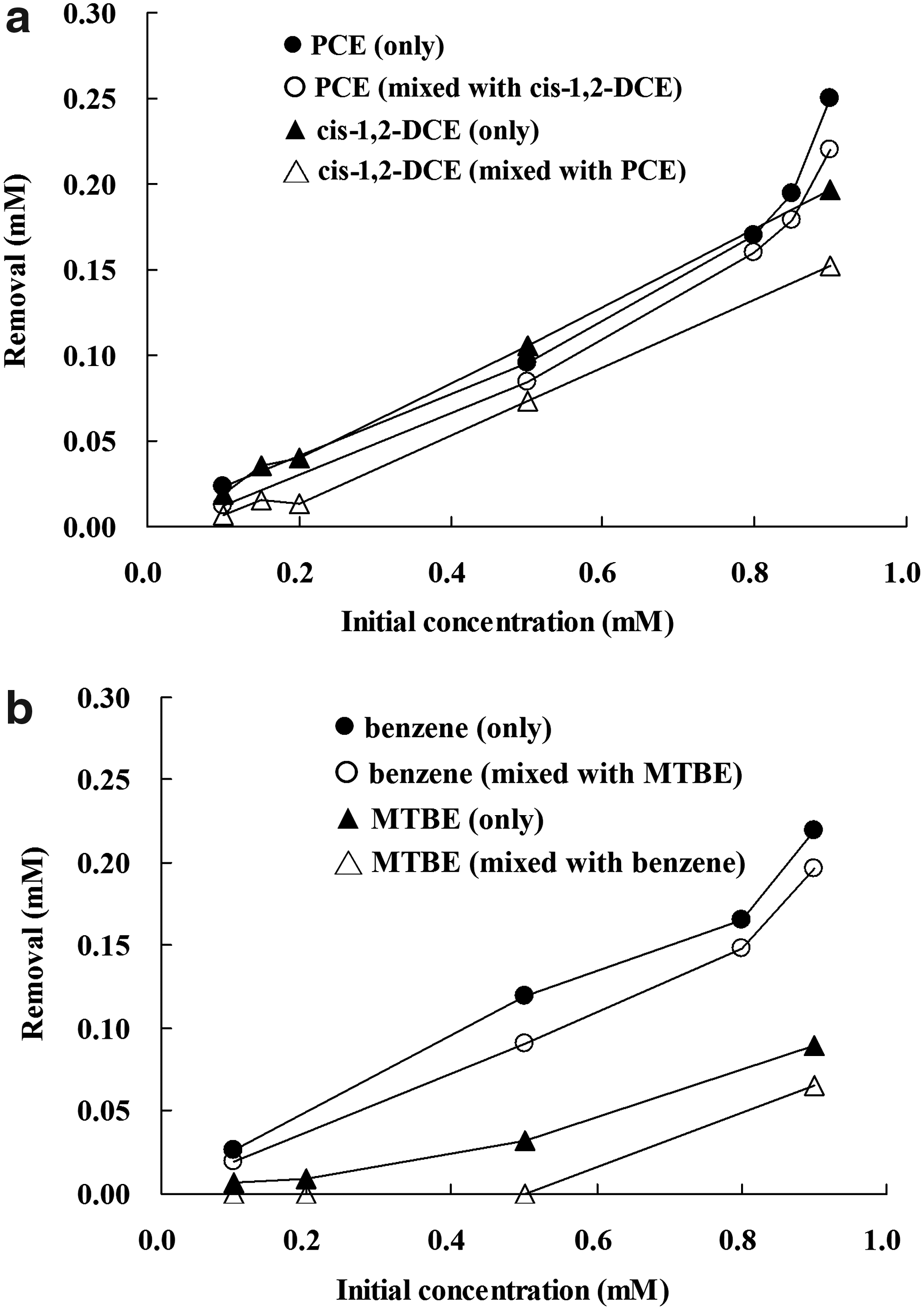
Comparison of Fenton-like removal in singular- and two-contaminant systems:

Changes in removal of compound pairs with same numbers of double bonds:
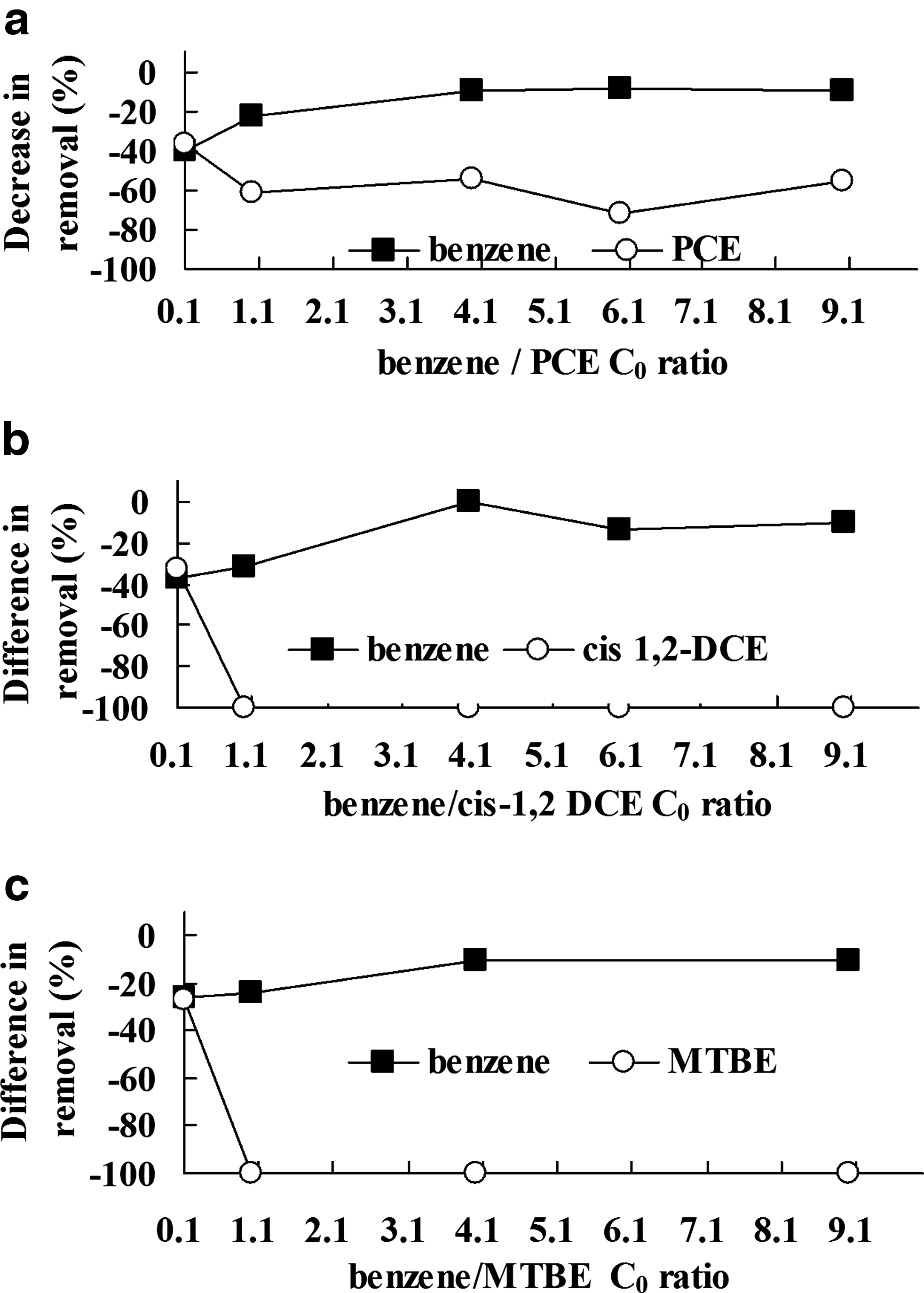
Changes in removal of compound pairs with different numbers of double bonds:
The compound with more unsaturated bonds causes more inhibition on the destruction of another compound. A comparison of the results in Figs. 3a and 4a reveals that although the kHO. ratios of toluene/benzene and benzene/PCE are the same (1.1), the PCE degradation in the benzene/PCE solution was suppressed more than the benzene degradation in the toluene/benzene solution (at C0 ratios ≥1.0, p=0.0004 for benzene [Fig. 3a] and PCE [Fig. 4a]). A similar result was found for PCE/cis-1,2-DCE (Fig. 3c) and benzene/cis-1,2-DCE (Fig. 4b). The kHO. ratio of PCE/cis-1,2-DCE is 11% less compared with benzene/cis-1,2-DCE; however, cis-1,2-DCE degradation was completely inhibited (−100%) by benzene in the benzene/cis-1,2-DCE solution, but was decreased 70% by PCE in the PCE/cis-1,2-DCE solution (at C0 ratios ≥1.0, p=0.002 for PCE [Fig. 3c] and cis-1,2-DCE [Fig. 4b]). Similar to cis-1,2-DCE, there was no MTBE degradation in the benzene/MTBE solution at C0 ratios >1 (Fig. 4c). The MTBE contains no double bond in the chemical structure. The cis-1,2-DCE contains one double bond, but its kHO. is the second smallest among the tested compounds. Therefore, at C0 ratios ≥4.0, the degradation of benzene is not affected (p=0.794 for benzene in Fig. 4a–c), but the degradation of cis-1,2-DCE and MTBE is completely inhibited.
At relatively high C0, a compound with lower kHO. and fewer double bonds can maintain its competitive potential. As shown in Fig. 3b, although the kHO. ratio of PCE/TCE is 1.4, at a PCE/TCE C0 ratio of 0.11 (i.e., the C0 of TCE was nine times that of PCE), there is no difference in mass removal of TCE between the TCE-only and PCE/TCE systems. On the other hand, the degradation of PCE was suppressed by the presence of high C0 of TCE. For the pairs with different numbers of double bonds (Fig. 4), both compounds exhibit the same extent of decline in degradation efficiency at a C0 ratio of 0.11. Similar results were found for all of the tested pairs.
Effects of H2O2 and goethite doses
Increasing H2O2 or goethite dose recovered the degradation efficiency of each compound in the two-contaminant system (Table 2). However, the extent of recovery for the compound is related to its kHO. value and C0 ratios. When the PCE/cis-1,2-DCE C0 ratio is 0.11 and the H2O2 dose was increased 50-fold, PCE degradation recovered 21% (from −78.4% to −56.8%); while cis-1,2-DCE degradation decreased slightly (from −13.7% to −17.4%). At a high PCE/cis-1,2-DCE C0 ratio (9), an increasing H2O2 dose recovered cis-1,2-DCE degradation from −86.7% to −73.7%, but PCE degradation efficiency decreased from −19.6% to −22.7%. Thus, increasing H2O2 dose helps compounds with a lower concentration to compete for Fenton-like removal. Such an improvement is more significant for compounds with higher kHO. values. A similar result was found in the goethite trials.
Repeated injection of H2O2 is commonly applied in the field to replenish the oxidant. The repeated addition of H2O2 restores the Fenton-like removal of a compound with less competitive potential. As shown in Fig. 5a, benzene degradation was suppressed by toluene only at the first H2O2 dose, but was recovered in the subsequent H2O2 addition. This is because each H2O2 dose reduced the toluene/benzene C0 ratio and favored benzene degradation upon the subsequent H2O2 doses. When the kHO. values of two compounds differ more, more repeated H2O2 injection is required to recover the removal of a compound with lower competitive potential. For the PCE/TCE pair with a C0 ratio=9.0 (Fig. 5b), TCE degradation recovered by 20% at the fifth H2O2 dose, while the PCE removal dropped by ∼20%. Due to the very high benzene/MTBE kHO. ratio and the effect of double bonds, little MTBE in the benzene/MTBE mixture was destroyed even after five doses of H2O2 (Fig. 5c). However, MTBE degradation is possible after benzene has been removed by persistent H2O2 injection.

Change in destruction after multiple doses of H2O2:
Impacts of competition on remediation
The above results imply that in two-contaminant systems, proper adjustments during site remediation are recommended due to the competition for Fenton-like removal. Take the benzene/MTBE plume as an example. MTBE has a larger weight percentage in gasoline, a higher solubility in water (1780 mg/L), and a lower sorption in soils. The benzene and MTBE concentrations are usually high in the region near the leakage point (inner zone), while MTBE is the dominant contaminant in the outer region of plume. Benzene and MTBE concentrations in sites in San Diego County, CA, ranged from 0.01–102 mg/L (Happel et al., 1998). The MTBE plume at the Naval Base, Ventura County, California was 1.5-fold in length of the benzene/toluene/ethylbenzene/xylenes plume (ESTCP, 2006). Therefore, persistent H2O2 injections and a long treatment period are necessary to overcome the inhibition of MTBE removal by benzene in the inner zone. In the outer region, because of the reduced benzene/MTBE C0 ratios, less H2O2 injection and a shorter treatment time are expected. Similar phenomena are expected in plumes of other binary contaminants.
Conclusion
The amounts of compounds removed increase with the C0 and the kHO. value of the tested components during in-situ Fenton-like remediation of two-contaminant systems catalyzed by natural iron oxides in aquifers at neutral pH. However, in two-contaminant systems, competition for radicals causes a reduction in degradation efficiency of each compound. The competitive potential of a compound is related to its kHO., C0, and number of double bonds of the compound. For two compounds that have similar kHO. values, the decline in the degradation is primarily related to the C0 ratio. When the kHO. values of two compounds differ greatly, the compound with the larger kHO. value can suppress the Fenton-like reaction of the smaller kHO. pollutant. The competition tended to more strongly affect the compound with fewer double bonds. In benzene/cis-1,2-DCE and benzene/MTBE systems, no degradation of cis-1,2-DCE or MTBE occurred at benzene/cis-1,2-DCE and benzene/MTBE C0 ratios >1. The lower kHO. compound retained its competitive potential only when it was present at relatively high C0. Repeated addition of H2O2 gradually restored the Fenton-like removal of the compound with less competitive potential.
The contaminated plumes can also contain multiple organic compounds, metals, ions, and humic matter. Furthermore, H2O2, O2, Fe(II), Fe(III), substrates and their radicals and other HO radicals are involved in the complicated branching pathways of Fenton-like degradation. Future studies addressing the competitive effects on the degradation subpathways among these species should help the design of in-situ Fenton-like remediation efficiency.
Footnotes
Acknowledgment
The study was supported by the National Science Council of Taiwan, R.O.C. (NSC 95-2211-E-020-006).
Author Disclosure Statement
No competing financial interests exist.