




Abstract
Abstract
Rice fields contribute substantially to global warming of the atmosphere through emission of methane (CH4). This article reviews the state of the art of factors affecting CH4 emissions in rice fields, focusing on soil organic matter content and water management practices. A quantitative relationship between these factors was established through a meta-analysis based on a literature survey. This relationship can be useful to update emission factors used to estimate CH4 in the National Emission Inventories. Methane emissions in rice fields can be as much as 90% higher in continuously flooded rice fields compared with other water management practices, independent from straw addition. Water management systems that involve absence of flooding in total or for part of the growing period such as midseason drainages, intermittent flooding, and percolation control, can reduce CH4 emissions substantially. Moreover, CH4 emissions increase with the amount of straw added up to 7.7 t/ha for continuously flooded soils and up to 5.1 t/ha for other water regimes. Above these levels, no further increase is produced with further addition of straw. With regard to rice straw management mitigation strategies, recommended practices are composting rice straw, straw burning under controlled conditions, recollecting rice straw for biochar production, generation of energy, to be used as a substrate, or to obtain other byproducts with added value. This review improves the understanding of the relationship between straw application rate, water regimes, and CH4 emissions from rice fields to date. This relationship can help to select the most appropriate management practices to improve current mitigation strategies to reduce atmospheric CH4.
Introduction
The amount of straw applied and the continuously flooded water management exert a strong influence on CH4 emissions (Yan et al., 2009). However, knowledge on the effect of the type of organic matter, especially on the dose and quality of rice straw, on CH4 emission from rice fields is still limited. Moreover, information on the combined effect of the addition of rice straw (increasing soil organic matter content) with varying water regimes is missing.
The aim of this article was therefore to review the state of the art of factors affecting CH4 emissions in rice fields, focusing on two management factors: soil organic matter content (affected by the addition of straw and its management) and water management practices. Here we aimed to establish a quantitative relationship between these management factors influencing CH4 emissions based on a literature survey through a meta-analysis. This quantitative relationship can help to select the most appropriate management practices to improve current mitigation strategies to reduce atmospheric CH4 from rice cultivation, and hence contribute to reduce its environmental impacts.
Factors Affecting CH4 Emission in Rice Fields
The emission of CH4 from rice fields results from a complex process where the organic matter in the soil is anaerobically broken down, and CH4 is finally produced as a byproduct in the metabolism of methanogenic archaea. Anaerobic conditions arise from the flooding of fields, which considerably decreases the availability of oxygen in the soil (Conrad, 1993; Neue, 1997; Watanabe et al., 2001). Once CH4 is formed in rice soils, it can be released to the atmosphere through three pathways: ebullition, molecular diffusion, and transport through the rice plant (Neue et al., 1994; Khalil and Shearer, 2006) (Fig. 1).
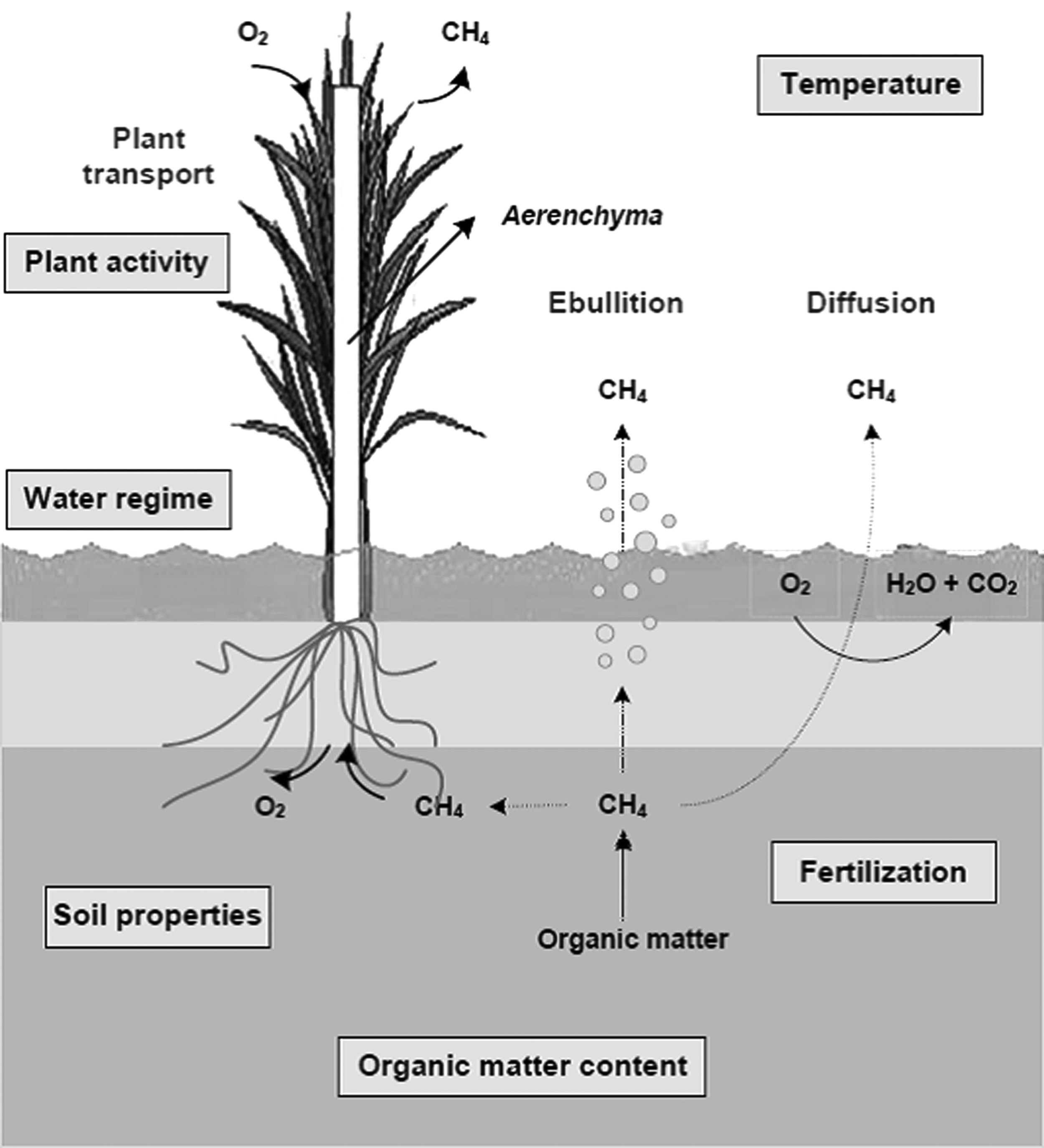
CH4 fluxes in rice fields show distinct diurnal and seasonal variations. Moreover, the emission of CH4 from rice fields depends on different factors, summarized in Fig. 1, such as water regime (Kang et al., 2002; Cai et al., 2003; Zhang et al., 2011), frequency, dosage and type of fertilization (Krüger and Frenzel, 2003; Nayak et al., 2006; Ma et al., 2007), soil organic matter content (Naser et al., 2007; Ma et al., 2009; Wang et al., 2010), rice cultivar and plant activity (Setyanto et al., 2004; Jia et al., 2006; Khosa et al., 2010), temperature (Wang and Li, 2002; Watanabe et al., 2005), and soil properties such as texture, pH, redox potential, and carbon/nitrogen ratio among others (Neue and Roger, 1993; Setyanto et al., 2002; Xu et al., 2003).
Several authors (Majumdar, 2003; Yan et al., 2005; Minamikawa et al., 2006; Zhang et al., 2011) suggested that organic matter content and water regime may be the most influential field management practices affecting CH4 emissions from rice fields.
Water management in rice cultivation is highly site-specific and depends on water availability and traditional cultural practices. In fact, water regime (irrigation and drainage) affects directly soil characteristics, preventing or promoting the development of reducing conditions. The presence of standing surface water is essential for the development of the anaerobic conditions in paddy soil by limiting the transport of atmospheric oxygen into soil, which is favorable for CH4 production (Yagi et al., 1996; Bharati et al., 2001; Singh et al., 2009). Consequently, CH4 mitigation strategies from rice fields must consider rice agricultural practices and water regimes that reduce or limit the flooded period.
With regard to soil organic matter content, readily mineralizable organic matter in the soil also constitutes a major source for CH4 formation in paddies (Neue et al., 1995). Therefore, the addition of organic matter such as rice straw into a flooded rice field provides an extra source of carbon, which can serve as substrate for methanogenic activity (Wassmann et al., 1993b). Furthermore, the decomposition of soil organic matter under anaerobic conditions enhances the reduction of soils, promoting the proper conditions for CH4 production (Denier Van der Gon and Neue, 1995). The effect of organic matter addition is more pronounced in soils with low intrinsic organic matter content.
Although the relationship between CH4 emissions and straw application has been reported in several studies carried out in Italy (Schütz et al., 1989), Japan (Yagi and Minami, 1990; Naser et al., 2007; Xu and Hosen, 2010), United States (Cicerone et al., 1992; Bossio et al., 1999; Kongchum et al., 2006), China (Hou et al., 2000; Lu et al., 2000; Zou et al., 2005; Wang et al., 2010; Zhang et al., 2011), Thailand (Chareonsilp et al., 2000; Vibol and Towprayoon, 2010), India (Jain et al., 2000; Khosa et al., 2010), and Philippines (Neue et al., 1994; Denier Van der Gon and Neue, 1995), knowledge gaps related to the combined effect of the type, dose, and quality of rice straw with varying water regimes still remain.
Relationship Between Water and Straw Management Practices on CH4 Emissions: A Meta-Analysis
A literature survey was performed searching in the Web of Knowledge and CAB Abstract databases using the following keywords: CH4 emission, rice, straw, water, and management. Articles were selected according to two criteria: (1) they reported the effect of water and straw management on CH4 emissions, and (2) they included field scale studies. A total of 24 peer-reviewed published research articles were reviewed. These articles reported studies from 1989 to 2011, conducted in eight countries (India, China, Philippines, Japan, Thailand, Indonesia, United States, and Italy). From these articles, a total of 149 CH4 emission rate (ER) values were obtained. An ER measures the magnitude of pollutant release from the source, expressed as the weight of pollutant per surface per unit of time. An emission factor (EF) is defined as the average ER of a given greenhouse gas for a given source, relative to units of activity (UNFCCC, 2012).
Table 1 compiles reported CH4 ER related to water and straw management practices obtained from these studies. CH4 ER ranged from 0.1 to 952 mg/[m2·day]. As shown in Table 1, four water management practices were identified: continuously flooded, nonflooding irrigated, rainfed, and intermittently flooded. Reported straw incorporation rates ranged from 0 to 12.5 t/ha. Table 1 shows the ER values as well as the crop duration and seasonal EF for each source and location.
Int. flood, intermittently flooded; Cont. flood, continuously flooded; ER, emission rate; EF, emission factor.
To analyze the effect of straw addition and water management on CH4 emissions, the values presented in Table 1 were related using a weighted quadratic regression model. In the model, a reported seasonal EF was used as the dependent variable, and each water management practice and straw dose were used as an independent variable using Proc Reg of SAS software (SAS, 2009). Average values for each straw incorporation rate were used. The selection of this model was based on the literature, where CH4 emissions have been reported to increase with straw addition until a certain value where no further increase in emissions occurs with further addition of straw (Schütz et al., 1989; Kludze and DeLaune, 1995). As a result, the regression equation indicated in Equation (1) was obtained:
where EF is the methane emission factor (kg CH4/[ha·year]); β0 is the intercept of the regression model; β1 is the regression coefficient of the linear effect of straw incorporation (Straw, t/ha); β2 is the regression coefficient of the quadratic effect of straw incorporation (Straw2, t/ha); β3 is the coefficient for a dummy variable defining the effect of continuous flooding on CH4 emission (Cont.flood; 0=nonflooding irrigated, 1=continuously flooded); and β4 is the linear effect of straw incorporation in continuous flooding, with respect to the other alternatives. Finally, ɛ is the model error.
Table 2 shows the results of the regression modeling. Results from the quadratic regression model showed a significant effect (p<0.001) of straw addition rate on CH4 emissions. The effect of continuous flooding was significantly different from the other water management practices (p<0.05). However, intermittently flooded, nonflooding irrigated, and rainfed water management did not differ significantly among them (p>0.05) in terms of CH4 emissions.
The model was significant at p<0.0001 (R2=0.85).
According to Table 2, the following regression equations can be used to predict CH4 EF within the range of straw incorporation rate from 0 to 10 t/ha. In continuously flooded rice fields, the model corresponds to Equation (2), when Cont.flood=1. Equation (3) explains CH4 emissions from paddies when water management is rainfed, intermittently flooded, or nonflooding irrigated (when Cont.flood=0):
Figure 2 shows the graphical representation of the quadratic regression model obtained from the literature survey. According to the model, average CH4 emissions in rice fields where no straw had been incorporated (e.g., straw was burned or removed) were 82.9 kg CH4/[ha·year], using rainfed, intermittently flooded, or nonflooded irrigated water management. However, CH4 emissions were on average 93% higher (160 kg CH4/[ha·year]) in continuously flooded rice fields where no straw had been incorporated, which is significantly higher than in other water management systems. This indicates that continuous flooding can promote conditions for CH4 formation, independent from the addition of organic matter into the soil. Consequently, CH4 emissions can arise from other organic matter sources such as roots and organic compounds supplied by root exudation and biomass litter, including leakages, secretions, mucilage, mucigel, and lysates (Schütz et al., 1991; Aulakh et al., 2001). Compounds leaked from roots normally include carbohydrates, organic acids, and amino acids (Vancura and Hovadik, 1965). As a result, those water management systems that involve water regimes different from continuously flooded management (absence of flooding in total or part of the growing period) present lower CH4 emissions compared with the continuously flooded management system independent from the amount of organic matter incorporated. The meta-analysis confirms that water management practices have a strong influence on the process involved in CH4 emission from rice fields.
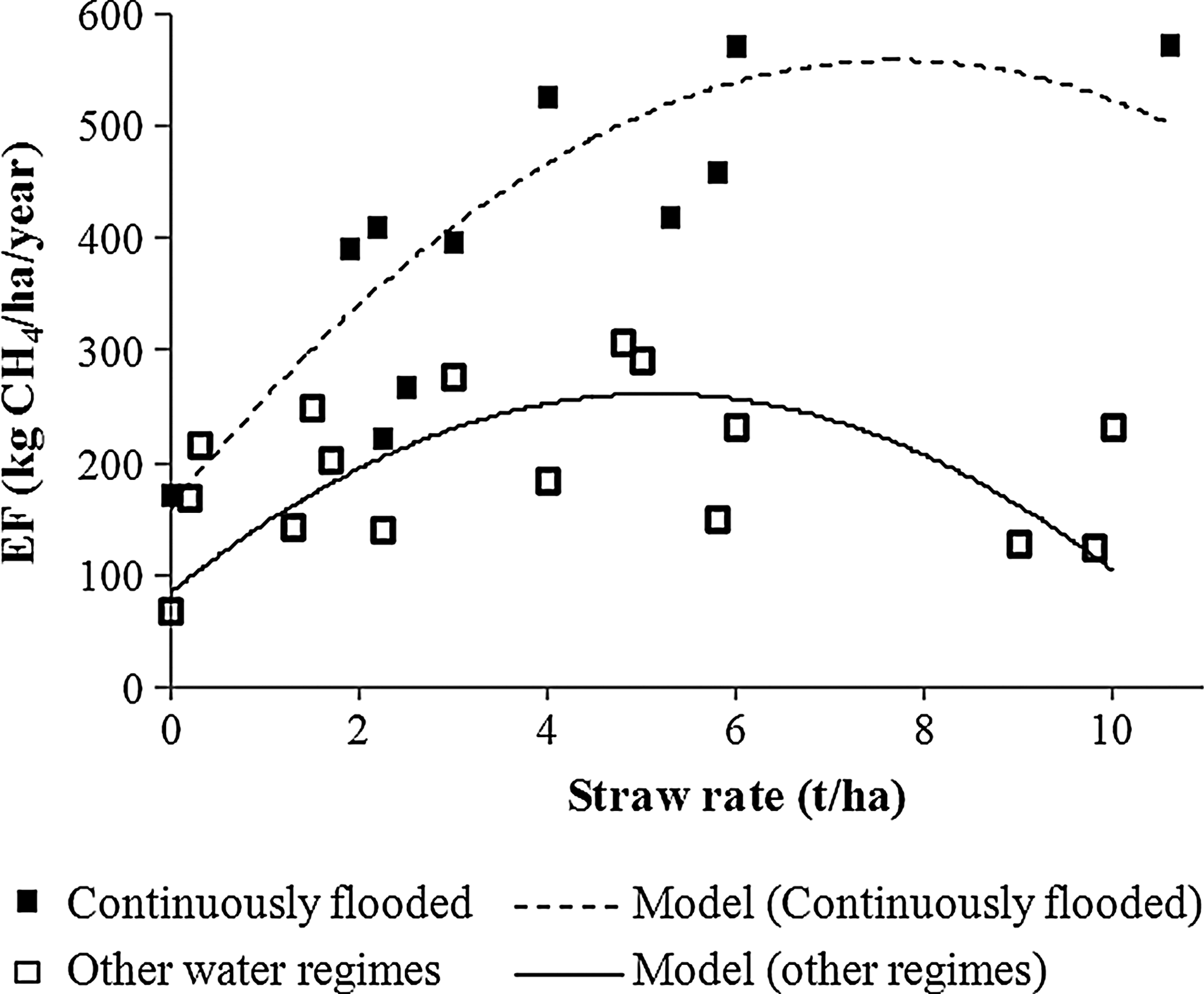
Regression model of methane emissions in rice cultivation based on straw addition rate and water management practices.
Regarding straw addition rate, results from the meta-analysis showed that the addition of straw increased CH4 emissions differently depending on the water management regime. In those systems without permanent flooding, CH4 emissions increase with rice straw incorporation up to a maximum of ∼5.1 t/ha of incorporated straw, corresponding to an EF about 261 kg CH4/[ha·year]. This straw application rate is common in rice fields; however, this value could vary for each country on the basis of the rice or wheat straw yield. Above 5 t/ha, no further increase in CH4 emissions is produced with further addition of straw. For continuous flooding, the maximum emission is produced at a higher straw application rate, equal to 7.7 t/ha (corresponding to an EF about 570 kg CH4/[ha·year]).
This behavior corresponds to a law of diminishing returns, which is common in many agricultural scenarios. When straw is incorporated at low rates, the increase of organic matter in the soil considerably enhances methanogenic activity with respect to no application of straw. However, as long as organic matter increases, it is not longer the limiting factor for CH4 emissions, and the emission process is then limited by other factors related with the activity of methanogenic archaea. Wassmann et al. (1998) explained that the dynamic changes in soils with high CH4 production rates can be attributed to intense bacterial degradation of organic material exceeding the availability of oxidants. Therefore, the inherent CH4 production capacity may be determined by an interaction of various chemical and physical parameters under anaerobic conditions.
Even more, CH4 generation from rice fields can decrease at very high straw incorporation rates. As indicated by Kludze and DeLaune (1995), plant growth is inhibited at high straw application rates, and this could be related with a reduction of the CH4 transport through the vascular system of the rice plants.
The emission model obtained in this study seems to be consistent with reported emission values within the range of straw application rate from 0 to 10 t/ha, but contradictory results were found for higher straw incorporation rates. Several authors have observed a similar trend as shown in the dose–response curve presented in Fig. 2. Schütz et al. (1989) reported that application of rice straw at 5 and 12 t/ha increased CH4 rates by factors of 2.0 and 2.4, respectively, compared with no addition of straw. However, adding as much as 24 t/ha of rice straw did not increase CH4 emissions with respect to 12 t/ha. In the same way, Kludze and DeLaune (1995) reported that application of rice straw at 11 t/ha enhanced CH4 emissions compared with no addition of straw, whereas 22 t/ha retarded CH4 emissions. However, Chareonsilp et al. (2000) found very low and variable CH4 emissions for a straw incorporation rate of 12.5 t/ha under continuous flooding. According to these observations, further studies are required to quantify more precisely how high incorporation rates (>10 t/ha) interact with different water regimes.
Other researchers have observed a linear relationship between CH4 emission and the amount of straw incorporated (Cicerone et al., 1992; Wang et al., 1992; Xu et al., 2003; Watanabe et al., 2005; Naser et al., 2007; Gogoi et al., 2008); however, results from the meta-analysis show that increasing organic matter inputs will only stimulate CH4 emission until a certain value, when other factor than organic carbon availability seems to become limiting (Denier Van der Gon and Neue, 1995). Nevertheless, although straw addition and water management are significant factors influencing CH4 emission from rice fields, other factors such as mineral fertilizer, the variety of rice, the type of soil, and environmental conditions may also considerably affect CH4 emission.
Mitigation Strategies Based on Water and Straw Management Practices
Mitigation of greenhouse gases is mandatory and so is its estimation. To reduce CH4 from rice fields, all influencing factors with their synergies and antagonisms must be studied. So far, CH4 estimations in the National Greenhouse Gas Emission Inventories are based on the methodology proposed by the Intergovernmental Panel on Climate Change (IPCC) Guidelines (IPCC, 2006). Our results improve the relationship between the straw application rate, water regimes, and CH4 emissions from rice fields to date. Our model describes more precisely how straw incorporation, water regime, and their interaction are affecting CH4 emissions, according to literature data.
In this framework, possible strategies to reduce CH4 emission from rice cultivation can be implemented by controlling production, oxidation, or transport processes through the plant, as shown in Fig. 1. These options include managing water regime and straw addition, establishing an adequate fertilization program, using nitrification inhibitors, and changing tillage practices, including crop rotation and selecting less-vigorous rice varieties (Aulakh et al., 2000; Wassmann et al., 2000; Majumdar, 2003; Minamikawa et al., 2006; Yan et al., 2009). However, mitigation strategies should be effective, technically and economically applicable, and easily understood and accepted by farmers. If possible, these techniques should also increase rice yield (Majumdar, 2003). As a result from this review, straw and water management practices have been identified as key factors affecting CH4 emissions, and consequently mitigation strategies should focused on these factors.
Water management strategies
Continuous flooding increases CH4 emissions regardless straw addition. Several studies have focused on management strategies to mitigate these emissions without compromising rice yields, such as limiting irrigation and allowing the standing water to drain from the field. However, mitigation options through water management can vary depending on different factors, such as soil texture, percolation rate, frequency of drainage, duration of dry period, and soil redox potential (Cai et al., 1997; Majumdar, 2003; Minamikawa et al., 2006).
Previous research has demonstrated that midseason aeration of rice paddy fields can reduce CH4 emission by about 50% (Kimura et al., 1992; Kanno et al., 1997; Yagi et al., 1997; Wassmann et al., 2000; Cai et al., 2003). Sass et al. (1992) and Kimura et al. (1991) observed that a single midseason drainage may reduce seasonal ERs by about 50%. Bronson et al. (1997) reported that midseason drainage at maximum tillering or panicle initiation suppressed CH4 emissions. However, midseason drainage is not feasible during periods of heavy rainfall and when excess water is not available to flood the field again. Therefore, in case of nonavailability of water for reflooding, it has limited applicability in time and space (Singh et al., 2009).
Draining paddy fields, which used to be under continuous flooding in the fallow season, significantly decreases CH4 emission from the fields (Xu et al., 2000; Cai et al., 2003). This technique is able not only to stop directly CH4 emission from the rice fields in the fallow season but also to reduce CH4 emission substantially during the following rice season (Cai et al., 2003). However, the rice yields in fields drained in the fallow season may be compromised compared with permanently flooded fields (Zhang et al., 2011).
Techniques such as intermittent irrigation can also reduce CH4 emissions, improving soil permeability and increasing soil redox potentials, which often result in increased rice yield (Wang et al., 1999). Jain et al. (2000), Buendia et al. (1997), and Sass et al. (1992) observed that CH4 emissions decreased in 28%, 55%, and 88%, respectively, when intermittent irrigation was applied. Moreover, in most cases, this practice did not reduce the rice yield, but required more water than the normal floodwater treatment.
However, soil aeration requires more water than the continuous flooding regime (Sass et al., 1992). Furthermore, drainage techniques must be managed carefully to prevent losses of nitrogen corresponding with nitrous oxide (N2O) emissions, a very active greenhouse gas (Wassmann et al., 1993a; Abao et al., 2000; Zou et al., 2005). These emissions could be increased through nitrification and denitrification processes, which are associated with soil drying and wetting, respectively (Neue, 1993; Bronson et al., 1997; Corton et al., 2000).
CH4 ERs decrease as the percolation rates increase by improving soil physical properties or by using underground pipe drainage (Yagi et al., 1997; Minamikawa and Sakai, 2006). Therefore, reducing the water depth and time of flooding by maintaining the soil saturated without standing water could be a technically feasible and agronomically and environmentally appropriate alternative to reduce CH4 emissions (Rath et al., 1999; Lemer and Roger, 2001).
Straw management strategies
A promising strategy to mitigate CH4 emissions consists in the integration of intermittent irrigation techniques and of organic matter management (Wang et al., 1999; Zou et al., 2005). Alternative uses of straw crop residue should be considered with regard to straw management.
Straw incorporation practices alter organic matter availability. The kind, rate timing, and degree of maturation of organic matter affect the magnitude of CH4 emission (Minamikawa et al., 2006). Moreover, the addition of straw has been associated with putrefaction processes releasing sulfur gases that can generate odor nuisances, harmful effects on aquatic organisms, and transmission of crop diseases (Chareonsilp et al., 2000; Tanji et al., 2003; Yi et al., 2008). In addition, straw incorporation could promote reducing conditions under which toxic products such as sulfides may be produced, causing toxicity to rice plants (Gao et al., 2004). Reducing the amount of labile organic matter in soils by composting organic substrates or promoting aerobic decomposition of biomass is considered as one of the effective means of mitigating CH4 emission in soils (Corton et al., 2000; Majumdar, 2003). However, this could increase N2O emission by nitrification of released ammonium (Flessa and Beese, 1995).
An alternative method of disposing rice straw is to apply it off-season. According to the 2006 IPCC guidelines, rice straw applied off-season produces less CH4 emission than if rice straw is applied just before rice transplanting (Yan et al., 2009). Consequently, incorporation of rice straw in the fallow season instead of the rice season is recommended as an option to reduce CH4 emission from rice fields (Lu et al., 2000; Xu et al., 2000).
The type of organic matter applied to the soil affects CH4 emission. Wassmann et al. (1993a) observed that applying residues from a biogas generator, CH4 emissions decreased by ∼60% as compared to fresh organic amendments and 52% compared to the combination of urea and organic amendments. According to Chareonsilp et al. (2000), burning straw instead of incorporating it directly reduces CH4 emission by 89%. According to these authors, zero tillage and mulching also reduced emissions when compared with fresh straw incorporation. Moreover, straw burning poses several benefits for the farmer, since it controls weed and crop diseases, prepares fields for the next harvest, and releases nutrients for the next crop (Lemieux et al., 2004; Cheng et al., 2009; Gadde et al., 2009).
Straw burning however produces high amounts of CO2, as well as considerable amounts of carbon monoxide (CO), CH4, nitrogen oxides (NOx), sulfur oxides (SOx), non-CH4 hydrocarbons, dioxins, polycyclic aromatic hydrocarbons, and particulate matter (Gadde et al., 2009). The emission of these pollutants during open burning of crop residues can cause relevant local air pollution problems and severe impacts on human health (Gullett and Touati, 2003; Hays et al., 2005; Lin et al., 2007), for example, bronchial asthma (Arai et al., 1998; Torigoe et al., 2000). Some of these air pollutants have significant toxicological properties and are considered potential carcinogens (Gadde et al., 2009). Due to the growing concern for air quality related with rice straw burning, this practice has been restricted in some parts of the world. Therefore, in most cases, straw burning cannot be recommended as a CH4 mitigation option.
It has been demonstrated that rice straw is not suitable for animal nutrition unless treated to improve its feeding value (Doyle et al., 1986; Bae et al., 1997). However, the high interest for reusing the large amount of rice straw generated worldwide has resulted in a wide variety of other potential treatments. Perhaps the most traditional use is the generation of energy (Zhang and Zhang, 1999; Okasha, 2007). A variety of technologies have been developed that include from direct burning to pyrolysis techniques to transform rice straw in a more versatile energy source (Pütün et al., 2004), producing different byproducts such as biochar, which could help to improve soils, avoid CH4 emissions, and sequester carbon in rice soils (Zhang et al., 2010; Haefele et al., 2011; Liu et al., 2011).
Rice straw has also been used for mulch production and as a substrate for mushroom production (Zhang et al., 2002). More recently, a variety of technologies have been developed to obtain other byproducts with added value. Rice straw has been used to obtain xylitol (Mayerhoff et al., 1997), sugars (Karimi et al., 2006), cellulose and lignine pulp (Rodríguez et al., 2008), and enzymes such as laccase (Niladevi et al., 2007). The potential of rice straw to produce natural fibers has been also investigated (Reddy and Yang, 2006), and it has been successfully used to produce biopolymers in combination with polyvinyl chloride (Kamel, 2004) and polypropylene (Grozdanov et al., 2006), or as a construction material with isolation properties (Yang et al., 2003).
However, the harvesting of straw from rice fields continues to be a major challenge. Therefore, although several alternative management strategies are available for it, the harvesting of rice straw implies using different agricultural machinery and an additional economical cost to be paid by farmers.
To optimize straw management, it is essential to improve our knowledge on crop characteristics, to develop a group of mitigation strategies to minimize emissions of CH4 to the atmosphere, as well as to maximize rice production and yield, without considerably modifying culture practices.
Conclusions and Recommendations
As a result from the review of the state of the art of factors affecting CH4 emissions in rice fields and a meta-analysis on how soil organic matter content (affected by the addition of straw and its management) and water management practices influence CH4 emissions, the following conclusions can be extracted:
Continuous flooding can promote conditions for CH4 formation, independent from the addition of organic matter into the soil. CH4 emissions in rice fields where no straw has been incorporated are 90% higher in continuously flooded rice fields compared with other water management systems such as rainfed, intermittently flooded, or nonflooding irrigated.
Water management systems other than continuously flooded are recommended to reduce CH4 emissions. The recommended water management mitigation strategies are midseason drainages, intermittent flooding, and percolation control.
CH4 emissions increase with straw incorporation rates up to 5.1 t/ha of incorporated straw, under nonpermanent flooding conditions. For continuously flooded soils, CH4 increased with straw incorporation up to 7.7 t/ha. Above these levels, no further increase in CH4 emissions is produced with a further addition of straw between 0 and 10 t/ha. Further studies are required to quantify more precisely how high incorporation rates (>10 t/ha) interact with different water regimes.
With regard to rice straw management mitigation strategies, recommended practices are composting rice straw, straw burning under controlled conditions, recollecting rice straw for biochar production, generation of energy, to be used as a substrate, or to obtain other byproducts with added value.
Our results improve the understanding of the relationship between straw application rate, water regimes, and CH4 emissions from rice fields to date. These data are useful to update the CH4 EF used to estimate CH4 emissions in the National Greenhouse Gas Emission Inventories.
The main challenge concerning CH4 mitigation options from rice fields is the difficulty of establishing a single global solution. Mitigation techniques based on straw and water management however may achieve relevant reduction and can be effective, technically and economically applicable, easily understood, and accepted by farmers. If possible, these techniques should also increase rice yield. The effect of mitigation strategies in the light of gaseous pollutants other than CH4 and the global environmental impact caused by rice cultivation should also be assessed.
Footnotes
Acknowledgments
This study was financially supported by Fundación Agroalimed from the Consellería de Agricultura of Valencia, Spain and the Vicerrectorado de Investigación of the UPV (Programa de Apoyo a la Investigación y Desarrollo, PAID-06-11 Program, Project No. 1950).
Author Disclosure Statement
No competing financial interests exist.