




Abstract
Abstract
Diesel engine technology has been driven by increasingly stringent environmental legislation. To comply with these laws, emissions-control systems are being rapidly improved. Within this context, development of exhaust gas after-treatment systems undertakes a significant role. Among the techniques used is selective catalytic reduction (SCR), which converts nitrogen oxides (NOx) into diatomic nitrogen (N2) and water (H2O). A reducing agent containing ammonia (NH3) is added to the flow and absorbed by a catalyst. Different reducing agents are currently used, principally anhydrous NH3, aqueous NH3, and urea. This study analyzed behavior of different urea- and formamide-based agents to SCR. Results are compared to those obtained with Adblue. In relation to the SCR system as well as to NOx reduction, we concluded that urea-based mixtures are the most efficient, although they present higher values of NH3 slip. Formamide-based mixtures are significantly less efficient than urea-based mixtures, but the NH3 slip levels produced by these mixtures are virtually none. A challenge is to find new reducing agent for SCR applications, considering that the deposits of urea formed during certain work conditions are a significant problem.
Introduction
Diesel engine emissions, in fact, can be controlled by applying different technologies at two different moments. The first application can be done during the combustion process itself, such as fuel injection with increasingly higher injection pressures, high pressures originating from turbocompressors, and recirculation of exhaust gases, among others (Xiaoping and Shu, 1995; Zheng et al., 2004). Another opportunity is called after-treatment of exhaust gases, where different technologies such as oxidation catalysts, particulate filters, and selective catalysts can be applied. In fact, to reach the tightest emission-level demands, it is often necessary to work not merely on engine modification but also on suitable advanced after-treatment.
Thus, for compliance with restrictive emission standards, diesel engines have been fitted with advanced exhaust after-treatment systems, including technologies such as diesel oxidation catalyst (DOC), selective catalytic reduction (SCR), lean NOx trap (LNT), and diesel particulate filters. These and other technologies have been used to reduce emissions of nitrogen oxides (NOx) or particulate-matter (PM), hydrocarbons (HCs), and carbon monoxide (CO) (Gekas et al., 2002; Liu et al., 2008). In some cases, the use of integrated systems has been necessary (Walker et al., 2004). The LNT+SCR combination, for example, can achieve optimum performance if the LNT is designed to produce ammonia (NH3), considering that the hardware investment associated with external reductant supply requirements will be not necessary. (Kouakou et al., 2009; Johnson, 2010). Some combinations demand attention, such as SCR+DOC. Jen et al. (2008) showed that platinum from DOCs can migrate to SCR catalysts, causing a negative effect on the SCR efficiency.
In the present work, PM measures were not obtained because the main idea was to compare and evaluate different reductant agents and their impact in NOx measures.
Among all technologies, SCR is recognized worldwide as the most effective NOx control technology. SCR systems are based on vanadium oxide or zeolites and have different operating temperatures, and they must be carefully selected for different applications (Parvulescu et al., 1998). Also, in SCR technology, a chemical reducing agent is used. NH3, used as a reducing agent, reduces the nitric oxide (NO) or nitrogen dioxide (NO2) through oxidation in the presence of oxygen. Today, the common and commercial NH3 source consists of a solution comprising 32.5% (w/w) urea and water, called AdBlue (BASF, 2005) in Europe and diesel exhaust fluid (DEF) in North America, which is introduced in the exhaust pipe after the engine turbocharger (Dieter et al., 2003). DEF or AdBlue converts to isocyanic acid and then into NH3 in the exhaust stream, and reacts with NOx over a catalyst to form harmless nitrogen gas and water (Willand, 1998).
Since pure NH3 is a toxic substance and generally presents serious handling and storage problems, there is a need to find an alternative reducer to replace it. From a technical standpoint, this alternative reducer needs to be decomposed into NH3without producing products harmful to health under the conditions used in SCR systems. From a commercial standpoint, the ideal reducer would be a nontoxic substance, easy to store, transport, and handle, with an affordable cost and great availability.
Different possibilities could be considered for NH3-based agents to reduce NOx to N2. Initially, there is the NH3 itself. In SCR systems, NH3 could be used in two different forms: pure anhydrous NH3, and NH3 in aqueous solution. Hammer et al. (2008) studied the SCR of NOx from exhaust gas using NH3 as a reducing agent, obtained by decomposition of guanidine, a product of protein metabolism easily found in beet juice. Among the benefits observed by researchers in this process is the way NH3 is easily obtained without the formation of undesirable products, and is able to convert up to 90% of NOx emissions. The mixture is not corrosive, unlike the commonly used aqueous solutions with a greater potential for NH3 formation, and it is also resistant to winter, with a freezing point of about −25°C. In this study, an aqueous solution composed of 40% guanidine was used as an NH3 precursor.
Secondly the usual NH3 precursor is urea. Urea (H2N·CO NH2) normally presents as a solid substance that forms colorless prisms, whose solubility in water at 17°C is 100 g/100 g H2O. Normally, aqueous solutions of urea have solubility values in water of about 50%, but SCR systems use a concentration of 32% (w/w). At a concentration of 32%, urea forms a eutectic solution characterized by a low crystallization point of −11°C. The use of eutectic solutions provides an additional advantage: the solid and liquid phases have the same concentration during the crystallization process. Even if there is a partial freeze in the tank of urea, the crystallization will not change the concentration of urea solution that will feed the SCR system. Gieshoff et al. (2000) evaluated an SCR system in a heavy-duty vehicle that used urea as a reducing agent of NOx along with a preoxidation catalyst before the selective catalyst. They noted that the inclusion of a preoxidation catalyst allowed the system to reduce NOx emissions to an excellent level of 75% when compared with only 45% efficiency using the same system without a preoxidation catalyst. Today, the urea solution has been widely used in heavy-duty vehicles.
Also, a third possible reducing agent is pure ammonium formate (HCOO·NH4; CAS#540-69-2), which is a solid substance with solubility in water at 0°C of 102 g/100 g H2O. The compatibility between solutions containing ammonium formate (denoxium) and the materials used in SCR systems has not been fully proven yet, and such solutions do not meet the ISO 22241 standard for urea in SCR systems. Therefore, technological solutions using ammonium formate are currently impractical.
A fourth agent, formamide, starts its process of partial decomposition into carbon monoxide and NH3 at 180°C. When heated abruptly, it breaks down into hydrogen cyanide (HCN) and steam. Jacob (2007), in his study that generated the patent No. DE102005059250-A1, used the mixture of water and formamide [HC(O)NH2] to reduce NOx from exhaust gases, where the mixture catalytically decomposed it into NH3. This study noted that the system was ideal for vehicular application because of its frost resistance, mixture storage stability, and because it does not accumulate residues in the exhaust pipe. According to Jacob (2007), formamide is a liquid easily miscible in water and can be used to produce aqueous mixtures with freezing points ranging from −25°C to −45°C, far below the freezing point of the aqueous eutectic mixture of urea that presents a freezing point of −11°C. Unlike urea, he noted that the formamide was volatile, thermally stable up to 160°C, could decompose almost completely into NH3 and CO in selective catalysts, and that the carbon monoxide generated did not present a risk for the system. In addition, all products resulting from the reaction between the mixture and exhaust gases are gaseous, whereas the products generated by the use of an aqueous urea solution can form solid deposits (Fig. 1). Cant et al. (1999) studied the reaction of formamide and nitromethane, two possible intermediates in SCR of NOx by methane (CH4-SCR) in catalysts based on Co-ZSM5, H-ZSM5, and Cu-ZSM5. They noted that the formamide reacted completely below 250°C with the base of Co-ZSM5, forming NH3 and CO by one route and HCN and H2O by another, and that the inclusion of NO caused the partial conversion of NH3 into N2 at 300°C. With the H-ZSM5 base, the behavior was similar, but with a greater conversion of NH3 in the presence of NO, while the reaction with the Cu-ZSM5 base produced CO2 and N2, apparently due to its high oxidation capacity. The researchers concluded that (1) formamide can be fully converted into to HCN, H2O, NH3, and CO in a catalyst with a base of Co-ZSM5 and H-ZSM5 at temperatures below 250°C, (2) some reactions with NH3 above 300°C can generate N2, and (3) CO can be generated at temperatures up to 360°C. Nitromethane is converted into NH3 and CO2 via HNCO in a catalyst with Co-ZSM5 and H-ZSM5 base below 300°C, and later the NH3 is converted into N2. Both reactions basically generate N2 and CO2 in a Cu-ZSM5 base catalyst.
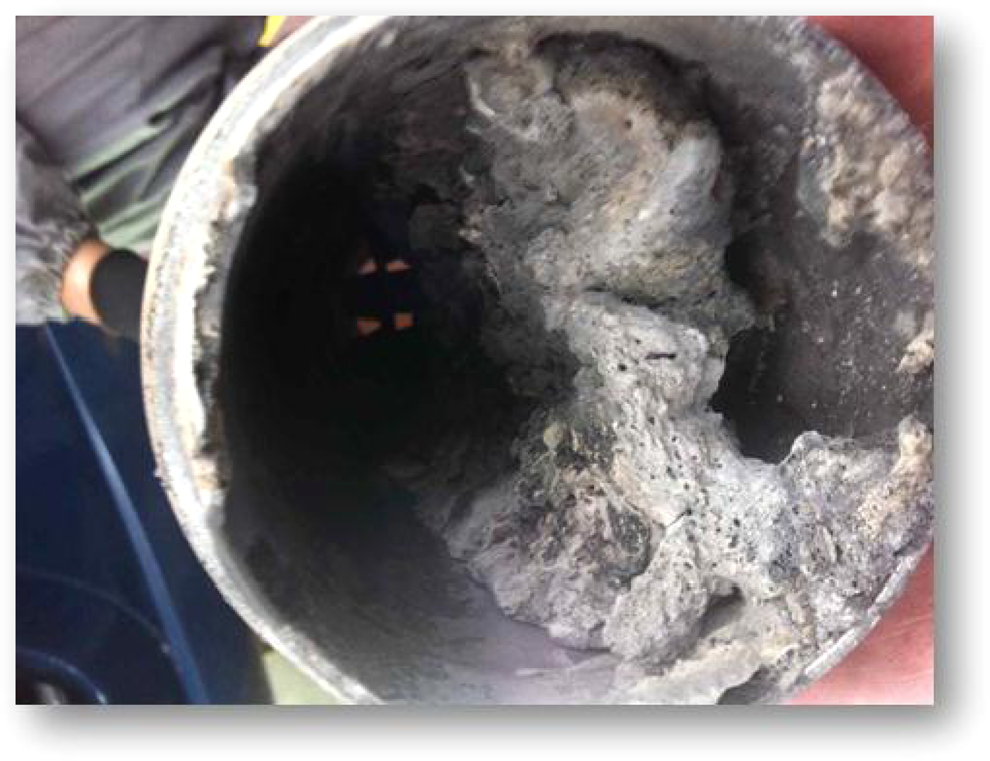
Urea deposits picture in catalyst inlet.
Unfortunately, the solution that has already been commercially adopted is not always without side effects. Currently, in MWM International Engines, where this study was conducted, there are huge problems with some applications that use the SCR system with Adblue as the NOx-reducing agent. Applications of small-cc engines with low ratings (150–190 horsepower [∼112–142 kW]) naturally have a low-temperature combustion exhaust, which makes the SCR system less efficient in these cases. Associated to this fact, there are buses with these engines that are on urban routes, stopping at bus stops to get passengers and naturally working on tracks of low rotation and low engine load, consequently under conditions of low exhaust temperatures. In these situations, serious problems of urea crystallization or deposit formation have been faced. Initially, it was believed that whatever the application, Adblue could be injected into the exhaust system at temperatures above 200°C. Today, it is known that in applications in the described urban conditions, problems of crystallization inevitably exist (as in Fig. 1). Recently, in one application, we evaluated the discouraging scenario in which, for each run of 4000 km, there was an accumulation of deposits of ∼3–4 kg in the exhaust system between the urea injector and the entry of the catalyst. Therefore, the importance of this work is tosearch for alternatives for possible application in work ranges where Adblue has undesirable results.
Although there are different reducing agents as precursors of NH3, presently, the only commercial NH3 source used is 32.5% (w/w) urea. In fact, both U.S. and European manufacturers had already decided on the use of the SCR system with urea as a source of NH3. This, however, does not discount research with experimental tests using alternative sources of NH3. Alternative routes are always welcome in any area of knowledge, especially in critical areas such as, for example, energy and treatment of pollutants. Notwithstanding the relevant past in the area of SCR technologies, there is still a future, new stringent limit and the availability of new reducing agents also opens new perspectives of research. In the present work, the main idea is to know, experimentally, the behavior of some other sources supplying NH3. The results will be compared with Adblue (baseline).
Experimental Protocols
Materials
This study used a four-cylinder turbocharged diesel engine with direct injection and an SCR after-treatment system installed in it. The injection system was controlled by an electronic Bosch system called Common Rail version 3.0 that allows multiple injections up to 2000 bar, which leads to a better air/fuel mixture. Tests were done in MWM International Engines in a test bench equipped with an electric dynamometer (Schenck W-400). Table 1 presents engine characteristics.
Emissions measurements were obtained using a MEXA 7200 DEGR HORIBA Analyzer. The reducing agent injection system used in the tests was the Bosch DENOX 2.2 system. This system has an integrated pump to suck the reducing agent, a filter, a pulse-width modulation valve to control the dose of the reducing agent, an injector, and an electronic control unit (Fig. 2). The input variables to control the dose of the reducing agent are the engine speed, torque, and exhaust gas temperature before and after the catalyst. The control module contains 12 three-dimensional maps. One map contains the rated temperature of the exhaust gases as a function of engine load and engine speed. The remaining 11 maps contain levels of the amount of reducing agent to be injected into the system depending on its speed and load.
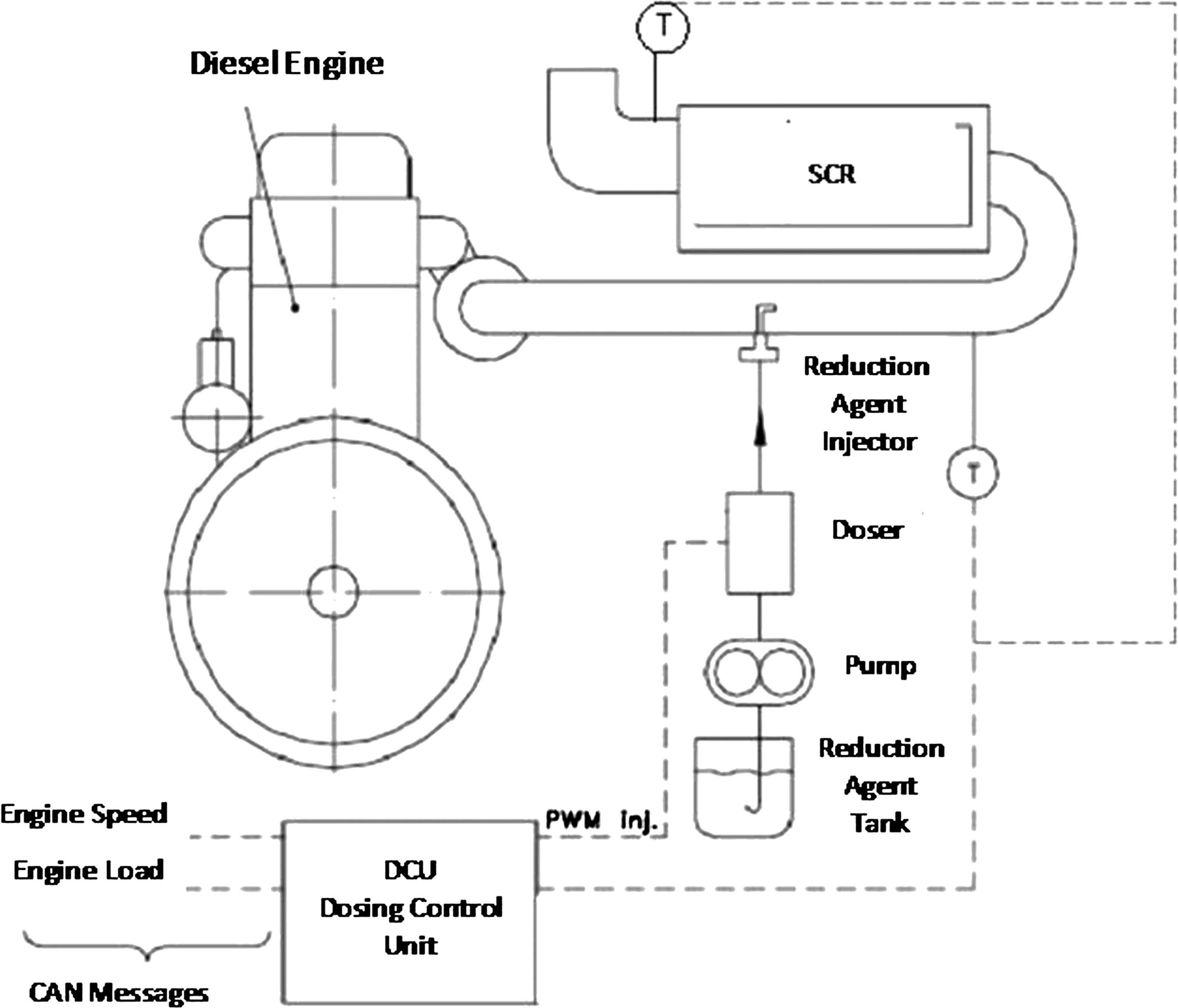
After-treatment system schema with selective catalyst applied on tests.
During development of the SCR systems to reduce NOx, the reduction of this gas occurs from the use of a reducing agent. In addition to gases usually measured such as CO, CO2, HC, NOx, and O2, the measurement of NH3 slip is extremely important, as there is a concern over the amount of NOx reduced and the amount of NH3 released into the atmosphere. The NH3 emissions in the tests were analyzed using a Siemens analyzer with laser diode, with measuring error of ±1%, LDS6 control center, 7MB6121 model, LDS6 sensors, and stainless steel piping heated to 200°C.
The catalyst used for the SCR system in the tests was provided by Johnson Mattey and consists of two extruded ceramic substrates with a diameter of 10.5 inches (26.67 cm) and 5.0 inches (12.7 cm) in length, obtained from a mixture of water-soluble compound derived from a selected metal and water.
Flame ionization detector analyzers are designed for measurement of the total HC concentrations in exhaust gas. The measuring principle is ionization of organic carbon atoms in hydrogen flame, which burns in an electric field. HC compounds are oxidized in the flame; ions are formed as an intermediate product. Ionization current could be considered in one first approximation as directly proportional to the amount of C atoms of the burned substance. This means that interference is possible with formaldehyde (HCHO). Loomis (2011) presented that 100 parts per million by volume (ppmv) of formaldehyde corresponds to 20 ppmv wet (ppmvw) C1. This means that in a reactive medium where there is formaldehyde, the total HC can not be measured correctly using only the flame ionization technique. As total HC gauges generally use this type of detection, it would also be necessary to use a formaldehyde meter in order to counteract the interference. So, in this study, the concentrations of the total HC are not presented due to the possibility of interference error from formaldehyde.
The reducing agents evaluated were: Adblue (mixture currently used in the automotive industry), Urea P.A. (aqueous mixture with 32% pure urea), Formamide P.A. (named FPA), urea+formamide (named U16F18), and urea+formamide (named U31F35). Each aqueous mixture is shown in Table 2.
Values are reported according manufacturer specifications. See the Materials section for compound descriptions.
Methodology
Calculation of the amount of injected NH3 was performed considering the overall mechanism in two steps, represented by Equations (1) and (2) with 100% conversion; however, intermediate reactions were disregarded.
All comparisons were made assuming the same NH3 quantity injected in the process.
Engine test runs were in accordance with the 13-mode European Stationary Cycle (ESC; Table 3). The ESC test is characterized by high average load factors and very high exhaust gas temperatures. ESC testing is required from Euro III through Euro VI.
For the engine tested: A=1372 rpm, B=1700 rpm, and C=2032 rpm.
The engine speeds A, B, and C to be used during the test are calculated from the following formulas:
A=nlo+0.25(nhi−nlo)
B=nlo+0.50(nhi−nlo)
C=nlo+0.75(nhi−nlo)
ESC, European Stationary Cycle; MTS, maximum torque speed; RPS, rated power speed.
ESC is operated through a sequence of 13 speed and load conditions. The final result is a weighted average of the 13 modes. The test cycle consists of a number of speed and power modes that cover the typical range of diesel engines. By randomly selecting the rotation speed B, Modes 3, 4, 8, and 9 will be evaluated, as they have different values of torque and, consequently, different exhaust gas temperatures. This allows us to observe the effectiveness of each reducing agent in relation to different exhaust gas temperatures.
The engine must be operated for the prescribed time in each mode, completing engine speed and load changes in the first 20 s. The specified speed shall be held to within±50 rpm, and the specified torque shall be held to within±2% of the maximum torque at the test speed. Emissions are measured during each mode and measured over the cycle using a set of weighting factors.
The low speed (nlo) is determined by calculating 50% of the declared maximum net power, and the high speed (nhi) is determined by calculating 70% of the declared maximum net power. Values of torque and rotation are given in Table 4.
Initially, for all modes under study, readings were made of gas emissions without the use of any compound to reduce NOx, and these readings were considered as a reference for other evaluations. For each ESC Mode under study, the reducing agent flow rate values (Qra) were fixed and calculated from Equation (3), using a theoretical efficiency value namedα, defined in Equation (4). Thus, the percentages of reducing agents in the solutions have been selected as to keep constant the theoretical final amount of NH3 injected onto the catalyst.
With the engine always stabilized in the condition of 1700 rpm and constant torque for each mode under study, after the water temperature and lubricating oil temperature were above 85°C and 100°C, respectively, through the DENOX 2.2 system, predetermined amounts of reducing agent were injected for 3 min into the exhaust pipe just before the selective catalyst. The amount of reducing agent injected for each mode was a function of the α value, which ranges between 0.1 and 1.2.
For each mode and different reduction agent, based on engine speed, engine load, and reducing agent flow rate values of NOx after catalyst, NH3, CO2, CO, and O2 were obtained using the Ellipse data acquisition system.
During the tests, to avoid possible variations that could cause significant differences in the results of the emissions of the gases under study, there was concern in controlling some parameters involved in the process evaluated for different modes. These parameters are described in the section Analysis of CO emissions. All conditions were maintained constant for all different reducing agents tested.
Combustion parameters and boundary conditions
For all ESC operation modes tested, namely Modes 3, 4, 8, and 9, the diesel temperature (40°C) and water temperature (80°C) were maintained as constant boundary conditions. Lube oil temperatures were monitored, but not held constant. Other parameters having direct influence on the behavior of the combustion process that were also controlled during the tests for each mode evaluated are
• Air inlet temperature and pressure: T1 and P1
• Temperature and pressure before the intercooler: T21 and P21
• Temperature and pressure at the inlet manifold/after intercooler: T22 and P22
• Temperature and pressure at the exhaust manifold: T3 and P3
• Temperature and pressure after turbine: T4 and P4
The details of temperature and pressure instrumentation points for the engine under study can be seen in Fig. 3. For the temperatures shown in Fig. 4, only the temperature of the intake manifold T22 was controlled via the control system and automation of the test bench. The value of 33°C was set for the testing of different modes, and the variation observed was approximately±1°C, which did not cause changes in the combustion process or the gaseous emissions. The other temperatures (T1, T21, T3, and T4) and the pressures (P1, P21, P22, P3, and P4) showed excellent repeatability in tests conducted with different reducing agents in different modes tested. However, pressure is not directly controlled by the control and automation system available at the testing bench.

Instrumentation scheme for temperatures and pressures in the engine used as subject matter of the study.
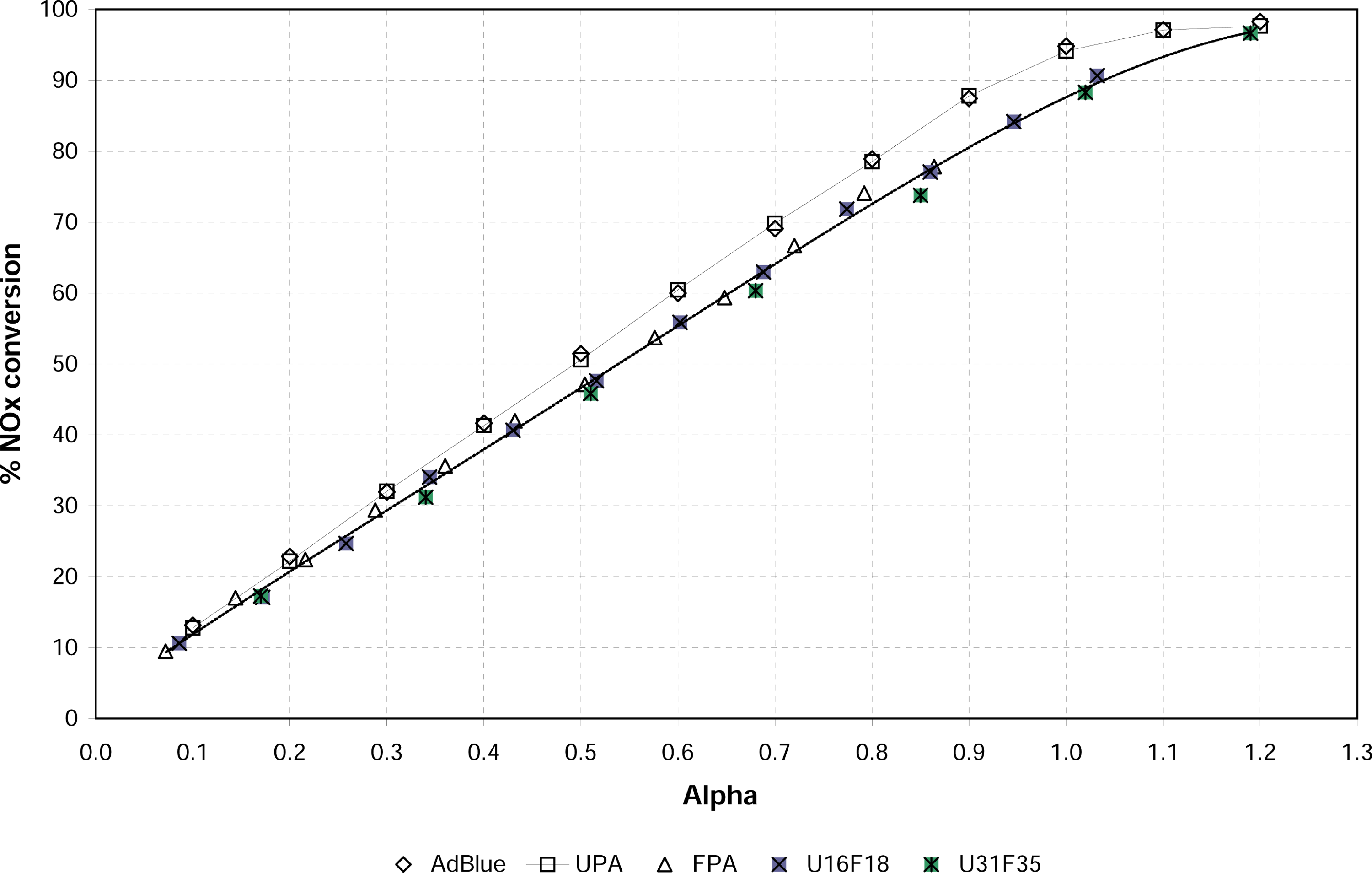
Efficiency of reducing agents in the European Stationary Cycle (ESC) Mode 3.
As previously mentioned, each mode under study has different values of torque and power and, consequently, different values of temperature of exhaust gases, allowing observation of the efficiency of each reducing agent in relation to different levels of exhaust temperature. Table 5 shows engine torque and power values for each mode tested.
In addition to the boundary conditions previously mentioned, other important variables are the combustion parameter, which werealso strictly controlled to ensure that changes in the results obtained from the exhaust gas emissions were only and solely a result of using different types of reducing agent. Among the combustion parameters, the most important ones are:
• The beginning of the main fuel injection [before top dead center (BTDC)]
• The quantity of main injection (mg/stroke)
• The beginning of the preinjection [difference between preinjection and main injection (DIF)]
• The quantity of preinjection (mg/stroke)
• The fuel injection pressure (bar)
Table 6 shows the values used during the tests, regardless of the reducing agent used. Another parameter of equal importance for analysis of the SCR system is the exhaust flow rate. The exhaust flow rate is the sum of the fuel flow rate plus the admission air flow rate. The variation of this parameter for the tests conducted with different reducing agents is <3%.
BTDC, before top dead center; DIF, difference between pre-injection and main-injection.
Besides the boundary conditions and combustion parameters set forth above, two other magnitudes that are also important for the analysis are the inlet and outlet temperatures of exhaust gases in the SCR catalyst used for the tests. Since the efficiency of the selective reduction system is directly proportional to the gas inlet temperature in the catalyst, Table 7 presents the average temperature values of the exhaust gases in the exhaust manifold (T3), in the exhaust pipe after the turbine (T4), and the inlet and outlet temperatures of gases in the selective catalyst, obtained from the various tests conducted with different types of reducing agents.
SCR, selective catalytic reduction.
Results and Discussion
There are several parameters that affect SCR, including temperature, initial NO and NH3 concentrations, and oxygen. First, it must be clear that all results have been analyzed considering the same α [defined in Eq. (4)]. Normalization allowed comparison among all reduction agents. The same α means the same NH3 quantity injected.
As previously mentioned, the present technology is based on the fact that NOx is selectively reduced by NH3 in the presence of an excess of oxygen over various catalysts. Busca et al. (1998) presented a great review of the reactions involved in the SCR process.
Evaluation of the ESC Modes 3, 4, 8, and 9 concerning the oxygen concentration range (Table 8) must be considered with temperature. The values inside indicate the efficiency of conversion.
Djerad et al. (2006) evaluated the relative contributions of selective reduction of NOx and NH3 oxidation reaction to product formation under different oxygen concentrations (2%, 6%, 10%, and 15% [v/v]) in a tubular flow reactor. In the cases of 10% and 15% O2, the maximum NOx conversion obtained is 99% at 250°C. In the present work, the maximum conversion, 99%, occurred with temperatures higher than in the Djerad study, 370°C and 450°C. Also, Djerad et al. observed that NOx conversions gradually decrease at temperatures >250°C, and attained 68% at 500°C due to the competitive reactions. At 500°C, NOx conversions in all cases are almost the same. This part is similar to the present result that showed that at 566°C, the maximum conversion does not exceed 65%.
NOx efficiency and NH3 emissions
Modes 3, 4, and 9 (lower temperature ESC Modes) had similar behavior. Thus, results of Mode 3 will be used as representative of the three. Figure 4 presents a comparison of the efficiencies obtained with different reducing agents evaluated in ESC Mode 3. The results for NOx emissions showed that agents Adblue and UPA32 have very close behavior, which is expected, since both have the same content of urea. It was also noted that for FPA mixed at either 16% or 32% with urea (U16F18 and U31F35, respectively), there was a decrease in the efficiency of NOx reduction as compared to agents with mixtures of AdBlue and chemically pure urea (UPA). For the same α, a difference of 10.0% is observed when comparing U16F18 or U31F35 with mixtures of AdBlue and UPA. This means that for the same efficiency, 10.0% more mass is needed as compared with the composition containing formamide.
Apparently with the increasing temperature in Mode 8, the formamide loses its removal efficiency more intensely (Fig. 5). In Mode 8, the temperature is higher, and at temperatures >460°C, the conversion efficiency of NOx for all reducing agents displays a significant reduction as compared with the efficiency shown by the same agents in modes with lower temperatures, such as Modes 3, 4, and 9, which operate in the range from 270°C to 450°C.
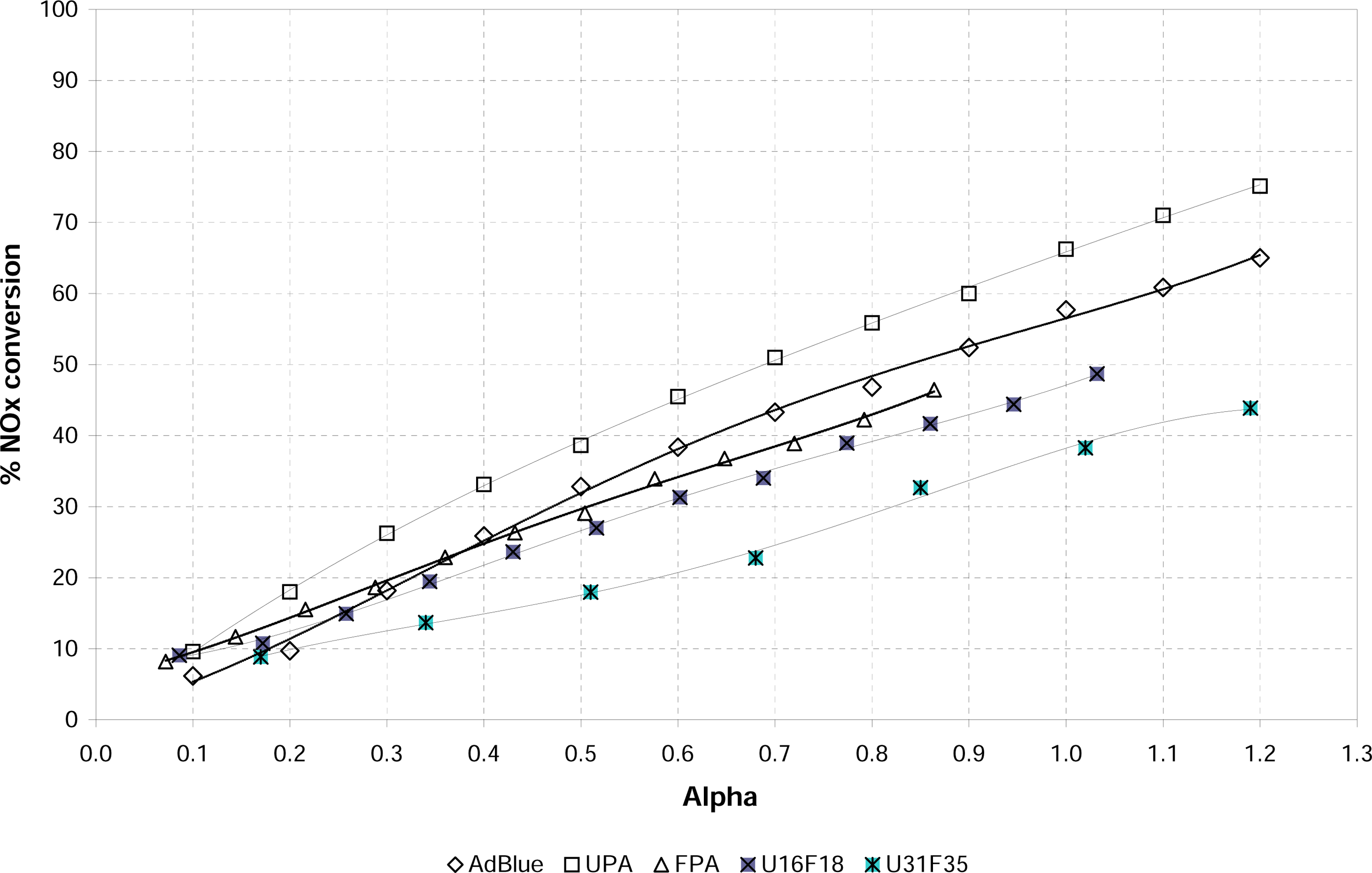
Efficiency of each reducing agent in ESC Mode 8.
As previously mentioned, when evaluating the reduction system, the behavior of NH3 emissions must also be observed, because the NH3 converted is not always used to neutralize NOx, depending on the concentration of this pollutant, the flow rate, the type of agent, and the temperature of the gases. Figures 6 and 7 display the results for NH3 emission for the modes studied.
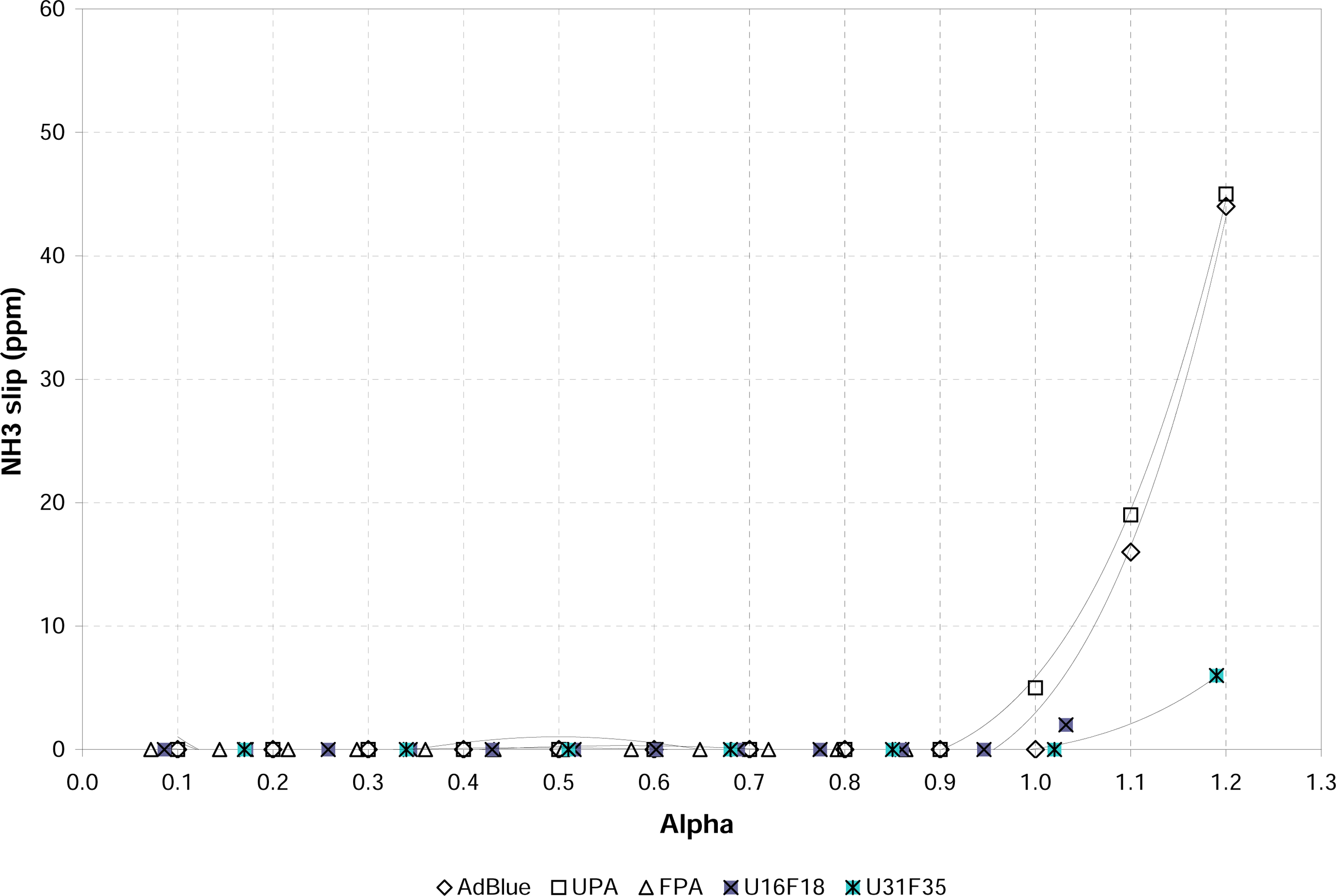
Ammonia slip values in ppm for ESC Mode 3.

Ammonia slip values in ppm for ESC Mode 8.
With regard to NH3 emission, it is observed that for Modes 3, 4, and 9, when the NO concentration decreases—that is, close to the point of cancellation of NOx—an exponential increase in the NH3 slip begins. Figure 6 shows the result for Mode 3, which is an illustration of this behavior. For these modes, the agents containing formamide did not show NH3 emission, but the annulment of NOx did not occur at the agent flow rates investigated.
Additionally, for situations with higher temperature, such as Mode 8 (Fig. 7), there is generally a drop in the efficiency of the agents leading to sharp NH3 slip, independent of the annulment of NOx emissions, as was observed in lower-temperature modes.
Considering the additional provisions of the Euro VI regulation that include the NH3 concentration limit of 10 ppm for gasoline (European Transient Cycle [ETC]) and diesel (ESC and ETC) engines, Adblue and UPA are not in compliance with this demand. Today, the manufacturers have utilized “slip cat,” that is, an oxidation catalyst downstream of the SCR catalyst that can be used to prevent NH3 slip.
Today, most of the vehicles that have the SCR system as a post-treatment system have a catalytic converter (the so-called slip cats) to reduce emission of NH3, which is not consumed during the SCR process. However, this slip cat has a cost and significantly increases the size of the catalyst system, because it is mounted immediately after the SCR.
According to the results showed in the present work, for the mixture of formamide compound, the release of NH3 is quite small in comparison to the AdBlue, allowing the possibility of removing the slip cat from the SCR system.
Analysis of CO emissions
Apparently, in relation to the CO during the tests, two distinct behaviors were observed: the first one in relation to the reducing agents that have only urea in their composition, which showed virtually no increase in gas emissions, where the chemical reactions that occurred in the process of NOx reduction followed the desirable reactions of the process that resulted in a reduction of NOx to N2. The second behavior observed was in relation to the reducing agents that have formamide in their composition, where there was a significant increase in CO emissions. Fig. 8 shows the representative behavior from Mode 8.
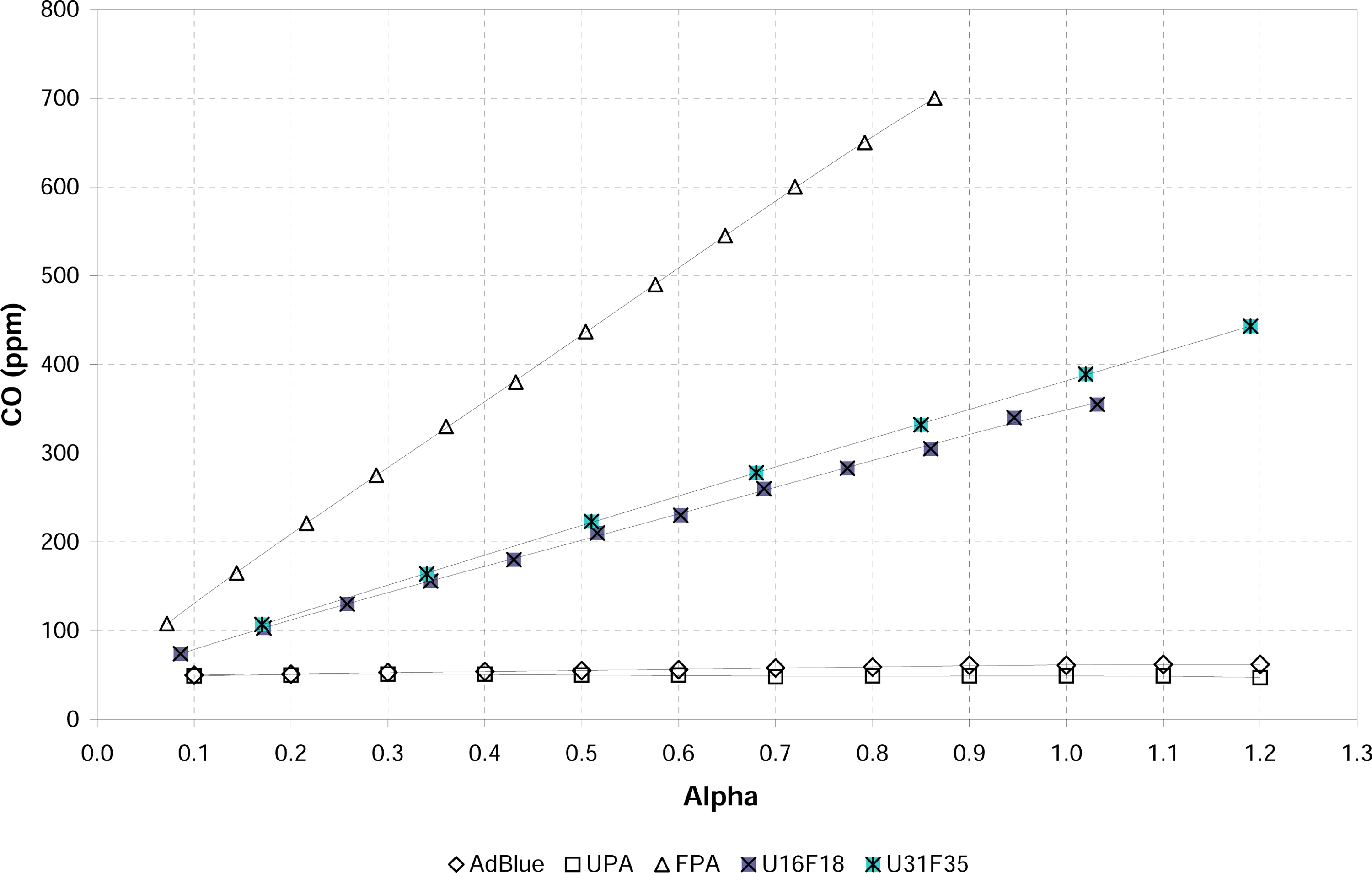
Carbon monoxide emission for different reducing agents in ESC Mode 8.
The literature shows that formamide starts its process of partial decomposition into CO and NH3 at 180°C. The formamide decomposition occurs via the competition between two mechanisms:
The path of both reactions has been examined in detail through theoretical studies; however, the literature disagrees about the order of energy from these reactions. Nguyen et al. (2011) compared the study of Martell et al. (1997), in which the energy barriers from 5 and 6 were 80.7 and 78.3 kcal/mol, to Liu et al. (2000), which reported results of 74.9 and 85.0 kcal/mol. Nguyen et al. (2011), in turn, agrees with Martell et al. (1997), reporting that the barrier has dehydrogenation energy of 78.8 kcal/mol, while decarbonation is 80.5 kcal/mol. According to the analysis of Nguyen et al. (2011), dehydrogenation is fully dominant when T<600K; for T≈600K, dehydrogenation and decarbonation have approximately equal branching ratios. For T>600K, kinetics would favor decarbonation.
The context of the present work does not deal with the study of kinetics and reaction mechanisms, but it can be inferred from the experimental data that there was predominance of the decarbonation mechanism compared to dehydrogenation, as there was an increase in temperature, which Martell et al. (1997) agrees with. The inlet temperatures in the SCR shown in Table 6 are 644K, 724K, 839K, and 549K in ESC Modes 3, 4, 8, and 9, respectively. According to the analysis of Nguyen et al. (2011), there would be predominance of dehydrogenation in Mode 9, and for Modes 3, 4 and 8, decarbonation would be the dominant stage. It is observed that the increase in the SCR inlet temperature causes an increase in CO emission regardless of the amount of reducing agent injected with urea only. A temperature increase causes two effects: a rise in reactivity and a change to the equilibrium constant. The first of these effects is always favorable, but the second one is only favorable in endothermic reactions, and is unfavorable in exothermic reactions. In a system having competing reactions, heat is capable of activating all reactions, but not necessarily in a selective way.
SCR is the dominant solution for meeting future NOx reduction regulations for heavy-duty diesel powertrains. The challenges are to achieve maximum NOx conversion with a minimum level of NH3 slip, to enhance low-temperature performance of SCR converters, and to satisfy in-use compliance to requirements. Although urea has been the global solution to mitigate NOx through the SCR system, this does not mean that it works very well in the whole cycle of work of all machines. Experimental measures in the field have shown that with conditions of low temperature, urea deposits are an enormous problem. This study examined the behavior of different reducing agents applied to the SCR system. Regarding the efficiency of the SCR catalyst system as to NOx reduction, it can be said that the mixtures containing urea as a base, such as urea (32%), urea/formamide (32%), and Adblue (32%) mixtures, were the most efficient ones regardless of the mode tested. On the other hand, the most efficient urea-based mixtures were also the mixtures presenting the highest values of NH3 emissions, a fact that requires manufacturers of diesel engines, together with the SCR system, to apply a slip-type catalyst to reduce NH3 levels to values of ∼25 ppm. The efficiency of formamide-based mixtures is not as significant as the urea-based mixtures, but the NH3 levels produced by these mixtures are virtually zero. In relation to CO, formamide-based mixtures showed a significant increase in emissions, which may have been responsible for the loss of efficiency in the reduction of NOx, whereas in urea-based mixtures, the value remained virtually unchanged, with the exception of urea (32%) mixture which, in Mode 9, at extremely low temperatures, showed a significant increase in HC emissions.
A suggestion for future work would be to analyze the form of injection of different reducing agents and how this influences of the behavior of different emissions, similar to a study conducted by Birkhold et al. (2006), but with all reducing agents tested herein. Another possibility for future study is the identification of reaction intermediates, not only to investigate the reaction route over a catalyst, but also to understand the effect of introducing doping material to this catalyst. Additionally, it is necessary to run the engine in transient conditions, which is more realistic than steady-state operations. All future work would be more beneficial if PM measures were obtained. Although formamide can be used with success in replacement of urea compounds, one important concern is the formaldehyde concentration released to the environment. Thus, it is fundamental to evaluate formaldehyde emissions.
Footnotes
Acknowledgment
The authors are grateful to MWM International Engines for support of this work.
Author Disclosure Statement
No competing financial interests exist.