




Abstract
Abstract
Degradation of 4-chloro-3,5-dimethylphenol (PCMX) by a heterogeneous Fenton-like process using nanoparticulate zero-valent iron (nZVI) and hydrogen peroxide (H2O2) at pH 6.3 was investigated. Interactive effects of three factors—initial PCMX concentration, nZVI dosage, and H2O2 concentration—were investigated using the response surface method based on the Box–Behnken design. Experimental results showed that complete decomposition of PCMX and 65% of total organic carbon removal were observed after 30 min of reaction at neutral pH under recommended reaction conditions: nZVI, 1.0 g/L; H2O2, 18 mM; and initial PCMX concentration, 0.15 g/L. Based on the effects of scavengers n-butanol and KI, removal of PCMX was mainly attributed to the attack of •OH, especially the surface-bonded •OH. A possible degradation pathway of PCMX was proposed.
Introduction
Advanced oxidation processes (AOPs) that allow degradation, and in some cases almost total mineralization, of various recalcitrant organic pollutants in a fast, effective, and inexpensive way have received increasing attention (Wang and Xu, 2012). Among these methods, heterogeneous Fenton-like systems using Fe-containing solids have been demonstrated to be useful to treat contaminants in water over a wider applicable pH range with several advantages, such as the possibility to recycle the iron promoter (Moura et al., 2005; Costa et al., 2008; Deng et al., 2008; Xu and Wang, 2012a, 2012b). In particular, nanoparticulate zero-valent iron (nZVI) has been chosen as an effective catalyst in environmental remediation because it has a smaller size and, thus, larger specific surface areas, facilitating greater reaction rates compared to bulk or microscale iron materials (Cao et al., 2008; Huang et al., 2008; Keenan and Sedlak, 2008a). In these systems, many variables, such as the initial pH, catalyst dosage, hydrogen peroxide (H2O2) dosage, initial pollutant concentration, and reaction time, will influence the degradation efficiency. In a conventional approach, optimization is usually performed using a rather one-factor-at-a-time approach, where one parameter is varied, thereby keeping the others constant (Zhang et al., 2008; Zhou et al., 2008). However, this method is laborious and time-consuming, and can neither evaluate the interactive effects among the variables nor guarantee the determination of optimal conditions. Recently, the statistical method of response surface methodology (RSM) has been proposed to determine the influences of individual factors as well as their interactive influences. RSM has already been applied in the investigation of AOPs (Ahmadi et al., 2005; Fu et al., 2007; Körbahti, 2007; Rauf et al., 2008; Arslan-Alaton et al., 2009; Zhang and Zheng, 2009; Wu et al., 2010). To date, the effect of estimating the interaction of various operating conditions on the biocides removal performances by the heterogeneous Fenton-like systems has not been reported using RSM.
In the present study, 4-chloro-3,5-dimethylphenol (PCMX) was chosen as a model pollutant. PCMX is widely used as a biocide and a preservative in cosmetics and medical products used in dermatology and general skin care (Yamano et al., 2003). So far, various AOPs, including UV/O3, sonochemical, and electrochemical AOPs, have been applied to decontamination of wastewater containing PCMX (Goskonda et al., 2002; Skoumal et al., 2008; Song et al., 2009). Goskonda et al. (2002) only mentioned the dechlorination process, with ∼75% chlorine released from PCMX after 24 h by sonochemical treatment. The electro-Fenton and UV/O3 processes that lie in the high-cost energy sources showed an efficient removal of PCMX, achieving complete decomposition after 15 min by electro-Fenton processes in 0.05 M Na2SO4 of pH 3.0 at 25°C, and after 6 min by UV/O3 at pH 4.0 and 20°C (Skoumal et al., 2008; Song et al., 2009). However, the degradation of PCMX by heterogeneous Fenton-like systems has not been reported. This work aims to investigate the treatability of wastewater containing PCMX with the nZVI/H2O2 system. A Box–Behnken design of RSM was employed to optimize the degradation process of PCMX. The individual and interactive effects of important process variables (nZVI dosage, H2O2 dosage, and initial PCMX concentration) on degradation efficiencies of PCMX were investigated, and a quadratic model is proposed to describe the relationship between the degradation efficiency and the operating variables. Furthermore, the effects of scavengers were determined to investigate the reactive oxidizing species mediated in the process, and a possible degradation pathway of PCMX is proposed.
Materials and Methods
Reagents
nZVI with grain sizes of 80–150 nm used in this study was prepared and characterized as described previously (Cheng et al., 2007; Xu and Wang, 2011). PCMX with a purity of ≥99% was purchased from Aladdin and used as such. Its characteristics are presented as follows: molecular mass, 156.6 g/mol; solubility, 0.33 g/L in water at 25°C; total organic carbon (TOC), 0.15 g/L PCMX in an aqueous solution (92 mg/L). 2,6-Dimethyl-p-benzoquinone (DMBQ; 99%) was supplied by Alfa Aesar. Analytical grade carboxylic acids, H2O2 (30%, v/v), n-butanol, and KI were obtained from the Beijing Chemical Factory. Distilled water was used throughout this study.
Experimental procedure
All experiments were carried out at the temperature of 30°C in the dark in conical flasks (25 mL) placed on a rotary shaker (TZ-2EH; Beijing Wode Company) with rotational force of 0.35 g. The conical flasks were not completely sealed, and (oxygen) gas could transfer to and from the solution. A given amount of nZVI was loaded into a conical flask containing 10 mL of an aqueous solution of PCMX. To initiate a reaction, a known concentration of H2O2 was added to the solution. Samples were collected at different time intervals using a 10-mL glass syringe and filtered immediately through a 0.22-μm filter film. n-Butanol (10 μL, 1 M) was immediately added into a l-mL sample as a reaction inhibitor. Each experiment was performed in triplicate to observe the reproducibility.
Analytical methods
The concentrations of PCMX and its intermediate were determined with a high-performance liquid chromatography (HPLC; 1200 Series; Agilent) equipped with a C18, 5-μm (4.6 mm×150 mm) reversed-phase column (ZORBAX Eclipse XDB-C18, Agilent) and a diode array detector. Aliquots of 20 μL were injected into the HPLC to quantify PCMX, running with the detector wavelength of 280 nm and a mobile phase of methanol/water (70:30, v/v) at a flow rate of 1.0 mL/min. The analysis of intermediate DMBQ was accomplished by HPLC with the detection set to 254 nm, using a mixture of methanol and water at a ratio of 55:45 (v/v) as the mobile phase at a flow rate of 0.8 mL/min.
Chlorine ion (Cl−) and carboxylic acids produced during the reaction were detected with a DX-100 ion chromatogram (IC; Dionex Co.) equipped with a Dionex RFIC™ IonPac® AS 14 analytical column (4 mm×250 mm) and a Dionex RFIC IonPac AG 14 guard column (4 mm×50 mm). The operational conditions were: eluent, 3.5 mM Na2CO3/1.0 mM NaHCO3; eluent flow, 1.0 mL/min; sample loop volume, 25 μL. The concentration of TOC was measured by a TOC analyzer (Multi N/C 2100; Analytik Jena), and pH was measured by a microprocessor pH meter (PH 211, Hanna).
Experimental design and statistical analysis
RSM based on the Box–Behnken design, using Design Expert 7.1.3, was applied to optimize the experimental conditions for PCMX degradation. This design was chosen since it fulfills most of the requirements for optimization of the process, which is spherical and rotatable or nearly rotatable, and requires factors to be run at only three levels (Yetilmezsoy et al., 2009; Singh et al., 2010). Three important operating parameters—nZVI dosage, 1.0–2.0 g/L; H2O2 dosage, 6.0–18.0 mM; and initial PCMX concentration, 0.05–0.15 g/L—were chosen as the independent variables and designated as A, B, and C, respectively. The experimental design involved three factors (A, B, and C), each at three levels coded −1, 0, and +1 for low, middle, and high concentrations, respectively. A total of 17 experiments were conducted with the first 12 experiments organized in a factorial design and the experimental trials from 13 to 17 involving the replication of the central point for estimation of errors. The experiments that were run and the obtained responses (removal of PCMX) are shown in Table 1.
PCMX, 4-chloro-3,5-dimethylphenol.
The degradation efficiency (%) was calculated by the following:
where C0 is the initial concentration of PCMX (g/L) and C is the PCMX concentration after a 90-min reaction.
In the optimization process, the quadratic equation model for three factors is expressed according to Eq. (2a).
where Y is the predicted response, that is, removal of PCMX; β0 is the constant coefficient, β1, β2, and β3 are the linear coefficients, β12, β13, and β23 are the interaction coefficients, and β11, β22, and β33 are the quadratic coefficients of the model; x1, x2, and x3 are the independent variables; and ɛ is the error. Because the independent variables were coded as A, B, and C in this study, the second-order polynomial equation was presented in the following form:
To obtain the interaction between the process variables and the response, analysis of variance (ANOVA) was performed based on the proposed model. The quality of the fit of a polynomial model was expressed by the coefficient of determination R2 and R2Adj, and its statistical significance was checked by the F-test in the same program. Model terms were selected or rejected based on the probability value with a 95% confidence level. Furthermore, the individual and the interactive effects of the independent variables on PCMX degradation were visualized by three-dimensional (3D) plots and their respective contour plots.
Results and Discussion
Degradation of PCMX in the nZVI/H2O2 system
The degradation of PCMX by nZVI alone, H2O2 alone, and nZVI/H2O2 systems at initial pH 6.3 (solution original pH, not adjusted) were investigated as shown in Fig. 1. After a 180-min reaction, the use of 1.5 g/L nZVI alone had little effect on PCMX degradation, and even throughout a 24-h reaction, only 12% removal of PCMX was observed (Fig. 1, inset). About 0.028 mM free chloride (i.e., 3% of theoretical chloride value according to the initial PCMX concentration) was measured in the solution after a 24-h reaction, indicating that the removal of PCMX was probably attributed to both surface adsorption and reductive dechlorination by nZVI (Cheng et al., 2007; Son et al., 2009). Similarly, no obvious decrease of the concentration of PCMX was found in the experiment only with 30 mM H2O2 even though the reaction time was extended. However, complete degradation of PCMX was achieved within 30 min in the nZVI/H2O2 system with initial parameters of pH 6.3, 1.0 g/L nZVI, 18 mM H2O2, and 0.15 g/L PCMX, which illustrated the high catalytic ability toward H2O2 activation for nZVI. As verified by the TOC measurement, after a 30- and 180-min reaction, TOC losses observed were 65% and 69%, respectively.

Comparison of 4-chloro-3,5-dimethylphenol (PCMX) degradation in nanoparticulate zero-valent iron (nZVI) alone, hydrogen peroxide (H2O2) alone, and nZVI/H2O2 systems at pH 6.3 with an initial PCMX concentration of 0.15 g/L. Inset: Result of PCMX degradation conducted in nZVI alone and H2O2 alone throughout the 24-h reaction time.
It should be noted that rapid degradation of PCMX was obtained at neutral pH in the nZVI/H2O2 system, indicating that no adjustment of the pH value was needed for effective oxidation. The solution pH value initially decreased from 6.3 to 5.1 after a 30-min reaction, and then decreased gradually to 4.8 after a 180-min reaction, which was ascribed to the formation of organic acidic intermediates. Thus, no or less adjustment of the pH value was needed before discharge.
Earlier studies have reported that in the presence of H2O2 or dissolved oxygen, nZVI particles can be oxidized to ferrous ions, which ultimately react with H2O2 via the Fenton reaction (Keenan and Sedlak, 2008a, 2008b; Lee et al., 2008). As seen in Eqs. (3) and (4), nZVI oxidation produces Fe(II) via a two-electron transfer from the particle surface to H2O2 or oxygen. The reaction of ferrous ions with H2O2 [Fenton reaction, Eqs. (5) and (6)] yields oxidative species responsible for oxidation that are hydroxyl radical (•OH) and/or the ferryl ion (e.g., FeO2+). Under neutral pH conditions, the oxidation of Fe(II) by O2 also generates superoxide radical anion (O2•−) and H2O2 via a series of one-electron transfers [Eqs. (7) and (8)] (Keenan and Sedlak, 2008b; Lee et al., 2008). These oxidative species produced during the reaction of nZVI and H2O2 can oxidize PCMX rapidly. Hence, further experiments were conducted to investigate the effects of the nZVI dosage, H2O2 dosage, and initial PCMX concentration on the removal of PCMX at solution original pH of 6.3.
Fitting model and ANOVA
To determine the effects of three independent variables on the degradation efficiency of PCMX, the Box–Behnken design matrix and corresponding results of RSM experiments are presented in Table 1. The second-order polynomial equation was used to explain the mathematical relationship between variables and response. The mathematical expressions of relationship to the degradation of PCMX with variables like A, B, and C are shown below as in terms of coded factors:
and in terms of actual factors:
By solving these equations and by analyzing the response surface contour plots, the optimum values of the selected test variables can be obtained.
To test the significance of the fit of the second-order polynomial equation for the experimental data, the ANOVA was conducted and the results are given in Table 2, as similarly reported by others (Baskan and Pala, 2009; Yetilmezsoy et al., 2009; Zhang and Zheng, 2009). The ANOVA of this model shows that the model is highly significant, as is evident from the F-value of 208.68 and a very low value of probability >F<0.0001. The nonsignificant lack-of-fit (>0.05) is good for data fitness in the model, which indicates that the quardratic model is valid for the present study. In this case, the probability values of each term except for B2 are <0.05, which reveals that these model terms are significant for PCMX degradation. In addition, very high correlation coefficients R2 and R2Adj of 0.9963 and 0.9915 show the good fitness of model in the experimental data, which implies that it can provide an excellent explanation of the relationship between the independent variables and the response.
R2=0.9963; Adj R2=0.9915.
RSM, response surface methodology.
The actual and the predicted PCMX degradation efficiencies shown in Table 1 and the diagnostic plot shown in Fig. 2 were used to estimate the adequacy of the regression model, which is also an important part of the analysis procedure. As seen in Table 1, the predicted response evaluated from the model fit well with those of the experimentally obtained response, indicating that the proposed model has adequate approximation to the actual value. As depicted in the plot of normal probability of the residuals (Fig. 2), the data points approximately lie on the straight line suggesting that response transformation is not required and there is not any apparent problem with normality.

Normal probability plot of studentized residuals for PCMX degradation.
Response surface plots and optimization of treatment based on removal of PCMX
The response surface and contour plots, as shown in Fig. 3a–3c, were utilized to assess the interactive relationships between the nZVI concentration, H2O2 dosage, and the quantity of PCMX in terms of reactive oxidant production, and consumption ultimately improving the process. The removal efficiencies of PCMX obtained as a function of the H2O2 dosage and nZVI addition are depicted in Fig. 3a. As can be seen in the plot, there is an increase in the PCMX removal with an increasing H2O2 dosage and a decreasing nZVI addition. The positive effect of the H2O2 dosage on the PCMX removal can be ascribed to more oxidative species (e.g., •OH) produced with a high-concentration H2O2 promoting the degradation of PCMX (Daud and Hameed, 2010).
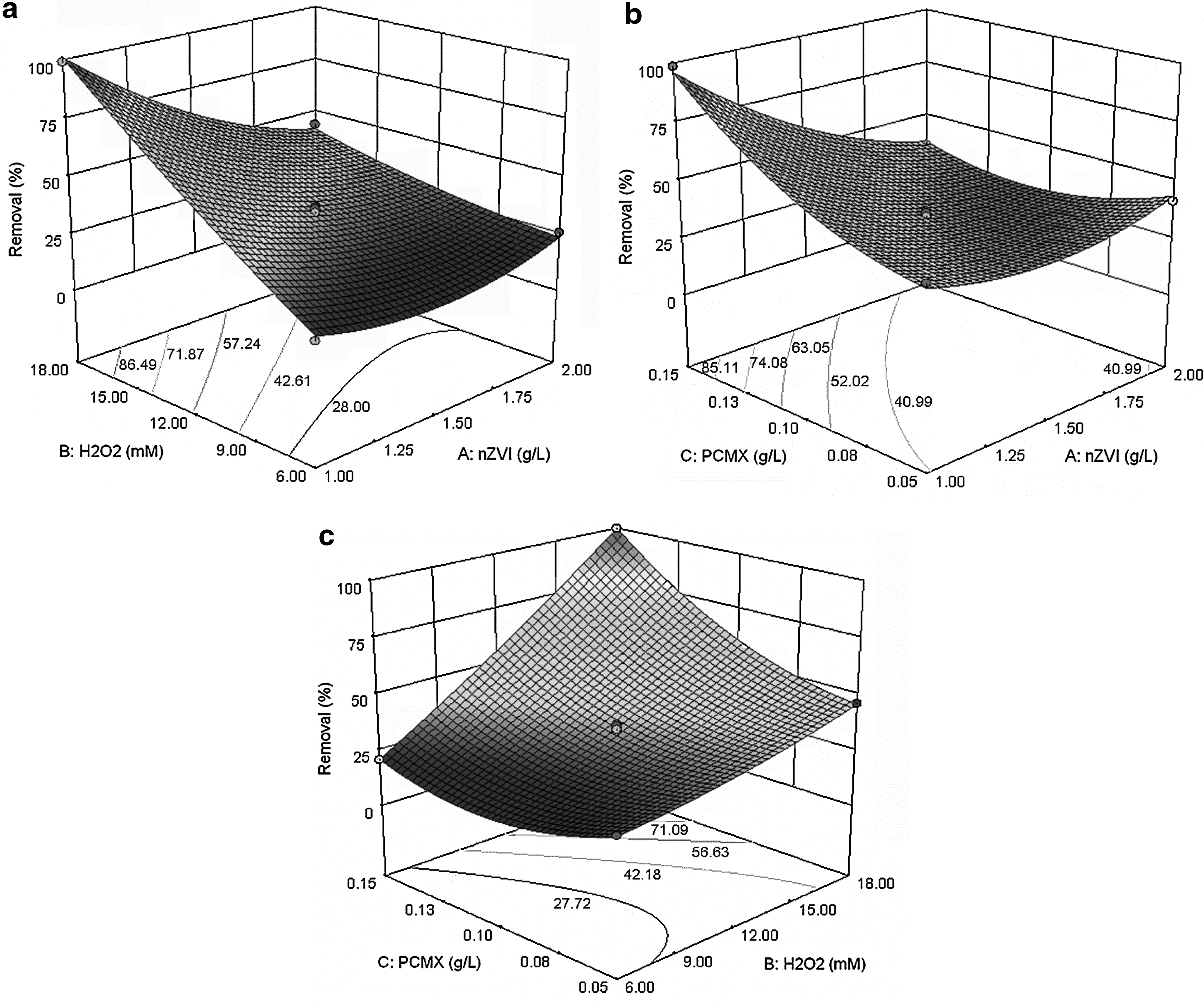
Response surface plot and contour plot:
As presented in the response surface of the initial PCMX concentration and nZVI addition (Fig. 3b), PCMX removal increased with an increase of initial PCMX concentration, whereas it decreased with an increase of nZVI addition. The negative effect of nZVI addition is attributed to the agglomeration of nZVI particles and the free radical scavenging effect of an excessive concentration of Fe2+ (Zhou et al., 2008; Liao et al., 2009; Xu and Wang, 2011). Complete PCMX removal was almost achieved at the initial PCMX concentration of 0.15 g/L and nZVI dosage of 1.0 g/L, which revealed that a concentration of 1.0 g/L nZVI was by far sufficient for providing active sites for H2O2 decomposition and producing reactive oxidants such as •OH (Ramirez et al., 2007; Daud and Hameed, 2010).
Figure 3c displays the response surface and contour plot for percent PCMX removal efficiencies as a function of initial PCMX concentration and H2O2 dosage with 1.5 g/L nZVI addition at pH 6.3 after a 90-min reaction. It was shown that the PCMX removal had its peak value, while both of the process variables were kept at maximum. As expected, when the initial PCMX concentration was 0.15 g/L, increasing the H2O2 dosage from 6 to 18 mM resulted in a dramatic increase in percent PCMX removals from 21% to 100%, indicating that the high-concentration H2O2 will produce more oxidative species (mainly hydroxyl radicals). However, only a 46% PCMX removal was obtained even with 18 mM H2O2 at the initial PCMX concentration of 0.05 g/L, which is due to the scavenging effect of hydroxyl radicals and the inhibition of iron corrosion by overdosed H2O2 (Zhou et al., 2008; Xue et al., 2009; Xu and Wang, 2011). In conclusion, it is desirable to run the heterogeneous Fenton-like process at a low nZVI addition, high H2O2 dosage, and high initial PCMX concentration within the experimental ranges.
The main objective of the optimization is to determine the recommended values of the process variables for the maximum PCMX removal efficiency from the model obtained experimentally. Under recommended working conditions of nZVI 1.0 g/L, H2O2 18 mM, and initial PCMX concentration 0.15 g/L, the model predicts complete PCMX removal in the nZVI/H2O2 heterogeneous system at pH 6.3 after a 90-min reaction. The three replicate experiments were conducted applying the recommended conditions to confirm the model adequacy for predicting the maximum PCMX removal efficiency. As shown in Fig. 1, the removal efficiency of PCMX reached 100% after only a 30-min reaction, which was in agreement with the model prediction. The results derived from this study suggested that the RSM was available, reliable, and successful for optimizing the removal of PCMX.
Identification of reactive species
Information regarding the reactive oxidizing species mediated in the process may be provided by determining the influence of different scavengers on the degradation of PCMX under the recommended conditions at pH 6.3 as shown in Fig. 4. The degradation of PCMX was inhibited greatly by the addition of excess n-butanol (350 mM), which can scavenger all the hydroxyl radicals produced in the system (Isariebel et al., 2009; Xu and Wang, 2011), indicating that •OH radicals (including surface-bounded •OH and free •OH) have significant roles in the degradation of PCMX. However, there was still 15% degradation of PCMX in the presence of n-butanol after a 180-min reaction, and some degradation intermediates were detected by HPLC and IC. As suggested by earlier studies (Jacobsen et al., 1998; Keenan and Sedlak, 2008b; Xu and Wang, 2011), this minor degradation of PCMX may be ascribed to the action of an alternate oxidant, such as Fe(IV), which can be formed at neutral pH values in the Fenton reaction [Eq. (6)].
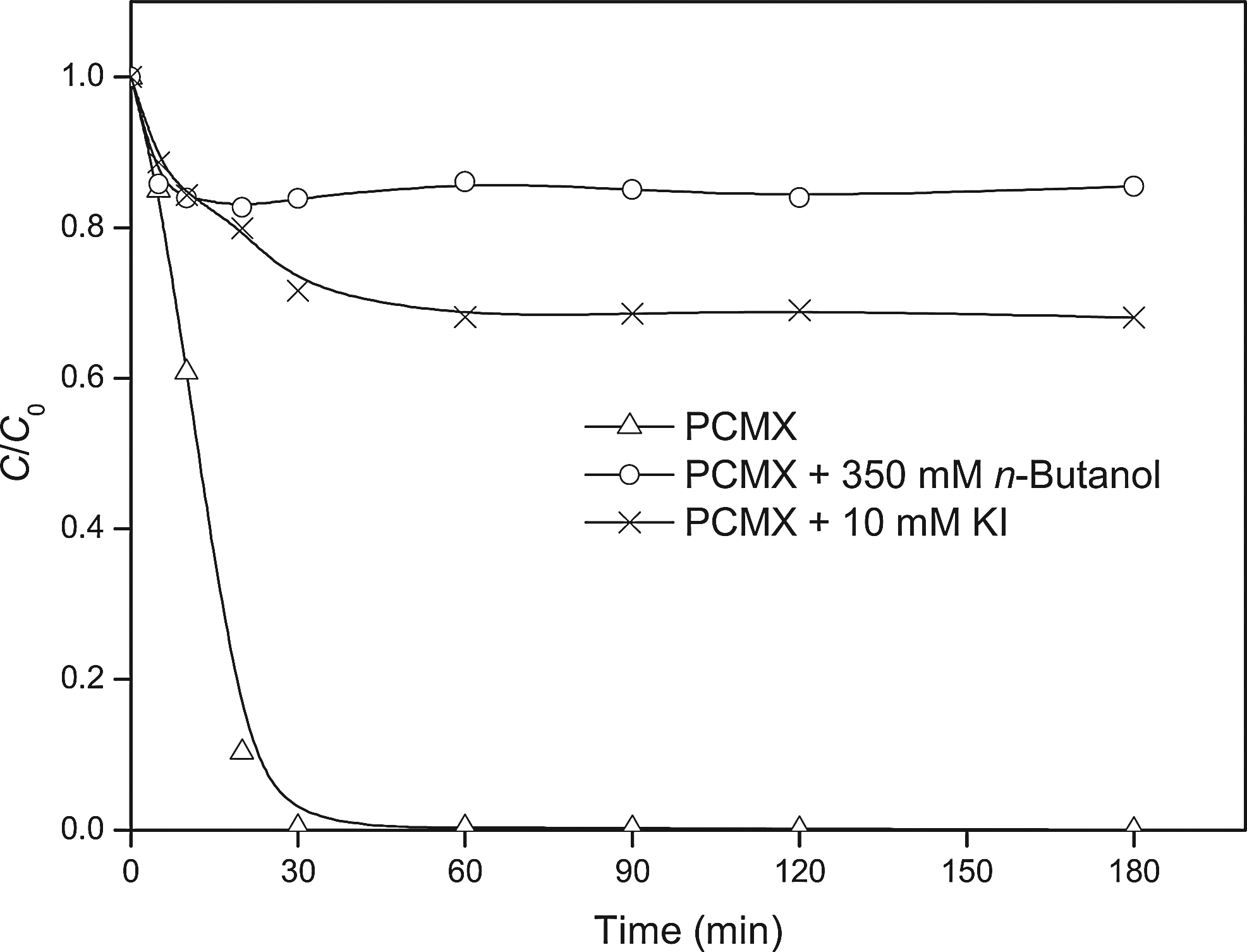
Effect of radical scavengers on degradation of PCMX with nZVI 1.0 g/L, H2O2 18 mM, and initial PCMX concentration 0.15 g/L at pH 6.3.
Iodide ion is used as a scavenger that can react quickly with hydroxyl radicals produced at the surface of nZVI particles with a rate constant of 1.2×10¹⁰/(M·s) (Martin et al., 1995; Song et al., 2007). As seen in Fig. 4, adding excess KI (10 mM) led to a considerable decrease in the degradation efficiency of PCMX from 100% (in 180 min without KI) to 32%, indicating that surface-bounded •OH was the major oxidant among the hydroxyl radicals responsible for the removal of PCMX. Therefore, about 15%, 17%, and 68% removal of PCMX might be ascribed to the action of Fe(IV), free •OH, and surface-bounded •OH, respectively.
Possible degradation pathway of PCMX
The evolution of degradation intermediates and chloride ion during PCMX degradation were identified by HPLC and IC to elucidate the mechanistic steps in the oxidation of PCMX by nZVI/H2O2 at pH 6.3 and the results are given in Fig. 5. As can be seen, about 92% of the chlorine was released from the aromatic ring of PCMX after a 180-min reaction. As shown in Fig. 6, initially, the PCMX molecule was attacked mainly by hydroxyl radicals giving 2,6-dimethylhydroquinone with loss of chloride ion (Skoumal et al., 2008; Song et al., 2009). Thereafter, benzene derivatives such as DMBQ that was detected by HPLC as shown in Fig.5 were yielded from the oxidation of this hydroquinone with oxidative species such as hydroxyl radicals. These benzene derivatives then underwent a benzenic ring opening followed by oxidative breaking, leading to the formation of carboxylic acids such as pyruvic acid and oxalic acid. Furthermore, acetic acid and formic acid were detected by IC after a reaction time of 180 min (data not shown). Ultimately, these smaller molecular organic acids such as pyruvic acid, oxalic acid, acetic acid, and formic acid remained in solution after a 180-min reaction, which was in accordance with the pH value of 4.8 and the residual TOC value of 31% after the 180-min reaction.
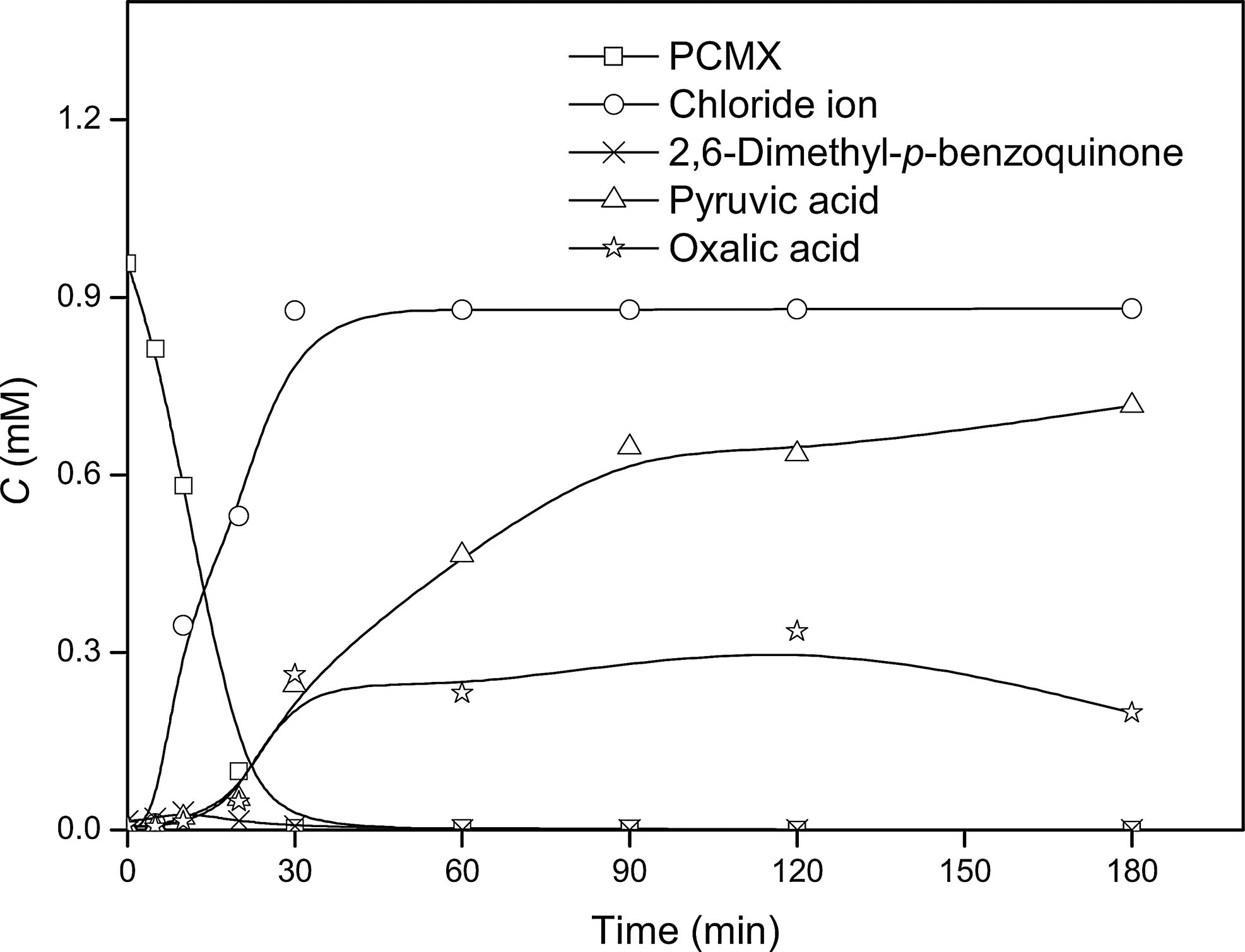
Variation of concentrations of PCMX, chloride ion, and intermediates during PCMX degradation detected by HPLC and ion chromatogram.
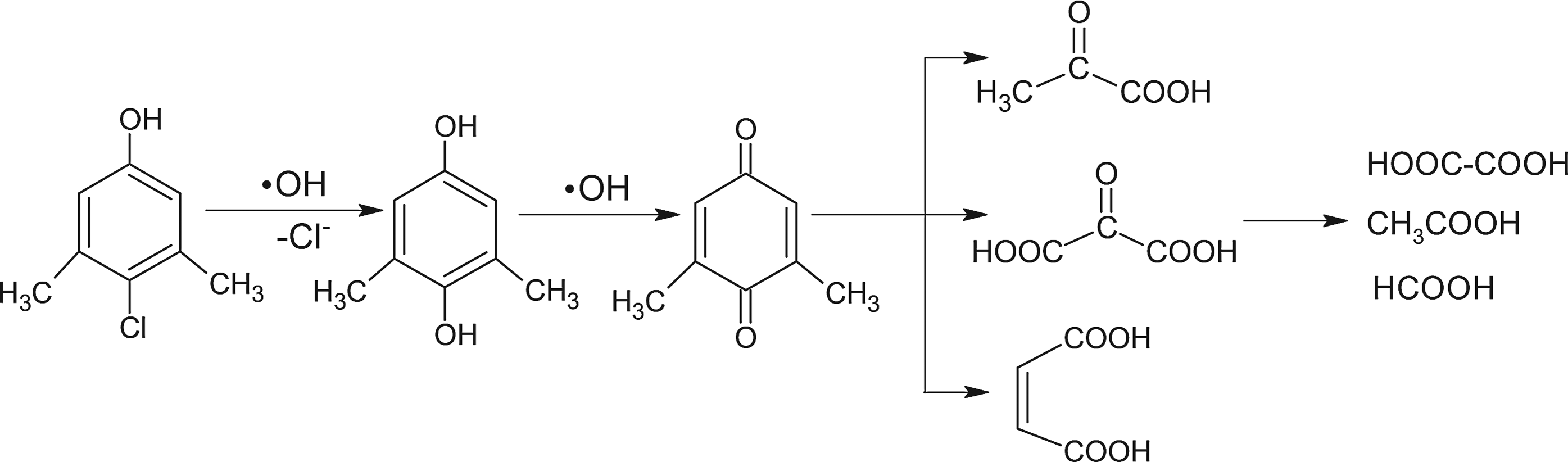
Proposed degradation pathway of PCMX by the heterogeneous nZVI/H2O2 process at pH 6.3.
Conclusions
The heterogeneous nZVI/H2O2 process is an effective method to remove the PCMX under neutral pH conditions, which has been optimized by using RSM based on the Box–Behnken design. A regression model was proposed to describe the significant effects of three operating variables (the initial PCMX concentration, nZVI and H2O2 dosage) as well as their interactive effects on the response (removal of PCMX). ANOVA indicated the proposed model agreed with the experimental data with R2 and R2Adj of 0.9963 and 0.9915, respectively. The recommended conditions were found to be nZVI 1.0 g/L, H2O2 18 mM, and the initial PCMX concentration 0.15 g/L for complete degradation of PCMX after a 90-min reaction, which was in agreement with the experimental finding. Moreover, reactive oxidizing species were identified according to the effect of scavengers, and the possible degradation pathway of PCMX was proposed based on the intermediates and chloride ion determined by HPLC and IC.
In the present study, the use of the RSM approach has helped to identify the most significant operating factors and optimum levels with minimum effort and time, and additional research is needed to apply it at the pilot scale for industrial wastewater treatment. The possible toxicity of nZVI on human health and ecosystems is also one of the key uncertainties associated with widespread application of this process. Further work should focus on the determination of eco- and human toxicity of nZVI, and the assessment of the feasibility of this process under conditions likely to be encountered in industrial application.
Footnotes
Acknowledgment
The authors are grateful for the financial support provided by the National Natural Science Foundation of China (Grant No. 51078210).
Author Disclosure Statement
No competing financial interests exist.