




Abstract
Abstract
Chromium is easily trapped by Fe-oxyhydroxides when the two elements are weathered from serpentinites. Additionally, manganese oxides are the only known naturally occurring oxidant for Cr(III). To elucidate the effects of Fe and Mn oxides on Cr speciation from serpentine mine tailing, this study explored Cr(VI) generation from lithiogenic Cr that increases as a result of tailing weathering, which was caused by partitioning changes of this element with pedogenic Fe and Mn oxides. Twenty-nine tailing samples (0–5 cm) were obtained from an abandoned site of serpentine mining on Wan-Ron Hill in eastern Taiwan. Samples were characterized using chemical extraction, as well as mineralogical and statistical approaches. Based on the experimental results, exchangeable Cr(VI) was observed in all samples ranging from 34.8 to 183 μg/kg. Chromite was the main Cr-bearing mineral examined in this study. Total labile Cr release and subsequent Cr(VI) generation led to the hypothesis that the labile Cr resulted initially and mainly from chromite weathering. Dithionite–citrate–bicarbonate and oxalate extractions facilitated identifying the incongruent dissolution between Cr and Fe (and/or Mn). The Cr(VI) increased with concentrations of various forms of Fe and Mn, except for total Fe, revealing that Cr(VI) could be released from the surface of the Mn oxides, where it had been oxidized, and subsequently re-adsorbed onto the surface of the surrounding Fe oxides.
Introduction
The less-mobile Cr(III) is considered an essential trace element in mammals, whereas the highly soluble Cr(VI) is a powerful oxidant and is classified as a mutagen, teratogen, and carcinogen (Gad, 1989). Therefore, the oxidized form of Cr, Cr(VI), constitutes a health hazard. The primary environmental goal when managing Cr-rich natural systems, such as serpentine mine tailings, is to assess the redox state of Cr (Fandeur et al., 2009). The concentration of Cr(VI) in groundwater in several areas with serpentine soils has been found to exceed the World Health Organization's limit (50 μg/L) for drinking water (Morrison et al., 2009). Despite the presence of a large part of Cr in chromite and Cr-substituted goethite in the serpentine soils from New Caledonia (Becquer et al., 2006), Cr(VI) concentration was >500 μg/L in the soil solution under the highly P-fertilized cropland (Becquer et al., 2003, 2010).
Most Cr exists as Cr(III) in the serpentine ecosystem, but redox reactions may lead to an oxidation of Cr(III) to Cr(VI), significantly contributing to natural inputs of Cr(VI) in the environment (Morrison et al., 2009; Mills et al., 2011). Manganese oxides are the only known naturally occurring oxidant for Cr(III) because of their high redox potential (+1.485 V for the MnIII2O3/Mn(II) redox couple, as compared to +1.350 V for the CrO42−/Cr(OH)3 redox couple), and because the electron exchange occurs on the surface of the mineral phase (Fandeur et al., 2009). Therefore, the ability of soil to oxidize Cr(III) is related to the amount of easily reducible Mn in the soil (Bartlett and James, 1979).
The weathering of serpentinitic rocks eventually causes large amounts of pedogenic Fe and Mn oxides to accumulate in serpentine soils (Becquer et al., 2006). Therefore, pedogenic Fe and Mn oxides are the main contributing phases of labile Cr resulting from weathered Cr-bearing minerals (Hseu et al., 2007; Cheng et al., 2011), despite Fe(III) not being considered an oxidant for Cr(III) because of the lower redox potential of the Fe(III)/Fe(II) couple compared to that of the HCrO4−/CrOH2+ and CrO42−/Cr(OH)3 couples (Fendorf, 1995). Silicon-rich goethite was the major Fe oxide observed in a study of serpentine ferralsols in New Caledonia, which scavenged large proportions of Cr (Becquer et al., 2006). In addition, the increased goethite resulted in the increase in the Fe and Mn oxide-bonding fraction of Cr in the serpentine soil from the shoulder to the footslope along a toposequence in eastern Taiwan (Cheng et al., 2011).
Ophiolites are sections of oceanic crust and the subjacent upper mantle that have been uplifted or emplaced and exposed within continental crustal rocks (O'Hanley, 1996). Ore deposits in serpentine terrains are abundant worldwide in ophiolite belts along tectonic plate margins. Mining activities frequently generate high amounts of waste. In this waste, serpentine mine tailings have strong environmental effects caused by high concentrations of Cr in the tailings, as well as increased wind and water erosion (Hsiao et al., 2007). Erosion processes in the tailings pose risks by decreasing the structural stability of soils and by releasing Cr via tailing drainage. These pollutant effects can attain local and, in some cases, regional scales and substantially affect urban activities and ecological functions (Wong, 2003).
Understanding the Cr oxidation potential during the weathering of serpentine mine tailing is critical in determining the health risks associated with Cr-rich rocks and soils. Serpentine outcrops are plentiful in eastern Taiwan, where mines have been exploited for serpentine ores, causing large amounts of tailing to be exposed on the surface. Fandeur et al. (2009) suggested that oxidation of Cr(III) to Cr(VI) by Mn oxides and/or Mn(III)-bearing Fe oxides occurs in a lateritic regolith in New Caledonia, which Cr(VI) was found between depths of 11 and 27 m. However, the authors did not find evidence of Cr(VI) occurrence in the surface deposits of serpentinites. Thus, information about Cr speciation in serpentine mine tailings is still lacking, and the observation of all Cr(VI) occurrence has not been complete and verified for the serpentine environment. The novelty of this work evaluated the hypothesis that Cr(VI) production released from the lithiogenic Cr increases as a result of weathering from serpentine mine tailing caused by pedogenic Fe and Mn oxides partitioning this element. The aims of this study were to (1) characterize the serpentine mine tailings related to the abundant Cr; (2) partition Cr, Fe, and Mn into various fractions in the tailings; and (3) explore the relationship between Cr(VI) generation and amounts of Fe and Mn oxides in the tailings.
Materials and Methods
Site description and tailing collection
The study area is located on Wan-Ron Hill along the Central Ridge of eastern Taiwan. This study was performed at an abandoned serpentine mining site on the hill (23°42′37″ N, 121°24′32″ E) at an altitude of 250–270 m with an average slope of 10% (Fig. 1). The area of the serpentine site is ∼2.5 ha. Wan-Ron Hill is situated in the boundary area between the Coastal Range and Central Ridge. The tailings were spread over the mining site that was devoid of plant growth on Wan-Ron Hill, which had a history of serpentine mining activity for 30 years (1970–2000). Twenty-nine tailing samples (0–5 cm) were randomly obtained from the abandoned site. The samples were air-dried, ground, and passed through a 2-mm sieve for laboratory analysis.
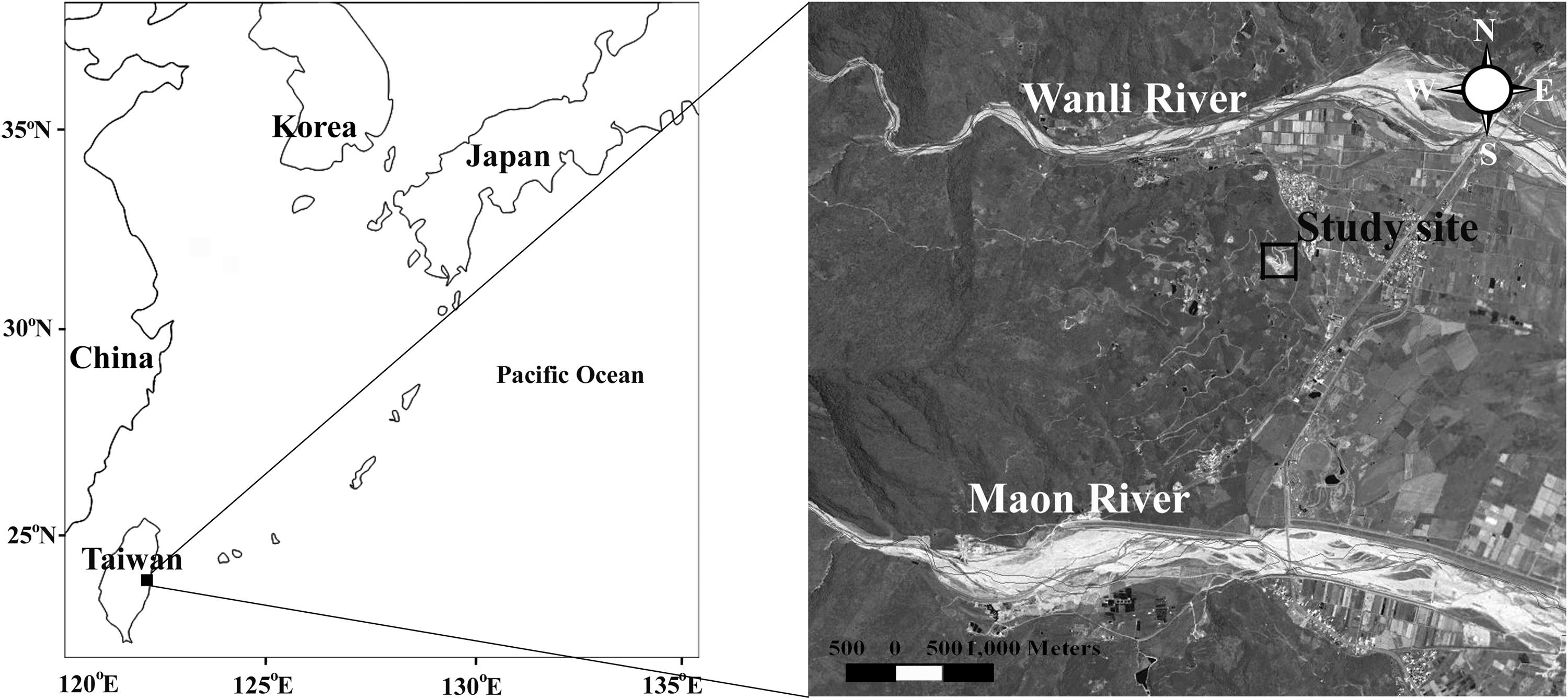
Location and study area by aerial imaging.
Physiochemical and mineralogical analyses
The distribution of particle sizes was determined using the pipette method (Gee and Bauder, 1986). The pH was measured using a mixture of soil and deionized water (1:1, w/v) with a glass electrode (McLean, 1982). Total organic carbon (OC) content was measured using the Walkley-Black wet oxidation method (Nelson and Sommers, 1982). For total concentrations of Fe, Mn, and Cr, 0.5 g of a sample was placed in a Teflon beaker and digested with a mixture of HF-HNO3-HClO4 modified from Baker and Amacher (1982). The soil digests were cooled, diluted to 50 mL with deionized water, and filtered through Whatman No. 42 filter paper into Teflon bottles. Furthermore, the metal content in the solutions was determined using a flame atomic absorption spectrophotometer (FAAS; Hitachi Z-2300). A standard reference material, CRM 034–050 (metals in soil) obtained from the Resource Technology Corporation, was digested in triplicate and analyzed using the tailing digestion method described for the purpose of metal recovery. Recovery of Fe, Mn, and Cr was 95%, 106%, and 93%, respectively.
Selective dissolution of pedogenic Fe oxides in study tailings was performed using two chemical reactants to characterize the degree of crystallization and, therefore, the status of tailing weathering. Acid ammonium oxalate (pH 3.0) extraction was performed for noncrystalline (amorphous and organic-matter bound) Fe oxides (Feo) (McKeague and Day, 1966), which was operated in the dark to avoid reduction of the Fe and extracted Fe based on complexation with oxalate only. The dithionite–citrate–bicarbonate (DCB) extraction was applied to crystalline and noncrystalline Fe oxides (Fed). In the DCB extractant, Fe oxides were reduced by dithionite and all soluble Fe species were complexed with citrate under the buffering of bicarbonate (Mehra and Jackson, 1960). The extractants, DCB and acid ammonium oxalate, were also used for Mn (Mnd and Mno) and Cr (Crd and Cro) associated with the Fe oxides (Mills et al., 2011). The extracts were filtered through Whatman No. 42 filter paper and Millipore filter paper <0.45 μm. The concentrations of Fe, Mn, and Cr in all solutions were determined using the FAAS.
Fresh tailing samples were analyzed for Cr(VI) and easily reducible Mn (Mnred). Regarding Cr(VI) measurement, a total of 5 g of tailing samples was shaken for 30 min with 15 mL of a 10 mM solution of K2HPO4 and KH2PO4 mixture, buffered at pH 7.2. Moreover, Cr(VI) in the filtrate was determined colorimetrically at a wavelength of 540 nm, using a 1,5-diphenylcarbazide solution (Bartlett, 1991). The Mnred was obtained by shaking for 6 h a 3-g sample with 30 mL NH4OAc (pH 7.0) containing 0.2% hydroquinone (Gambrell, 1996). The extracts were filtered through Whatman No. 42 filter paper and Millipore filter paper <0.45 μm. Furthermore, the Mn content in the solution was determined using the FAAS.
The X-ray powder diffraction (XRD) patterns of selected tailing samples were obtained from 20° to 50° 2θ, at a rate of 0.20° 2θ/min using a Rigaku D/max-2200/PC diffractometer with Ni-filtered Cu Kα radiation generated at 30 kV and 10 mA. The samples for XRD were performed on K-saturated and Mg-saturated samples with heating and glycerol treatment, respectively. Undisturbed blocks of tailings were also obtained from the study site and stored in aluminum boxes. After air-drying, polished samples were prepared for making 30-μm-thick sections by Spectrum Petrographics, Inc. Selected thin sections were analyzed by back-scattered electron (BSE) imaging and energy dispersive x-ray spectroscopy (EDX) with a scanning electron microscope (JEOL JSM-6360LV) at the Institute of Earth Sciences, Academia Sinica.
Statistical analysis
To evaluate Cr species that depend on the Fe and Mn oxides and other soil properties, correlation analysis and principal component analysis (PCA) were used. The Pearson correlation coefficient, r, measures the strength of a linear relationship between two parameters. PCA was further utilized for the multivariate statistical analysis, and for descriptive and correlation analyses. PCA is widely used to reduce data and to extract a small number of latent factors for analyzing relationships among observed variables (SPSS, Inc., 1999). The metal concentrations with various extractions evaluated in this study vary by an order of magnitude. Hence, PCA was applied to the correlation matrix in this study, and each variable was normalized to a unit variance. To ensure that the results are more easily interpretable, the PCA with varimax-normalized rotation was also applied, which can maximize the variances of the factor loadings across variables for each factor. Factor loadings ≥0.60 are typically regarded as strong and <0.30 as extremely poor (García et al., 2004). In this study, all principal factors extracted from the variables were retained with eigen values ≥1.0, as recommended by the Kaiser criterion (Kaiser, 1960). When the PCA with varimax-normalized rotation was performed, each principal component score containing information regarding all of the elements combined into a single number, whereas the loadings indicate the relative contribution each element made to that score.
Results and Discussion
General properties
This study used XRD to illustrate the TW-14 sample to examine the mineral origins of tailing for this study because the sample was the least altered, according to the morphological observation and its higher sand content as compared to the other samples. The XRD patterns show reflections at 1.42, 0.73, 0.475, and 0.36 nm, which are indicative of chlorite (Fig. 2). Vermiculite was characterized by the d-spacing of a 1.4-nm peak at 25°C, collapsing to a d-spacing of 1.07 nm when the K-saturated clays were heated at 350°C and 550°C. The XRD patterns indicated that serpentine (0.73- and 0.36-nm peaks) and chromite (0.475-, 0.294-, 0.289-, and 0.208-nm peaks) were also present. According to the observation of diffraction intensities for these minerals, chlorite and serpentines were the most abundant minerals; however, residual plagioclase and talc were identified in the studied sample.
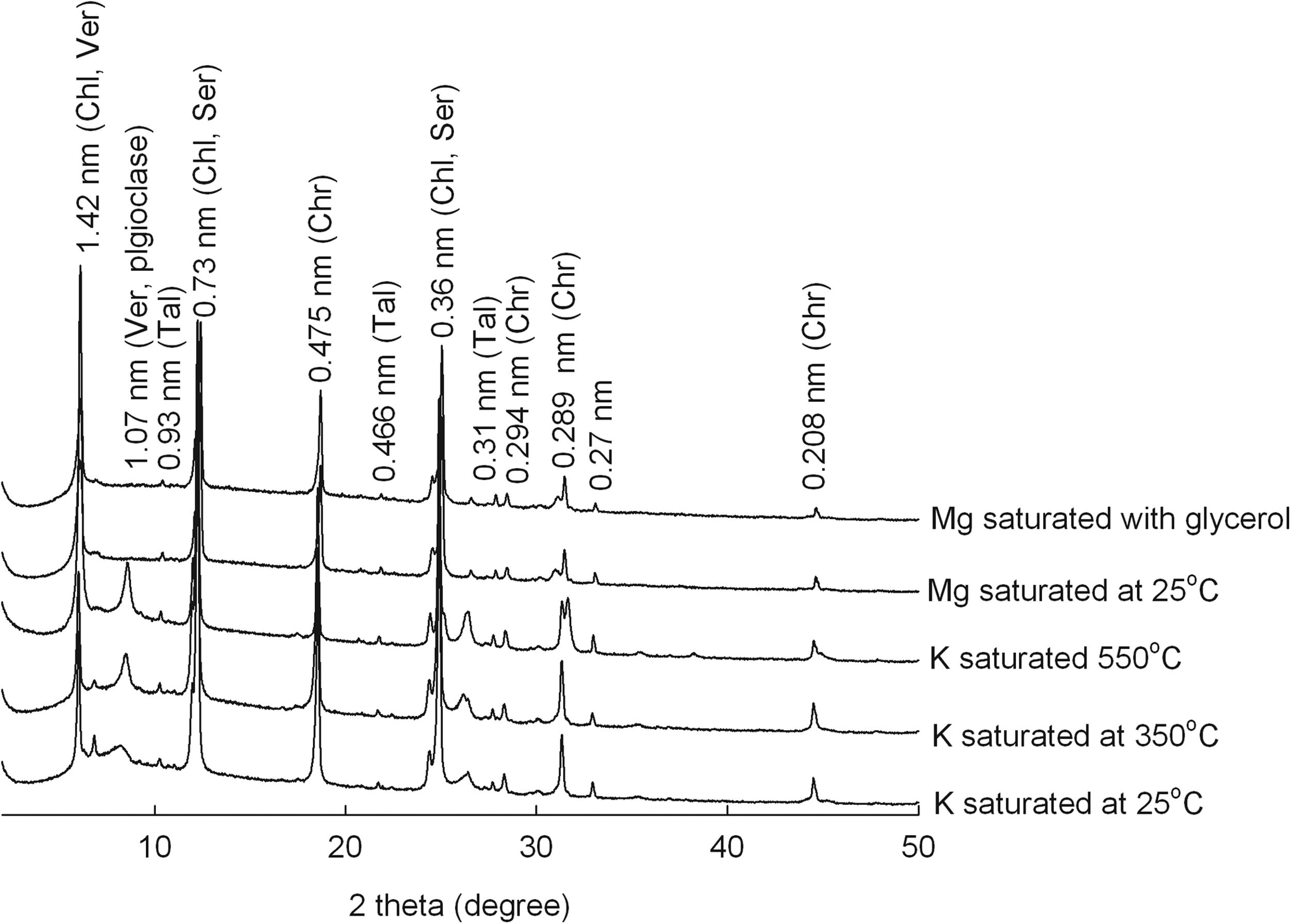
X-ray diffraction pattern of the TW-14 sample (Chl, chlorite; Ser, serpentine; Ver, vermiculite; Tal, talc; Chr, chromite).
The degree of tailing weathering is weak at this abandoned site; therefore, sand is the dominant particle fraction in all samples ranging from 50% to 90% (Table 1). The contents of silt and clay were lower than those of sand. However, the particle-size distribution varied substantially among samples, revealing the landscape disturbance caused by the previous mining activity. The pH of all samples ranged from 5.93 to 7.36. The OC content was lower than 1.0%, which may have resulted from the limited source of plant detritus. Total heavy metal contents ranged from 12.8 to 20.8 g/kg for Fe (Fet), from 0.61 to 0.86 g/kg for Mn (Mnt), and from 443 to 894 mg/kg for Cr (Crt). The heavy metal contents in this study were variable, but exceeded those in the soils from other parent materials. However, total metal contents in the study soils were within the normal ranges of ultramafic soils worldwide.
Total content of metal (Fet, Mnt, and Crt).
OC, organic carbon.
Various fractions of Cr associated with Fe and Mn
The DCB-extractable Cr (Crd) ranged from 16.7 to 126 mg/kg, whereas the amounts of Fed and Mnd were higher than Cr (Table 2). The DCB extraction released 1.9–24% of Crt in all samples, indicating a clear amount of Cr from the tailing weathering. Positive and significant (p<0.01) correlations between Crd and all fractions of Fe and Mn were found, except for Fet (Table 3). Chromite is probably inert to DCB extraction, but the Cr concentration increased with the Fe concentration with the DCB extraction in serpentine soils because both Fe and Cr were released during the serpentinites breakdown (Becquer et al., 2006). In addition, Fendorf (1995) and Becquer et al. (2003) have illustrated that Cr(III) can substitute for Fe and/or Mn oxides or sorb onto their surface in soils.
DCB-extractable Fe, Mn, and Cr (Fed, Mnd, and Crd).
Oxalate-extractable Fe, Mn, and Cr (Feo, Mno, and Cro).
Easily reducible Mn.
DCB, dithionite–citrate–bicarbonate.
p<0.05; bp<0.01.
The average concentration of Cro was much lower than that of Crd, because the oxalate is weaker than the DCB in reducing Fe oxides in soils. The concentrations of Feo and Mno were much higher than those of Cro in all the samples (Table 2). The Cro correlated positively and significantly with Feo (r=0.90, p<0.01) and Mnt (r=0.44, p<0.01), whereas no significant correlation was found between Cro and the other fractions of Fe and Mn. Only small proportions of either DCB- or oxalate-extractable Mn were extracted using hydroquinone (Mnred), which ranged from 18.3 to 208 mg/kg (Table 2), suggesting the presence of hydroquinone-resistant Mn oxides. The specific mineral phase of Mn in the studied tailings was not identified by XRD because of their low concentration in the samples, perhaps in conjunction with low crystallinity.
Exchangeable Cr(VI) was discerned in all samples ranging from 34.8 to 183 μg/kg (Table 2), which was higher than those of up to 42 μg/kg in the soils and alluvial sediments from serpentines in California (Mills et al., 2011). Chon et al. (2008) found that greater Cr oxidation was associated with Mn valence in the soils in Korea. Moreover, Fandeur et al. (2009) identified that the distribution of Cr(VI) was associated closely with Mn- and Fe-oxides with a significant preference for the later species using XANES on the thin sections of serpentine soils from New Caledonia. This distribution also indicated that the largest amounts of Cr(VI) were found in the Fe oxides located along the Mn oxides boundary. In this study, the Cr(VI) concentration increased with the concentrations of various forms of Fe and Mn, except for Fet (Table 3). Moreover, the Cr(VI) positively and significantly correlated with Crt, Crd, and Cro, suggesting that both lithiogenic Cr (Crt) and pedogenic Cr (Crd and/or Cro) are well poised for the oxidation of Cr(III) (Mills et al., 2011). The Cr(VI) positively and significantly correlated with various forms of Fe and Mn abovementioned, revealing that Cr(VI) could be released from the surface of the Mn oxides, where it has been oxidized, and subsequently re-adsorbed onto the surface of the surrounding Fe oxides. Cr(VI) is enhanced under basic conditions (Fendorf, 1995). Mills et al. (2011) found that the generation of Cr(VI) was kinetically limited in the alkaline pH range and the yield rates of Cr(VI) increased with added H+ in a laboratory incubation of serpentine soil. Therefore, this study determined that Cr(VI) was negatively and significantly correlated with pH (r=−0.47, p<0.01) for the serpentine tailings with the pH regimes. Furthermore, a positive and significant correlation (r=0.49, p<0.01) was found between Cr(VI) and clay, indicating that the weathering of tailings released Cr(III) and formed clay and lowered soil pH increased the rate of Cr(VI) generation on the abundant Mn oxide surfaces.
Elucidating the effects of Fe and Mn oxides on Cr(VI) generation
Chromite, the main Cr-bearing mineral examined in this study, was surrounded by serpentine, according to the BSE image of a selected thin section (Fig. 3a). The dark infillings of Fe/Mn oxides were clearly observed in the voids between matrices, indicating the accumulation of pedogenic Fe and Mn weathered from serpentinites. The pedogenic Fe and Mn oxides were low in crystallinity, as supported by the XRD data, indicating high reactivity with Cr in the soils (Chon et al., 2008). Regarding the serpentine tailing weathering for the study area, soluble Mg and Si have been almost completely leached and only nonsoluble elements, such as Fe, Mn, and Cr, remained in the soil. In such situations, these elements are subsequently precipitated as secondary Cr/Mn-bearing Fe-oxyhydroxides, which coexist with Cr-containing spinels (Fandeur et al., 2009). The EDX analysis identified a substantial amount of Cr in the chromite, which was partially substituted by Si and Al (Fig. 3b). Cheng et al. (2011) found that the imperfect edge of altered chromite toward the serpentine soil matrix had significantly lower Cr but significantly higher Si, suggesting that the central chromite grain is the relict part of a much larger chromite grain that underwent significant dissolution. Burkhard (1993) proposed that Si content in spinels is a relative index of chromite alteration. However, the DCB and oxalate extraction results in this study yield further insights into the incongruent dissolution between Cr and Fe/Mn, which were identified by Fandeur et al. (2009), who also suggested that the preferential release of Cr, as compared to Fe, resulted from the oxidative capacity of Mn oxides, leading to the oxidation of Cr(III) to Cr(VI).
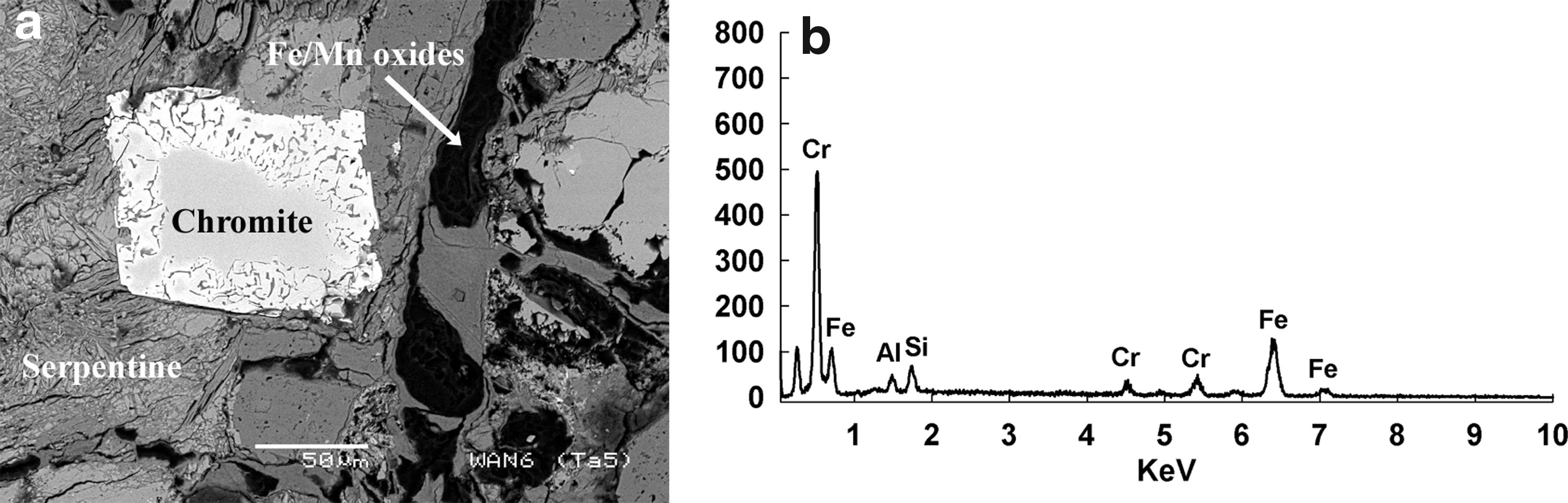
Scanning electron micropscopy back-scattered electron image on a thin section of serpentine tailing
The PCA results of the soil data, which produced four components that explained 86.7% of the total variance in the data, are reported in Table 4. Component 1 was composed of Cr(VI), Crd, Mnt, Mnd, Mno, Mnred, Fed, and Feo, and explained 43.3% of the variance. Component 2 explained 21.4% of the variance and was composed of Crt, Cro, and Feo. However, Components 3 and 4 explained 13.7% and 8.3% of the variance, respectively, without any factor of Cr species. According to the chemical extraction, as well as mineralogical and statistical studies, the processes of total Cr release and subsequent Cr(VI) generation in this study led to the hypothesis that the labile Cr resulted initially and mainly from chromite weathering. The Cr then substituted for Fe and/or Mn in oxyhydroxides or adsorbed onto their surfaces, as supported by the DCB and oxalate extractions for these elements (Tables 2 and 3). These results emphasize that the importance of pedogenic Fe and Mn oxides regarding Cr trapped in the examined tailings. Considering the oxidative reactivity of Fe and Mn, which modified the behavior of Cr speciation upon tailing weathering, Mn associated with the Mnd fraction likely acted as the potential oxidant to generate Cr(VI) evaluated using Mnred.
Values >0.60 are presented in bold.
PC, principal component.
Conclusions
In this study, total contents of Cr, Fe, and Mn were variable, but exceeded those in the soils from other parent materials. Chromite remained and was the major Cr source in the tailings. Correlations on extractions suggested that the amount of Cr from chromite weathering was clear and strongly associated with pedogenic Fe and Mn oxides. Moreover, exchangeable Cr(VI) correlated significantly positively with various forms of Fe and Mn. Despite the exceedingly small fraction (<0.01%) of total Cr that is present as Cr(VI), leaching of tailings at the mining site could be a significant source of Cr(VI) in the surrounding water bodies. The processes of total labile Cr production and subsequent Cr(VI) generation in this study led to the hypothesis that the released Cr resulted initially and mainly from initial chromite weathering; moreover, the Cr easily coexisted with pedogenic Fe and Mn oxides (Fed and Mnd), in which the Fe was a major source of reactive Cr and Mnred in the Mnd that acted as the oxidant to generate Cr(VI).
Footnotes
Acknowledgment
The authors would like to thank the National Science Council of the Republic of China, Taiwan, for financially supporting this research under Contract No. NSC 96-2313-B-020-010-MY3 and NSC 99-2313-B-020-010-MY3.
Author Disclosure Statement
No competing financial interests exist.