




Abstract
Abstract
Utilization of underlying local aquifers to treat, store, and recover locally produced reclaimed water provides the potential to reduce costs, energy, and infrastructure requirements of water supplies in urban areas. However, water quality issues, limited design and operational guidance, and physical footprint requirements are impeding the implementation of artificial recharge and recovery (ARR) systems in urban water infrastructure configurations. This article reviews the current practice of ARR and proposes approaches to improve the integration into urban settings regarding (1) feasibility of a reduced physical footprint of ARR systems, while maintaining water quality benefits and maximizing yield; and (2) manipulating subsurface hydrological, geochemical, and biological conditions to increase attenuation of key contaminants. The contribution of this interdisciplinary review article is to outline ways to achieve improved design and control strategies of ARR systems that ensure cost-effective water supply and consistent water quality by leveraging current understanding and technology.
Introduction
Several major aquifers in the United States and throughout the world are undergoing an inexorable process of depletion due to overextraction (Bartolino and Cunningham, 2003; Konikow and Kendy, 2005). The effects of depletion include rising pumping costs, deteriorating water quality, damaged ecosystems, and land subsidence. Today, an increasing degree of surface sealing in urban areas has decreased the rate of direct recharge, while contamination through anthropogenic activities, such as seepage from leaking sewers or septic tanks and seawater intrusion due to overextraction, has limited the use of unconfined shallow groundwater for drinking water supplies (Foster, 2001; Lerner, 2002).
A third challenge is due to potential effects of global climate change on water supply. Among the possible consequences of ongoing climatic changes in many regions, more precipitation is expected to occur in the form of rain rather than in the accumulation of snow packs (IPCC, 2001). This will reduce the reliability of water supplies unless surface storage is increased or subsurface storage is more widely utilized. At the same time, the warmer and wetter winters that are expected will result in higher volumes of peak runoff. If not effectively captured, this will reduce the availability of conventional water supplies.
Using natural treatment systems to augment local groundwater resources in urban settings via managed aquifer recharge (MAR) has been practiced for more than five decades in North America and over a century in Europe (Ray et al., 2008). Utilizing the subsurface to both increase storage capacity and to augment local water supplies with reclaimed water (treated municipal wastewater) is becoming increasingly attractive for water utilities because diversifying water portfolios can lead to a more reliable water supply in densely populated urban centers—particularly those found in arid, semiarid, or Mediterranean climates (Abiye et al., 2009). In addition, reuse of locally produced reclaimed water provides an additional sustainability benefit with the potential to reduce the amount of energy needed to move water over long distances and associated infrastructure (Dillon et al., 2009).
MAR systems include artificial storage and recovery (ASR) and artificial recharge and recovery (ARR) systems, such as soil-aquifer treatment and riverbank filtration (Maeng et al., 2011; Sharma and Amy, 2011) as illustrated in Figure 1. ASR is characterized by using dual-purpose wells that are used both for injection and recovery. This arrangement and operational regime is primarily designed to store water and usually limits water quality improvements that can be achieved in the subsurface (Maliva and Missimer, 2010). ARR systems, however, utilizing shallow aquifers can be designed to fulfill the twofold goal of enhancing water supply and quality. Physicochemical and biological attenuation processes in the subsurface, such as precipitation, sorption, and biotransformation, remove microbial and chemical contaminants during travel through porous media.
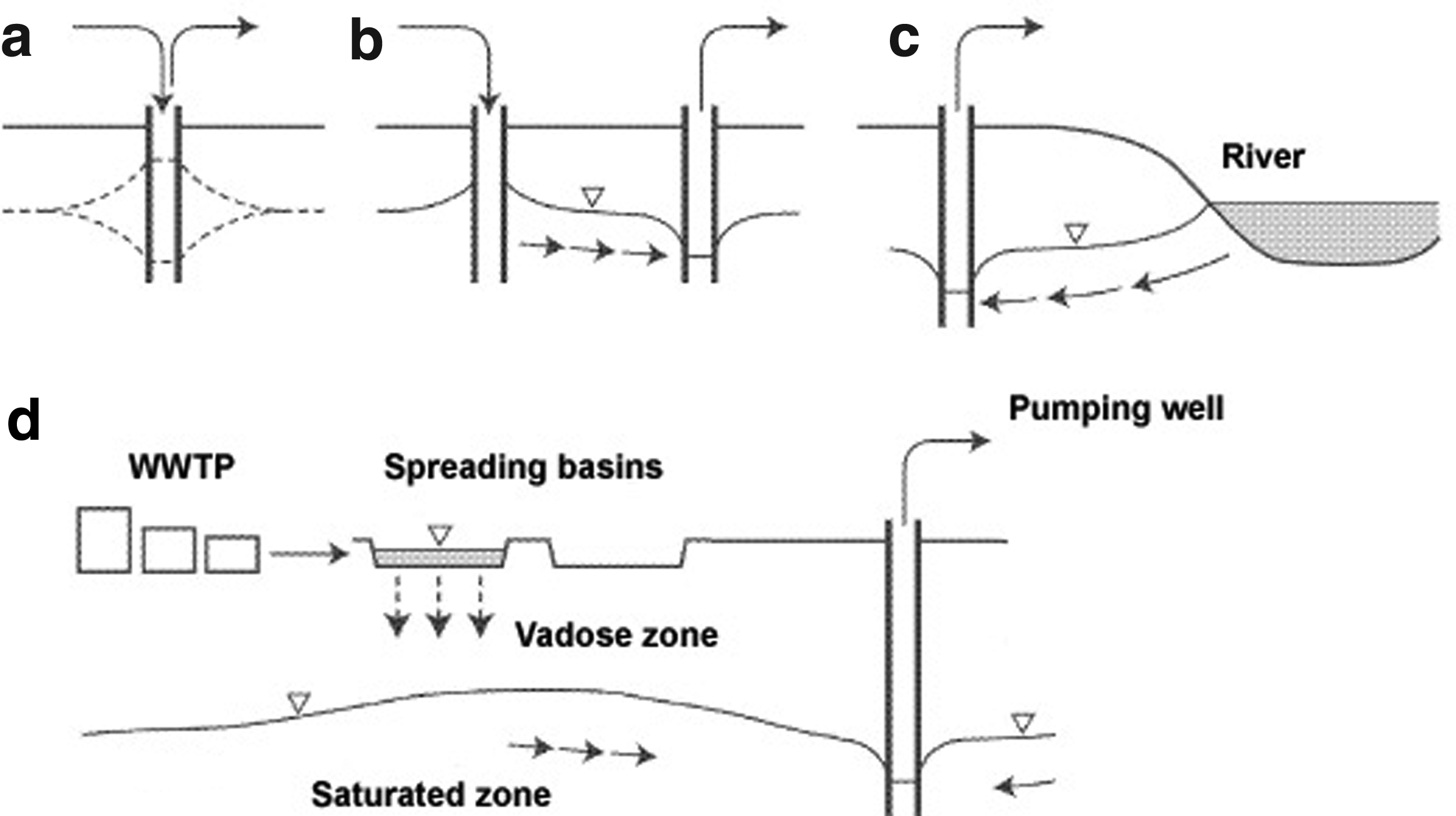
Schematic model of managed aquifer recharge illustrating the key elements of these systems, modified after Dillon (2005):
ARR design and operation varies according to different treatment and storage objectives. In some circumstances, ARR systems can be used as the sole treatment process or more generally serve as cost-effective pre- or post-treatment step within a multiple barrier treatment approach (Grünheid et al., 2005; Drewes and Khan, 2010; Maeng et al., 2011). Many of the ARR installations in the United States that use surface spreading basins are characterized by a relatively large footprint and are often operated as multipurpose basins that receive both impaired (i.e., reclaimed water and stormwater runoff) and more pristine imported surface water supplies as a function of resource availability (Drewes and Khan, 2010). Historically, the physical footprint of these ARR facilities has been driven by the need to provide a storage function for high flows, especially during storm events, to maximize the infiltration volume across a given surface area, and to provide easy access for mechanical maintenance to recover infiltration rates (Maliva and Missimer, 2010; Drewes and Khan, 2010).
While the operation of ARR systems is generally perceived to be a reliable and efficient process for safe water supply (Drewes and Khan, 2010; Maeng et al., 2011), the ARR performance in terms of water quantity and quality is highly dependent upon site-specific hydrogeological conditions, system design, source water quality, and treatment goals to be achieved (Maliva and Missimer, 2010; Maeng et al., 2011; Sharma et al., 2012). Water quality issues due to contaminants present in reclaimed water, background shallow groundwater, and urban stormwater runoff associated with adverse health effects have only recently received attention and can diminish the water quality of the recovered groundwater (Page et al., 2010; Ayuso-Gabella et al., 2011; Peterson et al., 2011; Debroux et al., 2012).
This article aims to critically review the current practice of ARR and its applicability for integration into urban settings regarding (1) the feasibility of a reduced physical footprint of ARR systems, while maintaining water quality benefits and maximizing the yield, and (2) manipulating subsurface hydrological, geochemical, and biological conditions to increase attenuation of key contaminants. This article discusses how these objectives could be achieved by a modified design and control strategies for ARR systems that ensure cost-effective water supply and consistent water quality by leveraging current understanding and technology.
Discussion
Impediments to the use of ARR systems in urban settings
In general, infiltration and artificial recharge result from spreading water on the soil surface via basins, furrows, and ditches, implementing infiltration trenches, shafts, or wells utilizing the vadose zone (Bouwer, 2002). The type of infiltration regime, geochemical and biological factors, storage, and recovery all affect the operation and performance of ARR systems. Common issues that affect the ARR performance include (1) clogging of the infiltration zone due to biomass growth or the accumulation of fines, where a loss in permeability reduces recharge and recovery rates; (2) poor control of flow that may include losses of recharged water via surface or subsurface migration as well as mixing of the recharged water with native groundwater of lower quality; and (3) water quality issues associated with biogeochemical processes in the vadose and saturated zones of the subsurface. How these issues can be addressed is discussed in the following sections.
Hydrological and physical limitations
Aquifer storage capability is mainly determined by the spatial extent and composition of the aquifer, as well as its degree of confinement and connectivity to streams and other aquifers (David and Pyne, 1995; National Research Council, 2008; Maliva and Missimer, 2010). Subsurface conditions in urban settings can be particularly challenging due to a higher degree of soil compaction leading to reduced permeability, channel structures due to existing or removed subsurface infrastructure (e.g., pipes, sewer or power lines), high anisotropy, and heterogeneity (Hibbs and Sharp, 2012). If different hydrogeological parameters like the hydraulic gradient, permeability, and mineralogy of the aquifer as well as ambient groundwater quality are not well understood (Bouwer, 2002; Sharma and Amy, 2011), an insufficient site characterization can lead to the poor performance of an ARR system, that is, low recharge rates, low storage capacity, and low yield (Maliva and Missimer, 2010).
Kloppmann et al. (2012) defines recovery efficiency (RE) of an ASR system as the percentage of water that can be recovered:
where Volrec is the cumulative volume of water recovered after some storage time and Volinj is the total volume of water injected. While this is a reasonable approach, quantifying RE for an ARR system is challenging since recovery must be qualified by quantity and quality characteristics that distinguish contributions from native groundwater and recharged water (Pyne, 1995; Reese, 2002; Sheng, 2005).
Recharging water by spreading water in ponds or basins for infiltration through the vadose zone has become a common practice in the United States because the installation and operation is cheaper than injection wells. In addition, unconfined aquifers, where surface infiltration is practiced, may have a larger storage capacity than confined aquifers (National Research Council, 2008). However, the surface infiltration system may create localized water mounding, which is a rise in the water table under the pond that is particularly pronounced if the transmissibility of the saturated zone is low. In addition, the infiltration system may also create perched water tables, which signify the appearance of saturated zones above the regional water table as water accumulates on top of low-conductivity layers or lenses (Bouwer et al., 1999). Stratification in the vadose zone may induce significant lateral flows that may be hard to predict or control. Mounding and perched aquifers may in some cases result in reduced infiltration rates as the gradient in the potential that drives water flow is reduced. The mounding effect can change the direction and magnitude of regional groundwater flow. In this case, stored water may flow back into a neighboring stream, discharge into brackish or saline waters in coastal regions, or actuate recharge of other connected aquifers with the consequence that some portion of the injected water is effectively lost for augmenting the water supply or cannot be recovered without installation of additional recovery wells. Analogous challenges are encountered in the design and operation of injection wells.
Reliable and cost-effective operation of surface infiltration requires monitoring of the hydrogeological structure, the recharge rates around the recharge locations as well as the hydraulic gradient over an ARR site. This can be accomplished through infiltration tests (Bouwer et al., 1999), geophysical methods (Haines et al., 2009; Maliva et al., 2009; Nenna et al., 2011), or thermal sensors (Anderson, 2005; Healy and Scanlon, 2010; Saar, 2011). In practice, groundwater mounds can be alleviated by reducing recharge rates, arranging infiltration ponds in long, narrow strips instead of compact round or square areas, dispersing ponds over large areas, and operating nearby groundwater pumping wells (National Research Council, 2008). Injection wells are used for recharging water directly into aquifers, where available land is scarce or infiltration through the vadose zone is not feasible due to the presence of low-permeability layers overlying a water-stored formation.
During water infiltration into an ARR system, physical, biological, chemical, and/or gas-introduced clogging of soils and compaction of the created clogging layer (Pérez-Paricio and Carrera, 1998) can dramatically reduce the hydraulic conductivity of in-fill pore spaces in the aquifer (Bouwer, 2002). Gas entrainment caused by chemical reactions or subsurface biological processes disrupts the continuity of water-filled pore spaces (Bouwer and Rice, 1989). During infiltration, particulate matter in water can be entrapped in the pore spaces (Konikow et al., 2001; Pavelic et al., 2007). In addition, the density difference between recharged water and native groundwater may generate a density-induced flow (Ward et al., 2007, 2008, 2009) in an aquifer with high hydraulic conductivity so that some portion of the recharged water may never be recovered. Chemical reactions related to the introduction of dissolved oxygen in an aquifer during infiltration or injection may result in the precipitation of insoluble products such as manganese oxides and iron hydroxides (Moorman et al., 2002). Anoxic to anaerobic conditions in the aquifer can mobilize manganese, iron, and other inorganic trace elements. Biomass growth, known as bioclogging or biofouling, can occur through introduction of elevated levels of substrates and nutrients, which can plug the pore spaces of the infiltration zone (Albrechtsen et al., 1998; Baveye et al., 1998).
To reduce the degree of clogging in the infiltration zone in practice, the near-subsurface area is agitated mechanically by scrapers, flushed by sand-washing devices, or maintained by applying wetting and drying cycles as a self-cleaning mechanism (National Research Council, 2008; Grützmacher and Reuleaux, 2011; Sharma and Amy, 2011). To maintain infiltration rates in injection wells, periodic backflushing and well rehabilitation methods such as shock disinfection by chlorination (Houben and Treskatis, 2007) need to be performed to avoid solids buildup and biofouling (Pyne, 1995). For injection wells not being in use, providing a steady slow flow of chlorine to maintain a chlorine residual is also critical. Reduction of the concentration of organic and colloidal material in pretreatment systems before recharge may prevent or minimize clogging from the outset.
Water quality issues of current ARR installations
Percolation and infiltration of reclaimed water through the vadose zone takes advantage of the natural attenuation capability of the subsurface. However, open recharge basins can experience excessive algae blooms when spreading nutrient-rich water, water losses due to evaporation, and occasionally an increase in mosquitos (Grützmacher and Reuleaux, 2011). After infiltration, the water quality in some ARR systems has been shown to be degraded by enhanced mixing (Eastwood and Stanfield, 2001; Lowry and Anderson, 2006), limited mass transfer (Culkin et al., 2008; Lu et al., 2011), and metal leaching/acid rock drainage (Mirecki, 2004; Arthur, 2005).
ARR systems are highly effective for the removal of turbidity, nutrients, organic matter, pathogens, and regulated and unregulated trace organic chemicals (Maeng et al., 2010; Bekele et al., 2011; Fox and Makam, 2011; Hogg et al., 2011; Zhang et al., 2011). Less efficient removal during ARR has been reported for specific pathogens and recalcitrant trace organic chemicals present in reclaimed water applied to recharge basins (Drewes et al., 2003; Cordy et al., 2004; Heberer et al., 2004). The detection of a variety of trace organic contaminants in municipal wastewater effluent (Richardson and Ternes, 2011) has raised concerns about the potential presence of wastewater-derived contaminants in water produced by ARR systems (Díaz-Cruz and Barceló, 2008; Drewes et al., 2008). The state of science for managing these chemicals of emerging concern and pathogens is addressed in the following section.
Understanding ARR as an engineered natural system
Factors influencing removal of pathogens and trace organic contaminants
Biotransformation of organic contaminants in ARR systems is dependent on multiple factors (Díaz-Cruz and Barceló, 2008). Previous studies have pointed to the redox environment of ARR systems as a primary driver for mobility, dissolution, degradation/transformation, and toxicity of organic as well as inorganic chemicals present in infiltrating water (McMahon and Chapelle, 2008; Farnsworth and Hering, 2011; Grützmacher and Reuleaux, 2011; Stuyfzand, 2011; Wiese et al., 2011). The impact of other physicochemical parameters like pH, ionic strength, and temperature on attenuation processes are estimated to play a significant though smaller role (Stuyfzand, 2011). Recent research has revealed that the removal of trace organic contaminants is also dependent upon the availability of biodegradable dissolved organic carbon (Rauch-Williams et al., 2010; Li et al., 2013), the concentration of trace organic chemicals in the applied water (Hoppe-Jones, 2012), and the degree of adaptation of the microbial community to the presence of trace organic contaminants (Rauch-Williams et al., 2010). As many subsurface reactions are time dependent, the residence time of groundwater is generally one of the most important controlling factors related to contaminant attenuation (Wiese et al., 2011). Rhine et al. (2003) reported that repeated or continuous exposure to trace organic contaminants can enhance biotransformation due to the selection of more adapted microorganisms. For hydrophobic trace organic contaminants, sorption onto organic matter and metal oxides can also play an important role in attenuation in subsurface systems as the retardation allows more time for biotransformation (Tolls, 2001; Higgins and Luthy, 2006). However, if sorption sites are limited, this does not provide a sustainable removal pathway.
Microbiologically driven transformation of contaminants in the subsurface occurs naturally and, therefore, is not site-specific or unique to certain ARR locations. Rather, microbial processes are determined by geochemical and hydrological subsurface conditions (Haack and Bekins, 2000). A recent study supports the presence of similar microbial communities across both laboratory and field scales in geographically distinct, but geochemically analogous settings (Li et al., 2012). Despite advances in understanding microbes and enzymes involved in biotransformation of trace organic chemicals at the single-strain, laboratory scale (Sharp et al., 2007, 2010), the composition, interaction, and function of microbial communities linked to effective attenuation is still an evolving field of research (Haack and Bekins, 2000; Lovley, 2003; Shade et al., 2009). In addition to molecular and microbial inquiries, automated sensing technologies can be helpful to direct the response of the microbial community to key boundary conditions (e.g., temperature, pH, dissolved oxygen, nutrient availability) in aquatic ecosystems (Shade et al., 2009).
Capturing the microbiological function through removal rate constants is important for the development of appropriate contaminant transport models that can assist in better design and operation of ARR facilities. While removal kinetics of trace organic chemicals can be determined using laboratory-scale one-dimensional (1D) soil column experiments, multiple mechanisms (e.g., hydrolysis, sorption, and biotransformation) occurring in these systems can contribute to contaminant attenuation, which limits the transferability of rate constants (Wiese et al., 2011). In addition, some laboratory-scale studies have employed influent trace organic chemical concentrations that are orders of magnitude higher than environmentally relevant concentrations (Patterson et al., 2011) resulting in degradation rate constants that are not always representative of ARR field conditions.
Based on previous biotransformation models, column studies, and field data, several authors have hypothesized that a threshold concentration for specific trace organic contaminants exists below which transformation of these compounds does not take place (Bouwer and McCarty, 1984; Grützmacher and Reuleaux, 2011; Wiese et al., 2011). However, recent results presented by Baumgarten et al. (2011) for sulfamethoxazole attenuation during ARR imply that proposed threshold values might be a matter of insufficient adaptation time of the microbial community in geomedia rather than the existence of a true threshold concentration.
Pathogen removal and deactivation by ARR occurs primarily by filtration/adsorption and die-off within the soil matrix (Gerba et al., 1991). Pathogen removal rates are specific to the physical and chemical properties of the microbes, subsurface media, solution chemistry, transport scale, type of source water (i.e., wastewater vs. surface water), and duration of contamination (years of operation) (Pang, 2009). Temperature appears to be a key parameter for inactivation in these systems (Gerba et al., 1991). Due to their small size (i.e., ability for longer distance subsurface travel), their low infectious dose (i.e., smaller numbers are of greater concern), and their potential for long-term persistence in groundwater, viruses are the pathogens of major concern during an ARR operation. Hepatitis A virus, adenoviruses, and parvoviruses appear to be the most thermally stable waterborne pathogens, although bacteria as well as protozoa may persist for long periods of time if environmental conditions are favorable (Gerba, 2007). In attending to model pathogen transport in soil-aquifer systems, the controlling factors are die-off, retardation, velocity, hydrodynamic dispersion, filtration, adsorption, and soil saturation. Furthermore, die-off of organisms is not always linear (i.e., rapid inactivation in the early beginning followed by a much slower inactivation rate), especially at low concentrations and this must be taken into consideration in any attempts to estimate inactivation rates (Gerba et al., 1991; Pang, 2009). Pang (2009) proposed a modified equation for the estimation of pathogen removal at ARR sites:
where N is the total log reduction of the pathogen between the source and extraction, H is the thickness of the vertical travel distance in meters, L is the horizontal travel distance in meters, and λ is the removal rate in log/m. The subscripts represent the removal in the subsurface, v and a represent the differences in removal between vertical (vadose zone) and horizontal transport.
Modeling approach for engineered ARR systems
In ARR systems, groundwater flow and storage is mostly affected by recharge and recovery regimes as well as existing regional flow conditions in the vadose and saturated zones. In general, depending on the degree of heterogeneity, the flow in a variably saturated aquifer is 3D. If a vertical path with no significant horizontal flow is assumed, it may be described by the 1D Richards equation (Richards, 1931) as follows:
where ψ is the pressure head [L], C(ψ)=∂θ/∂ψ is the specific moisture capacity [1/L], θ is the soil water content [-], θs is the saturated water content [-], S is the specific storativity [1/L], K is the hydraulic conductivity [L/T], z is the vertical coordinate [L], and q is the recharge/discharge term [L3/T].
Recharge or recovery components are suitably included in q as boundary conditions of the Richards equation for ARR systems (Kuehn and Mueller, 2000; Ray, 2002). To simulate horizontal flow, the above equation can be expanded into multiple dimensions. Eq. (3) is highly nonlinear due to the dependence of both the hydraulic conductivity and the pressure head on the water content that varies with time and is typically solved numerically with a suitable numerical scheme (Feddes et al., 1988; van Dam and Feddes, 2000). Temporal infiltration flux, total infiltrated water volume to the underlying aquifer, and the leakage of recharged water can be computed from the numerically derived pressure head distribution. The Richards equation is an approximate model for a complex process. The predictive capability of this model is limited by the presence of heterogeneity that may cause complex 3D flow patterns. Characterization of this heterogeneity remains a challenge.
Besides modeling reliable groundwater resource storage, the prediction of water quality is another important element of actively managing ARR systems. A solute transport model for ARR should be capable of simulating the movement, mixing, and reaction of dissolved chemicals (Kirkner and Reeves, 1988) in the aquifer when linked with the groundwater flow model. In its simplest form, the transport of a solute under isothermal and 1D isodensity flow includes the processes of advection, dispersion, and retardation. The following equation captures these processes:
where R is the retardation factor [-], C is the concentration [M/L3], q is the water flux field [L/T] obtained from the groundwater flow model Eq. (3), D is the dispersion coefficient (tensor in 2D or 3D space) [L2/T], θ is porosity [-], qs is the flux of the source/sink of concentration Cs [M/L3T], η is porosity [-], and r is a reaction or biotransformation term [M/L3T], which usually is assumed to follow first-order kinetics.
Multicomponent transport models that solve mixed equilibrium and kinetic geochemical reactions such as mineral precipitation/dissolution and ion exchanges (Hunter et al., 1998; Parkhurst and Appelo, 1999; Brun and Engesgaard, 2002; Prommer et al., 2003) can be expanded from Eq. (4). For rate-limited mass transfer, that is, the solute exchanges between mobile and immobile domains due to aquifer heterogeneity and preferential flow, a dual-domain ARR simulation needs to be employed (Culkin et al., 2008; Lu et al., 2011).
While mathematical equations of hydrogeochemical processes such as flow or equilibration of different element species are relatively simple, modeling the activity and metabolism of microorganisms under changing environmental conditions is more complex. At present, inclusion of microbially facilitated reactions relies on biotransformation rate constants. These kinetic constants are generally fixed values calculated from laboratory-scale studies as described above or estimated for the environment based on available biotransformation data (Lovley, 2003). In addition to biochemical limitations, diffusion controlled mass transfer can be a rate-limiting process. As a consequence, selected modeling efforts may not predict biogeochemical reaction rates correctly without field-specific calibration, or at least careful consideration of integrated biotransformation, transport, and mixing rates.
Clogging in recharge and recovery paths in an aquifer is another operational challenge to be incorporated into numerical modeling for better understanding and prediction of spatial and temporal evolution of an ARR system. Clogging can be modeled by porosity changes as a result of the attachment of particles (Herzig et al., 1970; McDowell-Boyer et al., 1986), precipitation of minerals, and biomass growth (Molz et al., 1986; Taylor et al., 1990; Clement et al., 1996; Thullner et al., 2004). Integration of these physical, chemical, and biological clogging processes into multiphase flow transport has also been developed and applied (Pérez-Paricio and Carrera, 1998; 2000). However, the resultant codes are complex and require a large amount of data and long simulation times; thus, their applicability has been limited (National Research Council, 2008). Instead, an empirical approach to approximate physical, chemical, and microbial clogging can be obtained by using laboratory and field measurements (Pavelic et al., 2007), which is more frequently used in practice. A combined water flow and contaminant transport model that can predict accurate water supply and quality changes within an ARR system has not yet been successfully developed. It is widely recognized that flow and reactive transport models are not able to predict physical, chemical, and biological processes accurately, although they can be useful for evaluating existing or new hypotheses on those interactions with laboratory- and field-scale experiments. Furthermore, while flow and transport through saturated and unsaturated laboratory-scale column setups using porous media have been well studied, experimentally validated models at the laboratory scale may not be applicable to problems at local or regional scales, where ARR is implemented in practice. Therefore, uncertainty in the numerical model should be considered (Kitanidis, 2007) with a need for recalibration and refinement as data become available during operation. To this end, the design of sampling networks, including monitoring wells or implementing real-time (Cheng et al., 2011), nonintrusive geophysical methods (Haines et al., 2009; Maliva et al., 2009; Nenna et al., 2011) can be helpful for improvement and optimization of process model outputs.
Geophysical techniques provide nonintrusive methods for groundwater exploration and monitoring on scales useful for ARR placement in urban settings, design, and maintenance decisions. Geophysical exploration for possible ARR site locations is possible at a regional scale using airborne electromagnetics. Airborne electromagnetics can detect lateral changes in apparent conductivity due to changes in sediments or identify the thickness of the unsaturated zone (Paterson and Reford, 1986) and clay layers (Gamey et al., 1996; Puranen et al., 1999).
Surface geophysical methods are useful on a smaller scale for assessing a location's viability for ARR. A ground penetrating radar can be used to map stratigraphy and geological features (Davis and Annan, 1989), delineate areas that hinder water flow, and map the water table and/or perched water tables (van Overmeeren, 1998). Electrical resistivity tomography and imaging can be used to identify clays (Fukue et al., 1999), identify macro- and microporosities and permeabilities (Griffiths, 1976; Robain et al., 1996), identify preferential flow pathways (al Hagrey et al., 1999), and characterize horizontal and vertical heterogeneities (Banton et al., 1997; Tabbagh et al., 2000).
Once a location has been identified as a possible ARR site, borehole geophysics can be used to perform a more localized analysis of the subsurface allowing for the detection of finer scale heterogeneities that is not otherwise achievable via other hydrologic or geophysical methods (Maliva et al., 2009). Neutron–gamma ray methods can detect iron sulfides (pyrite) and other minerals that may have a large impact on geochemical reactions in the subsurface (Maliva et al., 2009; Maliva and Missimer, 2010). These methods can also delineate between clay-rich soils and clean soils, which allows for the detection of thin clay layers, which could impede infiltration (Serra et al., 1980). Microresistivity imaging logs can measure porosity and detect fractures 360 degrees around the borehole at a scale as small as 50 μm (Maliva et al., 2009). Nuclear magnetic resonance logs map porosity and pore-size distribution and provide information about permeability. These logs can be used to identify the preferential flow and confining zones that are important to the storage of recharged water (Maliva et al., 2009; Maliva and Missimer, 2010).
Because they are not intrusive and are capable of being automated, geophysical methods can be effective tools for monitoring ARR processes. On a regional scale, interferometric aperture radar can be used to monitor hydraulic head changes and the effects of seasonal recharge and pumping (Bell et al., 2008; Reeves et al., 2011). This allows monitoring of the extent and effect of groundwater mounding. Locally, electrical resistivity imaging is an effective method for monitoring the vadose zone and can be related to saturation. Infiltration (Daily et al., 1992; Binley et al., 2001; Mitchell et al., 2011) or diurnal fluctuations in electrical conductivity due to temperature changes can be treated as a thermal tracer to estimate infiltration (Pidlisecky and Knight, 2011). The direct push probes developed and described in Pidlisecky and Knight (2011) and Mitchell et al. (2011) can monitor saturation remotely in real time, allowing for the automated estimation of infiltration and degree of pond clogging.
Intensive computational methods are required to optimize operation decisions in the management of large-scale, complex ARR systems in the presence of uncertainty, which provide dynamic updating of aquifer parameters through recalibration and corresponding decisions in response to incoming data. However, the use of coupled large-scale numerical models for aquifer parameter characterization/model calibration, adaptive ARR operation design, and uncertainty analysis on a fine temporal and spatial resolution scale requires significant computationally intensive efforts. For this reason, model reduction techniques (Antoulas, 2005) have been highlighted in subsurface modeling to develop an approximate numerical model that reduces the cost of simulations, while not losing the accuracy of results (Vermeulen et al., 2004; McPhee and Yeh, 2008). Along with this computationally time-saving modeling approach, recent advances in high-performance computing power and efficient data assimilation techniques enable us to handle large-scale flow transport models with real-time hydrogeological monitoring and high-resolution geophysical data and to compensate for errors in the flow transport model and ARR site characterization. Integrated ARR management modeling can provide a way to understand the subsurface system, predict the ARR system performance, and evaluate design options for management.
ARR design in urban settings
Designing more suitable ARR systems for optimal operation in urban settings requires a highly interdisciplinary approach that addresses challenges in scientific interpretation, engineering design, and modeling. With the goals of enhancing water quality during subsurface treatment, reducing the risk from contamination with polluted native groundwater, and increasing water yield, a modified design of ARR systems is proposed. Key components include a reduced physical footprint, establishment of sequential treatment zones, minimal mixing with native groundwater, and enhanced water recovery. As illustrated in Figure 2, this modified ARR design is characterized by the following steps.
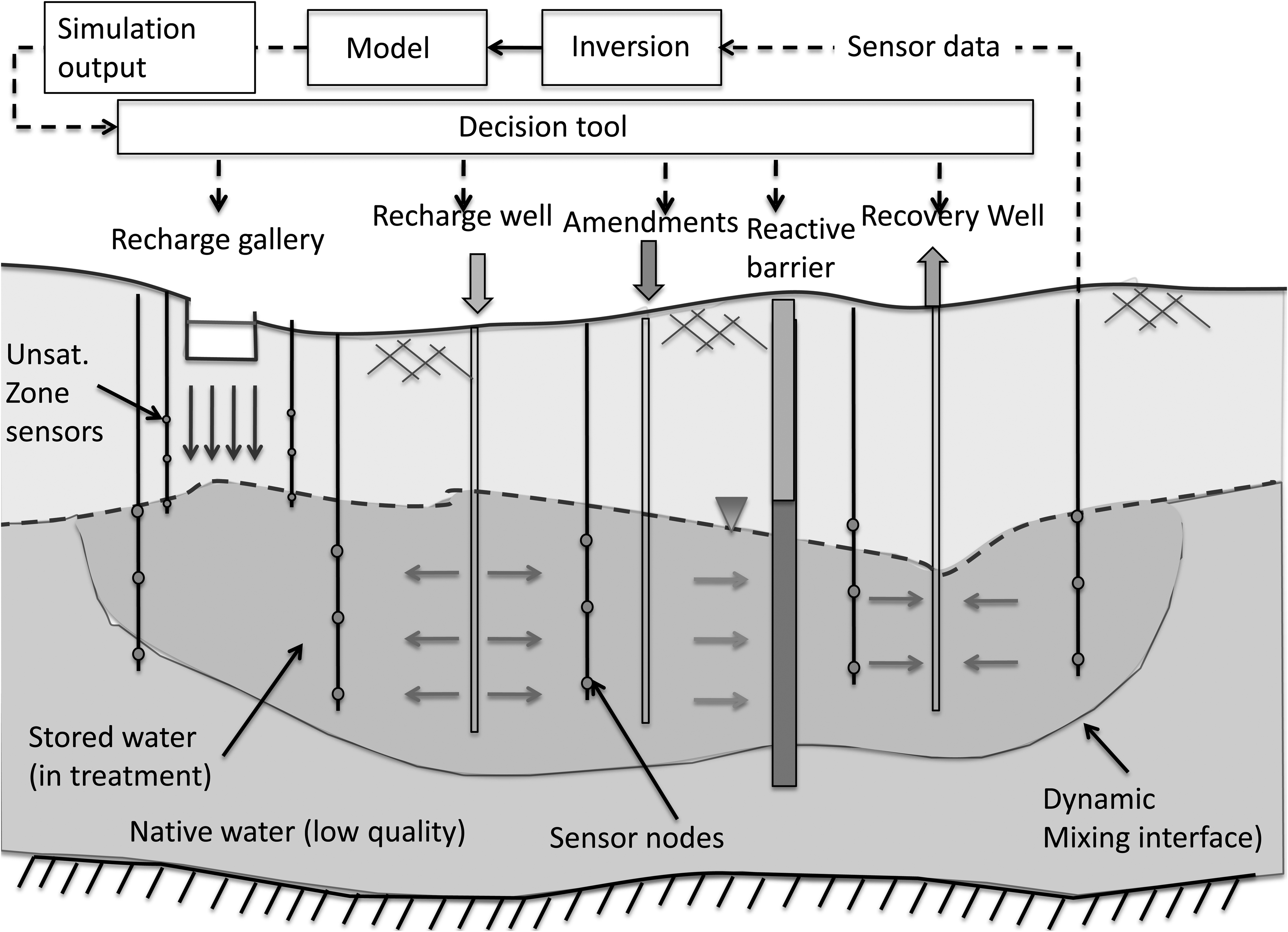
Conceptual model of a modified modular artificial recharge and recovery system suitable for urban settings.
1. Site characterization first involves the use of contemporary surface and borehole geophysical methods for identifying and assessing viable locations for ARR in urban locations. In addition to screening for undesirable geological features, these methods can provide a more precise characterization of field sites through the identification of heterogeneities and the assessment of infiltration capacity and storage space.
2. A thorough assessment of the clogging potential of the feed water quality can be conducted by characterizing surface and subsurface conditions of the proposed site. This assessment will help to predict, reduce, and prevent clogging processes that might occur. It can also be used to prescribe pretreatment strategies to mitigate clogging.
3. The core design concept of the modified ARR approach is the manipulation of subsurface conditions to stimulate desirable chemical and biological reactions, while reducing the physical footprint. Growth, activity, and metabolism of microorganisms with desired metabolic capabilities can be stimulated through the addition of certain electron acceptors (i.e., oxygen, iron), electron donors (organic matter, reduced mineral phases), and limiting nutrients that are present in limited quantities in impaired waters. The subsurface further provides metabolic necessities as well as the potential for the establishment of targeted reactive barrier zones (e.g., sorption of hydrophobic contaminants). As the redox state affects the mobilization of manganese, iron, and other inorganic trace elements, intentionally triggering these conditions in aquifer settings needs to be well understood. A possible modification of an engineered infiltration system is the establishment of sequential oxic and anoxic zones (possibly through the integration of a re-aeration and re-infiltration step using sequential ARR facilities) in the subsurface to achieve enhanced removal of compounds that are more effectively transformed under different redox conditions (Rauch-Williams et al., 2010). Grützmacher and Reuleaux (2011) suggest further design and operation-related possibilities, such as sunlight and temperature control in the spreading basin for enhanced photolytic degradation before infiltration.
4. Contemporary numerical models can capture the behavior of the subsurface flow and reactive solute transport to assess and optimize the performance of ARR systems. In addition, various aspects of subsurface processes that impede the RE such as clogging, mounding, and blending/mixing can be accounted for in these models. To be useful in practice, generalizations in modeling are required to limit the economic burden and specialized skill set required to populate and execute complex site-specific models.
5. Rate constants describing the attenuation of microbial and chemical contaminants as they relate to geochemical and water properties in addition to operational parameters can be used to inform contaminant transport models. However, additional research is needed to delineate and quantify key factors for attenuation processes of various contaminant groups in ARR systems. Drewes et al. (2011, 2013) proposed a suite of trace organic indicator compounds and surrogates as a more cost-effective approach to streamline the monitoring of trace organic compounds in impaired waters rather than measuring every possible chemical contaminant. An established rate constant database could then be used to implement a transferable design of ARR facilities that ensures uniform protection and performance across ARR sites.
6. Physical barriers (i.e., slurry walls) can be installed, where economically reasonable, to limit mixing of native and potentially contaminated groundwater with recharged reclaimed water. In compliment to near-surface physical barriers, an actively managed subsurface barrier in the form of a dense sensor network (e.g., temperature, electrical conductivity) and extraction wells can be established. Automated and intelligent monitoring of subsurface processes can be achieved using wireless sensor networks (Porta et al., 2009; Bandara et al., 2010; Barnhart et al., 2010). Guidance regarding how and where to place the sensors in this network can be informed from measurements obtained in laboratory-scale experiments. Distances between infiltration ponds, production wells, and geometry have to be carefully designed to fulfill the requirement of a small ARR footprint and production rates suitable for urban settings. To comply with regulatory requirements, appropriate control of reclaimed water quality used for infiltration, use of online monitoring devices, and/or operational controls to cope with process upsets and variability should be implemented (Dillon et al., 2010).
7. Integration of a simplified numerical model and its recalibration using collected data and real-time measurements (i.e., Lowry and Anderson, 2006; Pavelic et al., 2006) will enable dynamic, cost-effective ARR operation with pumping schedules and retention times that optimize subsurface groundwater storage, recovery, performance, and regulatory constraints. Additional hydrogeological or geochemical data collection designs may be considered during ARR operation if a data-worth analysis indicates potential benefits (James and Gorelick, 1994). The establishment of sampling networks, including monitoring wells and/or implementing real-time (Cheng et al., 2011), nonintrusive geophysical methods (Haines et al., 2009; Maliva et al., 2009; Nenna et al., 2011) can further improve and optimize process model outputs.
Conclusions
Water resource augmentation using ARR is a key component of a reinvented urban water infrastructure in a future of increasing population, water demand, urbanization, and climate change. The subsurface offers storage that is protected from evaporation and aboveground natural hazards with a benefit that it can also be used for water quality improvements. We predict two primary sources of impaired water suitable for recharge in urban settings: (1) reclaimed water, which has a benefit of increased generation with population growth as well as predictable supply; and (2) urban surface runoff of variable and generally impaired quality. While the aboveground footprint must be constrained, the subsurface offers increased proximal storage in urban centers. Primary challenges need to focus on identifying proper sites, enhancing water quality and satisfactory yield, and exchange rates.
An approach that integrates modern sensor and information technologies, hydrogeophysical methods of exploration and monitoring, and passive water treatment has the potential to revolutionize the way surface recharge facilities are operated in urban settings. New sensors are being rapidly developed with appealing characteristics: a smaller size, limited mechanical parts, robust and cost-effective materials, and enhanced conveyance. These sensors provide novel and ever expanding possibilities for real-time monitoring of pressure, moisture content, salinity, and even concentrations of indicator chemicals that can directly inform and support decision tools. Hydrogeophysical methods allow the selection of more suitable sites and to collect information during operation. Collectively, this information can lead to better decisions such as how and when to recharge, how to amend the quality of the recharge water, and when and where to recover water.
We envision an adaptation of these methods and techniques to optimize the performance of recharge facilities that require minimal aboveground space, lower energy and construction costs than conventional water treatment, and storage infrastructure that provides predictable water quality. If realized, these types of systems could become integral components of a future urban water infrastructure.
Footnotes
Author Disclosure Statement
No competing financial interests exist.