




Abstract
Abstract
Tremendous opportunities exist for enhancing water quality and improving aquatic habitat by actively managing urban water infrastructure to operate in conjunction with natural systems. The hyporheic zone (HZ) of streams, which is the area of active mixing between surface water and groundwater, is one such system that is overlooked by many water professionals, because the state of the science on this topic has not been transferred into practice. As a biogeochemically active zone, the HZ offers great potential to provide natural treatment of organic compounds, nutrients, and pathogens in urban streams, which are often strongly impacted by flow modifications and water pollution. Reliable treatment is most likely in streams in which the majority of flow occurs through the HZ, the flow is aerated, and sufficient residence times occur, which may be limited to specific channel morphologies and seasons. Integration of the HZ into stream management plans could also provide quality habitat in a landscape with increasingly depauperate biodiversity. Here, we review current knowledge on hydrological, chemical, and biological aspects of the HZ, with a focus on urban settings, and include a set of examples drawn from the literature of low-flow, effluent-dominated streams in which there is significant hyporheic flow and potential for contaminant attenuation. The HZ can be incorporated much more effectively into urban water management, including stream restoration efforts, by understanding the surface and subsurface features conducive to HZ flow and the water-quality and biodiversity improvements that can be gained in the HZ without posing unreasonable risk. The main barriers to implementation of HZ considerations include lack of information, absence of established metrics for evaluating success, small number of controlled HZ experiments in urban settings, and concern over risks to both public health and aquatic organisms. A combination of field studies, laboratory experiments, and model development that consider hydrological, chemical, and biological interactions in the HZ can overcome these barriers.
Introduction
To restore the ecology and aesthetics of urban streams, municipal wastewater effluent and urban runoff should be envisioned as resources, rather than wastes (Bischel et al., 2013). However, contaminants in these water sources have potential to affect drinking-water supplies and degrade aquatic life. For example, pharmaceuticals (e.g., acetaminophen), personal-care products (e.g., triclosan), and consumer products (e.g., perfluorinated surfactants) can reach aquifers through the hyporheic zone (HZ). In the HZ, surface water and groundwater is exchanged, chemical transformations of various types occur, and microorganisms and animals live (Boulton et al., 2010; Bianchin et al., 2011). The HZ is increasingly recognized for its potential to attenuate contaminants (Biksey and Gross, 2001). As a result of this function, it has been metaphorically called the river's liver (Fischer et al., 2005).
The HZ provides interrelated ecosystem services related to water quality and aquatic habitat. For example, transformations of redox-active chemicals occur in the HZ, which are partly facilitated by the suitable conditions that an intact HZ provides (Boano et al., 2010a). When relatively long residence times occur in HZs (e.g., hours to days), significant attenuation of contaminants and buffering of water temperature can occur, which can be considered a valuable ecosystem-service benefit associated with their management and preservation. Furthermore, microorganisms and animals use the HZ as both a primary and a refuge habitat at different life stages, create hydrologic flow paths that enhance permeability, and also have the potential to remove nutrients and trace organic chemicals (Clinton et al., 2010; Wood et al., 2010).
Most studies conducted on the HZ have taken place either in pristine headwaters or in agricultural areas rather than in urban areas, which exhibit site-specific dynamics that may not necessarily be generalized to all streams (Malcolm et al., 2010; Lewandowski et al., 2011). Urban streams are often located in lowlands (where cities are) and can have less turbulent, though higher-velocity (as a result of channelization for flood control) and higher-volume (as a result of flashiness from impervious surfaces) flows than mountain streams, and they often receive elevated sediment inputs and have reduced canopy coverage as a result of human development (Walsh et al., 2005). Furthermore, the turbulence level would also depend on whether the stream is located in a forest (and thus more likely to be composed of riffle-steps-pools) or in meadows (smooth meanders). The discharge of urban streams that are small or which exist in arid or semi-arid climates may be dominated by effluent from municipal wastewater treatment plants (WWTPs). In streams receiving municipal wastewater effluent, the HZ may contain relatively high concentrations of nutrients and trace organic contaminants, as well as high water temperatures relative to what is natural for the region (Tufenkji et al., 2002).
The objective of this article is to review the processes in the HZ that influence the fate of nutrients and trace organic contaminants, as well as the structure and function of ecological communities in the HZ, and to suggest practical HZ management strategies for enhancing both water quality and aquatic biodiversity. We identify (1) gaps in the current understanding of hyporheic processes in urban streams; (2) research needs for achieving contaminant attenuation and ecological improvement; and (3) barriers to the implementation of HZ management projects. The concepts examined are illustrated with a collection of examples, primarily drawn from low-flow, effluent-dominated streams in urban areas in the western United States and other developed countries in which there is high population growth and increasing water-demand pressures.
Discussion
Hydrology and the HZ
Many variables have been used to define the HZ, including those based on a fixed distance within or from the stream (e.g., a prescribed depth), ecology (e.g., shifts in floral and faunal distributions), morphology (e.g., changes in substrate type), chemistry, hydrology, residence time, and combinations of these variables (Williams, 1989; Boulton et al., 2010; Gooseff, 2010; Bianchin et al., 2011). The definition selected can dramatically affect the defined size of the HZ (White, 1993). For example, the depth of the HZ can range from several centimeters when bedrock is close to the surface to >10 m when streams flow over a sand or alluvial substrate (Chen, 2011; Stelzer et al., 2011). Moreover, the lateral extent of the HZ can range from just a few centimeters in bedrock-confined channels to multiple kilometers in large river systems with wide alluvial floodplains (Lapworth et al., 2009; Sawyer et al., 2009).
In this article, we define the HZ using the hydrological definition in which flowpaths originate and terminate at the stream, including the concept of residence time (Gooseff, 2010). For example, a 24-h HZ would refer to a region in which hyporheic water takes 24 h to pass from the stream through the subsurface zone of active mixing of surface water and ground water and then back to the stream. We use the term hyporheic exchange in the sense of Harvey et al. (1996) to refer to exchanges of water between channels and the subsurface at small scales (centimeter to meter). The size of the HZ under this hydrological definition can be measured in the field using tracers (such as NaCl, bromide, or temperature), and it fluctuates through space and time as the reservoirs of surface water and groundwater expand and contract. High-resolution distributed temperature sensing can be used to quantify spatiotemporal variability in vertical hyporheic flux (Briggs et al., 2012). The residence-time concept allows efficient linkage of the HZ to chemical transformation (Fig. 1).
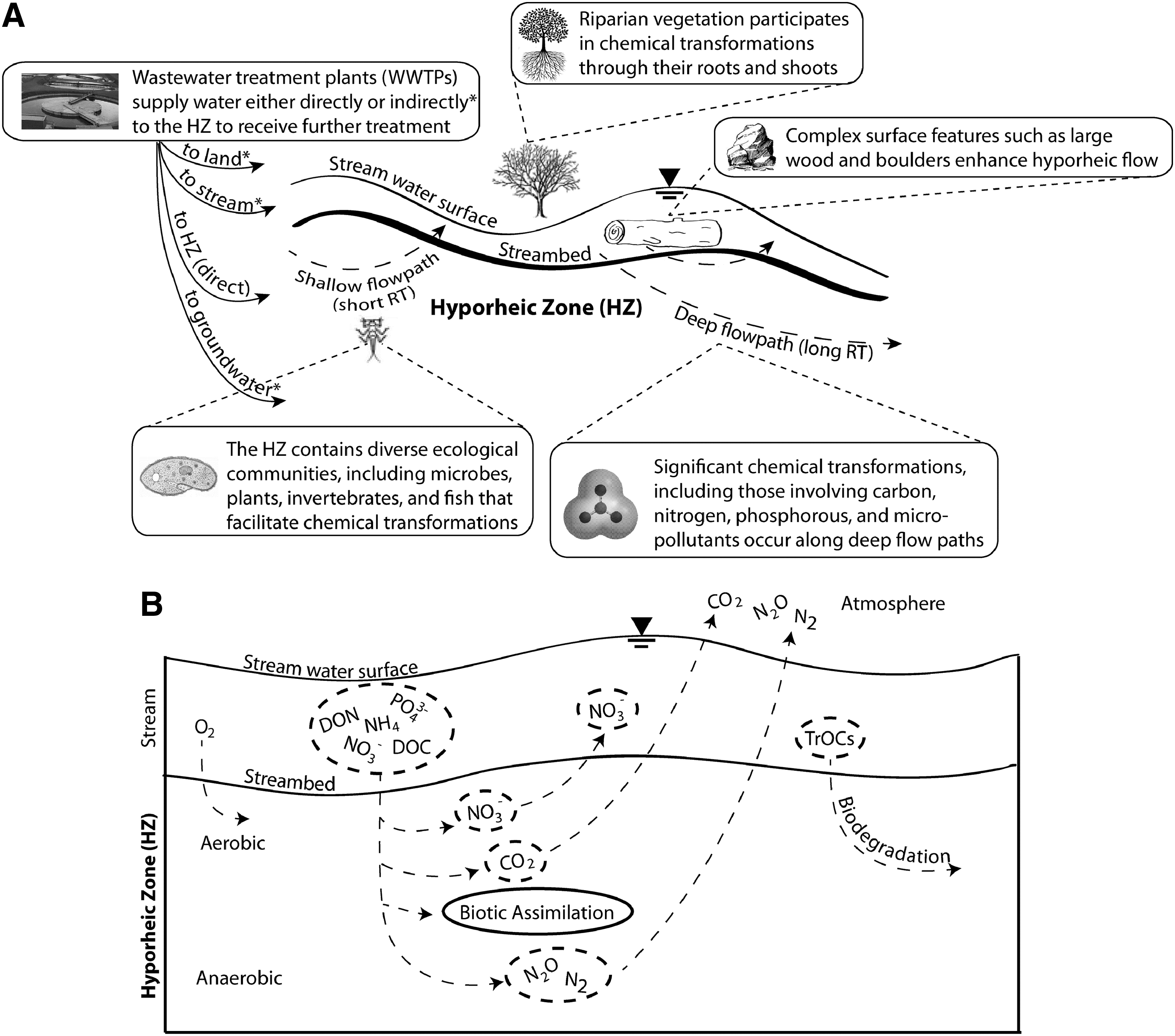
Simplified conceptual overview of:
A selection of case studies of low-flow, effluent-dominated urban streams in which there is documented pollutant attenuation and the HZ is likely a key factor was made to illustrate the range of settings, hydrology, pollution, attenuation, and implications for HZ management that are likely to be encountered in urban areas (Table 1), and additional examples are provided throughout the text to illustrate that other sites can exhibit similar characteristics. In Upper Silver Creek and Coyote Creek (Table 1), for example, residence times in the HZ were observed to range from 15 to 40 min along the ∼5 km reach examined. Under these conditions of short residence time, little degradation of dissolved trace organic contaminants was expected. In contrast, confirmation of significant natural attenuation of contaminants combined with low flows, and presumably long residence times, was observed in the Santa Cruz River (Table 1).
References cited in the table are indicated by superscripts: aLauver and Baker, 2000; bGrimm et al., 2004; cGrimm et al., 2005; dSmith, 2000; eTreese et al., 2009; fChen et al., 2009; gMendez and Belitz, 2002; hGross et al., 2004; iDing et al., 1999; jLin et al., 2006; kHoehn et al., 2007; lPlumlee et al., 2008; mMurphy et al., 2000; nVerplanck et al., 2005; oBarber et al., 2011; pBradley, 2008; qDennehy et al., 1998; rRosenberry et al., 2012; sRosenberry and Pitlick, 2009; tMcMahon et al., 1995; uBradley et al., 2009; vFernald et al., 2001; wKennedy/Jenks, 2011; xConant et al., 2004; yBeebe, 1997; zRoy and Bickerton, 2011; *Lewandowski et al., 2011; †PCB, 2001.
4-NP, 4-nonylphenol; APECs, alkylphenoxy ethoxylate carboxylic acids; DNAPL, dense nonaqueous phase liquid; HZ, hyporheic zone; MAF, mean annual flow; MDF, mean daily flow; NIWTP, Nogales International WWTP; NTA, nitriloacetic acid; PCE, perchloroethylene; PFC, perfluorochemical; SED, subsurface effluent discharge; TMDLs, to meet total maximum daily loads; WWTP, wastewater treatment plant; WWDC, wastewater derived contaminant.
Hydrology has been widely recognized to be the dominant driver of ecological structure and function in stream ecosystems (Resh et al., 1988; Power et al., 1995), and it certainly affects processes in the HZ (Boulton et al., 2010; Robertson and Wood, 2010). The connection of the HZ with the stream is best thought of conceptually in four dimensions, that is, the three spatial dimensions and time (Ward, 1989). As with stream management that is based on the natural flow regime principle (Richter et al., 1997; Poff et al., 1997; Tharme, 2003), the magnitude, frequency, duration, timing, and rate of change of flows through the HZ are all important components that should be considered along with water quality for a management program to be truly effective in meeting a stream's ecological needs (Hawkins et al., 2010; Poff et al., 2010).
The hyporheic flow regime can be altered by a variety of human activities, including those that change the streamflow regime or alter the streambed surface or subsurface (Boano et al., 2010b; Maier and Howard, 2011). For example, the streamflow regime in the Salt and Gila Rivers is altered by elevated storm runoff from impervious surfaces, upstream dam releases, and wastewater effluent discharge (Table 1). The associated reduction in retention time in many urban streams (because urban runoff is associated with high velocities and high volumes) can result in reduced infiltration into the HZ, giving rise to lower relative volumes and residence times (Grimm et al., 2005). Channelization, culverting, armoring of banks with riprap, and sediment inputs are some common activities in urban streams that would also alter the natural flow regime from surface water to the HZ (Brown et al., 2009; Stranko et al., 2012). Finally, the hydrology of a stream has a major impact on the processes in the associated HZ that affect water quality, including the establishment of appropriate redox conditions (Lewandowski et al., 2011).
Water quality and the HZ
The HZ forms a unique and dynamic ecosystem that is both influenced by and can significantly influence neighboring stream-water and groundwater quality. The cycling of elements, organic compounds, nitrogen (N), and phosphorous (P) in the HZ has been studied in depth (Findlay et al., 1993; Crenshaw et al., 2010; Lapworth et al., 2011). An understanding of the fate and transport of these solutes, which is related strongly to redox conditions, pH, and temperature, is critical to determine appropriate management practices for water-quality managers.
Hyporheic flow enhances mass transfer of dissolved organic compounds, nutrients, trace organic contaminants, and terminal electron acceptors [e.g., O2, manganese(IV), iron(III), and SO42−] to the subterranean habitats of both microorganisms and macroorganisms, thereby influencing transformation rates (Harvey and Fuller, 1998; Bernhardt and Likens, 2002; Gandy et al., 2007). HZ flow also results in contaminants contacting subsurface sediments and the integuments of aquatic biota, such as invertebrates and fish (Smith et al., 1998). Both transformation and sorption can be enhanced in the HZ under the right conditions (Triska et al., 1993; Paria, 2008).
Carbon
The HZ plays a paramount role in carbon cycling (Hendricks, 1993; Fellman et al., 2009). For example, riparian flora and fauna produce dissolved organic carbon (DOC), which supports biochemical processes that are vital to the health of streams (Fig. 1). DOC concentration in most unimpaired streams typically ranges up to 5 mg/L, while effluent from WWTPs typically contains between 5 and 30 mg/L (Imai et al., 2002). Thus, organic matter from municipal effluent may act as an additional source of DOC (Andersen et al., 2004).
Biofilms, that is, compilations of autotrophic and heterotrophic microorganisms which coat the surfaces of both water and substrate, in the HZ need DOC for their metabolism, causing the HZ to act as a DOC sink because of carbon uptake and sequestration that occurs through resident bacteria and invertebrates (Bärlocher and Murdoch, 1989). For example, Findlay et al. (1993) found that the metabolic activity of hyporheic organisms removed ∼50% of the DOC in interstitial water in the HZ underneath a gravel bar of Wappinger Creek, an impacted urban stream in New York. Efficient water exchange between the stream and the HZ accelerates the metabolism and increases consumption of DOC in the hyporheic water. More information on biofilms is provided in the ecology section.
Several studies have shown that hyporheic ecosystems are heterotrophic (i.e., microbes use DOC as a C source in addition to fixing CO2 to sustain growth). Thus, the HZ serves as a link between the river, which primarily consumes DOC, and the surrounding ecosystem that provides the C. A comparison between two small, pristine streams in Tennessee and North Carolina showed that relative to gross primary production (GPP), respiration was about 2.4 times greater in the stream with the larger HZ; the value of GPP in the stream with the larger HZ was 0.21 g O2/m2 per day compared with 0.32 in the other stream (Mulholland et al., 1997). The authors concluded that metabolism was enhanced in the HZ compared with the stream. Heterotrophic conditions have also been observed in 4th- and 5th-Strahler stream order rivers in Michigan (Uzarski et al., 2004), wherein an increase in nutrient and O2 supply associated with hyporheic flow was assumed responsible for respiration.
In contrast, a much lower hyporheic respiration rate relative to GPP was observed in the River Lahn in Germany, in which municipal wastewater effluent comprised 30% of base flow (Ingendahl et al., 2009). At this site, the observed contribution of the HZ to riverine ecosystem respiration rates was only 14%, compared with HZ respiration rates from 40% to 96% observed in other studies (Naegeli and Uehlinger, 1997; Fellows et al., 2001; Battin et al., 2003). The respiration rates in the upper 20 cm of sediment were approximately one order of magnitude greater than in sediments between 20 and 40 cm depths. The authors suggested that the eutrophic state of the River Lahn enhanced algal primary production in the stream and decreased respiration in the HZ. Wagner and Beisser (2005) investigated the effect of addition of nutrients in a 2nd-Strahler stream order gravel stream, the Oberer Seebach in Austria, on biofilms and hyporheic biota. Both the quantity and quality (i.e., the ability to support diverse communities) of the biofilm increased during the 8 month experiment, and the response of animals varied and was attributed to the quality of the biofilm; the living space for certain animals increased, and some exhibited increased reproductive success, while the mobility of others decreased.
Consequently, the composition and concentration of organic C can influence the biological activity in the HZ. However, different sites can exhibit contrasting relationships. For example, biofilm growth in hyporheic sediments in Stony Creek in New Brunswick, Canada, was not related to DOC concentration (Bärlocher and Murdoch, 1989). In contrast, Findlay et al. (2003) observed a positive correlation between the bacterial activity in biofilms and DOC concentration in Wappinger Creek in New York. These conflicting findings are likely related to whether C is a limiting nutrient in the ecosystem.
The nature of organic carbon can also affect the ability of the microbial community to transform trace organic contaminants, which are described in a later section. For example, microorganisms metabolizing on cattail and duckweed extracts exhibited a better ability to remove certain recalcitrant pharmaceuticals in microcosms compared with microorganisms metabolizing wastewater effluent (Lim et al., 2008). The highest increase in degradation rate was observed for gemfibrozil (a drug used to reduce lipid levels in blood), which was not degraded in DOC from wastewater effluent. However, it was almost completely transformed after 6 days in plant extracts, which is a residence time that could occur along deep flow paths in the HZ (e.g., residence times >10 h were observed in a bedrock constrained reach of Lookout Creek in Oregon (Kasahara and Wondzell, 2003). Differences between the wastewater-derived DOC and the plant-derived DOC for the existing communities were assumed responsible for the different attenuation rates. Consideration of plants in addition to microbes may, thus, be important for optimizing contaminant attenuation in the HZ.
Hydrologic modification can influence the concentration and composition of DOC in streamwater and hyporheic water. For example, Westerhoff and Anning (2000) found that streams with a natural flow regime had higher DOC concentrations compared with streams with regulated flow regimes characterized by damped temporal variability relative to natural high and low flows. They also found that DOC in streams dominated by wastewater effluent was composed of C molecules with lower molecular weight and less complex structure, which provides poorer substrate for biofilms, and consequently reduced food quality for the invertebrates and other organisms that feed on these biofilms. Although the organic C in the HZ was not investigated, the hyporheic water may be influenced by the stream water, especially along downwelling reaches with minimal groundwater exchange. Consequently, the diversity of the microorganisms and macroorganisms in the HZ of urban streams may be limited.
Nutrients
Excess nutrients are a major concern for stream-water quality and ecosystem health, and can result in eutrophication and anoxic conditions in the HZ. Nutrient balance can be disturbed by discharges from WWTPs, return flow from agricultural fields, and storm runoff (Withers and Jarvie, 2008; Carey and Migliaccio, 2009). Both biotic and abiotic processes in the HZ attenuate N and P and may provide an especially important ecosystem service during dry-season flows when urban streams are subject to the highest concentrations of these nutrients (Withers and Jarvie, 2008).
Denitrification occurs primarily by activities of the anaerobic microbial community residing within the lower HZ layers (Fig. 1). It is controlled by relative rates in advection and diffusion of N and O2 from the overlying stream water into the bed, with greater denitrification rates occurring under conditions of low oxygen flux (Claessens et al., 2010a, 2010b). Increased NO3− levels in streams can increase denitrification rates in sediments if residence times are long enough and the sediment zones are sufficiently voluminous, making the HZ a significant nitrate sink (Cirmo and McDonnell, 1997). The HZ may develop anoxic conditions that promote denitrification in shallow, deoxygenated sediments of effluent-dominated urban streams that are supplied by municipal wastewater effluent and urban runoff (Schipper et al., 1993; Mayer et al., 2010; Lewandowski et al., 2011). In addition, groundwater passing through the HZ may provide significant NO3− inputs to some surface waters, especially during base flow. Denitrification rates in the HZ depend highly on the amount of labile organic C available to serve as a microbial energy source, and, thus, N cycling is linked to C cycling (Holmes et al., 1996; Bernhardt and Likens, 2002; Strauss et al., 2002; Groffman et al., 2005; Birgand et al., 2007).
The efficiency of NO3− removal rates is highly variable and depends on both the relative amount and the residence time of stream water flowing into the HZ, and other variables, including seasonality, water temperature, pH, and riparian vegetation (Cirmo and McDonell, 1997; Groffman et al., 2005; Geza et al., 2010a; Zarnetske et al., 2011). The lowest NO3− concentrations typically occur in the summer months when plant growth is greatest and there is relatively lower flow as well as reduced nutrient loading (Birgand et al., 2007). Growing plants with their roots in the HZ take up N into their tissues and thus act as a nutrient sink, but they can subsequently release the N back into the water column on their death or senescence (Dosskey et al., 2010). In addition to such botanic processes, heterotrophic immobilization or assimilation of N can decrease nitrification rates, while at the same time consuming O2 and promoting denitrification (Mulholland et al., 2000; Baker et al., 2001; Groffman et al., 2005).
N transport in the HZ is closely linked to hydrologic flow paths (Cirmo and McDonnell, 1997; Pinay et al., 2009). Thus, information on hydraulic conductivity, grain-size distribution, streambed geometry, and stream velocity is needed to analyze hyporheic N exchange (Salehin et al., 2004). Although low O2 and increased NO3− levels promote denitrification in the HZ (Hill et al., 1998; Kasahara and Hill, 2006), the extent to which denitrification occurs is determined principally by hydrology. High hydraulic conductivity not only promotes large exchange volumes, but also limits residence time in the HZ, which is necessary for N removal (Grimaldi and Chaplot, 1999). Surface-water storage capacity can also be a main determining factor of residence time in N attenuation zones within the HZ (Hill et al., 1998), and denitrification rates are also influenced by surface features, such as riffle steps, gravel bars, and meanders (Kasahara and Hill, 2006).
P activity is affected by a variety of conditions. For example, under reducing conditions commonly encountered in O2-depleted zones deep in the HZ of pristine streams, or at shallower depths in effluent-dominated urban streams, iron and manganese oxides dissolve and the metal ions migrate upward until conditions become oxic where they precipitate as hydroxides and oxides (Jarvie et al., 2008). These freshly precipitated minerals, sometimes called the “oxic cap,” have large surface areas and can sequester P from the hyporheic water within the HZ (Lijklema, 1980), thereby acting as a barrier for P release into the water column (Jarvie et al., 2008). A combination of these mechanisms may be responsible for the P attenuation observed downstream of a WWTP along the River Vène in France where 25% of the P in the effluent was sequestered in the HZ (David et al., 2011). Conversely, release of P stored in hyporheic sediments of effluent-dominated urban streams has also been observed (Haggard et al., 2005).
A decrease in the thickness and the effectiveness of the oxic cap in attenuating PO43− concentrations can result in degradation of organic matter in effluent, can consume O2 in hyporheic sediments, and can cause metal oxides to reductively dissolve at shallower depths (Jarvie et al., 2008). For example, growth of sewage fungus caused reducing conditions and P release in shallow sediments in a small stream in eastern England called the Lone Pine Pasture Stream (Palmer-Felgate et al., 2010); more than 30 mg/L P was observed in the HZ of this stream.
Biological uptake by bacteria and plants in the HZ has been shown to remove or transform bioavailable PO43− to less available mineral forms. For example, the proportion of dissolved to total P in both surface water and groundwater was ≥90% in a chalk stream, the River Lambourn, in England, while in the HZ of this stream this proportion was <70% as a result of creation of particulate and colloidal forms of P (Lapworth et al., 2011). Similarly, greater PO43− uptake was observed in a pristine 2nd-Strahler stream order with a large HZ in North Carolina compared with a similar type stream with a smaller HZ in Tennessee (Mulholland et al., 1997). The uptake was, at least partially, related to biological activity within the HZ.
Trace organic contaminants
A wide range of these chemicals, which are synonymously referred to as emerging contaminants, microcontaminants, trace pollutants, and micropollutants, are derived from domestic and industrial wastewater and enter the urban water cycle via both WWTPs and storm water (Göbel et al., 2007; Ternes et al., 2008). They are typically defined to include minerals and chemicals that are present in the environment in trace amounts, which have a potentially deleterious effect on public health or aquatic ecosystems, and they are not typically regulated with regard to water-quality criteria (Sedlak et al., 2000). Their concentrations range from ng to μg/L (Plumlee and Reinhard, 2007; Monteiro and Boxall, 2010). Common examples include pharmaceutical compounds and household-cleaning products. These substances can lead to toxicity in some aquatic biota despite being present at very low concentrations, which presents a real but poorly understood challenge to water management (Conn et al., 2010; Brar, 2011).
A few reports of unregulated trace organic contaminants in the HZ are available (Hoehn et al., 2007), but a limited number of studies report the attenuation of certain regulated, organic wastewater-derived pollutants in the HZ, which may behave in a similar manner, including fuel oxygenates (Landmeyer et al., 2010), tetrachloroethene or perchloroethylene (Conant et al., 2004), and volatile organic compounds (Durand et al., 2007). In general, the few published studies have found that the HZ has a high capacity for degradation of organic contaminants, but that the volume of stream water entering the HZ is small relative to stream flow (Hoehn et al., 2007; Lewandowski et al., 2011). Thus, long travel distances would be needed to achieve sufficient residence time to provide water-quality enhancements.
Wastewater effluent is not the only source of trace organic contaminants to streams and their HZs (Rayne and Forest, 2009). For example, storm runoff from impermeable surfaces is a recognized contributor of such contaminants to urban streams (Oram et al., 2008; Zushi et al., 2008; Cousins et al., 2011; Grebel et al., 2013). Agricultural activities can release pesticides, such as pyrethroids and organophosphates, to streams, and these can flow into urban areas and have negative impacts on biodiversity (Liess and von der Ohe, 2005; Martin, 2009). Nonetheless, wastewater effluent is the primary source of most trace organic contaminants in urban streams. Clearly, more research in the area of organic contaminant interactions with the HZ, particularly in urban or agricultural streams, is warranted.
Managers of water utilities are concerned about potential risks, including the possibility of contaminated streamwater infiltrating through the HZ to underlying aquifers and negatively impacting drinking-water sources. For example, the commonly used wastewater-indicator compounds ethylenediaminetetraacetic acid (EDTA) and naphthalene dicarboxylic acid (NDC) were found in drinking water production wells located at 1.8 km and 2.7 km downgradient from the Santa Ana River in California and also in a monitoring well adjacent to the river (Ding et al., 1999) (Table 1); EDTA concentrations measured in this study ranged from 0.1 to 6.3 μg/L, and NDC concentrations ranged from undetectable to 1.5 μg/L. In contrast, other commonly used indicators such as nitriloacetic acid and alkylphenoxy ethoxylate carboxylic acids were attenuated more rapidly in a soil-aquifer-treatment system and were, thus, not encountered in the production wells in this study. Concerns about aquifer contamination through the HZ arising after the detection of perfluorochemicals prevented a planned water reuse project in Coyote Creek, California (Table 1). However, some aquifers underlying urban areas are already contaminated from legacy impacts, and downwelling of highly treated recycled water may actually improve water-quality conditions (Bischel et al., 2013).
Laboratory experiments have shown that biodegradation of trace organic contaminants occurs in hyporheic systems, and biodegradation may have been due to faster exchange, larger HZ area, longer residence time (e.g., due to deeper HZ caused by greater pressure head), or some combination of parameters. Under aerobic conditions in a batch experiment composed of water and sediment collected from the Roter Main, a river in Germany, biodegradation and sorption attenuated pharmaceuticals with half-lives ranging from 3 to 328 days, suggesting that biodegradation in HZ sediments is an important pharmaceutical-attenuation mechanism (Löffler et al., 2005). In another study, laboratory flume experiments simulating flow in this river found significant degradation of bezafibrate, gemfibrozil, and ibuprofen when the exchange of surface water and pore water in the upper 20 cm of sediments was experimentally enhanced (Kunkel and Radke, 2008). Increases in the flow velocity in the flume created more oxidizing conditions and enhanced advective transport of contaminants into the sediments, which accelerated degradation. Half-lives ranged from 1.2 to 6.9 days, and rate limited transfer was observed at low streamflow.
Apparently conflicting results obtained from laboratory studies and field studies may be related to the difference in geochemical conditions in the HZ. For example, in a follow-up field study of pharmaceuticals in the Roter Main, only limited attenuation was observed over a reach representing a travel time of 6–30 h under anoxic conditions (Radke et al., 2010), which is a marked difference from the outcomes of the laboratory studies that were conducted. In situ measurements in the field component of this study showed that photolysis was of limited importance, and naproxen was the only pharmaceutical observed to photodegrade with a half-life of ∼4 days.
Reactive tracers were used to assess attenuation of pharmaceuticals in the Säva Brook in central Sweden. Six compounds were studied, and only ibuprofen and clofibric acid were attenuated with half-lives of <0.5 day and 2.5 days, respectively (Kunkel and Radke, 2011). Due to the limited HZ exchange through the fine-grained sediments in the stream, the authors hypothesized that the observed degradation resulted from biofilms growing on submerged macrophytes and sediment in the uppermost (∼7 cm) HZ layer. In the River Erpe, which consists of ∼80% effluent, some attenuation of pharmaceuticals was observed in the top 100 cm of the HZ (Table 1), but the details of this attenuation were difficult to elucidate because of varying surface water composition.
The variability in attenuation rates of trace organic contaminants observed among stream studies indicates large differences between streams in surface, hyporheic, and groundwater conditions, illustrating the importance of site-specificity, and perhaps explaining some of the variability in the concentrations of trace organic contaminants observed among various aquatic reservoirs. The presence of O2 as an electron acceptor appears to be very important for the biodegradation of many trace organic contaminants, which often degrade aerobically (Meakins et al., 1994). Thus, degradation may not be optimal in some effluent-dominated urban streams that have a relatively large O2 demand. The different results observed also highlight the lack of mechanistic understanding of attenuation in both surface water and HZs. Aerobic and anaerobic degradation rates, and the rate of solute transport in the HZ, are poorly characterized.
Redox conditions
Oxygen depletion leading to localized anoxia in the HZ occurs for multiple reasons, both abiotic and biotic. These can include reductions in O2 concentrations in the supplying stream water, reductions in infiltration through the streambed because of reduced permeability (i.e., through siltation or channelization), switch from a downwelling to an upwelling condition as a result of changes in the groundwater head, increases in ambient temperatures that reduce O2 dissolution, high levels of nutrients or biological O2 demand leading to enhanced biological production and subsequent O2 depletion, and changes in the rates or pathways of microbe-mediated chemical transformations because of alterations in environmental conditions (Heffernan et al., 2008; Nogaro et al., 2010). Of particular concern in urban streams are impermeable concrete flood-control channels that completely disconnect streams from their HZ, thereby entirely eliminating the O2-supplying function of stream water (Bernhardt and Palmer, 2007).
The redox conditions in the HZ represent a dynamic balance between the influx of O2 as well as other electron acceptors, and DOC, which consumes O2 as it undergoes biodegradation. For example, turbulent flow aerates stream water, resulting in O2 concentration near saturation, 8–10 mg/L, depending on water temperature. Stream water DOC concentrations typically range from 1 to 20 mg/L (Worrall et al., 2004). In contrast, groundwater usually contains dissolved O2 concentrations around 1 mg/L, and DOC <1 mg/L (Malard and Hervant, 1999; Chapelle et al., 2012). The rate of organic C degradation depends on the chemical structure of the DOC, and highly aromatic organic matter is more persistent (Thurman, 1985). Stream water is said to have a net positive O2 demand if the O2 demand from DOC exceeds the dissolved O2 level. Continuous aeration of stream water from turbulent mixing can keep O2 levels high, and turbulent mixing is enhanced by higher streamflows. Therefore, the relative mixing of the surface water and groundwater in the HZ largely determines the redox conditions, because a greater surface water contribution typically results in more aerobic conditions.
The upper strata of hyporheic sediments is typically aerobic because of infiltration of aerated surface water, while biological degradation consumes O2 and creates reducing conditions in the deeper sediments. Oxidation of DOC is thermodynamically most favorable with O2 as the primary electron acceptor followed by NO3−, manganese oxides, iron (oxy)-hydroxides, and sulfate, in order of decreasing energy released during reaction. When O2 in the sediments is consumed, NO3− is converted to N2 gas, followed by reductive dissolution of manganese and iron oxides and consumption of sulfate. In pristine streams, the oxygenated area of the HZ typically extends to greater depths than in lowland streams, which exhibit less turbulence and aeration, and typically have finer grained sediments (i.e., sands, silts, and clays) that are more prone to clogging and thus less hyporheic exchange (Findlay, 1995; Boulton et al., 2011). Hill et al. (1998) observed that O2 concentrations declined with depth within the HZ of an agricultural stream in Ontario, Canada; the concentrations measured were greatest at the head of riffles where stream water infiltrated. Similarly, other researchers have observed changes in O2 concentration in the HZ caused by downwelling stream water (Hancock et al., 2005). In another lowland stream that receives a high wastewater supply, O2 consumption within the upper millimeters of the streambed sediments created reducing conditions in the HZ (Lewandowski et al., 2011).
Redox conditions vary significantly in the HZ, and strongly affect biological activity. Given the appropriate redox conditions for a particular contaminant, efficiency of biodegradation in the HZ is enhanced by microbes and potentially facilitated by burrowing animals, such as benthic macroinverterbrates. Biodegradation rates can be much faster for some pharmaceuticals under aerobic than under anaerobic conditions (Gröning et al., 2007; Kujawa-Roeleveld et al., 2008; Musson et al., 2010). In laboratory experiments, faster attenuation rates of selected pharmaceuticals that degrade aerobically have been observed in the upper part of the HZ (Kunkel and Radke, 2008). Respiratory and hydrolytic activity of bacteria is strongly linked to O2 consumption, and this bacterial activity is generally greater within oxygenated sediments, which has been demonstrated in slow-filtration column experiments (Mermillod-Blondin et al., 2005). In a study of the White Clay Creek in Pennsylvania, hyporheic respiration accounted for 41% of whole ecosystem respiration with most of the biological activity documented in the upper 30 cm of the sediments in reaches where HZ exchange was observed (Battin et al., 2003). Burrowing animals in the HZ create preferential flow channels that can enhance infiltration, thereby extending the aerobic zone to deeper sediments (Boulton et al., 1998).
Generally, redox conditions in the HZ change along a stream reach, and stream water will access both aerobic and anaerobic compartments. Thus, favorable conditions for biodegradation can exist for any contaminant provided residence times in the appropriate redox zones are sufficient. However, most trace organic contaminants degrade more efficiently in aerobic conditions (Meakins et al., 1994; Angelidaki et al., 2000), which tend to occur in the HZ during higher stream flows or under stream channels with surface features such as large boulders and large woody debris that promote turbulent mixing. During high flows, the volume percent of streamflow through the HZ can be small, which would limit attenuation. Thus, reliable removal of contaminants is more likely in streams in which both the majority of flow occurs through the HZ and the flow is aerated, which may be limited to specific morphologies (e.g., course grained substrates, riffle-pool sequences, channel meanders, and other complex surface elements).
Metal concentrations in the HZ are also primarily controlled by redox conditions. For example, under reducing conditions, manganese oxides and iron (oxy)hydroxides dissolve, releasing manganese and iron to the stream; however, manganese and iron oxides have a strong affinity to bind other metals, and, thus, they can be co-transported (Dzombak and Morell, 1990; Harvey and Fuller, 1998; Smedley and Kinniburgh, 2002). In contrast, infiltration of aerated surface water causes dissolved manganese and iron to oxidize and precipitate as oxide and hydroxide minerals with other metals co-precipitating or sorbing to freshly oxidized surfaces.
The HZ may prevent groundwater contamination because of its redox chemistry. For example, in mining impacted areas, the HZ has provided a barrier to metals (Gandy et al., 2007). At the Silver Bow Creek in western Montana, acidic, metal-contaminated groundwater mixed with stream water and iron formed oxides in the HZ to a depth of 80 cm, while manganese precipitated in the shallower, more highly oxidized sediments (Benner et al., 1995). In this study, Benner et al. (1995) suggested that the geochemical boundary of iron corresponded to the interface between the groundwater and the deeper HZ, while the geochemical boundary of manganese corresponded to the boundary between the water column and the shallower HZ.
Acidity
The acidity in the HZ, which is typically represented as the pH, is a relatively easy-to-measure master variable that affects chemical and biological processes. For example, metal sorption to sediment tends to decrease with pH (Stumm and Morgan, 1996). The pH of the HZ is a function of the relative acidities of the contributing groundwater and surface water, and it is also correlated to other parameters, such as O2 and DOC. Groundwater is typically well buffered near neutral pH, although mining impacted groundwater can be more acidic, and, therefore, the pH of the hyporheic water in mining areas may be lower (Gandy et al., 2007).
Oxidative precipitation of metal hydroxides consumes O2 and hydroxide ions, thus lowering the pH. In the Pinal Creek Basin in Arizona, for example, manganese-contaminated, acidic groundwater continually mixed with oxygenated neutral stream water, removing 20% of the manganese load in the HZ (Harvey and Fuller, 1998). The increase in O2 and pH within the HZ of this system controlled the microbially enhanced process of manganese oxidation. In contrast, reductive dissolution of metal oxides can increase pH. Petrunic et al. (2005) found that pH increased as microbially mediated reductive dissolution of manganese oxides occurred in column experiments that were designed to simulate conditions of aquifer recharge by rivers.
The pH can also be lowered in the HZ by production of organic acids by microbes during their processing of organic matter. For example, in a temperate forested stream in northern Wisconsin that receives large seasonal inputs of leaf litter, the pH decreased from 8.5 to below 7.0 within the HZ (Schindler and Krabbenhoft, 1998). This drop in pH was correlated to increases in methane and DOC, and to the biochemical activity of microbes processing the leaves.
Temperature
Water temperature is an important determinant of environmental conditions in the HZ because of its direct correlation with both O2 levels and biochemical reaction rates and pathways (Hatch et al., 2006; Schmidt et al., 2006; Webb et al., 2008). Emerging technologies for high-resolution measurement of water temperatures in the HZ include distributed sensors that rely on fiber optics (Briggs et al., 2012). The temperature of hyporheic water reflects the relative contributions of both surface water and groundwater (Krause et al., 2009; Rau et al., 2010). Surface-water temperatures follow ambient air temperatures with a relatively short time lag, and the temperature of smaller streams is more responsive to local atmospheric microclimates than the temperature of larger rivers because of their lower thermal mass (Nelson and Palmer, 2007). In contrast, groundwater temperatures remain relatively constant near the mean annual air temperature; however, smaller perched groundwater reservoirs may be influenced by stream temperature fluctuations (Chu et al., 2008).
The temperature regime of the HZ is, thus, responsive to human alterations to stream-water temperatures, which occur through a variety of mechanisms at different spatiotemporal scales, including WWTP discharges, dam releases, and climate change (Kaushal et al., 2010). Wastewater effluents are typically warm relative to natural rainfall, snowmelt, or groundwater and can, thus, raise stream temperatures (Kinouchi et al., 2007). The temperature of water released from dams depends largely on whether it is released from the bottom or the top of the impounded reservoir (Olden and Naiman, 2010). Climate change will likely increase regional streamwater and, consequently, hyporheic water temperatures, with consequent effects on ecological communities (Lawrence et al., 2010). Further, climate-induced changes in the western United States may have led to widespread forest infestations that influence the temperature, hydrology, and ecology of these urban corridors (Mikkelson et al., 2013).
Ecology and the HZ
The HZ is an important habitat for many freshwater organisms, which are often referred to as the hyporheos when they make use of this subterranean zone (Boulton et al., 1998; Wood et al., 2010). Some of these organisms only use the HZ transiently as a refuge when the conditions on the surface become unfavorable, such as during floods, droughts, or periods of impaired water quality or high predation pressure (Stubbington et al., 2011). Others use the HZ exclusively, and these have been observed to exhibit a higher level of endemism relative to biota in surface-water habitats because of the relatively lower level of disturbance (Gibert and Deharveng, 2002). In some cases, the ecological connection between the surface water and the HZ has been found to be very weak (i.e., the aquatic organisms do not appear to migrate between these two reservoirs), but often this is not the case. The reason for this lack of connectivity is not well understood, but it may be related to the highly variable nature of subsurface flow paths and also to the unique adaptations of biota, which in many locations are highly site specific (Dole-Olivier, 2011; Young et al., 2011).
The HZ is also an important component of the life cycle of many of these biota, including fishes, macroinvertebrates, and amphibians (López-Rodríguez et al., 2009; Resh and Rosenberg, 2010; Williams et al., 2010). For example, many salmonid fishes deposit their eggs in the HZ, and egg survival depends on localized downwelling of streamwater to both meet oxygen requirements and provide nutrients during early maturation (Soulsby et al., 2009). Downwelling may expose eggs to chemical contaminants in wastewater-effluent-impacted streams, which is a significant ecological concern. Many aquatic insects use the HZ during their young larval stages and before emerging from both the HZ and the stream to occupy terrestrial habitats during their adult life stages (Reynolds and Benke, 2012). Amphibians, such as salamanders, may use the HZ to forage, escape predation, obtain refuge from low streamflows, and also for nesting (Feral et al., 2005).
To survive in the HZ, biota must have specialized biological traits, including the ability to burrow through the substrate, navigate in the absence of light, and obtain sustenance from the relatively limited food sources available, such as microbes and partially decayed organic matter (Bonada et al., 2007; Mueller et al., 2011; Datry, 2012). For example, macroinvertebrates with burrowing ability often have relatively strong forearms to dig through sediments, and those that spend most of their time in the HZ often have reduced eyes or lack of eyes altogether as a result of the light limitation (Walters, 2011). Small body size is another common trait for hyporheic organisms as an adaptation to both the low flow and the low food availability (Boulton, 2007).
The hyporheic fauna are sampled using a variety of devices, and the device selected affects the densities measured and also the proportion and size of the taxa observed. For example, hyporheic sampling devices can include nonfrozen or frozen sediment corers, colonization chambers filled with artificial substrates, and pumps or bailers attached to standpipes or wells (Fraser and Williams, 1997). Since the numbers of organisms are often extrapolated and then expressed in cm3 or m3, the densities reported can be very high. Microorganisms are also an important component.
Biofilms serve an important function in water-quality enhancement through natural processes (Cardinale, 2011; Hsu et al., 2011; Writer et al., 2011). They have a three-dimensional matrix that supports interconnected communities of algae, bacteria, and fungi (Lear and Lewis, 2009; Augspurger et al., 2010; Pohlon et al., 2010). The maintenance of the biofilm is performed naturally by grazers, typically macroinvertebrates, which keep the constituent communities in an active growth state that provides optimal conditions for processing both organic and inorganic compounds as well as other chemical constituents in the aqueous environment, such as trace metals (Sabater et al., 2002).
The important role of biofilms in WWTPs and in constructed wetland systems is widely recognized (McBride and Tanner, 1999; Toet et al., 2003; van den Akker et al., 2011; Jasper et al., 2013), but their role in regulating processes in the HZ is not nearly as well understood. For example, the communities comprising biofilms are responsible for many of the important redox reactions that result in the transformation of trace organic contaminants (Gadd and White, 1993; Hockin and Gadd, 2003). Similar processes likely occur in the HZ; however, the community composition of biofilms in the HZ may be different than in surface waters.
Oxygen depletion can have dramatically negative effects on the life cycles of the hyporheos (Malard et al., 2002; Sabater and Tockner, 2010; Tomlinson and Boulton, 2010). For example, salmonid eggs, which are buried in the HZ in structures commonly known as redds, will fail to develop properly in the absence of O2, resulting in reduced fecundity of salmon populations (Tonina and Buffington, 2009). In addition, macroinvertebrates in the HZ are highly sensitive to O2 in the interstitial water, and their populations can be dramatically reduced or even completely extirpated if the local O2 supply is highly curtailed or eliminated (Olsen et al., 2010).
Excessive deposition of fine sediment is a byproduct of human development and has had dramatic negative effects on the hyporheos, as well as on the surface-water biota, of many urban streams (Paul and Meyer, 2001; Coleman et al., 2011). Increased siltation is often associated with conversion of forest lands to other uses or with construction of roads and buildings in urban areas. Fishes, macroinverterbrates, and amphibians have been observed to be adversely affected by siltation effects (Yamada and Nakamura, 2009; Larsen and Ormerod, 2010; Sternecker and Geist, 2010; Sullivan and Watzin, 2010; Louhi et al., 2011). Increased sediment in streams from urban development may also lead to increased P levels in stream waters (Geza et al., 2010b).
The deleterious effects of siltation result largely from the clogging of interstitial spaces between sand grains, gravels, and cobbles on the streambed (Arnon et al., 2010; Song et al., 2010). With pore spaces clogged, streamwater is no longer able to downwell into the HZ, which can cause the HZ to become water stressed (Kasahara et al., 2009). In addition, fine sediment can coat the gill surfaces of organisms, reducing O2-uptake efficiency and compounding the already deleterious effects of the associated reductions in O2 delivery (Kemp et al., 2011). However, many invertebrates and other organisms can restore permeability in the streambed through the process of bioturbation, which describes the formation of preferential flow paths and the mixing of sediment that occurs as a result of burrowing activities (Nogaro et al., 2010).
Many freshwater biota have physiologically optimal temperature ranges and if the local conditions are outside of this range, then the biota will be stressed or perhaps even eliminated (Li et al., 2011). Moreover, if water temperatures are outside of the range of natural variability for a sufficiently long time, nonnative species can overtake native species and reductions in biodiversity can occur (McDermott et al., 2010). Consequently, Olden et al. (2006) argue that watershed managers should aim at restoring not just natural flow regimes, but natural thermal regimes as well.
Active management of the HZ
Effluent-dominated, low-flow urban streams
These streams present a great opportunity to evaluate the efficacy of the HZ to improve water quality or serve as a barrier against aquifer contamination. Streams during low-flow conditions, which can have long residence times and a high percentage of the total streamflow passing through the HZ, appear more likely to exhibit measureable attenuation via sorption and biodegradation, provided redox conditions are suitable (e.g., sufficient O2 is available for trace organic contaminants that undergo aerobic degradation).
Consequently, we believe that there is promise for water-quality enhancements for effluent dominated streams in arid environments, particularly during the late summer, fall, and early winter, when streamflow is relatively low and HZ flows may be more significant. For example, recycled water added to dry urban streambeds, which are often dry because of anthropogenic activities such as ground-water pumping, may enable revitalization of the ecology of these areas while enhancing water quality of urban streams. We also believe that engineering HZs in reconstructed urban streams may have promise for providing water-quality enhancement.
Examples from the literature of low-flow, effluent-dominated urban streams with documented pollutant attenuation illustrate implications for active management in a variety of geographic settings and under a range of scenarios representing different HZ characteristics (Table 1). In these urban basins, mean annual rainfall ranged from 33 to 114 cm, watershed areas varied from 48 to 63,000 km2, and mean annual streamflows were measured between 0.084 and 444 m3/s (Table 1). The measurements collected at these sites included extensive hydrogeologic surveys and/or intensive analyses of nutrients and trace organic contaminants.
Stream restoration
Restoration projects in streams are increasingly being implemented to counteract the escalating negative effects of urbanization (Kondolf and Micheli, 1995; Ebersole et al., 1997; Palmer et al., 2009), but they typically target surface features of streams without directly considering the effects on the underlying HZ in the project designs (Hester and Gooseff, 2010). These projects often include channel reconfigurations (i.e., installing meanders), establishment of riffle-pool sequences, placement of structures to increase physical-habitat complexity (i.e., installing boulders and large wood), selective planting of riparian vegetation, re-stocking of imperiled aquatic species, gravel replenishment, and gravel cleaning operations (Sarriquet et al., 2007; Meyer et al., 2008; Bernhardt and Palmer, 2011). Gravel cleaning operations in the form of managed high-flow releases are intended to cleanse the bed of fine sediment and may be especially relevant to WWTP-effluent projects as suggested by the example of the Santa Cruz River in Arizona (Table 1). Some of these practices may also have serendipitous benefits to contaminant removal because of the aeration function they provide.
Many of these restoration techniques that are applied at the surface can directly affect the HZ. For example, installation of boulders and large wood will promote localized increases in the water-surface elevation (i.e., will effectively create small water-storage reservoirs), which will cause greater infiltration (potentially of oxygenated water) into the HZ provided the streambed is sufficiently permeable (Lautz and Fanelli, 2008; Scordo and Moore, 2009; Boulton et al., 2010). Many types of riparian vegetation will also enhance infiltration of water into the HZ, because their roots create macropores that can act as subsurface flow paths (Dosskey et al., 2010), but these same plants can also withdraw large volumes of water through evapotranspiration and thereby reduce the total volume of the hyporheic reservoir (Pollen-Bankhead and Simon, 2010). However, evapotransporation may also potentially enhance downwelling, because water removed by plants may be replaced by stream water.
Benthic macroinvetebrates are also recognized as playing an important bioturbation role in the HZ and can, thus, enhance permeability. They can break down particulate organic matter into smaller pieces through their food-collection activities (which can be then be more easily consumed by microbes) (Collins et al., 2007), and they can serve as a useful indicator for the success of ecosystem recovery and restoration (Del Rosario and Resh, 2000). Numerous structural and functional metrics are available for determining the biological integrity of the ecosystem based on macroinvertebrate community composition (Sponseller et al., 2010; Wesener et al., 2011). Riverine wetlands and the lateral components of the HZ into the floodplain are important sources and sinks for many macroinvertebrates (Paillex et al., 2009).
Nutrients and trace organic contaminants are a concern for human health and biodiversity that should be considered in stream restoration, and the HZ can play an important role (Higgins et al., 2010; Williams et al., 2010; Biksey et al., 2011; Lewandowski et al., 2011). For example, contaminated stream water can pass through the HZ to groundwater aquifers, which are often used for drinking water (Krause et al., 2011). In contrast, contaminated water can also travel from groundwater to streams, and the example of the Pine River in Ontario, Canada, where extensive anaerobic biodegradation was observed as occurring in the top 2.5 m of the streambed, suggests that the HZ can provide an effective layer of protection (Table 1). The management outcomes could be particularly relevant to urban streams located near leaking (exfiltrating) underground sewers, which are common in many older cities. Public health concerns exist related to trace organic contaminants (although the risk has been found to be very low in most cases examined), and there is some evidence of potential harm to fishes and other freshwater biota that are exposed to such contaminants (Glassmeyer et al., 2005; Vajda et al., 2008). In Boulder Creek, Colorado (Table 1), antidepressants were measured in native white suckers (Catostomus commersoni) and in HZ sediments (Schultz et al., 2010). This creek also serves as a heavily used recreational area for the local human community, and public health is thus highly relevant.
Management opportunities
A variety of HZ management techniques for water reuse for stream restoration are envisioned that require a more thorough understanding of the interaction between the hydrology, chemistry, and ecology of the HZ in urban-stream systems. The stream is not just a pipe conveying water to a larger pipe, as is sometimes conceptualized by wastewater managers (Bencala et al., 2011). It has both ecological and aesthetic value. In water-stressed streams and their associated HZs, reclaimed water can serve as a water supply for flow augmentation to provide further treatment or restore ecological condition (Fig. 1), particularly given the unlikely availability of alternative supplies of surface water or groundwater in the future.
The reclaimed water could be percolated through streambeds, stream banks, or floodplains (Fig. 1), depending on the site-specific conditions, to achieve objectives that are important to local stakeholders. Surface features, such as riffle-pool sequences and large-wood installations, could be engineered to increase residence time. If sufficient energy is available at a low cost, water could be pumped from shallow wells downstream and injected back into the system upstream to achieve greater residence time over a shorter stream reach. The example of the Willamette River in Corvallis, Oregon, suggests that subsurface effluent discharge into the HZ, preceded by treatment in constructed wetlands, can provide additional treatment and thus an additional layer of protection before flows reach the river (Table 1). Engineered elements could be incorporated in the stream channel to enhance aeration, and effluent discharges could be tailored to match ecologically significant components of the water-quality and flow regimes. Lastly, the relationship of the HZ with physical channel modifications, such as check dams that raise ground water levels, reduce channel erosion, and reduce local stream gradient, as well as the removal or replacement of impermeable channel linings, should be considered. Such physical modifications are already being implemented for ecological, recreational, and other purposes (e.g., Strawberry Creek in Berkeley, California) (Charbonneau and Resh, 1992).
As a potential engineered natural system to complement WWTPs, water could be routed from a treatment facility to a stream channel where the substrate composition of HZs could be designed as originally suggested by Vaux (1968) and recently revisited by Ward et al. (2011), possibly using recycled construction debris or gravel imported from an external source. Alternatively, the water could be delivered to an underutilized channel or a paleochannel (i.e., an ancient, currently inactive stream channel) where the substrate characteristics are amenable to water-quality enhancement. In addition, carbon filters with higher hydraulic conductivity than the surrounding substrate could potentially be added to HZs to enhance treatment and could be designed so that they could be removed periodically for cleaning or replacement, although this technique has not been tested. Manipulations that promote favorable HZ redox conditions should also be considered in addition to these structural applications. We propose that engineering enhanced contaminant removal in artificial or modified HZs is analogous to the accepted practice of reclaimed water treatment in constructed wetlands, providing both water-quality improvement and habitat enhancement.
Barriers and research or logistical needs
To optimize implementation of active HZ management strategies, further knowledge is needed of how the associated flow augmentations or substrate modifications might affect drinking-water reservoirs and the diverse ecological communities in the subsurface (fungal, microbial, floral, vertebrate, and invertebrate). The ecological communities in the HZ have not received as much attention scientifically as their counterparts on the surface, but they deserve equal attention in biodiversity conservation efforts. This idea should be introduced into the public consciousness. These ecological communities certainly play a paramount role in the regulation and maintenance of hydrologic flow paths, chemical reaction rates, and contaminant fate in the subsurface HZ environment.
The concept of active HZ management has been applied in only a very limited number of cases in urban areas, and data collection from these cases was often minimal, thus limiting our ability to evaluate the success of these projects (Table 1). It appears that the focus of research in the near term should be on effluent-dominated, low-flow streams in which attenuation of nutrients and degradation of trace contaminants is likely to be reliably high. A related issue is that metrics for monitoring conditions in the HZ are not well established, and, thus, appropriate metrics of both water quality and ecology should be developed. Moreover, research will need to address legitimate concerns that exist over the potential for both streamwater and groundwater contamination which could occur if HZs are intentionally made more permeable or filled to higher capacity. In addition to the contaminants described, the HZ is also involved in trafficking of pathogenic bacteria, which could have public-health implications (Grant et al., 2011).
New laboratory experiments and field studies should inform future model development. A wide variety of models have been adapted and applied to the HZ (Runkel, 1998; Lautz and Siegel, 2006; Kasahara and Hill, 2008; Claessens and Tague, 2009; O'Connor et al., 2010; Ward et al., 2011), but these models need further development and testing to be widely applied in active management scenarios. Development and refinement of such models requires tracer studies to calibrate residence times, and preliminary studies have occurred in urban streams (Ge and Boufadel, 2006; Ryan and Boufadel, 2006a, 2006b; Ryan and Boufadel, 2007; Ryan et al., 2010; Ryan et al., 2011; Toran et al., 2012). Conservative tracers are often used to visualize breakthrough curves, which are analyzed using the reactive-solute-transport and transient-storage concepts (Choi et al., 2000; Briggs et al., 2009; O'Connor et al., 2010). However, some subsurface-flow paths may be too long to be detected by such tracer experiments (Bencala et al., 2011), and turbulence through interstitial spaces is difficult to capture mathematically (Grant and Marusic, 2011).
Moreover, increased model sophistication has not generally led to greater reliability (Wondzell et al., 2009), and models based entirely on geomorphic data (as opposed to data from tracer experiments) may provide reasonable estimates of residence times in the HZ (Cardenas et al., 2004; Cardenas and Wilson, 2007; Cardenas, 2008). However, state-of-the-art models for the HZ have not been sufficiently linked mechanistically with hydrochemical processes, bioturbation from macrofauna, such as fishes and macroinvertebrates, or vegetation uptake-processes. These variables can clearly influence much of the variability in the biogeochemistry of the HZ, and, subsequently, pollutant attenuation, which as previously discussed is more likely in streams in which both the majority of flow occurs through the HZ and the flow is aerated.
Conclusion
Under appropriate conditions, HZ management offers a great and largely unexamined opportunity for improving water quality and supporting biodiversity in a rapidly urbanizing world that is facing the uncertainty of global climate change and continually changing cultural institutions and values. The HZ will inevitably respond to wastewater discharges whether water managers are aware of it or not, and increased awareness will enable these natural processes to be managed more holistically. This awareness issue for water managers is illustrated clearly by the example of the South Platte River in Colorado in which water utilities were unknowingly affecting hyporheic exchange processes with hourly fluctuations of their effluent discharge rates (Table 1). We envision that water utilities of the future will include HZ management of effluent-dominated streams in their portfolio of projects intended to provide public value, and that water will flow out of cities cleaner than it flows in, and in a form which will benefit the ecology. However, barriers should be overcome before this vision can become a reality, and progress will most likely be made by engaging multiple stakeholders. These stakeholders should include the general public who are the rate-payers, as well as the water professionals working in affiliated utilities, nonprofits, government, and academic institutions.
Footnotes
Acknowledgments
This work was made possible through funding provided by the National Science Foundation Engineering Research Center for Re-inventing the Nation's Urban Water Infrastructure, ReNUWIt (NSF EEC-028968). The authors thank M. Plumlee for reviewing all or portions of this article, and K. Bencala and J. Zarnetske for providing resources and thoughtful discussion.
Author Disclosure Statement
No competing financial interest exists.