




Abstract
Abstract
Urban stormwater contains a variety of contaminants that can adversely impact receiving waters. Contaminants of greatest concern include compounds derived from paving materials and automobile tires, biocides, and pathogens. Low-impact development systems built to manage urban stormwater often utilize some form of engineered infiltration or subsurface filtration to reduce the volume of runoff leaving a developed site. Use of infiltration techniques without proper consideration of contaminants in stormwater risks further degradation of urban ecosystems and water resources. Although engineered infiltration systems also have the capacity to remove contaminants from stormwater, the potential of these systems has not yet been fully exploited or optimized. With improved designs based on known mechanisms of contaminant removal, engineered infiltration has the potential to provide reliable treatment of urban stormwater, resulting in a water resource that is safe for aquifer recharge or urban stream restoration. This article discusses chemical and biological contaminants of concern in urban stormwater and the mechanisms by which they are removed during infiltration through porous media systems, including filtration, sorption, and chemical and biological transformation. Three strategies have been identified as opportunities to more effectively optimize treatment of stormwater: (1) choice of infiltration media; (2) manipulation of system hydraulic behavior; and (3) manipulation of redox conditions. Novel techniques to apply these strategies and topics requiring further research are also discussed.
Introduction
Urban stormwater is also a major source of nonpoint pollution to surface waters (USEPA, 1993, 1994). Contaminants such as trace metals, nutrients, pathogens, polynuclear aromatic hydrocarbons (PAHs), and pesticides have been observed at elevated concentrations in stormwater runoff (Makepeace et al., 1995; Caltrans, 2003; Pitt et al., 2004; Göbel et al., 2007; Olivieri and Boehm, 2007; Stachel et al., 2010). Urban stormwater is often toxic to biota (Marsalek et al., 1999; Burton, 2000), and recreational contact with surface waters that received urban stormwater can cause adverse human health effects (Dwight et al., 2004). In the United States, stormwater was not subject to controls, because it was not classified as a point source of pollution until 1987, when the Clean Water Act was modified to include stormwater in the National Pollution Discharge Elimination System (NRC, 2009). Subsequently, water quality protection has increasingly become a stated goal of stormwater management programs (USEPA, 2002).
In water-stressed regions, stormwater runoff is being increasingly viewed as a resource to supplement scarce freshwater supplies (Madison and Emond, 2008; LADWP, 2011; Pitt et al., 2012). Possible uses for stormwater include landscape irrigation (Barnett et al., 2000; Hatt et al., 2006), saltwater intrusion barriers (Madison and Emond, 2008), drinking water aquifer recharge (Vanderzalm et al., 2011), augmentation of potable water reservoirs (Moh and Su, 2009), nonpotable water use in buildings (Pratt, 1999), and base-flow augmentation to improve freshwater habitat and recreational use (USEPA, 1983, 1993). However, the process through which urban stormwater is captured, stored, and reused has mostly developed in an ad hoc manner. Due to the absence of ample documentation of the costs, risks, and benefits associated with the practice, many utilities are reluctant to integrate the practice into their long-term water resource plans.
Over the past decades, city planners and architects have begun embracing the use of low-impact development (LID) for urban stormwater management. In particular, LID structures based on infiltration, such as rain gardens, retention basins, infiltration trenches, bioinfiltration systems, sand filters, and porous pavement systems (NRC, 2009; Hunt et al., 2010), are common options. In engineered infiltration systems, structures containing porous media are employed to promote infiltration of rainwater with a goal of decreasing the volume of surface runoff. In some cases, the water is infiltrated directly to groundwater (e.g., infiltration trenches); while in other cases, the stormwater is temporarily retained in systems to reduce peak flows, where it may slowly infiltrate to groundwater or be discharged to a storm sewer or surface water (e.g., retention basins). Currently, most of these systems are primarily designed to ensure rapid infiltration of a specific volume (equivalent to a storm of a specific size).
Increased implementation of LID in urban centers across the United States is laudable and a first step in managing the hydrologic imbalances. However, inadequate attention has been given to the potential impacts on aquatic ecosystems and human health associated with stormwater contaminants. Although contaminant removal is not typically an explicit design criterion, infiltration-based LID practices usually improve water quality (USEPA, 2002; CWP, 2007), and the design of pollutant removal from stormwater in engineered infiltration systems is often based on empirical factors rather than premised on a fundamental understanding of pollutant removal mechanisms (Ellis, 2000). More research is needed to properly characterize the interactions between hydrologic impacts of LID, processes for contaminant removal, and large-scale implications in the urban environment in order to transform LID from aesthetic drainage features into reliable reclamation systems.
This article identifies key contaminants of concern for stormwater management, provides an overview of the processes affecting contaminant fate in engineered infiltration and related systems. It also documents promising approaches to improving contaminant removal during infiltration and highlights where further research is needed to design and operate more effective infiltration-based LID systems.
Discussion
Contaminants in urban stormwater
A variety of surfaces in industrial, commercial, and residential areas contribute to pollutant loading in urban stormwater. Due to the diversity of sources, contaminants in urban stormwater runoff are highly variable. Ultimately, the fate of a specific contaminant in urban stormwater will depend on many factors, including local contaminant sources, suspended particulate matter, the duration and intensity of the storm, and the amount of time that has elapsed since the previous storm (Lee et al., 2004; Sansalone and Cristina, 2004; Soller et al., 2005; Sheng et al., 2008). Despite the variable nature of urban stormwater, insights can be gained about the contaminants of greatest concern by comparing concentrations reported in stormwater with regulatory or health limits (Table 1A, B).
U.S. EPA national recommended water quality criteria. Criterion chronic concentration for aquatic organisms.
U.S. EPA maximum contaminant level (MCL) for drinking water.
U.S. EPA national ecoregional nutrient criteria.
U.S. EPA national recommended water quality criteria. Human health concentration for human consumption of water and aquatic organisms.
European Union Water Framework Directive environmental quality standards based on annual averages.
U.S. EPA Integrated Risk Information System (IRIS) 10−6 lifetime cancer risk.
Regulated indirectly through filtration and disinfection requirements.
References: aPitt et al., 1995; bReemstma et al., 1995; cBoxall and Maltby, 1997; dBucheli et al., 1998; eSolomon et al., 2001; fCaltrans, 2003; gPitt et al., 2004; hGreen and Young, 2006; iGöbel et al., 2007; jLau et al., 2007; kOlivieri and Boehm, 2007; lRajal et al., 2007; mCizek et al., 2008; nECSCHER, 2008; oHamza et al., 2009; pMurakami et al., 2009; qWeston et al., 2009; rKing and Balogh, 2010; sKrometis et al., 2010; tRegnery and Puettmann, 2010; uStachel et al., 2010; vSassoubre et al., 2011; wWalters et al., 2011; xSidhu et al., 2012; yStaley et al., 2012; zDuris et al., 2013.
—, no existing standard; 2,4-D, 2,4-dichlorophenoxyacetic acid; DEHP, Bis(2-ethylhexyl)phthalate; MBT, 2-mercaptobenzothiazole; PFS, perfluorinated surfactants; N.A., not applicable; TCPP, Tris (1-chloro-2-propyl) phosphate; TN, total nitrogen; TSS, total suspended solids.
Total suspended solids (TSS), trace metals, and nutrients (N, P) are among the most extensively monitored chemical contaminants in stormwater (USEPA, 1983; Pitt et al., 2004). After protective prefiltering steps to minimize suspended solids concentrations (e.g., sediment bays or grass strips), the majority of particles that enter the infiltration process are <50 μm in diameter (Roger et al., 1998; Furumai et al., 2002) and include a significant amount of colloidal material (Grout et al., 1999). These stormwater solids not only tend to have high organic carbon content (∼10%) compared with suspended particles (∼1%) (Roger et al., 1998; Badin et al., 2008), but can also contain significant amounts of inorganic Si, Al, Fe, and other trace metals (Grout et al., 1999). TSS serves as a surrogate for particle-associated contaminants, such as pathogens, hydrophobic organic contaminants (e.g., PAHs), and metals, such as Cu, Pb, Cr, and Ni, that show a high affinity for surfaces (Characklis et al., 2005; Murakami et al., 2005; Clark et al., 2006; Jartun et al., 2008).
Among the trace metals, Cu and Zn, which are released from vehicles (Davis et al., 2001) and roofing materials (Gromaire-Mertz et al., 1999; Davis et al., 2001), are problematic because their concentrations frequently exceed thresholds for aquatic organisms. Pb, Ni, and Cr, which frequently originate from air pollution and re-suspension of contaminated dust (e.g., Pb soil contamination from the use of leaded gasoline prior to 1996) (Davis et al., 2001; Sabin et al., 2005), pose the greatest risks to human health.
Nitrogen and phosphorus pose risks to aquatic ecosystems due to their potential to cause excess algae growth. Eutrophication can also affect drinking water quality through the production of algae that decrease the performance of drinking water treatment plants, introduce taste and odor compounds, and compromise the aesthetics of drinking water. Due to adverse health impacts on infants, high levels of nitrate in groundwater are also undesirable (USEPA, 2009). Sources of nitrogen and phosphorus in stormwater runoff include atmospheric deposition, fertilizer runoff, animal feces, combined sewer overflows, and sanitary sewer overflows (Collins et al., 2010; Berretta and Sansalone, 2011).
Compared with TSS, trace metals, and nutrients, relatively limited data are available on the concentrations of organic chemicals in urban stormwater. Some previous research efforts documented concentrations of organic contaminants in excess of water quality criteria for protection of aquatic life or guidance values established for drinking water (Table 1A). PAHs, such as fluoranthene, have been monitored more frequently than other organic chemicals due to their relatively high toxicity and presence in vehicle exhaust and paving material (Takada et al., 1990; Pitt et al., 1995). Other organic contaminants associated with automobiles, including tire rubber additives (e.g., benzothiazoles and alkylphenols), have also been detected in urban runoff (Kloepfer et al., 2005; Stachel et al., 2010).
Biocides such as the herbicides diuron, glyphosate, and 2,4-D, as well as pesticides such as pyrethroids or fipronil (Caltrans, 2003; Blanchoud et al., 2004; Gilliom et al., 2007; Weston et al., 2009; Gan et al., 2012), are also frequently detected. Many of these compounds are used routinely in residential and/or commercial properties as well as in transportation corridors. Furthermore, biocides such as atrazine and mecoprop are sometimes added to roofing materials. As a result, these compounds have been detected in roof runoff (Bucheli et al., 1998; Burkhardt et al., 2011).
A variety of other organic contaminants have been detected in urban runoff at concentrations approaching levels that may pose risks to humans or aquatic ecosystems. Chemicals in consumer products such as flame retardants (organophosphates; Regnery and Puettmann, 2010), perfluorinated compounds (Murakami et al., 2009; Kwok et al., 2010; Houtz and Sedlak, 2012), and plastic additives (phthalates; Björklund et al., 2009) have also been detected in stormwater. However, their sources are diffuse and not as well understood as the contaminants associated with cars or biocides. Additional research is needed to better characterize the sources, fate, and risk associated with these and other trace organic contaminants in stormwater.
Pathogens of concern in stormwater include protozoan cysts (2–50 μm), bacteria (0.2–5 μm), and viruses (20–100 nm). Pathogens may be present as individual particles, in aggregates, or attached to other particles. Some pathogens are specific to human sources (e.g., most viruses), whereas others also have animal sources (e.g., Salmonella and Campylobacter from birds, including pigeons). Limited information is available on the occurrence of actual human pathogens in stormwater (Table 1B; Olivieri and Boehm, 2007) owing to the challenges associated with measuring low, but highly variable, levels of a wide range of possible organisms in the complex stormwater matrix. As a result, stormwater monitoring usually focuses on pathogen indicator organisms, such as Escherichia coli, enterococci, and coliphage (Table 1B).
Pathogen indicator organisms have been detected at high concentrations in stormwater, surpassing drinking and recreational contact standards by many orders of magnitude. Sources of the indicator organisms include leaking sewer lines (Sercu et al., 2011) and feces deposited in the environment by animals. Nonfecal sources of indicator bacteria, including soils and vegetation, may be important in some settings (Byappanahalli et al., 2012; Olapade and Pung, 2012). The elevated concentrations of indicator organisms in stormwater represent a challenge to the nonpotable reuse of stormwater, as water reuse guidelines limit their concentrations. According to Pitt et al. (2012), the stormwater contaminants that are most problematic for its nonpotable reuse are the bacterial indicators, such as total coliform, fecal coliform, and E. coli.
Typical system design and performance
There are many variations in LID infiltration design (PGCM, 1999; USEPA, 2002; CWP, 2007; Hunt et al., 2010). Preliminary filtering, such as grass strips, sediments traps, or porous pavement, reduces system clogging by suspended solids. Water is stored in the subsurface or ponded in a depressed area on the surface, while it infiltrates through sand or other media before passing into natural soil underlying the system. Existing infiltration systems typically employ native soil (i.e., the soil originally present at the site) or mixtures of native soil and sand if the hydraulic conductivity of the native soil is too low (PGCM, 1999). Drains carry excess storm runoff to storm sewers or nearby surface waters. If there is an underdrain, there may be little or no infiltration into native soil and the water is instead discharged after infiltrating through the system media only, a common configuration of bioretention systems.
Infiltration systems are subject to highly variable conditions. Before a precipitation event, the media may be completely dry. After large storms, the media may remain saturated for an extended period of time. Due to temporal variations in precipitation patterns, infiltration systems will oscillate between varying states of moisture content. This transient behavior is one of the defining characteristics of stormwater infiltration systems, distinguishing them from other subsurface treatment processes, such as riverbank filtration and managed aquifer recharge (see Regnery et al., this volume). As will be discussed in the next few sections, the variable operating conditions of infiltration have important effects on several aspects of contaminant fate.
Not surprisingly, stormwater infiltration systems are effective granular media filters, with typical removal efficiencies for suspended solids >90% (CWP, 2007; Hatt et al., 2008; Li et al., 2008). As a result, much research has focused on the potential for accumulated suspended solids to reduce infiltration rates rather than options to further enhance suspended solids removal. For contaminant removal, however, as opposed to hydraulic performance, improvements in the removal of fine particles and colloids is more important, because they exhibit the greatest mobility within infiltration systems (Hatt et al., 2007), contain much of the load of particle-associated contaminants (Davies et al., 2003; Clark et al., 2006), and have been linked to enhanced contaminant transport within infiltration systems and soil systems (Karanthanasis, 1999; Massoudieh and Ginn, 2008).
Reported removal of metals in infiltration and bioretention systems varies among studies (50–99%; USEPA, 1999; CWP, 2007). Treatment efficiencies reported for operating infiltration systems are generally good for phosphorus (e.g., 85% median removal of soluble P), but bioretention cells show little to no removal (CWP, 2007). In contrast, infiltration systems provide poor treatment of total nitrogen (TN) and nitrate (40% and 0%, respectively), while the enhanced biological activity of bioretention cells are more effective (∼40% for both TN and NO3−), though still below ideal efficiencies (CWP, 2007). These data suggest that good treatment efficiencies are achievable for these contaminants, but that improvements in overall reliability will require more careful engineering.
Limited information is available on the removal of trace organic compounds in stormwater infiltration systems. The relatively few published studies indicate that hydrophobic contaminants, such as PAHs, are well removed (e.g., 90% in sand/compost/topsoil bioretention cells; LeFevre et al., 2012). Similarly, hydrophobic organic contaminants also show excellent removal in reed planted, peat/sand bioinfiltration filters; whereas hydrophilic compounds (e.g., TCPP) are poorly removed (Bester et al., 2009). Further research is particularly necessary to ensure adequate removal of hydrophilic organic stormwater contaminants that pose the greatest risks for groundwater contamination (Pitt et al., 1999).
Removal of pathogens from stormwater by engineered infiltration systems also requires further study and improvement. Several studies have reported higher concentrations of indicator bacteria in the effluent than influent of stormwater retention basins (Jin et al., 2004; Muirhead et al., 2006). The removal of viruses from storm water has not been studied in detail, though the virus was found to be more persistent than bacteria in effluent from a constructed reedbed, which was used to recharge the aquifer with stormwater (Sidhu et al., 2010). Li et al. (2012) observed 3-log removal of F-RNA coliphage and Clostridium perfringens by biofilters, but reported removal of E. coli to vary greatly with geomedia depth, presence of a saturated layer at the bottom of the biofilters, and the antecedent dry period.
In short, infiltration systems have traditionally been optimized to reduce and delay stormwater flows, rather than to remove stormwater contaminants. As will be discussed in the next few sections, various potential design modifications and management practices exist as a means of enhancing removal in these systems, but have not been widely adopted due to concerns about effectiveness and costs. Although additional treatment of contaminants is also expected to occur in the vadose zone underlying engineered infiltration systems, the infiltration systems themselves present the best opportunity for optimization, monitoring, and improvement.
Mechanisms of contaminant removal
There are three mechanisms through which contaminants are removed during passage through an infiltration system (Fig. 1): filtration, sorption, and transformation (or in the case of biological contaminants, inactivation and predation). Metals, hydrophobic organics, and pathogens can exist as both dissolved species (or freely suspended in the case of pathogens) and in association with particulates or colloids. While initial removal of particle-associated contaminants will be controlled by the mechanisms relevant for solids or colloids, these contaminants may later be released into the dissolved phase due to changes in equilibrium conditions. Thus, a robust and reliable treatment system will ideally possess mechanisms for removal of both particulate and dissolved contaminants.
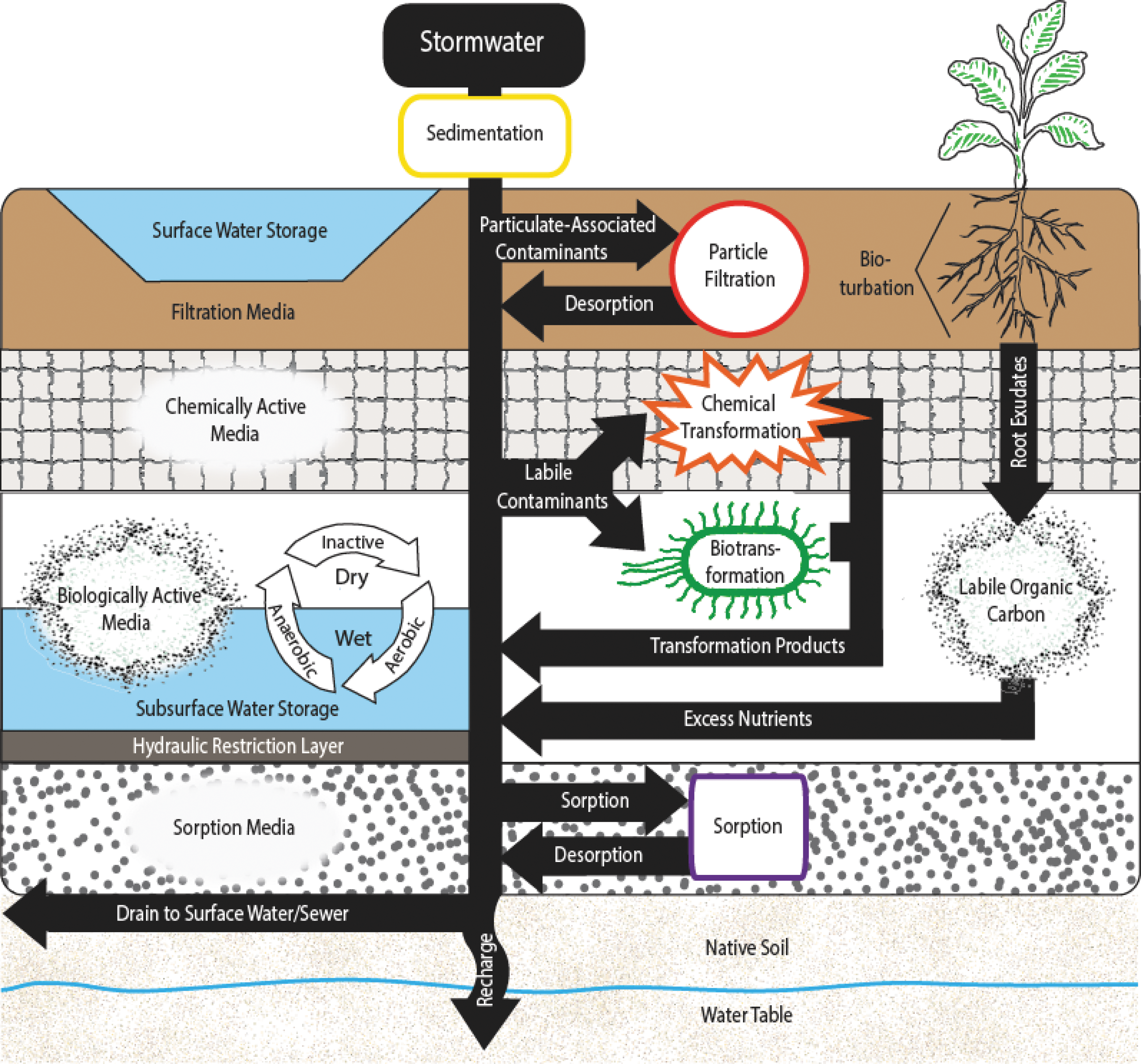
Schematic of contaminant behavior in an stormwater infiltration system.
Particles or colloids are removed from stormwater by filtration, which is governed by physical transport and chemical surface interactions (McDowell-Boyer et al., 1986; Ryan and Elimelech, 1996). Pathogens can be considered ‘biocolloids’ and are removed from the water phase via the same mechanisms by which other colloids are removed (Fontes et al., 1991; Stevik et al., 1999; Tufenkji, 2007; Walshe et al., 2010). Physical filtration occurs as particles are deposited in soil due to settling under gravity and straining at pores. Large particles, including protozoan cysts, are removed predominantly by straining at narrow pores (Tufenkji et al., 2004; Bradford and Bettahar, 2005). Straining is usually not important for bacterial, viral pathogens, or other colloids. The surfaces of sand and soil particles, as well as pathogens and stormwater colloids, typically have net negative charges, resulting in electrostatic repulsion that prevents attachment. For attachment to occur, the colloids should be transported into close proximity to the grain surface, such that short-range net attractive forces due to Van der Waals, steric, and hydrophobic interactions are greater than repulsive interactions.
Dissolved chemical and biological contaminants may be removed by sorption onto geomedia surfaces during infiltration. Sorption processes include ion exchange, chemisorption, surface precipitation, or, in the case of organic contaminants, absorption into organic matrices. Due to the higher selectivity of ion exchange sites for polyvalent ions, ion exchange tends to be the most important for compounds such as phosphate and metals (Liu et al., 2005; Genç-Fuhrman et al., 2007; Sansalone and Ma, 2011) with multiple charge sites or higher valency. Chemisorption, also known as surface complexation, results in a covalent-like bond between the dissolved species and the surface and is again most relevant for metals, phosphate, and, in some cases, organics and pathogens (Parikh and Chorover, 2006).
Chemical contaminants may be transformed abiotically by hydrolysis, oxidation, or reduction reactions on geomedia (Smolen and Stone, 1998; Stone and Morgan, 1984; Rangsivek and Jekel, 2005). Biotransformation of chemical contaminants also occurs within infiltration systems as the diverse microbial communities associated with the geomedia interact with dissolved and sorbed compounds (Kim et al., 2003; LeFevre et al., 2012). In addition, microbial biofilms may play a role in the removal of pathogen indicator organisms (Zhang et al., 2010, 2011) via predation by protozoa or competition for nutrients by biofilm communities. Pathogen die-off is higher under adverse conditions such as low moisture content (Yeager and Ward, 1981; Ceustermans et al., 2007) and nutrient scarcity, particularly carbon (Vidovic et al., 2007).
Based on these mechanisms, three strategies appear to provide the best opportunity for enhanced contaminant removal: (1) proper choice of infiltration media; (2) control of system hydraulics; and (3) control of redox conditions within the infiltration system.
Strategy 1: Media amendments
Sand is the most common media added to engineered infiltration systems and is used to increase system hydraulic conductivity. A variety of media have potential to improve the removal of both biological and chemical contaminants (Table 2). In addition, recycled materials, such as tire rubber, and industrial by-products, such as fly ash and blast furnace slag, have also been suggested as potential sorbents for contaminants present in urban stormwater (Babel and Kurniawan, 2003; Chang et al., 2010). The potential of some of these materials to release organic contaminants (Reddy and Quinn, 1997) and trace metals (Zhang et al., 2008), however, makes their applicability for stormwater treatment questionable.
Values will vary with particle size. Average particle size is not reported in reference.
Surface area depends on the synthesis method as well as on whether or not oxides are coated onto another media such as sand.
Value depends on the particular oxide form (e.g., goethite, ferrihydrite, hematite, etc.), surface area, and solution pH.
References: aOlsen, 1966; bLax et al., 1986; cMcBride, 1994; dDrizo et al., 1999; eEnglert and Rubio, 2005; fHsieh and Davis, 2005; gJang et al., 2005; hLiu et al., 2005; iGenç-Fuhrman et al., 2007; jAdams et al., 2009; kBaccar et al., 2009; lLiu et al., 2009; mZhang et al., 2010; nAgrawal, 2011; oBerretta and Sansalone, 2012.
GAC, granular activated carbon.
Addition of geomedia that alters the pH of infiltrating water has also been suggested for enhancing removal of certain contaminants, but many questions remain. To promote precipitation or surface complexation, calcite or media containing significant amounts of calcium oxide (i.e., fly ash, bauxsol, and cement) is used to increase solution pH. Under these conditions, metals or anions might precipitate [e.g., Cu(OH)2, Ksp=5×10⁻²⁰ (at 25°C), CuCO3, Ksp=1×10⁻¹⁰ (at 25°C), or Ca3(PO4)2, and Ksp=2×10⁻³³ (at 25°C)]. It is also possible that removal increases at elevated pH through other mechanisms. While this approach has been effective in laboratory testing (Arias et al., 2001; Liu et al., 2005; Genç-Fuhrman et al., 2007), the long-term viability of such systems and the potential for detrimental environmental impacts associated with pH adjustment is unclear.
Media amendments to enhance sorption
Sand used in engineered infiltration to increase system hydraulic conductivities, while effective for solids removal, has relatively limited ability to remove dissolved contaminants. The specific surface area and cation exchange capacity (CEC) of sand are very low compared with other geomedia (Table 2). While sand is capable of sorbing pathogens (Elliott et al., 2008) and dissolved stormwater contaminants such as metals (Liu et al., 2005; Genç-Fuhrman et al., 2007), phosphates (Arias et al., 2001), and organic compounds such as PAHs (Mader et al., 1997), its performance is very poor relative to other media. To enhance the removal of contaminants, sand can be amended with different types of geomedia to obtain both good hydraulic and treatment performance.
Metals removal can be enhanced by a variety of media that increase ion exchange capacity or provide sites for chemisorption. Ion exchange of cationic metals is enhanced by media with high CEC (Table 2) such as zeolites and granular-activated carbon (GAC) (Reed and Arunachalam, 1994; Pitcher et al., 2004; van Lienden et al., 2010). For example, the Freundlich isotherm constant for removal of Cu is approximately four times greater for GAC than for sand (Genç-Fuhrman et al., 2007), with a maximum sorption capacity of Cu more than 2500 times greater than that of sand (Liu et al., 2005). Since ion exchange is a reversible process, metals sorbed during one storm event could potentially be released after sites are saturated.
When employed, metal oxide-containing media likely leads to chemisorption of both cationic and anionic metals to the metal oxide surfaces (Liu et al., 2005; Genç-Fuhrman et al., 2007; Cederkvist et al., 2010). For example, Mn-oxide coated sand has a maximum sorption capacity for Cu that is ∼100 times greater than sand (Liu et al., 2005). The positive surface charge of Fe-oxides (pHpzc ∼8–9) at circumneutral pH electrostatically repels cationic metals, inhibiting surface complexation reactions, and is a less effective sorbent than Mn-oxides (pHpzc ∼5–7) for these contaminants, though still far more efficient than uncoated sand (Liu et al., 2005). Fe-oxide coated sand does remove anionic metals (e.g., CrO42−) (Genç-Fuhrman et al., 2007; Cederkvist et al., 2010) that are not repelled by the presence of positive surface charge.
Addition of geomedia is also effective in enhancing the removal of phosphate. For example, in a study of columns filled with sand or sand amended with ∼1% Fe-oxide, Rosenquist et al. (2010) observed that total phosphate removal in sand columns was negligible and was significantly improved by the presence of Fe (∼60% of the total influent load). Similarly, Erickson et al. (2012) achieved 88% removal of phosphate from stormwater by the addition of 5% iron filings to filtration media. It is believed that phosphate removal on most media amendments is attributable to surface complexation (Drizo et al., 1999; Arias et al., 2001; Molle et al., 2003; Zhang et al., 2008). Media exhibiting good removal of phosphate include Al- or Fe-oxide–coated sand, fly ash, shale, cementious media, and limestone (Drizo et al., 1999; Molle et al., 2003; Zhang et al., 2008; Sansalone and Ma, 2011). While both calcareous and metal oxide media function well for phosphate removal, Drizo et al. (1999) observed that even with similar surface areas, Al-oxide media had twice the phosphate sorption capacity of limestone.
There are several media amendments that are capable of enhancing surface sorption of organic contaminants during infiltration of stormwater, though organic contaminants will exhibit varying affinities for different media amendments due to the wide variability in their properties. Mineral surfaces suitable for metal or nutrient sorption generally perform poorly for sorption of organic contaminants, unless those compounds are electrostatically attracted to charged mineral surfaces [e.g., the anionic herbicide 2,4-D sorption to alumina (Clausen, et al., 1999)] or contain aromatic moieties that allow for an interaction between charged surface sites and highly conjugated π bonds [e.g., PAHs (Mader et al., 1997; Zhu et al., 2004; Mueller et al., 2007)]. Most neutral organic contaminants that are not highly aromatic (e.g., atrazine or isoproturon) show negligible sorption to charged surfaces (Clausen et al., 1999, 2001).
Sorption of most uncharged organic contaminants can be improved by media capable of hydrophobic interactions. Hydrophobic surface sorption of organics can be enhanced by the addition of activated carbon or biochars (Yu et al., 2006; Cho et al., 2009a; Beck et al., 2011). For example, addition of 0.1% to 1% char to soils has been observed to increase the Freundlich sorption coefficient of diuron by 5 to 100 times that of natural soil (Yu et al., 2006). Hydrophobic surface adsorption also occurs on organic-based materials such as wood chips or peat. In batch testing, Ray et al. (2006) observed that 1% mulch addition reduced concentrations of the PAH fluoranthene in urban stormwater by >90% at equilibrium. Since sorption of organics to hydrophobic media varies with contaminant hydrophobicity (Boving and Neary, 2004), these media are not expected to be effective for hydrophilic contaminants such as herbicides.
In media with significant organic matter (OM) content, the importance of absorption into the OM phase will vary among contaminants (Hassett and Banwart, 1989; Mader et al., 1997). If the organic carbon content (i.e., foc) of infiltration media is sufficiently high, however, absorption into OM will be the dominant removal process for most organic contaminants, even for charged organics (Higgins and Luthy, 2007; Tülp et al., 2009). The percent organic carbon in soils collected from infiltration trenches and basins in operation for decades has been observed to range from 5% to 20% (Aryal et al., 2006; Badin et al., 2011). While the foc is expected be lower in new systems, this could be mitigated by the addition of compost (30–70% OM) or similar organic-rich amendments.
Similar to dissolved contaminants, geomedia is a potential useful amendment for removal of colloids and pathogens through surface interactions. In groundwater, Fe- and Al-oxide-coated sands exhibit better removal of silica colloids, viruses (Pieper et al., 1997; Ryan et al., 1999; Foppen et al., 2006), bacteria (Scholl and Harvey, 1992; Foppen et al., 2008), and protozoa (Abudalo et al., 2010; Mohanram et al., 2010) than uncoated sand due to the electrostatic attraction between negatively charged pathogens and positively charged metal oxides (Harvey and Ryan, 2004). Columns packed with iron-oxide-coated sand were reported to remove significantly more E. coli from simulated stormwater than conventional bioretention media in short-term studies (Zhang et al., 2010). A few studies are reported that used other geomedia for colloid removal. For example, Foppen and Schijven (2005) tested E. coli removal in saturated columns containing quartz sand and varying fractions (5% to 100%) of sand coated with goethite, calcite, and activated carbon. Activated carbon removed 99.4%, calcite removed 98.2%, whereas goethite-coated sand removed only 92.6% E. coli.
Media amendments to enhance contaminant transformation
Contaminants can undergo chemical and biological transformation reactions as they pass through infiltration systems. These processes could result in mineralization of organic contaminants, denitrification (Kim et al., 2003; Hseih and Davis, 2005), or stable transformation products that pose potential risks to groundwater or surface waters [e.g., diuron (Tixier et al., 2001; Gooddy et al., 2002) or pyrethroids (Qin and Gan, 2006; Tyler et al., 2009)]. Interaction of pathogens with chemically and biologically active media has the potential to result in inactivation (Abbaszadegan et al., 2006; Zhang et al., 2010; Hrenovic et al., 2012).
Media amendments to enhance abiotic reactions
While only a modest amount of research has been conducted on the abiotic transformation of contaminants during stormwater infiltration, insights from other subsurface treatment methods can provide insights into the potential for enhancing rates of reaction during infiltration.
Several of the chemical contaminants of concern in urban stormwater undergo hydrolysis. For example, pyrethroid insecticides undergo base catalyzed hydrolysis (with half-lives from less 0.1 up to >80 days, between pH 5–9; Stangroom et al., 2000). For compounds that undergo sorption, the coupling of relatively slow hydrolysis reactions and longer retention times can result in transformation during infiltration. Certain types of geomedia, such as clays or metal oxides, also could increase contaminant hydrolysis rates through surface catalysis (Soma and Soma, 1989; Smolen and Stone, 1998; Salvestrini et al., 2004).
Abiotic oxidation and reduction reactions can result in transformation or inactivation of contaminants by reactions with geomedia as they pass through infiltration media. For example, Mn- or Fe-containing minerals are capable of oxidizing a variety of contaminants that are commonly present in urban stormwater, such as phenolic compounds, aromatic amines, and aromatic thiols (Stone and Morgan, 1984; McBride, 1987; Laha and Luthy, 1990; Li et al., 2008). To date, the feasibility of using Mn-oxides, or other oxidation media in infiltration systems, has not been explored.
Transformation of contaminants by reduction is also possible if geomedia with a sufficiently low redox potential are used. For example, zero-valent Fe (ZVI) has been employed to reduce a variety of halogenated organic compounds in contaminated groundwater at hazardous waste sites (Zhang, 2003). ZVI has also been investigated as a geomedia amendment to enhance the removal of metals from stormwater (Rangsivek and Jekel, 2005). Exposure to dissolved oxygen results in oxidation of ZVI, potentially limiting its application for reductive treatment in aerobic stormwater infiltration systems unless it can be protected from oxic conditions (Reinsch et al., 2010). However, even under oxic conditions, ZVI nanoparticles have been observed as having bactericidal effects (Lee et al., 2008) and may, therefore, be beneficial for increased pathogen inactivation.
There is some evidence that positively charged surfaces may enhance inactivation of pathogen indicators. For example, the bacteriophage MS2 and PRD1 were reported to be inactivated by iron-oxide coated sands (Ryan et al., 2002). Inactivation of pathogens could also be improved by doping infiltration media with antibacterial agents. A recent study showed that natural zeolite doped with Zn and Cu increased inactivation of pathogens during stormwater infiltration (Hrenovic et al., 2012). While such media may be useful for improving pathogen removal, care should be taken to ensure that antimicrobial agents do not leach from infiltration media and impact microbial communities in receiving waters.
Media amendments to enhance biotransformation
Management of the biological community during bioinfiltration is an important treatment opportunity. Biodegradable organic pollutants introduced by stormwater infiltration or other forms of bioavailable carbon present in the infiltration media maybe utilized by microbial communities as electron donors. N and P are also often limiting nutrients in the subsurface environment, and pollutants containing these elements can be utilized to enhance microbial growth. Active microbial communities within infiltration media also inactivate or otherwise remove microbiological contaminants by competition for resources or predation.
In addition to media which directly enhance sorption of contaminants, researchers have suggested that the addition of labile organic carbon enhances biological activity as a means of enhancing bioremediation rates. For example, addition of mulch to media in denitrifying infiltration systems increased denitrification by a factor of 3–21 relative to sand and soil mixtures alone (Hseih and Davis, 2005). Kim et al. (2003) also found that mulch improved NO3− removal during infiltration by 50–60%; while other media, such as alfalfa, sawdust, newspaper, woodchips, and sulfur, increased denitrification by more than 90% as compared with sand alone.
Similarly, Cederlund et al. (2007) found that microbial activity and biotransformation of the phenylurea biocide diuron in soils increased with the addition of straw as an organic carbon source. Alvey and Crowley (1995) also observed that organic media amendments increased atrazine utilization as a nitrogen source. Furthermore, addition of compost to soils enhanced microbial transformation of PAHs, which was attributable to the compost OM as opposed to other factors such as increased sorption or the compost microbial community (Kästner and Mahro, 1996). These results suggest that microbial activity activated by carbon additives may improve removal of organic contaminants during stormwater infiltration, particularly N-containing contaminants; however, the potential for more easily metabolized carbonaceous amendments to compete with and slow the mineralization of toxic, trace organic pollutants remains unclear.
Promotion of an active biofilm within the infiltration media is expected to enhance removal of pathogens via increased inactivation. The removal and inactivation of viruses by sand filtration has been studied for drinking water treatment (Elliott et al., 2008; Elliott et al., 2011). Elliott et al. (2008) attributed the removal of viruses in drinking water to the activity of the microbial community within the porous media, not modification of media surfaces by physical/chemical or microbial processes. These previous studies indicate that managing the biofilm, and contact time with the biofilm, can improve the removal efficiency of viruses. Only one research group, to our knowledge, has investigated the impact of biofilms from stormwater systems on pathogen removal: They reported that greater reductions of attached E. coli occurred as the column matured due to protozoan grazing in an 18 month column study (Zhang et al., 2011). In an earlier study, Zhang et al. (2010) reported high rates of decay for bacteria attached to filter media due to predation and nutrient competition from native microorganisms.
Enhanced biofilm development within infiltration systems can also enhance sorption of both colloidal and dissolved contaminants. Biofilms provide additional sites for adsorption of colloids and pathogens (Chabaud et al., 2006; Liu and Li, 2007; Liu et al., 2007). For example, Liu and Li (2007) reported enhanced removal of E. coli by Pseudomonas aeruginosa biofilms grown on glass beads, though overtime E. coli were slowly released back into solution. Investigators have also observed that biofilms increase uptake of dissolved metals (Hébrard and Delolme, 1999) during infiltration and increase sorptive removal of hydrophobic contaminants, such as PAHs (Wicke et al., 2007).
The functional lifetime of infiltration systems that depend on the presence of biodegradable additives is unclear. Alternatively, inclusion of planted top layers in infiltration systems could be beneficial as a renewable source of bioavailable carbon. It has been noted that root exudates and secondary plant metabolites have the potential to enhance biotransformation of PAHs and polychlorinated biphenyls (PCBs) (Singer et al., 2003). Planted bioretention columns have shown modest improvements in naphthalene removal, including increased expression of genes responsible for biotransformation of this contaminant, as compared with unplanted columns (LeFevre et al., 2012). Whether this mechanism is widely relevant to stormwater contaminants and conditions requires further investigation.
One potential drawback to biodegradable amendments is that carbon and nutrients may be released by the media in excess of what the microorganisms can use and thereby contaminate ground or surface waters (Hsieh and Davis, 2007; Bratieres et al., 2008; Cho, 2009b). Overly vigorous biofilm development may also result in clogging of infiltration systems, a phenomenon observed at sites where wastewater is infiltrated (McKinley and Siegrist, 2011). In addition, biofilm growth on media amendments added to enhance surface sorption of contaminants may reduce their sorptive capacity. For example, in studying PCB sorption to activated carbon, McDonough et al. (2008) observed that sorption capacities were reduced by approximately an order of magnitude on carbon subject to biofilm growth as compared to virgin carbon. Overall, more information is needed on the performance of both conventional and novel media for long-term removal of contaminants.
Apart from serving as a source of labile organic carbon, additives to infiltration media may impact the structure and behavior of the microbial community. For example, Wakelin et al. (2010) reported that sand filters (dm=0.2 mm) clogged while GAC and anthracite (dm ∼1 mm) filters did not when used to treat stormwater. They observed that the distribution of polysaccharides and DNA as well as the microbial species differed greatly between the filter materials. It is known that the nature of the support media can affect biofilm development. For instance, the buffering capacity of clays supports bacterial growth by maintaining suitable pH levels (Stotzky, 1966). Media impacts on biofilm development in engineered infiltration systems require further investigation to confirm the potential significance of this effect on contaminant removal and long-term infiltration system performance.
Strategy 2: Control of hydraulics and media saturation
The most basic and important hydraulic control of engineered infiltration systems is long-term maintenance of infiltration rates. Much research has, therefore, focused on the potential for suspended solids to reduce infiltration rates rather than to improve contaminant removal. Careful management of particles is critical for the long-term performance of infiltration systems, as particle deposition will form a cake layer over time. This layer will eventually act as a filter itself, which may enhance removal, but will reduce water infiltration rates. Several studies (Hatt et al., 2008; Li et al., 2008; Clark and Pitt, 2009) suggest that scraping the top layers of sediment from infiltration systems periodically can reduce clogging and restore hydraulic performance, though hydraulic recovery was reported to be incomplete (10–30%, Li et al., 2008) or unsustainable (Clark and Pitt, 2009) in laboratory experiments. Bioturbation by plant roots has also shown promise for preventing clogging (Hunt et al., 2010; Le Coustumer et al., 2012). Alternatively, more sophisticated methods for removing suspended solids, such as clarifiers (Sansalone et al., 2009) or coagulant addition (Kang et al., 2007), before contact with infiltration media have been effective. Particle destabilization with coagulants (Kang et al., 2007) also showed substantial improvement in removal of colloidal fractions (particle diameters <20 μM), potentially improving removal of colloid-associated contaminants, but management in the field operation could prove difficult. Additional research is needed to identify the most cost-effective means of balancing the need to control clogging and the costs associated with replacing media.
In addition, manipulation of hydraulic behavior of engineered infiltration systems is another tool that is used to optimize stormwater contaminant removal. The degree of saturation and the amount of water remaining in the basin over time depends on the intensity of precipitation, storm frequency, evaporation rates, the hydraulic conductivities of the various media within the system, and the hydraulic conductivity of the surrounding soil (Li et al., 1999). Moisture content and flow velocity may vary substantially even during a single infiltration event. Though highly variable, this behavior can be influenced by the placement height of drains or remotely operated valves on drains. Infiltration media of varying hydraulic conductivities (Table 2) and moisture retention capacities (Paul et al., 1971; Thompson et al., 2008) can also influence the behavior of engineered infiltration systems. These tools can be used to help control the hydraulic residence time within infiltration systems, to maintain saturated zones or minimize their formation, as well as to control their size, location, and lifetime.
Varying the moisture content of infiltration media affects the removal of particles and pathogens. Intermittent flows disrupt the air–water, water–soil, and soil–air interfaces where pathogens and colloids are attached. Intermittent flows can enhance the remobilization of colloids (Zhuang et al., 2007; Majdalani et al., 2008) and colloid-associated contaminants (Cheng and Saiers, 2010). Remobilization of particles and pathogens under intermittent flow has not yet been evaluated as an explanation for poor removal of pathogens in stormwater infiltration systems, though 80–90% of all indicator bacteria are reported to attach to particles <50 μm that are susceptible to mobilization under intermittent flow (Zhang and Lulla, 2006).
These data suggest that control of hydraulic conditions within engineered infiltration systems could be used to influence colloid and pathogen removal. For instance, maintaining unsaturated conditions may result in improvements in filtration efficiency of fine particles and colloids by maintaining stable soil–water–air interfaces; however, the lower infiltration rates necessary may make this approach impractical for some sites. Alternatively, to prevent colloid remobilization, maintaining steady hydraulic conditions within the infiltration system (e.g., by promoting and maintaining saturated zones in the infiltration media) may be preferable to improve colloid retention. Since the use of hydraulic manipulation to improve colloid and pathogen removal during infiltration has not been evaluated in detail, it is still unclear which of these approaches would ultimately be the most effective or whether potential treatment improvement would be significant to warrant use in field systems.
Moisture content within the infiltration system also influences microbial activity present within the infiltration media. If the media reaches a moisture content below 50% before the next storm, further microbial activity will be limited until the next inundation event (Huesemann and Truex, 1996). For example, the flush of microbial activity after a storm event in one urban infiltration basin that is capable of holding ∼31,000 m3 with a drainage rate of 0.5 m3/s was found to last ∼2 days (Badin et al., 2011). The speed at which infiltration media drains and dries will then limit opportunity for biotransformation. Li et al. (2012) observed that inclusion of a small but continuously saturated layer at the bottom of stormwater biofilters (by introduction of a raised drain) improved pathogen inactivation by maintaining an active microbial community even during long dry periods. Since biological reactions tend to be slower than sorption and other physical removal processes, fast draining systems will likely be less efficient biological reactors. Enhanced removal can be obtained by designs that result in lengthened hydraulic retention times (Bester et al., 2011), but higher capital costs associated with larger system size or water storage capacity may be prohibitive. Alternatively, inclusion of media that retain contaminants by sorption might retard their passage through the infiltration system, increasing opportunity time for biotransformation.
While increased water retention times and promotion of saturation zones may be beneficial for contaminant removal, there will be practical limits on the application of these strategies. Increased hydraulic retention times or slower infiltration rates require either greater storage volume or treatment system volume (associated with increased capital costs) or potential reductions in percent capture of runoff per storm event. Surface storage of water before treatment may be problematic. The lifetime of surface ponded zones in bioretention systems should not provide a suitable habitat for disease vectors such as mosquitoes (Hunt et al., 2010). Alternatively, issues with open surface ponds could be avoided by storage in closed tanks or in subsurface media.
Strategy 3: Manipulation of redox conditions
Microbial communities responsible for transformation or inactivation of contaminants during stormwater infiltration can be manipulated by controlling the concentrations of terminal electron acceptors. Turbulent flow conditions such as stormwater runs over urban surfaces lead to high dissolved oxygen concentrations entering the infiltration system, but dissolved oxygen concentrations will gradually decrease due to microbial respiration, as observed for larger-scale soil infiltration systems (Foulquier et al., 2011). The degree to which oxygen can be resupplied by diffusion from the atmosphere depends on soil moisture. If the media remains fully saturated for a sufficient period, oxygen will be partially or fully depleted, causing a shift in conditions that favor organisms adapted to microaerophilic, anoxic, or anaerobic conditions.
Forcing extended saturated conditions to enhance denitrification rates in stormwater infiltration systems is the most promising option available to improve treatment of nitrate. To accomplish this objective, investigators have employed raised underdrains (Kim et al., 2003) or low permeability media (Hsieh et al., 2007) in conjunction with amendments that provide organic carbon to create a long-lived saturated zone in which re-aeration rates are slow and biological activity is high. Nitrate removal efficiencies of approximately 80% were observed for pilot-scale bioretention systems with contact zones ∼0.05 m3 and infiltration rates of 4 cm/h, conditions reasonably representative of actual operating conditions (Kim et al., 2003).
Precise control of redox conditions can be difficult in these systems. After dry periods of dormancy, there are delays during which nitrate breakthrough occurred, before denitrifying biofilms reached maximum activity (Kim et al., 2003) and, in some cases, sulfate loss occurs, indicating that treatment systems progress from nitrate-reducing to sulfate-reducing conditions. Sulfate-reducing conditions may be undesirable, particularly in regions in which methylmercury formation is a concern (Rumbold et al., 2006; McKee, personal communication * ). One way to improve redox control of distributed treatment systems is by the use of simple remote or automated control. For instance, Quigley et al. (2008) employed hardware and software applications for real-time, dynamic control of distributed stormwater handling systems, including introduction of remote-operated valves that can be closed to maximize water holding time and be opened before impending storms without sacrificing overall water handling capacity. Similarly, addition of water quality sensors could allow for real-time information on redox conditions within infiltration media, and, in conjunction with remote controlled drain values, provide the ability to influence the range and lifetime of specific redox conditions. One potential limitation on this technique is the robustness and reliability of available sensor technology.
It is unclear whether enhancing suboxic, denitrifying conditions will significantly impact biological transformation of other contaminants. In some cases, aerobic degradation has been shown to be faster or more important than anaerobic degradation [e.g., phthalates, PAHs (Staples et al., 1997; McNally et al., 1998)]. However, there is increasing evidence that anaerobic degradation may still be relevant for many organic chemicals in stormwater [e.g., PAHs, diuron (Giacomazzi and Cochet, 2004; Zhang et al., 2006)]. If contaminants are not fully mineralized, the products of aerobic and anaerobic degradation may differ. For example, intermediate metabolites of diuron—which are considerably more toxic than their parent compound (Tixier et al., 2001)—are subject to further transformation and mineralization in aerobic systems. These compounds may remain as final products in anaerobic systems (Gooddy et al., 2002; Giacomazzi and Cochet, 2004). Although encouraging saturated conditions may be an attractive design option to promote nitrate removal, further research is needed to determine the relative benefits or detriments on other biodegradable stormwater contaminants.
Research needs
Managing stormwater in an efficient and sustainable manner is a serious challenge facing urban areas. Increased use of LID, including infiltration-based techniques, is one important tool to address this problem. The fate of contaminants in stormwater and the risk they represent, however, needs to be considered before widespread application of infiltration-based LID can be safely applied. Infiltration through engineered media has great potential to remove contaminants present in urban stormwater, but, at present, this potential benefit is not fully exploited.
Engineered infiltration designs based on a mechanistic understanding of contaminant removal will enable this technology to be used in a manner ensuring safe and reliable stormwater treatment. Based on the existing understanding of removal and transformation mechanisms discussed in this article, three design strategies have been identified that may be opportunities to more effectively optimize and manage treatment of stormwater.
One of the most powerful options available for improving contaminant removal in infiltration systems is the choice of infiltration media itself. For metals in particular, enhancing system sorption capacity via careful choice of infiltration media appears to be the best available method to improve removal during infiltration. As discussed earlier, a variety of relatively low cost media have been shown to positively impact removal of both biological and chemical contaminants via enhanced sorption. These include mineral amendments such as calcareous media, zeolites, clays, or metal oxides. Black carbon materials or organic materials such as wood, mulch, or compost have also been shown to improve removal of stormwater contaminants. Many media amendments are beneficial for the removal of several categories of contaminants. For instance, activated carbon enhances both trace metal and organic sorption; while Fe- and Al-oxides are suitable for the removal of many anionic contaminants, including oxyanions, pathogens, and colloids. The choice of media capable of removing a variety of contaminants simultaneously is the first step toward design of systems with broad spectrum treatment efficacy.
Significant questions remain regarding the use of media that rely on surface properties in infiltration systems. The stability of surfaces over long time periods is a potential limitation that requires further evaluation. Iron oxides and clay minerals, effective geomedia to enhance removal of contaminants, weather during dry–wet cycles and freeze–thaw cycles, and release of adsorbed contaminants (Mohanty and Ryan, 2011). Similarly, Li et al. (2012) observed a decrease in removal of E. coli from stormwater systems subjected to prolong drying and attributed the lower removal to generation of fissures in the geomedia. For redox active surfaces, such as metal oxides, the effect of variable redox conditions might reduce their effectiveness in field systems. Fouling of surfaces by natural OM and other constituents that compete for the surfaces, for example, phosphate, present in stormwater also may reduce effectiveness of geomedia, particularly those utilizing positively charged coatings or surfaces (Pieper et al., 1997; Abudalo et al., 2010). Some potential amendments are also highly biodegradable. As these materials are mineralized, sorbed contaminants could be released. Media resistant to biotransformation may last longer, but will eventually become saturated. Additional research is needed to assess the lifetime of amendments in infiltration systems. While an ideal infiltration system would have a long operational lifetime, it may also be feasible to periodically replace the media to maintain system performance.
Second and third strategies are control of media saturation and redox conditions within infiltration media. Designs that enhance media saturation have the potential to reduce remobilization of entrapped colloids caused by wetting and drying cycles, support extended microbial activity between storm events, or promote anoxic denitrifying conditions within the infiltration system. Alternatively, system design could be optimized to discourage media saturation and encourage oxic conditions that may be beneficial for the biotransformation of trace organic contaminants. However, manipulation of hydraulic behavior during stormwater infiltration for improved contaminant removal is a relatively unexplored area; the best methods for manipulating these engineered systems and well as the full extent of possible benefits and/or drawbacks are still unclear.
Ultimately, the combination of techniques to optimize treatment of one type of contaminant may not be suitable for another, making the design of broad spectrum treatment a challenge. Overcoming this complication requires a systems-level approach, with proper ordering of treatment methodologies chosen to optimize synergies and reduce antagonism between various techniques. Materials could be layered to create reactive barriers that target specific types of contaminants for removal in a logical progression. For instance, biodegradable carbon amendments for enhanced nitrate removal should not be placed above positively charged amendments for pathogen/colloid sorption where leached OM could foul surfaces. Alternatively, there may be advantages to mixing materials together; for example, metal oxides could be mixed with a soil matrix that supports biological activity. As with centralized water treatment plants, the proper ordering or isolation of treatment steps will be vital to maximize treatment efficiency.
Creative approaches to managing these distributed treatment systems will also be needed to create the necessary conditions to optimize the different mechanisms and the interactions between them. For example, in a distributed urban water infrastructure, it is possible that controlled infiltration of reclaimed wastewater might provide sufficient nutrients and moisture to enable the maintenance of microbial communities between storms. This procedure might encourage a healthy (and possibly vegetated) infiltration system that would be better suited to biologically remove contaminants when a storm event occurs. By maintaining a specific moisture content or regularly cycling between wet and dry conditions between storms, beneficial impacts on both the microbial communities and the abiotic redox conditions might be realized. These systems could be instrumented with sensors to control when reclaimed water (or stored stormwater from the previous storm) is allowed to percolate through the infiltration system.
While engineered infiltration has great potential for passive treatment of stormwater contaminants, questions still remain regarding the reliability of treatment as well as maintenance schedules and operating lifetimes of systems. Unlike centralized treatment, increased use of distributed infiltration systems will result in a large number of highly dispersed treatment sites. As with all distributed treatment, training of installation and operating staff, proper maintenance, and routine monitoring of contaminant reduction are a challenge. An a priori understanding of expected performance and reliability of these systems compared with anticipated operating lifetimes, as developed by thorough laboratory, pilot, and demonstration-scale testing would, therefore, be desirable.
Further, complicating the prediction of stormwater reclamation reliability is the variable nature of stormwater itself. The temporal dependence of stormwater (varying with season, the length of dry spells between storms, and periodic activities such as pesticide or fertilizer application) means that infiltration systems are subject to widely variable contaminant loading. For contaminant removal based on sorption to surfaces, competition between individual stormwater contaminants or between contaminants and background constituents, such as natural OM, is likely to affect treatment efficacy. Temporal variability of the stormwater matrix then has potential to further impact treatment reliability, making predictive modeling of these systems a challenge.
Although not specifically addressed in this article, there are also economic issues related to cost of media and balancing infiltration system capital and maintenance costs against expected levels of treatment. In addition, the complications of large-scale deployment of engineered stormwater harvesting systems need to be better understood. There is a lack of knowledge on the cumulative effect of LID on urban hydrology. While some research suggests positive effects at the small scale (Rushton, 2001; Holman-Dodds et al., 2003), the large-scale patterns of stormwater runoff from urban systems are quite complicated (Moglen, 2009; Mejía and Moglen, 2010a, b) and it is unclear whether or not the widespread adoption of LID will have a sufficient beneficial impact on hydrology at the watershed scale to justify its cost (Moglen, 2009). While there is a general consensus that increased infiltration will move urban watersheds toward a more natural state, concerns associated with unintended consequences of the practice on flood control, nutrient cycling, and other water management issues need to be resolved. This understanding is underpinned by scaling of local water flow and contaminant transport processes to the larger urban environment. The ability to accurately understand and predict these processes and how they scale will enable the development of models that can be used as tools to decide how best to arrange and deploy these stormwater infiltration systems.
Footnotes
Acknowledgment
This work was supported by the National Science Foundation (NSF) through the Engineering Research Center for Re-Inventing our Nation's Water Infrastructure (ReNUWIt) EEC-1028968.
Author Disclosure Statement
No competing financial interests exist.
*
McKee, L.J. (Personal communication, May 2012). Watershed Science Program Manager, San Francisco Estuary Institute, Richmond, CA.