




Abstract
Abstract
An endocrine disrupting chemical, di-(2-ethylhexyl) phthalate (DEHP), can be removed from wastewater by biological aerated filters, but the removal mechanism is not clear. This original study focused on the adsorption isotherm and kinetics of DEHP on biofilms from a biological aerated filter at 4°C. This low temperature was selected to reduce interactions between the biological metabolism and adsorption as much as possible. The experimental data at 4°C fit with the Langmuir and Freundlich isotherm models. R2 for the Langmuir and Freundlich isotherm is 0.969 and 0.949, respectively. For the Langmuir isotherm, qmax (Langmuir adsorption capacity) is 161.55 μg/g and kL (Langmuir constant) is 0.186L/μg. For the Freundlich isotherm, n (Freundlich constant) is 1.68 and k (Freundlich adsorption capacity) is 29.46 μg/g. The adsorption capacity of 1g biofilm for DEHP is 34.67 μg as calculated from pseudo-second-order kinetics, which corresponds well with adsorption rate data. There was a dynamic balance of DEHP concentration between biofilms and wastewater. Without biological activity, DEHP would migrate from the biofilms back into the wastewater if the concentration of DEHP in biofilms becomes higher than that in the wastewater. These results are fundamental to understand DEHP removal mechanisms in a biological aerated filter.
Introduction
A
The removal of DEHP from wastewater may be achieved by physical, chemical, or biological methods (Chan et al., 2007; Chen et al., 2009; Chung and Chen, 2009; Salim et al., 2010; Xia et al., 2011). There is a great deal of information regarding DEHP removal in activated sludge processes or conventional biofilm reactors (Roslev et al., 2007; Dargnat et al., 2009; Cheng et al., 2010; Clara et al., 2010; Ruel et al., 2010). However, the knowledge of DEHP removal in biological aerated filters, a common wastewater treatment process, is still poorly understood.
A general conclusion can be drawn that DEHP is removed by adsorption and biodegradation by biofilms on media in biological aerated filters (Juneson et al., 2002; Oliver et al., 2007). Metabolism of DEHP occurs after DEHP is adsorbed by biofilms, with adsorption being the key step of DEHP removal in biological aerated filters.
It is difficult to understand the behavior of DEHP adsorption by biofilms in biological aerated filters since adsorption and biodegradation occur simultaneously (Pirsaheb et al., 2009). Several chemical methods have been used to inhibit the activities of bacteria in biofilms, but the physical/chemical characteristics of the biofilms were altered by chemical treatment (Li and Bishop, 2004; Ren et al., 2007; Du et al., 2012).
Biological metabolism of DEHP is reduced when the temperature ≤4°C. At such low temperatures, the metabolism of bacteria almost stops and biodegradation can be neglected (Villa-Gomez et al., 2011). The biological aerated filter was operated at 4°C during all our experimental periods. Media (sands) with biofilms in the biological aerated filter were extracted and used directly as adsorbents.
The principal objective of this work is to reveal the nature of the DEHP adsorption process by biofilms in biological aerated filters. DEHP desorption processes were also studied and are reported in this article.
Materials and Methods
Chemicals
Analytical grade DEHP (C24H38O4) with purity >99% was used in all experiments. The DEHP density is 0.985 g/cm3 and molecular weight is 390.30.
Preparation of wastewater containing DEHP for adsorption experiments
Domestic wastewater was extracted from wastewater pipes located at a community in Beijing, China. This wastewater was treated by a pilot-scale tertiary treatment process, which is a combination of a sequencing batch reactor and a biological aerated filter in series.
Concentrations of DEHP in the effluent of the sequencing batch reactor was maintained at about 200 μg/L by DEHP spiking before entering into the biological aerated filter. For the batch adsorption and desorption experiments, the effluent of the sequencing batch reactor was filtered by 0.45-μm cellulose acetate filters with the filtrate used in adsorption and desorption experiments.
Biofilm preparation and quantity
The medium of the biological aerated filter was quartz sand with a diameter of 1.1 mm. Media in the filter with biofilms were extracted and used for the DEHP desorption experiments. To avoid DEHP saturation in biofilms on media, the addition of DEHP to the influent of the biological aerated filter was stopped 7 days before the extraction of media for adsorption experiments.
The quantity of biomass on media was measured as follows: media were dried at 105°C and weighed. Then, the media were placed in 1N NaOH solutions for 1 h to peel the biofilms from the media. To accelerate the process, a water bath at 80°C was used and solutions were shaken at 50 agitations per minute on a magnetic shaker. After the peeling process, media were dried at 105°C and weighed again. The mass difference of media before and after biofilm peeling was calculated as the total biomass.
DEHP analysis
DEHP in wastewater was determined by solid-phase extraction (SPE) with a high-performance liquid chromatography (HPLC) system.
The samples were filtered using 0.45-μm cellulose acetate filters and the DEHP was extracted from the filtrate by SPE using OASIS® HLB columns (3 mL, 60 mg; Waters). The columns were conditioned sequentially with 2 mL hexane, 2 mL methanol, and 2 mL distilled water. The columns were not allowed to run dry after conditioning. Sample loading was performed by using a vacuum pump at a flow rate of 10 mL/min. After the sample solution had passed through, the cartridge was washed with 5 mL of water and methanol (95:5) and vacuum dried for 3–5 min. After this, 9 mL eluents of ether and methanol (95:5) stayed in the column for 1 min before flowing out at the rate of 1 mL/min. Then, 1 g Na2SO4 was added into the eluate and allowed to rest overnight. The eluate was then dried with a stream of nitrogen until the volume was about 0.5 mL and reconstituted to a final volume of 1 mL by the addition of methanol. Finally, 10 μL of eluate was injected into the HPLC system (1100 series; Agilent Technologies).
The HPLC system was supplied with water and methanol as eluents (85:15) using a reversed phase C18 column (250 mm×4.6 mm, 5 μm particle size) at 35°C. The mobile phase flow rate was 1 mL/min. Spectrophotometry detection of analytes was performed at 226 nm wavelength.
Adsorption, kinetics, and desorption experiments
Media with and without biofilms were added into glass bottles containing 500 mL of wastewater (the filtrate). The glass bottles were shaken at 100 rpm on a magnetic shaker at a temperature of 4°C for 20 h to reach adsorption equilibrium. The DEHP concentrations in wastewater were determined before and after the equilibrium experiments.
Adsorption kinetics of DEHP by biofilms was tracked for 10 h with sampling at regular intervals. During the adsorption experiments, all other conditions and the DEHP analytical methods were the same as described above. Procedures for desorption experiments were the same as for the kinetics experiments except that the biofilms used were different (see Biofilm preparation and quantity ).
To get the true adsorption characteristics of biofilms, we kept the biofilms on media, at its original state, during the experiments as much as possible. Thus, in all the experiments, we used the media with the biofilms, but not the biomass peeled from the media as the adsorbent. However, the biofilms on the media distributed unevenly. We could not maintain an equal quantity of the biomass in each experiment, although the quantity of media with attached biofilms was easily kept equal.
Thus, in each adsorption experiment, we used the media that attached biofilms as the adsorbent. After the adsorption process finished, we peeled the biofilms from the media. Then, the quantity of the biomass, that is the real adsorbent, was obtained (see Biofilm preparation and quantity ).
For every sample in each experiment, we did duplicate the analysis. If the deviation was below 10%, we accept the results and the average data are given in the following figures and tables.
Results and Discussions
Adsorption by media without biofilms
The adsorption process of DEHP by the media (quartz sands) without biofilms attached is shown in Fig. 1.

Adsorption of di-(2-ethylhexyl) phthalate (DEHP) by the media without attached biofilms.
During the 10-h tracking period, the concentration of DEHP in wastewater remained almost stable. This indicates that the quartz sands adsorption of DEHP from wastewater is negligible. This result is similar to that obtained by Peterson et al. (2008). They found that cephapirin adsorption to nearly pure quartz filter sands is low (Peterson et al., 2008). In water treatment fields, sands are always coated or modified to enhance their adsorption capacity (Ahmedzeki, 2013; Que et al., 2013). Data in Fig. 1 lead us to the assumption that in our biological aerated filter, DEHP adsorption was fulfilled by the biofilms on the media (quartz sands) but not by the medium itself.
Adsorption isotherm
Figure 2 illustrates the adsorption equilibrium of DEHP in wastewater. Both Langmuir and Freundlich adsorption isotherm models were used for the analysis of the DEHP adsorption from wastewater.

Equilibrium adsorption isotherm of DEHP onto biofilms from wastewater.
As one of the most frequently employed models, the Langmuir model can be expressed as follows (Nassar and Ringsred, 2012):
where qe is the amount of DEHP adsorbed on the biofilms at equilibrium (μg/g); ce is the concentration of DEHP in wastewater at equilibrium (μg/L); and qmax (μg/g) and kL (μg−1) are constants in the Langmuir model, which represent adsorption capacity and energy of adsorption, respectively.
Equation (1) can be rearranged as the following linearized form (Khan et al., 2012):
The fit of experimental data to Equation (2), shown in Fig. 3a and Table 1 with R2 of 0.969, indicates that the Langmuir model is suitable for describing DEHP adsorption by biofilms over the concentration levels of our experiments. This result indicates that DEHP formed a monomolecular layer on biofilms at saturation and the number of adsorption sites on biofilms was limited.
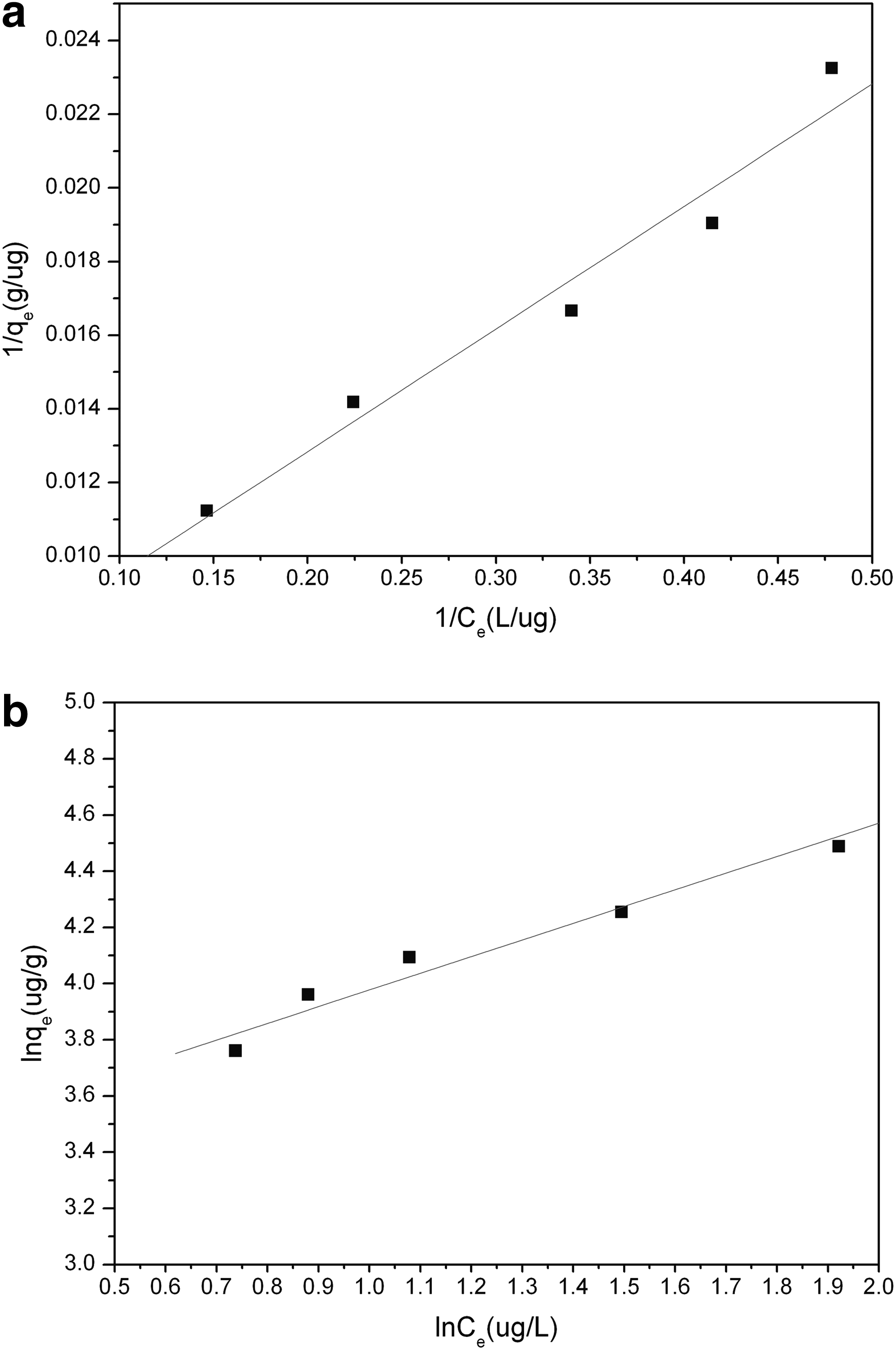
Equilibrium adsorption isotherm of DEHP following
A dimensionless constant called the equilibrium parameter, r
L
, can express the essential characteristics of the Langmuir isotherm (Shen et al., 2009).
where c0 is the initial DEHP concentration (μg/L) in wastewater, the value of which was 10.4 μg/L in our experiments. kL was calculated from Equation (2) and the value was 0.186. By the value of the equilibrium parameter, the nature of the isotherm can be assessed by the following classification (Shen et al., 2009).
r L was calculated from the data shown in Fig. 2 and was found to be 0.35, which implies that the adsorption processes was favorable.
The Freundlich model can be expressed as follows (Bashir et al., 2012):
where k (μg/g) and n are the Freundlich constants. Equation (4) can be linearized as Equation (5):
The fit of data to the linear form of the Freundlich model is shown in Fig. 3b and Table 1 with R2 of 0.949. This indicates that biofilm adsorption of DEHP from wastewater is likely a heterogeneous adsorption phenomenon (Venkata Mohan et al., 2007).
Data shown in Fig. 3 and Table 1 lead us to believe that both Langmuir and Freundlich models can describe the process of DEHP adsorption by biofilms. These findings are similar to those results of p-chlorophenol adsorption by biofilms (Wang et al., 2002).
Adsorption kinetics
Figure 4 shows the effects of time on the amounts of DEHP adsorbed from wastewater.
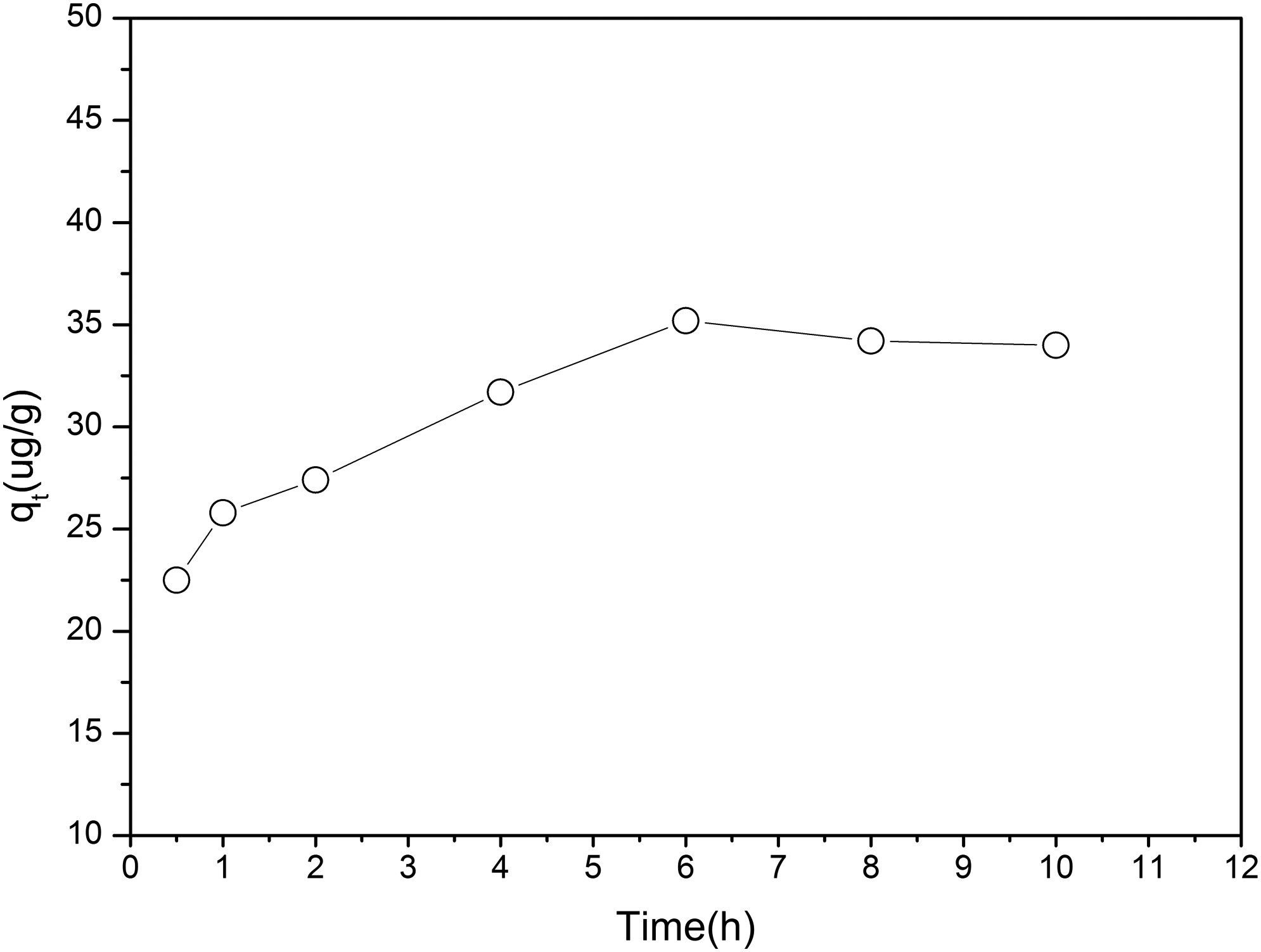
Transient of DEHP concentrations in wastewater for DEHP adsorbed onto biofilms.
The rate of DEHP adsorption by the biofilms was quicker earlier, but slowed down with time This was likely due to the abundance of free adsorption sites in the biofilms. As DEHP was adsorbed onto the surface of biofilms, fewer sites remained available and the concentration of DEHP in the wastewater decreased and the adsorption rate declined gradually as seen by the rate of change over time (Fig. 4). Approximately 6 h were required to reach equilibrium in our experiment, which is longer than other studies of phthalates adsorption by carbon (Venkata Mohan et al., 2007; Xia et al., 2011). This is likely due to the low temperature and low concentration of DEHP in wastewater. Possible reasons include the differences in the properties of carbon and biofilms.
The pseudo-second-order model for transient sorption assumes that the sorption rate can approximated by the pseudo-second-order expression (Li et al., 2011).
where qt is the amount of DEHP adsorbed on biofilms at any time (μg/g). k2 is the rate constant for the pseudo-second-order model (μg/g per hour).
The boundary conditions are t=0 and qt=0 to t=t and qt=qt. Thus, the linear integrated form of Equation (6) can be written as follows:
The plot of t/qt versus t should show a linear relationship if pseudo-second-order kinetics is applicable. The fit of data to Equation (7) is shown in Fig. 5 and Table 2 with R2 of 0.994. This indicates that the transient sorption of DEHP on biofilms from wastewater at 4°C closely follows pseudo-second-order kinetics approximation. Venkata Mohan et al. studied di-ethyl phthalate (DEP) removal from aqueous phase onto activated carbon. They found that sorption interactions of DEP onto activated carbon obeyed the same pseudo-second-order rate equation (Venkata Mohan et al., 2007).

Pseudo-second-order model plot of DEHP adsorption on biofilms.
Desorption
Results of the DEHP desorption experiment from the biofilm media are shown in Fig. 6.
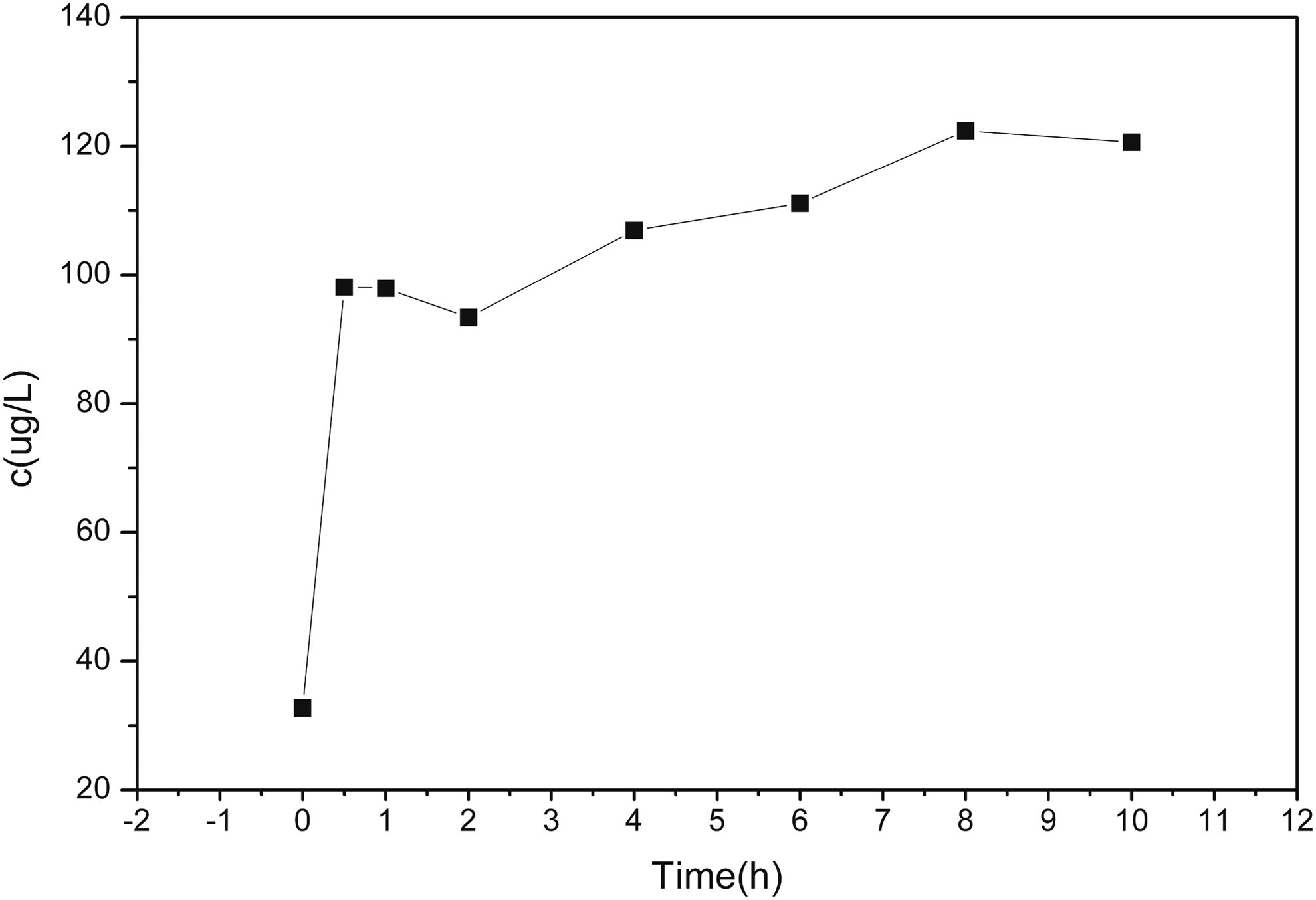
Time profiles of DEHP concentrations in wastewater for DEHP desorbed from biofilms.
The data shown in Fig. 6 reveal that DEHP desorption from biofilms was a very fast process during the initial period, but it needed a long time to reach the DEHP equilibrium between biofilms and wastewater at 4°C. Similar results are also found in DEHP adsorption by both pure bentonite and natural suspended particles (Sirivithayapakorn and Limtrakul, 2008). Our results lead us to conclude that there was a dynamic balance of DEHP between biofilms and wastewater. If biological effects were neglected, when the concentration of DEHP in wastewater was higher than that in biofilms on media, biofilms would adsorb DEHP from wastewater. When the concentration of DEHP in biofilms is higher than that in wastewater, DEHP will leave biofilms and go back into wastewater.
Conclusions
Adsorption characteristics of DEHP in biofilms at 4°C were studied. This low temperature was selected to reduce as much as possible the interactions between biological metabolism and adsorption.
This work indicates a transient balance of DEHP concentration between the biofilms and the wastewater. The adsorption of DEHP from wastewater reached equilibrium within 1 h, but equilibrium of desorption required times on the order of 8 h. The kinetics of DEHP adsorption on biofilms follows a pseudo-second-order transient model. In addition, the equilibrium data fit well with both the Langmuir and Freundlich isotherm models.
Footnotes
Acknowledgments
The authors thank Professor Mahlon R. Smith of Beijing University of Technology for very extensive English language assistance. This work was supported by the National Natural Science Foundation (50808002, 51178006), the Beijing Nova Program (2008B11), and the Importation and Development of High-Caliber Talents Project of Beijing Municipal Institutions (CIT&TCD201304055).
Author Disclosure Statement
No competing financial interests exist.