




Abstract
Abstract
This is the first study on application of a sponge-membrane bioreactor (sponge MBR) for recirculation of aquaculture wastewater in the Mekong delta, Vietnam. Performance of a sponge MBR with a moving-cube sponge medium (20% v/v) was evaluated at different hydraulic retention times (HRTs) for the specific example of catfish pond wastewater. The sponge MBR was operated at HRT values of 8, 4, and 2 h, which correspond to membrane fluxes of 5, 10, and 20 L/m2 per hour, respectively. The average chemical oxygen demand (COD) removal efficiencies were maintained at 93%, 94%, and 87% at an HRT of 8, 4, and 2 h, respectively, while the average total nitrogen (TN) removal efficiencies were 84%, 70%, and 57%. The COD and TN removal efficiencies decreased with a decrease in HRT (increase in membrane flux). Permeate concentrations of COD and TN were as low as 6.3 and 2.7 mg/L at the operated HRTs, respectively. Compared to the conventional MBR, the sponge MBR had twice the TN removal capacity at the same HRT due to simultaneous nitrification–denitrification. In addition, results implicated that the fouling rate (dTMP/dt) increased in an inverse proportion with HRT (h) according to the power equation (fouling rate=4.2474 HRT−2.225). Free movement of sponges in the reactor improved fouling due to sweeping of the cake layer on the membrane surface. Results reveal that the sponge MBR was effective in terms of simultaneous organic and nitrogen removal, fouling control, and water recirculation.
Introduction
Biological removal of organic compounds and nutrients from polluted aquaculture wastewater is an appropriate process for water quality and water reuse. The common biological methods include activated sludge process, biofilter, aerated lagoon, and constructed wetlands. However, these approaches often demand a large area due to the requirement for a high hydraulic retention time (HRT). Some treatment processes also have to be operated during a limited time after harvesting fish, when the treated wastewater is discharged into the river. In these situations, a compact and efficient membrane bioreactor (MBR) is proposed to be the most appropriate wastewater treatment solution.
The MBR combines the aerobic degradation with a direct solid–liquid separation of activated sludge using a microfiltration or ultrafiltration membrane. MBR provides better performance than conventional activated sludge, including a smaller required area, higher quality of treated wastewater, and long sludge retention time. Further, high biomass retention in the MBR makes it able to operate at high loading rates, with a comparable small reactor volume. The filtration process can remove microorganisms without chemical disinfection (Visvanathan et al., 2000). Moreover, the use of a medium in the MBR could improve MBR operation, which may increase the treatment performance by high biomass concentrations and reduced membrane fouling (Leiknes and Ødegaard, 2001; Thanh et al., 2012). The presence of the moving medium in the membrane tank can also reduce fouling. The mechanism reducing of the fouling membrane can cause the moving medium in the MBR tank capable of enhancing the combination of suspended and colloidal particles on the surface of the medium for reducing fouling and clogging on the membrane surface.
Jamal Khan et al. (2011) studied the performance of the MBR process in combination with a sponge medium at an HRT of 8 h (representing 15% volume reaction tank) to remove chemical oxygen demand (COD), total nitrogen (TN), and total phosphorus (TP). Results show that the effective removal of COD, TN, and TP with the sponge MBR is 98%, 89%, and 58%. This is higher than the standard MBR, which had a removal of 98%, 74%, and 38% for COD, TN, and TP, respectively. Guo et al. (2008b) found that the sponge MBR (sponge occupies 10% of reactor volume) results in a twofold enhancement of the filtration flux of the MBR. This clearly shows that the addition of sponges to MBR can reduce the contamination loading of the MBR.
Sponge has been considered as a suitable medium because it can act as a mobile carrier for active biomass, resulting in improved organic and nutrients removal, as well as reduce membrane fouling (Chae et al., 2004; Ngo et al., 2006; Guo et al., 2009). In addition, thick biofilm that is formed on the surface of the sponge is regularly removed by friction of individual sponge cubes with each other, whereas the fixed microorganisms within the sponge are very stable and active (Chae et al., 2004). Sombatsompop et al. (2006) investigated the effect of the HRT on membrane performance and sludge properties. MBRs were operated at different HRTs of 2, 4, 6, and 8 h. The MBRs consisted of three bioreactors that included suspended growth without a medium, a moving medium, and a fixed medium. The removal efficiency of COD in the moving medium was found to be 98% with a short HRT of 2 h. The nitrogen removal was accomplished by microorganism assimilation and nitrification reaction in the MBR at all HRT values.
This study aims to investigate the effect of different HRTs on treatment performance and fouling of sponge MBR for catfish wastewater treatment and recirculation.
Materials and Methods
Wastewater
Wastewater was collected from a catfish farm located in Long Xuyen City, An Giang province, Mekong delta, Vietnam. In the later stage of the experiment (after day 88, at the end of the 4-h HRT), serious flooding occurred in the provinces that inundated the pond. Thus, synthetic wastewater was replaced for catfish farm wastewater. The synthetic wastewater was made of catfish pellets with addition of NH4Cl. The concentrations of COD, NH4+-N, NO2−-N, NO3−-N, and TP were similar to those of the real catfish pond wastewater (Table 1).
The real catfish farm wastewater was used at the beginning of the study. From day 88 onward, similar synthetic wastewater component was substituted due to serious natural flooding that occurred in the study area.
COD, chemical oxygen demand; TP, total phosphorus.
MBR and operating conditions
The MBR has a working volume of 40 L with a submerged hollow-fiber membrane module (Tianjin Motimo Membrane Technology, Tianjin, China; surface area of 1 m2, nominal pore size of 0.2 μm). The MBR was operated in a cyclic condition (8 min on/2 min off). The sponge MBR was operated at HRTs of 8, 4, and 2 h. The solid retention time was controlled at 30 days for all HRTs (Table 2). Dissolved oxygen was maintained at a level higher than 4 mg/L by stone diffusers. The transmembrane pressure (TMP) was recorded daily by a pressure gauge. When the TMP reached a set-point value of 40 kPa (membrane fouling), a backwash pump (Blue-White Industries, Huntington Beach, CA) was automatically operated to flush off the caked layer formed on the membrane surface. The flow rate of the backwash pump was set at 20 L/h for 5 min. However, in this study, the backwash only occurred at the highest HRT of 2 h. Before the system started a new run, the membrane was cleaned by chemicals (0.5% NaOH and 0.5% NaOCl) for 4 h. Seed sludge for the sponge MBR was taken from a conventional activated sludge process (70% v/v) and sediment from the bottom of a catfish pond (30% v/v). The initial mixed liquor suspended solids (MLSS) concentration was approximately of 6000 mg/L.
HRT, hydraulic retention time.
Sponge medium
Polyurethane sponge, with a density of 18.2 kg/m3, and a sponge cube of 2 cm×2 cm×2 cm were used as a moving medium. The sponges were added in the MBR proportional to 20% of the reactor volume (Guo et al., 2010).
Analytical methods
Analyzed parameters were COD, nitrite, nitrate, ammonia, TP, MLSS, and mixed liquor volatile suspended solids (MLVSS). The biomass concentration in the sponges was estimated according to Guo et al. (2010). Analytical methods were done according to the standard methods (APHA, 1998). Nitrogen balance was estimated by Equation (1):
Nitrogen assimilated into the cell biomass was estimated based on the produced volatile-suspended solids (VSS). The assimilated nitrogen was equal to 12% VSS (Metcalf & Eddy, Inc., 2003). The nitrogen balance was conducted to estimate the simultaneous nitrification–denitrification (SND) that occurred in the sponge medium.
All results were statistically compared by one-way analysis of variance using Minitab 16.
Results and Discussion
COD removal
The average COD removal efficiency during the operating period is shown in Table 3. The removal efficiency of COD ranges between 87% and 94% with an HRT ranging from 2 to 8 h. The average COD concentrations in the permeate were ∼6.3 mg/L for the operated HRTs. A similar observation was reported by Côté et al. (1997), who suggested the effluent COD from a hollow-fiber MBR was maintained at a level below 16 mg/L, despite a five-stage change in the HRT from 2 to 24 h, and Guo et al. (2008b) found the COD removal efficiency over 97%. The COD removal was maintained at 93% and 94% at an HRT of 8 and 4 h, respectively, but was 87% at an HRT of 2 h, which indicates that the HRT affects the permeate quality in terms of COD removal. This is in contrast to the result of Sombatsompop (2006), who reported that the MBR provided an excellent and stable effluent quality at HRT values between 2 and 8 h.
Data was analyzed by Minitab 16 Statistical Software.
Superscript letters denote significant differences among periods of operation. Means in the same row that do not share the same letter are significant different (p<0.05).
The permeate COD not only complies with the Vietnam National Technical Regulation on the effluent of aquaculture-processing industry, QCVN 11:2008/BTNMT (50 mg COD/L), but also reaches the Vietnam National Technical Regulation for surface water quality, QCVN 08:2008/BTNMT (100 mg COD/L). Moreover, the organic content in treated wastewater was removed to a level that would make the water acceptable for such uses as park irrigation, vehicle washing, firewater, flushing a toilet, or aquaculture recirculation, according to the U.S. Environmental Protection Agency (USEPA, 2004). Based on these guidelines, the treated wastewater can be recycled directly to the catfish pond.
Nitrogen removal
Characteristics of catfish pond wastewater are mainly ammonia (NH3) with its derivatives, NH4+-N, NO2−-N, and NO3−-N. Ammonia and nitrite are harmful substances for aquatic animals. In a catfish pond, ammonia is generated by the natural decomposition of proteins, which are residues from various sources including zooplankton, fish excrement, and uneaten food. The average concentrations of NH4+-N, NO2−-N, NO3−-N, and TN in catfish wastewater treated with the sponge MBR are summarized in Table 4. During the operational period, the NH4+-N removal efficiencies at HRTs of 8, 4, and 2 h were 100%, 99%, and 86% in the sponge MBR, respectively, which implies slightly better nitrification at a higher HRT. Guo et al. (2009) reported ammonia nitrogen removal of >99% with 10% sponge medium at an influent ammonia nitrogen concentration of 15–20 mg/L. Jamal Khan et al. (2011) mentioned NH4+-N removal of 95.6% with 15% sponge medium at an HRT of 8 h. Liu et al. (2010) reported that increasing HRT from 2 to 4 h could enhance the NH4+-N removal from 47.2% to 98.1%. Table 4 indicates that there was no significant improvement between HRTs of 4 h and 8 h in terms of NH4+-N elimination, as almost all (99%) had been removed after 4 h.
TN=NH4+-N+NO2−-N+NO3−-N. Data was analyzed by Minitab 16 Statistical Software.
Superscript letters denote a significant differences among periods of operation. Means in the same row that do not share the same letter are significantly different (p<0.05).
TN, total nitrogen.
The average nitrite concentration was ∼0.03 mg/L with HRTs of 8 and 4 h, but >1.0 mg/L with an HRT of 2 h. This indicates a limited nitrification capacity of the MBR during a short retention time. An HRT of 2 h is too short to achieve complete nitrification. This result is similar to the result of Sombatsompop (2006). The results infer that changes of HRT affect the nitrogen removal efficiency of the sponge MBR.
TN removal efficiencies of the sponge MBR were 84%±8%, 70%±18%, and 57%±21% at HRTs of 8, 4, and 2 h, respectively. This indicates that TN removal of the sponge MBR increases with an increasing HRT. In the sponges, nitrification probably takes place on the surface of the sponge, whereas anaerobic/anoxic conditions inside the sponge provide a suitable environment for denitrification (Nguyen et al., 2010). This phenomenon is SND. A higher HRT enriches slow-growing microorganisms and creates effective contacts between microorganisms and substrates. SND occurs in the sponge medium because of the biomass captured within the pores of the sponge and a limited oxygen concentration inside the pores. This explains the comparatively high TN removal in the sponge MBR (Yang et al., 2009). Therefore, an HRT of 4–8 h could be the appropriate operating time for nitrogen removal in this system. Figure 1 provides a simplified illustration of the possible mechanism for nitrogen removal through SND in the sponge MBR.
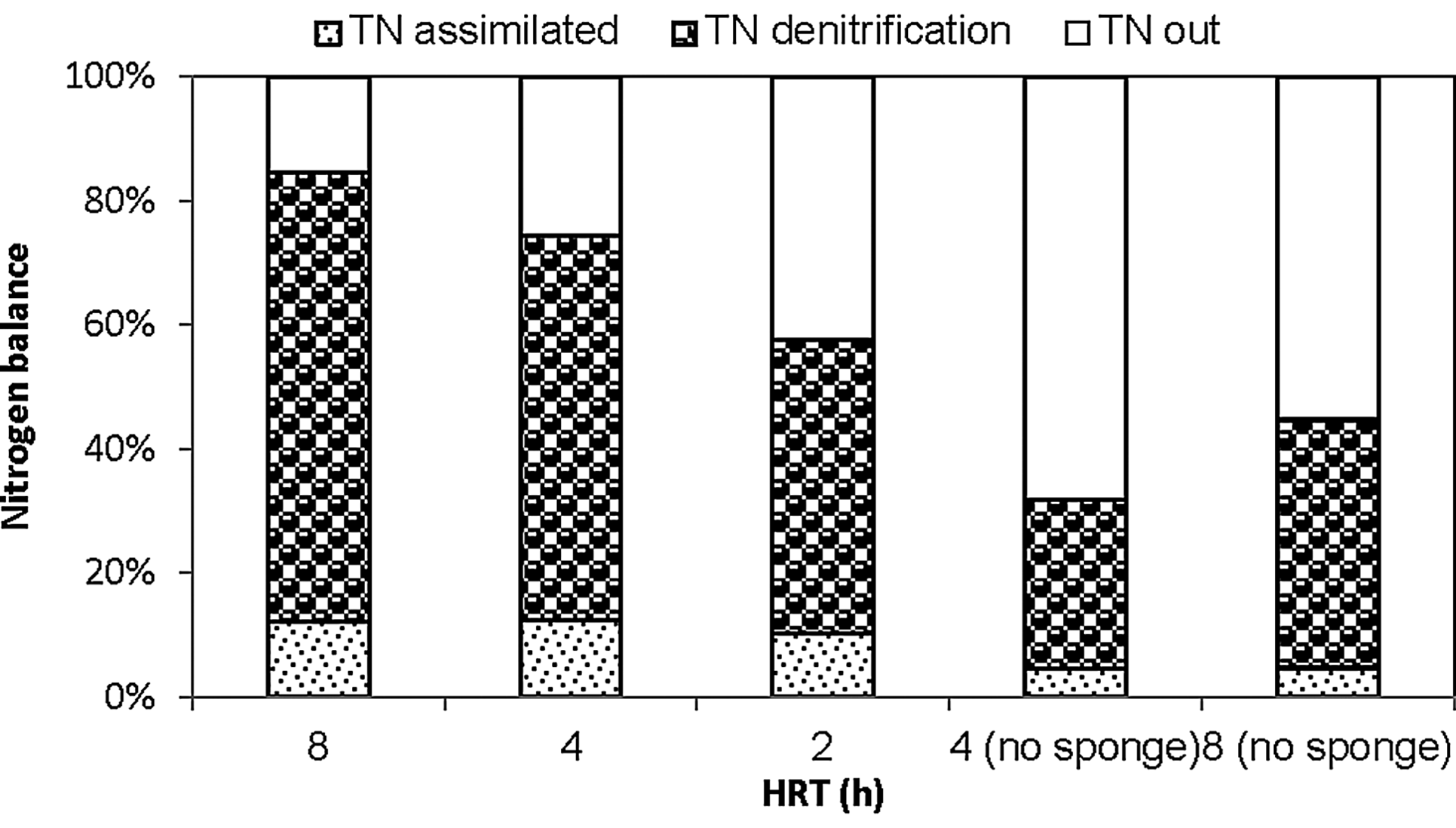
Nitrogen balance in a sponge-membrane bioreactor (sponge MBR).
The nitrification reaction occurs nearly completely at HRTs of 8 and 4 h, as the concentrations of TN are low in the membrane permeate of the sponge MBR. The TN concentration in the permeate at 2-h HRT is almost twofold higher than those at other HRTs. These results indicate that the reaction time of 2-h HRT is not enough for SND to occurr in the sponge MBR. The HRT influences the nitrogen removal capacity of the sponge MBR. Fig. 1 also shows that the amount of TN denitrified at HRTs of 8 and 4 h in the sponge MBR is 72% and 62% higher than at HRTs of 8 and 4 h in a conventional MBR (no sponge in the MBR), where the amount of TN denitrified was 40% and 27%. It is inferred that the sponge medium can achieve complete nitrogen removal through SND. The percentage of denitrification in sponge MBR is twice that in a conventional MBR at the same HRT.
Table 4 presents the average removal of TP in the sponge MBR, which is 82%, 56%, and 64% at HRTs of 8, 4, and 2 h, respectively. TP removal at a 4-h HRT is lower than that at a 2-h HRT probably because the concentration of TP in the influent at a 4-h HRT was lower than that at a 2-h HRT. The TP removal efficiency in this study is 82% higher in comparison with a conventional MBR: 58% in the sponge MBR, and 38% in the MBR without sponge in the studies of Jamal Khan et al. (2011).
Biomass in sponge MBR
Figure 2 shows that the biomass accumulated in the MBR with time from 8- to 4-h HRT. The trend was similar for biomass in sponges. The rate of biomass formation in sponges was higher than that in suspended growth; thus, the ratio of MLSS in sponge/total MLSS increased with the operation time, showing that the shorter the HRT, the higher the ratio. More biomass in sponges enhanced more TN removal and fouling control. It is observed that when operated at a 2-h HRT (high flux of 20 L/m2 per hour), the biomass started releasing from the sponges, and a large amount of biomass attached strongly to the membrane module. This resulted in total biomass reduction in the reactor since day 138, and serious fouling occurred in the 2-h HRT operating period (as described in the Fouling propensity of sponge MBR section). The average total biomass in sponges and in suspension was 3908±813 mg/L during this stage. The level sensor had a problem on day 148; the biomass was lost, and the total MLSS remained 2882 mg/L. Then, the total MLSS started increasing and reached 5136 mg/L on day 158.

Biomass fraction in the sponge MBR with time.
The MLVSS/MLSS ratio ranged from 0.21 to 0.69 during operation. The ratio reduced from 0.43 to 0.21 during the 8-h HRT. This was due to the endogenous respiration in the sponge MBR (F/M=0.07–0.52 mg COD/mg VSS per day). The ratio increased from 0.24 to 0.6 at 2- and 4-h HRTs. The MLVSS/MLSS ratio in the sponge MBR was lower than that in a conventional MBR.
Fouling propensity of sponge MBR
Figure 3 shows the variation of the TMP during the operation of the sponge MBR. The results show that TMP development fluctuated from 3.5 to 6 kPa in 58 days, from 6 to 18 kPa in 43 days, and from 20 to 40 kPa in 15 days for HRTs of 8, 4, and 2 h, respectively (Table 5). The TMPs fluctuated at an HRT of 4 h because the biomass concentration in the MBR was lost due to the malfunctioning water-level sensor.
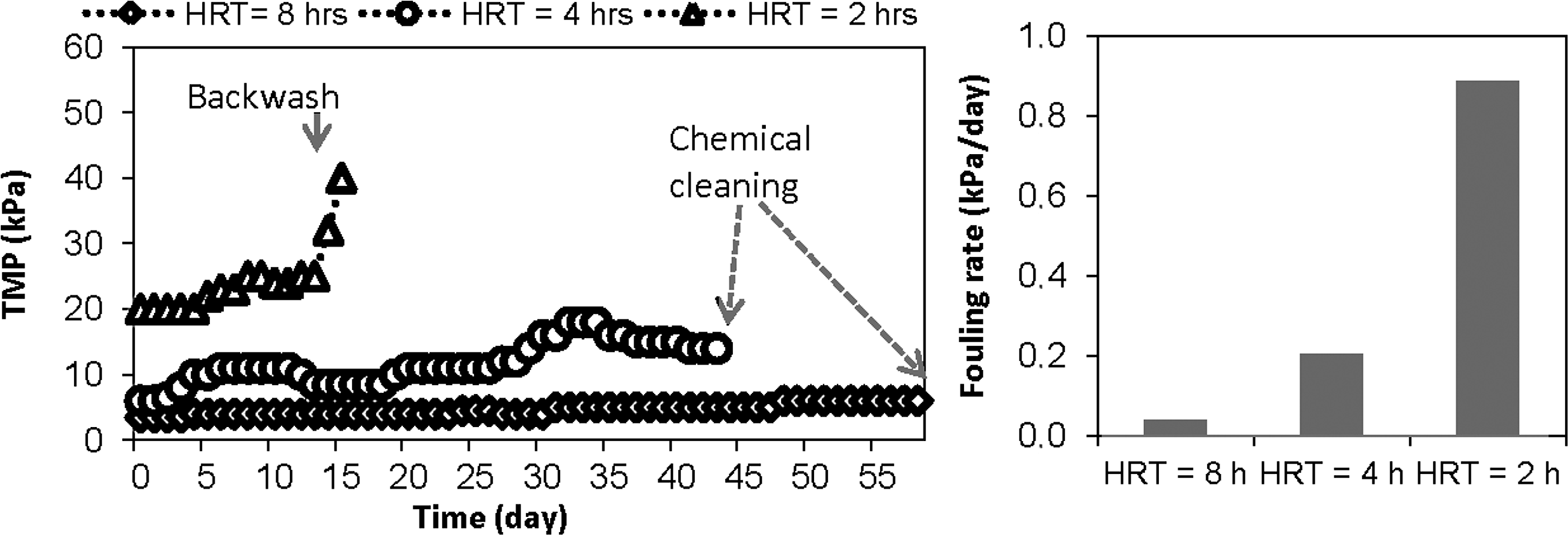
Profile of transmembrane pressure (TMP) with time (left) and fouling rate (right).
Sponge percentages are % (v/v).
MBR, membrane bioreactor; TMP, transmembrane pressure.
In the last period, the TMP reached 40 kPa, and the membrane was backwashed by permeate water. The need for membrane backwash after a comparatively short period operation (15 days) at a 2-h HRT was due to a high fouling speed because of a high flux (20 L/m2 per hour). This flux is slightly over the maximum allowable flux for the sponge membrane. This indicates that a reduction in the HRT (increasing membrane flux) results in an increase in membrane fouling, which is in agreement with previous studies (Cho et al., 2005; Kok-Kwang et al., 2011). In this study, the relationship between the fouling rate (kPa/day) and the HRT (h) in the sponge MBR was found to follow the power equation (dTMP/dt=4.2474 HRT−2.225, R2=0.9992).
Table 5 shows the comparison of the average fouling rates of some other reports. The lowest fouling rate of 0.04 kPa/day is for the sponge MBR treating catfish pond wastewater at a flux of 5 L/m2 per hour. It indicates that the flux (and thus the HRT) strongly influences the fouling propensity of the sponge MBR. The results imply that the fluxes <10 L/m2 per hour are suitable operating conditions of the sponge MBR for treating and reuse of catfish pond wastewater. If the fouling rate is slow, the membrane will be expanded, and the operation and lifetime investment for replacement and chemicals for backwashing membrane will be reduced.
Conclusion
This study investigated the organic compounds, nitrogen, and phosphorous removal performance of a sponge MBR at HRTs of 2, 4, and 8 h (fluxes of 20, 10, and 5, L/m2 per hour, respectively). It demonstrated that the sponge MBR exhibited the best treatment performance at an HRT of 8 h for COD, TN, and TP removal efficiencies of 93%, 84%, and 82%, respectively. The COD removal at HRTs of 8 and 4 h was not significantly different. An HRT of 4–8 h was required to stimulate an SND process, which is important to allow for a high reduction in the TN content of the catfish farm wastewater. The fouling rate was as slow as 0.04 and 0.20 kPa/day at a flux of 5 and 10 L/m2 per hour, respectively. The optimal flux for catfish farm wastewater should be in the range of 5–10 L/m2 per hour for a sponge MBR. In addition, the small size, high organic and nutrient removal efficiencies, and slow fouling rate of sponge MBR make this technology a potentially attractive alternative to conventional wastewater treatment methods. The treated wastewater can be recycled directly to the catfish pond during the culture period. Thus, it is clear that sponge MBR technology could contribute to a more environmentally sustainable development of catfish farming in the Mekong delta, Vietnam.
Footnotes
Acknowledgments
The authors would like to thank the Swedish International Cooperation Agency, the Partner Driver Cooperation Project on Sustainable Management of Ecosystem Services, for long term aquaculture production in the Mekong Delta
Author Disclosure Statement
No competing financial interests exist.