




Abstract
Abstract
Kinetic aspects of sorption of Cr(VI) on modified lignocellulosic material rice straw (RS-AE) in a neutral water solution has been studied through batch sorption experiments and test of experimental data with pseudo-first and -second order rate models, Elovich's equation and a diffusion model. Results showed pseudo-second order rate expression provided the best fit kinetic model for all of the Cr(VI)–RS-AE system studied. Activation energy (Ea=24.53 kJ/mol) suggested that the sorption of Cr(VI) is an endothermic chemical sorption process. It was found that film diffusion governed the rate-limiting process under most experimental conditions except for the dilute Cr(VI) solution (0.15 mM). The removal mechanism of Cr(VI) was also investigated in this work, and it found that Cr(VI) was removed mainly through ion exchange with chlorine on RS-AE under neutral pH conditions. Appearance of Cr(III) both in a solution and in RS-AE indicated that reduction of Cr(VI) was included in the removal mechanism.
Introduction
Conventional methods for removing Cr(VI) include chemical reduction followed with precipitation, ion exchange by resins, adsorption on activated carbon, reverse osmosis membrane, and so on. However, these methods have limitations on the disposal of toxic sludge or economic viability in developing countries (Gupta et al., 2001; Miretzky and Cirelli, 2010). Over the past several years, low cost adsorbents, such as fungal biomass (Deng and Ting, 2005), bark (Sarin and Pant, 2006), walnut hull (Wang et al., 2009), bamboo grass (Koroki et al., 2010), and other lignocellulosic materials from agricultural by-products, provide an alternative for removal of Cr(VI). An examination with sugarcane bagasse, sawdust, sugar beet pulp, and maize cob showed that Cr(VI) could be effectively removed in a strongly acidic solution (Sharma and Forster, 1994). The following studies also confirmed that the high adsorption capacity of Cr(VI) on cellulosic adsorbents only could be achieved under low pH conditions (Dupont and Guillon, 2003; Bishnoi et al., 2004; Park et al., 2004, 2008; Jain et al., 2009).
It was revealed that the pH value of an aqueous solution played an important role in sorption of Cr(VI) by lignocelluloses (Krishnani et al., 2008; Miretzky and Cirelli, 2010). At lower pH (<2), high sorption amount of Cr(VI) could be acquired because the reduction of Cr(VI) to Cr(III) favored Cr(VI) removal. In acidic solutions Cr(VI) has a very high positive redox potential and is easy to be reduced (Dupont and Guillon, 2003; Krishnani et al., 2008). As pH increases to neutrality or alkalescence, the redox potential of Cr(VI) and the attraction between Cr(VI) and adsorbent both decrease, which leads to a very low removal efficiency (Sharma and Forster, 1994; Dupont and Guillon, 2003). Furthermore, for many reported lignocellulosic adsorbents, it took hours, even days, to reach adsorption equilibrium (Krishnani et al., 2008; Park et al., 2008), and whether film diffusion or particle diffusion is the rate limiting step during Cr(VI) adsorption is not clear enough (Raji and Anirudhan, 1998; Sag and Aktay, 2002).
Obviously, rapid removal of Cr(VI) is desirable because short time consumption is meaningful in wastewater treatment practice. The ion exchange process was thought to be fast and effective to remove anionic species from water (Orlando et al., 2002; Dabrowski et al., 2004; Pehlivan and Cetina, 2009). Especially, the strong anion exchanger with quaternary amino groups could work under a large pH range because its functional group always positively charged from acidic to weak basic conditions (Anirudhan et al., 2006). In our previous study, a strong basic anion exchanger (RS-AE) was prepared by modifying rice straw with quatary ammonium, and we found the exchanger was effective for adsorption of Cr(VI) in a neutral solution and even under weak base conditions (Cao et al., 2013). The present study focuses on the sorption kinetics and mechanisms of Cr(VI) on RS-AE to find an appropriate model for the kinetics of removal in a batch reactor and understand the mechanisms that govern Cr(VI) removal.
Materials and Methods
Materials and chemicals
Raw rice straw was obtained in the countryside around Guangzhou, China. The straw was dried at 60°C after being washed with tap water and deionized water. It was shattered and sieved to obtain particles in the range of 0.2–0.9 mm (80–20 mesh). These straw particles would be used as raw material to prepare the anion exchanger. Trimethylamine water solution and epichlorohydrin were bought from Sinopharm Chemical Reagent Co. Ltd. The stock solution of 0.01 M Cr(VI) was made by dissolving certain weight dried potassium chromate (K2CrO4) in deionized water. All the Cr(VI) solutions with required concentrations were diluted from the stock solution. The pH of solution was adjusted by 0.1 M sodium hydroxide (NaOH) and 0.1 M hydrochloric acid (HCl) solution. All the chemicals are analytical grade.
Preparation of anion exchangers
Six grams of raw straw particles were first treated with a 10% (w/v) NaOH solution at room temperature for 2 h to activate cellulose in rice straw. The alkali treated straw was reacted with 60 mL epichlorohydrin in a three-neck flask for 6 h at 65°C to obtain epoxypropyl cellulose. The excess epichlorohydrin was removed from the reaction system by filtration. Then, 60 mL of trimethylamine solution was added into the flask and was reacted for 3 h at 80°C to introduce quaternary amino groups into rice straw. Products were successively washed with 1:1 ethanol and 0.1 M HCl solution to convert it into a chlorine resident form. Then, it was washed with plenty of deionized water and dried at 60°C. The dried product as the exchanger (RS-AE) would be used in the following experiments.
Total nitrogen content (N%) of RS-AE is 2.75% measured by the Vario EL III element analyzer (Elementar Co., Ltd.). Total exchange capacity (TEC, mEq/g) can be evaluated from N% with formula TEC=N%/1.4 (Laszlo, 1996). The TEC of RS-AE is 1.96 mEq/g, suggesting a great potential for Cr(VI) removal.
Adsorption experiments
Adsorption experiments were carried out in a 100-mL conical flask containing 0.1 g RS-AE and 50 mL of Cr(VI) solution. The flasks were put into a thermostatic orbital shaker under desired temperature (±1 K). The rotation rate was set at 150 rpm. The pH value of the Cr(VI) solution was 6.8 without any adjustment during the experimental process. The effect of initial concentrations on Cr(VI) removal kinetics was studied by varying initial Cr(VI) concentrations from 0.15 to 1.5 mM (0.15, 0.5, 1.0, and 1.5 mM) at a temperature of 298 K. While to study the effect of temperature on Cr(VI) adsorption kinetics, experiments were performed at a temperature of 291, 298, 308, and 318 K with a 1.0 mM Cr(VI) initial concentration. The contact time intervals (1, 2, 5, 10, 20, 30, 40, 50, 60, 70, 80, and 90 min) were adopted to obtain adsorption kinetic data. The supernatant liquid in the conical flask was separated by filtration, and the filtrate was collected for chemical analysis. The adsorption amount of Cr(VI) at time t, qt (mg/g), was calculated from mass balance equation in the following form [Eq. (1)]:
where C0 (mM) and Ct (mM) are the initial Cr(VI) concentration and the Cr(VI) concentration at time t, respectively; V (0.05 L) is the volume of Cr(VI) solution; m (0.1 g) is the mass of adsorbent; and MCr (52 g/mol) is the atomic weight of chromium.
Chemical analysis
In this work, the Cr(VI) concentration was determined by spectrometric measurement at λ=540 nm using an untraviolet–visible light spectrophotometer (UV2550-Shimadzu) after reaction with 1,5-diphenyl-carbazide. This method has been reported frequently for Cr(VI) determination in water solutions (Celik et al., 2004; Sarin and Pant, 2006; Pehlivan and Cetina, 2009; Miretzky and Cirelli, 2010). The inductively coupled plasma optical emission spectrophotometer (ICP; Optima 5000) was employed to measure the concentration of total Cr. The difference between total Cr and Cr(VI) concentration was used as Cr(III) concentration (Krishnani et al., 2008; Miretzky and Cirelli, 2010). In addition, X-ray photoelectron spectroscopy (XPS) was used to probe the oxidation state of chromium being sorbed on RS-AE.
Results and Discussion
Kinetics with different initial Cr(VI) concentration
The adsorption kinetic of Cr(VI) on RS-AE was examined at different initial Cr(VI) concentrations. As shown in Fig. 1a, the adsorption amount of Cr(VI) increases fast within the initial 20 min, and then it changes just a little. Therefore, it can be inferred that the adsorption equilibrium time is ∼20 min. The entire adsorption process can be divided into two stages, the rapid growth stage and the slow increase stage, which also was called the near equilibrium stage (Yoon, 2006). The rapid increase stage was possibly derived by electrostatic force between Cr(VI) anions and active adsorption sites on RS-AE. The slow near equilibrium stage may be resulted from decrease of electrostatic attraction after adsorption sites were saturated. Figure 1a also illustrates that equilibrium adsorption capacity of Cr(VI) on RS-AE was enhanced as the initial Cr(VI) concentration increased from 0.15 to 1.5 mM.
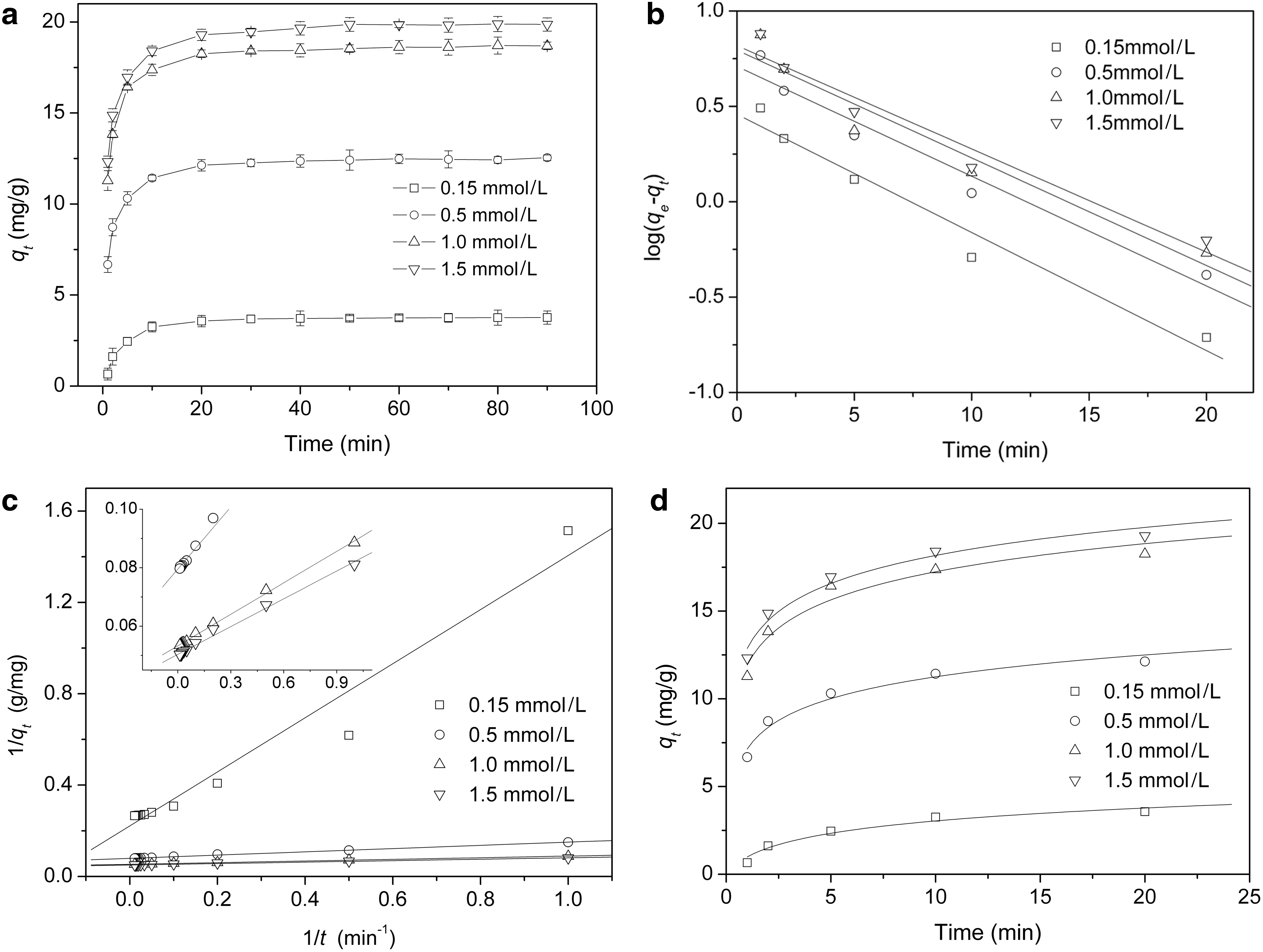
Sorption kinetics of Cr(VI) by RS-AE with different initial Cr(VI) concentrations.
The experimental data were further tested with different sorption kinetic models, such as the pseudo-first and -second order models and Elovich's equation. (Azizian, 2004; Qiu et al., 2009). Lagergren gave the pseudo-first order equation that was expressed as follows:
where qe and qt (mg/g) are the amount of adsorbed Cr(VI) at equilibrium and at time t, respectively; kp1 (1/min) is the pseudo-first order rate constant (Lagergren, 1898; Ho, 2004). After being integrated at the boundary conditions of qt=0 at t=0 and qt=qt at t=t, the pseudo-first order equation yields a commonly used form:
The pseudo-second order equation was presented as
where kp2 (g/[mg·min]) is the pseudo-second order rate constant of the adsorption process (Ho and McKay, 1998, 1999). Integrating Equation (4) with boundary conditions t=0 to t=t and qt=0 to qt=qt, gives
Separating the variables qt and t, Equation (5) was rearranged into a linear form:
The plot of 1/qt to 1/t should be a straight line if the adsorption follows the pseudo-second order rate equation. The Elovich's equation has been applied to describe adsorption of heavy metal ions from aqueous solutions on biomass materials (Sag and Aktay, 2002). It was expressed in the following form:
where a and b are constants related to desorption and initial adsorption rate, respectively (Ho and McKay, 1998; Cheung et al., 2001).
Solving Equation (7) with boundary conditions qt=0 at t=0 and qt=qt at t=t yields
In this study, the linear forms of pseudo-first and -second order models [Eqs. (3) and (6)] and Elovich's equation [Eq. (8)] were used to fit adsorption kinetic data of Cr(VI) on RS-AE.
The analysis results from kinetic models are shown in Fig. 1b–d. The calculated parameters from the three kinetic models are presented in Table 1. The correlation coefficients of the pseudo-second order equation are greater compared with the pseudo-first order and Elovich's equation. The experimental equilibrium adsorption capacities, qe,Exp, agree perfectly with theoretical values (qe,Cal) calculated from the pseudo-second order equation, and deviate considerably from that of the pseudo-first order equation. These results clearly indicate that Cr(VI) adsorption by RS-AE follows the pseudo-second order rate equation, which is applicable throughout the entire contact time as shown in Fig. 1c. The pseudo-first order and Elovich's equation did not apply throughout the whole contact time, and a relatively better fit only could be obtained in the first rapid stages as mentioned above (Fig. 1b, d).
Mathematical variables and constants are described in the text.
The effect of initial Cr(VI) concentrations on the adsorption rate can be seen from the variation of pseudo-second order rate constant kp2. As initial Cr(VI) concentrations increase from 0.15 to 0.5 mM, the pseudo-second order rate constant kp2 was obviously enhanced. However, when the initial concentration rose to 0.5 and 1.5 mM, it did not apparently increase and seems to fluctuate at a limit value. To explain this phenomenon, the relationship between the amount of Cr(VI) anions and the active adsorption sites provided by RS-AE was considered. In a dilute Cr(VI) solution (0.15 mM), total adsorption sites were sufficient compared to the number of Cr(VI). As a result, the adsorption rate was controlled by Cr(VI) concentrations, and the increase of Cr(VI) concentrations could effectively accelerate the adsorption. When the initial Cr(VI) concentration was enhanced to a high level, the adsorption sites became insufficient and turned to be the limiting factor to the overall adsorption rate. The amount of total adsorption sites is a constant dependent on the adsorbent dose that may restrict the adsorption rate at limit value.
Adsorption kinetics at different temperatures
Adsorption kinetic plots of Cr(VI) on RS-AE at 291, 298, 308, and 318 K are shown in Fig. 2a. Most of Cr(VI) was removed in the first 20 min, and the adsorption amount was increased with the contact time and temperature. The kinetic curves at different temperatures were also analyzed with pseudo-first and -second order adsorption rate equations and the Elovich's kinetic model as shown in Fig. 2b–d. The related parameters of the three kinetic models are presented in Table 2. The pseudo-first order and Elovich's equations were not applicable with the complete contact time. The kinetic curves at different temperatures can be well described by pseudo-second order rate equation, of which the correlation coefficient was greater compared with others and the calculated equilibrium adsorption capacities, qe,Cal, were closer to the experimental values.

Sorption kinetics of Cr(VI) by RS-AE at different temperatures.
From Table 2, it can be seen that the pseudo-second order rate constant kp2 increased with the enhancement of temperature. This indicates that the increase of temperature can accelerate Cr(VI) adsorption on RS-AE in the experimental scale. It is known that the temperature dependence of the rate of most chemical reactions can be fit successfully with the Arrhenius equation (Dogan and Alkan, 2003). So, the activation energy of Cr(VI) adsorption on RS-AE was evaluated by using the linearized Arrhenius equation in the following form (Ho et al., 2000):
where Ea is the adsorption activation energy (kJ/mol); k is the adsorption rate constant, and kp2 was considered as the overall rate constant for adsorption system of Cr(VI) on RS-AE; A is the Arrhenius constant; R (8.314 J/[K·mol]) and T (K) were the ideal gas constant and Kelvin temperature, respectively. The magnitude of activation energy of adsorption system was used to distinguish physical adsorption and chemical sorption. The energy requirement for physical adsorption usually is no more than 4.2 kJ/mol since the forces involved in physical adsorption are weak (Aksu, 2002; Aksu and Karabayır, 2008). Where chemical adsorption involves chemical bond force, which is much stronger than that in physical adsorption, the activated and nonactivated chemical sorption needs to be considered. The rate for activated chemical adsorption varies with temperature according to a finite activation energy from 8.4 to 83.7 kJ/mol (Li et al., 2009). The activation energy Ea for adsorption of Cr(VI) on RS-AE is 24.53 kJ/mol that was calculated from the slope of corresponding lnkp2 versus 1/T (shown in Fig. 3). This result suggests that Cr(VI) adsorption by RS-AE mainly involves chemical adsorption mechanism. The positive value of activation energy indicates that the adsorption is an endothermal process and the rise of solution temperature can accelerate it. Furthermore, the magnitude of activation energy also gives information on whether the adsorption rate is governed by reaction kinetics or the diffusion process. Diffusion controlled adsorption process have energies usually <25 kJ/mol and reaction kinetics controlled sorption have energies >30 kJ/mol (Ho et al., 2000; Al-Ghouti et al., 2005; Aksu and Karabayır, 2008). Therefore, Cr(VI) adsorption on RS-AE is possibly controlled by the diffusion process of Cr(VI) anions. Nevertheless, whether the adsorption rate is controlled by film diffusion or by particle diffusion deserves deeper analysis.

Arrhenius plots for sorption of Cr(VI) on RS-AE.
Film diffusion and particle diffusion
The adsorption process of an adsorbate in a liquid system by sorbent usually includes three consecutive steps (Suzukl, 1990; Mohan et al., 2006): (1) transport of adsorbate to penetrate the boundary film surrounding the sorbent and to reach the external surface of the sorbent (film diffusion); (2) transport of adsorbate from the external surface to the active adsorption sites existing on the internal surface of sorbent (particle diffusion); (3) adsorption reaction between adsorbate species and active adsorption sites. For an ion exchange process, the release of ions being exchanged should be considered because they also affect the rate of the adsorption process. Step (4) and (5) were added to the above process. (4) Transport of the exchanged ions from the internal surface to the external surface (particle diffusion); (5) transport of the exchanged ions from the external surface to the bulk solution (film diffusion).
Generally, adsorption or ion exchange reaction (step 3) is so rapid that it does not represent the limiting step of the overall adsorption process. Therefore, the overall adsorption rate is determined by film diffusion (steps 1 and 5), otherwise by particle diffusion (steps 2 and 4). The film diffusion and particle diffusion of ion exchange kinetic mechanism have been discussed in detail by Boyd et al. (1947) and Reichenberg (1953). A mathematical model of Equations (10)–(12) has been developed and used to distinguish between the film diffusion and particle diffusion controlled adsorption (Boyd et al., 1947; Reichenberg, 1953; Sarkar et al., 2003; Mohan et al., 2006; Qu et al., 2011). According to previous studies (Boyd et al., 1947; Reichenberg, 1953), the hypothesis of this diffusion model includes that the sorbent particles used in experiments are uniform spheres of radius (r) and the diffusion coefficient (Di) does not vary with the concentration of adsorbates during the sorption experimental process.
where F is the fractional attainment of equilibrium at time t, calculated as the ratio of the uptake amount at time t and the equilibrium adsorption capacity qe,Exp; B is a time constant, which is decided by the effective diffusion coefficient (Di), and the radius of the sorbent particle (r); and n represents an integer that defines the infinite series solution. The linearity test of Bt versus time plots can be used to distinguish whether the film diffusion or the particle diffusion controls the adsorption rate. If the plot of Bt versus t is a straight line passing through the origin, then the adsorption rate is controlled by particle diffusion mechanism otherwise it is governed by film diffusion mechanism. Bt values at each observed F can be obtained from Reichenberg's table (Reichenberg, 1953). Figure 4 shows the Bt plots versus time for Cr(VI) adsorption on RS-AE at different temperatures and concentrations. At lower initial Cr(VI) concentrations (0.15 mM), the plot is linear and approximately passes through the origin indicating that the particle diffusion is the rate limiting process. However, at other experimented conditions, Bt versus time plots do not pass through the origin suggesting that the adsorption rate is controlled by the film diffusion. The results imply that the rate of Cr(VI) adsorption by RS-AE usually is governed by film diffusion except that the adsorption occurs in a dilute Cr(VI) solution of which the particle diffusion turns to be the rate limiting step.
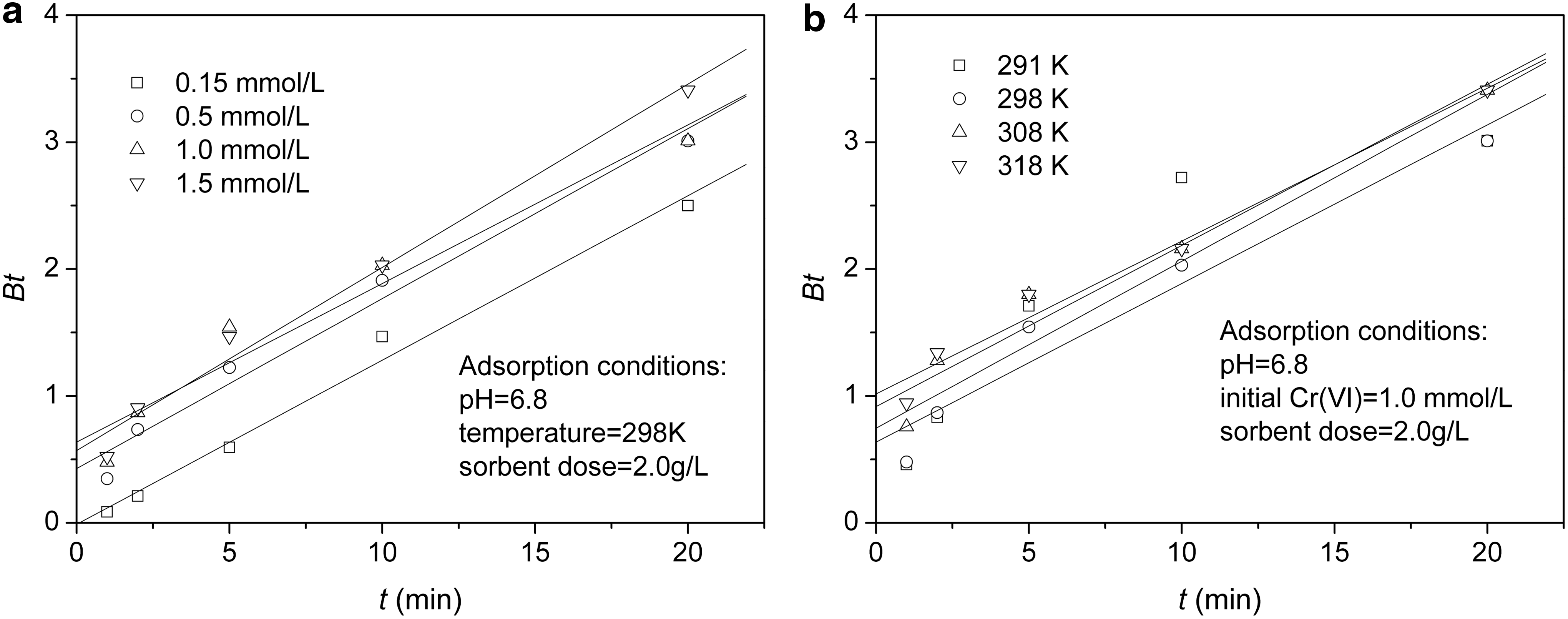
Bt versus time plots for sorption of Cr(VI) on RS-AE with different initial Cr(VI) concentrations
Removal of Cr(VI)
Anion exchange between Cr(VI) and chlorine
The reported removal mechanisms for Cr(VI) from a water solution include electrostatic interactions (Singh et al., 2005; Sarin and Pant, 2006), reduction (Gonzalez et al., 2008), electrostatic interaction and reduction (Sumathi et al., 2005), chelation (Gode et al., 2008), and ion exchange (Dabrowski et al., 2004). In this study, it was found that Cr(VI) anions were mainly removed through anion exchange with chloride ions (Cl−), which were loaded on RS-AE in the preparation of sorbents. Figure 5 shows the variation of the amount of desorbed Cl− and adsorbed Cr(VI) under different initial Cr(VI) concentrations. It is obvious that the amount of exchanged Cl− is always double the number of adsorbed Cr(VI). This positive relationship confirmed the exchange reaction between CrO42− and Cl−, which follows electric charge balance. The exchange reaction can be expressed by Equation (13):
where ES represents the exchange sites on the surface of RS-AE.
Reduction of Cr(VI) to Cr(III)
Figure 5 also illustrates that, at higher Cr(VI) initial concentrations, a small quantity of Cr(III) was formed in the solution after Cr(VI) adsorption. Accordingly, it can be inferred that the removal of Cr(VI) may involve the reduction of Cr(VI) to Cr(III). As we know, Cr(VI) is unstable in the presence of electron donors for its high redox potential value, and it is easy to be reduced to Cr(III) after being sorbed by living plants, rice husk, coir pith, and other lignocellulosic materials (Krishnani et al., 2008; Miretzky and Cirelli, 2010). To confirm the reduction of Cr(VI), the XPS method was used to probe the oxidation state of chromium on RS-AE after Cr(VI) was, respectively, sorbed at acidic, neutral, and basic conditions. The XPS Cr 2p3/2 spectra of RS-AE are shown in Fig. 6. The bands at binding energy of 576.5 and 581.0 eV are attributed to Cr(III) and Cr(VI), respectively (Dambies et al., 2001; Park et al., 2004). The ratio of Cr(III) and Cr(VI) was approximately evaluated from the peak area. The result confirms that Cr(VI) was reduced to Cr(III) during sorption or after being sorbed on RS-AE. Furthermore, the ratio of Cr(III) and Cr(VI) increased with the decrease of pH value of adsorption solution. It shows that the reduction reaction of Cr(VI) is easier to occur in acidic conditions.
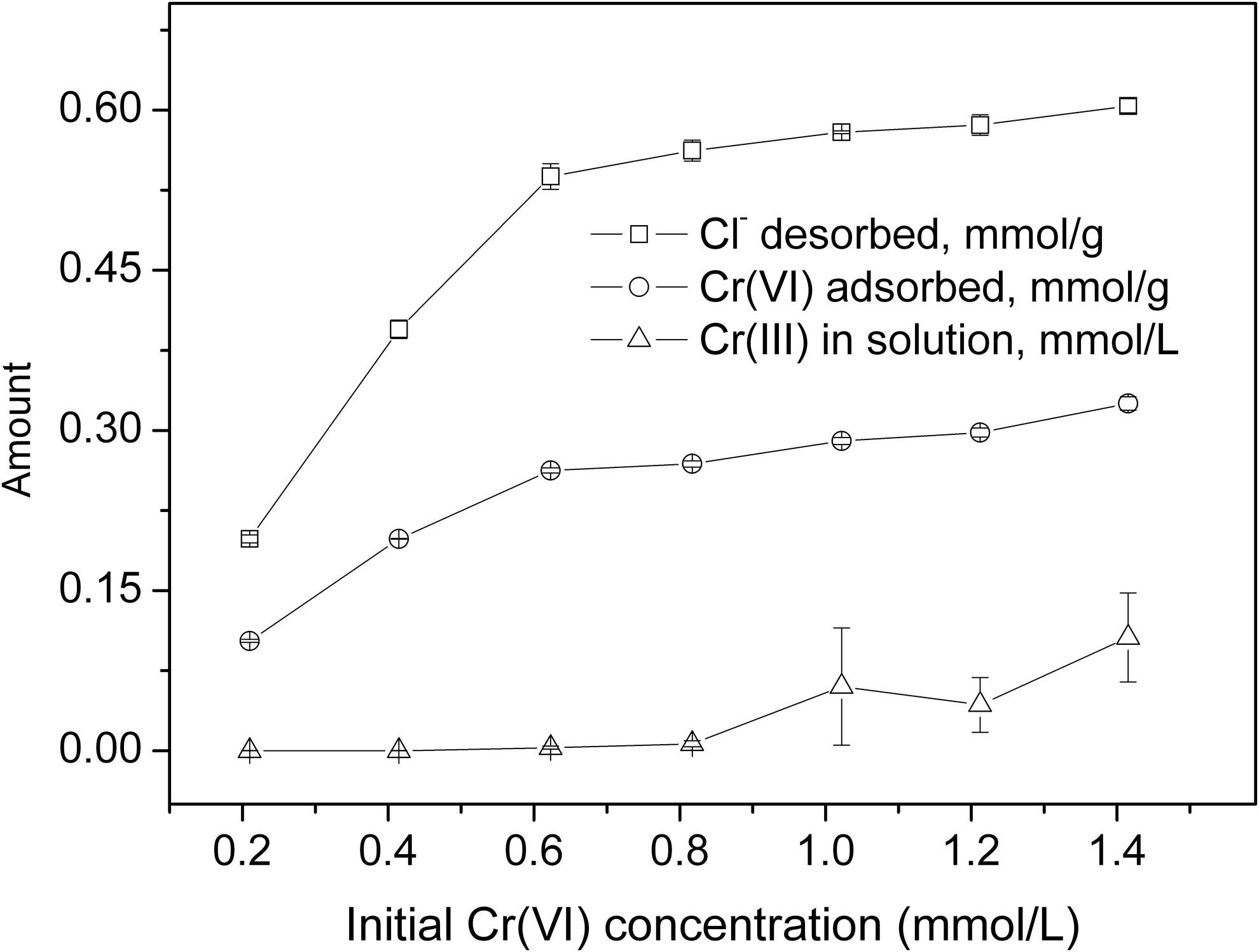
The mechanism analysis of Cr(VI) sorption on RS-AE (sorption conditions: pH=6.8; temperature=25°C; sorbent dose=2 g/L; contact time=60 min).
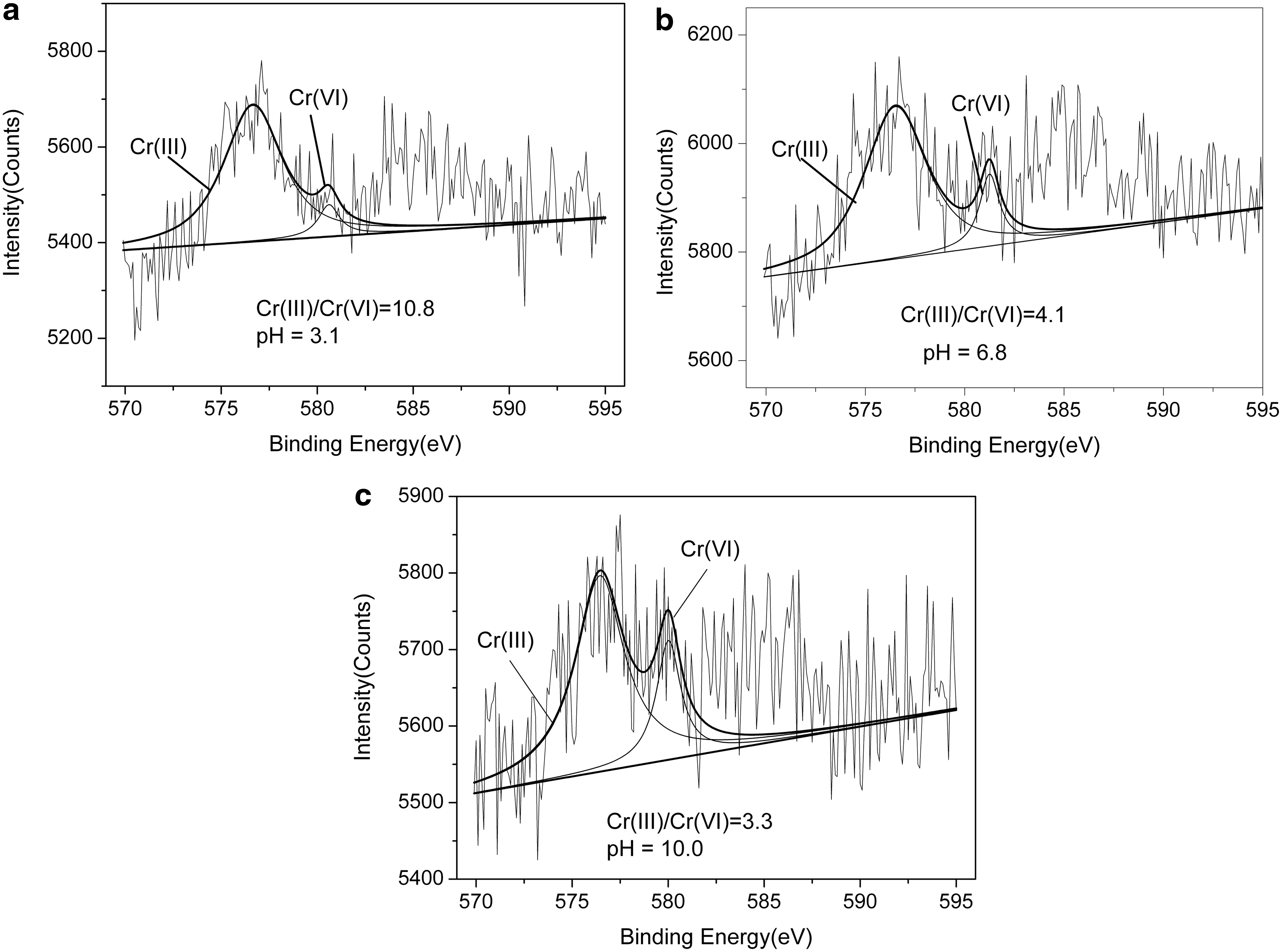
Chromium 2p3/2 X-ray photoelectron spectra of Cr(VI) adsorbed RS-AE with solution pH value of 3.1
In addition, the experimental results show that RS-AE actually has the potential to bind Cr(III) cations. It was assumed that a portion of the formed Cr(III) was released to the adsorption solution and the left is still bound to RS-AE. Therefore, almost no Cr(III) was detected in the adsorption solution with lower Cr(VI) initial concentrations, as shown in Fig. 5.
Conclusions
The sorption of Cr(VI) anions in a neutral aqueous solution on RS-AE is an endothermic and chemical sorption process, and it follows the pseudo-second order adsorption kinetic equation. Increase of temperature and initial Cr(VI) concentration lead to an increase of the overall adsorption rate (kp2). The sorption rate was controlled by film diffusion under most of the experimental conditions except for diluted Cr(VI) solution (0.15 mM) at which particle diffusion was the rate-limiting step. Cr(VI) was mainly removed through ion exchange with chlorine ion that was loaded on RS-AE in advance. The appearance of Cr(III) in the neutral adsorption solution and on the RS-AE sorbent indicated that the removal mechanism included the reduction of Cr(VI).
Footnotes
Acknowledgments
This work was supported by the National Natural Science Foundation of China (No. 41073088), the Scientific Research Fund for Imported Talents of Huaqiao University (No. 12BS211), and the Key Lab of Pollution Control and Ecosystem Restoration in Industry Clusters, Ministry of Education, China.
Author Disclosure Statement
No competing financial interests exist.