




Abstract
Abstract
Absorption capacity of biochar for crude oil and the mineralization potential of the absorbed oil in seawater were determined in laboratory-scale experiments. Texas, South Louisiana, or Qua-Iboe (Nigeria) crude oils were contacted with each of four commercial hardwood biochars and six synthesized biochars in seawater from the Gulf of Mexico and Long Island Sound (U.S.). Synthesized biochars were made from maplewood anoxically at different heat treatment temperatures (HTT) from 300°C to 700°C. Oil absorption capacity of the biochars determined in dip tests using oil on seawater ranged from 3.6 to 6.3 g/g. Oil-imbibed biochar particles were buoyant. Seawater enhanced absorption capacity in relation to the H/C ratio. Oil was less effectively absorbed in the form of weathered water-in-oil microemulsion (“chocolate mousse”) than in as-received form. Absorption capacity peaked at HTT about 400°C and correlated poorly with %C, H/C ratio, O/C ratio, surface area, and porosity. It is proposed that swelling, in addition to macropore filling is responsible for the high capacities of biochar. In biometer tests, CO2 evolution from subcapacity levels of Texas crude in biochar suspended in seawater was stimulated relative to oil in the absence of biochar in three tests; whereas, stimulation in a fourth test was not statistically significant. Thus, biochar may prime biodegradation by providing a favorable solid support and an interstitial reservoir of hydrocarbons for degrader biofilms. While less absorptive than many experimental high-tech absorbents, biochar may serve as an inexpensive alternative for recovery of marine oil spills in a form suitable as a fuel or as an aid to natural attenuation.
Introduction
We report here studies on novel carbonaceous absorbents that should be inexpensive to produce and deploy and can be used to aid natural attenuation or to recover the oil in a form suitable as a fuel. The absorbents are produced from pyrolysis of biomass wastes under low oxygen and moderate temperature. This yields carbonaceous materials known as biochars that have high porosity and hydrophobic surface area. Biochar has attracted interest for its positive effects on soil fertility and its value as a carbon sink (Lehmann and Joseph, 2009). The use of biochar in efforts to mitigate or stabilize oil spills could advance the latter purpose. When used in oil spill remediation, biochar itself is not expected to pose a significant environmental threat, as charcoals from biomass fires are natural components of soil and sedimentary carbon pools (Masiello and Druffel, 1998; Skjemstad et al., 1999). Previous work by Kumagai et al. (2007) reported absorption from the neat phase of two heavy oils by rice husks carbonized at temperatures from 300°C to 800°C; however, those absorbents were about two-thirds inorganic in composition (mainly SiO2). The objective of the present study was to assess the potential of these biochars to serve in a first response to remove or stabilize marine oil spills. We conducted oil dip tests to determine absorbency and tested the bioavailability of absorbed oil toward mineralization by seawater microorganisms.
Experimental Protocol
Materials
South Louisiana and Qua-Iboe (Nigeria) crudes were purchased from Onta Geology (Toronto, Canada). Texas Crude was purchased from Texas Raw Crude (Midland, TX). The oils were stored in sealed amber jars. Some properties of the oils are in Table 1. Certain experiments were performed on physically-weathered Qua-Iboe crude. First, the volatile components were removed by evaporating a layer of crude (∼0.3 cm) in a 20-cm diameter aluminum pan in a fume hood until the weight loss reached 0.03% of initial weight per hour (∼73 h). Then, oil-in-water microemulsion (mousse) was prepared under simulated wave action by shaking 4 g of the evaporated oil and 40 g seawater in a 60-mL screw-cap vial placed in a horizontal position on an orbital shaker (radial distance, 1.3 cm; Lab-Line Instruments, Melrose Park, IL) at 230 rpm (0.77 g) for 4 h.
Onta Geology.
Bobra and Callaghan, 1990.
This study.
Biochars were produced from maple wood shavings at different heat treatment temperatures (HTT) of 300°C, 350°C, 400°C, 500°C, 600°C, and 700°C. Shavings (∼0.4 mm thick) were packed into a stainless steel reactor placed in the center zone of a temperature-programmable three-zone tube furnace (Lindberg/Blue M Tube Furnace; Asheville, NC). Under a flow of 1.5 L/min nitrogen, the shavings were first heated at 100°C for 1 h to drive off moisture, and then heated at the rate of 25°C/min to the desired HTT, which was held for 2 h. The biochar product was removed after allowing the reactor to cool to room temperature, stored for at least 2 weeks in air to complete chemisorption of oxygen, and then gently crushed to pass a 0.5 mm screen.
Four commercial biochars were also tested. Agrichar® was a gift from BEST Energies Australia (Somersby, Australia). Soil Reef® was a gift from EcoTechnologies Group (Berwyn, PA). Pure Black™, originally purchased from BuyActivatedCharcoal.com (Crawford, NV), was a gift from Prof. Nicholas Basta (Ohio State University). CQuest® was purchased from Dynamotive Energy Systems (McLean, VA). Agrichar and CQuest were received as fine particles and used without further processing. Soil Reef and Pure Black were received as small chips that were crushed gently in a mortar and sieved to obtain the <2 mm fraction. In certain experiments, the biochar was acid-washed to remove inorganic carbon by shaking with 1 M HCl for 2 h, rinsing repeatedly with deionized water, and drying at 105°C.
Glass beads (GB), 425–600 μm in diameter, were obtained from Sigma-Aldrich (St. Louis, MO). PP mat (Pro-wipe 880 Berkshire) was purchased from Fisher Scientific (Waltham, MA). It was cut into 40 mm×40 mm strips for the dip test.
Water from Long Island Sound (LIS) was collected at Hammonasset Beach State Park (Madison, CT; 40°1.2639′ N, 70°2.5531′ W) in autoclaved Nalgene containers. Water from the GoM was collected off the coast of Mississippi (30°4.875′ N, 88°35.3916′ W) in sterilized carboys and transported on ice to the Experiment Station. The water samples were filtered through 40 μm paper (grade 417; VWR, Lutterworth, United Kingdom) to remove large particles and stored in 1 L autoclaved high-density polyethylene (HDPE) bottles at 4°C.
Oil absorption tests
Dip tests were performed in neat oil or oil on seawater. Absorbent (0.5 g) was packed into a bag made from two 40 mm×80 mm×0.9 mm-thick sheets of nonwoven PP fabric (Kumagai et al., 2007) sewn shut with cotton thread. PP matt did not require the bag. For dip tests in neat oil, the bag or matt was submerged in the oil for 17 h and then suspended from a rack by thread for 7 min sufficient to allow excess liquid to drip off. Oil absorption was determined by weight. For dip tests in oil on seawater, the bag or matt was placed into a 400 mL beaker containing oil (10 mL) and seawater (80 g) and incubated on an orbital shaker (C25KC Incubator Shaker; New Brunswick Scientific, Edison, NJ) for 17 h at 20°C and 150 rpm (0.50 g). After incubation, it was suspended by thread and excess liquid allowed to drip off for 7 min. The bag or matt was then placed into an amber jar and extracted with 20 mL of hexanes, followed by four additional 10-mL portions of hexanes. The concentration of oil in the combined extracts was quantified by integrating the absorption spectrum over the region 340–400 nm in comparison with calibration standards in hexanes. In either dip test, an empty bag served as a blank to determine the specific absorption capacity of the bag. The specific oil absorption capacity (g/g) of the test absorbent is given by,
where Woil is the weight of oil absorbed by the bag and its contents, qbag is the specific capacity of bag material, Wbag is the weight of the empty bag, and Wabs is the weight of the test absorbant.
Absorption of mousse was tested by shaking by hand glass vials containing biochar (0.7 g), seawater (40 mL) and different amounts of mousse and allowing to settle overnight at 20°C.
Biodegradation experiments
Condensed inorganic nutrients solution was prepared by dissolving 0.85 g KH2PO4, 2.18 g K2HPO4, 3.33 g Na2HPO4, 10 g NH4NO3, and 0.025 g FeCl3·6H2O in 1 L deionized water accompanied by warming (Brakstad and Bonaunet, 2006). The filtered solution (0.45 μm paper; Millipore) was adjusted with NaOH to pH 8.0 and autoclaved. Standardized 0.1 M NaOH solution was stored in an HDPE bottle. Carbon dioxide-free nanopure water was prepared by boiling, then sparging with nitrogen for 15 min, and was stored in a glass bottle. Both bottles were fitted with a rubber septum and an Ascarite (II) CO2 trap (Acros Organic) fashioned from a capped syringe barrel with needle.
Seawater (60 g) and biochar (0.05 g) were placed in the flask compartment of a previously-autoclaved Corning biometer culture flask (Fisher Scientific, cat. no. 4443-250). Then nutrient solution (0.65 mL), followed by South Louisiana crude (25 μL), were added to the flask compartment and the side arm compartment was charged with 5 g of standardized 0.1 M NaOH solution. The flask compartment was stoppered with the provided trap attachment filled with Ascarite (II). The side arm was equipped with a 15 cm needle fitted with Mininert Syringe Valve (Fisher Scientific) inserted through the provided rubber stopper of the biometer. With this apparatus, sampling could be achieved with minimal introduction of atmospheric CO2. Controls were set up in the same way, absent biochar, oil or both. For sterile controls, the seawater or seawater plus biochar were autoclaved along with the biometer, or else HgCl2 (73 mg/L) was added as chemosterilant.
Biometers were incubated in the dark on the C25KC orbital shaker at 25 rpm and 20°C. At predetermined times, the NaOH trap fluid was removed by syringe and the side arm rinsed three times with 5 mL CO2-free nanopure water. The side arm was then freshly recharged with standardized NaOH. A solution of 1 M BaCl2 (1 mL) was added to the combined trap fluid and rinsates to precipitate BaCO3, and the mixture titrated with standardized 0.05 M HCl to a phenolphthalein endpoint.
Results and Discussion
Biochar properties
Biochars vary widely in their physical-chemical properties (Table 2). The %C ranged from 60.8 to 91.7, H/C atomic ratio from 0.116 to 1.56, O/C atomic ratio from 0.048 to 0.383, N2 specific surface area from <0.1 to 427 m2/g, CO2 micropore surface area from 157 to 629 m2/g, N2 total porosity from 0.0019 to 0.27, and CO2 microporosity from 0.045 to 0.18. The CO2 surface areas are greater than the N2 surface areas because the matrix is more penetrable by the gas (i.e., diffusion through small pores is less kinetically restricted) at the higher temperature of the CO2 isotherm, which appears to be characteristic of biochars (Braida et al., 2003); and (Mukherjee et al., 2011). A previous study, (Cao et al., 2012) using advanced 13C NMR techniques found that BC300 is composed mainly of lignin and cellulose biopolymers. Carbohydrates are completely lost by 350°C, most ligno-cellulosic resonances by 400°C, and all sp3 carbon resonances by 500°C, replaced by polyaromatic structures. The mean minimum aromatic cluster size increases linearly with HTT from ∼8 carbons in BC300 to ∼76 carbons in BC700 (Cao et al., 2012). Increasing HTT leads to increasing degree of carbonization and micropore development of the produced char. Other properties of the biochars are given in Teixido et al. (2013).
From C, H, O, and ash analyses by Galbraith Laboratories (Knoxville, TN). Ash content is residue after combustion at 900°C. Values of O/C for the commercial biochars are estimated assuming O is the difference between the ash-free mass and the sum of the C and H masses.
Based on Brunauer–Emmett–Teller (B.E.T.) fit of the N2 adsorption isotherm at 77 K.
Based on Grand Canonical Monte Carlo Density Functional Theory analysis of the CO2 isotherm at 273 K.
Based on N2 adsorption at p/p0=0.95–0.96.
SSA, specific surface area; nd, not determined.
Oil absorption tests
Figure 1A shows absorption capacities of the series of prepared maple biochars and reference materials in oil on seawater for the three crude oils. The biochar capacities from oil on seawater range from 3.8 to 6.2 g/g. A clear relationship between capacity and viscosity of the oil is not apparent from this limited data set (r2 ranging from 0.001 to 0.850, showing no trend with HTT). Nor is there a clear relationship between capacity and density (r2 from 0.014 to 0.731, showing no trend with HTT). The absorption capacity of PP matt for oil on seawater ranged from 8.1 to 11 g/g for the three oils. These values are comparable to reported values of 3–9 g/g for uptake of diesel, hydraulic, and engine oils from the neat phase (Lim and Huang, 2007) and of 8–15 g/g for uptake of motor oil, peanut oil, diesel, and ethylene glycol from the neat phase (Zhu et al., 2011), but are lower than the values of 20–35 g/g reported for uptake of motor oil, bean oil and sunflower seed oil from oil on freshwater (Lin et al., 2012). The variation likely reflects the difference in oil composition and experimental techniques used in these studies. The oil capacity of the biochars is generally lower compared with the PP matt (p<0.1). The absorption capacity of the GB was negligible. Biochar imbibed with oil at half capacity or greater is buoyant in seawater indefinitely. By contrast, some pure biochar particles are not buoyant.

Oil absorption capacity of the biochars determined in dip tests.
Figure 1B compares Texas crude absorption capacities of the four commercial biochars and BC500 in neat oil compared with oil on seawater. BC500 was included because its capacity for oil on seawater was intermediate among the biochars tested in Fig. 1A, and for the purpose of cross–comparing the commercial biochars with the synthesized biochars. Absorption capacity in the oil-seawater mixture is statistically the same compared to neat oil (p=0.05 level) in three out of five cases tested. In one case (Agrichar), absorption from neat oil was significantly greater than absorption from oil-seawater. In another case (BC500), the opposite was true. Even as the capacity for neat oil remains nearly constant (∼3 g/g) over the range in H/C ratio of 0.116–0.555 of the biochars in Fig. 1B, the capacity in oil-seawater mixture correlates with H/C (r=0.886; p=0.045). This trend indicates that, as the degree of carbonization of the biochar declines, water transitions from being a competitor to a facilitator of oil uptake.
Among the maple series (Fig. 1A), absorption capacity in oil on seawater along the maple biochar series reaches a maximum at an HTT of about 400°C. However, the effect of HTT is weak. Kumagai et al. (2007) also found only minor effects of HTT and heat treatment time on oil absorption capacity of rice husk chars. On comparing absorption capacity in oil on seawater in Fig. 1 with biochar properties in Table 2, it is apparent that absorption capacity trends poorly with% C (r=0.13–0.56), H/C (r=0.23–0.58), O/C (r=0.13–0.54), N2 surface area (r=0.46–0.68), CO2 micropore surface area (r=0.37–0.62), CO2 microporosity (r=0.33–0.59), and N2 total porosity (r=0.43–0.67).
Biochar total porosity (ranging from 0.006 to 0.27 cm3/g) is, in any case, far from sufficient to account for the oil absorption capacity, which is on the order of several times by volume. In a previous study, Braida et al. (2003) showed that uptake of benzene from aqueous solution by a wood charcoal causes swelling of the charcoal, as indicated by increases in sedimentation volume (height of a sediment column after centrifugation under a prescribed set of conditions) and decreases in specific gravity (determined by standard volume-displacement methodology) with loading. The ability of some solvents to efficiently extract polycyclic aromatic hydrocarbons and other compounds from soot black carbon has also been attributed to swelling of the matrix, which facilitates molecular diffusion into the liquid phase (Akhter et al., 1985; Jonker and Koelmans, 2002). Thus, the high oil capacities may be due to a combination of fixed-pore filling and swelling processes. A reasonable explanation for the observed peak in capacity at HTT about 400°C (Fig. 1A) is that, with increasing HTT, absorption on the one hand becomes favored due to increasing hydrophobic character (related to %C; inversely related to O/C), but on the other hand becomes disfavored due to decreasing matrix flexibility of the biochar. The swelling hypothesis may also explain the trend toward water enhancement of oil absorption with decreasing carbonization mentioned above. Water may facilitate swelling by breaking links between biochar segments via hydration. These links may become more resistant as carbonization increases. The high capacity of PP matt most likely does not result from swelling, but from adhesion forces of free-phase oil globs with the fabric mesh.
Mousse is less effectively absorbed than raw crude by the biochars, as well as by the PP matt. However, it was difficult to quantify biochar absorption capacity for mousse in the dip test we used because the mousse clung nonreproducibly to the test bag. Figure 2 illustrates experiments in which the mousse of Texas crude was mixed in seawater with BC400 at a weight ratio of 5.6, 4.5, or 3.5 g/g. The specific absorption capacity of BC400 in oil-seawater mixture for Texas crude is 4.8 g/g (Fig. 1A), close to the intermediate dose. It can be seen that at mousse:BC400 ratios of 5.6 and 4.5 g/g, the mousse is still in a relatively free phase that blots on filter paper; whereas, at a mousse:BC400 ratio of 3.5, the mousse congeals into a buoyant, semirigid sphere that blots much less on filter paper. The PP matt also blots less at a mousse:PP ratio of 7.5 g/g, which is below the raw crude:PP value of 10.5 g/g. Thus, the oil absorption capacity of biochar for mousse is reduced relative to that of the original crude.
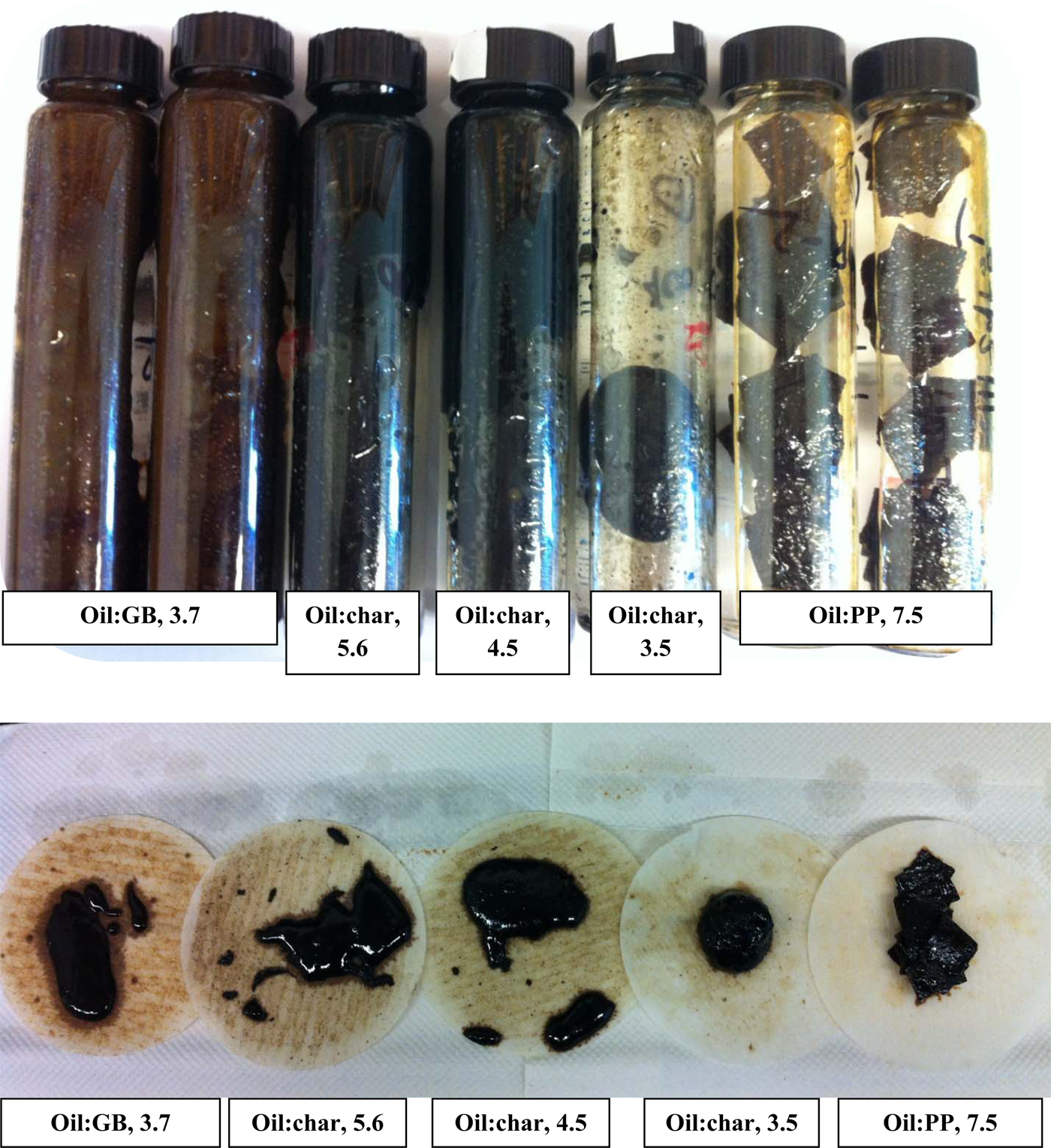
Absorption of Texas crude mousse in seawater by GB, BC500, and PP matt at the indicated oil:absorbent ratio (g/g). The upper photo shows the vials after the mixing period. The lower shows the product collected on filter paper. Note that oil from oil:char 3.5 and the PP matt does not readily blot out on the filter paper.
Biodegradation of biochar-absorbed oil
Evolution of CO2 from seawater and seawater combined with oil and/or biochar is shown in Fig. 3. These experiments were designed to test whether sub-capacity levels of Texas crude were protected from, or primed for microbial attack by the biochar. Sub-capacity levels are presumably more tightly held than capacity levels and thus, reflect more challenging conditions for the microbes. The experiments employed Agrichar or BC500 added to GoM seawater without nutrient enrichment, or BC500 added to LIS seawater with nutrient enrichment.
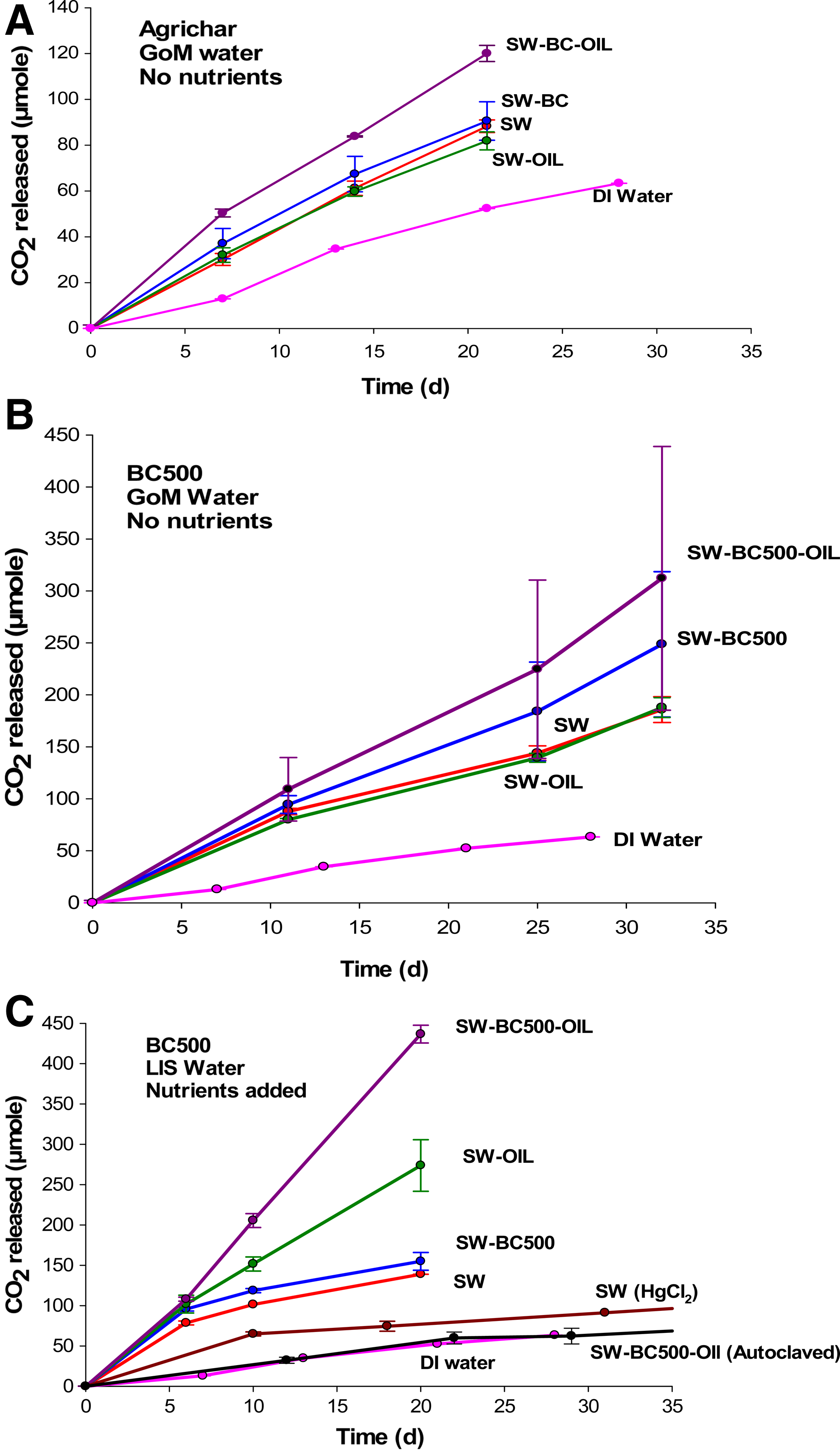
Mineralization curves for seawater (SW) combined with biochar and/or oil.
Release of CO2 from ultrapure water and the autoclaved seawater-biochar-oil control was similar (Fig. 3C) and its magnitude likely represents systematic methodological error. The HgCl2-sterilized seawater control released more CO2 than the ultrapure water and autoclaved control. The difference may represent outgassing of carbonate from the seawater. Release of CO2 was significantly greater from seawater than from HgCl2-sterilized seawater (Fig. 3C), a possible sign of biological activity towards dissolved natural organic matter. Release of CO2 from the nutrient amended LIS water was generally greater than release from the non-nutrient amended GoM water.
Compared to seawater alone, biochar addition to seawater resulted in slight increases in CO2 rate for Agrichar in GoM, BC500 in LIS, and BC500 in GoM (Fig. 3), but the differences were not significant (p>0.2) after 21 or more days. Any difference that may have existed is possibly due to the small fraction of biochar C (typically 2–19%) found to be quickly bioavailable to soil microbes in soil tests (Lehmann et al., 2011). Compared to seawater alone, addition of oil to seawater resulted in a statistically insignificant change in CO2 release for GoM water (p>0.1; all times), but a significant increase in CO2 release for the nutrient-amended LIS water (p<0.05 after 10 or more days). Addition to seawater of biochar and oil together resulted in increases in CO2 release compared to seawater plus oil or seawater plus biochar in the case of Agrichar in GoM (p<0.1 after 21 days) and BC500 in LIS (p<0.05 after 10 days). The same trend was observed in the case of BC500 in GoM seawater, but due to large variation among replicates the difference was not significant (p>0.4 all times). Thus, from these limited tests, biochar does not inhibit, but may prime the initial stages of crude oil mineralization. It is possible that biochar provides a more favorable support for biofilm attachment compared to the liquid oil.
Summary
We have shown that biochar produced from hardwood over a range of temperatures can absorb several times its weight in crude oil, and that the imbibed oil may be primed toward biodegradation in seawater over the short term. Although the specific absorption capacities of the biochars we tested are lower than the capacities reported for many synthetic absorbents, the use of biochar in first response to an oil spill has a number of advantages. The feedstock may be any of a variety of organic wastes, some of which are abundant, and the technology for producing biochar is simple and well-established. Thus, the absorbents can be produced inexpensively and in large quantity ready to be deployed. Biochars can be tailored such that their oil absorbency is enhanced by seawater. Biochar can be stored moist to facilitate handling and reduce fire hazard. It could be applied directly to the surface or enclosed in fabric booms. Oil-imbibed particles are buoyant in seawater, permitting retrieval. Since biochar itself has value as a fuel, the retrieved material can be combusted in an industrial furnace without the need for an oil separation step. Alternatively, the material can be left in the environment to allow natural attenuation of the oil, as biochar itself is environmental benign and its presence is not considered undesirable. Being buoyant, particles will remain afloat in the photic zone of the seawater column where photolysis and aerobic heterotrophic activities are greatest. Biochar particles may provide a favorable and stable support for colonization of oil-degrading microorganisms, which will have at their disposal a reservoir of hydrocarbons within the particle pore network. When applied to affected shoreline habitats, biochar can potentially mitigate crude oil toxicity by reducing the bioavailability of oil to higher organisms, but this remains to be tested.
Footnotes
Acknowledgments
We thank Harry Stewart (Gautier, Mississippi) and Bobby Lewis (Captain of the Obsession, Ocean Springs, Mississippi) for obtaining GoM water samples, Dr. Charisma Lattao for help with biochar analyses, and Kathyrine Lee for her involvement in preliminary experiments. This work was supported by the National Institute of Food and Agriculture, U.S. Department of Agriculture, through Hatch and Stennis programs.
Author Disclosure Statement
No competing financial interests exist.