




Abstract
Abstract
Enhanced electrokinetic (EK) removal of Cr, Cu, and Zn from sediment by using original and modified integrated ion exchange (IIX™) cathodes was investigated. IIX cathode design and EK device process modifications were made to improve performance: separation of IIX cathode components (IIXS), combination of modified IIX cathode with pulsed electric field (IIXSP), and separation of IIX cathode components with addition of an anion exchange resin compartment (IIXA). After using the IIXSP, overall Cr, Cu, and Zn removal efficacies were significantly improved compared with the other treatments investigated. No improvements in overall Cr, Cu, and Zn removal efficacies were achieved by utilization of IIXA. Nevertheless, significant removal efficacies occurred at the anode region since distribution of the alkaline front was prevented. However, metal accumulation in the cathode region occurred. This was a consequence of metal cation complexation with Cl− released from the anion exchange resin that changed the direction of metal migration. Enhancing EK remediation of Cr-, Cu-, and Zn-contaminated sediment can be achieved by using a modified IIX cathode.
Introduction
T
The H+ ions generated by the ion exchange reaction neutralize the OH− ions produced at the cathode as a result of water electrolysis, allowing control of the soil pH around the cathode. At the same time, metals are sorbed onto the ion exchange resin and are therefore removed from the soil/sediment. The heavy metals absorbed onto the IIX electrodes can be recovered, resulting in regeneration of the electrodes, which can then be reused in the soil/sediment treatment process.
In this work, enhanced EK removal of Cr, Cu, and Zn from real sediment using the original IIX cathode was investigated. To enhance the performance of the IIX cathode and therefore the EK treatment, different modifications of the IIX cathode were made.
Experimental Protocols
Chemicals and analytical methods
All chemicals used were at least analytical reagent grade. The sediment particle size was determined using ISO method 13317-2:2001. pH and oxidation-reduction potential (ORP) of the contaminated sediment were measured by a pH meter (340i, WTW). Sediment pH measurements were carried out in deionized water (sediment:water=1:5) with a SenTix®21 electrode. The ORP of the contaminated sediment was measured with a SenTix®ORP electrode placed directly in the sediment. The ammonium acetate method was used to measure cation exchange capacity (CEC). Acid neutralizing capacity (ANC) was measured and calculated according to the Gran method. OM content was determined by weighing the dried sample and then heating it in a furnace at 550°C for 4 h. The protocol for chemical extraction for determination of pseudo-total metal content in the sediment was performed in accordance with U.S. EPA Method 3051A. To determine the speciation of Cr, Cu, and Zn in the sediment, samples were sequentially extracted according to the extraction procedure proposed by the Community Bureau of Reference (BCR). Analyses of metals were carried out using flame atomic absorption spectrophotometry (PerkinElmer; AAnalyst 700) in accordance with U.S. EPA Method 7000b. Detailed descriptions of the procedures are given in a previous study (Rajić and Ugarčina Perović, 2011). The anion exchange resin used was Purolite A850 (Cl− form), while the cation exchange resin was DOWEX HCR-W2 (H+ form). Graphite particles for the original IIX cathode were obtained from graphite electrodes.
EK experiments
Experimental conditions are summarized in Table 1 and the EK device and IIX cathode modifications are shown in Fig. 1. The EK device consisted of an EK cell, a DC power source (0–30 V, 0–3 A), and an ammeter. The Plexiglas test cell consisted of the sample compartment (dimensions 16 cm×5 cm×10 cm). Tap water was used as anolyte (200 mL). Sediment samples were collected from the Great Backi Canal (Vojvodina, Serbia). The top sediment sample was taken with an Eijkelkamp core sampler in the middle of the canal (water depth ranging from 2.0 to 5.5 m). A nonhomogenized sediment sample was measured for each experiment test and placed into the sample compartment of the EK cell. A constant voltage was applied to the system and the electrical voltage gradient was 1 VDC/cm for each experiment test.

EK device used for conventional and enhanced treatment. EK, electrokinetic; IIX, integrated ion exchange.
IIX, integrated ion exchange.
The reasoning behind the IIX cathode modifications is as follows:
1. The main drawback of the IIX cathode is that by mixing graphite particles with ion exchange resin, large amounts of resin are placed opposite the ion migration pathway. Therefore, separate regions in the IIX cathode were designed (IIXS). Implementing the resin as a permeable reactive barrier (PRB) results in using less resin. Also, the aim was to achieve easier manipulation of the ion exchange resin after treatment (removal and regeneration). 2. Metal ion sorption onto different sorbents that act as PRBs can be limited due to the high drift velocity of the metal ions during EK treatment (Elsayed-Ali et al., 2011). Implementation of a pulsed technique with defined intervals without current (OFF intervals) should thus result in more ions being sorbed onto the resin in the IIX cathode (IIXSP). This should occur as during OFF intervals, electromigration is absent. This is especially true in the IIXS cathode design as the resin thickness is less than when using mixed components like the original IIX. Additionally, the pulsed technique allows for diffusion of H+ and metal ions in the sediment. These are limited during electromigration (Reddy and Saichek, 2004; Ryu et al., 2010). It has been shown that more metals desorb from sediment particles during pulsed electric field application and are therefore available for electromigration. This can lead to more intense H+ ion formation from the resin. 3. The limited release of H+ ions from the resin can affect the IIX cathode performance. This is likely due to the amount of released H+ depending on the amount of sorbed metal ions (Reaction 1). The amount of metals that are available for the sorption onto the resin during the EK treatment of sediment can be limited by different factors (redox potential, high buffer capacity, high CEC, etc.). According to that, the neutralization of OH− ions by the H+ released from the resin can be limited. The solution could be the implementation of an anion exchange resin in the region between the cation exchange resin and the graphite electrode (Fig. 1). It sorbs the OH− ions according to the following reaction:
At the end of each experiment, the sediment sample was sectioned into five parts. Each part was assigned as the normalized distance z/L (z=distance from the anode, L=the sediment bed length) from the anode: 0.1, 0.3, 0.5, 0.7, and 0.9. The pH and metal pseudo-total concentrations of the initial sediment sample and in each of its sections were measured. The electric current was monitored continuously during the treatments. The increase in target metal removal efficacies and pH value decreases at z/L=0.9 compared with CNV were used as criteria for assessing the efficacy of the EK treatments using the modified IIX cathodes.
Results and Discussion
Sediment properties
Particle size composition of the sediment used in this study was determined as follows: sand (90.7%), silt (13.1%), and clay (3.8%). The sediment has a high OM content (20.3%), which is mainly responsible for the high CEC value (17 meq/100 g), since the clay content is relatively low. The high ANC value (144 meq/100 g) indicates that the sediment cannot easily be acidified, which is an important parameter in predicting EK metal removal. The initial pH of the sediment was 7.4 and ORP was −361 mV. Pseudo-total metal concentrations were 144 mg/kg Pb, 5.75 mg/kg Cd, 312 mg/kg for Cr (no Cr(VI) was detected), 392 mg/kg Cu, and 993 mg/kg Zn. Ni was not detected in the sediment sample. The Cr, Cu, and Zn concentrations in the sediment indicate that sediment remediation is necessary (Official Gazette, 2012). The results of the BCR sequential extraction of metals from the initial sediment sample are presented in Table 2. Note that Cr exists mainly in the oxidizable (78.6%), Cu in the reducible (59.2%), and Zn in the acid-soluble fraction (53.6%). However, Cu also exists in a high percentage in the oxidizable fraction (30.0%).
Changes in sediment pH values after EK treatments
The changes in the sediment pH values after the EK treatments are given in Fig. 2. Note that there was no change in the sediment pH value after CNV, as a consequence of the high sediment ANC and CEC values. Slight pH decreases occurred at z/L=0.9 after IIX (0.6 pH units), IIXS (1.3 pH units), and IIXSP (1.3 pH units). This indicates the possibility of using the IIX cathodes for EK treatments. The pH at z/L=0.9 after PLS was 2 pH units higher. During PLS treatment, diffusion of OH− ions occurs, leading to alkaline front formation in the sediment. After IIXA, significant pH changes occurred at each normalized distance despite the high sediment ANC and CEC values. Note that only Zn appears in the acid-soluble fraction (Table 2) and is therefore available for electromigration. Since no significant acidification of the sediment occurs during IIX, IIXS, and IIXSP (except at z/L=0.1), the concentration of metals available for sorption onto the cation exchange resin is limited. In addition, naturally occurring cations exist in stabile forms in sediments with negative ORP. Consequently, the amount of H+ released from the resin is limited, which affects neutralization of OH− ions. Thus, the use of the anion exchange resin in the IIX cathode (IIXA) revealed effective neutralization of the OH− ions. As a consequence, sediment pH at z/L=0.9 decreased significantly (3.5 pH units). Higher current values that were achieved resulted in producing more H+ compared with other treatments. The amount of H+ ions produced during each experiment can be calculated according to the following (Suzuki et al. 2007):
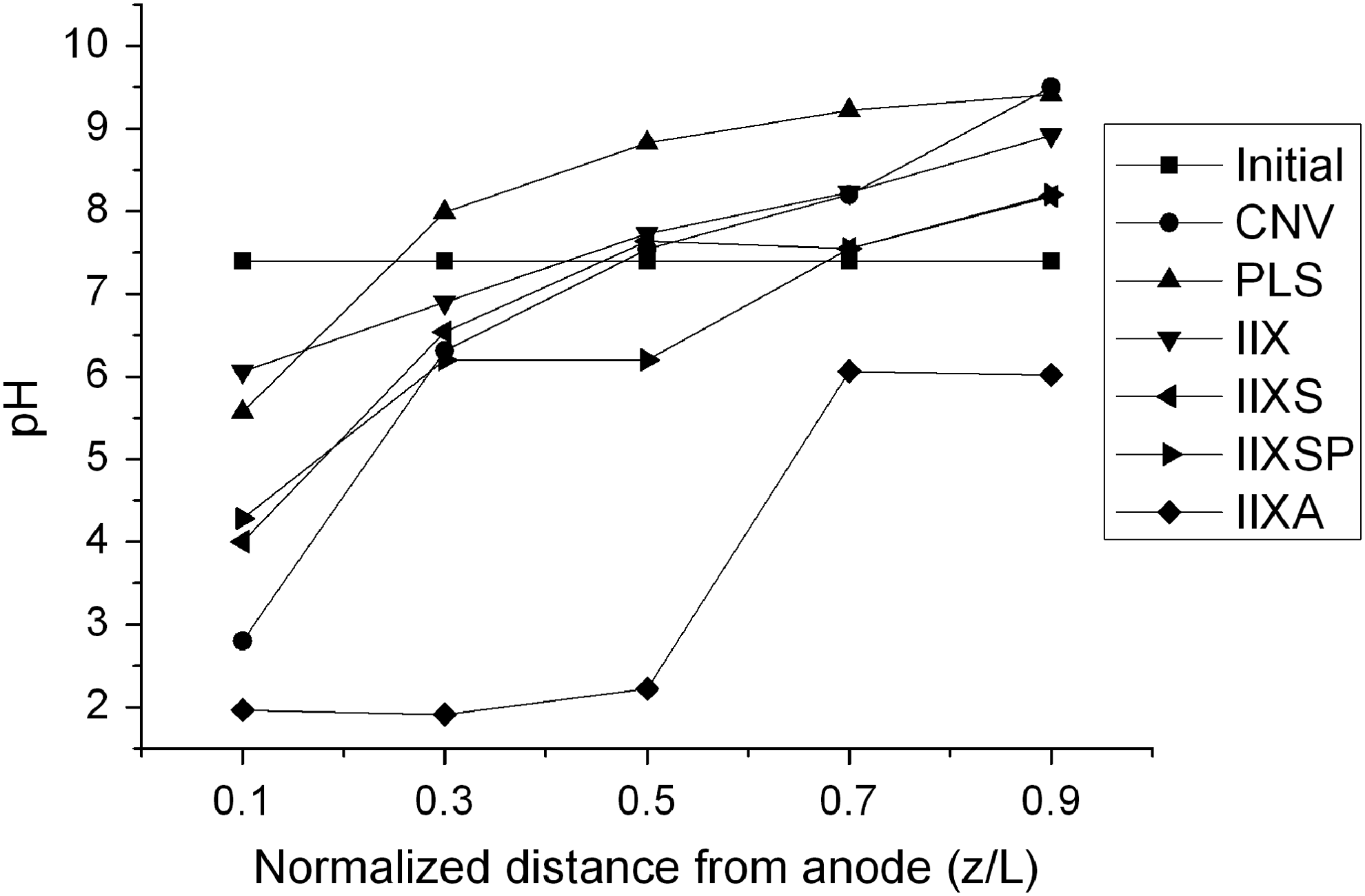
Changes in sediment pH values after EK treatments. See Table 1 for abbreviation definitions.
where N is the number of electrons generated by electrolysis (same as the number of H+ ions), I is current (A), t is time (s), and F is Faraday's constant (96,485 C/mol). The amount of H+ ions produced during IIXA corresponds to pH=3.5 and is nearly four times higher than after CNV, PLS, and IIX, three times higher than IIXS, and 1.5 times higher than IIXSP. Additionally, although H+ produced from the cation exchange resin migrates toward the cathode, it also diffuses into the sediment through the water layer above the sediment sample.
Distribution of Cr, Cu, and Zn in the sediment after EK treatments
The overall Cr, Cu, and Zn removal efficacies after the EK treatments are given in Table 3. The distribution of Cr, Cu, and Zn in the sediment after the EK treatments is given in Fig. 3. After CNV, Cr removal was significantly greater than Cu and Zn, due to its higher ionic mobility. The ionic mobilities of Cr, Cu, and Zn (×10−9 m2/[Vċs]) are 9.72, 7.77, and 7.65, respectively. High removal efficacies were not achieved for the target metals. This is due to the high buffer capacity of the sediment, which disabled the acid front formation and migration. Although 50% of Zn existed in the acid-soluble fraction initially, overall the Zn removal efficacy was minor. Zn was mainly associated with carbonates and since an acid front was not formed, it could not be extracted for the sediment bed.
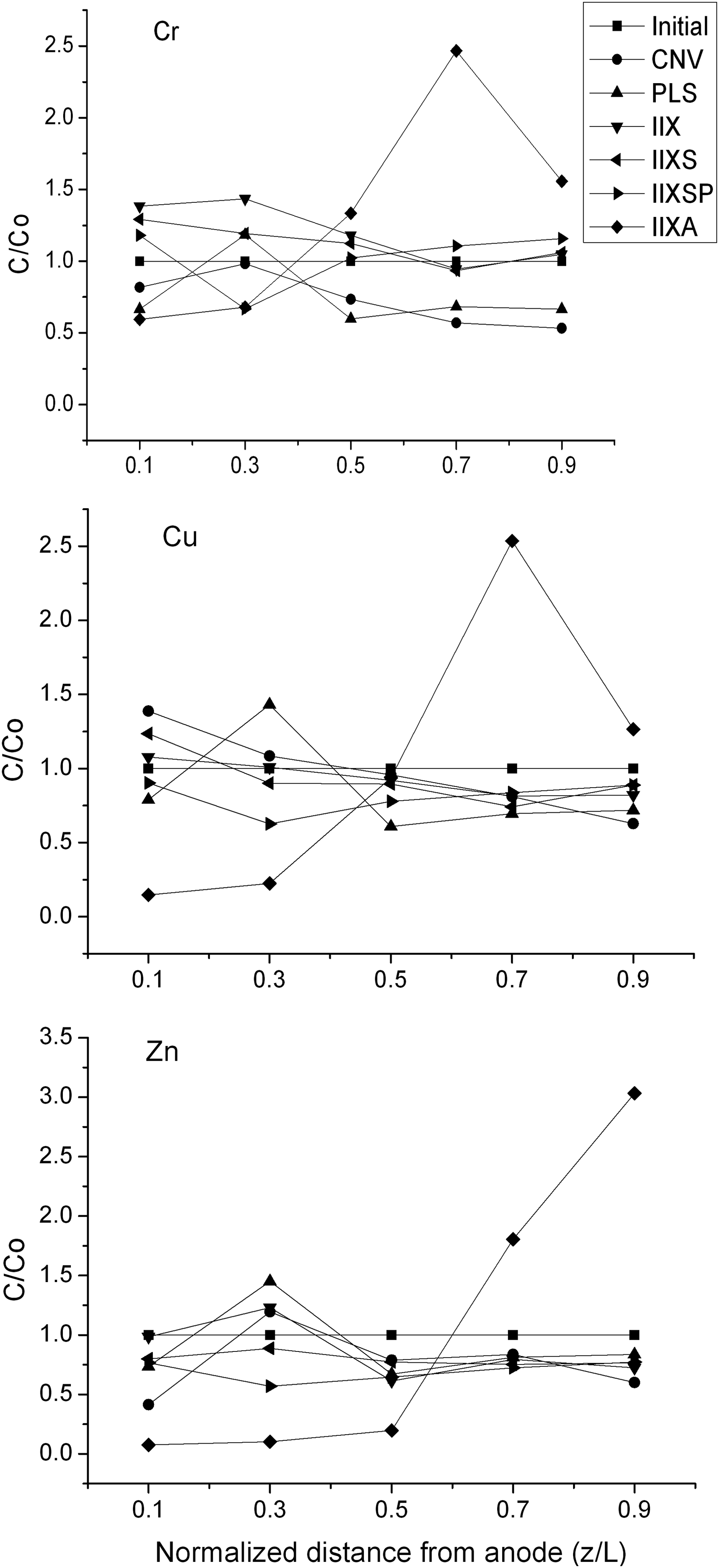
Distribution of Cr, Cu, and Zn in sediment after EK treatments.
See Table 1 for abbreviation definitions.
As shown in Table 3, after IIX, target metal removal efficacies were similar to those achieved after CNV. Using the separate regions of the IIX cathode constituents resulted in a slight improvement in Zn removal compared with CNV (∼10%), whereas no improvement was achieved for Cu and Cr. Using the separate regions as well as the original IIX cathode was not effective since OH− ions were not adequately neutralized. Yet, IIXS achieved the same efficacy as IIX while using less resin. The high buffer capacity of the sediment again prevented acid front distribution. This led to limited desorption of metal ions from the sediment particles and consequently these were not available for sorption onto the cation exchange resin. As a result, H+ ion release from the cation exchange resin was limited.
The treatment with the modified construction of the IIX cathode and a pulsed electric field was the most efficient for removal of Cr, Cu, and Zn from the sediment (Table 3). After IIXSP, the pH value decreased at z/L=0.9 (Fig. 2) more than the CNV and PLS. The removal efficacy increase was a combined effect of the pulsed electric field application and using the modified IIX cathode. The efficacy of the pulsed technique is related to the diffusion of metal ions, which improves the desorption processes from the sediment particles occurring during OFF intervals. So the pulsed technique increases the amount of cations in the sediment leading to exchange with the resin and a pH reduction at z/L=0.9. Comparing the efficacies of PLS and IIXSP, it can be concluded that the presence of the cation exchange resin influences the EK treatment. Unlike PLS, there was no accumulation of metals at z/L=0.3 after IIXSP. This was probably due to the reduction in pH at z/L=0.9 in the presence of the resin, so OM dissolution and anion organometallic complex formation is absent. During PLS, these anion organometallic complexes migrated toward anode resulting in metal accumulation.
IIXA resulted in the accumulation of Cr, Cu, and Zn in the cathode region. Nevertheless, the sediment pH decreased after treatment through the entire test cell (Fig. 2) and significant removal efficacies were achieved near the anode. The efficacies achieved at z/L=0.1 and 0.3 are 40% and 32% for Cr, 85% and 77% for Cu, and 92% and 89% for Zn, respectively. A high Zn removal was also achieved at z/L=0.3 (81%). This is because Zn is mainly present in the acid-soluble fraction. The removal efficacies for Cr are significantly lower than those of Cu and Zn, since the Cr in the sediment exists mainly in the stable fraction (Table 2). Although Cr has high ionic mobility, its transfer number decreased after Zn and Cu mobilization in acidic conditions and the presence of a high amount of H+ ions. As shown in Fig. 3, metals accumulate in the sediment in the cathode region after IIXA. Cu and Zn accumulation at z/L=0.7 and 0.9 probably occurs due to the formation of soluble complexes with Cl− ions released from the anion exchange resin (Reaction 2). These anion complexes migrate toward the anode. Accumulation of Cr is a consequence of slightly soluble Cr(III)-chloride formation. Since there are enough available sites for metal sorption on the cation exchange resin (1.9 eq/L), these can possibly account for the metal accumulation.
Changes of electric current during EK treatments
Changes in electric current during the EK treatment are given in Fig. 4. Note that the electric current changes were similar during CNV, IIX, and IIXS, and correspond to the metal distribution in the sediment after these EK treatments (Fig. 3) and the overall removal efficacies (Table 3). During IIXSP, the current values were higher than those during the CNV, PLS, IIX, and IIXS. This is a consequence of more ions being present in the sediment interstitial water due to the pulsed electric field application. This is in accordance with the overall metal removal efficacies achieved after IIXSP (Table 3). As shown in Fig. 4, the current increased significantly at the beginning of treatment IIXA. Afterward, it decreased, but remained higher than during the other treatments. This is due to more metal ions being present in the sediment due to the lowering of the pH at the anode region. Current decreased significantly after 7 days after each experiment (Fig. 4) thus disabling further treatment.
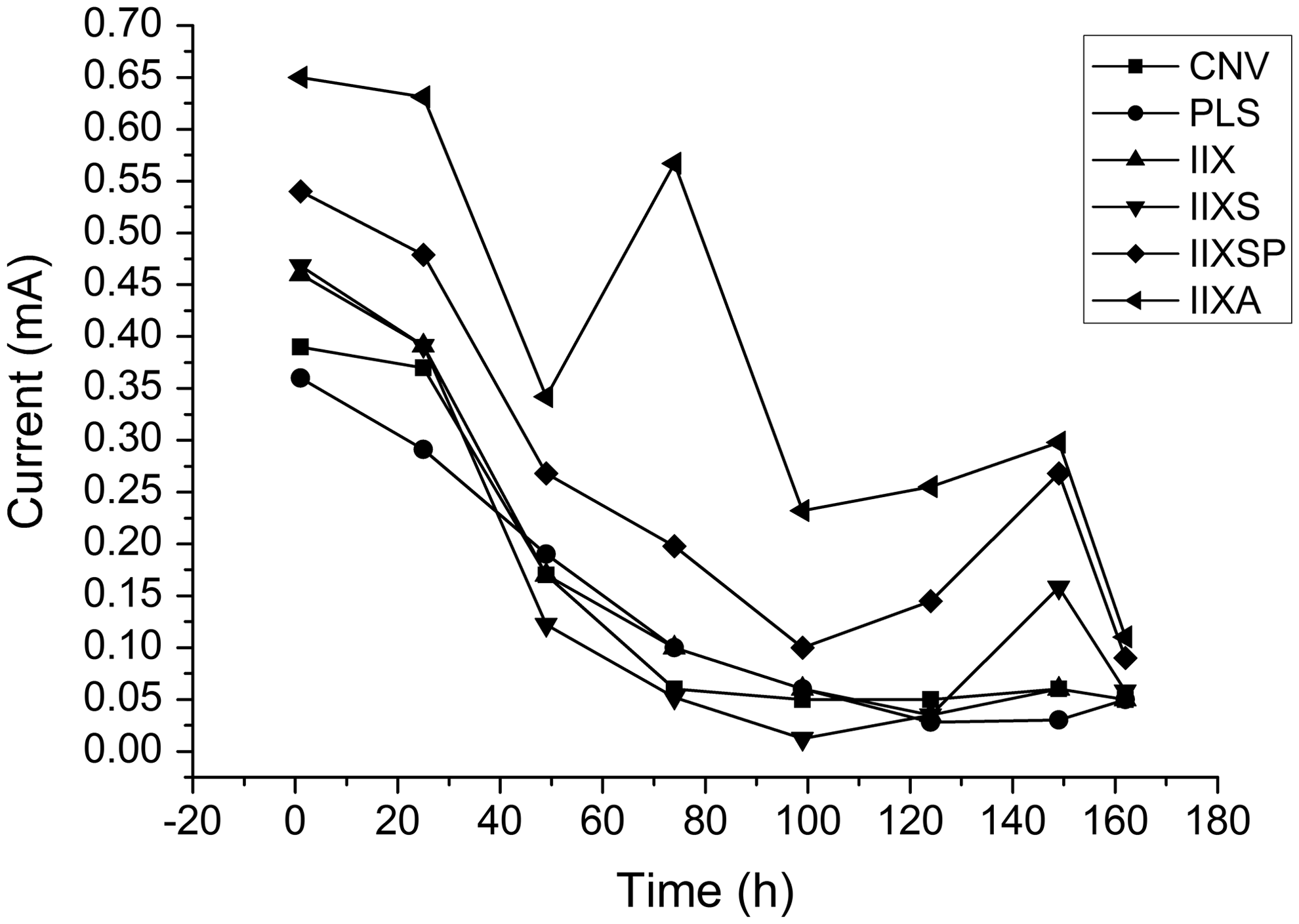
Changes of electric current during EK treatment.
Summary
Use of original and modified IIX cathodes for EK sediment treatment were investigated. The aim was to prevent hydroxyl ion penetration in the sediment. This was not achieved when using the original IIX cathode, mainly due to the limited amount of H+ ions produced from the cation exchange resin. This occurred since the amount of metal ions available for exchange was negligible. Implementation of an anion exchange resin in the region between the cation exchange resin and the graphite electrode (IIXA) overcame this problem, and resulted in a pH decrease in the sediment and high removal efficacies of the target metals in the anode regions. Using separated IIX cathode constituents (IIXS), to more easily manipulate the ion exchange resin after treatment and reduce resin utilization, was effective. A slight pH decrease appeared in the cathode region after IIXS. Cr, Cu, and Zn removal efficacies increased when the pulsed technique was employed (IIXSP) due to the combined effect of the pulsed technique and utilization of the modified IIX cathode. This was due to the diffusion of metal ions improving the desorption processes, which appear during OFF intervals and therefore reactions at the resin leading to pH changes. It can be concluded that the modified IIX cathode as used in IIXA can be effective for improving EK treatment of contaminated sediments. Separation of the original IIX cathode constituents requires less resin to achieve the same degree of metal removal, and by combining with the pulsed technique can be an efficient EK technique for the removal of metals from sediment. However the regulation limitation values for these metals were not achieved. In this study, we demonstrate that the modified IIX cathodes are more efficient for disabling hydroxyl ion penetration in sediment and as a result, removal efficacy of target metals increased. To gain regulation limitation values for sediments with characteristics demonstrated here, it is necessary to implement some of the techniques that improve metal desorption.
Footnotes
Acknowledgment
This research was funded by the Ministry of Education and Science of the Republic of Serbia (Grants No. TR 37004 and III 43005).
Author Disclosure Statement
No competing financial interests exist.