




Abstract
Abstract
This article aims to compensate for the insufficiency in measurement concepts and indicator systems of corporate environmental responsibility (CER). For this purpose, we used the content analysis method of qualitative research to examine environmental management actions as inferred from corporate social responsibility reports issued by leading Taiwanese high-technology electronic firms with international levels of technology. A CER framework was developed using integrated information. This article indicates that firms focus on dimensions, such as green social capital, green strategy transition, and green benefit output. The framework presents the current practice of corporate environmental strategic actions in the industry. Moreover, the framework can be used to build an environmental management measurement system that reflects the environment in which leading firms operate and to guide firms or governments in their efforts toward sustainable development.
Introduction
U
Literature Review
Corporate environmental management and strategy
According to institutional theory, an organization that experiences external environmental pressure must modify its organizational structure or adjust its activities to meet environmental demands (Scott, 1987). Therefore, contemporary companies must commit to the society, environment, and consumer health through CSR (Chen and Lin, 2011) regardless of the company size (Lamberti and Noci, 2012). Environmental management issues have received international attention. For instance, the International Organization for Standardization (ISO) has proposed a series of environmental protection-related certifications (e.g., ISO 14001), and the United Nations Framework Convention on Climate Change (UNFCCC) continually convene the Conference of the Parties (COP) (e.g., COP19 in Warsaw). According to Maxwell et al. (1997), enterprises can adopt a positive environmental strategy to generate numerous advantages, including cost reduction, quality enhancement, promotion of enterprise image, and creation of a new market opportunity. Chen (2008) indicates that investment in and the development of green core competence can help enterprises improve their efforts toward green innovation and green image. Therefore, investment in green products and green process innovations positively contributes to enterprises. Enterprises can emphasize the green product and green process innovative performance to gain competitive advantage.
A case that illustrates CEM is Walmart, which has significantly emphasized the greening elements of its supply chain, recalling its efforts in 2010 in encouraging key suppliers to reduce carbon emissions. Most recently, the retail giant announced that its supply chain initiatives can increase sustainability for its products and supply chain partners. These new initiatives focus on the sustainability index of the company. Walmart executives have developed this sustainability index and endeavored to include additional elements of its supply chain. The index was developed to evaluate suppliers and products from 100 categories. Since Walmart's creation of the index, more than 500 companies in its supply chain have participated in improving sustainability, accounting for 70% of sales in those categories (Irwin, 2012).
Corporate environmental responsibility and sustainable development
One study applied content analysis to examine the CSR reports of listed companies in China and reported that 79% of companies showed a positive attitude toward undertaking social responsibilities (Gao, 2011). CER is generally considered part of CSR. Sindhi and Kumar (2012) proposed a CER framework to elucidate the underlying reasons for adopting CER as a strategy. In addition, they indicated that CER is accepted as a norm for sustainable organizations (Sindhi and Kumar, 2012). Moreover, Lee (2012) emphasized that CER should be regarded as the pivotal activity in implementing an environmentally oriented strategy in business.
An example of sustainable development activity is the Eco-Schools USA, an internationally acclaimed program that provides a framework for helping educators integrate sustainable principles into their schools and curriculum. With the assistance of partnering organizations, Eco-Schools International has admitted 9.5 million students in 37,000 K-12 schools worldwide. This program is solely hosted by the National Wildlife Federation in the United States. Launched in 2009, Eco-Schools USA has facilitated the development of green school buildings, grounds, and curriculum in 366 schools across 41 states (Greenerprinter, 2013).
Research Method
The present study developed a CER framework. Surroca et al. (2010) define CER as “the broad array of strategies and operating practices that a company develops in its efforts to deal with and create relationships with its numerous stakeholders and the natural environment.”
The content analysis method of qualitative research is a set of procedures that allows effective inference on communications. The inferred information considers the recipient of the information, the sender of the information, or the actual information. The approach to inference varies according to the preference of researchers on either theoretical or empirical study (Weber and Roeth, 1999).
Case selection
Data from the Department of Investment Services of the Ministry of Economic Affairs in Taiwan reveal that Taiwan became the second largest manufacturer of information hardware worldwide in 2005. With 70% of the market share, Taiwan is likewise the largest supplier of semiconductors, optoelectronics, information, and communications worldwide (Hsu et al., 2011). Therefore, the present study selected leading Taiwanese high-technology electronic firms (Companies A, B, and C) with international levels of technology as research participants.
Data source
The study used the 2009 CSR reports of Companies A, B, and C that were published on the Internet. The links are listed as follows.
Data processing
This study applied the content analysis method of qualitative research to examine the environmental management action based on CSR reports, following the study of Neuman (2003). The procedure involved determining the research focus, discussing and clarifying the process with experts, and thoroughly examining the CSR reports. We selected the data and categorized them. The data selection process involved data screening, data interpretation, categorization of data into charts, and naming and adjusting the data. These steps completed the first variable system (Company A). The same processes were performed to complete other variable systems (Companies B and C), which were finally represented as figures for systematic comparison and management.
This study constructed its CER framework using the environmental management action of Company A for data partition, attribute identification, and open coding. By referring to the CER framework of Company A and using the axis coding and CER concepts of Companies B and C, the CER framework of Company A was developed into a more comprehensive CER framework. The coding name refers to the business environmental management tools proposed by Toth (2007).
Constructing the CER framework: Steps and rationales
The steps in constructing the framework and the rationales for such actions are as follows.
Step 1: Establishing a conceptual framework
Indicators of corporate environmental management performance are limited; therefore, industrial conditions and social needs in Taiwan are inaccurately evaluated. High-technology companies cause significant pollution to the ecological environment, and thus typically pay greater attention to an environment-friendly image compared with other companies. To address these issues, we selected leading multinational high-technology electronic companies in Taiwan as benchmarks; analyzed their relevant environmental management actions, which were published in CSR reports, from a professional perspective; and established a conceptual framework for CER.
Step 2: Evaluating the adequacy of the framework
The sample consisted of three high-technology electronic companies in Taiwan. The conceptual framework for CER was used to verify the statistical sufficiency of these firms as required by the qualitative research methods adopted in this study, and then, to decide whether or not to incorporate additional companies into the framework. The three benchmark companies were selected based on the following reasons.
We selected Company A because it was included in the Dow Jones Sustainability Index (DJSI) for nine consecutive years until 2010. Moreover, the wafer plant of Company A, which is located in Hsinchu, received the US Leadership in Energy and Environmental Design (LEED) Gold Certification and the Taiwan Ecology, Energy Saving, Waste Reduction and Health (EEWH) Diamond Certification for its green building. Company A initiated and led semiconductor industries and their upstream and downstream firms in the establishment of the Integrated Circuit (IC) Product Category Rule. Company A likewise obtained the IC Eco-Labeling Type 3 international certification and the IC product carbon footprint mark issued by the Taiwan Electrical and Electronic Manufacturers' Association. All plants owned by Company A in Taiwan, China, and the United States have obtained ISO 14001, OHSAS 18001, and QC 080000 certifications. Furthermore, according to the latest data, Company A was included in the DJSI and chosen once again as the Semiconductor Sector Leader in DJSI in 2012. Company A likewise received the award of BEST CSR in Taiwan from Finance Asia and seven US Leadership in LEED certifications until 2012 (includes one platinum certification and six gold certifications).
Company B was selected because it was the first firm to earn carbon footprint certification worldwide in 2009, and it built a low-carbon supply chain to fulfill its commitment to providing clients with low-carbon services. Company B was likewise included in the World Index and Asia-Pacific Index of the DJSI. The firm has received nine environmental awards from the Environmental Protection Administration (EPA) of Taiwan since 2001. Company B has received six awards from the EPA for its performance in waste cleaning, renewable resource cleaning, and resource deduction and recycling since 2003. Company B was awarded the Outstanding Business in Low Carbon Technology Integration and Application by the Ministry of Economic Affairs. Furthermore, according to the latest data, Company B was likewise included once again in the World Index and the Asia-Pacific Index of the DJSI in 2012. In addition, Company B received three awards from the Taiwan Institute for Sustainable Energy (TAISE) and EPA for its performance in CSR report, corporate environmental management, and green procurement in 2012.
Along with Company A, Company C was selected for gaining the Social Responsibility Award given by the Global Views Monthly in Taiwan. Part of the DJSI in 2009, the firm was the only thin-film transistor–liquid crystal display manufacturer worldwide to earn this honor. Furthermore, according to the latest data, Company C likewise received two awards from the TAISE and Ministry of Economic Affairs for its performance in the CSR report and green products in 2012.
Step 3: Understanding current corporate green strategies
This study used the latest versions of CSR reports at the moment as research materials for analysis (i.e., CEM content of the 2009 CSR reports of Companies A, B, and C). No CEM research has investigated corporate-instituted green strategies or measures. With regard to major issues, particularly those related to CER, companies tend to build a fully executable strategic framework in terms of business goals, organization strategic switch, and technology. Therefore, a conceptual framework for CER with existing corporate green strategic actions not only reflects the philosophy of CER and corporate green objectives, but also the fundamental framework for regulating CER. A thorough understanding of the existing corporate green strategies and measures can be gained from the most accurate, reliable, and easily accessible documents (i.e., published CSR reports).
Step 4: Selecting the main analytical framework
The main analytical framework of Company A was selected for constructing the general structure because Company A is the best performing company among the three companies under study in terms of CEM, as indicated in the actual CSR report. The company is likewise the strongest among the three benchmark companies in terms of capital in 2009 (Company A: NT$595 billion; Company B: NT$260 billion; Company C: NT$88.3 billion). The resource-based view states that enterprises have both tangible and intangible resources that are convertible into capacities. In this regard, Company A has the greatest resources, and thus, the largest opportunity to convert these resources into capacities for CEM or CER.
Step 5: Analysis of content relevant to CEM
The theme of this study, CEM, prompted us to select the CEM content from the 2009 CSR report of Company A, copy and paste it into a word document, and perform an initial analysis of the content. An example of the analysis is presented in Table 1.
Step 6: Naming of variables
After analyzing the content relevant to CEM, we labeled the variables according to open coding principles and the CEM tools proposed by Toth (2007). After assigning names to the variables, we discussed with experts whether the directions and results of such naming are appropriate. If the name provided was identified as inappropriate, we modified the category and naming. Examples are presented in Table 1.
A complete example of the initial brief coding data for Company A is presented as Table 2.
LEED, Leadership in Energy and Environmental Design; ISO, International Organization for Standardization; EPD, environmental product declaration; IC, integrated circuit; GHG, greenhouse gas; PLC, product lifecycle; ESS, environment, safety, and sanitary; VOC, volatile organic compound.
Step 7: Completion of the initial conceptual framework for CER
We drew the conceptual framework for the CER of Company A as categorized by the company and adjusted the document labels. We then analyzed the CEM content in the 2009 CSR reports of Companies B and C and constructed their conceptual frameworks for CER. The procedures were similar to those used for Company A.
Step 8: Integration of the conceptual frameworks into a single framework
We compared the conceptual frameworks for CER of Companies B and C with that of Company A and integrated the three frameworks. These frameworks exhibited no significant difference, but showed minor variations in secondary dimensions and component factors, with essentially similar main principles. Therefore, in terms of the establishment of the conceptual framework for CER, the three samples (Companies A, B, and C) were sufficient for this study as required by qualitative research methods. Additional samples for analysis are thus unnecessary. Finally, a conceptual framework for CER was obtained by integrating the complete framework of the three benchmark companies.
Rationale
Reasons for constructing the framework of Figure 1 are as follows. In Taiwan, the content of the measurement considers the perceptions of environmental groups instead of those of firms. Nevertheless, international indicators are not adjusted despite differences in economic development and economic directions among countries. Using a single foreign indicator to measure the performance of a country may be inaccurate. Therefore, this study used the CSR reports of leading high-technology electronic companies in Taiwan to evaluate the environmental management actions of these firms for the content analysis method of qualitative research. In addition to the systematic implementation of company environmental management actions, a suggested framework for CER was developed in this study. The CER framework built from the current environmental strategy actions of a case company can reflect the environmental responsibility philosophy of the company and its green technology objectives, indicating its appropriateness as a fundamental framework in regulating CER and guiding other firms or governments in their efforts toward sustainable development.
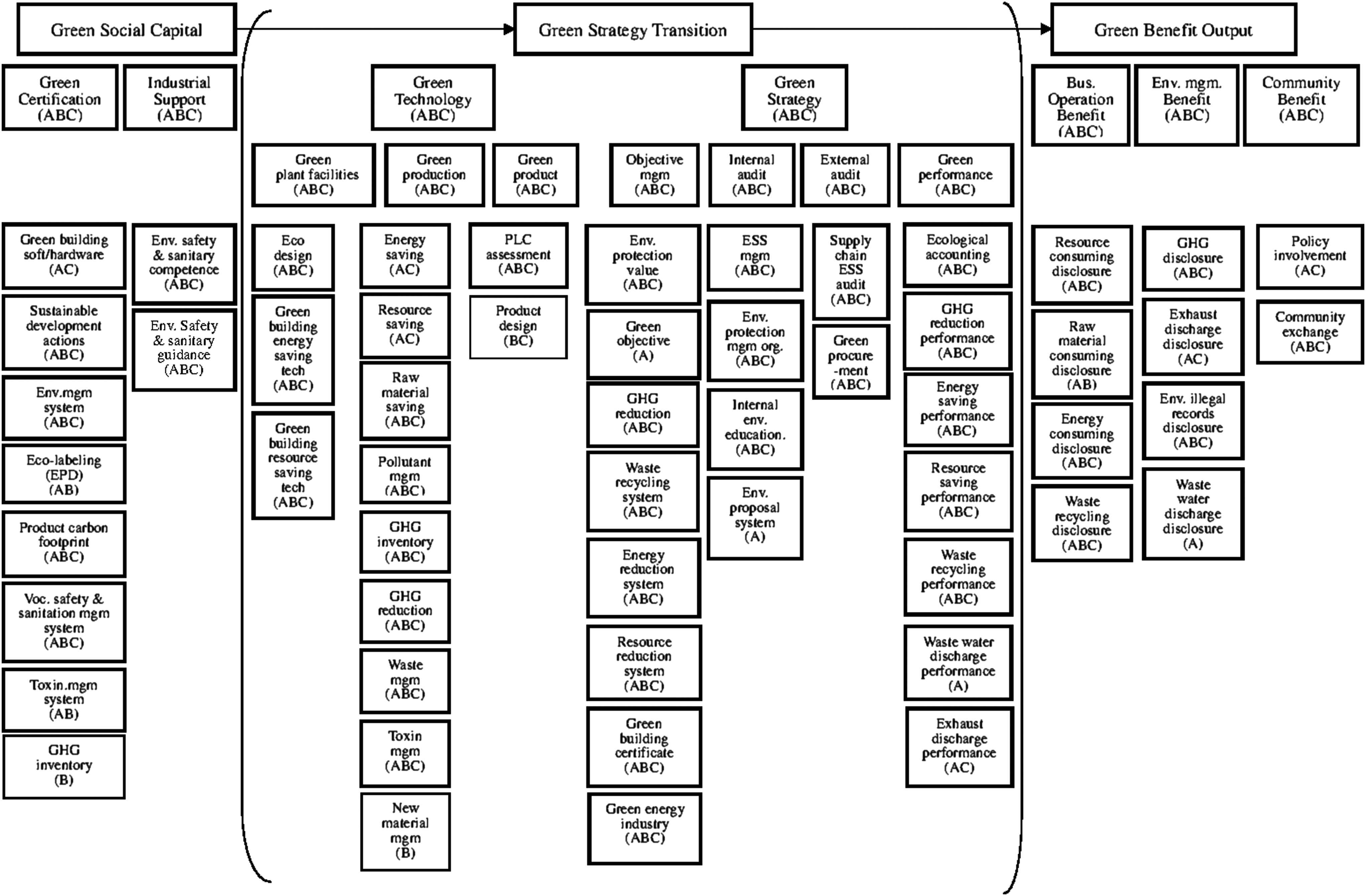
Framework for corporate environmental responsibility (CER). A, B, C in parentheses indicate elements of the CER framework used by Companies A, B, and/or C. Bus., business; env., environmental; EPD, environmental product declaration; ESS, environment, safety, and sanitary; GHG, greenhouse gas; mgm., management; org., organization; PLC, product lifecycle; tech., technology; voc., vocational.
Research Findings
Figure 1 shows the complete CER framework. Letter A in the text box indicates that the item exists in the framework of Company A; the same applies for letters B and C. The thick box indicates the corporate environmental framework of Company A.
Green social capital
According to Meyer and Rowan (1977) and DiMaggio and Powell (1983), an organization is an open system, and an interactive input–transform–output relationship occurs between organizations and the external environment. Therefore, green social capital in this study is defined as “all of the institutions, strategies, and activities to which a corporation inputs its resources to improve its environmental performance.”
Green certification provides organizations with the orientation to practice environmental management. For instance, LEED is a voluntary, consensus-based, market-driven program that provides third party verification of green buildings. From individual buildings and homes to entire neighborhoods and communities, LEED is transforming the way built environments are designed, constructed, and operated. Comprehensive and flexible, LEED addresses the entire lifecycle of a building (USGBC, 2013). Meanwhile, ISO 14000 is a family of standards related to environmental management that exists to help organizations (a) minimize how their operations (processes, etc.) negatively affect the environment (i.e., cause adverse changes to air, water, or land), (b) comply with applicable laws, regulations, and other environmentally oriented requirements, and (c) continually improve in the above-mentioned aspects (Wikipedia, 2013). Moreover, data analysis indicates that green social capital has 2 secondary dimensions and 10 component factors.
Green strategy transition
Green strategy transition is defined as “all of the institutions, strategies, and activities that a corporation uses to transform its resources to improve its environmental performance.” Besides, the data analysis indicates that green strategy transition has 2 secondary dimensions, 7 tertiary dimensions, and 36 component factors.
Green benefit output
Green benefit output is defined as “all of the outcomes and outputs from the environmental strategy of the corporation, which it utilizes to improve its environmental efficiency.” Furthermore, the data analysis indicates that green benefit output has 3 secondary dimensions and 10 component factors.
Comparisons with other indexes and frameworks
GRI developed the GRI index, a measurement framework for the preparation of CSR reports. The GRI index is a set of prevalent standards for sustainability reports that are extensively adopted by global corporations. This index includes four major report content indicators, namely, strategies and analysis, introduction to the organization, report parameters and governance, and commitment and participation. Moreover, the index has six major performance measurement indicators and 121 subindicators. The major indicators are economic performance, environmental performance, labor practice and reasonable work performance, human rights performance, social performance, and product responsibility performance. The comparison of our CER framework with the GRI index indicates that our research targets have relatively concrete actions in green social capital, green strategy transition, and green benefit output. The GRI indicator emphasizes green strategy transition and green benefit output dimensions. We can assume that the GRI indicator does not value the efforts of the green social capital. In contrast, our CER framework has a more comprehensive scope and provides a clear thinking direction.
Meanwhile, the ESI was developed by the World Economic Forum's Global Leaders for Tomorrow, the Yale Center for Environmental Law and Policy, and the Columbia University Center for International Earth Science Information Network. The ESI consists of the structure of variable→indicator→component. The ESI structure comprises five components, namely, environmental system, reducing stresses, reducing human vulnerability, social and institutional capacity, and global stewardship. Each component consists of several indicators, with each indicator including several variables. The index average in component is the presentation of tested countries in this field, and the index average of all items is the ESI score of the tested country. A high rank of ESI score indicates that a country has satisfactory environmental sustainability. The latest 2005 ESI, with 5 components, includes 21 indicators, each composed of 2–8 variables, as well as 76 other variables. A comparison of our CER framework with ESI shows that the CER framework and ESI involves concrete actions in green social capital, green strategy transition, and green benefit output. However, ESI does not emphasize industrial support in the green social capital dimension nor green strategy in the green strategy transition dimension. We can assume that ESI does not value the efforts of industrial support and green strategy. In contrast, our CER framework provides a more comprehensive and detailed content for regulating CER as well as a guide for the sustainable development of firms and governments.
Furthermore, this study found another CER framework that was proposed by Sindhi and Kumar (2012). Their study presented a typology of factors for CER toward easy comprehension and proposed a conceptual framework by considering the factors, barriers, and benefits of CER. The CER framework proposed by Sindhi and Kumar (2012) is illustrated as Figure 2.
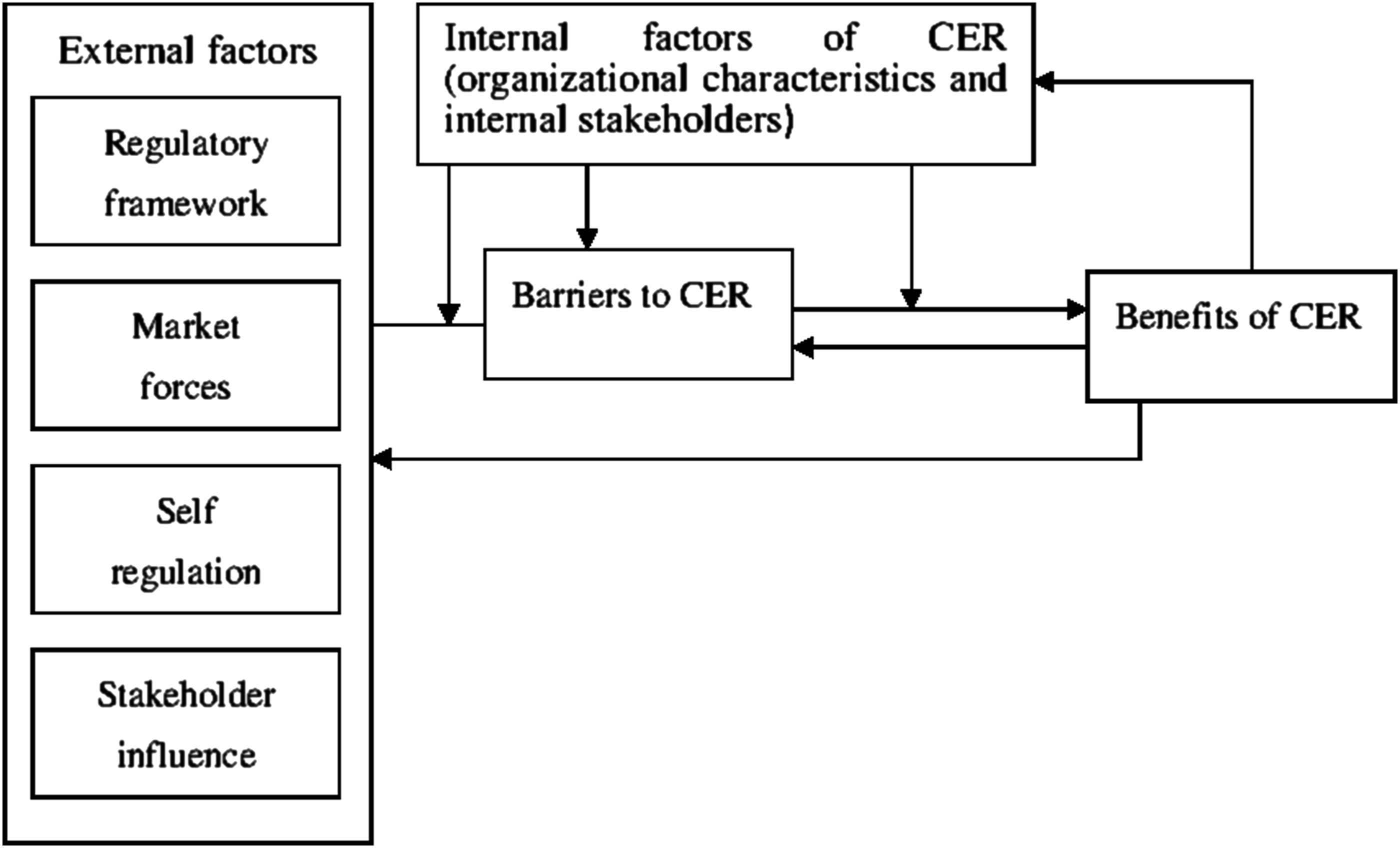
Interdynamics among the factors, barriers, and benefits of CER.
We compared our CER framework with that proposed by Sindhi and Kumar (2012) in terms of scope, specific activities, and metrics. The results of the comparison are as follows.
In terms of scope, the CER framework developed by Sindhi and Kumar (2012) is briefer than our proposed framework. In addition, the former can elucidate the underlying reasons for adopting CER as a strategy specific to the context of a developing country. However, at the enterprise level, no link indicates that the enterprise is actually implemented at the CER level. Our CER framework addresses the deficiencies of the framework prepared by Sindhi and Kumar (2012) by expanding its application from the planning level to the enterprise level. Our CER framework likewise ranges from enterprise social capital to strategy transition and benefit output. Similarly, our CER framework is suitable for developed countries or firms that are either exporting or planning to export to developed countries. Thus, our framework can assist these countries and firms in attaining progress toward fulfilling the goal of sustainable development.
In terms of specific activities, our framework provides direction for the sustainable development of firms that intend to practice CER. Therefore, our CER framework is designed for organizational practice in CER, whereas that provided by Sindhi and Kumar (2012) is an analytical framework that can provide reference materials for firms before they consider conducting CER.
In terms of metrics, that is, conducting a visual inspection from the form process of theoretical framework, Sindhi and Kumar (2012) adopted the interview method to construct their CER framework. However, in our study, we adopted the content analysis method based on corporate documents/records of environmental management actions (i.e., CSR reports). Obtaining information through interviews is challenging because the interview method could easily include the personal knowledge, technological skills, experiences, and values of the interviewee, resulting in nonobjectivity. However, the required data can be obtained directly through interviews with firms or managers. In contrast, the content analysis of our study is based on CSR reports. The source of the data for our content analysis is the actual practice of the company, representing not only existing data but also objective records. Thus, our results reflect objectivity and neutrality. However, reliability of data depends on the data themselves. Based on the theoretical foundation of data abundance for content analysis, we believe that although our CER framework was constructed based on three leading Taiwanese electronic firms with international levels of technology, the framework can be widely used in high-technology industries and even in manufacturing industries. A follow-up study can further analyze the interview and qualitative data.
The reasons for adhering to the content analysis of research companies, which improves the framework for CSR and CER, are illustrated as follows.
International indicators of CSR/CER do not determine the necessary adjustments for countries that vary in economic development and economic directions. Advanced CSR/CER indicators are mostly targeting on high-technology industries. For instance, the European Union (EU) enacted into law the Waste Electrical and Electronic Equipment directive, Directive of Eco-design Requirements of Energy-using Product, and Restriction of Hazardous Substances Directive in 2003. These laws will be retuned or heavy fines will be exacted if electronic products exported to the EU fail to meet the regulations.
This study focused on leading electronic firms with international levels of technology. The CER framework in this study was constructed using the content analysis method of corporate environmental strategies executed by these firms. Therefore, actual corporate practice was the source of data on which the content analysis was based. The CER framework obtained from these results can reflect the real conditions in the industry. Thus, the corporate environmental strategy implemented by high-technology industries can be determined. Moreover, on the basis of data abundance of the content analysis method, our CER framework can be generally used in high-technology industries and even in manufacturing industries despite being based on three leading electronic firms with competitive technology. Meanwhile, the CER framework developed by Sindhi and Kumar (2012) can be used for firms that were merely interviewed. In summary, the interview method is prone to nonobjectivity because the data obtained from such a technique may include personal knowledge, technological skills, experiences, and values of the interviewee. In contrast, the data used in the present study for content analysis were obtained from the actual corporate practices, which represent not only existing data but also objective records. Thus, the results obtained from these data can maintain objectivity and neutrality. Therefore, our proposed approach is expected to improve the framework for CSR and CER.
Conclusion and Implications
Conclusions and theoretical implications
Research that establishes a relative environmental responsibility framework through environmental strategy action is lacking. Countries have different industries and directions for economic development, and this study is the first to consider corporate strategic action on environmental responsibility as basis for constructing a CER framework. This study reveals that the concepts of the companies extensively vary from environmental awareness and resource conditions to green objectives, internal audits, external corresponding activities, and performance settings. These concepts comprehensively shape the framework. This study likewise determines that the case companies effectively practice green social capital, green strategy transition, and green benefit output dimensions. Our proposed CER framework is practical and provides direction for the sustainable development of firms that intend to undertake CER, whereas the analytical framework designed by Sindhi and Kumar (2012) provides reference materials for firms before they consider engaging in CER. Moreover, compared with the GRI index, our CER framework has a more comprehensive scope and provides a clear direction. Compared with the ESI, our CER framework provides a more comprehensive and detailed content for regulating CER and guiding firms and governments in their efforts toward sustainable development.
A corporation intent on executing environmental responsibility that is consistent with its corporate tenets and objectives tends to systematically develop a feasible and fully functional strategic framework in accordance with its fundamental operation philosophy, operational objectives, organizational and strategic transition, or technology (from product design and raw material procurement, production equipment, design of facilities, and assembling management). Therefore, a CER framework built from the current environmental strategic actions of a case company can reflect the environmental responsibility philosophy of the company and its green technology objectives, proving its appropriateness as a fundamental framework for regulating CER.
Managerial implications
Export revenue of Taiwan constitutes a large portion of its gross domestic product. Higher profits for Taiwanese industries are gained when their environmental actions can more efficiently meet international demands. Thus, Taiwanese companies must allocate additional resources to green production, green products, objective management, internal audits, green performance, and practical green benefit output. Companies should likewise establish a set of mechanisms in green performance auditing and environmental proposals. Employees and departments of firms can actualize and focus on environmental protection only by internalizing the external cost of environment and abandoning the mentality of public goods. Hsu et al. (2011) indicate that Taiwan constitutes 70% of the market share and is the largest supplier of semiconductors, optoelectronics, information, and communications worldwide. Considering this large percentage, the results, although derived from Taiwanese companies, can be used by government departments for strategic planning. Subsequently, the CER processes of other companies can be effectively promoted.
Limitations and suggestions for future research
This study only investigated one industry, high-technology industry. Future research can select various industries to allow for comparison. Moreover, this study was conducted only in the context of Taiwan. Thus, future research can include other countries or measure other countries directly for the purpose of comparison.
Footnotes
Author Disclosure Statement
No competing financial interests exist.