




Abstract
Abstract
Recent studies have shown that treated municipal wastewater can be a reliable cooling water alternative to fresh water. However, elevated nutrient concentration and microbial population in wastewater lead to aggressive biological proliferation in the cooling system. Three chlorine-based biocides were evaluated for the control of biological growth in cooling systems using tertiary treated wastewater as makeup, based on their biocidal efficiency and cost-effectiveness. Optimal chemical regimens for achieving successful biological growth control were elucidated based on batch-, bench-, and pilot-scale experiments. Biocide usage and biological activity in planktonic and sessile phases were carefully monitored to understand biological growth potential and biocidal efficiency of the three disinfectants in this particular environment. Water parameters, such as temperature, cycles of concentration, and ammonia concentration in recirculating water, critically affected the biocide performance in recirculating cooling systems. Bench-scale recirculating tests were shown to adequately predict the biocide residual required for a pilot-scale cooling system. Optimal residuals needed for proper biological growth control were 1, 2–3, and 0.5–1 mg/L as Cl2 for NaOCl, preformed NH2Cl, and ClO2, respectively. Pilot-scale tests also revealed that Legionella pneumophila was absent from these cooling systems when using the disinfectants evaluated in this study. Cost analysis showed that NaOCl is the most cost-effective for controlling biological growth in power plant recirculating cooling systems using tertiary-treated wastewater as makeup.
Introduction
Treated secondary municipal wastewater is an obvious cooling water alternative based on the proximity to its potential use, quantity, and consistent quality (Vidic and Dzombak, 2009). This impaired water is among the most promising alternative cooling water sources in the U.S. for power plant recirculating cooling systems (Li et al., 2011a). Previous studies demonstrated that secondary treated municipal wastewater subjected to nitrification and sand filtration (MWW_NF) results in optimal water quality to control corrosion (Hsieh et al., 2010; Choudhury et al., 2012), scaling (Li et al., 2011b; Liu et al., 2012), and biological growth (Dzombak et al., 2012) when using this impaired water as the only makeup for recirculating cooling systems.
A recirculating cooling system is a warm and nutrient-rich environment ideal for growth of both planktonic and sessile bacteria. Biological growth (biofouling) is a common and significant problem in the operation of cooling systems (Melo and Bott, 1997; Frayne, 1999; Flemming, 2002). Along with the favorable growth conditions available in the cooling system (e.g., elevated temperature, neutral pH, constant aeration), organic matter and nutrients present in tertiary-treated effluent are concentrated in the cooling systems, which make controlling biological growth an even more challenging task.
Most microorganisms can form biofilms (Costerton et al., 1999) and are able to colonize on heat exchanger surfaces within 4–8 h (Rossmoore, 1995). Sessile biological growth in cooling systems adversely impacts the efficiency of heat exchangers and promotes microbiologically-induced corrosion underneath the biofilm matrix (Characklis, 1990; Ludensky, 2005). This phenomenon can be further exacerbated when using impaired water as the cooling tower makeup (Puckorius and Diehl, 2003; Zaidi, 2006).
In addition, presence of Legionella species due to poor biological control in the recirculating water (Fraser et al., 1977; Edelstein, 1993; Yu, 2008) is of particular concern because of the potential for aerosol emissions from cooling towers. The Cooling Tower Institute (CTI) proposed that cooling tower operators monitor for Legionella regularly and suggested that planktonic heterotrophic bacteria count in the bulk water be maintained below 104 colony-forming units (CFU)/mL and sessile heterotrophic bacteria count on surfaces be below 105 CFU/cm2 to reduce health and operational risks (CTI, 2008).
Sodium hypochlorite (NaOCl), monochloramine (NH2Cl), and chlorine dioxide (ClO2) are known agents for biological growth control in recirculating cooling towers using fresh water (Kim et al., 2002; Ludensky, 2005). Several studies evaluated the use of treated municipal wastewater as cooling tower makeup in power plants and pointed out the importance of controlling biological growth in the cooling system by using these oxidizing chemicals (Adams et al., 1980; Selby et al., 1996; Chien et al., 2012b).
Grant and Bott (2005) suggested that only doses resulting in sufficient residual biocide can succeed in biological growth control. However, none of the previous studies provide sufficient detail to demonstrate the effectiveness of these biocides when using tertiary treated wastewater in recirculating cooling systems. Besides the biocidal effectiveness and demand, it is also important to understand the cost of appropriate biological growth control.
The specific objectives of this study were: (1) to evaluate the effectiveness of NaOCl, NH2Cl, and ClO2 for the control of biological growth in concentrated tertiary effluent (secondary treated municipal wastewater subjected to nitrification and sand filtration [MWW_NF]) under well-controlled laboratory conditions; (2) to examine the effectiveness of NaOCl, NH2Cl, and ClO2 to control planktonic and sessile biological growth in recirculating cooling systems using MWW_NF as makeup water at 4–5 cycles of concentration (concentration factor for makeup water due to evaporation in the cooling tower); (3) to evaluate the potential of NaOCl, NH2Cl, and ClO2 to control biological growth, including Legionella pneumophila, in pilot-scale recirculating cooling tower systems; and (4) to determine the cost of using NaOCl, NH2Cl, and ClO2 for biological growth control.
Materials and Methods
Tertiary treated wastewater samples were collected from Franklin Township Municipal Sanitary Authority (FTMSA) in Murrysville, PA. The main wastewater treated in their 18.5×10⁶ L/day (4.9 million gallons per day [Mgal/day]) facility is municipal sewage and a small amount of urban runoff. The water characteristics of MWW_NF are shown in Table 1. This wastewater treatment facility incorporates primary sedimentation, aerobic biological trickling filters, secondary clarification, nitrification, sand filtration, and UV disinfection. Samples were collected after sand filtration and before UV disinfection.
BOD, biological oxygen demand; COD, chemical oxygen demand.
Wastewater sample preparation
Wastewater samples collected from FTMSA were transported in a chiller to the laboratory, where they were refrigerated until use. All samples were used within 3 days of collection. The planktonic heterotrophic bacteria count in 20 different samples collected during a period of 1.5 years (April 2010–October 2011) averaged 106.33±106.32 CFU/mL. Thus, a minimum inactivation rate of 99.5% would be required to achieve the target biological growth criterion developed by CTI (i.e., 104 CFU/mL). Wastewater samples were concentrated to four cycles of concentration (CoC4) by evaporation at 40°C. A fine bubble diffuser was used to provide gentle aeration throughout the evaporation process to simulate ammonia stripping in recirculating cooling systems. The pH of wastewater increased above 7.8 during evaporation because of carbonate buffering and was reduced to 7.0–7.2 by the addition of hydrochloric acid before each experiment. Concentrated samples were used in the batch and bench-scale tests within 24 h.
In pilot-scale tests, tertiary-treated effluent was stored in 75-gallon high-density polyethylene tanks to serve as a cooling tower makeup source. Details about the pilot-scale units were reported previously (Chien et al., 2012a). The makeup tanks were treated with preformed NH2Cl at 1 mg/L to represent fresh tertiary effluents discharged from municipal wastewater treatment works. Planktonic heterotrophic bacteria in the recirculating water and in the makeup water were measured every 3–4 days during the pilot-scale tests. The average planktonic heterotrophic plate counts (HPCs) in the makeup water tank in all three tests were 104.04±104.33 CFU/mL for 27 samples. The disinfection was not properly administered on Days 25 and 27, resulting in extremely high HPCs (>105 CFU/mL) on those days (the implication of this variability is discussed in the section Biocidal efficacy in pilot-scale experiments with CoC 4–5 MWW_NF).
Chemical preparation and residual analysis
Preparation, use, and analysis of NaOCl and NH2Cl are described by Chien et al. (2012b). ClO2 stock solution was prepared using a small-scale ClO2 generator (Envirox H1000SRE; Nalco Company). ClO2 concentration in the liquid stock solution varied from 300 to 500 mg/L depending on the quality of sodium chlorite stock solution. ClO2 residuals were measured using a Hach DR/890 portable datalogging colorimeter (Hach) following the Indophenol method 10171 and 10126 (Hach).
Biological analysis
Water samples were cultured for planktonic bacteria counts following the spread plate count method [Method 9215 C Spread Plate Method (APHA, 2012)]. A standard plate count agar (Fisher Scientific) was used as the culture medium and the cultured samples were incubated for at least 48 h at 35°C to derive most probable numbers of colony-forming units. Circular stainless steel coupons (5.61 cm2 in area) were used to monitor sessile biological growth as described by Chien et al. (2012b). Water samples were analyzed every week for Legionella species by the Special Pathogen Laboratory (Pittsburgh, PA). At the end of the field test, a 2 cm×2 cm piece of drift eliminator from each pilot-scale system having visible biomass accumulation was also analyzed for Legionella. Analysis of Legionella was conducted by a certified reference laboratory (Special Pathogens Laboratory) using modified ISO Standards 11731:1998 and 11731-2:2004.
Experimental design
Evaluation of biocidal effectiveness and efficiency followed similar procedures developed previously by Chien et al. (2012b). The three-stage evaluation process was employed to provide side-by-side comparison of the chosen biocides at 40°C in batch-, bench-, and pilot-scale tests. Batch experiments were designed to evaluate planktonic biological growth and biocide performance under static, well-controlled conditions. It should be noted that breakpoint chlorination tests were conducted by first dosing NaOCl in one batch reactor at a rate of 1 mg/L/min until breakpoint chlorination was achieved (i.e., free chlorine was equal to total chlorine residual). The other batch reactors then received a slug NaOCl dose determined from this initial test before adding the required free chlorine residual. The bench-scale recirculating system was used to study sessile biological growth and biocidal inactivation efficacy under the influence of hydrodynamic forces similar to those observed in full-scale cooling systems. A pilot-scale cooling system equipped with both cooling and heating sections was assembled to study biological growth control when using treated wastewater as cooling tower makeup under realistic process conditions (Chien et al., 2012a).
Cost analysis for the use of three biocides in a full-scale cooling system was based on the dosing rate of each biocide obtained from the pilot-scale studies that was extrapolated to a full scale 550 MW power plant cooling system requiring 28.8 million L/day (7.5 Mgal/day) (NETL, 2008) of MWW_NF with consistent quality.
Results and Discussion
Biocide demand and biocidal efficiency in tertiary treated municipal wastewater at 40°C
Table 2 shows the biocide demand and biocidal efficiency of NaOCl, NH2Cl, and ClO2 in raw MWW_NF at 40°C. It should be noted that concentration–time (Ct) values were calculated using the residuals measured after 130 min, while heterotrophic bacteria were cultured from samples collected after 120 min. Breakpoint chlorination was first evaluated in batch tests and it was determined that a Cl2:N as TKN weight ratio of 7.7 was required to consume 3.0 mg/L TKN (0.74 mg/L of NH3-N plus organic nitrogen) in the unconcentrated MWW_NF sample at room temperature. Although the ammonia concentration in MWW_NF was fairly consistent, records show that the average ammonia concentration was 1.42 mg/L as N and that the largest recorded value among 20 samples tested in this study was 3.4 mg/L. Therefore, even higher dose of NaOCl may be required to achieve free chlorine residual if the wastewater is not fully nitrified.
Free chlorine residual as Cl2.
Total chlorine residual as Cl2.
Monochloramine residual as Cl2.
Chlorine dioxide as Cl2.
MWW_NF, secondary treated municipal wastewater subjected to nitrification and sand filtration; HPC, heterotrophic plate count; CFU, colony-forming units; Ct, concentration–time.
LeChevalier et al. (1988) showed that a Ct value of 3.3 mg/L/min was required to achieve 99% inactivation of common heterotrophic bacteria at 1–2°C in chlorine demand-free water. However, the relatively high water temperature in this study resulted in higher chemical reactivity and rapid decomposition of free chlorine residual. Even the initial NaOCl dose of 4 mg/L above the breakpoint chlorination resulted in no measurable residual after a contact time of 2 h. Although there was no residual left in the batch reactor, planktonic HPCs analyses showed an average 99.99% inactivation rate regardless of the amount of NaOCl added beyond breakpoint chlorination.
Batch tests with MWW_NF were also conducted to evaluate the effectiveness of in situ–formed NH2Cl. Theoretically, the ammonia concentration in the wastewater should be sufficient to form total combined chlorine residual as inorganic chloramines, for example, NH2Cl, NHCl2, etc. (Asano and Levine, 1998). However, NaOCl dosage <2 mg Cl2/mg NH3-N (NaOCl dose <4 mg/L) was unable to provide any combined chlorine residual within the contact time of 2 h. High temperature may have driven the OCl− to oxidize compounds other than ammonia, as previous studies have shown that the reaction of NaOCl with specific organic compounds was greatly enhanced by the increase in temperature (Abou-Rass and Oglesby, 1981; Sirtes et al., 2005). Chlorine demand in these tests with MWW_NF was similar to that observed for secondary treated municipal wastewater (Chien et al., 2012b) regardless of the improved quality of wastewater used in this study. Biocidal efficiency observed under these conditions was similar to that observed for breakpoint chlorination, where a Ct value of 28.6 mg/L·min was able to achieve almost 99.9% HPC inactivation.
As shown in Table 2, the use of preformed NH2Cl in MWW_NF resulted in a reliable residual maintenance. An initial NH2Cl dosage of 1.0 mg/L was required to achieve 99.5% inactivation rate with a Ct value of 22.1 mg/L/min. This Ct value was lower than that required for 99% inactivation of heterotrophic bacteria in chlorine-demand free water at 1–2°C but it was within the range of Ct values (15–72 mg/L·min) required to achieve 99.9% inactivation of common heterotrophic bacteria in drinking water at 25°C (LeChevalier et al., 1988, 1990). This result confirms previous findings that an increase in water temperature greatly enhances the reactivity of NH2Cl in treated municipal wastewater (Chien et al., 2012b).
ClO2 residual was consistently observed in MWW_NF after 2 h of contact time in all four batch tests conducted in this study. It is interesting to note that ClO2 residual remained the same regardless of the increase of ClO2 dosage above 1 mg/L. An initial dosage of 2 mg/L ClO2 corresponding to Ct value of 15.6 mg/L/min was required to achieve the target 99.5% inactivation of HPCs in 2 h. A Ct value of 9.1 mg/L/min was unable to achieve target inactivation of HPCs in MWW_NF, while a 50 times lower Ct value was shown to be sufficient to remove 99% of HPCs in chlorine demand–free water at 1–2°C (LeChevalier et al., 1988). Stampi et al. (2002) also observed that the inactivation of total HPCs was lower than that of specific coliforms present in the secondary effluent.
Impact of cycles of concentration on biocidal efficiency and biocide residual in tertiary treated municipal wastewater at 40°C
Batch tests with slug biocide dosages were conducted in 4× concentrated (CoC 4) MWW_NF with a target initial biocide dose equal to four times the dose required in the tests with unconcentrated MWW_NF. The initial dosages for NaOCl, NH2Cl, and ClO2 were 8 mg/L as NaOCl, 4 mg/L as NH2Cl, and 8 mg/L as ClO2, respectively. A dose of 9.6 mg/L of NaOCl was added to reach breakpoint chlorination in CoC 4 MWW_NF that contained 0.03 mg/L NH3 as N.
Figure 1 shows biocide residual in each test during a 2-h experiment. The Ct values for breakpoint chlorination, in situ–formed NH2Cl, preformed NH2Cl, and ClO2 in these tests were 16.3, 85.2, 153.4, and 64.4 mg/L/min, respectively. Biocide residual in the case of in situ–formed NH2Cl and ClO2 had a significant drop within the first 10 min. On the other hand, preformed NH2Cl had a much slower and gradual decrease in biocide residual, while 1 mg/L free chlorine residual after breakpoint chlorination gradually diminished within 40 min from the beginning of the test.
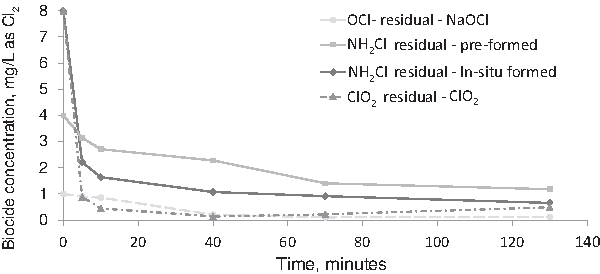
Biocide residuals in 4× concentrated secondary treated municipal wastewater subjected to nitrification and sand filtration (CoC 4 MWW_NF) during batch tests at 40°C.
Although the use of preformed NH2Cl appears to be the most promising biocide with respect to maintaining the biocide residual in the wastewater, results of the biocidal efficiency analysis shown on Fig. 2 suggests that only 1 mg/L NaOCl after breakpoint chlorination could achieve 99.5% (about 3 log) inactivation rate in CoC 4 MWW_NF. This result indicates that the initial biocide dosage required to achieve 99.5% HPC inactivation in concentrated wastewater (CoC 4 MWW_NF) is much greater than that calculated based on a simple increase in cycles of concentration.
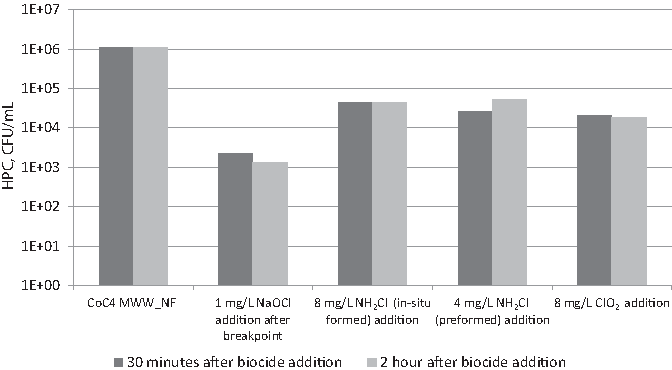
Biocidal efficiency of chlorine-based biocides against planktonic heterotrophic bacteria in CoC 4 MWW_NF in batch tests at 40°C.
Biological growth control in bench-scale recirculating system with CoC 4 MWW_NF
The effectiveness of different biocides in controlling biological growth was further tested in a bench-scale recirculating system designed to simulate temperature, flow velocity, and water quality similar to those in a full-scale recirculating cooling systems. Concentrated MWW_NF was aerated in these tests and the average pH in all three tests was 8.4±0.05. The initial planktonic HPCs in the untreated CoC 4 MWW_NF were 105.76±105.26 CFU/mL. The bench-scale test lasted for 72 h and the recirculating system was treated with periodic biocide dosing to maintain a desired biocide residual. Planktonic HPCs were cultured at 4, 8, 12, 24, 48, and 72 h and sessile HPCs were cultured after 12, 24, 48, and 72 h. Planktonic and sessile HPCs profiles in these experiments are shown in Fig. 3.

Effectiveness of NaOCl, NH2Cl, and ClO2 against planktonic and sessile heterotrophic plate counts (HPCs) in a bench-scale recirculating system operated with CoC 4 MWW_NF at 40°C.
A recirculating cooling system operated with surface water is usually treated by maintaining a free chlorine residual between 0.5 and 1 mg/L (CTI, 2008). The same criterion was adopted in this study evaluating the use of MWW_NF as makeup. Since the initial inorganic ammonia concentration in CoC MWW_NF was 0.09 mg/L as NH3-N, NH2Cl was only detected in the system during the early stages of the test (i.e., until the breakpoint chlorination was achieved). The free chlorine residual was 1.27±0.75 mg/L as Cl2 after reaching the breakpoint chlorination, and NaOCl was added to the system at a rate of 1.10 mg/L/h (i.e., total mass of biocide divided by total volume of makeup water added to the system during the entire test) to maintain this residual. Planktonic HPCs decreased from 105.89 to<104 CFU/mL after 4 h and remained below the control criterion until the end of the experiment. The analysis of sessile HPC indicated that biofilm formation was also controlled below 105 CFU/cm2 in the presence of 1.27 mg/L free chlorine residual.
Previous work has shown that NH2Cl residual of 3 mg/L can achieve good biological growth control when using secondary treated wastewater as cooling tower makeup (Chien et al., 2012b). A slightly lower target NH2Cl residual of 2–3 mg/L was used in this study since the tertiary effluent had better water quality. NH2Cl residual (2.29±0.42 mg/L of NH2Cl) accounted for approximately 83% of the total chlorine residual (2.77±0.50 mg/L as Cl2). Preformed NH2Cl was added to the system at a rate of 0.59 mg/L/h to maintain the NH2Cl residual in CoC 4 MWW_NF. Both planktonic and sessile HPCs were maintained below the control criteria of 104 CFU/mL or 105 CFU/cm2, respectively, throughout the experiment.
At present, there is no clear standard indicating the required ClO2 residual for biological growth control in recirculating cooling tower systems. A widely accepted industrial criterion for Legionella control in recirculating institutional water system is to maintain ClO2 residual between 0.5–0.7 mg/L (Zhang et al., 2009). Therefore, a ClO2 residual between 0.25–0.5 mg/L as Cl2 in recirculating system was adopted in this test. The ClO2 residual was 0.27±0.12 mg/L as Cl2 throughout the test. The dosing rate required to maintain this ClO2 residual in CoC 4 MWW_NF was 1.04 mg/L/h and was successful in controlling both planktonic and sessile HPCs in CoC 4 MWW_NF below the desired control criteria. Table 3 summarizes the biocide residual, biocide dosing rate, and results of biological growth control for selected biocides.
Using the listed parameters, both planktonic and sessile biological growth were well-controlled.
TC, total chlorine residual; MCA, monochloramine residual.
Biocidal efficacy in pilot-scale experiments with CoC 4–5 MWW_NF
Pilot-scale experiments were conducted to confirm the findings from bench scale studies under more realistic conditions. The pilot scale experiment focused on the biocidal effectiveness against HPCs and L. pneumophila based on the optimal dosages obtained from bench-scale tests. Chemical regimes used for corrosion and scaling control are described by Choudhury et al. (2012) and Liu et al. (2012).
Effectiveness of NaOCl to control biological growth in pilot-scale cooling tower is shown in Fig. 4. Free chlorine residual in this test was maintained at 1.99±1.80 mg/L as Cl2, while NH2Cl residual averaged 0.09±0.02 mg/L as Cl2. The formation of NH2Cl was limited due to low initial ammonia concentration (0.75±0.25 mg/L) and effective ammonia stripping in the recirculating cooling system (Hsieh et al., 2012). On average, free chlorine residual accounted for 32±20% of total chlorine residual. Although NaOCl was dosed into the cooling water reservoir at a similar rate as in the bench-scale study (1.2 mg/L of NaOCl per hour), organic matter in MWW_NF resulted in conversion of >60% of NaOCl to organic chloramines. Planktonic HPCs in recirculating water were below the target criterion of 104 CFU/mL throughout the test except on Day 25 (planktonic bacteria increase occurred due to the failure of makeup water tank disinfection). The 10-day and 28-day sessile samples approached the sessile biological growth control criteria of 105 CFU/cm2, because the concentration of free chlorine was quite low in the period preceding these sampling events.
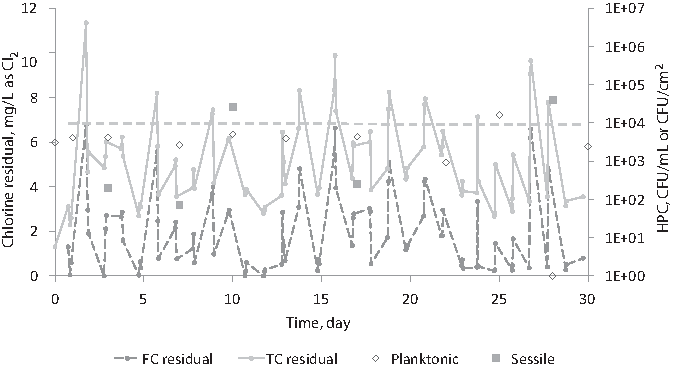
Biocide residuals and HPCs in recirculating cooling system with chlorination and MWW_NF. Dashed line indicates the planktonic biological growth control criteria, 104 colony-forming units (CFU)/mL.
Effectiveness of preformed NH2Cl for biological growth control is shown in Fig. 5. Previous studies (Vidic and Dzombak, 2009; Chien et al., 2012b) demonstrated that the use of preformed NH2Cl is suitable for biological growth control in cooling towers using secondary treated municipal wastewater as makeup. In this test, NH2Cl residual was maintained at 2.76±1.10 mg/L as Cl2 for 30 days. On average, the NH2Cl residual accounted for 85% of total chlorine residual (3.16±1.11 mg/L) throughout the test. Planktonic HPCs results were mostly<104 CFU/mL, except for one sample on Day 25, because nearly no NH2Cl residual was detected in the system 1 day before sampling and because of high initial HPC in the makeup water. Among the four sessile samples taken during the 30-day period, none of the samples showed the biofilm growth that approached the control criterion of 105 CFU/cm2. In general, sessile HPCs were well controlled to at least 1-log below the CTI criterion throughout the test.

Biocide residual and HPCs in recirculating cooling system with chloramination and MWW_NF. Dashed line indicates the planktonic biological growth control criteria, 104 CFU/mL.
Biological growth control with ClO2 is illustrated in Fig. 6. ClO2 residual averaged 0.41±0.16 mg/L as Cl2 throughout the experiment. In the first 10 days of testing, the ClO2 was maintained between 0.25 and 0.5 mg/L and it was observed that planktonic HPCs frequently exceeded the control criterion. The target residual concentration was then increased to 0.5–1.0 mg/L ClO2 for the remaining test period. This adjustment resulted in much better control of sessile biological growth, which was reduced from 104.5 to <102 CFU/cm2 on day 28.
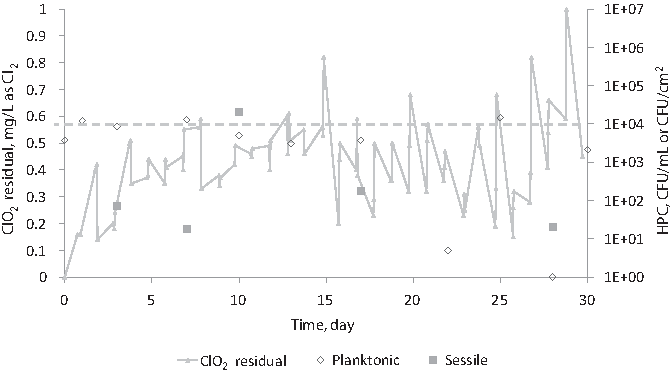
Biocide residual and HPCs in recirculating cooling system with ClO2 and MWW_NF. Dashed line indicates the planktonic biological growth control criteria, 104 CFU/mL.
Recirculating cooling water samples from pilot-scale systems were sent weekly to the Special Pathogen Laboratory for Legionella analysis. Pieces of drift eliminator and packing with visible microbial deposit were also analyzed for Legionella at the end of the test. Regardless of the type of biocide used, all samples were negative for Legionella, indicating that this opportunistic pathogen was not able to grow in the pilot-scale cooling systems fed with MWW_NF and with continuous biocide addition over a period of 30 days.
Economic analysis
Economic analysis was conducted based on the biocide usage observed in pilot-scale tests with MWW_NF as makeup. Biocide dosing rate was calculated by multiplying the volume of biocide stock solution consumed daily and biocide concentration in the stock solution. The biocide dosing rate was then normalized by daily makeup water volume to estimate the overall cost required for large scale cooling systems based on the chemical unit costs obtained from manufacturers. Table 4 lists the biocide dosing rates, chemical unit costs, and estimated daily costs for all three biocides. NaOCl was the most cost-effective biocide; while preformed NH2Cl was the most expensive because it required more than twice the amount of NaOCl. The high biocide unit cost of ClO2 reflects the cost of the more complicated production process and the value of the chemicals required for ClO2 generation.
2009 commodity price obtained from suppliers.
U.S. dollar value in 2009.
Residual as free chlorine.
Residual as monochloramine.
Residual as chlorine dioxide.
Summary and Conclusions
The primary objective of this study was to investigate the effectiveness of NaOCl, preformed NH2Cl, and ClO2 as biocides to control biological growth in recirculating cooling systems employing tertiary treated municipal wastewater as sole makeup water. A secondary objective of this study focused on costs for the different biocides used to achieve proper biological growth control.
The cycles of concentration and ammonia concentration in recirculating water critically affected the biocide performance in the cooling systems. A linear increase in the initial biocide dosage with an increase in cycles of concentration of wastewater was not adequate to control the planktonic biological growth regardless of the type of biocide used. Variable ammonia concentrations in pilot-scale cooling systems resulted in occasionally more aggressive sessile biological growth.
Optimal biocide dosing schemes necessary to achieve adequate biological growth control were evaluated in bench- and pilot-scale tests. Bench-scale studies in a recirculating system with continuous biocide addition indicated that all three biocides could achieve biological growth control criteria for 72 h despite periodic addition of fresh microorganisms and nutrients. Pilot-scale tests were conducted using the optimal biocide dosing and residuals determined from bench-scale tests. The studies revealed that the biocide dosing rates established in bench-scale tests did not adequately reflect the biocide dosages required to maintain target residuals in larger recirculating cooling systems. The optimal residuals of NaOCl, NH2Cl, and ClO2 to achieve recommended biological growth criteria were 1, 2–3, and 0.5–1.0 mg/L as Cl2, respectively. Free chlorine was the most cost-effective disinfectant for recirculating cooling systems using tertiary treated municipal wastewater (MWW_NF).
Pilot-scale tests also revealed a complete absence of L. pneumophila from the system, which ensures the safety of those who work or live around a recirculating cooling system using tertiary treated municipal wastewater as makeup.
Footnotes
Acknowledgments
This study was supported by the U.S. Department of Energy, National Energy Technology Laboratory, Grant nos. DE-FC26-06NT42722 and DE-NT0006550. The views and opinions of the authors expressed herein do not necessarily state or reflect those of the United States Government or any agency thereof. The authors thank Jason D. Monnell (GAI Consultants Inc.), Wenshi Liu (University of Pittsburgh), Mahbuboor R. Choudhury (Bangladesh University of Engineering and Technology), and Ranjani Theregowda (Transtech Engineering) for helpful suggestions in the course of the study. The authors gratefully acknowledge the Franklin Township Municipal Sanitary Authority, and especially manager James Brucker, for supporting the pilot-scale cooling tower tests at their facility.
Disclosure Statement
No competing financial interests exist.