




Abstract
Abstract
Benzene, toluene, ethylbenzene, and xylene (BTEX) are a group of monoaromatic petroleum-derived pollutants. Dissimilatory iron-reducing bacteria are able to obtain energy for growth and function by coupling the oxidation of organic compounds and the reduction of Fe(III) to Fe(II) in a subsurface environment. Batch experiments were conducted to study the effects of groundwater geochemical compositions on the degradation of BTEX coupled to microbial dissimilatory Fe(III) reduction. Results indicated that, the BTEX degradation coupled to microbial dissimilatory Fe(III) reduction could be described as pseudo-first-order kinetics, the order of BTEX degradation rate exhibited xylene>ethylbenzene>toluene>benzene. Cations and anions underwent inhibition-dominated reactions (carbonate, calcium, and magnesium) or enhancement-dominated reactions (bicarbonate and sulfate) on degradation of BTEX: (1) lower concentrations of carbonate, calcium, and magnesium enhanced the BTEX degradation, whereas higher concentrations exhibited inhibition of BTEX degradation; (2) increase in bicarbonate concentrations led to a higher BTEX removal efficiency; (3) it was found that removal of BTEX was accelerated at concentrations of SO42−<200 mg/L, and was proportional to BTEX removal efficiency. Therefore, groundwater geochemical compositions have profound effects on degradation of BTEX coupled to dissimilatory Fe(III) reduction, which has important significance for removing of aromatic compounds from a contaminated aquifer.
Introduction
B
Fe(III) oxides and oxyhydroxides are ubiquitous constituents of soils, sediments, and aquifers. The microbial dissimilatory Fe(III) reduction is recognized as an important process for in situ bioremediation due to the abundance of Fe(III), and numerous studies have suggested that dissimilatory iron-reducing bacteria possess the ability to immobilize or degrade a wide variety of contaminants (Lovley, 1995; Roden and Wetzel, 2002). Dissimilatory Fe(III) reduction is an important process in the biogeochemistry of soils and aquifers. Under suboxic conditions, Fe(III) minerals are reductively dissolved through a number of alternative abiotic and microbial pathways. In particular, they serve as terminal electron acceptors for the oxidation of organic matter by iron-reducing bacteria (Lovley, 1987; Van Cappellen and Wang, 1996; Roden and Wetzel, 2002). In anoxic environments, the biogeochemical cycling of iron can be coupled to the microbial and abiotic transformation of organic contaminants in groundwater, such as BTEX compounds, which can be oxidized coupled to microbial dissimilatory Fe(III) reduction (Lovley et al., 1989; Lovley and Lonergan, 1990; Tobler et al., 2007). Petroleum-contaminated aquifers often contain extensive anaerobic zones and Fe(III) is generally the most abundant electron acceptor for organic matter oxidation in these systems (Lovley, 1991, 1997; Anderson, 1998). Hence, microbial dissimilatory Fe(III) reduction coupled to BTEX oxidation plays significant roles in the natural attenuation of organic pollutants in the subsurface environment.
Previous studies have shown that the groundwater geochemical constituents, such as carbonate, bicarbonate, calcium, magnesium, and sulfate, had profound influences on the performance of zero-valent iron (ZVI)-based permeable reactive barrier (Devlin and Allin, 2005). Most of these studies focused on evaluating the porosity and reactivity changes of ZVI influenced by groundwater geochemical constituents (Klausen et al., 2001; Suk et al., 2009). In addition, in the microbial systems, although numerous studies had demonstrated that the mechanism of the biodegradation of BTEX organic contaminants coupled to microbial Fe(III) reduction (Anderson and Lovley, 1999), iron-reducing bacteria are thought to mediate the degradation of BTEX through the reduction of Fe(III) minerals (Zhang and Han, 2002; Jiang et al., 2005); direct evidence for the effects of groundwater geochemical constituents on the degradation of BTEX coupled to microbial Fe(III) reduction under anaerobic conditions in natural systems has not been provided. For this reason, the objectives of this study were (1) to investigate the effects of groundwater geochemical constituents on the degradation of BTEX coupled to microbial Fe(III) reduction and (2) to assess the reasons for the cation and anion tendency to either enhance or inhibit the BTEX degradation coupled to microbial Fe(III) reduction.
Experimental Materials and Methods
Materials
Akaganeite preparation
The suspended akaganeite (β-FeOOH) was prepared by hydrolyzing FeCl3·6H2O according to procedures introduced by Schwertmann and Cornell (Schwertmann and Cornell, 1991). To remove the Cl− ions, the suspended akaganeite precipitate was dialyzed with demineralized water.
Bacteria
Iron-reducing bacteria were extracted from landfill leachate, and then cultured and purified by ferric citrate medium plates (ferric citrate 5 g/L, NaCl 2 g/L, CaCl2 1 g/L, MgCl2 2 g/L, NH4Cl 3 g/L, KH2PO4 2 g/L, pH 7.2) and routinely cultured in a liquid ferric citrate medium on a rotary shaker (120 rpm) at room temperature. Microbial cells were kept anaerobically in the Luria Bertani medium (tryptone 10 g/L, yeast 3 g/L, NaCl 5 g/L, pH 7.1). The cultured cells were washed three times with the experimental medium solution to remove the growth medium, and then concentrated by centrifugation just before inoculation.
Experimental setup
Experiments were set up in 25-mL sterile borosilicate glass serum bottles closed with Teflon-lined gray butyl septa under anaerobic conditions. To determine the effects of groundwater geochemical constituents on degradation of BTEX coupled to microbial dissimilatory Fe(III) reduction, a series of solutions were prepared containing 100 mg/L BTEX (benzene, toluene, ethylbenzene, and xylene concentration of 25 mg/L, respectively), microbial cells (1 mL/25 mL), 0.106 g/L akaganeite, 4 g/L citric acid, and different concentrations of CO32−, HCO3−, Ca2+, Mg2+, and SO42−. The injection of citric acid cosubstrate was to facilitate the degradation of BTEX by iron-reducing bacteria. The serum bottles were sealed with butyl rubber membrane after the solutions were prepared; all experiment solutions were allowed to react for 41 days. Samples were taken at selected time point to analyze the concentrations of BTEX.
Analytical methods
BTEX were measured by GC (Shimadzu-2010). The chromatographic analysis conditions were the DB-1 capillary column (30 m×0.25 μm×0.25 mm), the inlet temperature was 200°C, carrier gas was nitrogen, FID detector, splitting injection, the split ratio was 5:1, and the volume of injection sample was 1 μL. The advanced temperature procedure: keep the initial 40°C for 2 min, and then the temperature increased up to 85°C; keep the 85°C for 3 min.
Results and Discussion
Kinetics of BTEX degradation
Figure 1 shows the kinetics of BTEX degradation coupled to microbial dissimilatory Fe(III) reduction. The result indicated that, the BTEX degradation could be described as pseudo-first-order kinetics. A regression model was described as:
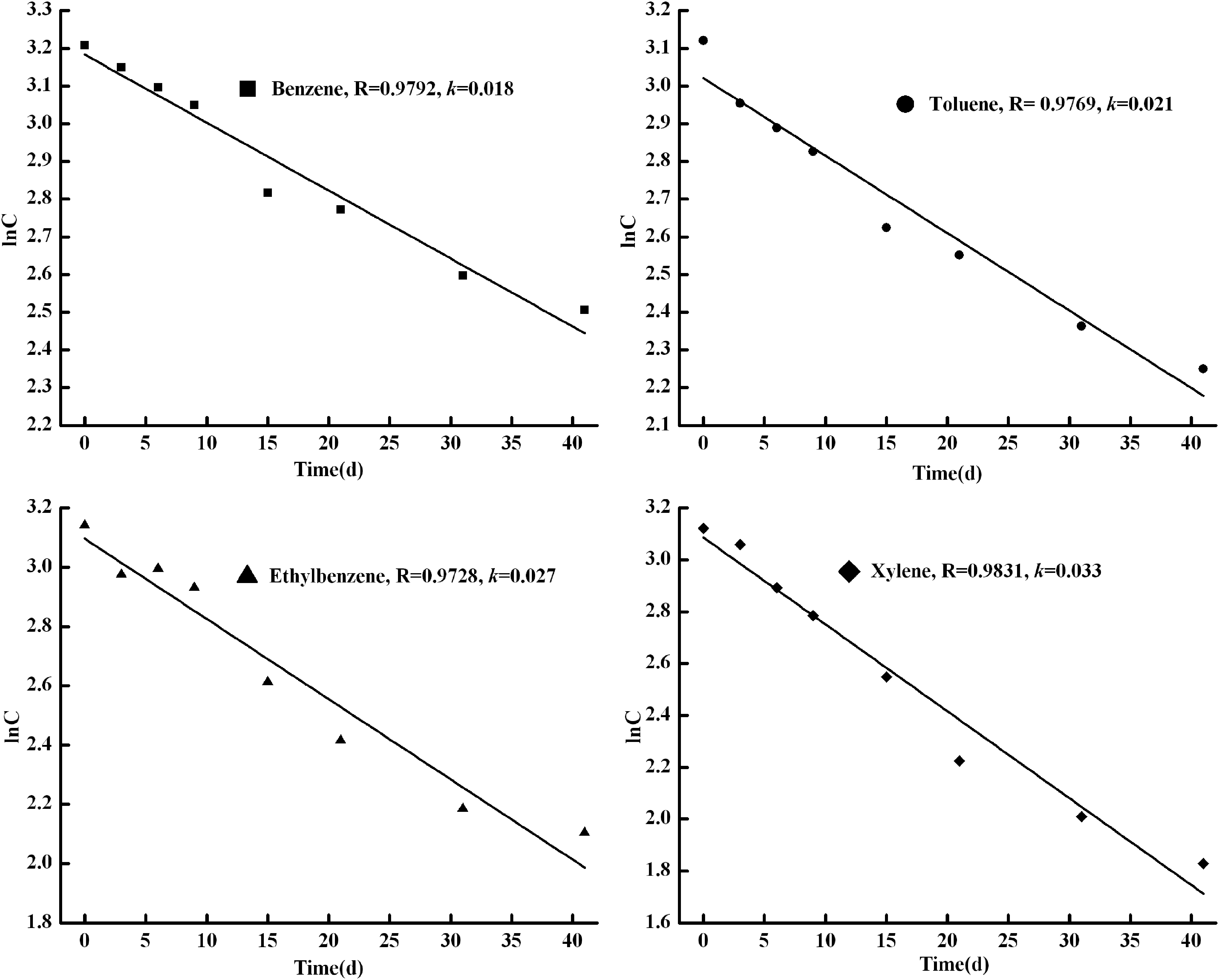
Kinetics of benzene, toluene, ethylbenzene, and xylene (BTEX) degradation coupled to microbial dissimilatory Fe(III) reduction.
where k was the first-order rate constant, C was the BTEX concentration, C0 was the initial BTEX concentration, and the half-life (t1/2) can be calculated according to Equation (2):
The kinetics of BTEX degradation coupled to microbial dissimilatory Fe(III) are presented in Fig. 1. The result indicated that, the BTEX degradation rate constant, k, was 0.018, 0.021, 0.027, and 0.033 d−1 for benzene, toluene, ethylbenzene, and xylene, respectively. The order of BTEX degradation rate exhibited xylene>ethylbenzene>toluene>benzene. Also, the calculated half-life of BTEX, t1/2, was 38.5, 33.0, 25.7, and 21.0 days for benzene, toluene, ethylbenzene, and xylene, respectively.
Effects of carbonate and bicarbonate
The effects of carbonate on BTEX degradation coupled to microbial dissimilatory Fe(III) reduction over time expressed in Fig. 2. It could be found that the removal efficiencies were enhanced in the presence of 50 and 100 mg/L CO32−. At the concentration of 50 mg/L CO32−, the removal efficiencies of BTEX increased 9.20%, 13.93%, 15.01%, and 1.96% for benzene, toluene, ethylbenzene, and xylene, respectively. At the concentration of 100 mg/L CO32−, the removal efficiencies of BTEX increased 5.92%, 12.05%, 22.71%, and 1.12% for benzene, toluene, ethylbenzene, and xylene, respectively. However, the BTEX removal efficiencies were decreased at the higher CO32− concentration (150 and 200 mg/L). These differences were caused by the following possible reasons: First, with the buildup of Fe(II), surface Fe(II) gradually formed by Fe(II) adhered to iron mineral surfaces, which would reduce the contact chance between microbial cells and Fe(III) minerals. The lower concentration CO32−(50 and 100 mg/L) favored the formation of carbonate green rust [FeII4FeIII2 (OH)12][4H2O·CO3] (Phillips et al., 2000; Williams and Scherer, 2001; Agrawal et al., 2002), which would facilitated the desorption of reduced Fe(II) ion from the surface of cell-bound Fe(III) minerals, and an underlying Fe(III) center is exposed, which in turn, becomes available for reduction. As a result, the BTEX removal efficiency was increased. Second, the precipitation formation of FeCO3 and Fe2(CO3)(OH)2 became the main process at the higher CO32− concentration (150 and 200 mg/L), the bacterium-Fe(III) mineral interfaces were covered with the majority of the precipitation, which could restrict the effective contact between microbial cells and Fe(III) centers, and resulted in a limited electron transfer (Klausen et al., 2003; Jeen et al., 2006; Parbs et al., 2007; Pekov et al., 2007), thereby the BTEX oxidation removal was decreased.

BTEX concentration variation curves over time at different concentrations of CO32−.
Figure 3 shows the effect of bicarbonate on BTEX degradation over time. The results indicated that the BTEX removal was accelerated at the concentration of HCO3− <200 mg/L. The possible reason was that sufficient Fe(II) had accumulated through microbial dissimilatory Fe(III) reduction, and then Fe(II) complexation [FeHCO3+ and Fe(HCO3)2] gradually began to form. The Fe(II) complexation appeared to alleviate a suppression caused by accumulation of Fe(II) for the BTEX oxidation coupled to Fe(III) reduction (Royer et al., 2002). In addition, the buffering effect of bicarbonate for the solution pH might account for the higher BTEX removal. Moreover, carbonate, from bicarbonate, was generally considered to form carbonate green rust, a reactive phase, which was beneficial for being utilized by microorganisms (Devlin and Allin, 2005; Erping et al., 2009). Furthermore, produced Fe(II) combined with carbonate and formed new biogenic minerals (Michael et al., 2002), which also made contributions to BTEX removal.

BTEX concentration variation curves over time at different concentrations of HCO3−.
Effects of calcium and magnesium
Figure 4 illustrates the effect of total hardness on BTEX degradation over time at the mol ratio of mixed calcium to magnesium 1:1. It can be seen from the figure that calcium and magnesium, depending on their concentration, could enhance or inhibit the BTEX degradation. At the concentration of 50 mg/L calcium and magnesium, the removal efficiencies of BTEX increased 10.09%, 4.18%, 10.90%, and 4.34% for benzene, toluene, ethylbenzene, and xylene, respectively. A drastic decrease was observed, while the total hardness concentration increased. The results suggested that calcium and magnesium could be essential elements for microbial growth, and the appropriate concentration could facilitate the BTEX oxidation degradation coupled to microbial Fe(III) reduction. However, the precipitations of white flocculent calcium and magnesium oxyhydroxides were observed at a concentration of total hardness more than 50 mg/L, and the precipitations might partly attached to the surface of akaganeite, passivated reactive surfaces by blocking electrontransfer sites, leading to bacterium-Fe(III) mineral interfacial reactivity losses and the BTEX removal restriction (Arnold and Roberts, 2000; D'Andrea et al., 2005; Lo et al., 2006).
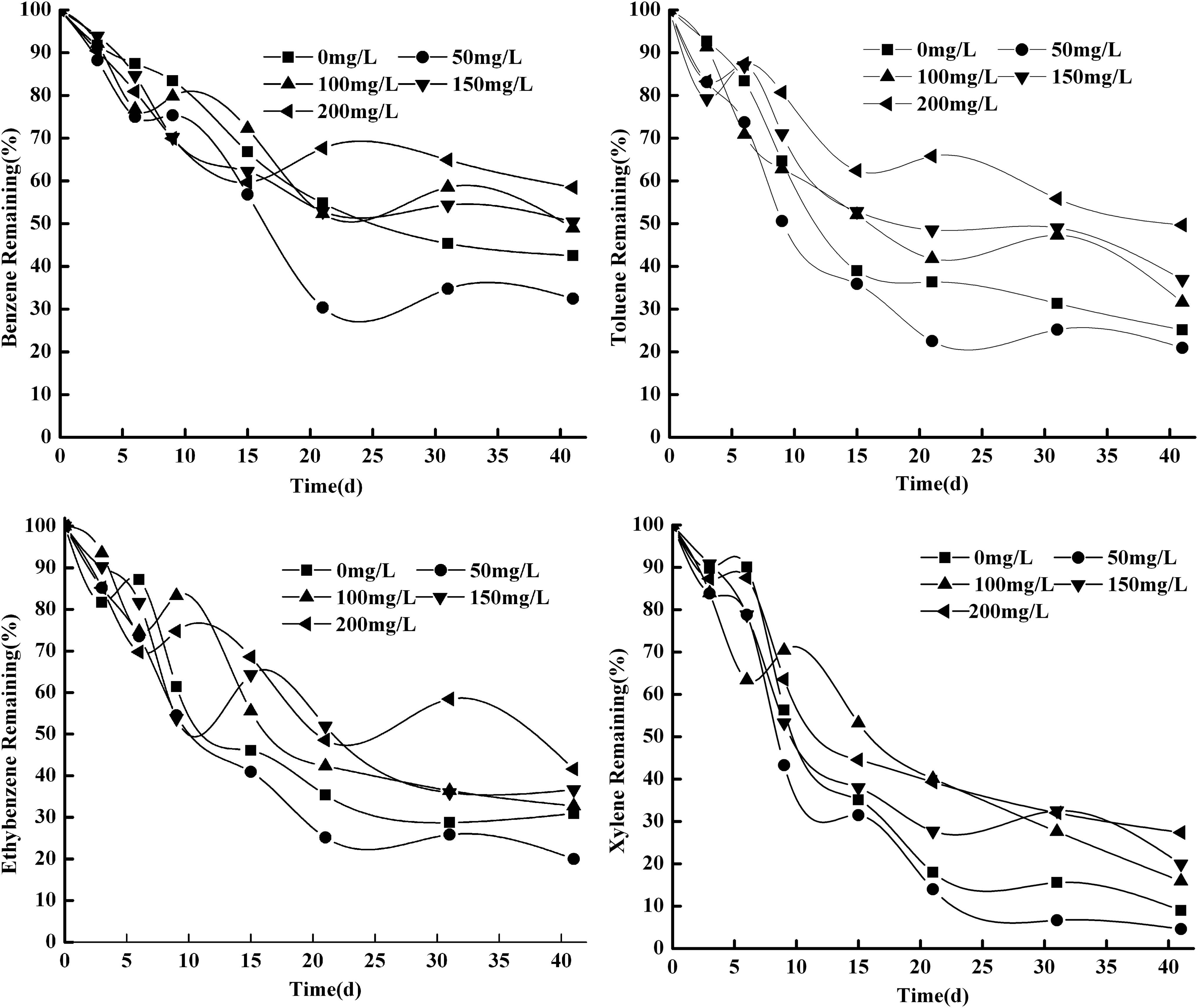
BTEX concentration variation curves over time at different concentrations of total hardness.
Effects of sulfate
Figure 5 shows the effects of sulfate on BTEX degradation over time. It was found that the removal of BTEX was accelerated at the concentration of SO42−<200 mg/L, and it was proportional to BTEX removal efficiency. Although the constraint of surface areas and crystallinity, the insoluble Fe(III) minerals could not compete with sulfate as alternative electron acceptors and the sulfate reduction processes might predominate reactions (Cummings et al., 2000), the copresence of Fe(III) and SO42− enhanced the performance by providing more opportunities or more reducing intensity; therefore, the removal of BTEX was enhanced when Fe(III) minerals and sulfate were copresent in the system. As the reaction went on, the formation of iron sulfide black precipitate would alleviate an inhibition caused by accumulation of Fe(II), which also contributed to accelerate the BTEX degradation coupled to the microbial Fe(III) reduction.

BTEX concentration variation curves over time at different concentrations of SO42−.
Conclusions
Batch experimental studies revealed that the groundwater geochemical constituents has profound effects on the BTEX oxidation degradation coupled to microbial Fe(III) reduction. The BTEX degradation coupled to microbial dissimilatory Fe(III) reduction could be described as pseudo-first-order kinetics, the order of BTEX degradation rate exhibited xylene>ethylbenzene>toluene>benzene; carbonate, calcium, and magnesium hardness enhanced or inhibited the BTEX degradation depending on their concentration; the increase of bicarbonate concentrations led to higher BTEX removal efficiency; the BTEX removal efficiency was proportional to the concentration of SO42− <200 mg/L.
Footnotes
Acknowledgments
This study was performed as part of the research on technical methods of investigation and remediation for soil and groundwater contaminated site (1212011220985), and supported by the Key Laboratory of Groundwater Resources and Environment, Ministry of Education Jilin University.
Author Disclosure Statement
No competing financial interests exist.