




Abstract
Abstract
Glass beads are used in road markings to obtain retroreflectivity and recently have received attention due to the presence of arsenic (As), lead (Pb), and antimony (Sb). In this study, six domestic (U.S.-manufactured) and 12 imported batches of glass beads were analyzed for total metal and metalloid concentrations using field-portable X-ray fluorescence. For domestic batches, average concentrations of 8 mg/kg for As, 23 mg/kg for Pb, and 55 mg/kg for Sb were observed. On the other hand, the imported batches were found to have averages of 485 mg/kg for As, 97 mg/kg for Pb, and 106 mg/kg for Sb. Samples from batches followed Gaussian distributions; however, variability in concentrations within the imported batches was significant with errors ranging from 18% to 22% for As, 50% to 83% for Pb, and 13% to 16% for Sb. Based on these results, additional studies are warranted to evaluate the potential for leaching of metals.
Introduction
Glass beads used on highways are composed of soda-lime silica glass (Marini, 2003), typically: 73% SiO2, 15% Na2O, 4% MgO, 7% CaO, and 2% Al2O3 (Doremus, 1973). In addition, this glass often includes trace concentrations of other metal oxides that can play a major role in the physical and chemical properties of the glass. For example, additions involve network formers such as B2O3 and P2O5, viscosity reducers to lower melt temperature (e.g., Li2CO3, Na2CO3, and K2CO3), and stabilizers to reduce solubility (e.g., MgO, CaO, SrO, BaO, ZnO, and PbO) and increase resistance to chemical attack (e.g., B2O3). Refining agents such as As2O3 and Sb2O3 are used to remove entrapped CO2 gas formed during heating. Additionally, coloring and decoloring (color compensating) agents include Cu, Cr, Mn, Fe, Co, Ni, V, and Se (Hynes and Jonson, 1997). Inorganic arsenic (As) also acts as a decolorizer by controlling the oxidation state of iron in the glass. PbO is introduced as a stabilizer and modifier, improving the physical and chemical durability of glass. Currently, these improved properties can be achieved by using other additives, such as trace concentrations of W, Ti, Zr, and Ba (Hayden, 2004); however, obsolete methods involving the use of regulated metals and metalloids for enhancing glass properties may still be practiced in developing countries. As such, glass beads produced in China and imported into the United States may have elevated metal and metalloid concentrations. Duty (2006) reported elevated As, Pb, and Sb concentrations in glass beads imported from China to North America. Of the nine glass bead samples studied, Duty (2006) found concentrations as great as 1160 parts per million (ppm) for As, 1150 ppm for Pb, and 840 ppm for Sb, while the majority of the North American beads did not exhibit detectable metal concentrations.
In North America, ∼500 million pounds (∼226.8 million kg) of glass beads are used each year in pavement markings (Sentruk, 2008; van de Griend et al., 2009), which are increasingly being imported. As a result, metals and metalloids associated with these glass beads may be applied on highways (Sentruk, 2008). Because of their effectiveness in optimizing optical properties, As, Pb, and Sb are three elements that have been observed by a number of users of glass beads (Flint, 2008; van de Griend et al., 2009). At the same time, concern has arisen because of their hazardous and toxic nature. Arsenic occurs naturally in soils and minerals and is a known carcinogen through both inhalation and oral routes of exposure (ATSDR, 2007). Lead is a toxic metal that was used for many years, in paint and gasoline for example; therefore, it has been found throughout the environment. Even at low levels, lead may cause a range of health effects, including neurological ones in infants (ATSDR, 1997). Antimony is found in the earth's crust but used in various industrial applications, such as metal alloys, semiconductors, coatings, pigments, and lead acid batteries. Oral exposure to antimony may result in gastrointestinal effects (ATSDR, 1992). On the other hand, inhalation of antimony can cause pulmonary toxicity and chronic interstitial inflammation (U.S. EPA, 1999).
The objective of this research was to evaluate the range of metal and metalloid concentrations in imported and domestic (U.S.-manufactured) glass beads, assess variability within batches procured by DOT agencies, and evaluate the statistical difference between imported and domestic batches. Furthermore, this research examines the need to further investigate the effects of the distribution of metals and metalloids in domestic versus imported batches in addressing the environmental impact of glass beads applied on roadways.
Materials and Methods
Eighteen batches (10 pounds [∼4.54 kg] each) of glass beads were collected from their original 2000-pound (∼907.2 kg) source and were procured from the NJDOT and its vendors. Six of these batches were manufactured in the United States and the remaining 12 were imported. Samples were manually split into duplicates or triplicates throughout the study. This manual approach was evaluated against the use of a Riffle Splitter, which is a sampling device used by laboratories to mechanically split geotechnical samples (Ingamells and Pitard, 1986). Six samples from one of the batches (Batch 15) were split with the aid of a Riffle Splitter. These mechanically split samples were analyzed with a Niton® XL3t 600 Series X-ray fluorescence (XRF) analyzer (Thermo Scientific, Billerìca, MA) and concentrations were compared to those split manually. Results demonstrated equivalent concentrations given the errors (Fig. 1). Therefore, the manual approach used in this work to split samples was determined to be adequate and sampling was conducted manually throughout the study.

Comparison of average metal concentrations for each metal with and without using the Riffle Splitter. Error bars indicate 2 × standard error, based on six samples collected from adjacent locations in Batch 15.
Elemental composition
Average elemental compositions of the domestic and imported glass beads were analyzed using a bench-scale PW2400 XRF spectrometer under helium gas conditions and analyzed quantitatively with SuperQ+ software. NIST standards 611, 613, 615, and 617 with concentrations of trace metals, 0.2, 1, 50, and 500 mg/kg, respectively, were applied for calibration in quantitative analysis of trace metals in the glass matrix.
Total metal concentrations
Ten samples were collected from each of the 18 batches along with 10% replicates and 10% duplicates, and examined for total metal and metalloid concentrations using field-portable (FP)–XRF. The effective measurement area of FP-XRF was 1×2 cm2. XL3t is a self-calibrating instrument involving a “fundamental parameters” approach to predetermine interelement matrix effects combined with pure element or known standard intensity responses in developing a quantitative algorithm for a specific sample type (Kalnicky and Singhvi, 2001). Fundamental parameters methods provide multisite capabilities by eliminating the requirement for site-specific standards. Each sample was analyzed for 180 s with errors ranging from 0.3% to 30%. The analyzer provides quantitative measurements of elements with an atomic number >14. The tool is internally calibrated and has reported limits of detection for elements (As, 9 mg/kg; Pb, 8 mg/kg; and Sb, 30 mg/kg) with errors ranging from 1–15% for As, 3–27% for Pb, and 2–28% for Sb. Total concentrations measured were statistically analyzed to assess the sampling distribution using Minitab®. Variability within each of the 18 batches was also studied. Twenty samples collected at periodic intervals within Batches 12, 13, and 14, were evaluated for assessing variability of total concentrations of As, Pb, and Sb.
Statistical analysis
Because an objective of this study was to address whether metal and metalloid concentrations were statistically different among the batches as well as between domestic and imported glass beads, an additional analysis was conducted. Concentrations in the imported batches were statistically compared to domestic batches using the Welch t-test. The Welch t-test, a variation of student t-test, was selected as the preliminary statistical analyses using analysis of variance (ANOVA) indicated that the samples exhibited significant differences in variances (p>0.50). To apply this test, samples are assumed to come from a Gaussian distribution. Ten samples were collected from each batch obtained and analyzed for statistically significant differences in average concentrations. Although ANOVA is the recommended method (Mendenhall and Sincich, 1988) for this type of analysis, Welch t-test was used because the ANOVA approach assumes equal population variances, which was not true in our study.
Results and Discussion
Elemental composition
Results demonstrate differences in composition between the U.S.-manufactured glass beads and those imported from China. The average composition measured using the XRF spectrometer clearly indicates greater concentrations of metallic oxides in the imported beads as compared to those in the domestic beads (Table 1). While concentrations of the silica and dominant oxides were similar, the absence of CuO, As2O3, PbO, and Sb2O3 in domestic batches and their presence in the imported batches highlights the production differences. The domestically manufactured glass beads showed on average 0.02% of BaO and 0.01% of ZnO, and on the other hand, the concentrations of both were relatively greater in the imported glass beads: 0.3% BaO and 0.05% ZnO. More significantly, for the domestic batches PbO, CuO, As2O3, and Sb2O3 were not observed; in contrast for the imported beads, they ranged between 0.005% and 0.13%. It is important to note that oxides of Pb, Cu, As, Sb, Ba, and Zn are assumed in quantifying concentrations through the XRF analysis; the speciation has not been assessed. A number of product recalls have involved imported and namely Chinese-made goods. In their analysis, Berman and Swani (2010) reported that although minimizing the production cost plays a role, poor enforcement of product safety standards in China is one of the main reasons for such failures. In the case of glass beads, outdated technology is likely at fault (van de Griend et al., 2009). Manufacturers in China have used decades old technology involving metals and metalloids to enhance optical properties of glass beads, whereas advanced technology without the use of such metals is currently available (Hayden, 2004; van de Griend et al., 2009).
Boldface indicates metals and metalloids studied in this research.
Below the detection limit of the XRF.
XRF, X-ray fluorescence.
Total metal concentrations
Concentrations in domestic batches were observed to range from 9 to 22 mg/kg for As, 8 to 98 mg/kg for Pb, and from 34 to 74 mg/kg for Sb (Fig. 2). Peak concentrations were as great as 22 mg/kg for As, 98 mg/kg for Pb, and 74 mg/kg for Sb. Among the domestic batches, 4 and 6 were observed to have statistically greater concentrations of As and Pb as compared to Batches 1, 2, 3, and 5 (Fig. 2). However, Sb was observed to have uniform concentrations in all the domestic batches with no statistically significant difference. Results of the imported batches revealed much greater concentrations of As, Pb, and Sb; peak concentrations were found at 876 mg/kg for As, 691 mg/kg for Pb, and 198 mg/kg for Sb. Concentrations ranged between 1 and 876 mg/kg for As, 8 and 691 mg/kg for Pb, and 21 and 198 mg/kg for Sb. For the imported glass beads, Batches 7–11 exhibited concentrations statistically lower than Batches 12–18 (Fig. 2). Variability was significant for the imported batches, ranging from 50% to 83% for Pb, from 17% to 22% for As, and from 13% to 16% for Sb (Fig. 3), based on 20 samples collected from each batch of 12, 13, and 14. Error refers to the standard error of the mean based on triplicate samples studied throughout this research. A survey conducted across the United States indicates that the present allowable total metal concentrations in glass beads set by various states (i.e., NJ, GA, LA, CA, TX, CO, AZ, WA, OR, and KS) range between 50 and 200 mg/kg for As, Pb, and Sb (NJDOT, 2008). Results suggest that the concentrations of metals and metalloids found in this study do exceed these limits, but more importantly may pose a potential environmental impact; this impact from leaching is being considered in other work. Furthermore, metals and metalloids are observed to be nonuniformly distributed in the glass bead structure as well as among the batches studied. Foreign manufacturers potentially add traces of metals and metalloids to enhance the physical and optical properties of glass beads during the manufacturing process (Flint, 2008; van de Griend et al., 2009). Manufacturing of glass beads involves crushing glass (recycled or virgin) and heating it to a semimolten state in a furnace. The semi-molten glass particles then become spheres in the processing and are collected upon cooling (VDOT, 2010). Because of the physical state of the glass, a nonuniform distribution of metals results, as observed in batch variability.

Peak and average total metal concentrations measured with field portable X-ray fluorescence (FP-XRF) based on 10 samples collected from Batches 1–18. Error bars represent standard error based on 2 × standard deviation.
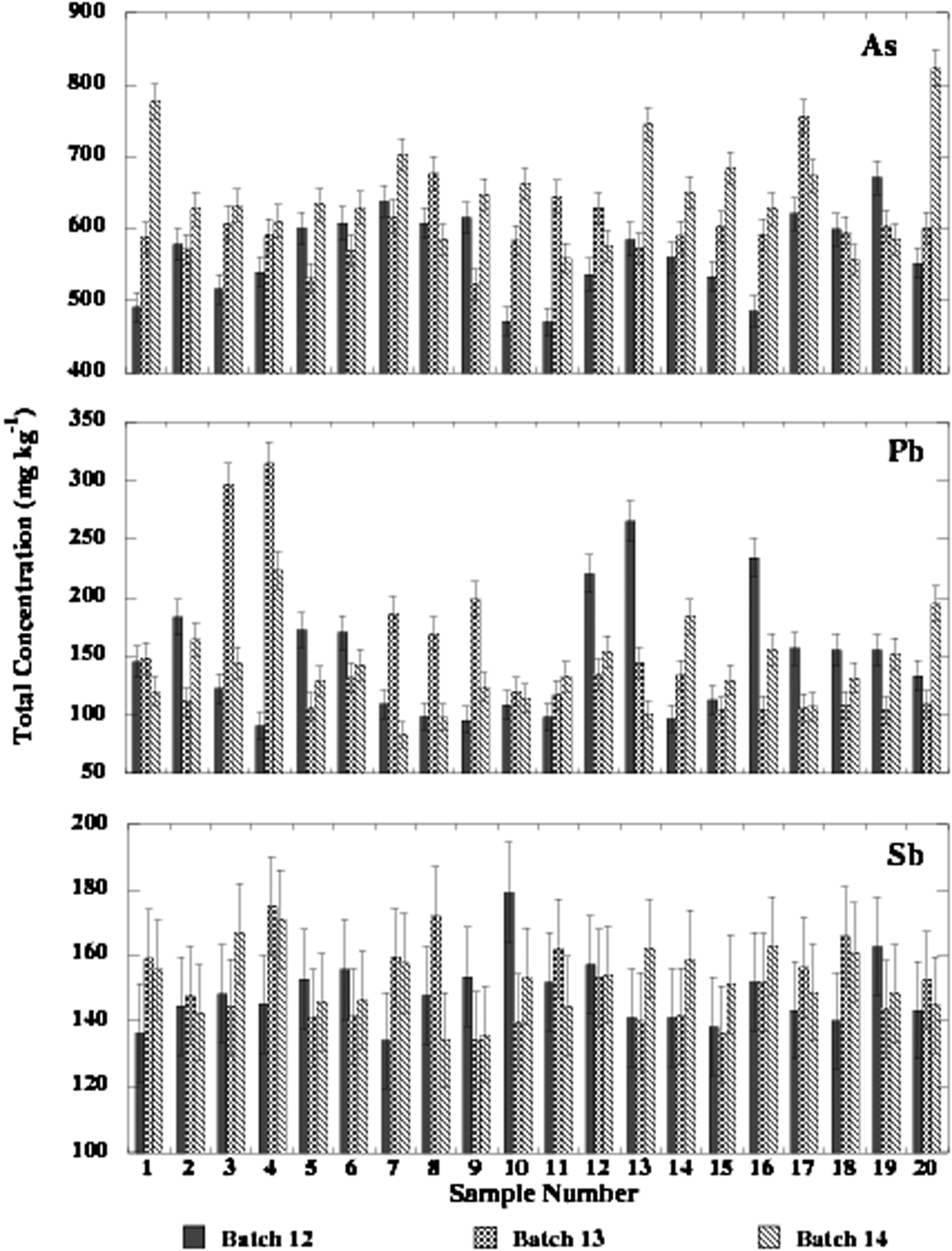
Analysis of variability for As, Pb, and Sb based on 20 samples from each batch shown. The error ranged from 17% to 22% for As, from 50% to 83% for Pb, and from 13% to 16% for Sb.
Statistical analysis
Total metal concentrations in domestic and imported batches were observed to follow Gaussian distributions; additional moments were not needed for skewing or broadening of the tails. To illustrate the sampling distribution, results from studying Batches 12 and 14 are reviewed here (Fig. 4). Total As, Pb, and Sb concentrations were measured using FP-XRF. The fit of the distribution was examined with the Anderson–Darling (AD) test statistic, which measures how well the data follow a particular distribution. When the p-value for the AD test is greater than the chosen significance level (usually 0.05), the fit is considered significant. The probability plots for As concentrations in Batches 12 and 14 reveal p-values of 0.118 and 0.085, respectively; both greater than the α of 0.05 (95% confidence level). Testing the null hypothesis that metal concentrations follow a Gaussian distribution versus the alternative that they do not, we find that the null hypothesis cannot be rejected. Similarly, the sampling distributions for Pb concentrations were consistent with Gaussian distributions (p-values of 0.235 and 0.632, respectively). For Sb (Fig. 4), results show p-values of 0.885 and 0.510 (>0.05), demonstrating the strength of the Gaussian distributions.
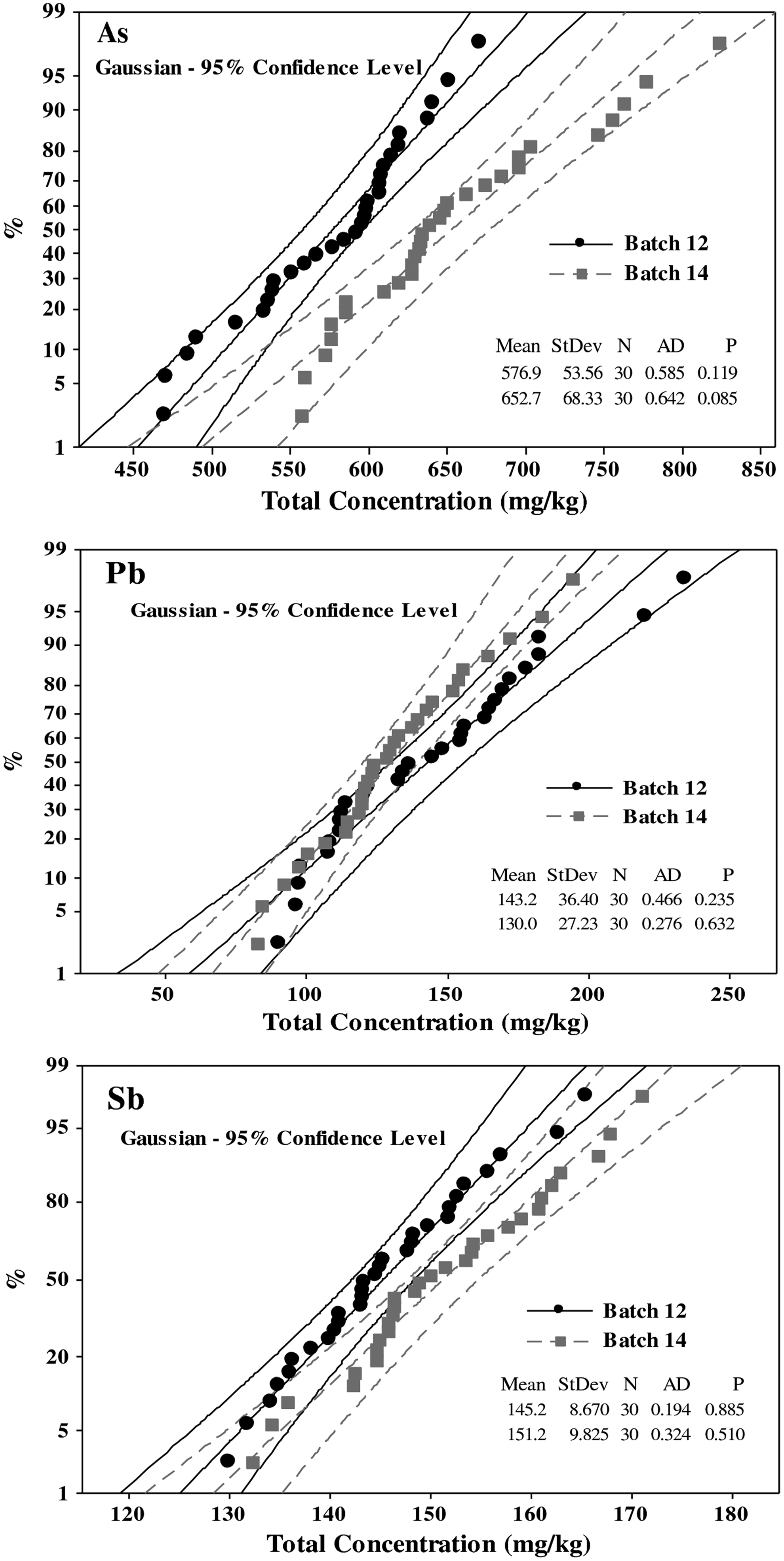
Assessment of the confidence levels for the data following a Gaussian distribution based on 30 samples. Batches 12 and 14 are illustrated for As, Pb, and Sb.
To address whether concentrations were significantly different between any two select batches, the Welch t-test was applied for each species probed, As, Pb, and Sb. Testing was carried out with the null hypothesis that there is no difference between mean concentrations in two select batches (|μ1−μ2|=0) against the alternative hypothesis that the means are different (|μ1−μ2|≠0) at a 95% confidence level. For a p-value greater than the significance level (i.e., 0.05), the null hypothesis cannot be rejected; alternatively for p-values≤0.05, the null hypothesis can be rejected. In general, metal and metalloid concentrations in domestic batches were an order of magnitude lower than concentrations observed in the imported batches. The results (Fig. 5) indicate the significance or insignificance of the Welch t-test based on average As, Pb, and Sb concentrations found in Batches 1–11. Batches 12–18 are not shown, as the null hypothesis can be rejected (p-value<0.05), thereby signifying differences in mean concentrations. The domestic and imported batches were statistically different apart from a few exceptions in the case of As (Fig. 5a) and Pb (Fig. 5b). On the other hand, based on average Sb concentrations in domestic and imported Batches 1–11, the null hypothesis cannot be rejected (Fig. 5c). Nonetheless, these concentrations were statistically lower than imported Batches 12–18.

Results of the Welch t-test for
Glass bead batches were provided by a number of glass bead manufacturers and suppliers, which may explain the variability or statistically significant differences and unequal variances within the domestic batches. The concentrations exhibited in the domestic glass beads are less than the current regulations and specification limits imposed by most states at this time. Among the imported batches, concentrations in Batches 7–11 exhibited lower metal concentrations as compared to Batches 12–18, indicating that the null hypothesis can be rejected (Fig. 2). Concentrations of Sb in Batches 7, 8, 9, and 11 and those of Pb in imported Batches 9 and 11 were lower than the concentrations in the domestic Batches 1–6; the difference may be explained by the origin or processing of the glass bead batches. On the other hand, concentrations of As in Batches 7 and 8 were comparable to those in imported Batches 1–6, but were greater in Batches 9–11. Nevertheless, total concentrations of As, Pb, and Sb in imported Batches 12–18 are greater and statistically different from the domestic based on the Welch t-test. The elevated concentrations observed in the imported batches demonstrate the need to address the potential impact from applying the glass beads on roadways.
Summary
This study revealed the presence of elevated concentrations of As, Pb, and Sb in glass beads. Specifically, peak concentrations were found at 876 mg/kg for As, 691 mg/kg for Pb, and 198 mg/kg for Sb. Variability within the batches was observed to be significant and should be accounted for when randomly sampling batches. Through an analysis of 20 samples from each imported batch, the error was found to range from 50% to 83% for Pb, from 18% to 22% for As, and from 16% to 18% for Sb. Samples from the batches showed that total concentrations were consistent with Gaussian distributions. Furthermore, based on the Welch t-test, differences between the domestic and imported concentrations were statistically significant for most of the batches. The domestic batches exhibited, in general, lower metal and metalloid concentrations as compared to the imported batches. The finding of significant metal and metalloid concentrations in the imported highway marking beads raises the question of whether leaching may be an important process in the long-term use of these glass beads. Therefore, an understanding of leaching characteristics is needed over a range of relevant environmental conditions, namely, pH, de-icing salts and their concentrations, abrasion, and leaching time.
Footnotes
Acknowledgment
The authors kindly acknowledge the support of New Jersey Department of Transportation which funded this research.
Author Disclosure Statement
No competing financial interests exist.