




Abstract
Abstract
Fixed-bed sorption process can be very effective at removing arsenic from contaminated groundwater. In this study, a continuous operation was demonstrated for the removal of both arsenite [As(III)] and arsenate [As(V)] from aqueous media in a column packed with nanoscale iron–manganese binary oxides (NIM). Treatment performance of the sorbent was quantified by upflow column experiments at different flow rates and bed depth. Bed depth service time model was used for the prediction of column service time, and the predicted values were compared with experimental values. A study of competing ions showed that silicate caused the greatest decrease in the As removal rate relative to phosphate and sulfate. Column regeneration studies were carried out for three sorption–desorption cycles using 0.1 M NaOH as the eluent, the NIM bed saturated with arsenic could be efficiently regenerated and reused. We found that NIM could be used for different types of real groundwater. This column study revealed that NIM was an efficient medium for As(III) and As(V) removal in groundwater.
Introduction
The methods available for arsenic removal have been adequately reported in the literatures. Recently, iron–manganese binary oxides (NIM) were studied for the removal of arsenic from groundwater (Chen et al., 2006; Zhang et al., 2007a, 2007b), their efficient arsenic removal attributes to the oxidation and adsorption of sorbents. Nanomaterials have shown great potential in a wide range of environmental applications due to the extremely small particle size, large surface area, and high reactivity (Masciangioli and Zhang, 2003; Li et al., 2006). It can be hypothesized that decreasing the particle size of the Fe-Mn oxides from micro- to nanoscale can improve the oxidation and sorption of arsenic in groundwater. To obtain nanoscale NIM particles, an improved contact mode of reagents and drying process were used during preparation.
Continuous column experiments are more accurate than batch experiments for representing the real environmental conditions (Nikolaidis et al., 2004). Very few studies have been undertaken under the continuous flow conditions, which are more useful in large-scale experiments (Maji et al., 2012). This study was designed to test the fixed-bed column performance of NIM as a sorbent for the removal of As(III) and As(V) from groundwater in a continuous flow system. We analyzed the breakthrough behavior of a column packed with a new sorbent NIM, and the effect of various column parameters were investigated, including the flow rate, initial concentration, bed depth, and competing ions. The dynamic process of sorption was modeled by the bed depth service time (BDST) model, which predicted the bed depth and service time. The recyclability of the NIM bed saturated with arsenic was tested to regenerate NIM for reuse. For the purpose of application for the removal of total arsenic, this study was also conducted using real arsenic-contaminated groundwater samples obtained from the Shanyin district, Shanxi province of China.
Materials and Methods
Chemicals and groundwater
Arsenate and arsenite stock solutions were prepared from sodium arsenate (Na2HAsO4·7H2O; Sigma-Aldrich) and arsenic oxide (As2O3; Sigma-Aldrich), respectively. Hydrochloric acid was the guarantee reagent, and potassium borohydride (KBH4; Sigma-Aldrich) was used for the analytical determination of arsenic. All other chemicals used were of analytical grade.
The synthetic groundwater (pH 7.0) in the laboratory containing 123 mg/L HCO3−, 9.6 mg/L SO42−, 70 mg/L Cl−, 12 mg/L SiO32−, 18 mg/L Ca2+, 4.3 mg/L Mg2+, 3.9 mg/L K+, and 65 mg/L Na+ was used as the background electrolyte, which was immediately prepared before use. Arsenic working solutions were freshly prepared by diluting arsenic solutions with synthetic water. Fresh groundwater (degassed) was used for all the experiments.
Field groundwater samples contaminated with arsenic were acquired from Xiao Geda (N 39°29.387′, E 112°54.900′, depth 22 m, Sample X) and Hei Geda (N 39°22.144′, E 112°51.579′, depth 39 m, Sample H) in the Shanyin district, Shanxi province of China on August 10, 2012 by the authors.
Analysis
As(III) and As(V) were separated according to the method proposed by Le et al. (2000). A silica-based strong anion-exchange column (500 mg sorbent of 40-μm particle size and 60-Å pore size) was obtained from Supelco, and was pretreated with 50% methanol and ultrapure water before use. All samples were analyzed within 24 h of collection.
Total arsenic [As(III)+As(V)] concentrations were determined using inductively coupled plasma optical emission spectroscopy (ICAP6300, Thermo Fisher Scientific). As(III) analysis was performed using hydride generation-atomic fluorescence spectroscopy (HG-AFS; AFS-933, Jitian Corp.). Before analysis, the aqueous samples were acidified with 10% HNO3 in an amount of 2%. The solution was diluted to 10 mL with deionized water (solution pH 3.1) and then was analyzed. KBH4 was used as the reducing agent, and HCl (10 v/v%) was used as the carrying fluid. As(V) concentrations were calculated from the differences between the total arsenic and As(III). Each sample was analyzed twice. Calibration was carried out daily with freshly prepared arsenic standards before the sample analysis.
Sorbent preparation
The NIM sorbent was prepared according to the following procedure: 12.51 g FeSO4·7H2O and 2.37 g KMnO4 were dissolved in 200 mL of fresh ultrapure water, respectively. The FeSO4 solution in a sealed sprayer was continuously sprayed into the vigorous magnetic-stirring KMnO4 solution, keeping the droplet as tiny as possible to facilitate the following reaction (Zhang et al., 2007b):
The species Fe(III) hydroxide in this system was dependent on the solution pH, and a 5 M NaOH solution was simultaneously added to keep the solution pH in the range of 7.0 and 8.0. The formed suspension was stirred continuously for 1 h, aged at room temperature for 12 h, and then washed repeatedly with fresh ultrapure water several times until pH reached neutral. The suspension was filtrated and dried at 105°C for 4 h, and calcined at 600°C for 6 h. The dried sorbent was crushed and stored in a desiccator for use.
Sorbent characterization
The specific surface area and pore-size distribution were measured by nitrogen adsorption using the Brunauer–Emmett–Teller (BET) method with an ASAP 2020M surface area analyzer (Micrometrics Instrument Corporation). The particle size and morphology images were determined by a transmission electron microscopy (TEM; CM12/STEM, Philips). The particle shapes were visualized with scanning electron microscopy (SEM; FEI Quanta 200) and the element contents were determined with energy dispersive X-ray spectroscopy (EDX).
Sorption–desorption in a fixed bed column
Polyethylene columns with 1.60 cm inner diameter and 0.45 μm membrane at the bottom were loaded with 30 g fine quartz sand (500–1000 mesh) and 1.5 g NIM. The addition of quartz sand was made to improve the flow distribution. The bed height of the column was 10 cm and the porosity was 0.41. Synthetic groundwater spiked with arsenic passed through the column in an up flow mode using a peristaltic pump. The pH of the influent water was 7.0±0.2. The effluent of the column was collected at certain time intervals and As(III) and As(V) were measured.
Desorption was carried out by passing 0.1 M NaOH through the column bed in an upward direction at a flow rate of 15 mL/min. The effluent solution was collected and analyzed. On completion of the desorption cycle, the column was rinsed with ultrapure water in the same way as for sorption till the eluting ultrapure water attained pH 7.0. The desorbed and regenerated column bed was reused for the next cycle. All column experiments were carried out in duplicates at room temperature (25±1°C) and the deviations were within 5%.
BDST analysis model
Several mathematical models have been developed for the design of column parameters. Among various models, the BDST model proposed by Bohart and Adams is widely used (Gupta and Sankararamakrishnan, 2010). The BDST model describes a relation between the service time and the bed depth of the column and is expressed as follows (Sankararamakrishnan et al., 2008):
where C0 is the initial solute concentration (mg/L); Cb is the desired solute concentration at breakthrough (mg/L); Ka is the adsorption rate constant (L/mg·h); N0 is the adsorption capacity (mg solute/L adsorbent); Z is the bed depth of NIM (cm); v is the linear flow velocity of feed to bed (cm/h); and t is the service time of column under the above conditions (h). The form of the Bohart–Adams equation shown in Equation (2), can be used to determine the service time, t, of a column of bed depth Z, given the values of N0, C0, and Ka, which must be determined for laboratory columns operated over a range of velocity values v.
Results and Discussion
Characteristics of sorbent
The BET surface area was 212.65 m2/g and pore volume was 0.69 cm3/g. The TEM showed the size of particles ranging from 10 to 20 nm (Fig. 1a). The surface morphology of SEM indicates that NIM was a microporous structure. The shapes of the sorbent were not completely spherical (Fig. 1b) and the EDX plot of NIM indicates the atom rate of iron/manganese to be 3:1 (Fig. 1c).

Effect of flow rate on breakthrough
Experiments were conducted in the continuous flow fixed column with the synthetic groundwater contaminant with arsenic. Two flow rates were used for both As(III) and As(V) solutions. The breakthrough curves at both flow rates are shown in Figure 2. The figure shows that sorption reached saturation faster with a greater flow rate. This tendency was consistent with findings by other researches (Kundu and Gupta, 2005). The exhaust times of As(III) (corresponding to 90% of influent concentration) for flow rates 2.5–5 mL/min were found to be 39.5–26.8 h, while the exhaust times of As(V) were found to be 26.7–14.1 h, respectively. The sorbent had a higher sorption capacity for As(III) than for As(V), because fresh active sorption sites were created at the solid surface during As(III) oxidation during the reductive dissolution of Mn-oxides (Zhang et al., 2007b), resulting in an increase of formed As(V) removal.

Experimental breakthrough curves of
As indicated in Figure 2, the residence time of the effluent inside the column is insufficiently long at a higher flow rate. The insufficient time decreases the bonding capacity of arsenic ions onto the surface of NIM; hence, the time available to reach saturation decreases, resulting in lower removal efficiency (Han et al., 2009). In general, the sharper breakthrough curves were observed at the higher flow rate.
Figure 2a shows the breakthrough of As(III) removal and change in concentration of arsenic species in the aqueous phase with time. A partial depletion of As(III) from the solution by oxidation or/and adsorption occurred until breakthrough. During the initial reaction period, sorbed As(III) was quickly oxidized to As(V) by manganese dioxide of the sorbent. A part of the formed As(V) was detached from the surface, resulting in an appearance of As(V) concentration in the solution. Consequently, As(V) both in solution and on surface of the sorbent increased gradually with reaction time. The appearance of extremely low concentration of As(V) almost zero in the aqueous phase proves that the As(V) produced from As(III) oxidation on the NIM surface can be quickly sorbed by the coexisting Fe-oxides. Thus, the mechanism of As(III) removal by NIM can be preliminarily proposed as the sorption of As(III) by the Fe-oxides on NIM surface, the oxidation of sorbed As(III) to As(V) by the Mn-oxides on NIM surface, and finally, the sorption of As(V) by the Fe-oxides on NIM surface.
Effect of bed depth
The breakthrough curves obtained for the bed height of 10, 20, and 30 cm at the flow rate of 5 mL/min are shown in Figure 3. The initial influent concentration of As(III) or As(V) was maintained at 10 mg/L. A technique described requires only three column tests to collect the necessary data (Hutchins, 1973). The BDST model can be expressed as

Effect of bed depth on
where the slope a equals
Conditions: flow rate 5 mL/min, influent arsenic initial concentration 10 mg/L, and pH 7.0.
The critical bed depth (Z) required for preventing arsenic concentrations exceeding 0.01 mg/L, which is obtained by substituting t=0 in Equation (2), is given below:
The BDST model can be used to design systems for treating other influent solute concentrations. The equation for an experiment conducted at the influent solute concentration of C1 is:
while the equation for a new influent solute concentration of C2 is given by
The new slope and intercept values can be determined as follows:
where a1 and a2 are slopes, b1 and b2 are intercepts at influent concentration C1 and C2, respectively, and Cb is the breakthrough concentration for C1 and C2.
The degree of predictability for a different initial concentration of arsenic by the BDST model was evaluated by running two columns of 5 mg/L of As(III) and As(V) at a flow rate of 5 mL/min and a column bed depth of 10 cm. The results are listed in Table 2 from which it is evident that the system follows the BDST model. Analysis shows that the BDST model parameters can be useful to estimate the process for other flow rates without further experimental runs.
Interference effect of phosphate, silicate, and sulfate ions on uptake of As(III) and As(V)
Previous studies suggested that carbonate, fluoride, and nitrate had little effect on arsenic adsorption by NIM (Chang et al., 2009); thus, we focused our attention on the influence of common anions such as phosphate, silicate, and sulfate in groundwater on arsenic adsorption (Zhao and Stanforth, 2001; Nguyen et al., 2011). Indeed, phosphate, silicate, and sulfate affected the sorption of arsenic in both As(III) and As(V) (Fig. 4). Phosphate could be strongly sorbed onto iron oxides (Luengo et al., 2007) and thus can compete with arsenic for binding sites. It is evident that in the case of interfering anions, the effect of silicate on arsenic sorption is the most, then phosphate, and the effect of sulfate is the least. In general, their influence on As(V) is greater than on As(III). Arsenate, phosphate, and silicate are all tetrahedral anions; they can compete at the surface of iron oxides to form inner-sphere complexes with the hydroxyl groups (Su and Puls, 2001).
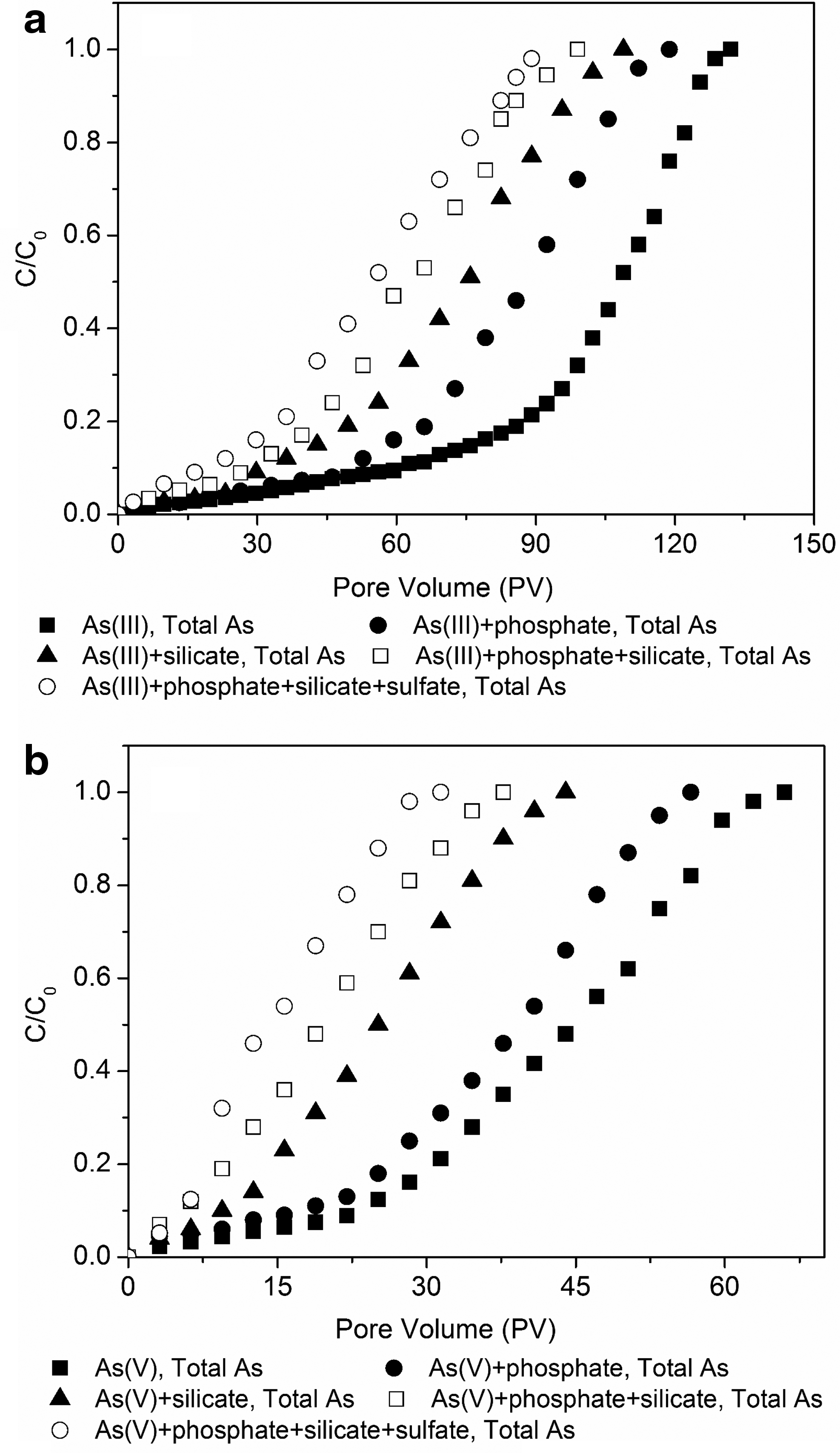
Effect of interfering ions on
Desorption of arsenic and regeneration of NIM
Once the column reached its full capacity of treatment of arsenic, efficient regeneration and reuse of the sorbent material were of crucial importance for developing a widely accepted, inexpensive remediation technology. To this end, the exhausted 10-cm-depth column, after the run, regenerated using 0.1 M NaOH for three cycles. The arsenic recovery profile during desorption is shown in Figure 5. Calculations revealed that 13 and 7 pore volumes were adequate for about 99% As(III) and As(V) recovery, respectively, in the first cycle. The first 10 and 5 pore volumes elute almost 85% of the sorbed amount of As(III) and As(V), respectively. From these observations, it inferred that the sorption sites of NIM particles were easily accessible through the interparticle pore structure. In other words, the clogging of pores did not occur, which was further confirmed by the fact that the flow rate remained more or less constant during both the sorption and desorption experiments and that the sorption–desorption process was reversible (Han et al., 2009).
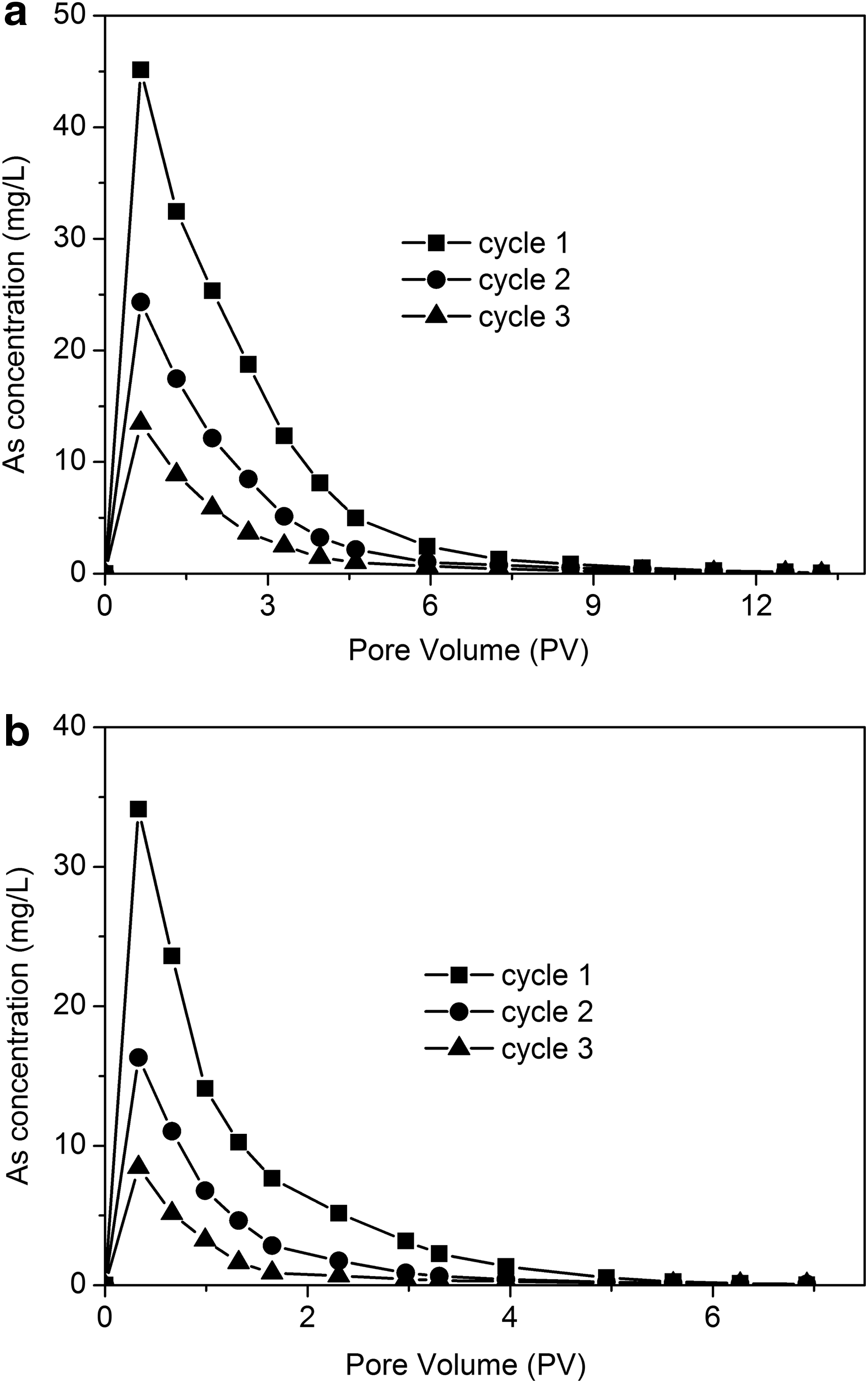
Desorption of
Reusability of sorbent
After regeneration, the bed was reconditioned using ultrapure water to remove the excess NaOH contained in the sorbent and thus lower the pH to about 7.0. Following rinsing, the NIM sorbent was essentially ready for the next sorption cycle. During the next cycle of sorption, the process was conducted in the same condition. Figure 6 shows three consecutive sorption cycles, from which it was evident that the removal efficiency in the following cycle decreased no more than 25%. As also evident from Figure 6, decreased breakthrough and exhaustion time were observed as the regeneration cycles progressed, resulting in a narrowed mass transfer zone. However, a good sorption capacity was obtained after three cycles. The regeneration efficiency (the adsorption capacity of regenerated adsorbent compared to the previous adsorbent) was found to be around 70% for both As(III) and As(V). It was also found that the concentrations of iron and manganese in the effluent were below the limit of detection, suggesting that no secondary pollution occurred during the removal of arsenic by NIM. Hence, one can conclude that the regeneration and subsequent reuse of the sorbent NIM offered an economical approach for arsenic removal from groundwater.

Sorption breakthrough curves of
Applicability of sorbent to arsenic-contaminated groundwater
The prepared NIM sorbent was evaluated in a fixed-bed reactor to decontaminate arsenic in real groundwater samples. The characteristics of the water samples are given in Table 3. According to the results of water quality analysis, the geochemical characteristics of the two samples were different; the type of sample X is Na-Cl, while sample H is Na-HCO3. Figure 7 shows that about 40 pore volumes of sample water could be treated using the bed height of 10 cm to drop the concentration of arsenic to the WHO drinking water standard (10 μg/L). The breakthrough volume of As(III) and As(V) were both about 165 pore volume for actual groundwater. As the concentrations of total arsenic in the two groundwater samples were both less than 350 μg/L, which was far below the removal capabilities by the sorbent, so even if the type of groundwater quality and salinity were different, the arsenic removal was roughly similar. During the experimental procedures, As(III) in effluent aqueous was not detected, indicating that As(III) was oxidized/sorbed completely by NIM. This set of experiment once again confirmed that the sorbent was efficient to treat the real arsenic-contaminated groundwater. We will discuss the scale of preparation and costs after field tests in the future.
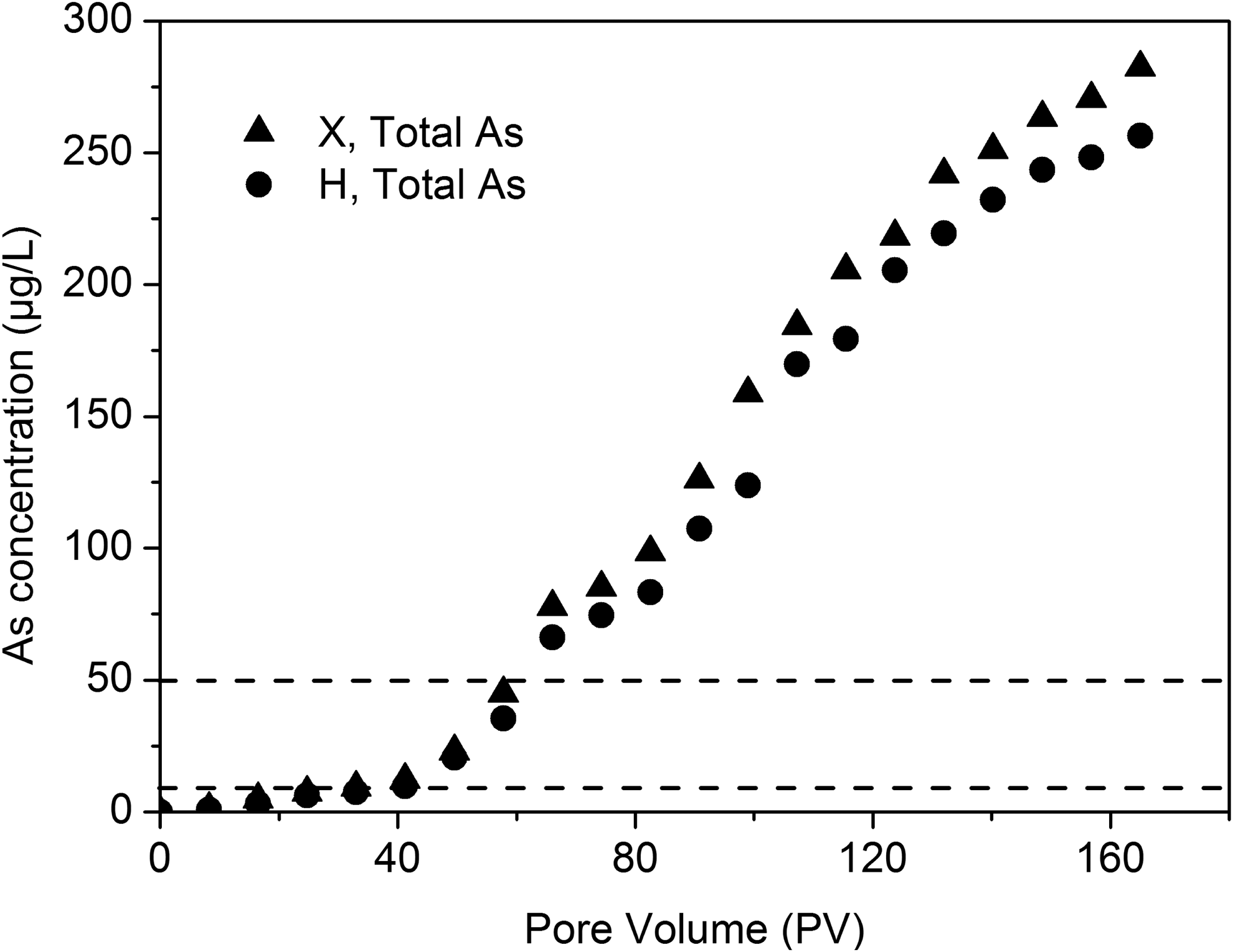
Applicability to arsenic-contaminated groundwater (bed depth, 10 cm; flow rate, 5 mL/min).
Conclusions
In the present work, NIM was prepared and characterized by TEM, SEM, and EDX analysis. Experimental and theoretical investigations were carried out to evaluate the fixed-bed column performance of arsenic removal from aqueous solutions. The breakthrough processes of both As(III) and As(V) were carried out and their removal efficiency was compared. The sorption of arsenic was dependent on the flow rate and bed depth. The breakthrough prediction by the BDST model provided a good agreement between the experimental and theoretical breakthrough curves. The silicate is the greatest effect on arsenic removal, followed by phosphate and sulfate. NIM can be easily regenerated using a 0.1 M NaOH solution, and the NIM column can be reused to remove arsenic from contaminated groundwater efficiently for three cycles. This study showed that NIM was an effective sorbent for removal of As(III) and As(V) from both synthetic and actual field groundwater.
Footnotes
Acknowledgment
This work was funded by the National High Technology Research and Development Program 863 (No. 2012AA062602) and the National Natural Science Foundation of China (No. 41120124003).
Author Disclosure Statement
No competing financial interests exist.