




Abstract
Abstract
The goal of this study is to evaluate the capacity of poultry litter-derived biochar to treat acid mine drainage (AMD) from the Ilkwang mine, an abandoned Cu mine in South Korea, using batch and column experiments. We hypothesize that the biochar can act as a possible neutralizer and sorbent to remove toxic constituents from AMD. The AMD from Ilkwang mine is strongly acidic (pH 2.4 [spring]/2.5 [summer]) and contains high concentrations of Fe (119.1/302.8 mg/L), Al (40.6/51.3 mg/L), Mn (9.2/12.1 mg/L), Cu (12.9/30.7 mg/L), Zn (15.5/26.8 mg/L), As (0.2/0.4 mg/L), and
Introduction
Biochar, a subset of black carbon produced by thermal decomposition of biomass, has received much attention in recent years for its availability for environmental application. The pyrolysis of biomass produces bio-oil and syngas as a renewable bioenergy, which can lessen the effect of global climate change by reducing green house gas emissions (Ro et al., 2010; Woolf et al., 2010). Simultaneously, the pyrolysis produces a carbon-rich product, biochar, proposed as a long-term carbon sink in terrestrial ecosystems (Lehmann, 2007). Biochar has been increasingly investigated as an adsorbent in soils and sediments because of its high surface area and strong sorption affinity for aromatic organic compounds (Chun et al., 2004; Chen et al., 2008). Biochar can also remove toxic metals and anions in soil and water (Mohan et al., 2007; Uchimiya et al., 2010; Peng et al., 2012).
Although biochar has been studied as a sorbent for removal of toxic metals in water and soil, little attempt has been made to directly utilize biochar to remove toxic metals and anions from AMD (Petlz, 2011). In this study, we tested the ability of poultry litter-derived biochar for treating AMD from an abandoned mine in South Korea. We characterized and evaluated the quality of AMD according to Korean drinking water standards. Through batch and column experiments, the extent of removal of dissolved constituents by biochar was evaluated. The possible removal mechanisms of metals and dissolved constituents from AMD in a biochar system were discussed.
Materials and Methods
Biochar was prepared by pyrolysis from dried pellets of poultry litter. The poultry litter pellets (<6 mm in diameter) were obtained from Perdue AgriRecycle, Inc. The biochar was prepared through slow pyrolysis of dried poultry litter pellets at 400°C for 8 h at a Delaware State University facility. A detailed description of the biochar has been published elsewhere (Song and Guo, 2012). The Brunauer, Emmett, and Teller (BET) surface area, pH, point of zero charge (PZC), cation exchange capacity (CEC), and elemental compositions of biochar are summarized in Tables 1 and 2. A scanning electron microscopy image of the n-hexane soot shows that it consisted of agglomerates of spherical particles 50–100 nm in diameter (Oh and Chiu, 2009). Crystalline species identified by x-ray diffraction (XRD) include feldspar, quartz, calcite, and dolomite (Oh et al., 2013). AMD was sampled from an abandoned Ilkwang mine in Busan metropolitan city, South Korea. The Ilkwang mine was one of the largest Cu mines in South Korea, producing Cu, Au, Ag, W, and Zn (Choi, 2005). Since it was abandoned in early 1990s, AMD produced from the entry of the mining tunnel has contaminated nearby streams and farmland soils. AMD was sampled twice in March (spring) and July (summer before a rainy season) from the entry of the mining tunnel, and at each time, pH, redox potential (Eh), temperature, electrical conductivity (EC), and dissolved oxygen (DO) were measured on site using an Orion 5-star multiparameter portable meter (Thermo Fisher Scientific). Sampled AMD was stored in a sterilized polyethylene bag in an ice box. After being rapidly transported to the laboratory, the AMD sample was filtered through a 0.22-μm cellulose membrane filter (Millipore) for chemical analysis. For batch and column experiments, AMD was collected using 50-L tanks, which were stored in the refrigerator (<5 days) before the experiments. At the start of each experiment, initial concentrations of dissolved constituents were analyzed, which confirmed no significant changes during the holding period.
Reference: Oh et al. (2013).
PZC, point of zero charge; CEC, cation exchange capacity; BET, Brunaur, Emmett, and Teller.
Elemental content was analyzed by inductively coupled plasma optical emission spectroscopy after aqua regia extraction.
Batch experiments were performed using a 500-mL Erlenmeyer flask containing 200 mL of AMD (sampled in March) and 5 g of biochar at room temperature. Duplicate flasks were shaken by an orbital shaker at 150 rpm throughout the experiment except during sampling. At different elapsed times, three 1-mL aliquots were withdrawn using glass syringes and immediately passed through a 0.22-μm cellulose membrane filter before chemical analysis. Three filtered samples were appropriately diluted for analytical determination. A set of control bottles was set up under identical conditions but without biochar.
Column experiments were performed using a glass column [2.5 cm (D)×22 cm (L); Omnifit] packed with biochar to evaluate the removal of dissolved constituents from the AMD (sampled in July) in a continuous flow system. The porosity of biochar column was 0.69. By changing the flow rate of a peristaltic pump (Cole-Parmer), hydraulic retention times in the columns were maintained differently at 3.3–51.9 min. The column effluents were passed through a 0.22-μm cellulose membrane filter to remove particles for chemical analysis. The concentrations of Cu and Zn were determined by an atomic absorption spectrophotometer (5100 ZL; Perkin Elmer) and anions were analyzed by ion chromatography (Dionex). Other dissolved constituents were analyzed using inductively coupled plasma optical emission spectroscopy (ACTIVA; JY Horiba). Analytical duplicates, standards, and blank samples were used for quality control of the data we obtained.
Results and Discussion
Characterization of AMD
Physical and chemical properties and dissolved constituents in AMD from Ilkwang mine are summarized in Tables 3 and 4. In both samples in spring and summer, the pH of AMD was strongly acidic (2.5 and 2.4) and redox potentials were 495.8 and 475.4 mV, respectively. High EC (2286 and 2669 μS/cm) showed that the AMD includes a substantial amount of dissolved ions (Table 3). Like other AMDs, high concentrations of Fe, Mn, Al, and
EC, electrical conductivity; DO, dissolved oxygen; Eh, redox potential.
Treatment of AMD by biochar in a batch reactor
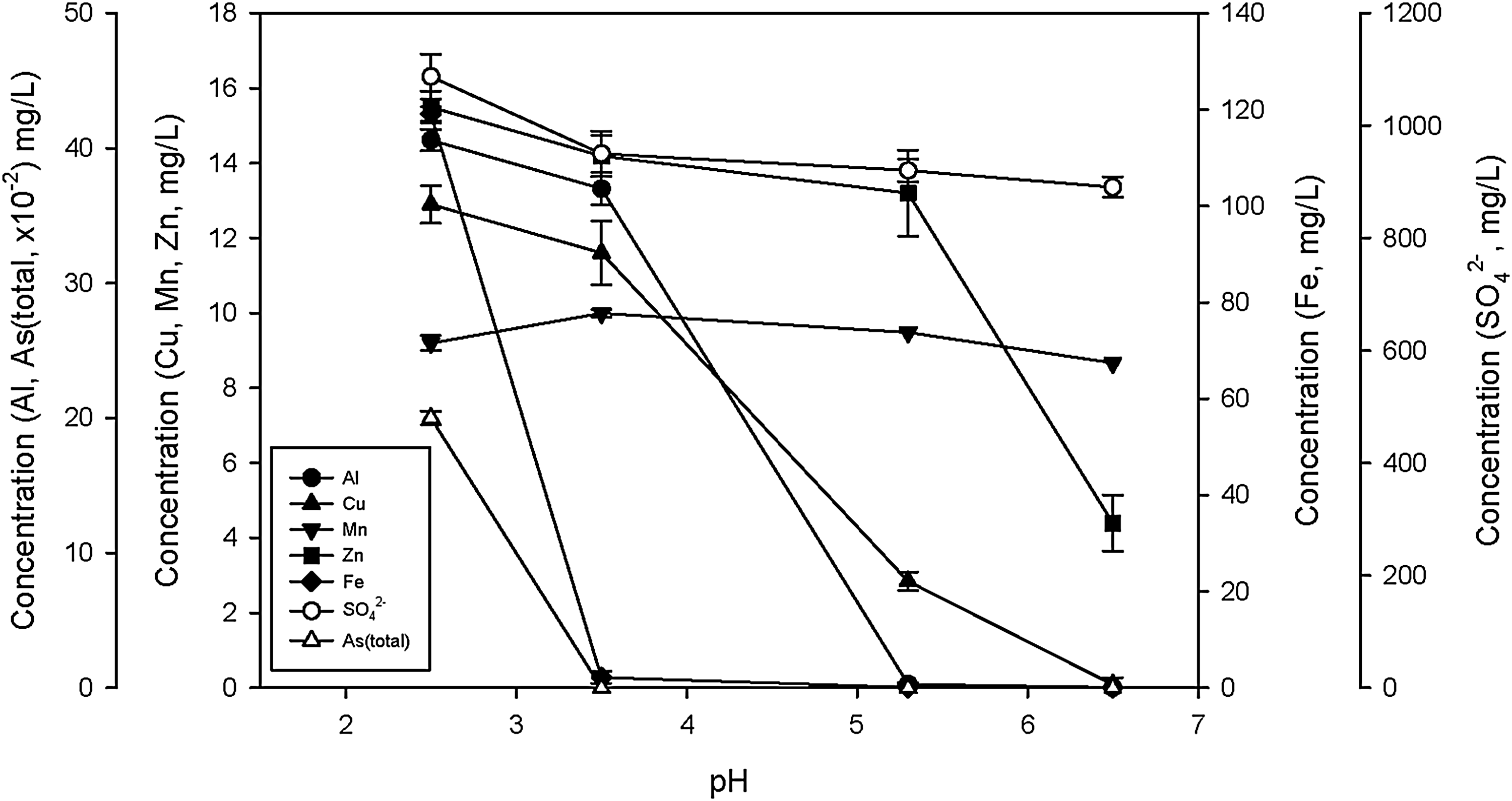
With biochar, the pH of AMD rapidly increased from 2.5 to 6.0 in 5 h, and continuously increased to 6.5 in 24 h (Fig. 1). The existence of carbonate minerals (e.g., calcite and dolomite) in the biochar used in this study (Oh et al., 2013) accounts for AMD neutralization. Biochar has a buffering capacity to increase the pH of soil when applied for soil reclamation (Lehmann and Joseph, 2009). Due to the increase of pH in the presence of biochar, dissolved toxic constituents could be removed from the AMD. Fe and Al were completely removed from the AMD in 1 and 3 h, respectively (Fig. 1). Copper and Zn gradually disappeared from the AMD, showing 0.3 and 0.2 mg/L in 12 and 24 h, respectively. To determine the effect of pH on the removal of dissolved toxic constituents from the AMD, control experiments were performed by increasing the pH using 0.1 N NaOH in the absence of biochar. The pH of AMD was increased stepwise from 2.5 to 6.5. At each pH, AMD was shaken for 1 h to reach equilibrium and dissolved constituents were analyzed after filtration through a 0.22-μm cellulose membrane filter. Preliminary experiments confirmed that 1 h shaking is enough to reach equilibrium. As shown in Figure 2, more than 98% of Fe was removed from the AMD at pH 3.5, consistent with previously reported results (Wei et al., 2005). At pH 6.5, Al was completely removed and Mn was inert. According to solubility products (Ksp) of Fe(OH)3, Al(OH)3, and Mn(OH)2 (6×10−36, 1×10⁻³², and 8×10⁻¹⁴, respectively) (Sawyer et al., 2002), the precipitation of Fe and Al, and no reaction of Mn at pH 6.5 are clearly reasonable. Copper was completely removed and the Zn concentration was decreased to 4.5 mg/L by increasing the pH to 6.5. The removal of

Concentrations of Cu, Zn, Al, Fe, Mn, As, and
Concentrations of Cu, Zn, Al, Fe, Mn, As, and
Considering the removal in the pH system (Fig. 2), Fe, Al, and Cu were mostly removed through precipitation by increasing pH in the biochar system. In case of Zn, besides precipitation as Zn(OH)2, other mechanisms (i.e., coprecipitation with other metal hydroxides or sorption to the biochar surface) may be involved. Unlike the pH system, 61% of Mn was removed in the presence of biochar (Fig. 1). The removal may be explained by sorption to the biochar surface. Although biochar has a high CEC (42.0 mEq/100 g), it does not appear that sorption of dissolved metals to biochar is dominant due to positive net charge of biochar surface [pH 2.5–6.5 vs. PZC of biochar (8.2)]. Because the effect of pH on the removal of Mn was inert (Fig. 2), other mechanisms [e.g., ionic exchange between cations and protons in surface functional groups or interactions between cations and localized π-electrons in the graphitic structure (Uchimiya, 2010)] may be responsible for the sorption of Mn, which remains to be determined. Due to the positive net surface charge and increasing pH,
Treatment of AMD by a biochar column
The removal trend in a biochar column is similar to that in batch experiments. The biochar column also effectively removed Fe, Al, Cu, and Zn from the AMD with short retention time (Fig. 3). Over 95% of Fe and Al were removed from the AMD in 7.1 min. Copper and Zn gradually and continuously disappeared, showing over 98% removal in 36.2 min. Because the biochar-to-AMD ratio significantly increased in the column, compared to the batch experiments, removal of Mn and
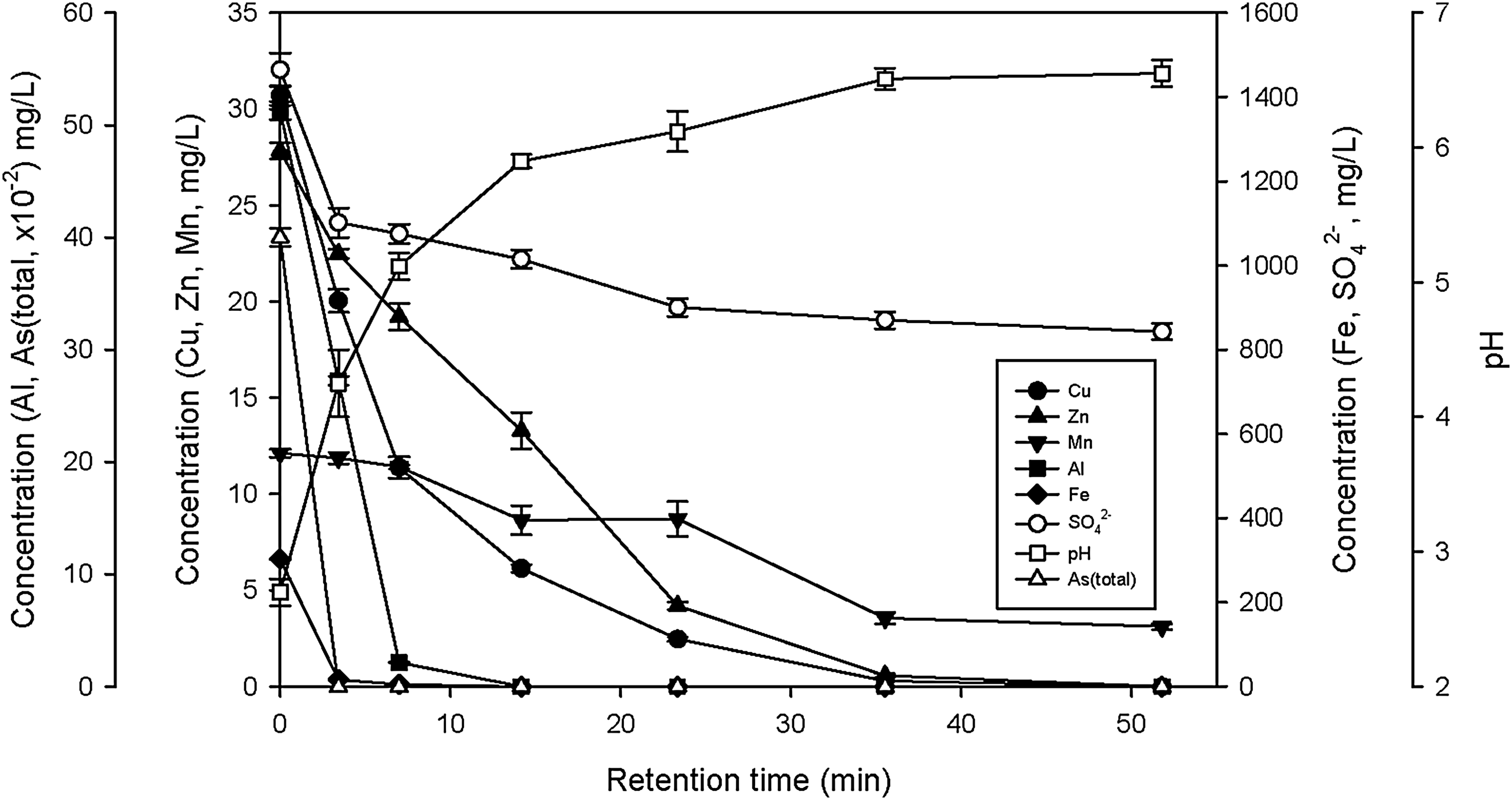
Concentrations of Cu, Zn, Al, Fe, Mn, As, and
Conclusions
The present study assessed the application of poultry litter-derived biochar as an active treatment method for treating AMD using the batch and column experiments. AMD from the Ilkwang mine is strongly acidic and contains many toxic constituents including Fe, Al, Mn, Cu, Zn, As, and
Footnotes
Acknowledgments
This research was supported by the Basic Science Research Program through the National Research Foundation of Korea (NRF) funded by the Ministry of Education (2009-0064688 and 2013-007767). The authors thank professor Mingxin Guo of Delaware State University for preparing the biochar used in this study.
Author Disclosure Statement
No competing financial interests exist.
References
Supplementary Material
Please find the following supplemental material available below.
For Open Access articles published under a Creative Commons License, all supplemental material carries the same license as the article it is associated with.
For non-Open Access articles published, all supplemental material carries a non-exclusive license, and permission requests for re-use of supplemental material or any part of supplemental material shall be sent directly to the copyright owner as specified in the copyright notice associated with the article.
