




Abstract
Abstract
Degradation of the azo dye C.I. Reactive Blue 194 (RB 194) by sponge iron in the presence of ultrasound (sponge iron-US) has been investigated, and an evident synergistic effect was observed. Degradation of the dye RB 194 followed pseudo-first-order kinetics. The degradation rate constants by sponge iron, ultrasonic irradiation, and sponge iron-US were 0.00494, 0.0200, and 0.138 min−1, respectively. Effects of operating parameters such as the dosage and particle size of sponge iron, initial pH of the solution, ultrasonic power, and the dye initial concentration on the degradation rate of the RB 194 were investigated. Results showed that the degradation rate of the RB 194 increased with increasing the sponge iron dosage and decreased with increasing the particle size of sponge iron, initial dye concentration, and the initial pH of the solution. The main degradation products of the dye RB 194 were tentatively identified by a gas chromatograph with a mass spectrometer and ion chromatography and a possible degradation pathway of the RB 194 was also proposed.
Introduction
T
In the last decade, zero-valent iron (Fe0) has been recognized as a promising material in decolorization of azo dyes. This method has been proven to be a cost-effective treatment approach and is widely used to treat wastewater containing chlorinated aliphatics (Shin et al., 2008), chlorinated aromatics (Kim and Carraway, 2000), and organic dyes (Pan et al., 2011). The destruction of the azo bond of azo dyes led to decolorization of dye solutions in visible regions. However, the loss of reactivity over time, due to the corrosion products or other precipitates on the iron surface, is a great concern.
Sonolysis has emerged in the last two decades as an important class of advanced oxidation processes employed to accelerate the oxidation of a wide range of hazardous organic compounds in polluted water (Wang et al., 2008, 2010; Mishra and Gogate, 2011; Xiong et al., 2011; Zhang et al., 2011; Eren, 2012). The mechanism of ultrasonic degradation of organic compounds can be attributed to acoustic cavitation (Didenko et al., 1999). The formation, growth, and implosive collapse of the bubbles in liquids not only liberate considerable energy in a short time but also cause enhanced agitation of the liquid to speed up the mass transfer. It is thought that ultrasound (US) serves to sweep reactive intermediates or products from metal surfaces thereby reactivating and cleaning the surfaces for subsequent reactions (Hung et al., 2000). Therefore, the combination of sonication and elemental iron is a good alternative to increase the efficiency of the degradation process.
High decolorization rates have been observed in the reactions of azo dye with cast iron in the presence of US (Shen and Shen, 2006; Lin et al., 2008). Liu et al. (2007) found that the addition of granular activated carbon can accelerate the degradation rate of azo dye Acid Orange 7, since many batteries were formed due to the potential difference of the electrode between Fe and C. It is well known that the sponge iron is a more porous material with high specific surface areas and the main elements are Fe and C. In the present article, the degradation of the azo dye C.I. Reactive Blue 194 (RB 194) in water by sponge iron with ultrasonic irradiation (sponge iron-US) was studied. The effects of operating parameters on the degradation rates of RB 194 were investigated, and the main degradation products of the dye RB 194 were tentatively identified by a gas chromatograph with mass spectrometer (GC-MS) and ion chromatography.
Materials and Methods
Reagents
RB 194 (Fig. 1) is an industrial product and was obtained from the Shanghai Dye Co. The sponge iron was obtained from Beijing Steel Co. Ltd. and was sieved by mechanical vibration to obtain a reasonably uniform particle size (0.5–1, 1–2, 2–3, 3–4, and 4–5 mm). Their specific surface areas are found to be 92, 89, 88, 83, and 81 cm2/g, respectively. Chemical analysis of sponge iron revealed the following: zero valent iron (more than 91.2%), ferric oxide (4.6%), carbon (3.4%), and impurity ∼0.8%. All other chemicals were of the analytical grade. Laboratory grade water was prepared with a Milli-Q pure water system.

Molecular structure of the azo dye C.I. Reactive Blue 194 (RB 194).
Experimental procedures
The dye stock solution of RB 194 was prepared in distilled water and was diluted according to the working concentration. The required pH of the solution was adjusted by adding 0.l M HCl or NaOH. One hundred milliliters solution of RB 194 (concentration 20 mg/L) was added to a jacketed reactor. Sponge iron was first dipped in 1% HCl for 1 min and then rinsed with distilled water, after which an appropriate amount of sponge iron was added. The ultrasonic irradiation of RB 194 was carried out using a 20 kHz ultrasonic generator (Model GA 92-II DB; Ningbo Xinzhi Technology Co.) equipped with a titanium probe (diameter 8 mm). The ultrasonic generator was operated at 300 W. The total acoustic power injected into the sample solution was found to be 106 W/L measured by means of the calorimetric method (Kimura et al., 1996). The titanium probe was immersed into the solution at a depth of about 10 mm. Sonication was performed in pulses with a 50% duty cycle. A constant temperature of 25°C±1°C was maintained by circulating water. At different time intervals, 2.0 mL of sample was withdrawn from the reactor using a syringe and filtered through 0.45 μm membranes (Millipore) to determine the concentration of the remaining dye.
The UV-vis spectra of the dye RB 194 were recorded from 200 to 700 nm using a UV-vis spectrophotometer (UV-2450; Perkine Elmer) with a spectrometric quartz cell (1.0 cm path length). The maximum absorbance wavelength (λmax) of RB 194 was found at 600 nm. The absorbance of the dye in the reaction mixture was determined at different reaction times by measuring the absorption intensity at 600 nm. The absorption was converted to a concentration through the standard curve of RB 194 according to the Beer–Lambert law. The degradation ratio of RB 194 was calculated as follows:
Where R% is the degradation ratio of the dye, and C0 and Ct are the initial and remaining concentrations of RB 194, respectively.
Identification of degradation products
The degradation products of the dye RB 194 were analyzed by a combination of GC-MS as ethylic ester derivatives. For this analysis, the pH of the sample was adjusted to 7 with 1 M NaOH and 100 mL solution was concentrated to 2 mL in a vacuum freezing dryer. And then, the sample was esterified with ethanol under catalysis of oil of vitriol (H2SO4, 98%). The esterification products were dried with sodium sulfate, and then a 2.0 μL sample was injected to the sample container of GC/MS-QP2010NC for GC-MS analysis. The GC oven temperature program was as follows: initial temperature 40°C held for 5 min and then increased at 5°C/min to 260°C. Helium was used as a carrier gas at a constant flow rate of 2.0 mL/min. The resolution of the MS was 1000. Positive electron ionization was used. The scan rate was 3 s and the mass range scanned was 10–500 amu. The degradation products were identified by comparison with the mass spectra of the pure samples obtained from a mass spectra database.
The anions of RB 194 degradation products such as oxalic acid, maleic acid, nitrate, and sulfate ion were detected by using Dionex ICS2000 ion chromatograph with Dionex IonPac AS19 analytical column (250×4 mm i.d.). The mobile phase was 0.8 mM sodium carbonate–1.0 mM sodium bicarbonate with a flow rate 1.0 mL/min. The injection volume was 50 μL.
Results and Discussion
The synergetic effect between sponge iron and sonication
The degradation of RB 194 in aqueous solutions using the sponge iron-US treatment was investigated. The degradation experiments were carried out in three approaches: (1) sponge iron alone (20.0 g/L), (2) US irradiation alone (106 W/L), and (3) sponge iron-US treatment. Other experimental conditions are as follows: solution temperature 25°C and pH 3.0. The results are shown in Fig. 2. Sponge iron alone and ultrasonic irradiation alone yielded RB 194 degradation ratios of only 41.5% and 12.3%, respectively, after 25 min of reaction. In contrast, the removal efficiencies of RB 194 were found to be 97.1% with the addition of 20.0 g/L of sponge iron. The degradation efficiency of RB 194 by sponge iron-US was much higher than the sum of the individual effects of sponge iron and US, which might be due to a synergistic effect.
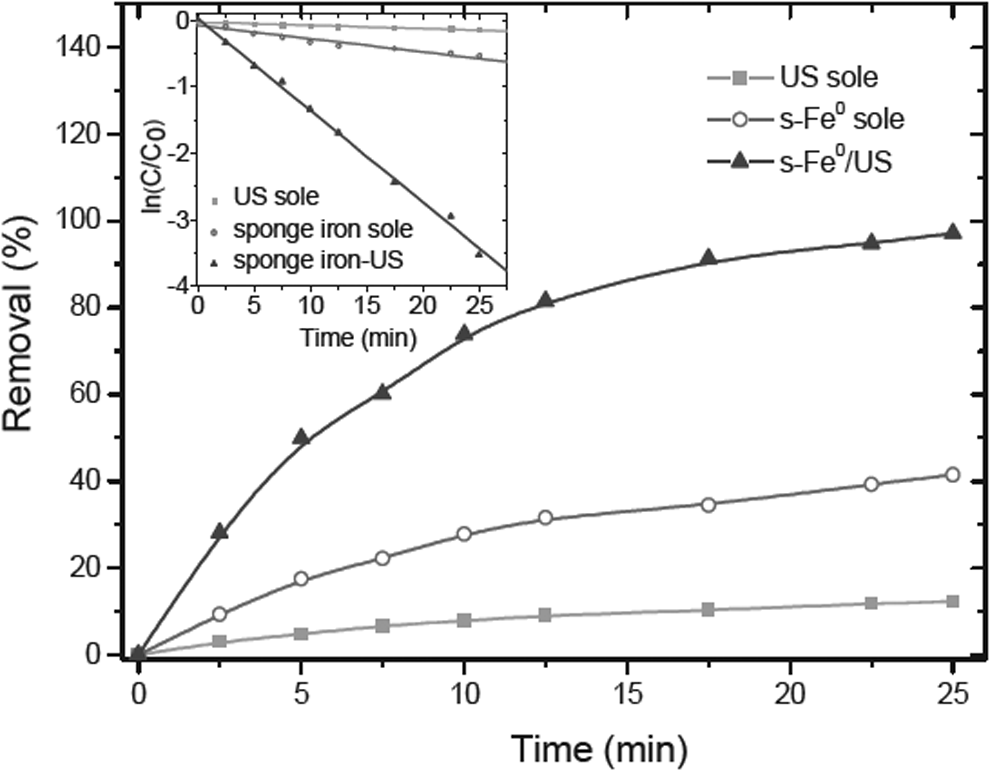
Degradation of RB 194 in water by sponge iron, ultrasound (US) irradiation, and sponge iron-US treatment. The inset is the corresponding kinetics curve (sponge iron=20 g/L, US power=10.6 W/L, dye concentration=20 mg/L, pH=3.0).
The reason for the synergistic effect may be due to the turbulent flow conditions within the reaction system, which resulted from transient cavitations. During the decomposition reaction, RB 194 molecules transferred from the bulk solution to the vicinity of the sponge iron surface and then were decomposed by the reductive species. The degradation products of RB 194 and the hydrolysates of iron oxides/hydroxides covered on the surface of sponge iron, which inhibited the contact between sponge iron and the dye molecules, and thereby, the degradation rate of RB 194 was decreased. The ultrasonic cavitations led to the cleaning of the sponge iron surface, and the overall mass transport was enhanced in the presence of ultrasonic irradiation. On the other hand, the synergistic effect is also attributed to the Fenton's reaction (Chen et al., 2011). Fe0 is corroded and Fe2+ is generated under ultrasonic irradiation. The partial recombination of •OH produced from the sonolysis of water results in the formation of hydrogen peroxide (H2O2) in an US system. The mechanism can be described as follows:
The reactions above imply that the concentration of •OH radicals could remarkably increase in the Fe0-US system compared with that during US alone, and more dye molecules were oxidized with •OH radicals.
The concentration of RB 194 in the aqueous solution decreased exponentially with the reaction time, both in the sponge iron and sponge iron-US treatments. The degradation rates can be expressed by the following equation:
Where C0 and Ct are the initial and remaining concentrations of RB 194, respectively, k is the degradation rate constant, and t is the sonication time. The results indicate that the degradation of RB 194 follows pseudo-first-order kinetics (inset in Fig. 2). The rate constants for the degradation of RB 194 by sponge iron and sponge iron-US are 0.020 min−1 (R=0.970) and 0.138 min−1 (R=0.998), respectively. The reaction rate was increased by 6.9 times with the ultrasonic irradiation compared with that of absence of US.
Sponge iron dosage
To investigate the role of sponge iron dosage on the degradation of the dye RB 194, a series of experiments were conducted with different sponge iron dosages from 5.0 to 30.0 g/L (dye concentration 20 mg/L, power 106 W/L, pH 3.0). The result showed that the removal of the RB 194 increased with the increasing of the sponge iron dosage (Fig. 3). As the degradation of the dye mainly occurred at the Fe0/H2O interface, the surface area of the sponge iron affected the degradation rate. The degradation rate increased with the increasing dosage of sponge iron, it can be explained that more sponge iron provided substantially more surface active sites to accelerate the degradation reaction. On the other hand, the addition of inert particles such as Cu and Al2O3 can promote the sonochemical reaction rate (Dai et al., 2006; Shimizu et al., 2007). The effect of particles is based on the increase of the cavitation bubbles due to the supply of crevices as well as the wall of the particle that plays a role in producing tiny bubbles with a promotion of jet toward the wall. The increase of the cavitation bubbles accelerates production of •OH radicals and other oxidants during their collapse. The sponge iron particles might have the similar effect in the Fe0-US system by enhancing the degradation of the dye. Therefore, higher degradation rates were observed with more sponge iron addition.

Effect of sponge iron dosage on the removal of RB 194 in the sponge iron-US treatment. The inset is corresponding the kinetics curve (dye concentration=20 mg/L, US power=10.6 W/L, pH=3.0).
The stability and reusability of the sponge iron are crucial for its practical application. To test the reusability of the sponge iron, we carried out the dye bleaching experiment repeatedly four times. The sponge iron was recovered from the reaction mixture at the end of each process, dipped in 1% HCl for 1 min, washed by distilled water, and then reused for evaluating its stability. As shown in Fig. 4, the removal of the dye is similar to the fresh sponge iron. The results indicate that the sponge iron is stable in this study.
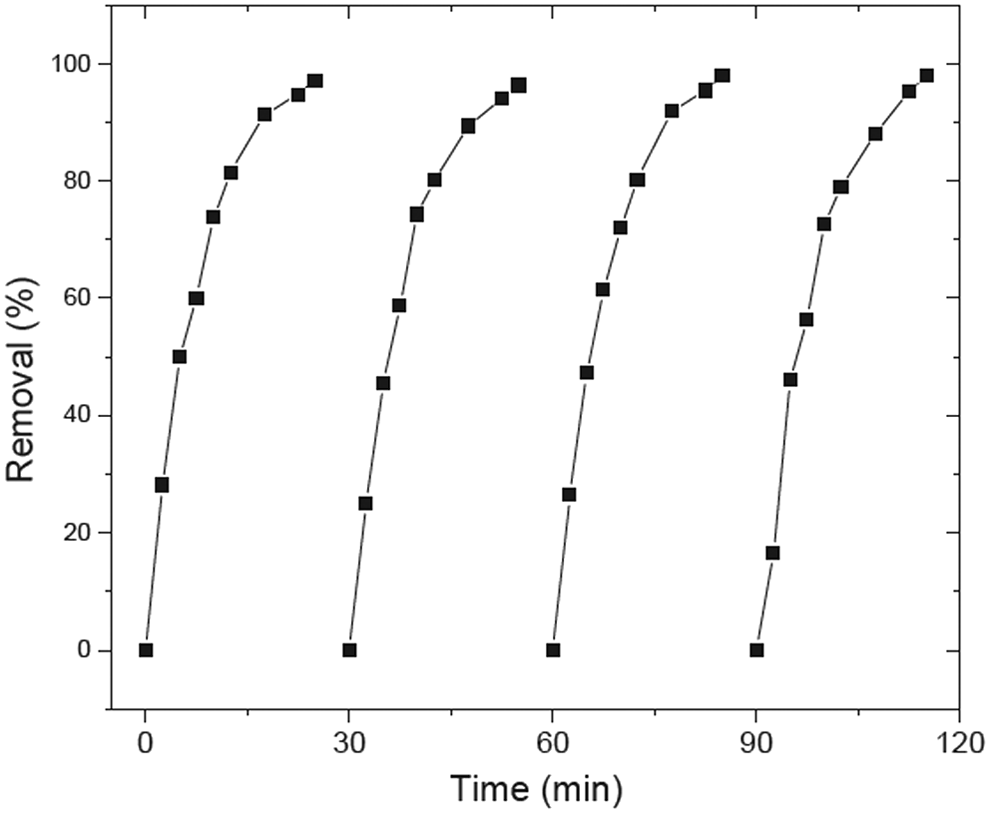
Removal of RB 194 during repeated degradation experiments (dye concentration=20 mg/L, sponge iron=20 g/L, US power=10.6 W/L, pH=3.0).
Particle size of sponge iron
To investigate the effect of the particle size of sponge iron on the degradation of the dye RB 194, a series of sponge iron particles with averaged diameters of 0.5–1.0, 1.0–2.0, 2.0–3.0, 3.0–4.0, and 4.0–5.0 mm were selected for the degradation experiments. The results showed that the removal of the dye RB 194 increased with the decrease of the particle size of sponge iron (Fig. 5). The relative increase in the removal with smaller particle sizes may be attributed to the fact that they have larger surfaces that increase the dye's contact frequency with the sponge iron surface. In addition, small particles have shorter diffusion paths, which allow the dye molecules to deeply penetrate the sponge iron more quickly, resulting in a higher degradation rate.

Removal of RB 194 with different particle sizes of the sponge iron (sponge iron=20 g/L, US power=10.6 W/L, dye concentration=20 mg/L, pH=3.0).
Initial pH value of the solution
The pH of the solution was an important parameter for the degradation of pollutants in water by the sponge iron-US treatment, which controls the concentration of Fe2+ and the production rate of •OH. The effect of the initial solution pH on the removal of the dye RB 194 was investigated at different pH in the range of 2.0–9.0 with initial dye concentration 20 mg/L, power 106 W/L, and 20.0 g/L sponge iron addition. The results are shown in Fig. 6.
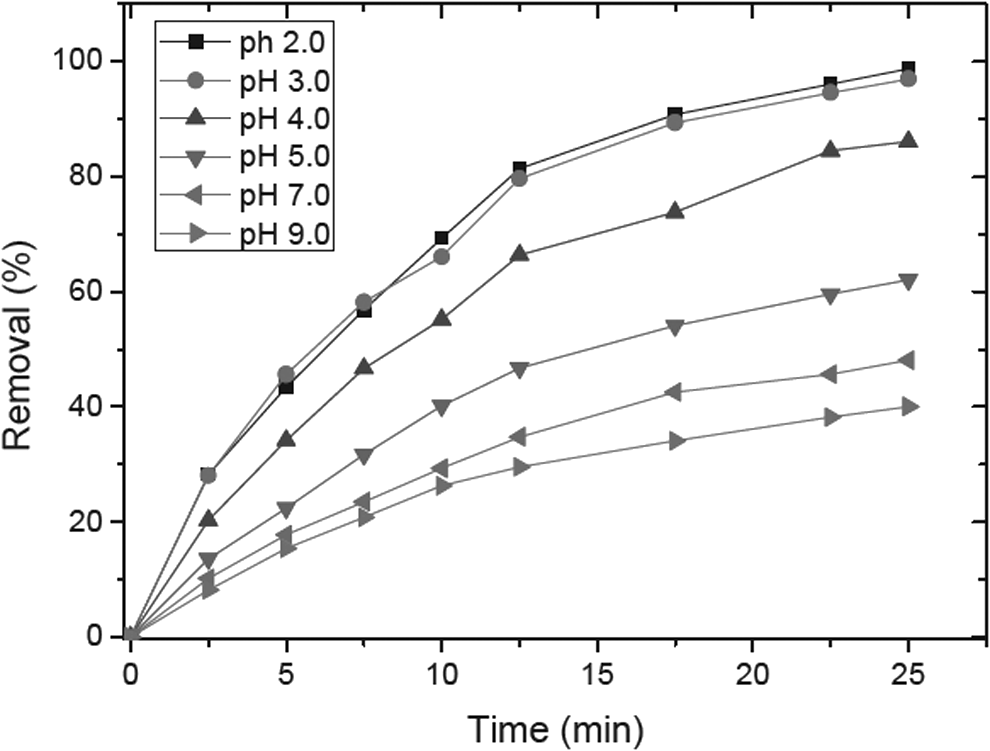
Effect of solution pH on the removal of RB 194 in the sponge iron-US treatment (sponge iron=20 g/L, US power=10.6 W/L, dye concentration=20 mg/L).
Higher removal of RB 194 was found in acidic solutions (pH value 2.0–3.0), and the removal decreased with increasing initial pH from 3.0 to 9.0. These experimental observations are attributed to two reasons: (1) when effective collision between dye molecules and elemental iron happens, elemental iron, as an electron donor, loses electrons. Meanwhile, the dye molecule, as an electron acceptor, gets electrons and combines with H+ and turns into transitional products and finally terminal products. High H+ concentration is a benefit to this process. (2) The concentration of Fe2+increases in acidic solutions due to the reaction of Fe0 with H+, and the optimal pH for Fenton reactions ranges from 2.0 to 3.0 (Kiwi et al., 2000; Jiang and Waite, 2003).
Ultrasound power
The effect of ultrasonic power on the degradation of RB 194 was investigated at initial dye concentration 20 mg/L, pH 3.0, and sponge iron 20.0 g/L. The results are shown in Fig. 7. Generally, higher US intensities accelerate the sonochemical reactions. Increasing the ultrasonic power from 35 to 106 W/L led to increases in degradation. From 106 to 171 W/L powers, however, the degradation rate decreased slightly. This result is consistent with those from previous studies (Lim et al., 2007; Guo et al., 2010). Increased ultrasonic power provides more energy to the reaction system that can accelerate cavitation effects. When the ultrasonic intensity exceeds an optimal value, however, a large number of gas bubbles are produced in the solution and less energy is allocated to the dye solution because of the scattering effect of these bubbles on the sound waves. It is also possible that coalescence, in the presence of an increased number of cavities, results in the formation of a large cavity that collapses less violently. Thus, with increasing operating intensity, the utilization efficiency of US and degradation rate of the dye, both decrease.
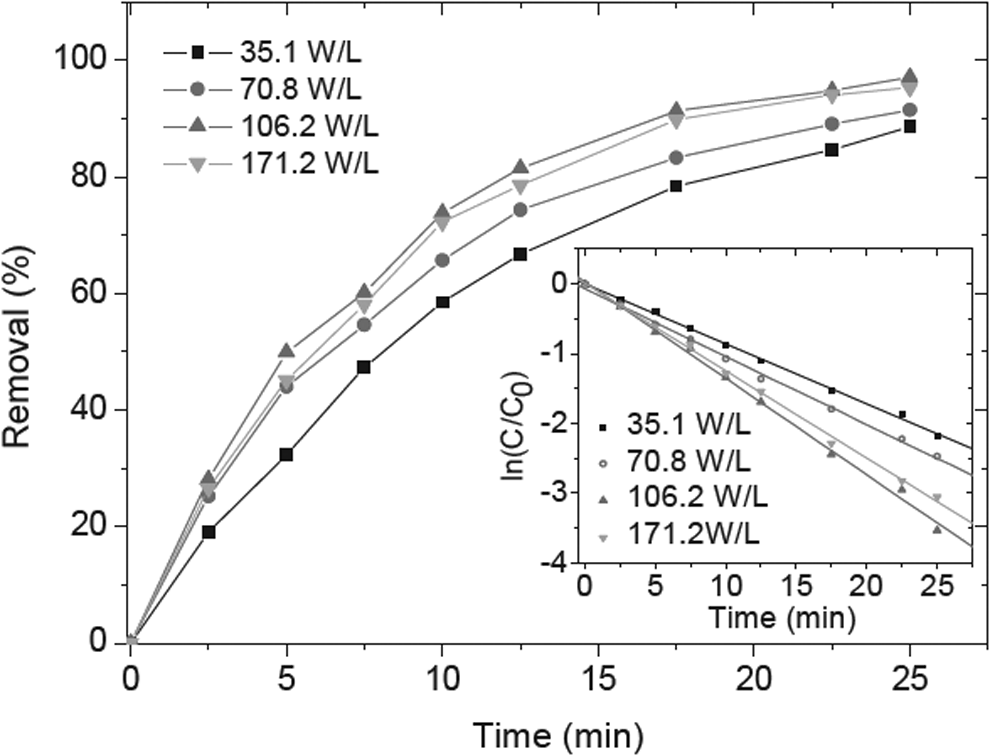
Effect of ultrasonic power on the removal of RB 194 in the sponge iron-US treatment (sponge iron=20 g/L, dye concentration=20 mg/L, pH=3.0).
Initial concentration of RB 194
The effect of initial concentrations of the RB 194 on the removal was investigated and the results of which are shown in Fig. 8. The removals of RB 194 were 98.7%, 97.1%, 94.1%, and 84.2% when the dye initial concentrations were 10, 20, 30, and 50 mg/L, respectively. The degradation of the dye with sponge iron-US involves mainly the adsorption of dye onto the iron surface and the sequent surface reaction. When the sponge iron dosage is fixed, the adsorption capacity of iron is limited. The adsorption of the dye molecules onto the iron surface would hinder other dye molecules in the bulk solution to be adsorbed and decomposed on the iron surface. These results indicate that the degradation rate of the dye is a strong function of the number of sponge iron surface active sites.
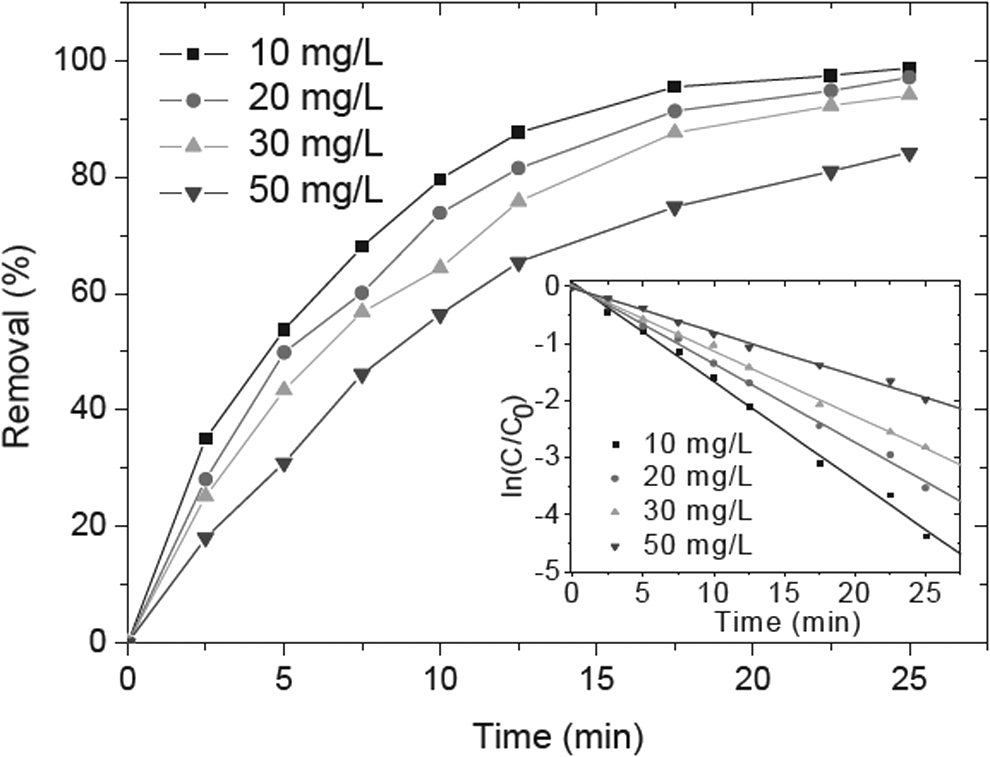
Effect of the dye initial concentration on the removal of RB 194 in the sponge iron-US treatment (sponge iron=20 g/L, US power=10.6 W/L, pH=3.0).
Degradation mechanism of RB 194
To investigate the degradation pathway of the dye RB 194, the main degradation products of RB 194 were tentatively identified by GC-MS and an ion chromatograph. The mass spectral data of the degradation products are listed in Table 1. It was found that dihydroxybenzene (1), 4-(Phenyldiazenyl)phthalic acid (2), 2,5-dihydroxynaphthaquinon (3), 6-chloro-1,3,5-triazine-2,4-diol,phthalic acid (4), benzoquinone (6), aniline (7), phthalic acid (8), maleic acid (9), oxalic acid and (10), nitrate and sulfate ions were the main degradation products. Based on such degradation products, the degradation pathway of the dye RB 194 was proposed, as presented in Fig. 9. The first step was the breaking down of the azo bond between the benzene ring and naphthalene ring and the C-N bonds between the benzene ring and triazine ring. Aniline-like compounds, naphthalene-like compounds, and triazine-like compounds were formed during this step (in the dashed square in Fig. 9). Aniline-like compounds transformed to phenols could be oxidized to benzoquinone, which could be further oxidized to yield maleic acid and oxalic acid. Then, maleic acid and oxalic acid were further oxidized to produce CO2 and H2O. Naphthalene-like compounds transformed to 4-(phenyldiazenyl) phthalic acid and 2,5-hydroxynaphthoquinone. Such compounds then transformed to phthalic acid and further oxidized to yield maleic acid and oxalic acid. Triazine-like compounds were further oxidized to 6-chloro-1,3,5-triazine-2,4-diol with the amino group transforming to a hydroxyl. During the above process, the sulfate ions through sulfonic groups being cut off, the benzene and naphthalene rings were formed. Nitrate ions were formed by oxidization of nitrogen in the RB 194 molecules.
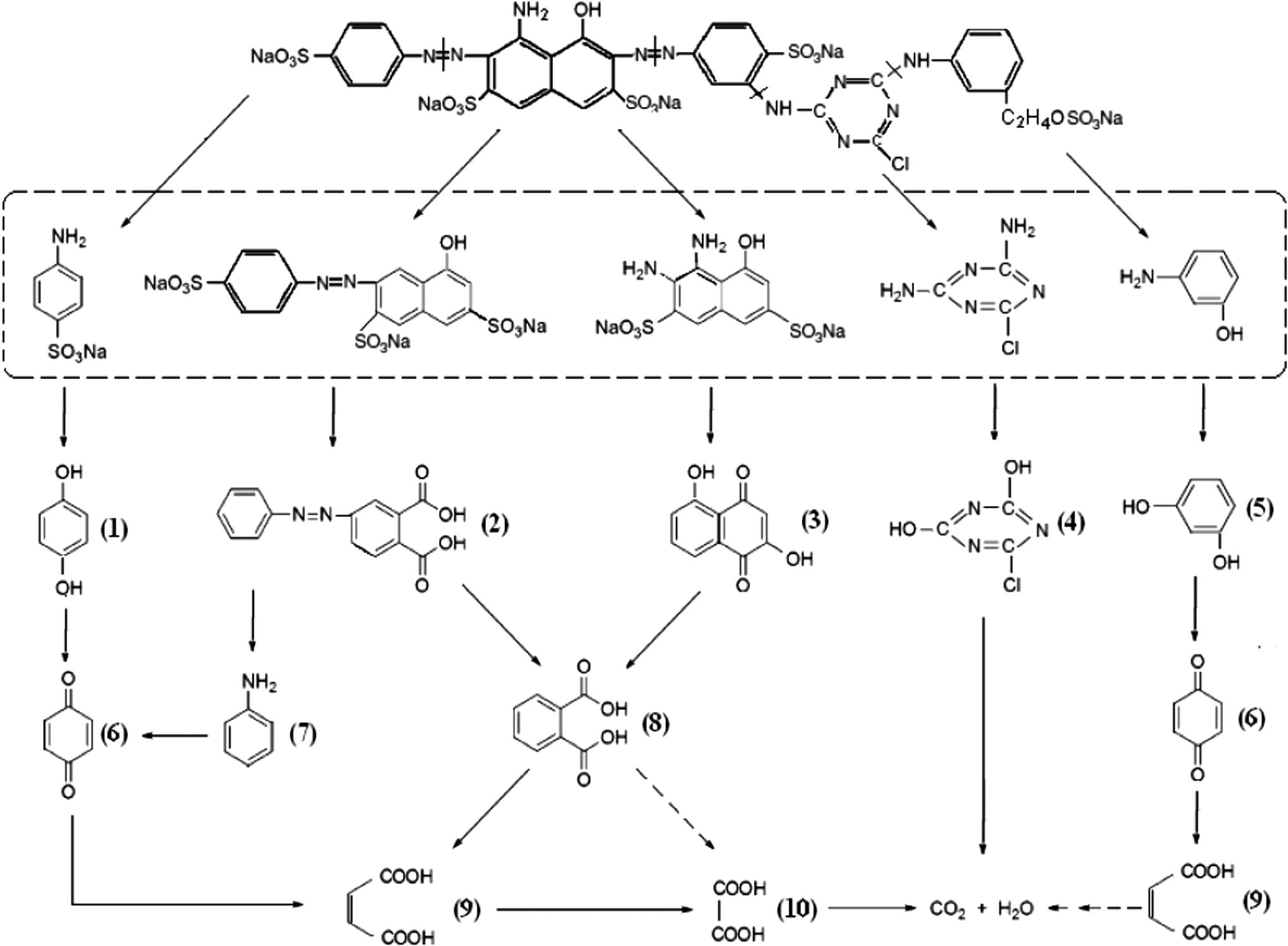
Possible degradation pathway of RB 194.
GC-MS, gas chromatograph with mass spectrometer; IC, ion chromatograph.
Conclusions
This study showed that an obvious synergistic effect was achieved by sponge iron combining with US radiation for the decomposition of the azo dye RB 194. The degradation rate constants of the RB 194 by sponge iron, ultrasonic irradiation, and sponge iron-US are 0.0049, 0.0200, and 0.138 min−1, respectively. A 6.9-fold increase in the reaction rate was observed in the presence of US compared with that of the absence of US. The effects of the dosage and particle size of the initial pH of the solution, ultrasonic power, and the dye initial concentration on the degradation of the RB 194 by sponge iron-US had been assessed. The results showed that the degradation rate of the RB 194 increased with increasing the sponge iron dosage and decreased with increasing the particle size of sponge iron, the initial pH, and the dye initial concentration of the solution. However, the use of US is energy consumption and it will increase the electricity when applying this technology for decoloration purposes.
Footnotes
Acknowledgment
The authors are grateful for the financial support from the Shandong Natural Science Foundation (No. Y2008B14).
Author Disclosure Statement
No competing financial interests exist.