




Abstract
Abstract
Catalytic wet air oxidation (CWAO) of fomesafen wastewater was studied using CeO2-TiO2 catalysts. The catalysts were prepared by coprecipitation method and characterized by Brunauer, Emmett, and Teller (BET) surface area, X-ray diffraction, and X-ray photoelectron spectroscopy. In addition, effects of temperature, oxygen partial pressure, and initial pH on the removal efficiency of chemical oxygen demand (COD) were investigated. Moreover, kinetics of CWAO of wastewater of fomesafen production was studied. Results showed that the CeO2-TiO2 catalyst with Ti/Ce of 3:1 had the largest BET surface area. When the reaction temperature was 250°C, oxygen partial pressure was 3 MPa, pH was 5.0, and reaction time was 3 h, the COD removal rate reached 78%. The ratio of biochemical oxygen demand (BOD5) to COD increased from 0.03 to 0.32 after 3 h, which indicated that CWAO can effectively improve the biodegradability of wastewater of fomesafen production. Furthermore, the second-order kinetic model conformed well to experimental data with correlation coefficients greater than 0.90. This is the first study to investigate the CWAO of real wastewater from fomesafen production with CeO2-TiO2 catalyst. This study can add new knowledge to CWAO of the real wastewater of fomesafen production and further enhance the understanding on the function and applicability of CeO2-TiO2 catalyst.
Introduction
F
Wet air oxidation (WAO) is the liquid phase oxidation of organics at elevated temperature and pressures using molecular oxygen as oxidant (Love et al., 1999; Pintar et al., 2004; Kim et al., 2007; Yang et al., 2009; Besson et al., 2010). It is suitable for the treatment of the wastewater, which is too concentrated and toxic to be treated with biological approach because any organic compound could be ideally mineralized to the end product by WAO (Love et al., 1999). To get reasonable removal rate and conversion, typical WAO method has to be performed under high temperature (150–320°C) and high oxygen pressure (0.5–20 MPa). Such requirements will inevitably lead to high equipment and operational costs.
Compared with conventional WAO, catalytic wet air oxidation (CWAO) offers lower reactive conditions and much higher oxidation efficiencies (Rodríguez et al., 2004; Huang, 2009). For example, refractory organic compounds, such as carboxylic acid and ammonia, can be oxidized more easily during the CWAO process than during no-catalytic process (Cybulsk, 2007). In recent years, mixtures of metal oxides have been reported to exhibit good activities (Yang et al., 2006; Royer and Duprez, 2011; Ren et al., 2012). Ceria (CeO2) is of great concern because of its high oxygen mobility, strong interaction with the supported metal phases (strong metal–support interaction), and the modifiable ability (Shen et al., 2009; Chen et al., 2011). In addition, supported CeO2 has exhibited excellent catalytic activity (Ruckenstein and Wang, 2002; Men et al., 2005; Posada et al., 2006). Titanium dioxide (TiO2) has good low-temperature catalytic activity and stability (Huang et al., 2012). Thus, the catalytic activity of CeO2-TiO2 has been extensively investigated. Compared with single-component oxide carriers, composite oxide carriers, such as TiO2-Al2O3, CeO2-ZrO2, and CeO2-TiO2, possess higher surface areas, better redox abilities, and oxygen storage capacities (Lin et al., 2012; Vindigni et al., 2012).
Most recent years, as a support or a catalyst, much more attention for CeO2-TiO2 catalysis have been paid in selective catalytic reduction of nitrogen oxides (Su et al., 1999; Wang et al., 2012) and low-temperature CO oxidation (Gómez-García et al., 2007). To the best of our knowledge, there is no reference to present CWAO for the real wastewater of fomesafen production. In this article, the catalyst CeO2-TiO2 was prepared with coprecipitation method and was used to investigate the CWAO of the real wastewater of fomesafen production. The catalyst CeO2-TiO2 was evaluated by Brunauer, Emmett, and Teller (BET), X-ray diffraction (XRD), and X-ray photoelectron (XPS). Moreover, the effects of temperature, oxygen partial pressure, and initial pH on the CWAO of wastewater were investigated. Finally, the kinetics of CWAO of fomesafen production wastewater was studied.
Experimental Materials and Methods
Chemicals
Real wastewater of fomesafen production was obtained from a pesticide plant located in Heilongjiang Province, China. The COD of initial fomesafen wastewater is 15,000 mg/L. The pH is about 1.0. The ratio of biochemical oxygen demand (BOD5) to COD is 0.03, suggesting that the wastewater has very poor biochemical degradability. Gas chromatography–mass spectrometer results showed that the wastewater mainly contains nonbiodegradable organic pollutants (polycyclic aromatic hydrocarbons) and inorganic pollutants (halogenating reagents and acids).
Catalyst preparation
CeO2, TiO2, and CeO2-TiO2 catalysts were prepared by the coprecipitation method. Titanium solution was prepared by adding quantitative titanium tetrachloride slowly to deionized water in the ice-water bath. Cerium solution was prepared by adding quantitative cerium (III) nitrate to deionized water in the ice-water bath. Titanium solution and cerium solution were mixed in certain molar proportion of Ti to Ce. After blending well, the mixed solution was added to ammonia and precipitated with continuously stirring for 3 h at room temperature. The pH was adjusted to 11 by ammonia when the precipitation process was over. Then, the precipitate was dried at 100°C for 24 h and calcined under air flow at 350°C for 5 h to get CeO2-TiO2 catalyst. The CeO2 catalyst and TiO2 catalyst were obtained by, respectively, adding the Ce(NO3)3 and TiCl4 solution to the ammonia with the aforementioned method (Cybulski, 2007).
Catalyst characterization
N2 adsorption–desorption isotherms were obtained at 77 K using Micrometrics ASAP 2010 analyzer. Before measurement, the samples were degassed at 572 K for 2 h. The surface area was calculated from a multipoint BET analysis of nitrogen adsorption isotherm.
XRD analysis was carried out in D/max-IIIA powder diffractometer using Cu Kα radiation. The analysis was performed over a scanning range of 20–98° (2θ) at a speed of 0.04°/s.
PHI 5700 energy instrument, with a Al Kα X-ray source (1,486.6 eV) and pass energy of 29.5 eV operating at a pressure of 7×10⁻¹⁰ Torr, was used to analyze the composition and the chemical state of the surface elements for the catalysts. The binding energies were calibrated with respect to the signal for contamination carbon (binding energy=284.62 eV).
Experimental procedure
The pH of wastewater of fomesafen production is about 1.0. Such low pH will inevitably lead to higher demands for the equipment and speed up the equipment corrosion. Thus, the pH was adjusted to 5.0 before conducting the CWAO experiments. The experimental apparatus is shown schematically in Fig. 1. The WAO experiments were conducted in a 2-L stainless steel autoclave with a stirrer. One liter of wastewater of fomesafen production was loaded into the reactor. Two grams per liter catalyst was added into the reactor before pouring the wastewater. The wastewater was heated to the desired temperature and pressure. After attainment of the desired temperature, oxygen gas was sparged into the reactor in the liquid phase. In the experiments, the operating temperature was chosen to be within the range from 150°C to 300°C and the air flow rate was set at 1.5 L/min. The operating pressure was chosen to be within the range from 2 to 4 MPa. The mixer was set at 300 rpm to minimize the gas/liquid interfacial resistance and to keep the reactor content well mixed (Gao et al., 2010). After 1 min of steady-state performance, the first sample was collected for analysis. This time was taken as “zero” time for a reaction; afterward, samples were taken out periodically for analysis. The COD concentration of fomesafen wastewater was detected by the potassium dichromate method (APHA, 1995).

Schematic diagram of experimental setup. PI, pressure indicator;
Results and Discussion
Catalysts selection
Different catalysts were used to test their effect on the removal of COD. The operating conditions were as follows: temperature 250°C, catalyst concentration of 2.0 g/L, oxygen partial pressure of 3 MPa, and pH of 5.0. The activity curves of various catalysts are shown in Fig. 2. The CeO2-TiO2 catalysts exhibit the higher activity than other catalysts. The COD removal efficiency without catalysts only reached about 30% after 3 h, while the COD removal efficiencies with TiO2 and CeO2 catalysts increased to 43% and 39%, respectively. Notably, the removal efficiencies of the catalysts CeO2-TiO2 were far greater than that of other catalysts. This demonstrates that the composite catalysts have high catalysis activity. In addition, the stability of CeO2-TiO2 catalyst with Ti/Ce of 3:1 was tested. After the experiment, the catalyst was recalcined and reused at three times. The removal efficiencies of COD were 74%, 71%, and 70%, respectively. Furthermore, the leaching concentrations of Ti and Ce determined by inductive coupled plasma measurement were 0.1 and 0.7 mg/L after the experiment, indicating that CeO2-TiO2 catalyst with Ti/Ce of 3:1 has good stability.
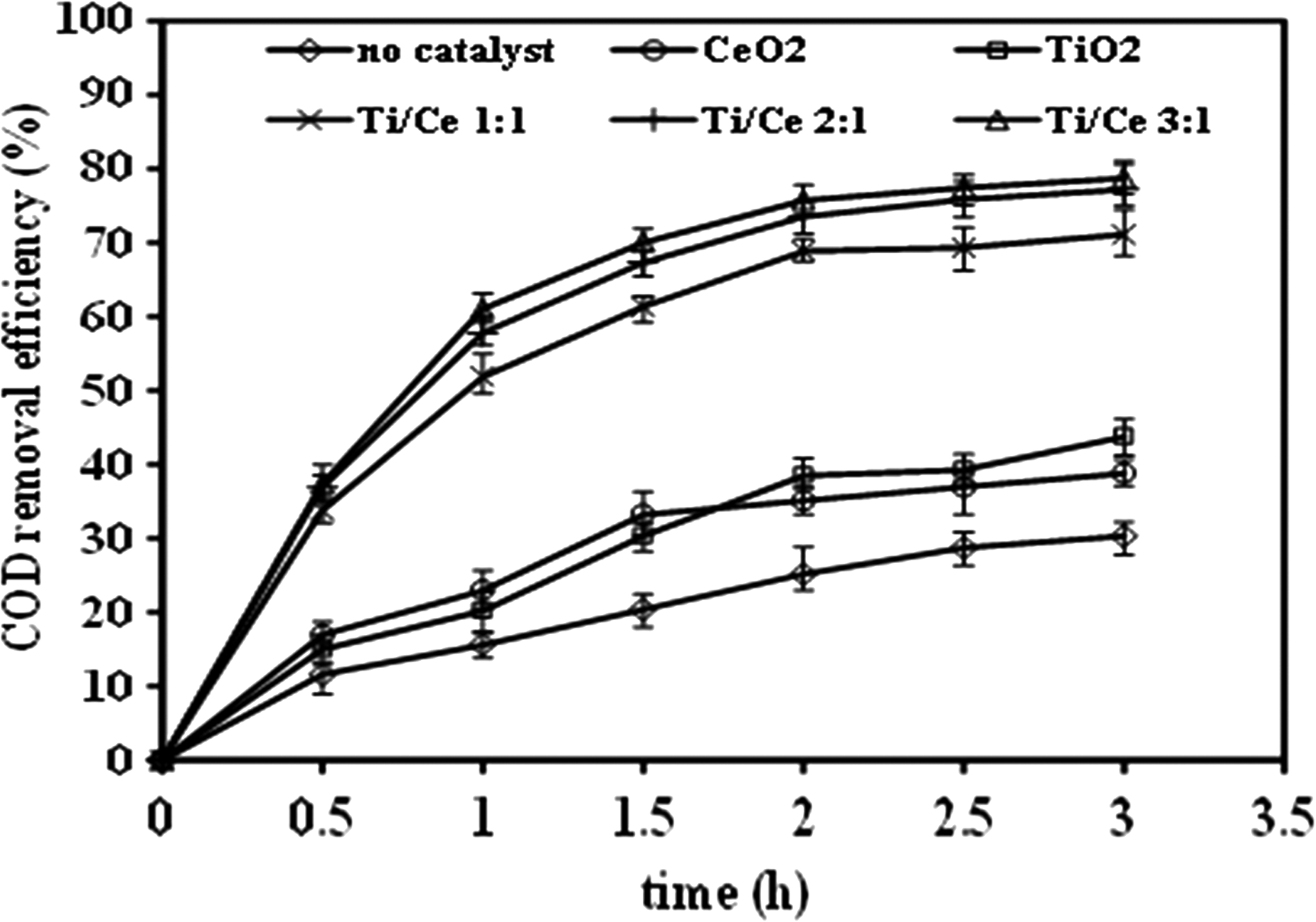
Chemical oxygen demand (COD) removal efficiency of fomesafen production with different catalysts during the catalytic wet air oxidation (CWAO) process. Reaction conditions: 250°C, 3 MPa, pH of 5.0.
It can be seen from Fig. 2 that the maximum removal efficiencies of COD (78%) was obtained after 3 h by Ti/Ce with a molar ratio of 3:1. For the other two CeO2-TiO2 catalysts, the removal efficiencies were 71% (Ti/Ce of 1/1) and 77% (Ti/Ce of 2/1), respectively. It means that Ti/Ce with a molar ratio of 1:1 has the lowest catalytic activity. While the catalytic activities for Ti/Ce with molar ratios of 2:1 and 3:1 were almost the same. The catalytic activities of catalysts mainly depend on the characterization of catalysts. The differences in COD removal efficiency for the CeO2-TiO2 catalysts with different ratios of Ti to Ce will be further discussed by linking the characterization of catalysts in the next section.
Catalysts characteristics
As described in the previous section, the catalyst CeO2-TiO2 with Ti/Ce of 3:1 reached the maximum COD removal efficiency. To further study the characterization of the catalysts, the catalysts with different Ti/Ce ratios were analyzed by N2 adsorption, XRD, and XPS methods.
BET surface areas for different catalysts are summarized in Table 1. The catalyst with Ti/Ce of 3:1 has the largest surface area among the catalysts. In the previous study, the maximum BET surface area of the CeO2-TiO2 was 153.1 m2/g (Su et al., 1999), which is lower than that of this study. The reason might be attributed to the prepared method and the molar ratio of Ti to Ce.
BET, Brunauer, Emmett, and Teller.
The XRD pattern of the CeO2-TiO2 is presented in Fig. 3. For TiO2 catalyst, the peaks of anatase titania and rutile titania are detected. It indicates that TiO2 catalyst calcined at 350°C exists as the coexistence of anatase and rutile, and the rutile titania is the dominate structure. However, previous study showed that the dominate structure is anatase (Cybulski, 2007). This difference could be ascribed to the calcination temperature. In their study, the calcination temperature is 500°C. For CeO2 catalyst, only diffraction peaks of an attributive indicator as cubic CeO2 are detected. This suggests that Ce exists as CeO2. For CeO2-TiO2 catalysts, Fig. 3 shows that CeO2 exists, while no obvious anatase or rutile phase of TiO2 is observed. Also, the peaks of CeO2 become wider. This phenomenon could be attributed to the reason that the interaction between Ce atom and Ti atom inhibited the crystal formation of TiO2. However, with the increase of Ti content, there is no obvious difference among CeO2-TiO2 catalysts.
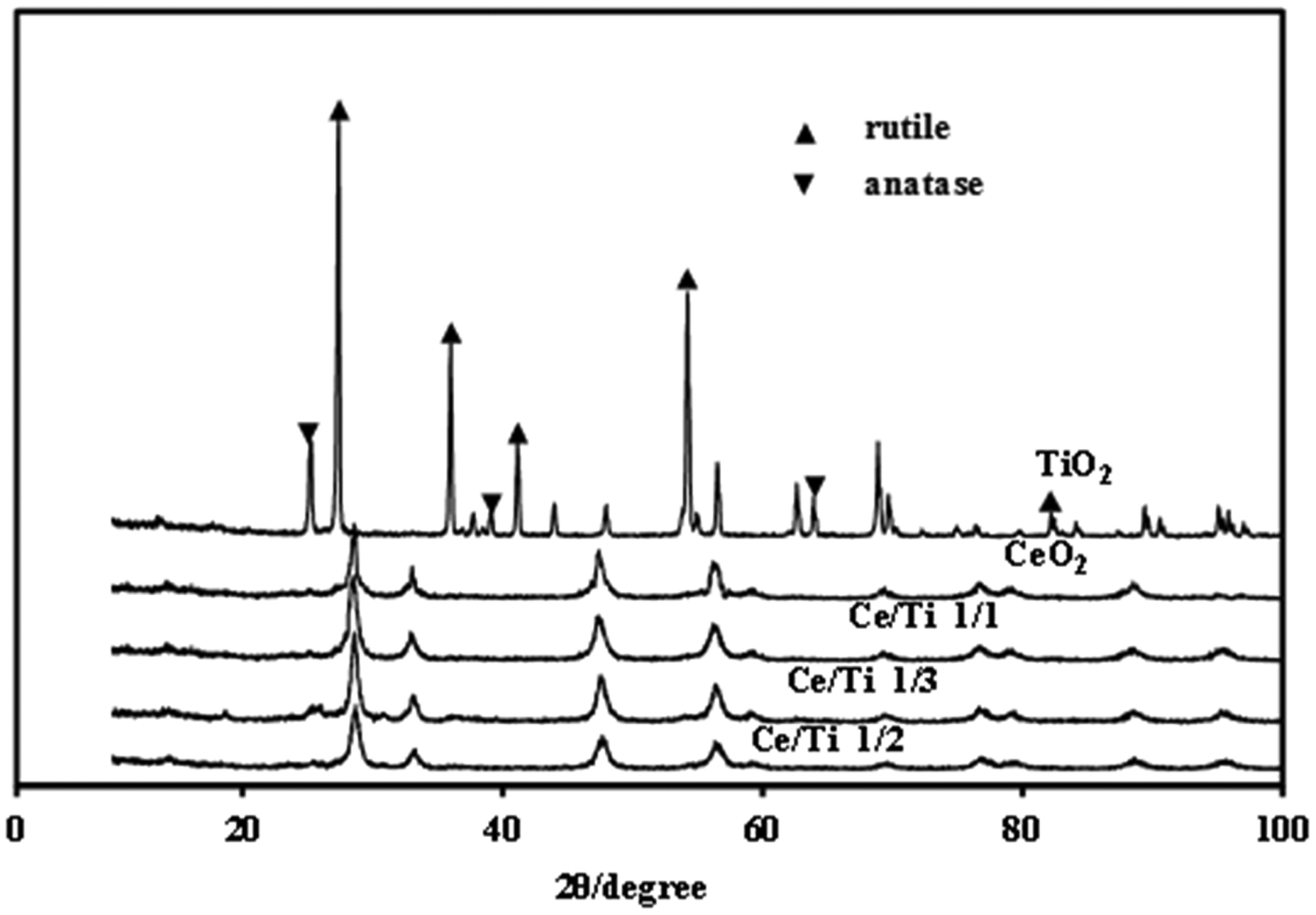
X-ray diffraction patterns of different catalysts.
To get a better understanding about the chemical state of all elements on the catalysts, the CeO2-TiO2 catalysts were investigated by XPS technique. Figure 4 shows the XPS spectra of Ce3d. Ce3d spectra are complicated. There characteristic peaks occurred in the binging energy of 880–890, 895–910, and 916 eV, which corresponds to the XPS spectra of Ce(IV) according to the previous studies (Levec and Pintar, 2007; Guo et al., 2012). From these peaks, Ce(IV) oxidation state is predominant. In addition, adjacent double peaks were observed, suggesting that Ce(III) is on the surface of CeO2-TiO2 catalyst. Also, it can be seen that for the catalyst with Ti/Ce of 1:1, the peaks of Ce(III) and Ce(IV) become much wider and weaker than that of the catalyst CeO2, but narrower and stronger than that of the catalysts with Ti/Ce of 2:1 and 3:1. For the catalysts with Ti/Ce of 2:1 and 3:1, the faint scattering Ce(III) and Ce(IV) peaks are observed. This probably indicates that CeO2 exists as amorphous. There is no obvious difference for the CeO2-TiO2 catalysts with Ce/Ti of 1:2 and 1:3.

Ce3d X-ray photoelectron (XPS) spectra of CeO2-TiO2 catalyst.
Figure 5 presents the XPS spectra of Ti2p concerning double peaks (Ti2p3/2 and Ti2p1/2). The binding energy of Ti2p3/2 peaks is located in 458.2–458.8 eV, corresponding to TiO2 form in the catalysts. This is consistent with that observed in TiO2 and TiO2-supported metal catalysts (Moulder et al., 1992; Huang et al., 2012). The test results demonstrate that Ti is present as amorphous phase TiO2 and small amounts of Ti(III) exists on the catalyst surface. Furthermore, for the catalyst with Ti/Ce of 3:1, the peak is much wider and higher than the other two catalysts, indicating that there are more Ti contents.

Ti2p XPS spectra of CeO2-TiO2 catalyst.
Figure 6 reflects the XPS spectra of O1s. The O1s XPS spectra exhibits single peak, and the peaks are asymmetric. The right sides are wider than the left, indicating that the different types of oxygen exist on the catalyst surface. This phenomenon could be attributable to the presence of Ce(III). The presence of Ce(III) may result in a charge imbalance, which would lead to oxygen vacancies and unsaturated chemical bonds. This situation could generate additional chemisorbed oxygen or weakly adsorbed lattice oxygen species on the surface of the catalyst (Larsson and Andersson, 2000).

O1s XPS spectra of CeO2-TiO2 catalyst.
Chemisorbed oxygen is strong oxidant, and it could promote the formation of O2• and HO2•, which can increase the oxidation efficiency of organic pollutants. Thus, the presence of chemisorbed oxygen demonstrates that the composite catalyst of CeO2-TiO2 has good activity. In general, the CeO2-TiO2 catalysts have better performance than CeO2 and TiO2 catalysts. For the catalysts with Ti/Ce of 2:1 and 3:1, they have almost the same characteristic. The difference in removal efficiency of the real wastewater of fomesafen production between the catalysts with Ti/Ce of 2:1 and 3:1 could be attributed to the difference of BET surface areas.
In summary, the addition of Ti could promote the dispersion of CeO2 particles. Therefore, CeO2 peaks become wider and weaker, and CeO2 particles become small in the CeO2-TiO2 catalysts. It contributes to increase the surface area of CeO2-TiO2 catalysts.
Effect of temperature on COD removal efficiency
There are many factors, such as reaction temperature, oxygen partial pressure, and initial pH value, which can affect the oxidation of wastewater. Thus, it is necessary to investigate the influence of these factors on the CWAO process. As mentioned in the previous section, the catalyst with Ti/Ce of 3:1 has the best activity in CWAO of the real wastewater of fomesafen production. Therefore, the catalyst with Ti/Ce of 3:1 was applied in the next experiments. Other reaction conditions were fixed as follows: oxygen partial pressure of 3.0 MPa and pH of 5.0. Figure 7 shows the effect of temperature on COD removal efficiency. The temperature effect on the COD removal efficiency is obvious within the temperature range from 150°C to 250°C. The COD removal efficiency increased from 43% to 75%. However, this effect appears to be negligible as it becomes higher than 250°C. The increase of COD removal efficiency was roughly 1% when the reaction temperature increased from 250°C to 300°C. Thus, 250°C is a feasible temperature.

COD removal efficiency at different temperatures. Reaction conditions: 3 MPa, pH of 5.0.
Effect of oxygen partial pressure on COD removal efficiency
The oxidation reaction of the real wastewater occurred in the liquid phase. The oxygen partial pressure plays an important role during the process of oxidation reaction. It can prevent wastewater vaporization and ensure the concentration of oxygen in the liquid phase. In this study, the effect of oxygen partial pressure was studied by varying the oxygen partial pressure: 2, 3, and 4 MPa. Figure 8 shows the effect of the operation pressure on the COD removal efficiency at 250°C with pH of 5.0. The beneficial effect of an increase in the operation pressure is apparent. The COD removal efficiency increased with the oxygen partial pressure increasing, which resulted from the solubility of oxygen in water increased with the partial of oxygen increasing. However, this beneficial effect is diminishing as the operating pressure is increased to 4 MPa, which could be attributed to the oxygen saturation (Zou et al., 2009). The oxygen partial pressure has little effect on the COD removal efficiency when the concentration of oxygen in the liquid phase reached saturation. Considering high requirements of the experimental apparatus and COD removal effect as the oxygen partial pressure increased, 3 MPa is a suitable oxygen partial pressure.

Effect of oxygen partial pressure on COD removal efficiency. Reaction conditions: 250°C, pH of 5.0.
Effect of initial pH on COD removal efficiency
When oxygen partial pressure was 3 MPa and the reaction temperature was 250°C, CWAO experiments of the real wastewater of fomesafen production were performed under different initial wastewater pH values. The results are shown in Table 2. With the increase of pH value, the COD removal efficiency decreases. The maximum of COD removal efficiency is obtained at pH of 5.0, which reaches 78% after 3 h. It can be seen that acid condition is better for treating the real wastewater of fomesafen production. Comprehensive consideration of COD removal efficiency and high demands for the equipment, pH of 5.0 is acceptable in practical processes.
COD, chemical oxygen demand.
Reaction kinetics
Primary WAO studies were performed at six different temperatures (150°C, 175°C, 200°C, 225°C, 250°C, and 300°C). Other conditions were fixed as follows: oxygen partial pressure of 3 MPa and pH of 5.0. The results of the experiments were used to elaborate the kinetics of CWAO of the real wastewater of fomesafen production. The linear forms of the first-order and the second-order kinetic models are given in Equations (1) and (2), respectively (Tunc et al., 2012, 2013):
where C0 and Ct are the COD concentrations at time 0 and time t, respectively; k1 is the first-order rate constant; and k2 is the second-order rate constant. Since the amount of oxygen was excess in the process of reaction, the effect of oxygen limitation on the reaction was not considered. The simulated results are presented in Fig. 9. Figure 9(a) and (b) displays the first-order kinetic model and second-order kinetic model fit of the COD removal data for CWAO treatment, respectively. As it showed, the second-order kinetic model fit the measured data better than the first-order kinetic order for all test runs. Based on the above model fit of the measured data shown in Fig. 9, the reaction rate constants were obtained from the slopes. The rate constants are given in Table 3. Table 3 showed that the second-order kinetic rate constants increased with the temperature increasing. This demonstrates that reaction temperature has important effect on the COD removal efficiency of the real wastewater of fomesafen production.

Reaction kinetic plot dependent on COD concentration. Reaction conditions: 3 MPa, pH of 5.0.
All the values of R2 are higher than 0.93. The values of average relative error are lower than 5%.
The rate constant k is related to the reaction temperature T according to the Arrhenius equation:
where A is frequency factor, s−1; Ea is activation energy, J/mol; R is gas constant, J/mol K; and T is the temperature, K.
According to Equation (3), the relationship between the reaction rate constants and the temperature is plotted in Fig. 10. The value of Ea was 27.2 kJ/mol, which is consistent with the previous study (Kim et al., 1983). In their study, they determined the kinetics of WAO of carbonaceous material in the wet process phosphoric acid with air and oxygen as oxidants. The value obtained in their study was in the range of 13.4–56.94 kJ/mol with the oxygen partial pressure range of 0.7–3.0 MPa. Also, the Ea of 27.2 kJ/mol suggests a free-radical process of CWAO systems (Mishra et al., 1995).
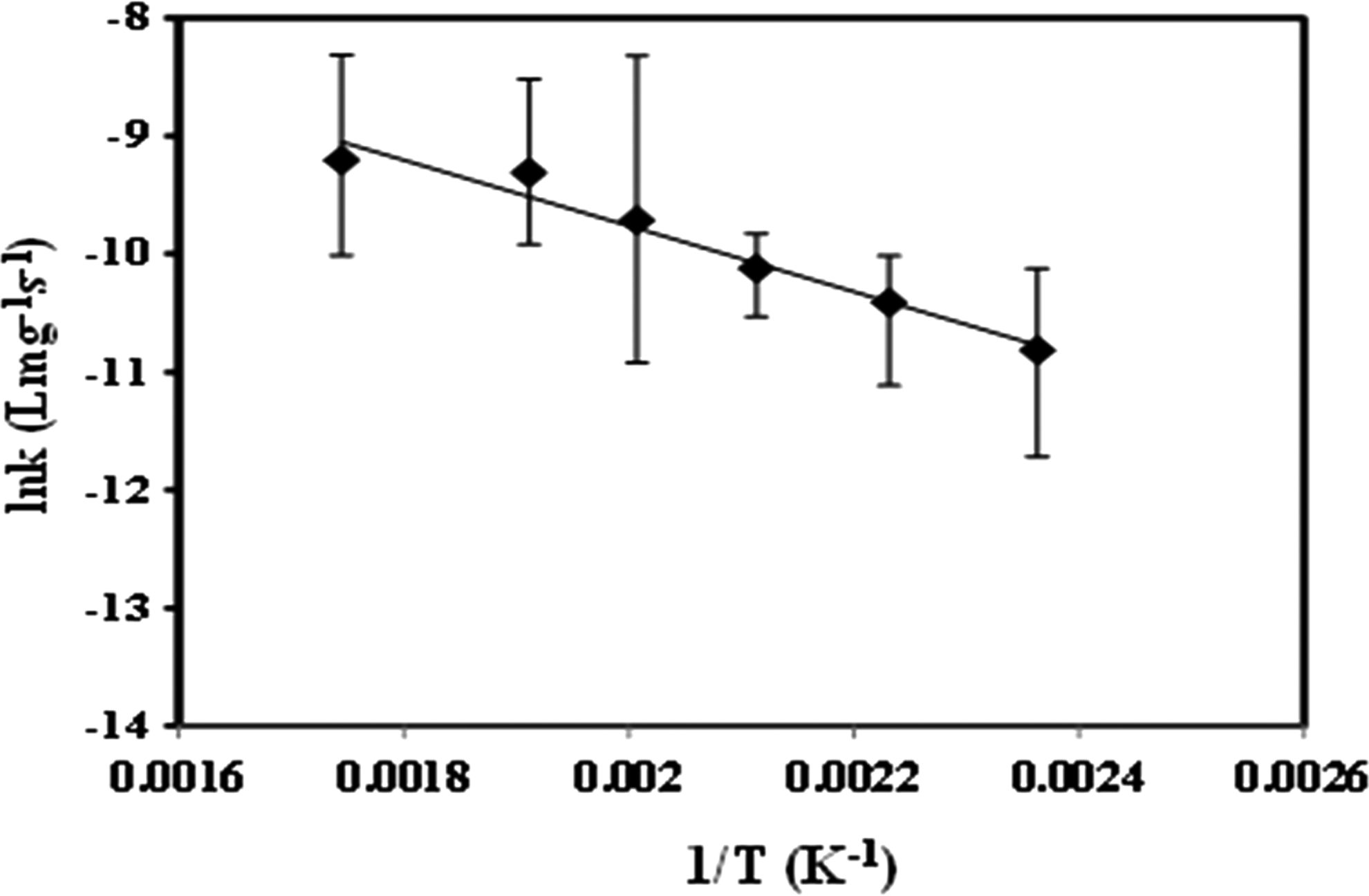
Arrhenius plot of COD removal of wastewater of fomesafen production catalyzed by CeO2-TiO2.
Biodegradability of effluents after CWAO of wastewater of fomesafen production
When the pH was 5.0 and reaction temperature was 250°C, the catalyst with Ti/Ce of 3:1 was used in the experiment. The real wastewater of fomesafen production was treated during the CWAO process. Values of BOD5/COD of effluents at different times were measured. The results are shown in Fig. 11. The initial BOD5/COD of the wastewater was 0.03, which suggests that it has poor biodegradability. This value increased to 0.32, indicating that the effluent had good biodegradable. Thus, the biodegradability of the real wastewater of fomesafen production was greatly improved. This also demonstrates that CWAO can effectively improve the biodegradability of wastewater of fomesafen production.

Time course of biochemical oxygen demand (BOD5)/COD of wastewater of fomesafen production during the CWAO process.
Mechanism of WAO reaction
The value of Ea (27.2 kJ/mol) obtained in this study indicates that the mechanism of CWAO of wastewater of fomesafen production is a free-radical process. This process involves a free-radical chain reaction. In general, the free radicals include hydroxyl radical (OH•) and hydroperoxyl radical (HO2•), which are strong oxidative reactive species in the aqueous solution (Fernandez et al., 1998; Cybulski and Trawczyński, 2004). During the free-radical process, HO2• could be produced according to the following reactions:
The pollutants in the solution could first absorb on the catalyst surface [Reaction (4)]. And then, Reaction (5) takes place on the catalyst surface, which can be finished in a short time. And then, the chemisorbed oxygen could trap the electron of Ce3+ and produce O2−• [Reaction (6)]. By Reaction (7), HO2• can be easily formed from O2−•. For different Ti content of CeO2-TiO2 catalysts, there exist the higher content chemisorbed oxygen and the lower value of Ce(III) on the catalyst surface. In this case, the chemisorbed oxygen can quickly accept the electron from Ce3+ and transform into O2−•, which quicken the occurrence of HO2•. Therefore, by adding CeO2-TiO2 catalysts into the solution, the removal efficiencies of COD significantly increase during the CWAO process. On the other hand, compared to CeO2 and TiO2 catalysts, CeO2-TiO2 catalyst has larger specific surface area. This can increase the active sites on the surface of the catalyst. It is advantageous for the oxygen and pollutant to be absorbed on the surface, which can promote the Reactions (4) and (6). In addition, among the different Ti content of CeO2-TiO2 catalysts, CeO2-TiO2 catalyst with Ti/Ce of 3:1 has the largest BET surface area. Therefore, CeO2-TiO2 catalyst with Ti/Ce of 3:1 reached the highest removal efficiency of COD.
Conclusion
The composite catalyst of CeO2-TiO2 prepared by the coprecipitation method has large BET surface area. The catalyst CeO2-TiO2 exhibited good activity in the process of reaction. Chemisorbed oxygen is found on the catalyst surface, which can increase the oxidation efficiency of organic pollutants. In addition, the addition of CeO2-TiO2 effectively improves the biodegradability of wastewater of fomesafen production. The second-order kinetic model described well the oxidation reaction of fomesafen wastewater by CWAO. The value of activation energy indicates that the mechanism of CWAO of the real wastewater of fomesafen production is a free-radical process.
Footnotes
Acknowledgments
This work was supported by the National Natural Science Foundation of China (40102027, 50578151), the National Water Pollution Control and Management Major Project of China (2009ZX07419), the National Key Scientific Instrument and Equipment Development Project (2012YQ060115), and Fundamental Research Funds for the Central Universities (2652013101, 2652013086, 2652013087).
Author Disclosure Statement
No competing financial interests exist.