




Abstract
Abstract
Although flue gas desulfurization (FGD) gypsum has become an effective soil amendment for sodic soil reclamation, it carries extra heavy metal contamination into the soil environment. The fate of heavy metals introduced by FGD gypsum in sodic or saline–alkali soils is still unclear. This work aims to investigate the effects of FGD gypsum addition on the heavy metal distributions in a sodic soil. Original soil samples were collected from typical sodic land in north China. Soil column leaching tests were conducted to investigate the influence of FGD gypsum addition on the soil properties, especially on distribution profiles of the heavy metals (Pb, Cd, Cr, As, and Hg) in the soil layers. Results showed that pH, electrical conductivity, and exchangeable sodium percentage in amended soils were significantly reduced from 10.2 to 8.46, 1.8 to 0.2 dS/m, and 18.14% to 1.28%, respectively. As and Hg concentrations in the soils were found to be positively correlated with FGD gypsum added. The amount of Hg in the leachate was positively correlated with FGD gypsum application ratio, whereas a negative correlation was observed between the Pb concentration in the leachate and the FGD gypsum ratio. Results revealed that heavy metal concentrations in soils complied well with Environmental Quality Standard for Soils in China (GB15618-1995). This work helps to understand the fate of FGD gypsum-introduced heavy metals in sodic soils and provides a baseline for further environmental risk assessment associated with applying FGD gypsum for sodic soil remediation.
Introduction
D
Various soil restoration methods have been developed so far. Among them, reclamation by calcium-based gypsum is one of the most effective methods. Natural gypsum mineral has been traditionally used for soil reclamation. However, the mining and processing requirements of gypsum ore make the massive application of natural gypsum for soil reclamation economically unattractive and environmentally unfavorable.
However, sodic or saline–alkali soil reclamation can benefit from the fast developing Chinese power industry. China has the world's largest coal consumption ratio in the existing energy structure, with over 70% of its electricity generated from coal. Most coal-fired power plants have already installed wet flue gas desulfurization (FGD) scrubbers under increasingly stringent environmental regulations. The operation of so many FGD scrubbers has led to a by-product issue, that is, how to dispose of or treat the large quantity of FGD gypsum (mostly CaSO4·2H2O). Over 20 million tons of FGD gypsum was generated in 2010 (Li et al., 2010). A small fraction of the FGD gypsum has been used by the building material industry for wallboard or block. Most of the FGD gypsum needs to be used or treated to avoid massive disposal needs and potentially secondary pollution. Therefore, using FGD gypsum produced by the power industry in the agricultural sector to reclaim sodic soils could be one of the best solutions of this FGD by-product (Xu et al., 2005). Sodic or saline–alkali soil reclamation by FGD gypsum has been demonstrated to effectively improve crop production (Wang et al., 2008). To date, this reclamation practice led by Tsinghua University has been conducted in over 10 Chinese provinces with a total area exceeding 6,000 hectares. Moreover, there have been some studies on the use of FGD gypsum for acidic soil remediation to reduce the soluble phosphorus in soils or as sulfur sources for crops (Stehouwer et al., 1999; Chen et al., 2008; Watts and Torbert, 2010).
As a by-product from coal-fired power plants, however, FGD gypsum is a very complex chemical mixture. One of the great concerns about FGD gypsum is that it contains heavy metals either from the coal fuel for power generation or from the limestone for desulfurization. The introduction of heavy metals with the FGD gypsum into the sodic soils may give rise to ecological hazards in the soil environment. Previous studies have indicated that heavy metal contents in some commercial FGD gypsum were compliant with the Chinese Environmental Quality Standard for Soils (GB15618-1995) (Xu et al., 2005; Wang et al., 2008). Stout and Priddy (1996) used FGD gypsum to reduce subsoil acidity of a Rayne soil and increased alfalfa dry matter yields by 14%. The tests showed no increase in heavy metal concentrations in either the alfalfa or the treated soils (Stout and Priddy, 1996). The safety evaluation conducted by Sakai et al. (2004) showed no effect of FGD gypsum application on the content of heavy metals in corn grains. Liu and Lal (2013) found FGD gypsum as the best amendment for improving mine soil quality without extra significant increase in heavy metal concentrations. Most recently, a series of tests applying FGD gypsum in acidic soils showed insignificant impacts of gypsum on trace element contents in both the soils and agricultural products (Watts and Dick, 2014). However, since the heavy metals can accumulate in the soil and exposure to heavy metals is generally chronic, more investigations are needed on the fate of the heavy metals carried by the FGD gypsum in sodic soils. Both laboratory and field tests are needed to fully understand the environmental and ecological impacts of long-term use of the FGD gypsum for sodic soil reclamation.
Column leaching tests were conducted in this study to investigate the influences of FGD gypsum addition on sodic soil properties, especially on the distribution of heavy metals among the soil layers. The objective of this study was to explore the migration of the heavy metals introduced by the FGD gypsum in the treated soils. Five heavy metals, namely arsenic (As), mercury (Hg), cadmium (Cd), chromium (Cr), and lead (Pb), were specifically targeted in this study.
Materials and Methods
Soil samples and FGD gypsum
Sodic soil samples were obtained from a village near Baotou City in Inner Mongolia Autonomous Region, China. These samples were collected at depths of 0–80 cm below the surface. The soils were then air-dried, disaggregated to pass through a 2-mm sieve, and mixed well for further tests.
Main components of FGD gypsum are CaSO4·2H2O, CaSO4·1/2H2O, and CaCO3. The concentrations of other trace elements in the FGD gypsum are closely related to the coal elemental composition, limestone properties, and processes upstream of the FGD. As a result, the contents of these elements in FGD gypsum (usually <1%) vary slightly for different power plants (Wang et al., 2008; Shi et al., 2011). For convenience, an FGD gypsum sample was collected from a local power plant with a typical commercial wet FGD process widely used in the country. This FGD gypsum sample was used as a soil amendment. Table 1 lists some properties of the original soil samples, together with the concentrations of some heavy metals in both the soil and FGD gypsum samples. The concentration of total Fe in the original soils was ∼200 mg/kg. Total Al concentration was not measured in this study. Although Al was soluble in soils with high acidity, it is in the insoluble form in alkaline soils (Haapala et al., 1996).
FGD, flue gas desulfurization.
Soil column leaching tests
Soil column leaching tests were conducted to simulate in situ soil reclamation with FGD gypsum and to investigate the fate of the heavy metals among the soil layers. The columns were made from lead-free PVC tubes with an inner diameter of 10 cm and a length of 123 cm. The bottom end of each tube was closed by a plastic cap with a hole in the central part for leachate collection. A bed of clean silica beads was filled immediately above the cap in each column to uniformly distribute the leachate flow. The sieved and mixed soil samples were filled into the columns to a density of 1.42 g/cm3. The top of each column had a 3-cm-thick silica bead bed to uniformly distribute the deionized water feed flow from the top. The total height of each soil column was 113 cm. The columns were finally covered by plastic caps to prevent dust from settling on the column top. All the columns were fixed vertically.
Single-factor tests were used to explore the effects of the FGD gypsum application ratios on the fate of the heavy metals in the soils. The quantity ratios of FGD gypsum added to the sodic soils were designed to be 0 (referred to as CK, which stands for control), 0.26, 0.52, 0.78, 1.04, and 1.30 wt%. These were equivalent to the additions of 0, 7.4, 14.8, 22.2, 29.6, and 37.0 t/ha of FGD gypsum for reclamation. The FGD gypsum was mixed well with the soil samples in the top 0–20-cm layer in the columns. Three columns were repeated in parallel for each application ratio to check the reproducibility.
Deionized water was used at the beginning of the tests to wet the soils in the columns until leachate appeared at the bottom of the columns. Two hundred milliliters of deionized water was added every 2 days for leaching with the leaching rate controlled at about 50 mL/h for 4 h. The whole leaching period lasted 60 days. The leachate was assembled and collected on the 20th, 35th, 42nd, 48th, 55th, and 60th days. The total leachate volume for each column was 6 L. This amount of leachate was close to the irrigation intensity (annual irrigation quantity of 7,500 m3/ha) at the soil sampling site. The contents of the heavy metals in the collected leachate were then measured.
After leaching tests, the soil columns were dismantled into 20-cm-long sections. The contents of the heavy metals were examined in the top four sections, that is, the 0–20, 20–40, 40–60, and 60–80-cm soil layers from the top to the bottom. The impacts of different FGD gypsum application ratios on the fate of the heavy metals in the treated sodic soils were investigated.
Analytical methods and procedures
The heavy metal contents in the leached soils and leachate samples were measured after the leaching tests. The soil samples were first pretreated by microwave acid digestion (ETHOS One microwave digestion labstation, Milestone Srl) according to US EPA Method 3052. The total Cd, Cr, and Pb contents were analyzed by a flame/graphite furnace atomic absorption spectrophotometer (TAS990, Beijing Purkinje General Instrument Co. Ltd.). The total As content was measured by hydride generation atomic absorption spectrometry (WHG-630A flow injection hydride generator). The Hg content was measured by an RA-915+ mercury analyzer (Lumex Analytics GmbH).
In addition, the pH, electrical conductivity (EC), and exchangeable sodium percentage (ESP) were measured for the soil samples in the top layer (0–20 cm) of the columns in accordance with the NY/T 1121-2006 soil testing standards (MoA, 2006). All the soil samples were air-dried and passed through a 2-mm sieve. A part of each soil sample was put into deionized water in a ratio of 1:2.5 (soil to water weight) and agitated until the soil particles were fully dispersed and equilibrated with the water. The pH was then measured using an Mi150 digital pH meter (Martini, Milwaukee Instruments). The EC was measured after the soil samples were mixed with deionized water in the ratio of 1:5 (soil to water weight). The mixture was agitated for 3 min to extract all the soluble salts into the solution. The suspension was then filtered and the EC of the filtrate was measured using an Mi170 EC meter (Milwaukee Instruments). The exchangeable cations, Ca2+, K+, Mg2+, and Na+, were extracted using ammonium acetate. Their concentrations were measured using an inductively coupled plasma optical emission spectrometer. The ESP was then calculated (Kopittke et al., 2006; Seilsepour et al., 2009; Chi et al., 2011) as follows:
where [Na], [Ca], [K], and [Mg] are concentrations (units: cmol/kg) of exchangeable cations Na+, Ca2+, K+, and Mg2+, respectively.
Statistical analyses
Statistical analyses were conducted on all the obtained data. A paired samples t-test was used to compare the treated soil samples with the CK data in terms of the pH, EC, ESP, the concentration of the exchangeable cation, and the heavy metal distributions along the soil columns. Pearson correlations were used to analyze the heavy metal distributions in both the soils and the leachate with respect to the FGD gypsum application ratios. p-Values<0.05 indicated statistical significance.
Results and Discussion
Effects of FGD gypsum addition on sodic soil properties
Soil ESP, EC, and pH are very important soil properties that significantly affect plant growth. Since the FGD gypsum was only added to the top layer (0–20 cm) of the soil columns, the pH, EC, ESP, and exchangeable cation concentrations were measured only in the top soil layer after leaching. Comparisons of these data show the reclamation effects of FGD gypsum on sodic soils. Table 2 lists the pH, EC, and ESP of the top soil layer for various FGD gypsum application ratios. The original soil sample had high pH and ESP (10.2% and 30.2%, respectively), indicating that the soils were strongly sodic (Kopittke et al., 2006) and very strongly alkaline (Soil Survey Division Staff, 1993). As a certain amount of exchangeable Na+ can be removed with leachate, the ESP of the untreated soil of the control upon leaching decreased from the original 30.2% to 18.1%.
p, significance of the paired samples t-test relative to the control (CK).
EC, electrical conductivity; ESP, exchangeable sodium percentage.
When the soils were treated with 0.26 wt% of FGD gypsum, the EC and ESP of the soils decreased significantly. The ESP dropped to <15%, while the decrease in pH was statistically insignificant (p=0.172). With the increasing FGD gypsum ratios in the soils, the pH, EC, and ESP of the treated soils declined significantly. For gypsum application ratios higher than 0.78 wt%, the ESP of the treated soils decreased to <5%. The treated soils could then be regarded as nonsodic. Although the pH decreased to 8.46, indicating that the soils were still moderately alkaline (Soil Survey Division Staff, 1993), the ESP was as low as 1.28% when the FGD gypsum application ratio reached 1.30 wt%.
Variations of the exchangeable cation concentrations in the soils also offer some insights into the effects of FGD gypsum addition on the soil chemical properties. Figure 1 shows the concentrations of the exchangeable cations in the top soil layer (0–20 cm) as a function of the FGD gypsum application ratios. The exchangeable Ca concentrations were generally positively correlated (Pearson coefficient 0.96 with p=0.03) with the gypsum ratios in the soils. The Ca concentration became statistically significantly higher than that of the control (CK) when more than 1.30 wt% gypsum was added. This can be explained as the contribution of the FGD gypsum, which is moderately water soluble, that is, ∼2.0–2.5 g/L (Bock, 1961). Thus, the mixing of the FGD gypsum with the soil directly increased the Ca2+ concentration in the soil. The extra Ca2+ from the FGD gypsum can then be available to displace Na+ from the exchange sites on soil particles (Carroll, 1959). Some Mg2+ and K+ cations could also be replaced. When water is available, these Na+, Mg2+, and K+ cations will be removed from the soil after being replaced by Ca2+ cations. This situation is confirmed by the results shown in Table 2 and Figure 2. The concentrations of exchangeable K+, Mg2+, and Na+ are negatively correlated with FGD gypsum application ratios (Pearson coefficients: −0.911 for K+, −0.953 for Mg2+, and −0.972 for Na+ with p<0.02). The increase in gypsum addition to the soils gave rise to a much larger influence on the exchangeable Na+ than on the other exchangeable cations. When the sodic soil was treated with 1.30 wt% of FGD gypsum, the exchangeable Na+ concentration decreased from 20.1 cmol/kg (or 4631.5 mg/kg) in the control to 1.2 cmol/kg, resulting in significant decreases of both EC and ESP.
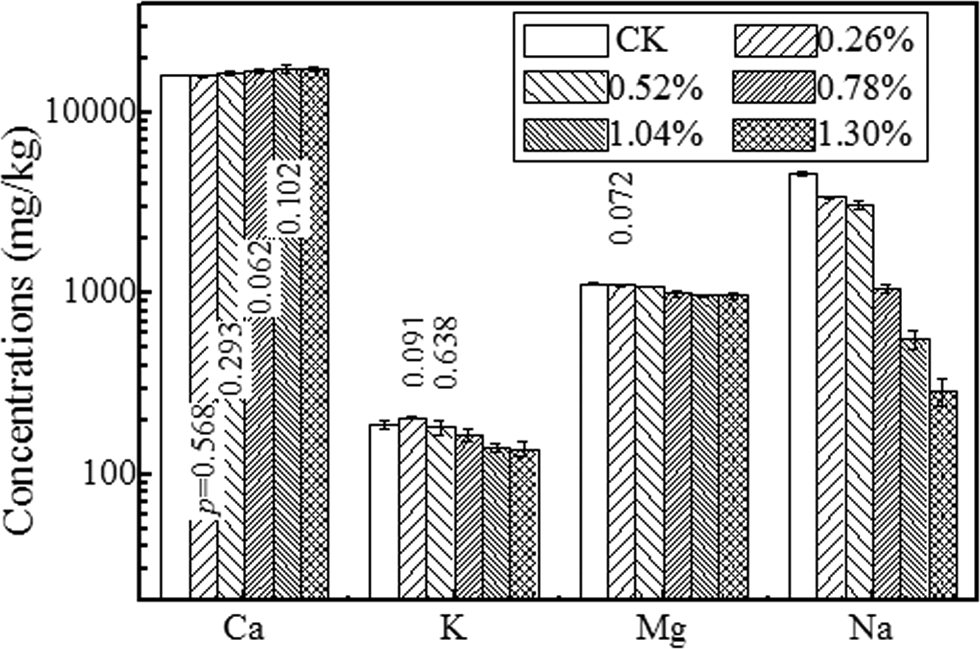
Exchangeable cation concentrations in top soil layers for various flue gas desulfurization (FGD) gypsum application ratios (Values of p on or above the bars are the significances that are >0.05 of the paired samples t-test).

Distribution profiles of heavy metals,
Distributions of the heavy metals among the soil layers
As shown in Table 1, the FGD gypsum used in this study contained low levels of heavy metal concentrations that were similar to the tested soils. Although the concentrations of Pb and especially Hg in the gypsum were higher than in the soils, they were far below the limits regulated by the Chinese Environmental Quality Standard for Soils (GB15618-1995). GB15618-1995 also superintends limits for other heavy metals, such as Zn and Cu, in addition to those listed in Table 1. These metals were not investigated in this work because results of previous studies showed that the Zn and Cu concentrations in FGD-treated soils were much lower than those specified in the GB15616-1995 regulation (Xu et al., 2005; Wang et al., 2008). In addition, within certain limits, Zn and Cu are essential to biochemical processes in organisms (Chen et al., 2012). Therefore, only five heavy metals, that is, As, Hg, Cd, Cr, and Pb, were investigated in this work since they are mostly toxic and have little known vital or beneficial effects on crops.
Figure 2 shows the distributions of the heavy metals along the soil layers in the columns. For the control (CK), the As and Cd concentrations gradually increased from the top layer down to the lower layers of the column after leaching. This implies that As and Cd may move downward to lower layers with the leachate. This result was similar to that found by Egiarte et al. (2009). In their study of downward-moving heavy metals in biosolid-amended soils, accumulation of Cd was observed at the lowest part of the soils rather than in the uppermost horizon due to the high mobility of Cd (Egiarte et al., 2009). Contrary to those of As and Cd, the Pb and Hg concentrations decreased with the soil depth. Syrovetnik et al. (2007) also reported a decrease in Pb concentrations with depth in the Oostriku peat after sequential leaching. Statistical analyses showed no significant differences in the Cr concentration among all the layers for the control (t-test significance >0.1). Cr has two redox states in soils, trivalent Cr(III) and hexavalent Cr(VI). Cr(VI), a highly toxic species, is highly soluble and thus has higher mobility, while Cr(III) tends to combine with hydroxide ions and deposit on soil particles (Gardea-Torresdey et al., 2005). However, only total Cr concentrations were measured and the status of Cr was not analyzed in this work.
Reasons for differences in the distributions among these heavy metals are complex. Some researchers attribute these differences to different mobility levels of the heavy metals (Bruemmer et al., 1986; Egiarte et al., 2009). Pb and Hg are usually found to have the lowest mobility, while Cd is relatively mobile in soils (Bruemmer et al., 1986). Differences in leachability or sorption affinity are also used to explain the different distributions among the heavy metals. Huong et al. (2010) found the leachability of heavy metals decreased in the order of Cd>Ni>Cr>Zn>Pb. Stietiya et al. (2014) revealed the sorption affinity of Ni, Zn, and Cd in the decreasing order of Ni>Zn>Cd. These evidences could explain the results of heavy metal distributions in the treated soils in this work. As the leachability of Cd is high, more Cd in the upper parts of soil columns could be leached and move downward. For Pb, however, the situation is opposite to that of Cd. More Pb in the lower parts of the soil columns could be leached due to longer contact time with the leachate than that in the upper parts.
Nonetheless, it should be noted that the behavior of heavy metals in soils involves complex processes, such as desorption, transport in pores, adsorption, and dissolving. In alkaline soils, heavy metals generally exist as metal–organic complexes, carbonates, or phyllosilicates (Rashad et al., 2011). When subject to leaching, they may migrate with the leachate from the upper layers downward to the lower layers or may concentrate in certain layers. Their fate depends on the extractability and mobility of the heavy metals, which are heavily dependent on not only the pH, organic matters, clay mineral, Fe/Al oxides, and calcium carbonate in the soil but also their redox states (Bruemmer et al., 1986; Shaheen et al., 2013). The addition of FGD gypsum could have several effects on the soils in terms of the heavy metal concentrations. Since the FGD gypsum contains heavy metals, its addition will directly increase the heavy metal concentrations in the soils. For alkaline or sodic soils, however, the gypsum will also increase the calcium cation fraction in the soils. This will decrease the soil alkalinity, as shown in Table 2, which will modify the heavy metal solubility (Bruemmer et al., 1986). The calcium cations may also improve the exchange capacity of the soil colloids, which will change their affinity for the heavy metals. The detailed mechanisms of FGD gypsum effects on the heavy metal distributions in the treated soils will be further investigated in the next stage of the research.
As shown in Figure 2, the addition of the FGD gypsum had insignificant effects on the heavy metal distributions among the soil layers compared with those for the control. Since the gypsum was only added to the top layer, the Hg concentrations in this layer increased steadily with the FGD gypsum application ratios. The concentrations of the other heavy metals in the top layer of the treated soils showed no obvious increases compared with those of the control. This finding was consistent with those found by Stout and Priddy (1996) and Liu and Lal (2013). Paired samples t-test analyses of the data showed that the variations of the heavy metal concentrations versus the amounts of FGD gypsum were insignificant. The effects of FGD gypsum addition on the total amount of each heavy metal element in the soils were further analyzed by averaging the heavy metal concentrations over the four layers of the columns. As shown in Figure 3, the average As, Hg, and Cd concentrations in the treated soils increased with the FGD gypsum application ratio. More specifically, the As and Hg concentrations were positively correlated with the FGD gypsum ratios with Pearson correlation coefficients >0.9 and significances p<0.01. However, the correlations between the other heavy metal concentrations and the gypsum application ratios were insignificant.
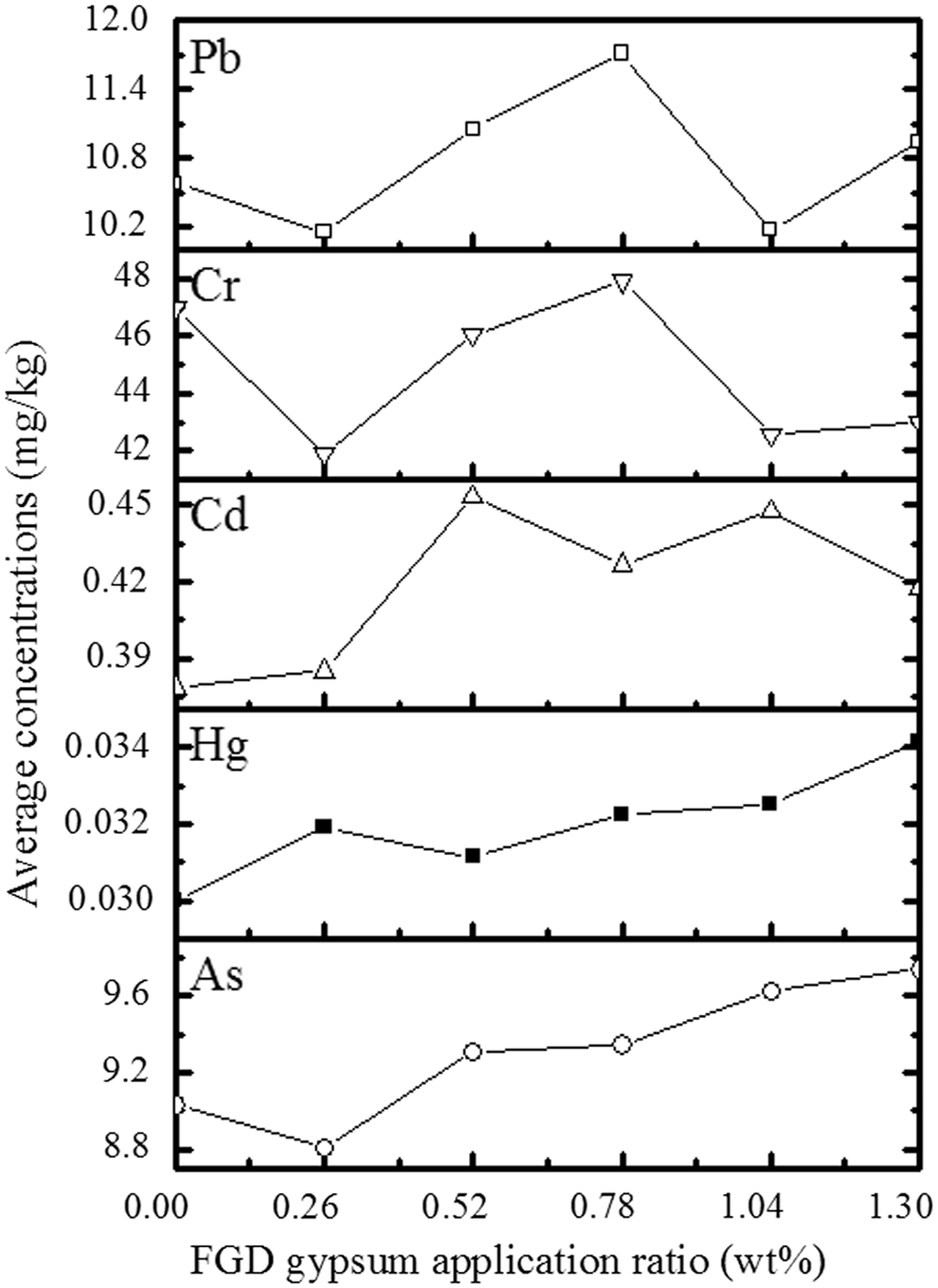
Heavy metal concentrations in soils averaged over all layers (0–80 cm) for various FGD gypsum application ratios.
For most of the FGD gypsum application ratios, the heavy metal concentrations in the treated soils did not exceed the limits in the GB15618-1995 (represented by the dotted lines in the charts). The only exception was Cd in the subsurface layers (the 40–60-cm layer in Fig. 2c), where the Cd concentration slightly exceeded the limit (0.6 mg/kg) for gypsum application ratios of 0.52–1.04 wt%. This could be due to the high mobility of Cd in the soils.
Heavy metals in the leachate
Heavy metals in soils can be subject to desorption, extraction, and migration in the column and can dissolve into the leachate. The heavy metals in the leachate from the soils will then contaminate the groundwater. Thus, the effects of the FGD gypsum addition on the heavy metal concentrations in the leachate were further investigated. Figure 4 shows the variations of the heavy metal concentrations in all the collected leachate samples with respect to various FGD gypsum application ratios. Most heavy metal concentrations reached maxima in the fifth or sixth leachate samples. Due to its low mobility, the Hg concentrations in the first three leachate samples were too low to be detected. The Pb concentrations in the first four leachate samples were almost constant and lower than those in the last two leachate samples.
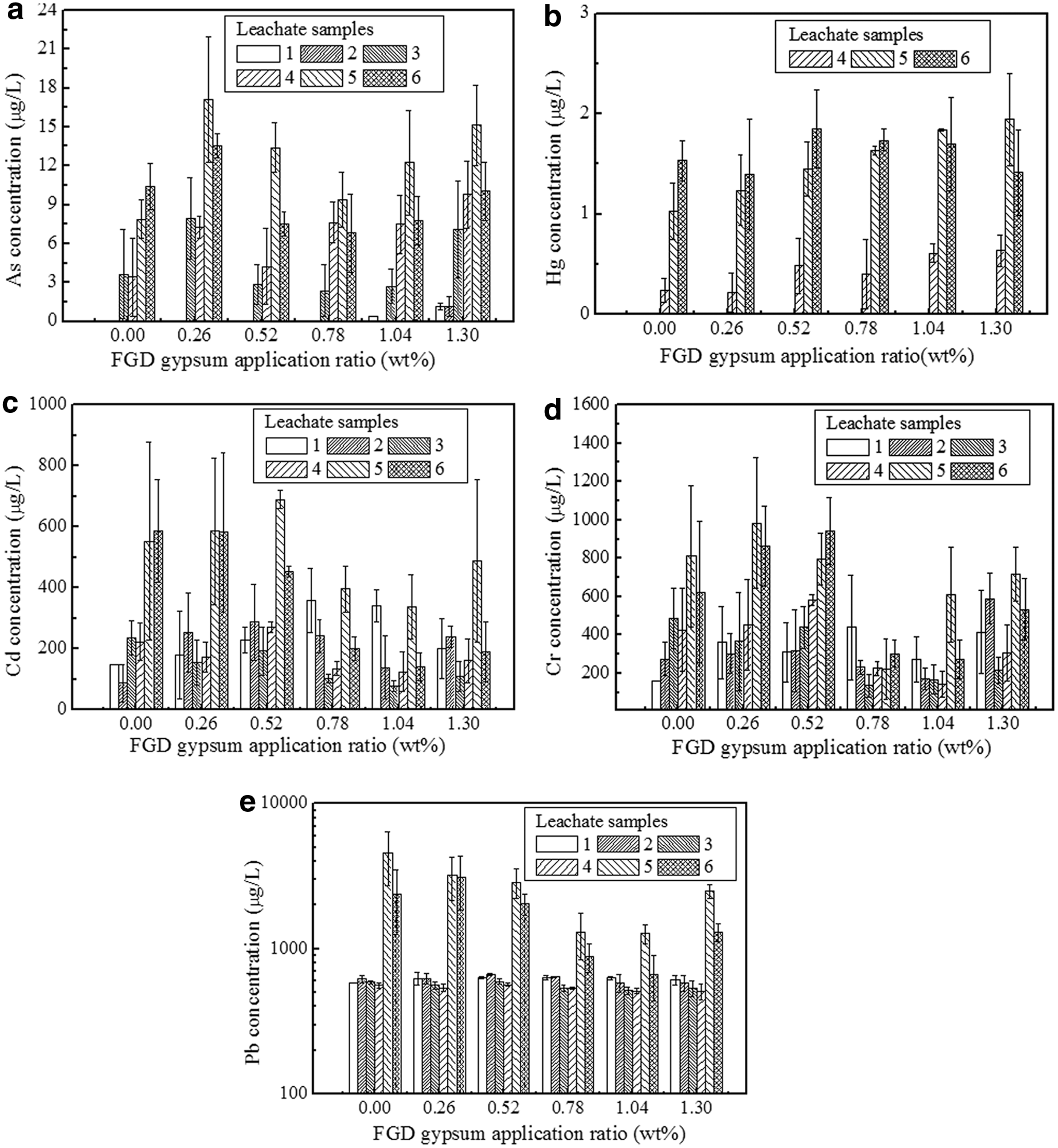
Concentrations of heavy metals,
As can be seen in Figure 4, arsenic was not detectable in the first two leachate samples until the gypsum application ratio reached 1.04 wt%. The Hg concentrations in the leachate samples increased with increasing amounts of FGD gypsum. This tendency was not obvious for the other heavy metals. Almost all the maximum concentrations of As, Cd, Cr, and Pb appeared in the fifth leachate samples and these maxima decreased for the gypsum ratios of 0.78–1.04 wt%. The underlying mechanisms for this result were hard to clarify without further comprehensive investigations on the properties of the leachate and the soils. These will be the main focus of future research along with the leaching kinetics under the alkaline conditions.
Total amount of each heavy metal collected in the leachate was obtained through multiplying the concentrations by the leachate volumes. As shown in Figure 5, the total amount of Hg in the leachate was positively correlated with the FGD gypsum application ratios (p=0.014), while that of Pb was negatively correlated with the FGD gypsum application ratios in the treated soils (p=0.044).
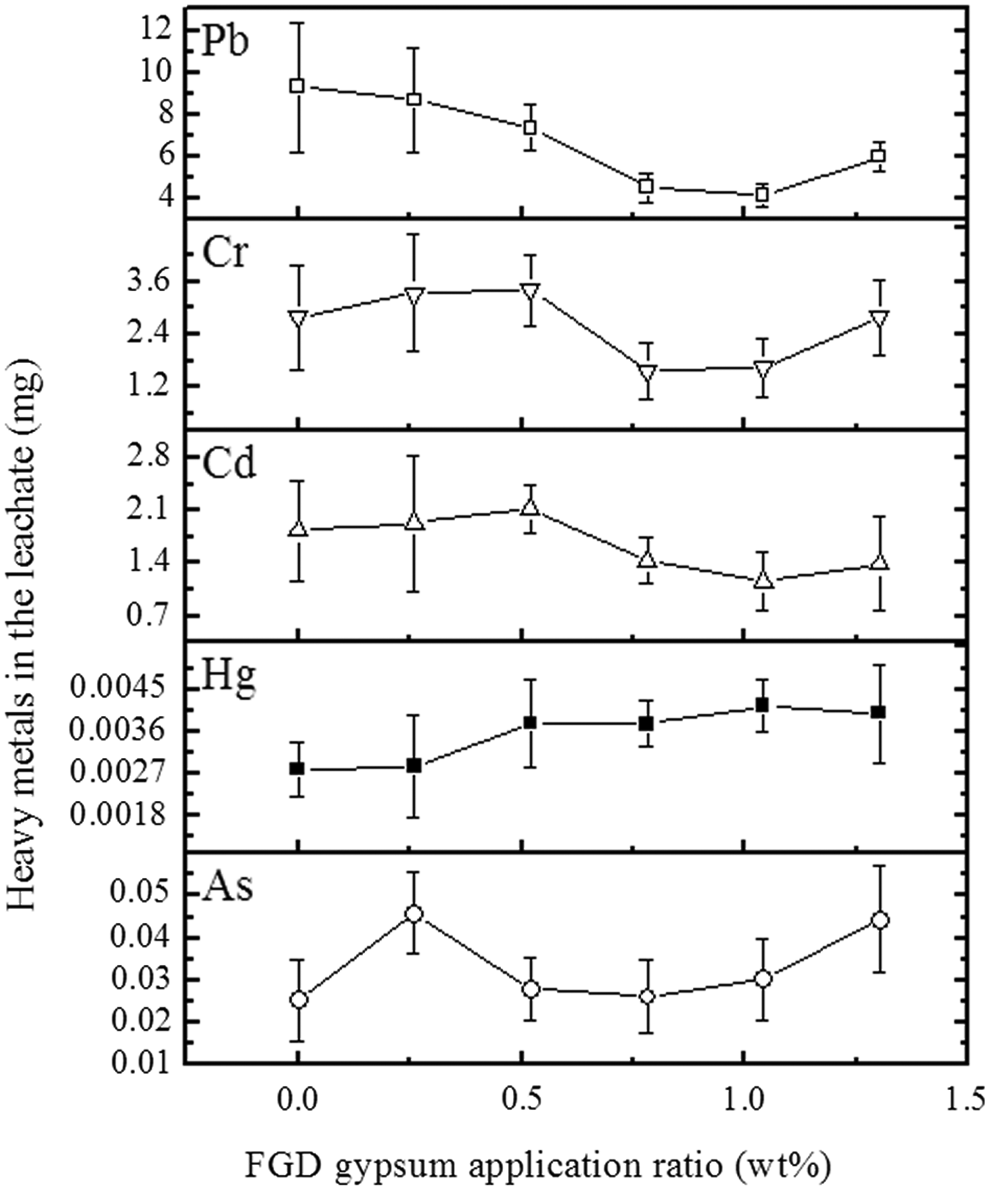
Heavy metal amounts in the leachate for various FGD gypsum application ratios.
Mass balance was evaluated for all these heavy metals in the soils and leachate samples before and after leaching. Relative deviations were calculated as follows:
where HMa is the total mass (unit: mg) of a heavy metal species in the soil column and leachate after leaching, and HMb is the total mass (unit: mg) of a heavy metal species in the soil and FGD gypsum before leaching. The results are listed in Table 3. As can be seen, the relative deviations for Pb and Cd are within ±10%, while those of As and Cr are around −30%. The errors could be due to the uncertainties in sampling and analytical methods or procedures.
Further discussion
As and Hg concentrations in the treated soils were positively correlated with the FGD gypsum application ratios. Thus, the reclamation of saline–alkali or sodic soils using FGD gypsum may contaminate the soils with these heavy metals. However, the heavy metal concentrations in the treated soils were still below the limits in the GB15618-1995 even for the maximum gypsum application ratio (1.30 wt% or 37.0 t/ha). In reality, average gypsum application ratios of between 29.6 and 37.0 t/ha have been used in practical applications using FGD gypsum for sodic or saline–alkali soil reclamation. There have been a few cases where the soil ESP has been extremely high. For these cases, the application ratio of the FGD gypsum amendment was still <60 t/ha (Wang et al., 2008). Since gypsum is not very soluble, experience has shown that reclamation effects using FGD gypsum on sodic or saline–alkali soils can be effective for 5–10 years (Wang et al., 2008). Furthermore, as can be seen in Table 1, the heavy metal concentrations in the FGD gypsum were almost the same as or sometimes lower than those in the original soils. Since the mass fractions of gypsum added to the soils are quite small (1–2 wt%), the contribution of heavy metals from the FGD gypsum to the soils was negligible.
Nonetheless, as the Chinese government tightens environmental protection enforcement, more stringent regulations will be imposed on power plants to control flue gas emissions in the coming decade. Selective catalytic reduction (SCR) systems are expected to be installed in the next few years in most Chinese coal-fired power plants to reduce NOx emissions. These systems will transfer considerable quantities of heavy metals, especially water-soluble oxidized Hg, into the FGD gypsum. This will then bring new challenges for using FGD gypsum for sodic/alkali soil reclamation. The safety of applying FGD gypsum from the SCR system will be investigated in the near future. Nevertheless, the results obtained in this work provide a baseline for the future research efforts on this issue.
Conclusions
Sodic soil properties and heavy metal contamination in the soils and groundwater due to FGD gypsum amendments were investigated using soil column leaching tests. Addition of FGD gypsum greatly reduced the exchangeable Na, K, and Mg cation concentrations in the sodic soils. The strong sodic and alkaline soils turned to be nonsodic and moderately alkaline with FGD gypsum amendments. The concentrations of As and Cd increased with depth in the soil columns upon leaching, while the Pb and Hg concentrations decreased due to the differences in their mobility. The heavy metal concentrations in the FGD gypsum-treated soils were still below the limits given by the Environmental Quality Standard for Soils in China. No obvious heavy metal contamination was introduced when 1–2 wt% of FGD gypsum was used to reclaim the sodic soil. However, the concentrations of As and Hg in the treated soils were positively correlated with the FGD gypsum application ratios. This suggests that the heavy metal concentrations (Hg and As, in particular) should be carefully monitored before FGD gypsum is used for soil remediation. This study helps to assess the potential environmental risks related to FGD gypsum amendments for sodic soil reclamation.
Footnotes
Acknowledgments
This work was supported by the Tsinghua University Research Fund (20101081776) and the National Key Technology R&D Program (Grant No. 2013BAC02B06). The authors thank Tsinghua University and the Ministry of Science and Technology of China for their financial support.
Author Disclosure Statement
No competing financial interests exist.