




Abstract
Abstract
Electrochemical oxidation is widely used to remove harmful organic and inorganic substances as well as pathogenic microorganisms. In this study, removal of Microcystis ichthyoblabe cells and the hepatotoxin it produces, microcystin-LR (MC-LR), was achieved by oxidation using Pt/Ti electrodes with constant voltage system. In addition, a possible mechanism for the removal of phosphorus is posited. Cyanobacteria cells were severely damaged and 96% were removed after 12 h of the electrochemical treatment. MC-LR decreased rapidly, and was undetectable after 24 h. Concentrations of Na+ and K+ ions gradually increased as treatment proceeded. Ca2+ ions decreased because of deposition of these ions on the cathode surface. Total phosphorus was decreased by 29% after 71 h because of the deposition of inorganic phosphorus on the cathode surface. Phosphorus was deposited on the cathode surface along with calcium ions as CaHPO4 (monetite) and/or CaHPO4·2H2O (brushite). This article is the first to report a possible phosphorus-removal mechanism by electrochemical treatment.
Introduction
C
Electrochemical oxidation treatments are powerful methods for the removal of harmful organic materials. Many oxidants (such as hypochlorite, chlorine dioxide, chlorine, hypochlorous acid, hydrogen peroxide, ozone, hydroxyl radical, etc.) can be generated by electrochemical oxidation (Stucki et al., 1991; Comninellis and Pulgarin, 1993; Comninellis, 1994; Kraft et al., 1999; Tanaka et al., 2002; Kerwick et al., 2005). The oxidants are highly reactive and efficiently remove harmful organic materials.
When the potential of a metal is greater than the redox potential of the sample, it may be considered inert (Galster, 2000). The novel metals (particularly Au and Pt) have proven to be useful in organic degradation by electrochemical oxidation treatment because they have the higher redox potentials than the oxygen-generation potential. However, Pt has a relative higher exchange current than Au; therefore, Pt is preferred in electrochemical treatments.
Few studies have investigated the removal of cyanobacteria and cyanotoxins by electrochemical oxidation (Liang et al., 2005; Shi et al., 2005; Xu et al., 2007). However, to the best of our knowledge, no studies have investigated the simultaneous removal of Microcystis cells and their microcystins by electrochemical oxidation.
Nitrogen and phosphorus are nutrients that strongly influence the occurrence of a cyanobacteria bloom. Reyter et al. (2010) showed that nitrate can be removed using copper and Ti/IrO2-coupled electrodes by changing the anode/cathode surface area ratio. Kerwick et al. (2005) reported phosphate adsorption on the cathode. However, the mechanism was not determined.
Therefore, this study was conducted to evaluate the removal of simultaneous Microcystis cells and its microcystins by electrochemical oxidation. In addition, we provide a possible mechanism for the removal of phosphorus.
Materials and Methods
Algal culture
A unialgal culture of Microcystis ichthyoblabe (TAC95 strain; Tsukuba Algae Collection, National Science Museum) was used in this study. TAC95 was cultured in the late exponential growth phase or early stationary growth phase that corresponded to 14 days after inoculation in batch mode containing the sterilized 10 L Microcystis aeruginosa (MA) medium (Table 1) under illumination at ∼16 μmol/(m2·s) and a 24-h light cycle at 23°C±1°C. TAC95 is known to produce only MC-LR (Yokoyama and Park, 2003).
MA, microcystis aeruginosa.
Apparatus
Figure 1 shows a schematic of the electrochemical oxidation reactor. The cultured cells were directly introduced into the sterilized electrochemical reactor. The volume of the algal solutions (Microcystis cells+MA medium) to be treated was 4 L. The anode and cathode were made of Pt coated on a Ti substrate, and the dimensions of the electrode were 50 mm wide by 200 mm in diameter. The surface area immersed in the algal solution was 100 cm2, and the distance between the anode and cathode was 5 mm. Agitation during treatment was provided by a magnetic stirrer (at about 200 rpm) and a potential of 10 V was maintained between the electrodes throughout the experiments with a DC power supply. A Ag/AgCl electrode was chosen as the reference electrode and a potential of anode was measured. The distance between the anode and the reference electrode was 1 mm. Conductivity of algal solution was measured using an electrical conductivity meter (HEC-110; DKK-TOA Co., Tokyo, Japan). Measurement of pH values in the vicinity of anode and cathode and whole solution was carried out using a pH meter (HM-21P; DKK-TOA Co.) at the ∼1 cm back of anode and cathode and more than 10 cm from the electrodes, respectively. All electrochemical oxidation treatments were carried out under illumination at ∼16 μmol/(m2·s) and a 24-h light cycle at 23°C±1°C.
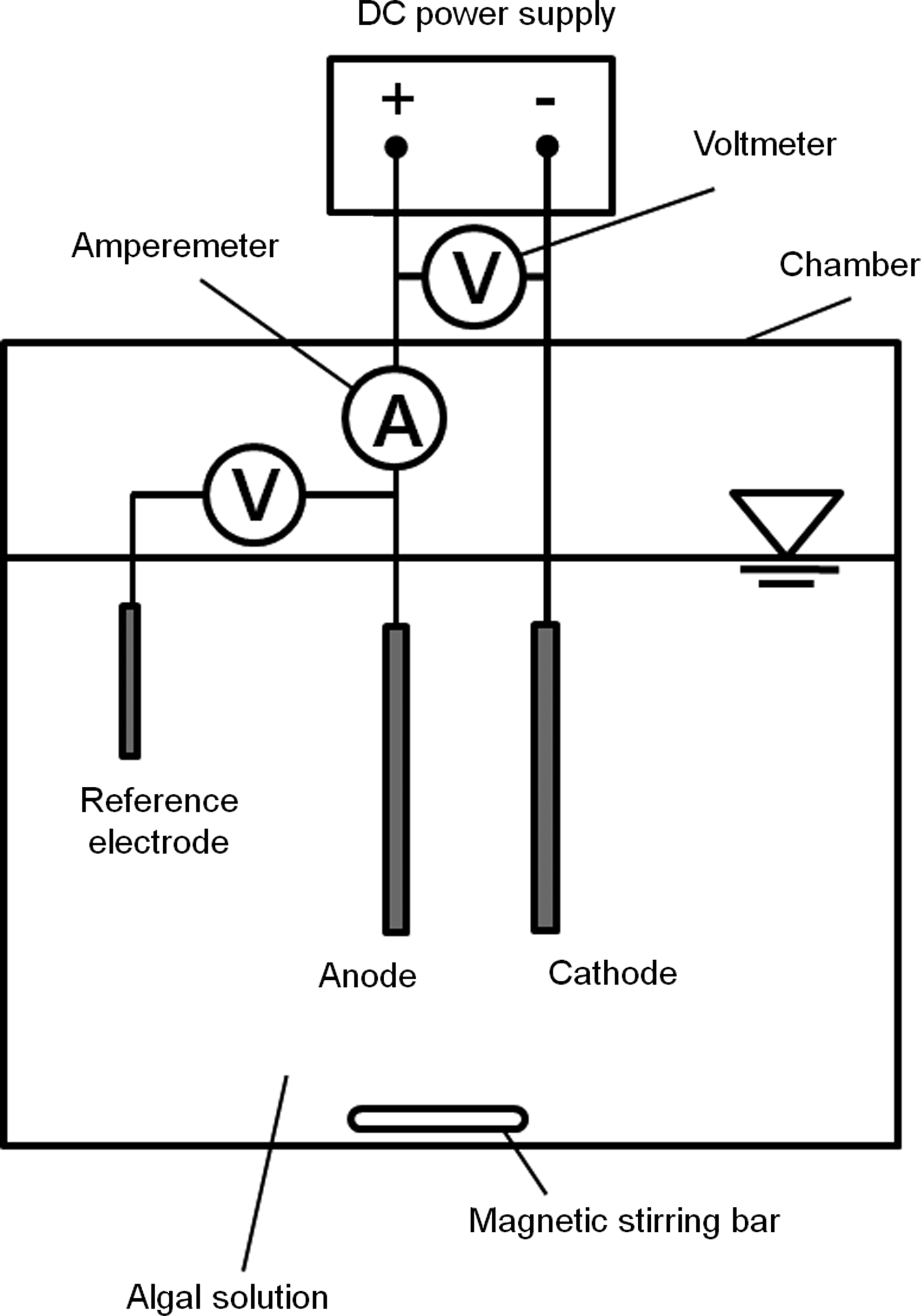
Schematic of electrochemical treatment.
Microcystis cell density
Ten-milliliter samples were harvested at each time point during the treatment and fixed with formaldehyde (final concentration=2%). The samples were placed on a Fuchs-Rosenthal hemocytometer, and the cells were counted by microscopic examination at ×400 magnification (BK51; Olympus, Tokyo, Japan).
Concentration of MC-LR
Concentrations of MC-LR were measured according to the method described by Xie et al. (2007). The HPLC system consisted of a Shimadzu (Kyoto, Japan) LC-9A pump with an ODS column (Cosmosil 5C18-MS-II; 4.6×150 mm; Nacalai Tesque, Kyoto, Japan) coupled to an SPD-10A detector set at 238 nm, an SPD-M10A photodiode array detector, and a C-R6A integrator. The analytes were separated using a mobile phase consisting of methanol:0.05 M phosphate buffer (pH 3.0, 58:42) at a flow rate of 1 mL/min. The MC-LR concentration was quantified against MC-LR standards (Kanto Ltd., Tokyo, Japan).
Concentration of cations (Na+, K+, and Ca 2+ ions)
Ten-milliliter aliquots were filtered through a glass-fiber filter (GF/C; Whatman, Maidstone, United Kingdom) and the filtered water was injected into an ion chromatograph (IC) for analysis.
The IC system consisted of a JASCO (Tokyo, Japan) PU-1580i pump with a column (Shodex IC YK-421; 4.6×125 mm; Showa Denko, Tokyo, Japan) coupled to a DG-1580-53 degasser, a CO-1565 oven, and a Showa Denko Shodex CD-5 conductivity detector. The analytes were separated using a mobile phase consisting of 5 mM tartaric acid, 1 mM dipicolinic acid (pyridine-2,6-dicarboxylic acid), and 50 mM boric acid at a flow rate of 1 mL/min.
Phosphorus analysis
Total phosphorus (TP) and dissolved total phosphorus (DTP) were measured by the high-temperature persulfate oxidation method (Menzel and Corwin, 1965). Dissolved inorganic phosphorus (DIP) was measured according to the spectrophotometric molybdenum blue method (Murphy and Riley, 1965). Particulate organic phosphorus (POP) and dissolved organic phosphorus (DOP) were calculated by the following equations:
Analysis of the deposits on the cathode
Deposits on the cathode were removed by scraping and dried at 60°C for 48 h. The deposits were coated with osmium (Osmium coater Neo-AN; Meiwafosis Co., Ltd., Tokyo, Japan). The morphology and element compositions were investigated using a scanning electron microscope (SEM; JSM-7600F; Jeol, Tokyo, Japan) coupled with energy-dispersive X-ray spectroscopy (X-max; Oxford Instruments, Abingdon, United Kingdom).
To investigate the crystallinity of the deposits, X-ray diffraction (XRD) analysis was carried out. Half of each deposit sample was annealed at 550°C for 2 h, and the other was analyzed without further treatment. They were then measured using an XRD (Ultima IV; Rigaku Co., Tokyo, Japan) and intensity data were collected over the 2θ range of 10°–60° in steps of 0.02° (Cu Kα radiation).
Results and Discussion
Variations in the potential of electrodes, the current density, and the conductivity of algal solution
Figure 2 shows the variations in the potentials of anode. The potential of anode was maintained ∼5.0 V (vs. NHE). Figure 3 shows the variations in the current density and the conductivity of algal solution. The current density and the conductivity of algal solution showed a similar tendency and they gradually increased. Conductivity of algal solution could be increased by electrolysis of bicine that contained with MA medium as a buffering agent. In addition, it might be increased by the release of the ionic matters from the damaged M. ichthyoblabe cells. The current density could be influenced by the change of the conductivity of algal solution.
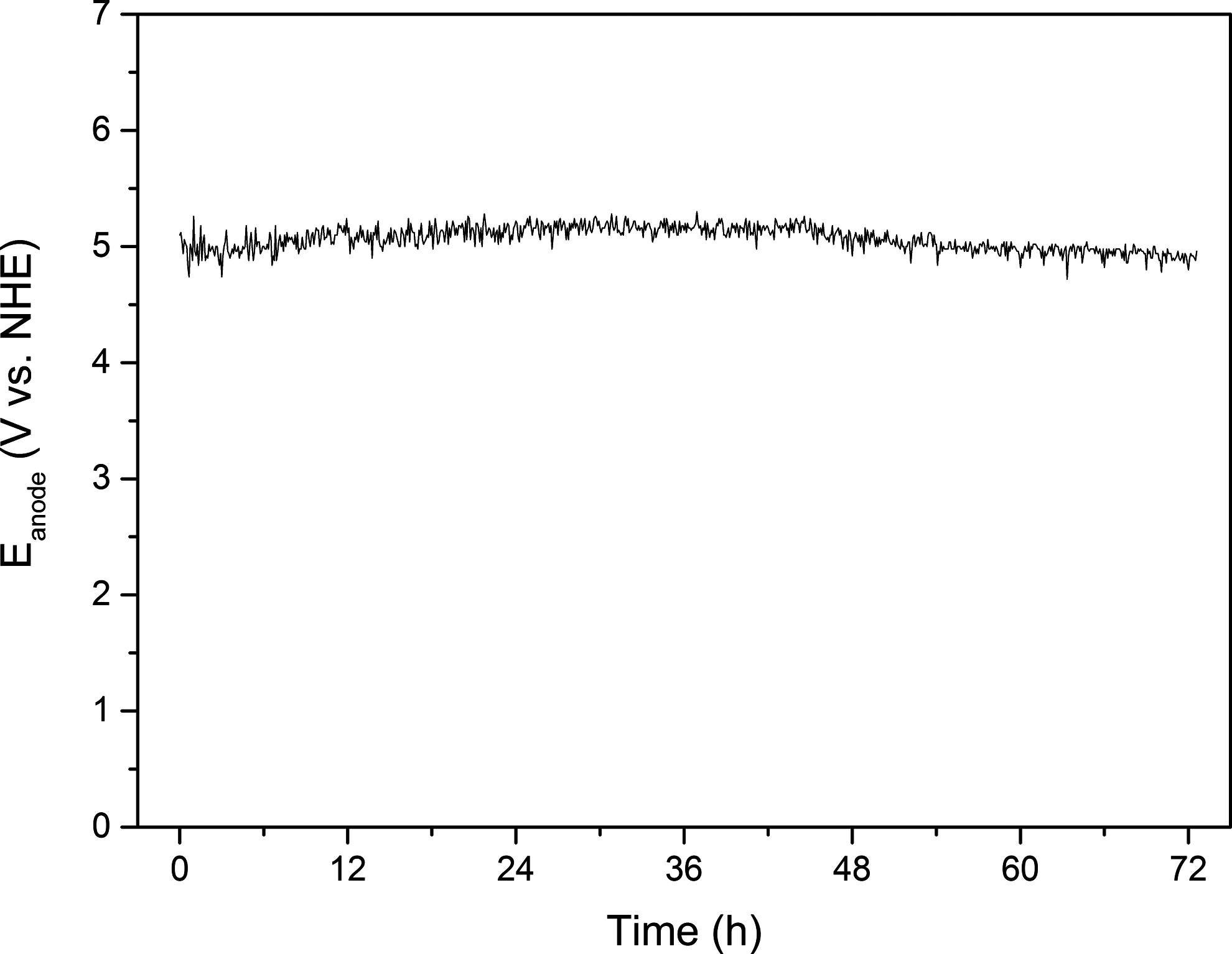
Variation in potentials of anode measured by reference electrode (Ag/AgCl).

Variation in current density and conductivity of the algal solution during the electrochemical treatment. Results shown are mean data from triplicate experiments, and error bars indicate standard deviations.
Variations in the cell density and the MC-LR concentration
Figure 4a shows the variations in the cell density of M. ichthyoblabe with and without the electrochemical oxidation. Cell density without treatment increased continuously from 0 to 71 h. However, the cell density with treatment decreased by 96% over 12 h. Liang et al. (2005) investigated the removal of M. aeruginosa cells by continuous electrochemical oxidation using Ti/RuO2 electrodes and Xu et al. (2007) evaluated the effects of operating conditions, such as different electrode materials, current density, and agitation, on the growth inhibition of M. aeruginosa. The removal aspect of Microcystis cells by the electrochemical oxidation is in agreement with Liang et al. (2005) and Xu et al. (2007).

Variation in cell density
As shown in Fig. 4b, the variations in the MC-LR concentration of the control group showed a similar tendency with variations in the cell density. MC-LR treated with the electrochemical oxidation also rapidly decreased, and was undetectable after 24 h. Shi et al. (2005) investigated the removal efficiency of MC-LR and MC-RR under different conditions by electrochemical oxidation. The removal aspect of MC-LR is in agreement with Shi et al. (2005). The removal of Microcystis cells (>96%) and MC-LR (not detected) was achieved after the passage of 3.2×10⁴ coulombs and 6.2×10⁴ coulombs, respectively.
Oxygen and hydrogen can be generated by electrochemical oxidation on the anode and cathode surfaces, respectively. Ozone can be generated at the high anodic potentials according to the following reaction (Amadelli et al., 2000).
Ozone can be decomposed by OH− ions, and hydroxyl radicals are formed according to the following reaction (Szpyrkowicz et al., 2001; Kerwick et al., 2005).
In the presence of chloride ions, chlorine, hypochlorous acid, and hypochlorite ions can thus be produced electrochemically (Szpyrkowicz et al., 2001).
Hypochlorous acid (HOCl), ozone (O3), and hydroxyl radical (OH•) are highly reactive and efficiently remove MC-LR (Acero et al., 2005; Onstad et al., 2007). These oxidants can oxidize also Microcystis cells.
Variations in the concentration of cations (Na+, K+, and Ca 2+ ions)
Figure 5 shows the variations in the concentration of cations of the solutions when separated from the living Microcystis cells with and without the electrochemical oxidation. The concentration of Na+ ions and K+ ions with the electrochemical oxidation increased gradually compared with the control (Fig. 5a and b, respectively). The cell density of Microcystis cells decreased by 96% over 12 h (Fig. 2); however, the concentration of Na+ ions and K+ ions gradually increased after the same time period. K+ ions are known to be released from damaged cell membranes (Zhou et al., 2013). In addition, particle analysis of the Microcystis cells shows that the size of the Microcystis cells with the electrochemical oxidation gradually decreased (data not shown). Thus, it appears that Na+ ions and K+ ions were extracted into the solution by the disintegration of the cells.

Variation in concentration of cations.
As shown in Fig. 5c, the concentration of Ca2+ ions gradually decreased and they could be decreased because of deposition onto the cathode surface (Kraft et al., 1999):
Variations in TP, POP, DOP, and DIP
Figure 6 shows the variations in TP, POP, DOP, and DIP. TP is the sum of POP, DOP, and DIP. TP decreased by 29% over 71 h. POP was not detected in the samples after 6 h because it was removed from the solution by the algal cells, in agreement with the cell density results (Fig. 2a).
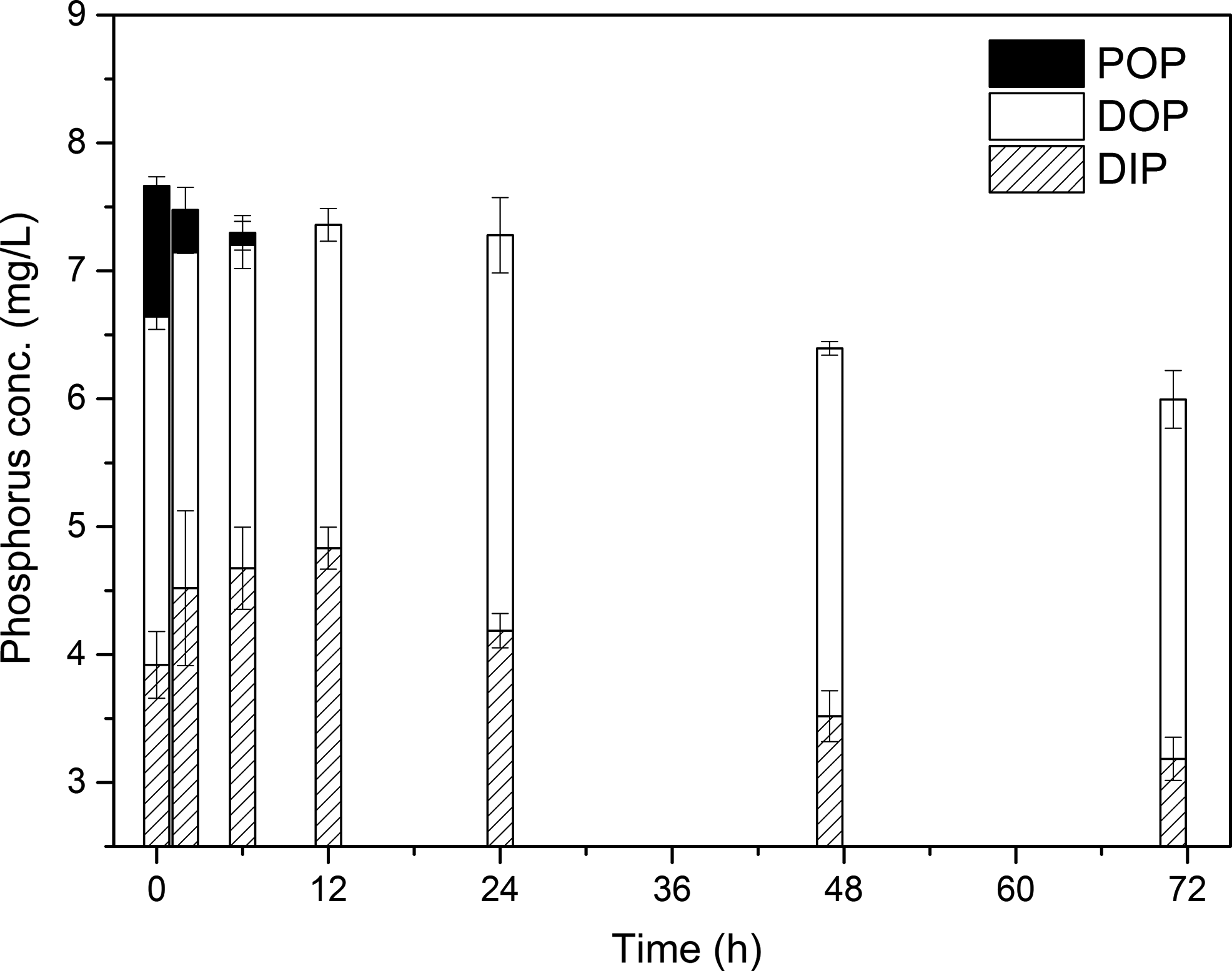
Variation in particulate organic phosphorus (POP), dissolved organic phosphorus (DOP), and dissolved inorganic phosphorus (DIP). Total phosphorus is the sum of POP, DOP, and DIP. Results shown are mean data from triplicate experiments, and error bars indicate standard deviations.
DIP increased from 3.92 to 4.83 mg/L during the initial 12-h period, and then decreased. DOP increased from 2.72 to 3.09 mg/L during the initial 24-h period, and then remained constant. The increase of DIP and DOP in the initial treatment period is most likely due to release from the disintegration of the algal cells.
Overall, the decrease in phosphorous caused by the decrease of DIP resulted from the deposit on the cathode surface; the removal rate of phosphorus was 0.03 mg/L/h.
Analysis of the deposits on the cathode surface
Figure 7 shows the SEM image of the deposits from the cathode surface. Table 2 shows the elemental composition (C, O, P, and Ca) for each spectrum collected from the sample. As shown in Fig. 7 and Table 2, Ca was not distributed uniformly, with high levels of Ca detected in spectra 1, 4, and 5. Therefore, Ca was deposited in grains on the cathode electrode.
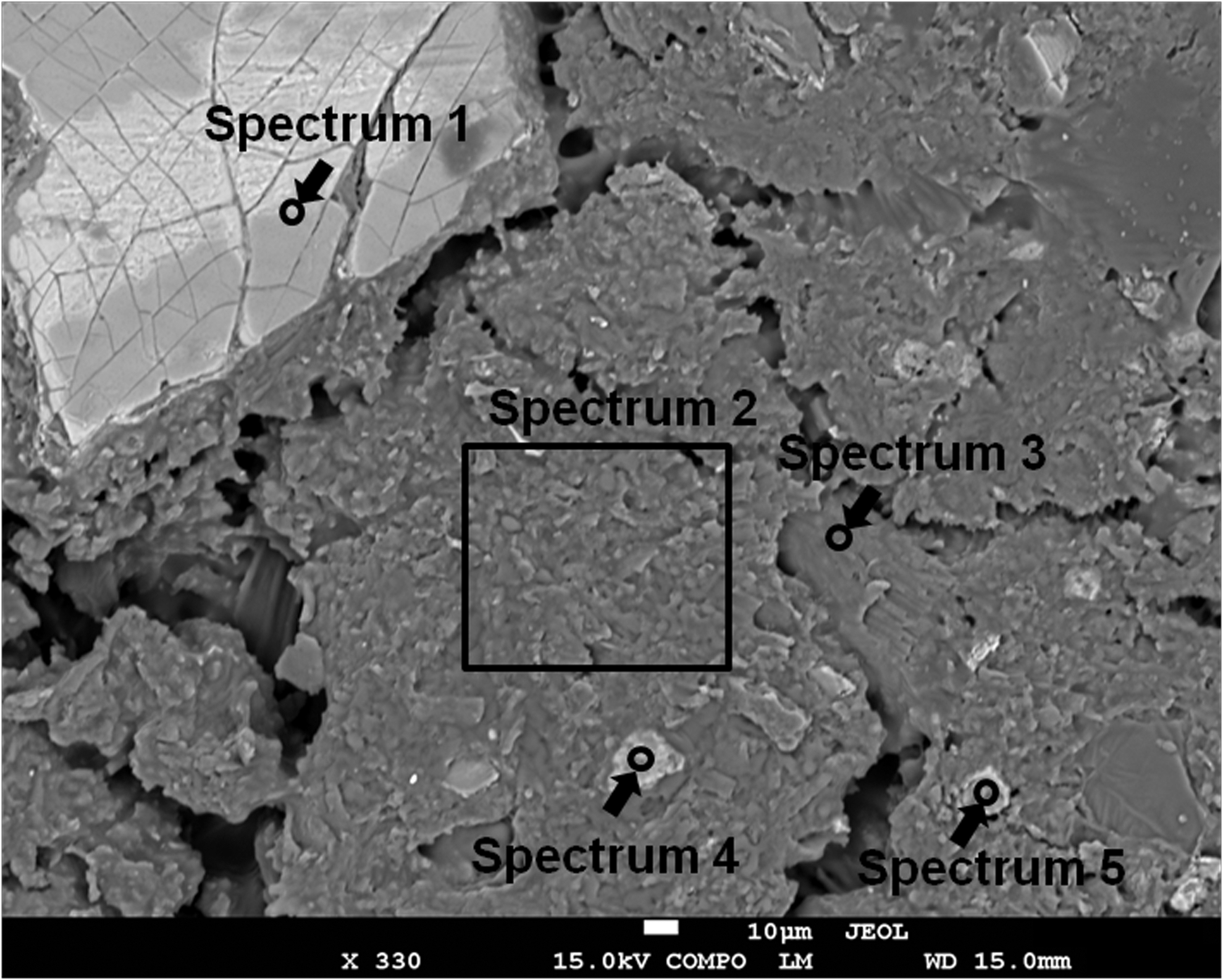
Scanning electron microscope image of deposits from the cathode surface. Spectra 1–5 were analyzed by energy-dispersive X-ray spectroscopy, and results are shown in Table 2.
−, x ≤1; +, 1<x ≤20; ++, 20<x ≤50; +++, 50<x.
High levels of P were detected in spectra 4 and 5, which also contained high levels of Ca and O. This implies that P is being deposited as calcium phosphates. As the solubility of calcium phosphates decreases with increasing pH, calcium phosphates deposit on the cathode because the pH increases in turn because of the reduction of H+ ions (Monma, 1994). The pH of the algal solutions during the electrochemical oxidation was maintained at 8.0 to 8.3 throughout the experiment. However, the pH in the vicinity of the anode and cathode was below 3 and >12, respectively.
The materials seen in spectra 2 and 3 contained high levels of C. Therefore, they could be derived from algal cells and deposited on the cathode. XRD analysis was conducted to investigate the crystallinity of the deposits. Figure 8 shows the XRD patterns of the deposits from the cathode, with and without annealing at 550°C for 2 h. The deposits appeared to be amorphous. To investigate any potential crystallinity of the deposits, they were annealed at 550°C for 2 h. CaCO3 and CaHPO4 (monetite) were detected in the annealed samples. CaHPO4 (monetite) and/or CaHPO4·2H2O (brushite) can be deposited electrochemically on the cathode surface according to the following equations.
X-ray diffraction patterns of deposits from the cathode with and without annealing at 550°C for 2 h.
However, monetite was detected only in the annealed sample, most likely because brushite converts to monetite at ∼220°C (Dosen and Giese, 2011).
Overall, P and Ca were deposited as CaHPO4 and/or CaHPO4·2H2O. On the other hand, Ca was deposited not only as CaHPO4 and/or CaHPO4·2H2O, but also as CaCO3 on the cathode surface.
To remove Microcystis cells and phosphorus, chemical and electrochemical methods using Al3+ and Fe3+ ions have been studied (Bektaş et al., 2004; Cooke et al., 2005; Dosen and Giese, 2011) where the algal cells and phosphate are coagulated. However, phosphorus can be returned to the solution when precipitated by Fe3+ ions (Cooke et al., 2005). A method using Al3+ ions was highly efficient at removing phosphorus (Bektaş et al., 2004). However, when removing both algae and phosphorus, microcystin can be released from the Microcystis cells because of damage to the algal cell (Han et al., 2013). Microcystis cells, microcystin, and phosphorus (in presence of Ca2+ ions) can be removed continuously by electrochemical oxidation, and by using this method, calcium phosphates can be recovered more easily as they deposit on the cathode surface.
Conclusions
In this study, the simultaneous removal of Microcystis cells and their microcystins was achieved by the electrochemical oxidation. Ninety-six percent of the M. ichthyoblabe cells were removed after 12 h. MC-LR was undetectable after 24 h.
The concentration of Na+ ions and K+ ions gradually increased with the electrochemical oxidation. Ca2+ ions decreased because of their deposition on the cathode surface.
TP decreased by 29.2% after 71 h as a result of the decrease in DIP, in turn because of the deposition on the cathode surface. Phosphorus was deposited on the cathode surface with calcium ions as a precursor of CaHPO4 (monetite) and/or CaHPO4·2H2O (brushite).
The anode materials could be influenced on the effect of organic degradation by electrochemical oxidation treatments (Stucki et al., 1991). The SnO2/Ti anode (dimensionally stable anode; DSA) was more effective in removal of bisphenol A than Pt/Ti anode (Tanaka et al., 2002). Further work is necessary to evaluate the removal of Microcystis cells and its microcystins using a DSA electrode.
Footnotes
Acknowledgment
This research was financially supported by the Korea Institute of Civil Engineering and Building Technology (KICT), Project No. 2014-0216.
Author Disclosure Statement
No competing financial interests exist.