




Abstract
Abstract
This study aims to investigate the feasibility of utilizing Al-F hydroxide precipitates generated in Al hydroxide [Al(OH)3] adsorption [Al(OH)3-Fads] and aluminum (Al) coagulation [Al(OH)3-Fcoag] for adsorptive removal of As(III) and As(V). Al(OH)3-Fads, Al(OH)3-Fcoag, and pristine Al(OH)3 were characterized by nitrogen sorption, X-ray photoelectron spectroscopy, and fourier transform infrared spectroscopy (FTIR) before and after arsenic adsorption. The kinetic study indicated that As(III) and As(V) adsorption on these Al-based solid wastes followed the pseudo-second-order model. The calculated adsorption capacity of Al(OH)3-Fads and Al(OH)3-Fcoag for As(III) was 48.0 and 31.0 mg/g, while it was 84.0 and 56.3 mg/g for As(V), respectively. These adsorption capacities were 25–50% lower compared with pristine Al(OH)3. Anion exchange of fluoride by H2AsO4− and HAsO42− dominated in As(V) removal by Al(OH)3-Fads, while formation of an As-O complex played a more important role in As(V) removal by Al(OH)3-Fcoag. The maximum concentration of released fluoride after the adsorption of As(III) and As(V) by Al(OH)3-Fads and Al(OH)3-Fcoag was below the Chinese Class-II industrial discharge standard for fluoride (<20 mg/L). Results from this study indicated that the aluminum hydroxides generated in the fluoride removal process could be reclaimed as an adsorbent for As(III)/As(V) removal from industrial wastewater.
Introduction
T
In the past decade, much effort has been focused on the development of novel adsorbents with high removal capacity, such as nanocrystalline TiO2 (Xu and Meng, 2009), treated laterite (Guo et al., 2007; Maiti et al., 2012), iron and manganese binary oxide (Wu et al., 2011), and magnetite Fe3O4-reduced graphite oxide (Luo et al., 2012). However, their high fabrication cost limits their wide application in practice. Most recently, some low-cost adsorbents such as agricultural and industrial by-products have been investigated for arsenic removal (Soner Altundoğan et al., 2000; Mandal et al., 2012). For instance, Mandal et al. (2012) studied the adsorption of As(III) and As(V) by the mangrove sediment, and results showed that ligand exchange and adsorption reactions occurred in both organic matter and the hydroxide phase (Mandal et al., 2012). Industrial waste such as red mud and iron oxide-loaded melted municipal solid waste incinerator slag was also tested, and the calculated maximum adsorption capacity for As(III) and As(V) was 8.86 and 10.80 μmol/g, respectively. Besides, the adsorption of As(III) onto red mud was exothermic, whereas that of As(V) was endothermic (Soner Altundoğan et al., 2000).
Fluorosis due to the long-term exposure to fluoride through drinking water is another global health concern. Aluminum (Al) coagulation and Al (hydro) oxide adsorption have been well studied and widely used for fluoride removal. However, the large amounts of aluminum hydroxide solid wastes generated in both processes have created a high demand for more environmentally benign and cost-effective alternatives. One option that exhibits a promising future is the conversion of the solid wastes into adsorbents. With our knowledge of the solid wastes having a high porosity and an affinity for arsenic, we aim to investigate the feasibility of using the solid wastes as sorbents for arsenic removal in this study. Furthermore, the fluoride removal mechanisms and the speciation of fluoride involved in these two systems are different. In Al (hydro) oxide adsorption, fluoride is mostly adsorbed on the surface of adsorbents. By contrast, in coagulation, fluoride participates in the formation of aluminum hydroxide [Al(OH)3] precipitates, and hence, it is captured inside the particles besides attaching to the surfaces. In addition, the different states of fluoride may affect the interfacial characteristics of these two wastes which, in turn, affect their performance in arsenic removal.
In this study, we aim to investigate the feasibility of reusing two kinds of solid wastes generated in the adsorption and coagulation treatment of fluoride as adsorbents for arsenic removal. The solid wastes obtained from the adsorption process were mainly Al(OH)3 flocs with adsorbed fluoride, which were named as Al(OH)3-Fads. However, the solid wastes obtained from the coagulation process were mainly Al-F-OH precipitates, which were named as Al(OH)3-Fcoag. The adsorption performance of Al(OH)3-Fads, Al(OH)3-Fcoag, and pristine Al(OH)3 for As(III) and As(V) removal was evaluated in terms of adsorption isotherms and adsorption kinetics. These adsorbents before and after arsenic adsorption were characterized by X-ray photoelectron spectroscopy (XPS), fourier transform infrared spectroscopy (FTIR), Brunauer-Emmett-Teller (BET) surface area analyzer, and sequential extraction procedures to illustrate the adsorption mechanism.
Chemicals and Methods
Chemicals
All chemicals used in this study were of analytical grade. The stock solutions of As(III), As(V), fluoride, and Al salt were prepared by dissolving NaAsO2, Na3AsO4, NaF, and AlCl3·6H2O in deionized water, respectively.
Preparation of Al(OH)3-F solid wastes
A plexiglass beaker on a conventional Jar test apparatus was used to fabricate the three adsorbents, Al(OH)3-Fads, Al(OH)3-Fcoag, and pristine Al(OH)3. First, NaOH solution (1.25 M) was slowly added into 500 mL AlCl3·6H2O solution (20 mmo/L) under stirring at 100 rpm until the pH of the solution reached 7.0±0.2. After settling for 30 min, the resultant solids were separated from the solution by filtration with a 0.45-μm membrane and washed with distilled water several times. After freeze-drying, pristine Al(OH)3 was obtained. The procedure of fabricating Al(OH)3-Fads and Al(OH)3-Fcoag was similar with that of pristine Al(OH)3, only with a slight modification. For preparing Al(OH)3-Fads, 500 mL fluoride solution (178 mM) was added into the beaker after the formation of Al(OH)3 solids under slow stirring at 50 rpm for 20 min; meanwhile, pH was maintained at 7.0±0.2. For fabricating Al(OH)3-Fcoag, 500 mL fluoride solution (178 mM) was added into 500 mL AlCl3·6H2O solution (20 mM) instead of NaOH solution. Then, pH was adjusted to 7.0±0.2 with NaOH or HNO3. The two kinds of obtained fluoride-containing solid wastes were washed with distilled water for several times, freeze-dried, and then kept in an air-tight container for use.
Batch adsorption experiments
Equilibrium isotherm experiments were performed in 50-mL polypropylene tubes with As(III) or As(V) solutions at an initial concentration in the range of 5–80 mg/L at room temperature and an adsorbent dosage of 0.02 g/L. During the adsorption, the pH of the solutions was maintained at 7 with HNO3 or NaOH. The tubes were shaken at 30 rpm on a utility rotary shaker for 24 h. The liquid phase was then filtered by a 0.45-μm membrane to analyze the concentrations of fluoride, As(III), As(V), and Al. The used adsorbents were freeze-dried for subsequent characterization.
The experiments of adsorption kinetics were conducted in 1,000 mL As(III) or As(V) solution with an initial concentration of 10 mg/L and an adsorbent dosage of 0.02 g/L. Samples were taken at specified time intervals. The pH effect on the adsorption performance of the adsorbents was studied by the solution pH that varied in the range of 4–9 at an As(III) or As(V) initial concentration of 80 mg/L.
Extraction procedure
Sequential extraction experiments were carried out to clarify the species distribution of As(III) or As(V) in different binding phases on used adsorbents. A three-step extraction was conducted to investigate the following three binding phases of arsenic (Shiowatana et al., 2001): (1) water-soluble As; (2) surface-adsorbed As; and (3) AlO-associated As. First, the extraction was carried out in sequence with ultrapure water, 0.5 M NaHCO3, and 0.1 M NaOH in polypropylene centrifuge tubes. These tubes were shaken for 24 h at 30 rpm. After each step of extraction, the samples were centrifuged at 3,000 rpm for 2 min. The obtained liquid phase was filtered through a 0.45-μm membrane for As analysis. The three target phases of arsenic after each step of extraction corresponded to water-soluble As (Species-I), surface-adsorbed As (Species-II), and AlO-associated As (Species-III).
Analysis and characterization
The concentrations of Al and As were analyzed by inductively coupled plasma–optical emission spectroscopy (OPTIMA 2000DA; PerkinElmer), and the detection limits were 0.8 μg/L for Al and 4 μg/L for As. The concentrations of fluoride were measured by a fluoride ion selective electrode (PF-1; Kangyi Instrument Ltd.) with the detection limit of 0.05 mg/L. BET surface area (SBET) was determined by standard multipoint techniques of N2 adsorption with a BET analyzer (ASAP2000; Micromeritics). The ζ-potential of samples was measured by a ζ-potential analyzer (Zetasizer 2000; Malvern). XPS results were obtained by an ESCA-lab-220i-XL spectrometer (Shimadzu) with monochromatic Al Kα radiation (225 W, 15 mA, 15 kV).
Adsorption models
Adsorption kinetic models
The following two kinetic models were used to clarify the adsorption process pseudo-first-order (Yuh-Shan, 2004) and pseudo-second-order (Ho and McKay, 1999) as described in Equations (1) and (2), respectively.
where q and qe are the mass of metal adsorbed (mg/g) at time t and at equilibrium, respectively; k1 and k2 are the pseudo-first-order and pseudo-second-order kinetic rate constants.
Adsorption isotherm models
The Langmuir (Mckay et al., 1982) and Freundlich (Mckay et al., 1982) isotherms were used to analyze the adsorption of As(III)/As(V) on Al(OH)3-F solid wastes and pristine Al(OH)3 as represented by the equations below.
where Ce and qe are the As(III) or As(V) concentration and the amount of As(III) or As(V) adsorbed at equilibrium; qm and L are Langmuir constants related to adsorption capacity and energy of adsorption; Kf is the Freundlich constant; and n is an indication of surface heterogeneity and surface affinity of adsorption.
Results and Discussion
Adsorbent characterization
Table 1 illustrates SBET, pore size, and pHPZC of pristine Al(OH)3, Al(OH)3-Fads, and Al(OH)3-Fcoag. Al(OH)3 showed the highest SBET of 195.6 m2/g, which is slightly higher compared with Al(OH)3-Fads and Al(OH)3-Fcoag, 150.2 and 123.7 m2/g, respectively. This indicates that some pores of the pristine Al(OH)3 might be filled by fluoride. The average pore size of Al(OH)3-Fads and Al(OH)3-Fcoag also slightly declined compared with Al(OH)3, which provides further evidence. The ratios of F to Al (RF:Al) on the surfaces of these adsorbents, as indicated by XPS analysis, were observed to be 2.2:1 and 0.8:1 for Al(OH)3-Fads and Al(OH)3-Fcoag, respectively. However, the corresponding RF:Al values in the bulk phases were both determined to be 1.0:1. This indicates that fluoride mainly exists on the surface of Al(OH)3-Fads, whereas it is included within Al(OH)3-Fcoag.
The ratio of F to Al on surface was obtained from the results of X-ray photoelectron spectroscopy.
The ratio of F to Al in the bulk phase was obtained from the analysis of the concentration of Al and F before and after the fabrication of Al(OH)3-Fads and Al(OH)3-Fcoag.
There is no F on Al(OH)3 surfaces, and the ratio of F to Al is meaningless.
Adsorption kinetics
Figure 1 illustrates the variation of adsorption density of As(III) and As(V) (qt) onto pristine Al(OH)3, Al(OH)3-Fads, and Al(OH)3-Fcoag as a function of adsorption time. It is clear that the incorporation of fluoride into Al(OH)3 inhibited the adsorption of both As(III) and As(V). The maximum qt value of Al(OH)3 is 8.4 mg/g for As(III) and 58.7 mg/g for As(V), respectively. By contrast, the maximum qt,As(III) values of Al(OH)3-Fads and Al(OH)3-Fcoag are 4.3 and 6.5 mg/g, respectively, being 49.3% and 22.9% lower compared with Al(OH)3. The adsorption of As(V) onto Al(OH)3-Fads and Al(OH)3-Fcoag is also lower compared with onto Al(OH)3. The maximum qt,As(V) value is 30.6 mg/g for Al(OH)3-Fads and 43.5 mg/g for Al(OH)3-Fcoag, which are 47.9% and 25.9% lower compared with Al(OH)3, respectively. Moreover, the incorporation of fluoride in Al(OH)3-Fads and Al(OH)3-Fcoag slowed down the adsorption of As(III) and As(V) to some extent. Adsorption of As(III) and As(V) on Al(OH)3 was very fast and q t,As(III) and q t,As(V) almost reached equilibrium within 2 h. However, it took about 12 h for Al(OH)3-Fads and Al(OH)3-Fcoag to reach the adsorption equilibrium of As(III) and As(V).
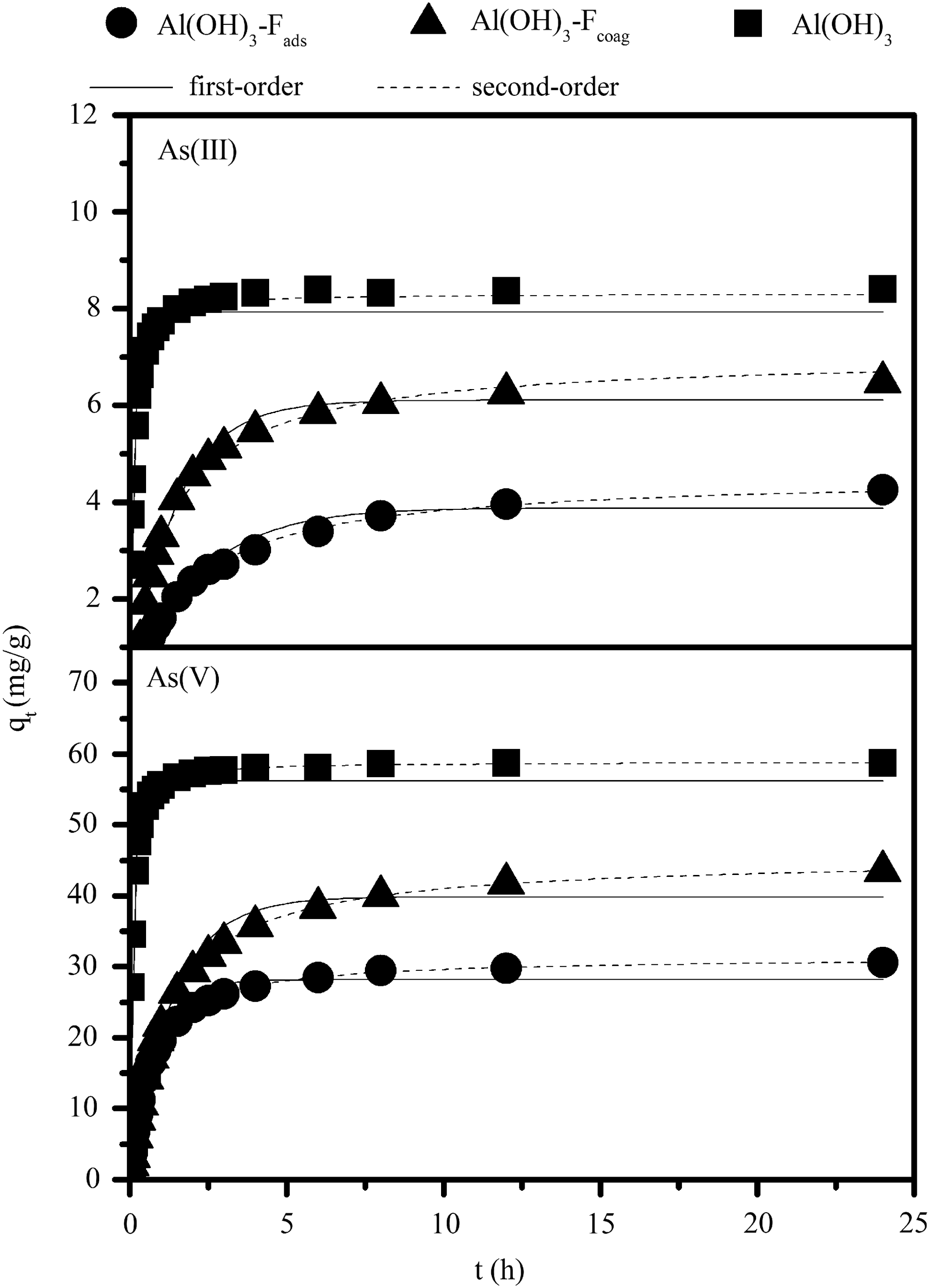
The variation of adsorption density of As(III) and As(V) onto the three adsorbents with prolonged contact time (experimental conditions: initial concentration=10 mg/L, contact time=24 h, pH=7, ionic strength=0.01 M NaNO3, adsorbent dose=0.02 g/L).
To further illustrate the effect of fluoride on the adsorption of arsenic, the experimental data were respectively fitted by pseudo-first-order and pseudo-second-order kinetic models. Table 2 summarizes the obtained parameters and regression coefficient (R2). The fitted curves using these kinetic equations are plotted in Fig. 1. As indicated by higher R2, the pseudo-second-order model better fits the adsorption of arsenic onto these adsorbents than the pseudo-first-order model. The value of k2qe in the pseudo-second-order model is an indicator of the adsorption rate. The calculated k2qe values of As(III) adsorption onto Al(OH)3-Fads, Al(OH)3-Fcoag, and Al(OH)3 are 0.5, 0.7, and 15.0/h, respectively. The adsorption of As(V) on the adsorbents yields higher k2qe values, being 1.6, 0.9, and 17.7/h, respectively, which is related to the faster adsorption rate of As(V) compared with As(III) adsorption. The different adsorption rate between As(III) and As(V) is attributed to the difference of the electrostatic interactions between them and these adsorbents. The pHPZC values of Al(OH)3-Fads, Al(OH)3-Fcoag, and Al(OH)3 were determined to be 7.4, 8.0, and 8.0, respectively. Hence, the three adsorbents have positive surfaces at pH 7 in this study. As(III) exists as the neutral species H3AsO3 at pH 7, whereas As(V) is predominantly in the negatively charged species H2AsO4− and HAsO42−. Hence, the stronger electrostatic attraction between As(V) and the adsorbent surfaces leads to the faster and more significant adsorption of As(V) on these adsorbents.
Adsorption isotherm
Figure 2 illustrates the adsorption isotherm of As(III) and As(V) onto Al(OH)3, Al(OH)3-Fads, and Al(OH)3-Fcoag. The maximum adsorption capacities (qe,exp) of As(III) and As(V) onto these three adsorbents are listed in Table 3. The results also show that the incorporation of fluoride into Al(OH)3 through either adsorption or coagulation greatly decreased its adsorption capacity toward As(III) and As(V). Compared with Al(OH)3-Fcoag, Al(OH)3-Fads has a higher qe,exp, which indicates that more adsorption sites are available on the Al(OH)3-Fads surface than on the Al(OH)3-Fcoag surface. This was confirmed by SBET analysis. The SBET of Al(OH)3-Fads and Al(OH)3-Fcoag are 150.2 and 123.7 m2/g, respectively.

Adsorption isotherms of As(III) and As(V) onto the three adsorbents (experimental conditions: contact time=24 h, pH=7, ionic strength=0.01 M NaNO3, adsorbent dose=0.02 g/L).
Table 3 illustrates the fitted parameters for the Langmuir and Freundlich models. The Langmuir model has a higher R2 value, which means that it is more suitable to describe the adsorption of As(III) and As(V) than the Freundlich model. The Langmuir isotherm is based on the assumption that monolayer surface coverage limits the adsorption due to surface saturation (Guo et al., 2007). The maximum adsorption capacity calculated by the Langmuir model (Qmax,cal) of As(III) and As(V) on both Al(OH)3-Fads and Al(OH)3-Fcoag is lower than those on Al(OH)3. The introduction of negatively charged fluoride into Al(OH)3 not only occupies the surface sites but also inhibits the adsorption of As(III) and As(V). In addition, the L values of Al(OH)3-Fads, Al(OH)3-Fcoag, and Al(OH)3 were calculated to be 1.3, 1.5, and 1.6 L/mg for As(V) and 0.01, 0.06, and 0.03 L/mg for As(III), and this indicated the stronger affinity of these adsorbents toward As(V) than that toward As(III).
Effect of pH on the adsorption of As(III) and As(V)
Figure 3 illustrates the adsorption density of As(III) and As(V) onto these adsorbents over a wide pH range from 4 to 9. The adsorption of As(III) onto Al(OH)3-Fads, Al(OH)3-Fcoag, and Al(OH)3 declines with increasing pH in pH ranges from 4 to 6 and from 7 to 9. At pH below 8, nonionic H3AsO3 is the dominant As(III) species, and the adsorption of As(III) was mainly attributed to the Van der Waal force (Lin and Wu, 2001) and the formation of an inner sphere surface complex (Ona-Nguema et al., 2005). At elevated pH above 7, the dissociation of H3AsO3 to anionic H2AsO3− occurred, and the adsorption of As(III) onto the positive surfaces was improved due to specific bonding and electrostatic interaction. At pH above 8, these adsorbents showed negatively charged surfaces, and the adsorption of negative As(III) was inhibited accordingly.
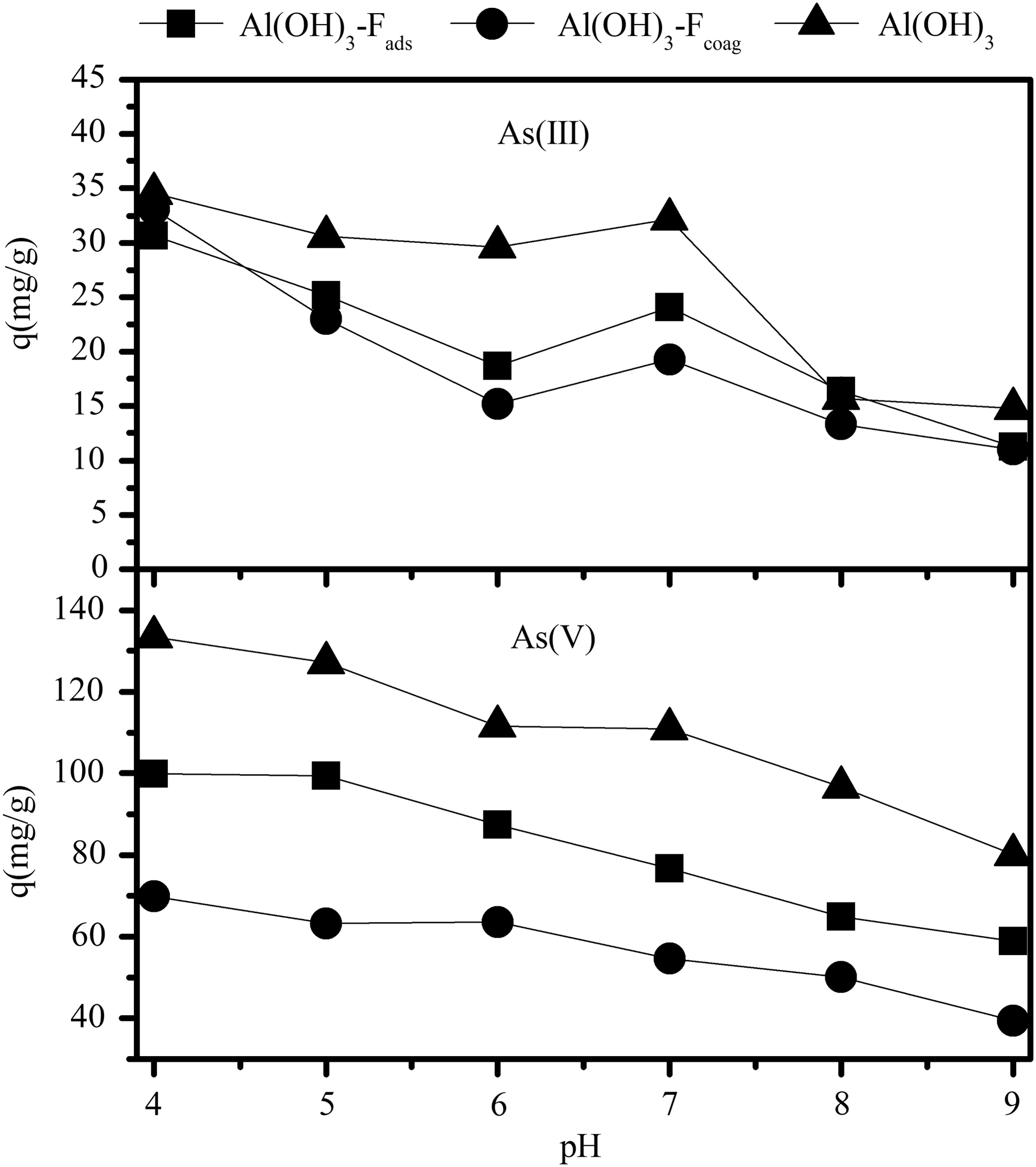
Uptake of As(III) and As(V) onto the three adsorbents in the pH range 4–9 (experimental conditions: initial concentration=80 mg/L, contact time=24 h, ionic strength=0.01 M NaNO3, adsorbent doses=0.02 g/L).
The uptake of As(V) on these adsorbents also declines with increasing pH. Results of MINTEQ modeling indicate that As(V) mainly exists in the form of H2AsO4− in the pH range from 3 to 7 and HAsO42− is the dominant species at pH >7. On the other hand, the point of zero charge (pHpzc) was determined to be 7.4, 8.0, and 8.0 for Al(OH)3-Fads, Al(OH)3-Fcoag, and Al(OH)3. At pH below these pHpzc, these adsorbents showed positive surfaces as described in Equation (5). The electrostatic attraction between the positively charged sites and As(V), H2AsO4,− and HAsO42− is stronger at a lower pH which, in turn, results in a higher As(V) uptake. At pH above pHPZC, these adsorbents exhibited negative surfaces as described in Equation (6) and the repulsive forces inhibited the adsorption of negative As(V) species thereafter.
Proposed mechanisms involved in the adsorption of As(III) and As(V)
The variation of solution pH during the adsorption of As(III) and As(V) onto these three adsorbents was monitored and the results are shown in Fig. 4. A significant decrease in solution pH during As(III) and As(V) adsorption as a function of adsorption time was observed. The pH of the solution remained unchanged after 50 min for As(III) and 5 h for As(V). To make the variation of pH with contact time more obvious, the results were only shown up to 50 min for As(III) and 5 h for As(V).
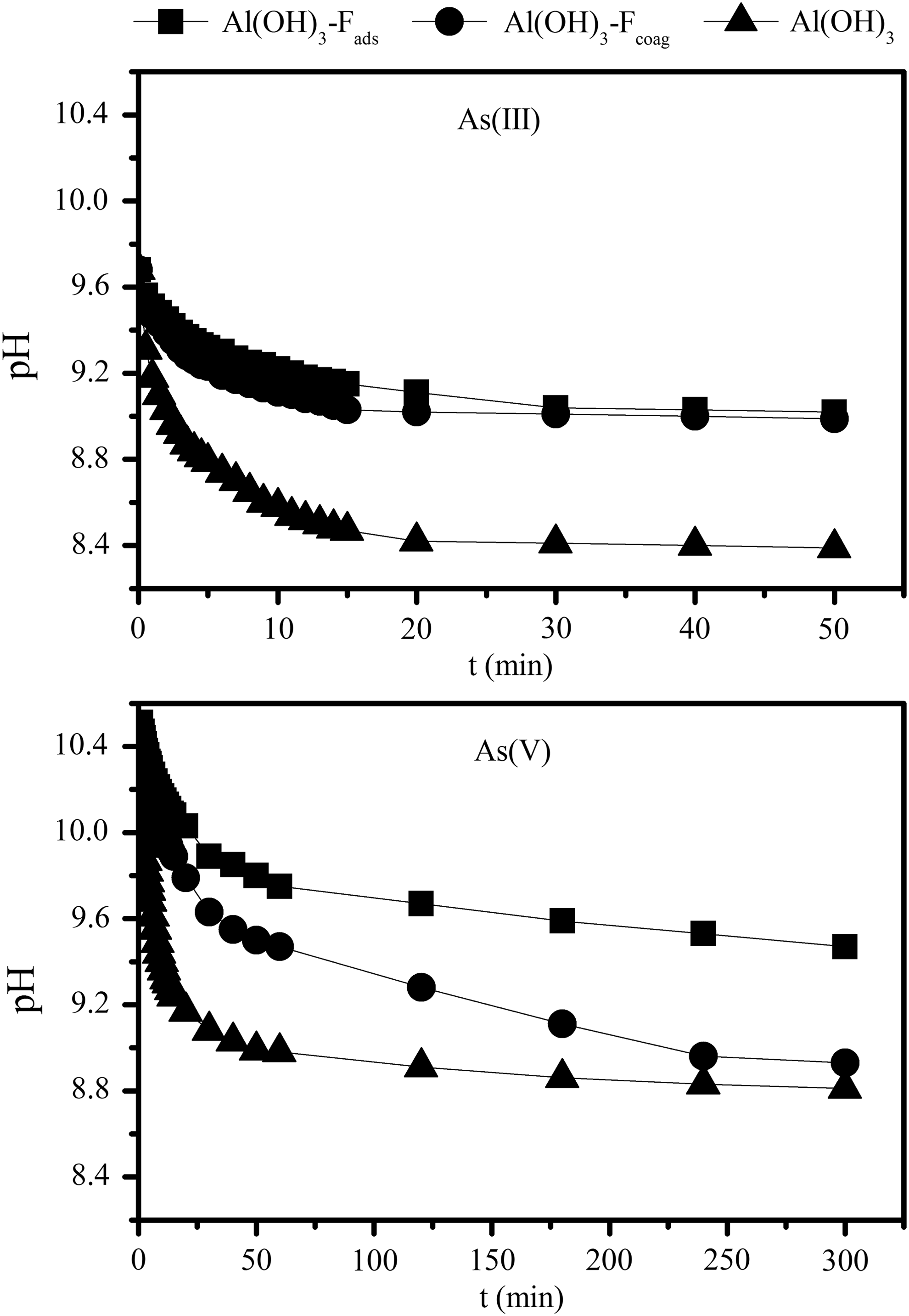
Solution pH variation during the adsorption of As(III)/As(V) by the three adsorbents with prolonged time (experimental conditions: initial concentration=80 mg/L, contact time=24 h, ionic strength=0.01 M NaNO3, adsorbent dose=0.02 g/L).
The decrease of pH during As(III) and As(V) adsorption can be explained by the deprotonation of the H n AsO4(3−n)− or H n AsO3(3−n)− (n=1, 2, 3). During the adsorption process, the protonated sites on the surface will adsorb negatively charged As(III) and As(V) species. This will shift the equilibrium of deprotonation and release more hydrogen ions, thus leading to the reduction of pH. A longer time is required to achieve equilibrium for As(V), and the equilibrium pH is also lower compared with As(III). This further suggests that the adsorption of As(III) and As(V) may be dominated by different mechanisms. Sequential extraction experiments were conducted to provide quantitative information on the distribution of arsenic [i.e., As(III) and As(V)] in three different binding phases on the three adsorbents, and the ratios of the arsenic species are shown in Fig. 5. The water-solute fraction (Species-I) is the dominant As(III) species on Al(OH)3-Fads, Al(OH)3-Fcoag, and Al(OH)3 and its ratios are 51.3%, 42.2%, and 47.3%, respectively. By contrast, the ratios of As(III) species binding to −OAl (Species-III) are much lower, being 7.8%, 20.0%, and 14.6% for Al(OH)3-Fads, Al(OH)3-Fcoag, and Al(OH)3, respectively. This indicates that the incorporation of As(III) onto Al(OH)3-Fads, Al(OH)3-Fcoag, and Al(OH)3 mainly exists in a soluble form.

The content and ratios of As(III)/As(V) in different binding species within the three adsorbents.
However, the smaller variation of pH values for Al(OH)3-Fads and Al(OH)3-Fcoag indicated that other processes apart from complexation may take place in the adsorption of As(V), such as ion exchange (Liu et al., 2012), as described in Equations (7) and (8).
For the binding phases of As(V), Al(OH)3-Fcoag has the highest percentage of 34.7% for the soluble form (Species-I). Its percentage of Species-II and Species-III is 26.9% and 38.4%, respectively. The As(V) species binding to −OAl, expressed as Species-III, bond strongly with the solid phase and hardly released into the solution. A slight difference is observed between Species-I and Species-III for As(V) loaded on Al(OH)3-Fcoag, which indicates that both complexation and electrostatic attraction play important roles in As(V) removal by Al(OH)3-Fcoag. Compared with Al(OH)3-Fcoag, the ratios of Species-III on Al(OH)3-Fads and Al(OH)3 are much lower, being 23.9% and 28.2%, respectively. This means that the formation of an As-O complex is of more importance for As(V) removal by Al(OH)3-Fcoag than by the other two adsorbents. As(V) on Al(OH)3-Fads and Al(OH)3 is mainly extracted in the surface-adsorbed fraction (Species-II) at 58.7% and 42.6%, respectively. Fluoride is mostly adsorbed on the surface of the adsorbent Al(OH)3-Fads in the removal of fluoride by adsorption. Thus, more F- on the surface of Al(OH)3-Fads could exchange with the negatively charged anions H2AsO4− and HAsO42− compared with Al(OH)3-Fcoag in the adsorption of As(V).
After discussing the adsorptive properties of Al(OH)3-Fads and Al(OH)3-Fcoag, it is necessary to address whether fluoride and Al are leached during the adsorption process. The concentration of leached fluoride in the solution was measured during adsorption of As(III) and As(V), and the results are illustrated in Fig. 6a. The maximum concentration of released fluoride is 11.3 mg/L in the adsorption of As(III) by Al(OH)3-Fads, 11.8 mg/L in the adsorption of As(III) by Al(OH)3-Fcoag, 14.6 mg/L in the adsorption of As(V) by Al(OH)3-Fads, and 14.0 mg/L in the adsorption of As(V) by Al(OH)3-Fcoag. These are all below the Chinese Class-II industrial discharge standard for fluoride (<20 mg/L). The ratio of released fluoride to Al (RF:Al) in molar terms during As(V) adsorption is higher than that during As(III) adsorption, as shown in Fig. 6b. Due to the hard–hard combination, in agreement with the soft–hard acid base concept, the presence of fluoride ion can produce changes in the concentration of Al in water. For Al(OH)3-Fads, the value of RF:Al first increases and then decreases with the increasing equilibrium concentration of As(III)/As(V). This suggests that the fluoride ions compete for the active sites with negatively charged anions, H2AsO4− and HAsO42−. The variation of RF:Al for Al(OH)3-Fcoag is small compared with Al(OH)3-Fads. This indicates that the fluoride mainly exists on the surface of Al(OH)3-Fads, whereas it is solidified within Al(OH)3-Fcoag.

The release of fluoride and Al from Al(OH)3-Fads and Al(OH)3-Fcoag during adsorption of As(III)/As(V).
The XPS binding energy and the ratios of main elements on the surfaces of different adsorbents before and after adsorbing arsenic were obtained from XPS analysis. As shown in Fig. 7a, the adsorption of As(III) and As(V) shows little influence on the binding energy of O 1s within Al(OH)3-Fads and Al(OH)3, and the interaction between O atoms and arsenic is assumed to be weak. Interestingly, the binding energy of O 1s within Al(OH)3-Fcoag slightly shifts from 531.3 to 531.7 eV after adsorbing As(III) and to 531.8 eV after adsorbing As(V). This might be attributed to the decreased electron density in the O 1s shell owing to the combination of As(III) and As(V) with the interfacial −OH groups (Mohan and Pittman, 2007). Hence, it is further proven that that the formation of surface complexes plays a more dominant role in the adsorption of arsenic by Al(OH)3-Fcoag than that by Al(OH)3-Fads and Al(OH)3.
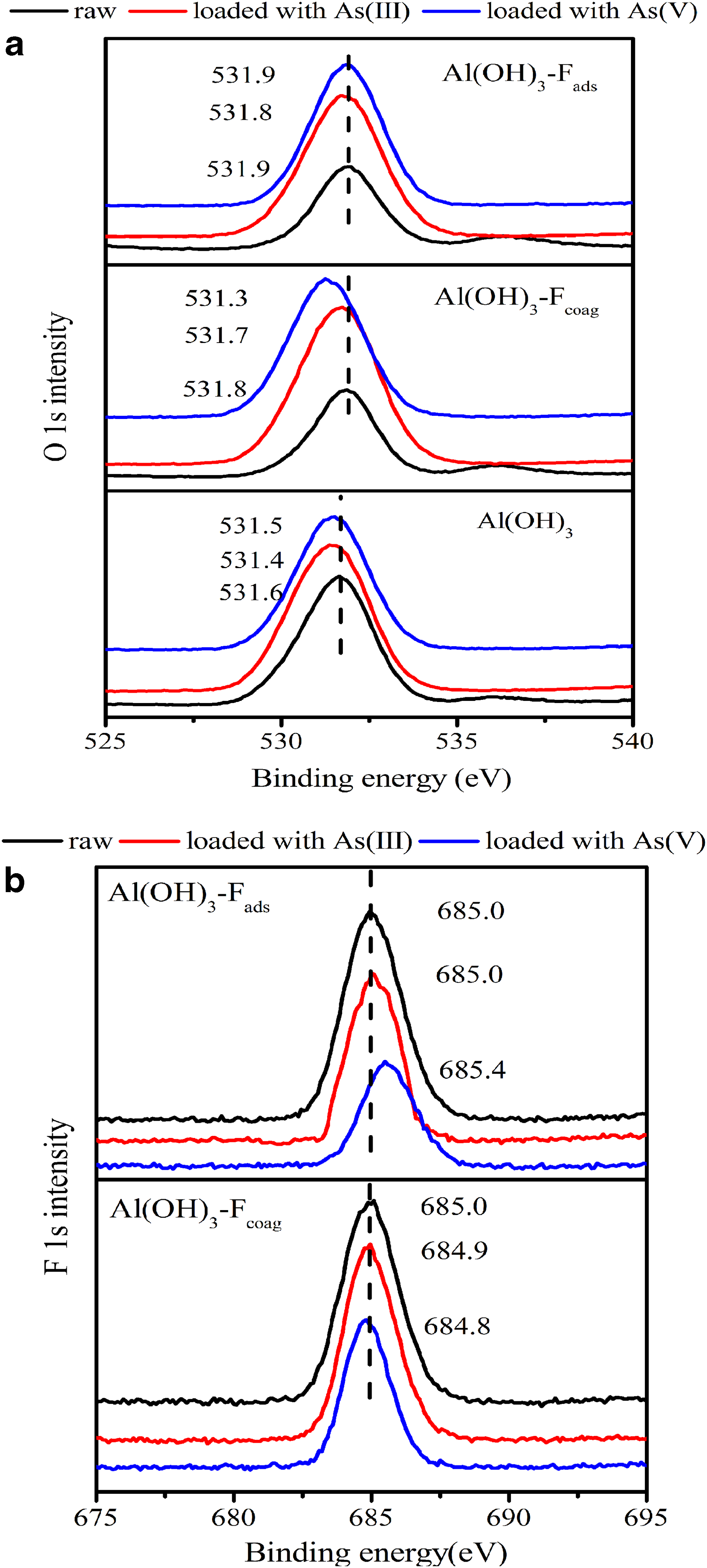
X-ray photoelectron spectroscopy spectra of
XPS spectra in Fig. 7b shows little variation in the binding energy of F 1s after the adsorption of As(III) for both Al(OH)3-Fads and Al(OH)3-Fcoag, and it is suggested that elemental F rarely participates in the removal of As(III). The adsorption of As(V) onto Al(OH)3-Fads contributes to the shift of the binding energy of F 1s from 685.0 to 685.4 eV, and this is attributed to the stronger binding between fluoride and Al(OH)3-Fads surfaces. On the other hand, the content of F1s on surfaces also shows different trends after the adsorption of As(III) and As(V). After adsorbing As(III), the content of F1s slightly decreases from 12.9% to 10.4% for Al(OH)3-Fcoag, whereas it significantly decreases from 28.7% to 14.5% for Al(OH)3-Fads. The adsorption of As(V) also contributes to a sharp decrease of F 1s content from 28.7% to 7.2% for Al(OH)3-Fads and to an insignificant change from 12.9% to 10% for Al(OH)3-Fcoag. This further demonstrates that fluoride mainly exists on the surface of Al(OH)3-Fads, whereas it is solidified within Al(OH)3-Fcoag through the formation of inner-sphere Al-F complexes. Moreover, it can be concluded that more F− on the surface of Al(OH)3-Fads exchanges with the negatively charged anions H2AsO4− and HAsO42− compared with Al(OH)3-Fcoag, as indicated in Equations (7) and (8).
The adsorption of arsenic onto aluminum (hydro) oxides is highly dependent on the interfacial hydroxyl groups (−OH), and the formation of surface complexes plays an important role. Figure 8 illustrates the FTIR spectra of Al(OH)3-Fads, Al(OH)3-Fcoag, and Al(OH)3 before and after the adsorption of As(III) and As(V). These three adsorbents show a broad band centered at 960 cm−1, which corresponds to the bending vibration of the −OH groups on their surfaces (Sun and Doner, 1996). Moreover, the intensity of the hydroxyl band on Al(OH)3-Fcoag is stronger than on Al(OH)3-Fads and Al(OH)3, indicating more −OH sites on the surface. As mentioned above, coprecipitation and adsorption are involved in the removal of fluoride by coagulation and Al-F-OH participates formed thereafter (Gong et al., 2012). These peaks reduce remarkably after the adsorption of As(III) and As(V), owing to the participation and the consumption of −OH groups by arsenic species. In addition, new peaks at 997 and 870 cm−1 appear that are assigned to the O-As(III) and O-As(V) stretching vibrations (Sun and Doner, 1996). Only a slight difference is observed in the intensity of O-As(III) on the three adsorbents. By contrast, the intensity of O-As(V) on Al(OH)3-Fads is much weaker than that on Al(OH)3-Fcoag and Al(OH)3. This indicates that the surface complexation is less dominant in Al(OH)3-Fads than Al(OH)3-Fcoag and Al(OH)3, in agreement with the XPS results.

Fourier transform infrared spectroscopy (FTIR) spectra of adsorbents before and after adsorption of As(III) and As(V).
Conclusions
The Al-based solid wastes generated from fluoride removal by adsorption and coagulation, Al(OH)3-Fcoag and Al(OH)3-Fads, were characterized and applied for adsorptive removal of As(III) and As(V) from the aqueous solution. Kinetic study results indicate that As(III) and As(V) adsorption on these Al-based solid wastes followed the pseudo-second-order model. The calculated adsorption capacity of Al(OH)3-Fads and Al(OH)3-Fcoag for As(III) was 48.0 and 31.0 mg/g, while for As(V) it was 84.0 and 56.3 mg/g, respectively. These adsorption capacities were 25–50% lower than those of pristine Al(OH)3. Anion exchange of fluoride by H2AsO4− and HAsO42− dominated in As(V) removal by Al(OH)3-Fads, while formation of an As-O complex played a more important role in As(V) removal by Al(OH)3-Fcoag. The maximum concentration of released fluoride after the adsorption of As(III) and As(V) by Al(OH)3-Fads and Al(OH)3-Fcoag was below the Chinese Class-II industrial discharge standard for fluoride (<20 mg/L). The solid wastes generated in fluoride removal processes could be potentially utilized as adsorbents for As(III)/As(V) removal from industrial wastewater. It it noted that the arsenic content in the obtained solid wastes exceeds the Identification Standards for Hazardous Wastes of China and should be carefully and safely handled and disposed. The strategy for the stabilization and safe disposal of these solid wastes is to be studied in the future.
Footnotes
Acknowledgments
This work was supported by the National Natural Science Foundation of China (Grant no. 21177143 and 21177144) and the key project of the National “863” High-tech R&D Program of China (2012AA062604). Appreciation is also extended to the Outstanding Youngster Fund (51422813) and Joint Research Fund for Overseas Chinese Scholars and Scholars in Hong Kong and Macao (51328803).
Author Disclosure Statement
No competing financial interests exist.