




Abstract
Abstract
In sulfate-rich saline wastewater, biological sulfate reduction can occur spontaneously or applied beneficially for its treatment. Although application of sulfate-reducing bacteria (SRB) on saline domestic wastewater, obtained by seawater-based toilet flushing for instance has been suggested repeatedly, no study on the effect of applicability in the complete range of seawater concentration has been performed (salinity range of 0–3.5% and sulfate concentration of 0–2500 mg/L). The present article examines the long-term effect of seawater on biological sulfate reduction using three sequencing batch reactors fed with different volumetric fractions of seawater and freshwater. To evaluate this effect, the effluent quality, sulfate reduction rate, and microbial population in the reactors were investigated. The biomass-specific biological sulfate reduction rate decreased significantly (∼45%) when salinity increased from 0.7% to 3.5%, while total organics removal remained unaffected. Differences in microbial population were observed for sludge adapted to 0.7% or 3.5% salinity. Even at high salinity (3.5%) and moderate temperature (20°C), biological sulfate reduction occurs and organics are removed sufficiently (>97%) by SRB. Therefore, biological sulfate reduction can be considered as a feasible process in treatment of saline- (≤3.5%) and sulfate (≤2500 mg/L)-rich wastewater.
Introduction
M
An advanced urban water cycle approach applied in Hong Kong aims to save potable water (∼30%) and energy (∼35%) by introducing the seawater toilet flushing and by incorporation of the SANI process for wastewater treatment (Chen et al., 2012). In Hong Kong, the nonsaline greywater is mixed with the saline toilet water (approximate ratio 2:1–3:1), resulting in an increased salinity of wastewater. Leung et al. (2012) suggests a novel concept in which nonsaline greywater is treated separately from saline sewage, to reuse the nonsaline domestic wastewater for the production for drinking water. Therefore, it becomes vital to investigate whether the SANI process can be applied on wastewater with salinity levels in the range from 0.7% to 3.5% salinity. The fact that saline water can replace potable water for non-potable purposes in urban water system, that sulfate-reducing bacteria (SRB) play a crucial role in the SANI process by removing COD and producing the sulfide used for autotrophic denitrification, and the acknowledgement that SRB are less studied than the other major microbial populations involved in wastewater treatment, were the main reasons for this study to focus on the salinity effect on SRB. The study specifically assumed seawater toilet flushing and seawater intrusion to sewers as the main sources of increased salt and sulfate content in the sewer.
Increase of seawater contribution to sewage alters both the salt concentration and the COD/SO42− ratio, as salinity and the presence of sulfate are interlinked. Salt in the sewage increases the density of activated sludge (Uygur and Kargi, 2004; Moussa et al., 2006; Lay et al., 2010). Moreover, in the conventional wastewater treatment plants (WWTPs), an increase of salt content in sewage reduced the COD, phosphate, and nitrogen removal efficiency (Li and Guowei, 1993; Panswad and Anan, 1999; Uygur and Kargi, 2004). The COD/SO42− ratio has a considerable effect on SANI process. The theoretical optimal ratio is 0.67 gCOD/gSO42−, higher values will lead to COD excess and possible methane formation (Greben et al., 2004). Thus, both salinity and sulfate content in sewage are very crucial for designing biological sulfate reduction, to obtain complete COD removal.
None of the studies on biological sulfate reduction focused so far on the combined effect of COD/SO42− ratio and salinity. Moreover, salinity is so far usually investigated with NaCl as representative for all salts in saline water, while the actual seawater composition is much more complex. This study addressed the question whether SRB can be used to efficiently treat saline black water, to be able to reuse the fresh greywater. Therefore, the long-term effect of higher seawater content in the sewage (combined effect of COD/SO42− ratio and salinity) on SRB in terms of conversion rates, growth, morphology, and population was investigated at 20°C.
Materials and Methods
Experimental setup (long-term)
Long-term effect of salinity and COD/SO42− ratio on the biological sulfate reduction was investigated in three reactors using different seawater concentrations in the influent: R20%, R60%, and R100% were the percentages representing the amount of seawater in the feed, respectively; 20%, 60%, and 100% seawater in the influent, in which 100% seawater corresponds to 35 g/L salt and 2500 mg/L sulfate. In the seawater, the ratio between salts and sulfate is rather constant. To mimic the complete specter of salt present in seawater, aquaria salt was used in the experiments to produce artificial seawater. The typical salinity, achieved by aquaria salt addition, and sulfate concentrations of these three feeds are stated in Table 1. A 3-L dished bottom reactor (130 mm diameter and 250 mm height) was used. Reactors operated continuously in cycles of 6 h, in which 1.5 L was gradually added and 1 L broth remained in the reactor after effluent withdrawal. The cycle consisted of 5 h and 20 min feed-reaction phase (all feed [1.5 L] was slowly added over the first 110 min of this feed-reaction phase), 20 min settling, and 20 min effluent withdrawal. The following parameters were controlled during the feed-reaction phase: temperature (20°C), pH (7.6±0.2), dissolved oxygen (0%) by nitrogen gas sparging and mixing (300 rpm). The sludge retention time (SRT) was controlled at 15 days, by removing sludge from the reactor manually based on the volatile suspended solids (VSS) concentrations in the reactor and effluent; the method is described in the “Analytical methods” section. The quality of the effluent was analyzed weekly.
TSS, total suspended solids; VSS, volatile suspended solids; COD, chemical oxygen demand.
The reactor with 20% seawater operated for 76 days. Thereafter, the conditions in the same reactor were changed by increasing seawater concentration to 60%, in combination with a new inoculum. After 1 week of operation, the R60% sludge was divided over two reactors. One continued to operate at a seawater level of 60% for 225 days, while the other operated at 100% seawater level for 175 days. After 39 days, all three reactors achieved sufficiently stable operation and a constant effluent quality was produced.
Inoculum
To boost the microbial diversity during the experiments, new inoculum (∼5% v/v) was added every 2 weeks to reactors. The reactors were regularly inoculated with activated sludge from the WWTP Amsterdam West (The Netherlands) and sediment from a pond in the ecological garden of KWR Watercycle Research Institute (Nieuwegein, The Netherlands).
Synthetic media
As acetate and propionate are the main soluble carbon components in domestic wastewater (Mino et al., 1998; Chen et al., 2004), only these two carbon sources were included in the synthetic wastewater. Composition of synthetic wastewater (feed) was 2.68 mM NaCH3COO·3H2O and 1.15 mM NaC3H5O2 (300 mg COD/L in total), 0.09 mM K2HPO4, 0.04 mM KH2PO4, 2.89 mM NH4Cl, 0.34 mM MgCl2·6H2O, 0.39 mM CaCl2, and 1 mL/L trace elements solution (Lau et al., 2006). The amount of aquaria salt (Reef Crystals™), and thus sulfate, varied for the three operated reactors as depicted in Table 1.
Analytical methods
Effluent quality was analyzed weekly for organics (COD), sulfide, and sulfate concentrations. To determine the fraction of organics, the sulfide was removed by filtration, as it forms precipitates with zinc (Poinapen et al., 2009). The CODorganics concentration was determined with a standard test kit (Hach Lange LCK 414). In some samples the acetate and propionate concentration was determined by gas chromatography. To avoid sulfide loss during analyses a drop of NaOH was added to the sample directly. Then the sulfide concentration was measured according to the methylene blue method (APHA, 1995). Sulfate was analyzed by spectrophotometer with a standard test kit (Hach-Lange LCK 514). To determine whether H2S was present in the off gas, the off gas was sparged through an iron solution which was checked for color change (APHA, 1995). For SRT determination of the system total suspended solids (TSS) and VSS measurements were performed as described in standard methods (APHA, 1995). Samples were taken from the reactor just before settling (reactor completely filled) and from the effluent. The samples were filtered with 2.7-μm glass microfiber filters (Satorius, FT 3 1101 047) and incubated at 105°C (TSS) followed by 550°C (VSS). The diameter of the granules was determined through microscopic analyses.
Sulfate reduction rate determination
For each reactor condition (R20%, R60%, and R100%) batch tests were performed in threefold to determine the sulfate reduction rate. Each batch test used 30 mL sludge, taken from the long-term reactor in the end of the feed-reaction phase, and 50 mL synthetic wastewater which equals the synthetic media of the long-term reactor. Oxygen was removed from the medium by N2 flushing for 1 min and the buffer capacity of the medium was such that the pH changed up to a maximum of 0.2 U. The accumulated sulfide production over time was used for determination of the sulfate reduction rate.
Terminal restriction fragment length polymorphism
The microbial composition of sludge from all three reactors and two inoculums were analyzed with terminal restriction fragment length polymorphism (TRFLP) and sequencing. DNA was isolated with the Power Biofilm DNA Isolation kit. After a twofold polymerase chain reaction amplification cycle with the primer set DSR1334R and DSR1Fmix specific for the dsrA gene (Table 2), TRFLP was performed as described in Santillano et al. (2010). Furthermore, the amplified samples were cloned with the pGEM®-T Easy Vector kit. Colonies were picked and analyzed by Macrogen. The obtained sequences were analyzed by a nucleotide and protein blast (Altschul et al., 1997).
Results
To examine the long-term effect of seawater on biological sulfate reduction, three sequencing batch reactors were operated in conditions in which 20%, 60%, and 100% of the freshwater was replaced by seawater, to increase the sulfate and salt concentration (Table 1). Hereafter, the long-term effects of various levels of displacement of freshwater by seawater on substrate conversion, effluent quality, biomass growth, morphology of the sludge, and microbial composition are described.
Effluent quality
After 38, 35, and 39 days, respectively, the sequencing batch reactor with 20%, 60%, and 100% fraction of seawater reached a steady state operation in terms of effluent quality. For all three reactors, the progression of COD, sulfate, and sulfide concentration in time is depicted in Fig. 1, and the main results are summarized in Table 1. Both the COD and sulfur balance were closed in all reactors at 100±7% (Table 1). In the off-gas, neither CH4 nor H2S were observed (data not shown).

Profiles for effluent quality analyses of COD (♦), sulfate (■), and sulfide (▴) for the reactors operated at a salinity of 0.7%
An incomplete COD removal was observed in all three reactors. In R20%, in which only 500 mg SO42/L was introduced, sulfate was the limiting component. This expectedly resulted in a COD concentration of 72 mg/L in the effluent (Table 1). In R60% and R100%, sulfate was not the limiting component and the CODsubstrate concentration of the effluent reached 8 and 12 mgCOD/L, respectively. The CODsubstrate left in the effluent consisted of solely acetate. Additional information on all long-term reactors is summarized in Table 1.
A considerable decrease of the maximum sulfate reduction rate, which took place during the pulse-feed regime applied in batch tests, instead of slow-feeding procedure in the main reactor, was noticed for sludge adapted to higher seawater levels. The maximum sulfate reduction rate for the sludge in the reactor operated at 20% seawater was 2.29 mmolSO42−/gVSS·h, while in the reactor with 100% seawater it was 1.24 mmolSO42−/gVSS·h. Thus, a salinity increase from 0.7% to 3.5% resulted in a biological sulfate reduction rate decrease of 45%.
Biomass growth
The progression in time of the VSS concentration within the reactor for all three conditions is stated in Fig. 2. Jointly Figs. 1 and 2 demonstrate that the steady state for VSS (g/L) is reached approximately a month later than the steady state for effluent quality. A small increase in VSS, from 1.2 to 1.5 g/L, in the reactor was observed when more COD was removed (Table 1). The VSS/TSS ratio however, decreased slightly from 0.87 to 0.61. The yield of SRB was constant in all three reactors at 0.022±0.002 CODbiomass/gCODsubstrates. The amount of sludge produced, on the contrary, increased from 28 to 39 mgCOD/day (Table 1). These values were calculated based on the assumption that 1 g biomass (VSS) represents 1.32 g COD, resulting in an yield of 0.03 gVSS/gCODsubstrates.
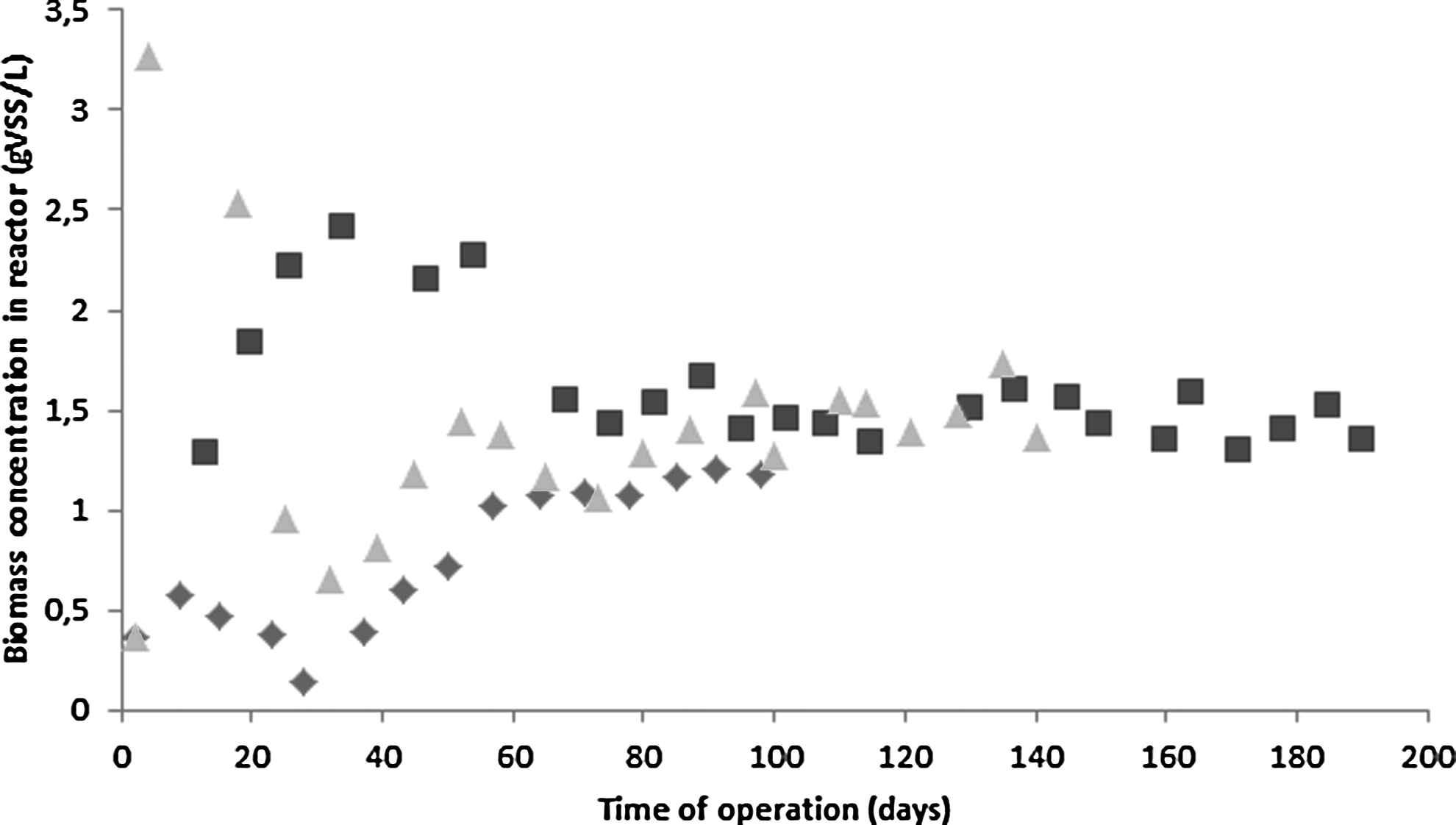
Volatile suspended solids (VSS, g/L) profiles in time within the reactor operated at a salinity of 0.7% (♦), 2.1% (■), and 3.5% (▴).
Morphology
A decrease in VSS/TSS ratio was observed for reactors with higher seawater content (Table 1); this might be due to higher levels of salt in the extracellular polymeric substance (EPS) matrix and the formation of precipitants. Microscopic analyses showed a considerable increase of granule diameter during operation of the reactor, from ∼20 to 500 μm (Fig. 3). The granules from the reactor that operated at 3.5% salinity had a larger diameter than the sludge from the other reactors. The settling velocity of the sludge after adaptation increased compared to the inoculum, but was equal over the reactors.

Sludge flocs from inoculum and granules from the reactors operated at a salinity of 0.7%, 2.1%, and 3.5%.
Sludge population
To analyze the effect of seawater concentration on the SRB population and its diversity in the reactors, TRFLP and sequencing analyses were performed. The TRFLP profile in Fig. 4 demonstrates that the three reactor samples were ∼70% similar, but very different from the used inoculum of sludge from the WWTP Amsterdam West (∼25%) and pond sediments from the ecological garden (∼10%). The SRB diversity in sludge from the WWTP Amsterdam is, as expected, larger than in sludge from the ecological garden. Overall, there are several bands present in the TRFLP profile from the different reactor samples, suggesting that there is a variety of SRB species present in these samples.

Terminal restriction fragment length polymorphism analyses based on dsrA gene of sludge from reactors operated at such conditions that 20%, 60%, or 100% of the content was seawater instead of fresh water and sludge from the wastewater treatment plant (WWTP) Amsterdam-West and the ecological garden of KWR Watercycle Research Institute in Nieuwegein, which were used as inoculum for the reactors.
However, it was observed that a pure SRB strain can result in at least two TRFLP bands. Therefore, from each sample 25 clones were selected for sequencing to investigate the SRB diversity (Table 3). In all three reactors a dominant SRB species was observed. In the reactors R20% and R60%, the sequence accession number of this dominant strain is KF921953. The nucleotide blast showed the highest sequence similarity with Desulfotalea arctica as cultured strain (Table 3). This species was, however, not detected as the dominant strain in the R100% reactor. Still, in all three reactors, some other species were also detected similar to those observed in the inoculum sludge. In the sample from the WWTP Amsterdam West, a wide variety of SRB was observed, while there was only one dominant SRB detected in the sludge sample from the ecological garden. These sequencing results confirmed the TRFLP band patterns. The protein blast showed that the closest related cultured strain to the detected dominant species in the reactor was Desulforhopalus singaporensis. This SRB species was also derived from sludge of the ecological garden (Table 3). In none of the three reactors methanogens were observed by means of autofluorescence microscopy or methane production.
All sequences which appeared twice or more from 25 analyzed clones of each sample.
WWTP, wastewater treatment plant.
Discussion
To conclude whether SRB can treat wastewaters with a high salt content, the activity of SRB was investigated for the treatment of wastewater containing salinity from almost fresh water to seawater level. Herewith, a successful application of SRB on saline wastewater is elaborated from the conversion rates, morphology, and population shift perspectives.
Conversion rates
Effluent quality of the operated sequencing batch reactor system was correlated to the activity of SRB. The ability of SRB to remove COD is directly dependant on the COD/SO42− ratio. In the absence of sulfate, methanogens might convert COD anaerobically. Sulfate was the limiting component in the reactor operated at only 500 mg/L sulfate (COD/SO42− >0.67). As a result, complete COD removal could only be achieved in the presence of active SRB competitors like methanogens (Dar et al., 2008). Therefore, methanogens or acetogens could be present in R20%, in which sulfate was limiting. In addition, the sludge inoculum from the WWTP Amsterdam West contained methanogens. Nevertheless, neither methane production nor a complete removal of acetate and propionate was observed. Therefore, it was assumed that no methanogens were present and furthermore, no autofluorescence was observed under the microscope. In R60% and R100% a substantial COD removal was achieved of more than 97%.
While the reactors were fed with a mixture of acetate and propionate, the remaining COD in the effluent of all three reactors, 72, 8, and 12 mg/L for R20%, R60%, and R100%, respectively, consisted of solely acetate. Three reasons for acetate presence in the effluent are hypothesized, namely: (1) propionate is incompletely converted into acetate, (2) more propionate than acetate is fed, (3) SRB have preference for propionate over acetate. In van den Brand et al. (2014b) it was explained that reason 1 and 2 caused the sole acetate composition of COD in the effluent. It is suggested to increase the solid retention time to achieve complete acetate removal also.
A maximal sulfate reduction rate was measured in pulse-fed batch experiments, while the long-term reactors operated with a slow-feeding procedure. However, since there was COD left in the effluent, the maximal sulfate reduction rate can be considered as the actual rate in the mother reactors. The maximal sulfate reduction rates (1.24–2.29 mmolSO42−/gVSS·h) observed in these reactors are a twofold higher than rates obtained by sludge from a WWTP (Lens et al., 1995). However, since it is possible that SRB are active in the population and the SRT can differ, a direct comparison is very difficult.
For an efficient operation of the SANI process it is crucial that sulfide remains dissolved in the liquid phase, as it is required for subsequent autotrophic denitrification. Since the COD and sulfur balance were satisfactorily closed with sulfide measurements in the liquid in all three reactors, salt apparently showed no effect on H2S volatilization under such specific conditions.
Biomass growth
Yield in the three reactors was considered to be equal (Table 2), as the variation fits within the inaccuracy of the measurement. The VSS/TSS ratio in reactors and in the effluent decreased at elevated seawater fractions. Partially this can be explained by the increase of the TSS concentration in the reactor feed, which increases from 0.002, 0.005, to 0.007 g/L for R20%, R60%, and R100%, respectively. Nonetheless, it is considered as negligible for the differences in VSS/TSS ratio. Therefore, it is suggested that the increase of ash content was caused by precipitation, due to elevated presence of ions. The VSS concentration increased for the reactors R60% and R100%, which is explained by the increased COD consumption. The average yield of these three reactors was 0.022 (gVSS/gCODsubstrate), and was in accordance with previous studies (Takahashi et al., 2011; van den Brand et al., 2014a).
The pore size of the filters used for these analyses was 2.7 μm, resulting in nondetectability of single cells in the samples. However, the potential underestimation of the VSS and TSS analyses are expected to be minor, since single cells are flushed out quickly in a sequencing batch reactor operation. Furthermore, the original pore size of the filter becomes less relevant, due to the building up of sludge on the filter.
Morphology
It is generally advantageous for the design and operation of a WWTP that the settling time is shortened, and thus sludge settling ability is an important parameter. Ekama et al. (1997) reported a deterioration of sludge settling at high salinity; however, in the present study, an improved settleability was observed. Moussa et al. (2006) suggested that high salinity can be toxic or inhibitory for bacteria, which can lead to an increase of floc size as a part of bacteria's defense mechanisms. Moreover, Reid et al. (2006) demonstrated that the EPS concentration in the mixed liquor increased after a salt shock. The ability of microorganism to bind in the matrix formed by EPS contributes to the formation of granules (Sutherland, 2001). Combined with the short settling time (20 min), which favors granular as opposite to flocculent sludge, this explains the increase in the granular size from inoculum to adapted sludge. Still, the increase of diameters of the granules for higher salt levels could also be caused by a longer duration of the experiment, and therefore more selection could have occurred.
Granules might also cause a minor decrease in diffusion rates, however, it is assumed that this does not affect the effluent quality, as the concentrations are very high and therefore neglected the diffusion rate. On top of that, the achieved sulfate reduction rates are very high. Since granules are known to reduce the WWTP space, providing some microbial protection for toxicity, at high rates with high biomass retention and organic load (de Kreuk and van Loosdrecht, 2006; Adav et al., 2008), the formation of granules with SRB is considered beneficial for its application.
Microbial population
In general it is considered advantageous to start with a high diversity of SRB as inoculum in a startup phase. In the sludge from the WWTP Amsterdam-West, many bands were observed in the TRFLP profile (Fig. 3) compared to the other samples, suggesting the presence of a high variety of SRB.
TRFLP profiles revealed that the sludge microbial populations from the reactors were very similar (∼70%), however, very different from the inoculum. Sequencing results showed that all three reactors were dominated by only one, but not the same, SRB species. Note that Table 3 comprises no clones which were observed only once. The other half of the population was a variety of SRB species, which were found 1–5 times, out of 25 analyzed clones per sample, possibly partly caused by the bi-weekly addition of a new inoculum (5% v/v). Although the system was challenged by an inoculum biweekly, the conditions present in the reactor were advantageous for a certain SRB species to become dominant.
TRFLP profiles indicate a significant higher similarity in SRB population between R60% and R100% than these reactors with R20%. However, this statement is contradictory to the clone sequencing result, as clone sequencing demonstrated that according to the nucleotide blast, the dominant SRB species in R20% and R60% was similar (KF921953) and the closest cultured relative was D. arctica. In R100% another dominant strain was detected, of which the closest relative was a Desulfopila inferna. It seems that only a minor SRB population shift occurred from R20% to R60% and R100% under elevated seawater fraction. Nonetheless, a different nucleotide sequence does not result necessarily in a different functional protein, therefore, it is possible that the functional processes did not change between these three reactors.
D. arctica was isolated from cold arctic marine sediments and the optimum NaCl range for this species is reported between 1.9% and 2.5% (Knoblauch et al., 1999). Although in this experiment aquaria salt is used, it is assumed that the salinity matrix could be compared, due to dominant presence of NaCl. The salinity of R60% fits within this range, but in R20% the salinity is lower (0.7%) and in R100% it is higher (3.5%). Probably the conditions were in favor of D. arctica in R20% and R60%, but due to an increase of salt concentration in R100% this species could not dominate in this reactor. D. inferna is isolated from a tidal sand-flat in the Wadden sea, which is known for its salt content and relatively low temperature (10–20°C). Assuming parallel increase of sulfate with salinity, D. inferna are likely to be present in environments with elevated seawater concentrations.
According to the protein blast, however, the dominant species in the reactors was most similar to the cultured Desulforhopalus singaporensis (Table 3). This species grows slowly on propionate, but is not able to utilize acetate (Lie et al., 1999). Still, acetate removal was observed within all three reactors (Table 1). The applied temperature (20°C) and pH (7.6) fits within the optimal ranges of D. singaporensis (Lie et al., 1999). D. singaporensis is known for its ability to be active in the presence of salt as it is cultivated from a marine sulfidogenic mud from a saltwater marsh in Singapore.
The most similar cultivated strain resulting from nucleotide and protein blast was different, but a more thorough evaluation showed that the results are quite comparable. For the sequence KF921954, the most dominant strain in R100%, resulted in a first hit for D. singaporensis for protein blast, while it was the second most similar cultured strain for the nucleotide blast (78% similarity). Also for the dominant strain in the R20% and R60% reactors, KF921953, a comparable result was observed. The protein blast resulted in the first cultured strain of D. singaporensis, while for the nucleotide blast this strain appeared to be the second most similar cultured strain (79% similarity). The similarities between protein and nucleotide results were likewise found for the other sequences obtained from this study.
Dominant populations found in these samples show to have a relatively low similarity with known SRB populations (<98%). Therefore, it can be concluded that these specific conditions, referring to a treatment of domestic wastewater at moderate climates in the presence of salt, resulted in the dominance of a new unknown SRB population.
Application
Studies demonstrated that the saline sewage treatment with the SANI process is promising and more sustainable than conventional sludge systems for treating saline municipal wastewater (Lau et al., 2006; Wang et al., 2009; Lu et al., 2011). In these studies a mixture between saline black water and fresh greywater was used. As a result, it becomes difficult to reuse this freshwater to further overcome fresh water shortage, which was the reason to introduce seawater for toilet flushing after all. This study demonstrated that the effluent quality, settling characteristics, growth and competition between SRB and methanogens were not negatively influenced by the elevated salinity. The effects of salt on autotrophic denitrifiers and nitrifiers were investigated already and no technical barriers were reported (Koenig and Liu, 2004; Moussa et al., 2006). Therefore, now all microbial activities involved in the SANI process have been investigated for successful saline black water treatment.
Many industrial effluents contain excessive amounts of salt and sulfate. Previously it has been demonstrated that particular ions can have a stronger inhibitory effect than others (Knoblauch et al., 1999). The effect of aquarium salts, including all ions in concentration realistic to seawater is, therefore, also of more interest to the industry than solely the effect of NaCl for seafood processing industries, which deals with a variety of salts. This study demonstrated that in a range from 0% to 3.5% salinity, with a salt composition similar to seawater, sufficient sulfate reduction rates can be obtained.
In conclusion, in the present study the long-term salinity effects on an enriched SRB culture were evaluated at 20°C. The COD/SO42− ratio in the feed varied between 0.80, 0.26, and 0.16, while the salinity was 0.7%, 2.1%, and 3.5%, respectively, which can be expected for saline wastewater when seawater is used for toilet flushing. The main conclusions drawn from the current study are: (1) a higher seawater concentration caused a decrease in the sulfate reduction rate, but it was still sufficient enough for efficient COD removal (>97%) over the whole salinity range from 7 to 35 g/L; (2) seawater elevation caused a switch in dominant population, without effect on the effluent quality; (3) SRB growth (in mgCOD/day) increased for higher salinities, due to an increased COD consumption; (4) long-term operation of SRB reactor resulted in the formation of granules, probably due to its selection as the settling time was short; and (5) these specific conditions result in the dominance of new unknown SRB species within the reactor.
Footnotes
Author Disclosure Statement
No competing financial interests exist.