




Abstract
Abstract
During the past decades, pressures on global environment and energy security have led to an increasing demand on renewable energy sources and diversification of the world's energy supply. The Portuguese energy strategy considers the use of Forest Biomass Residues (FBR) to energy as being essential to accomplish the goals established in the National Energy Strategy for 2020. However, despite the advantages pointing to FBR to the energy supply chain, few studies have evaluated the potential impacts on air quality. In this context, a case study was selected to estimate the atmospheric emissions of the FBR to the energy supply chain in Portugal. Results revealed that production, harvesting, and energy conversion processes are the main culprits for the biomass energy supply chain emissions (with a contribution higher than 90%), while the transport processes have a minor importance for all the pollutants. Compared with the coal-fired plants, the FBR combustion produces lower greenhouses emissions, on a mass basis of fuel consumed; the same is true for NOX and SO2 emissions.
Introduction
R
According to the European Directive 2001/77/CE and the National Plan for Climate Change (Resolution of the Council of Ministers No. 93/2010), Portugal has to increase the share of renewable energy to 39% in the annual gross electricity consumption by 2010. In 2007, the Portuguese government defined a new commitment for 2010, setting a target of 45% of electricity consumption from renewable sources. More recently, the government adopted the National Energy Strategy for 2020, which is based on five main areas: (i) agenda for competitiveness, growth, energy, and financial independence; (ii) investment in renewable energies; (iii) promotion of energy efficiency; (iv) ensuring security of supplies; and (v) economic and environmental sustainability (Resolution of the Council of Ministers No. 29/2010). This strategy defines specific targets, for 2020, for different renewable energy sources such as hydropower, solar, wind, geothermal, sea waves, biomass, and biofuels. Regarding biomass, an increase from 100 to 250 MW is foreseen through the implementation of new power plants supplied by forest biomass residues (FBR, defined in this work as the organic matter generated in the wood processing, namely, branches, twigs, tops, and barks). The location of new thermal power plants was defined by the Portuguese government with the objectives of increasing the quota of renewable energy in the global electricity production and promoting the development of FBR harvesting and management to boost local economy and to prevent forest fires; the latter is a recognized important environmental problem in Portugal with socioeconomic impacts. These measures also represent an important role at the socioeconomic level through the creation of employment, being responsible for 3.2% of the gross national product and for 12% of the national exportation (ANEFA, 2011).
Currently, the largest industrial biomass thermal plants in Portugal include a set of 10 dedicated thermal power plants and 8 cogeneration plants corresponding to an installed capacity of 273 MVA (MegaVolt-Ampere). In addition, 13 new thermal power plants with an installed capacity of 95 MVA are planned (AIFF, 2010). The FBR to energy supply chain includes a set of different activities and operations. Most studies regarding biomass to energy ignore the carbon flux within the FBR to energy environmental analysis, presuming that “CO2 in equals CO2 out” (Rabl et al., 2007), and they often do not take into consideration that there are several pollutants released into the atmosphere, including GHG (carbon dioxide, methane, and nitrous oxide) along the FBR chain. In fact, some degree of fossil fuel integration in the process is required to produce and harvest the feedstock, in processing and handling the biomass, transport of raw feedstock and processed biofuel, and the thermal plant operation (Jungmeier and Schwaiger, 2000; Bradley, 2004; Cowie, 2004). Despite this, there is a lack of research and scientifically supported knowledge with respect to an integrated assessment of the environmental impacts related to the FBR to energy supply chain in Portugal, from its production to its final use as a fuel in combustion processes, as translated by a lack of published information on the subject. The specificity of several operations related to biomass to energy are often subjected to distinct practices and uses in different regions worldwide, and it requires the acquisition of further understanding supported on a local/regional base.
In this context, and considering the relevance of the study of the impact of the biomass to energy on air quality for a policy on renewable energy, this work intends to significantly contribute to the Portuguese policy of biomass to energy by delivering insight on the impact of the FBR to energy supply chain on air pollution, including the evaluation of the most significant operations and the GHG balance, based on a case study. For that purpose, some operations during the FBR to energy supply chain were characterized, namely from the FBR collection of forests, until its energy conversion at the thermal power plant. The fuel consumption during those operations was characterized, namely fossil fuels, and an estimation of related atmospheric emissions was made.
Characterization of FBR to Energy Supply Chain
The FBR to energy supply chain is made up of a range of different activities. These can include soil preparation and planting, fertilization and management, harvesting, handling, storage, in-field/forest transport, road transport, and utilization as a fuel at the thermal power plants (Allen et al., 1998). For structuring international supply systems, four general system components or operation types are distinguished: FBR collection/production, pretreatment, transport, and energy conversion. Hamelinck et al. (2005) emphasizes that the chain operations can be selected and organized in several ways, but many aspects are interdependent, so there is a limited degree of freedom in choosing alternatives and in systematizing these processes. However, although the main operations can be similar in basic principles, the field practices and related efficiency can differ among regions in the result of several factors, such as forest type, landscape orography, equipment used, and field workers formation. Thus, this always needs to be supported by regional knowledge of implemented practices.
In this article, each operation in the FBR to energy supply chain will be analyzed only by considering the forest exploration; operations related to soil preparation, planting, and fertilization processes as well as the forest management are beyond the scope of this work and will not be investigated. Figure 1 presents a representative diagram of the FBR to energy supply chain.
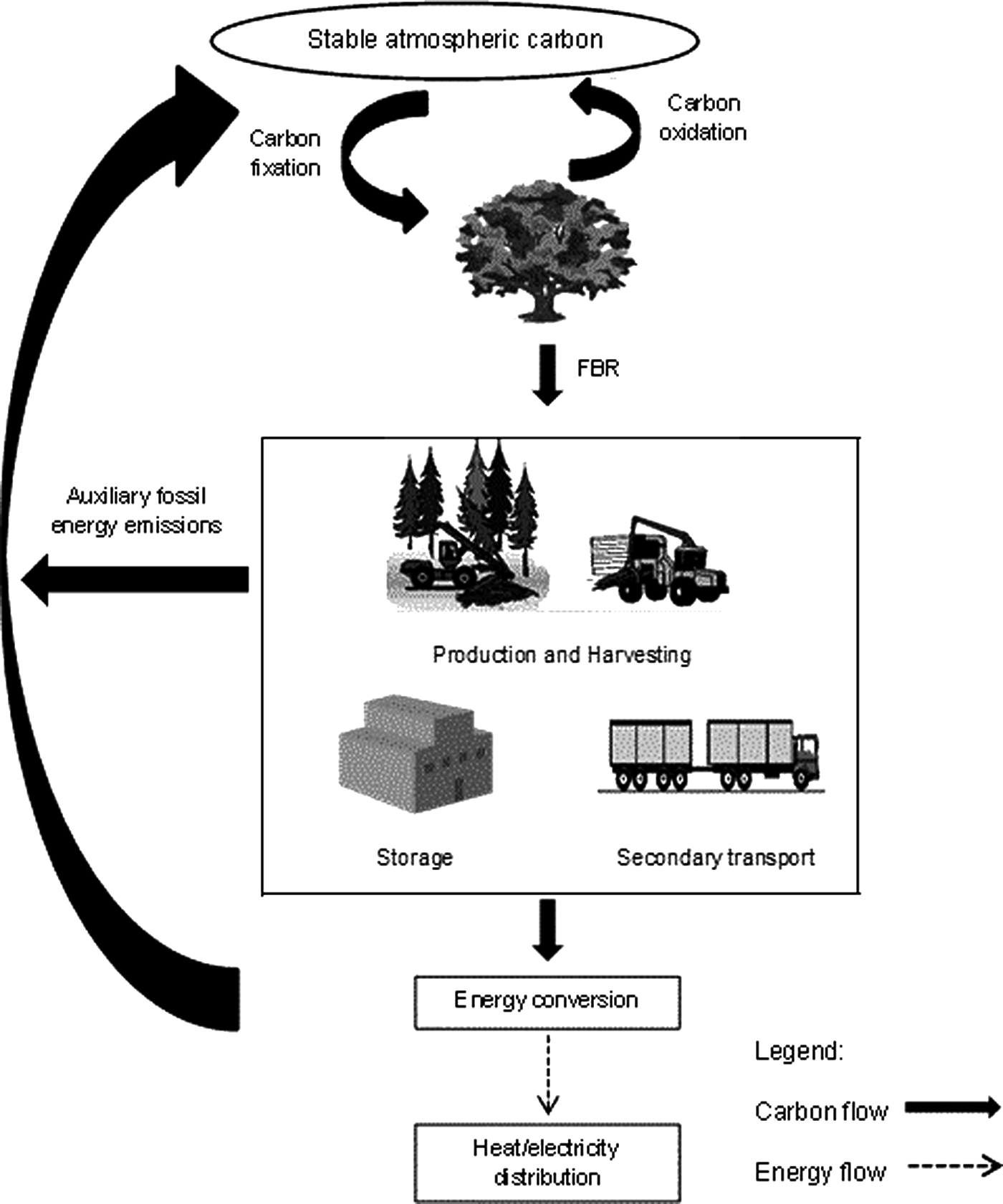
Forest Biomass Residues to energy supply chain.
A system of production and harvesting of FBR to energy can be understood as a set of operations carried out to supply an industrial thermal power plant. The technologies and techniques used for the harvesting, processing, and delivering of FBR to thermal plants are diverse and are in constant evolution (Frombo et al., 2009a). The choice of the best techniques is influenced by several factors, such as (i) type and state of the road network, for example, forest roads may be impassable for large biomass trucks because of the gradeability, cornering ability, ground clearance, and turnaround requirements that differ from the configurations of trucks used for conventional log trucks; (ii) terrain accessibility, namely orography, since the conditions of the site influence the use of heavy harvesting and extraction equipment; accessibility also contributes to determining forwarding distances to roadsides or landings and distances to thermal power plants; and (iii) biomass storage, because storage space and costs can be a problem and the storage of large quantities can be problematic along the roadside; physical and microbial degradation and spontaneous ignition are also issues that need to be understood with chip and biomass storage (Alakangas and Virkkunen, 2007). All these factors are further evaluated by taking into account the economic efficiency, that is, achieving the greater yield line.
During the production and harvesting of FBR, three basic operations are performed (Yoshioka et al., 2005):
(i) Felling—this first step consists of cutting trees at the stump. The raw material can be felled manually by a chainsaw or mechanically by feller bunchers. Manual cutting is more economic in small-scale FBR production and avoids the soil disturbance associated with the equipment operation. Manual crews are also easy to mobilize and can work on very small units and in difficult terrain. Mechanical methods are better suited for large-scale operations, allowing the collection of bunches as it cuts, and then lay the cut material in a pile. A swing feller buncher can accumulate biomass from a 20-m circle without moving the base machine. The primary limitation with feller bunchers is that the cutting device will only operate on one stem at a time (unless two are growing very close together). This means that productivity can be significantly affected by the size (volume) of the individual stems. (ii) Processing—this consists of cutting branches and peeling the logs, usually using a Harvester or an agricultural tractor fitted with tows. To facilitate the collection of the branches and tops of the trees, these are left in small piles that are 0.5–2 m in height. The piles are formed while the single-grip felling head of the harvester places all the trees at certain points on the side of the strip road. The piling of the residues may decrease the productivity of harvesting, usually in a percentage of 5% or less. The physical characteristics of the land, such as the orography (with the Harvester it is not possible to collect FBR on slopes higher than 30%), the forest density, and its conservation status, are factors that constrain this operation. (iii) Primary transport—this consists of moving FBR from the cutting point to roadside. The residues are hauled from the logging site to roadside storage with forwarders, which have grapples without plates between the forks to avoid the stones and soil being lifted along with the residues.
After the production and harvesting of FBR, the following operation of the FBR supply chain is the pretreatment process, which consists of the conversion of raw FBR into a denser material and with less water content, thus with better quality as a fuel, for example, with a higher energy density (De Mol et al., 1997). This process includes a size reduction (chipping) and drying, mainly to improve transport and storage characteristics or to address the requirements of the furnace feeding conditions at the biomass thermal power plant. Chipping can take place at the roadside storage place, at a terminal storage, or at the end-use facility. When chipping is done by the roadside, the chips are usually blown directly into the containers of the long-distance transport vehicle. The capacity of mobile chippers varies according to the size and power of the model. Due to their mobility and the good quality of the chips, drum chippers built on the truck chassis dominate in large-scale roadside chipping. When crushing is done at the terminal, bigger machine units are used due to the higher material amounts. Since the size and weight of this machinery makes transportation difficult, this machinery is best for larger worksites such as fuel terminals.
In the terminal harvesting chains, the different work phases of the harvesting chains are not dependent on each other due to the storage periods of the material. The use of terminals may reduce the demand for storage areas at the end-use facility and increase logistical possibilities for optimized energy wood deliveries—the most suitable material can be delivered to the place where it is most needed, exactly at the right time. With the changing demand for chips, the terminal also acts as buffer storage, thus improving the reliability of deliveries. Large stationary crushers are used for crushing material at the plant. A stationary crusher is able to achieve proper comminution of several kinds of biomass delivered to the plant (Frombo et al., 2009b). However, the use of this terminal storage requires the acquisition of facilities, equipment, rental or purchase costs of land for the installation, and adequate access (De Mol et al., 1997). Regarding the drying operation, in the Portuguese case chip, moisture content is usually reduced by allowing residues to lose some moisture in-field (at ambient conditions). The moisture content in the residue will decrease to between 35% and 45% within 14 days after felling, depending on the time of the year and site factors.
The third component of the FBR to energy supply chain is the secondary transport, which consists of loading the truck with the FBR stacked in the previous processes and its transportation to the thermal power plant. Given the typical locations for the FBR sources, the transport infrastructure is basically sustained on the road transport mode for fuel collection and delivery. Other factors that promote the use of road transport include the distances over which the fuel is transported (which tend to be relatively short, around 35 km in the Portuguese case) and the higher flexibility that road transport can offer in comparison with other modes of transport. Using heavy duty vehicles (rather than agricultural or forestry equipment) for FBR transport is essential due to the average distance from the forest to the thermal power plant, and the cargo capacity and road speed of such vehicles (Allen et al., 1998). There are two main factors that should be considered in the planning of the transport process: (i) characteristics of the biomass to be transported and (ii) the transport distance.
The logistics underlying the FBR to energy supply chain culminates with its use in energy conversion systems. Currently, FBR is used for distinct applications, and the most common include (i) production of thermal energy, (ii) dedicated production of electric energy, and (iii) production of thermal and electric energy (Loo and Koppejan, 2008).
Thermochemical processes (pyrolysis, gasification, and combustion) are the most common for biomass conversion into several useful forms of energy (heat and power), although combustion is currently the most employed. The most common technologies include fixed bed and fluidized bed (Quaak et al., 1999). The fixed-bed system includes a variety of grates, and it basically can be distinguished according to the way the fuel is supplied or transported throughout the furnace. Fluidized-bed systems include the bubbling or circulating varieties, depending on the gas velocity and bed particle size (Quaak et al., 1999). This type of technology has been indicated as the most promising, because of its fuel flexibility, high combustion efficiency, and low environmental impact (Tarelho et al., 2011). Gasification can also be applied to the energy conversion of biomass, and several types of gasification processes can be used to obtain a high-quality energy carrier (synthetic gas) (Quaak et al., 1999). Depending on the technology used for thermochemical conversion of biomass, different product gases and pollutants will be obtained with distinct impacts on air quality. In addition to the main products of combustion, carbon dioxide (CO2), and water (H2O), flue gas emissions from biomass combustion include compounds associated with incomplete combustion (carbon monoxide [CO], hydrocarbons, and carbon particles), or with the conversion of several chemical elements present in the fuel (nitrogen oxides (NOX), nitrous oxide (N2O), sulfur dioxide (SO2), hydrochloric acid (HCl), and ash], and are influenced by the operating conditions and fuel properties (Quaak et al., 1999; Winter et al., 1999; Werther et al., 2000; Demirbas et al., 2005; Joller et al., 2007; Tarelho et al., 2011).
To understand the complexity of the FBR energy supply chain and assess its impacts in terms of atmospheric emissions, a case study is analyzed (see Study Case Section).
Study Case
The case study includes a forestry company located in the Aveiro region (in Portugal) that usually supplies a nearby biomass thermal plant. The city of Aveiro is a medium-sized city, with an area of approximately 198 km2 and 78,000 inhabitants (INE, 2013) and is located on the Northwest coastline 70 km south of Oporto.
The biomass thermal plant is constituted by one thermal power plant and one cogeneration plant, with a total installed capacity of 47.6 MWe (URL1). The amount of FBR needed to fulfil the fuel needs of the existing thermal power plant and cogeneration plant is 9.18×10⁴ tons of FBR in a dry basis per year (t/yr) and 2.06×10⁵ t/yr, respectively (see Methodology Section), representing a total of 2.98×10⁵ t/ yr. The biomass thermal plant operates 350 days per year, and the technology used includes fluidized-bed combustors. The main business of the company collaborating in the study is the exploration of wood (wood logs) for the pulp and paper industry, having also a subsequent economic interest on the exploration of the FBR to be delivered as a fuel at biomass thermal power plants. However, according to the forest operators, around 30% of the FBR produced during tree harvesting of the on-site wood log processing stays in the field.
To estimate the atmospheric emissions related to the FBR to energy supply chain, it is necessary to access a set of variables, among them being (i) resources used; (ii) working hours; (iii) course distances; and (iv) machinery consumption.
Field data from the forestry company revealed that there are usually two chainsaws (two-stroke) working daily for tree logging (8 h per day), each of them spending 0.8 L of gasoline per hour. This represents an annual consumption of around 1580 L of gasoline (each chainsaw). In addition, they also use two types of specific forestry machinery, a Harvester and a Forwarder, for the management of the logged trees, with a total of 1976 annual working hours and an annual fuel consumption of 940 L of diesel (each machine). The company operates 247 days per year.
According to the information obtained from the forestry company, the FBR are transported from the collection point (in the forest) to the transfer center and later to the industrial thermal plants. The primary transport is made with an adapted tractor with trailer or with a Euro III class truck. The adapted tractor is used for short distances, 10 km, and the truck is used for longer distances. The truck has a capacity of about 80 m3, around 10 tons of FBR (on a wet basis), depending on the moisture content. Considering that the forestry company collect the FBR in several points in the Aveiro region, this study was based on the standard case scenario, namely assuming the average path distance between the forest collection point and the transfer centre (18 km). At the transfer center, the FBR is stored and processed (chipping) to be transported to the industrial plant (at a distance of 18 km). To perform the secondary transport, the company also uses a Euro III class truck, with a capacity of about 70–90 m3 (around 12–26 tons of FBR, on a wet basis). As a result, the primary and secondary transport procedures are responsible for performing 3,537,000 and 708,400 km annually, respectively. It should be noted that despite both distances, from the forest to the intermediate processing point and from there to the thermal power point are given as an average of 18 km; the primary and secondary transport can exhibit different mileages, mainly due to the distinct characteristics of the FBR and the capacity of the trucks. Table 1 compiles the detailed information and data specific of the case study used.
FBR, forest biomass residues.
Methodology
A specific methodology was followed to assess the atmospheric emissions in the value chain of FBR to energy. Two main steps were performed: (i) estimation of atmospheric emissions related to the FBR to energy supply chain and (ii) analysis of the CO2eq (CO2 equivalent) balance. A detailed description is presented in the next few sub-sections.
Emissions from FBR to energy supply chain
To calculate the emissions of gaseous pollutants associated with the production and harvesting processes, the methodology adopted was based on the application of the classical mathematical equation for estimating the emission of a pollutant (Ei) according to Equation 1 (EMEP/EEA, 2009).
where Ei - Emission of compound i, kg/s; Ai- Activity level, as expressed by primary energy consumption rate (based on the fuel consumption rate), MJ/s; and EFi - Emission factor for compound i, kg/MJ.
The emission factors applied were collected from the European Monitoring and Evaluation Program/European Environmental Agency (EMEP/EEA) air pollutant emission inventory guidebook 2009 (updated June 2010). The emission factors provided have been derived from the Danish Inventory; Winther and Nielsen (2006) with heavy metals and POPs taken from EMEP/Corinair 2006 represents average emission factors for the broad Nomenclature for Reporting (NFR) categories fuel type and broad engine type (two stroke or four stroke). The emission factors applied are relative to nonroad mobile sources and machinery, and they are included in SNAP 08—other mobile sources and machinery (Forestry)—according to the Selected Nomenclature for Air Pollutants (SNAP). The emission factors applied in this study are compiled in Table 2.
The activity level corresponds to the amount of fuel consumption (diesel or gasoline), resulting from the information provided by the forestry company (as previously mentioned).
The same approach was used to estimate the emissions from the combustion of FBR in industrial installations. The applied emission factors were collected from the EMEP/EEA air pollutant emission inventory guidebook 2009 (updated June 2010), with the exception of the GHG pollutants (CH4 and N2O). The emission factors provided have been derived from available data, taking into account the results of an assessment of emission factors included in previous versions of the EMEP/EEA guidebook and including more recent information from the Best Available Techniques (BAT) reference document (the so called BREF) in Large Combustion Plants. The emission factors applied are relative to industrial biomass combustion, and they are included in SNAP 01 - Combustion in Energy and Transformation Industries. The emission factors considered for GHG estimation were collected from the 2014 IPCC Climate Registry Default Emission Factors Release related to wood combustion in thermal power plants (Intergovernmental Panel on Climate Change [IPCC], 2014).
It should be noted that it was not possible to obtain detailed information of the fuel characteristics and operation conditions used in the case study thermal power plant, thus the emission factors used represent recommended values for the most common combustion technologies used in the thermal plants considered in the study, that is bubbling fluidized-bed combustors. The EMEP/EEA inventory provides factors that represent a mean of the emissions for the range of technologies, with a 95% confidence interval, which are recommended in the absence of detailed information of the types of combustion or abatement technologies used. The emission factors applied in this study are compiled in Table 3.
The activity level corresponds to the FBR consumption rate. Therefore, it was necessary to estimate the biomass consumed in the industrial thermal plants, and for that purpose Equations (2) and (3) were used.
where,
Estimation of the FBR consumption rate was based on average fuel characteristics (namely the lower heating value of FBR) and average thermal efficiency for the conversion of biomass to electric power. For the thermal efficiency of the conversion of biomass to electric power, an average value of 25% (typical in these installations in Portugal) was used, for the thermal power plant and the cogeneration plant; it is recognized that the thermal efficiency for the conversion of biomass to electric power in thermal power plants is in the range of 20% and 35%; in cogeneration plants, the efficiency for electric power production can be a little lower, for example, as low as 15% when the plant is operated toward heat control (Loo and Koppejan, 2008). An average value of 15.7 MJ/kg (dry basis) for the lower heating value of the FBR was used (Rafael et al., 2015). The installed electrical power was obtained from the national database of electric power plants based on renewable energy sources (URL1). The power available in the fuel is directly related to the heating value of the fuel and its feed rate, and it is given by Equation (3).
Emissions of gaseous pollutants associated with the road transport of the FBR (primary and secondary transport processes) were calculated with the Transport Emission Model for Line Sources (TREM) (Sturm et al., 1998). The prime objective of TREM is the estimation of road traffic emissions, with high spatiotemporal resolution to be used in air quality modeling. Therefore, roads are considered line sources and emissions induced by vehicles are estimated individually for each road segment while considering detailed information on traffic fluxes. The average speed approach is used for emission factors estimation, which is considered sufficient when the influence of driving dynamics can be neglected.
Besides average speed, emission rates depend on engine capacity, vehicle mass, and emission reduction technology. Therefore, to provide an accurate estimation of air pollutant emissions, an adequate aggregation of vehicles by categories and classes is an important task (Borrego et al., 2003).
Input information required by TREM basically includes the following data: (i) road network spatial data, namely the network geometry and road segment length; (ii) traffic volume (ADT - Average Daily Traffic) and vehicle speed for each road segment; and (iii) vehicle fleet data (based on the vehicle age, emissions reduction technology, and engine capacity, among others). Due to the type of road used for the FBR transport (secondary roads), a velocity of 50 km/h was considered. The fuel consumed by the truck is diesel.
In the current model version, the calculation algorithm is implemented for the following pollutants: CO, NOX, CO2, SO2, N2O, nonmethane volatile organic compounds (NMVOC), methane (CH4), and particulate matter (PM10). Furthermore, fuel consumption is estimated to provide additional data to be compared with statistical information as a measure of model evaluation. The estimated emission factors are displayed in Table 2.
Atmospheric emissions associated to the FBR harvesting and transport were determined on a wet basis, and the FBR consumed in the thermal plants was estimated on a dry basis, and thus it was necessary to convert the values to the same basis to allow the comparison of the processes, and the wet basis was adopted. Knowing that the FBR is used as a fuel in the thermal plants with an average mass ratio of moisture of 0.54 kg of water per kilograms of FBR on a dry basis (kg/kg), on a wet basis the resulting mass fraction of moisture (wwh) is around 0.35 kg/kg. As a result, the FBR consumption rate, estimated on a wet basis, is 4.58×10⁵ tons of FBR per year (t/yr). Table 1 synthesizes the detailed information and specific data of the study case, specifically the FBR processed in each operation and the mass fraction of moisture used in calculations (based on field data).
It should be noted that it was not possible to obtain detailed information and reliable data of the chipping process, therefore this component of the FBR energy supply chain was not analyzed.
The methodology adopted for data analysis allows an integrated perspective of the atmospheric emissions related to the operations considered in the FBR to energy supply chain. Two types of analysis were performed: (i) assessment of the contribution of each process to the total emissions in the FBR energy supply chain, based on a ton of FBR consumed (in a year) (tons of pollutants per tons of FBR on a wet basis, t/t); in this way, the relative weight of each process is obtained; and (ii) assessment of the magnitude of atmospheric emissions for each specific operation (in tons of pollutant per year).
GHG balance
As discussed in Rafael et al. (2015), there is no consensus in the scientific community regarding the “carbon neutrality” of biomass as a fuel and its contribution to climate change. However, the EMEP emission from the previous available report (EMEP/EEA, 2009), used as reference in this work, follows a perspective of “carbon neutral” not considering the CO2 emissions (in the combustion process). Despite that, power production from FBR combustion involves other carbon flows, including fossil fuel burned during biomass harvesting, processing, and transportation. Therefore, the assumption that FBR power is currently a “carbon neutral” process should be tempered. In this context, a simplified GHG balance of the FBR to energy supply chain was applied to this case study. This analysis was made according to a specific approach, because the balance was performed considering that, for the same amount of thermal or power energy output, a fossil CO2eq emission is “avoided” when using FBR. Therefore, the GHG balance consists of the sum of the carbon estimated emissions for each operation process [Eq. (4)].
To perform this analysis, it was necessary to estimate the CO2eq that would be emitted if the thermal plant worked with coal consumption. The emission factors were obtained within the same references, based on coal combustion. Due to there being a solid fuel, therefore employing similar technologies to those required for FBR combustion, coal was selected.
Results
Considering the previously described methodology (Methodology section), the annual emissions associated to the FBR exploration (production and harvesting, transport and energy conversion processes) were estimated.
The contribution of each exploration process to the atmospheric emissions of the FBR to energy supply chain is displayed in Fig. 2. It is evident that the emissions associated to the production/harvesting process have a major contribution to the atmospheric emissions of the FBR energy supply chain, being the main source of CO2eq, CO, PM10, and NMVOC. This contribution is related to the use of fossil fuels (diesel and gasoline) by the machinery. In this analysis, the secondary transport presents a remaining contribution to the atmospheric emissions of the FBR to energy supply chain.
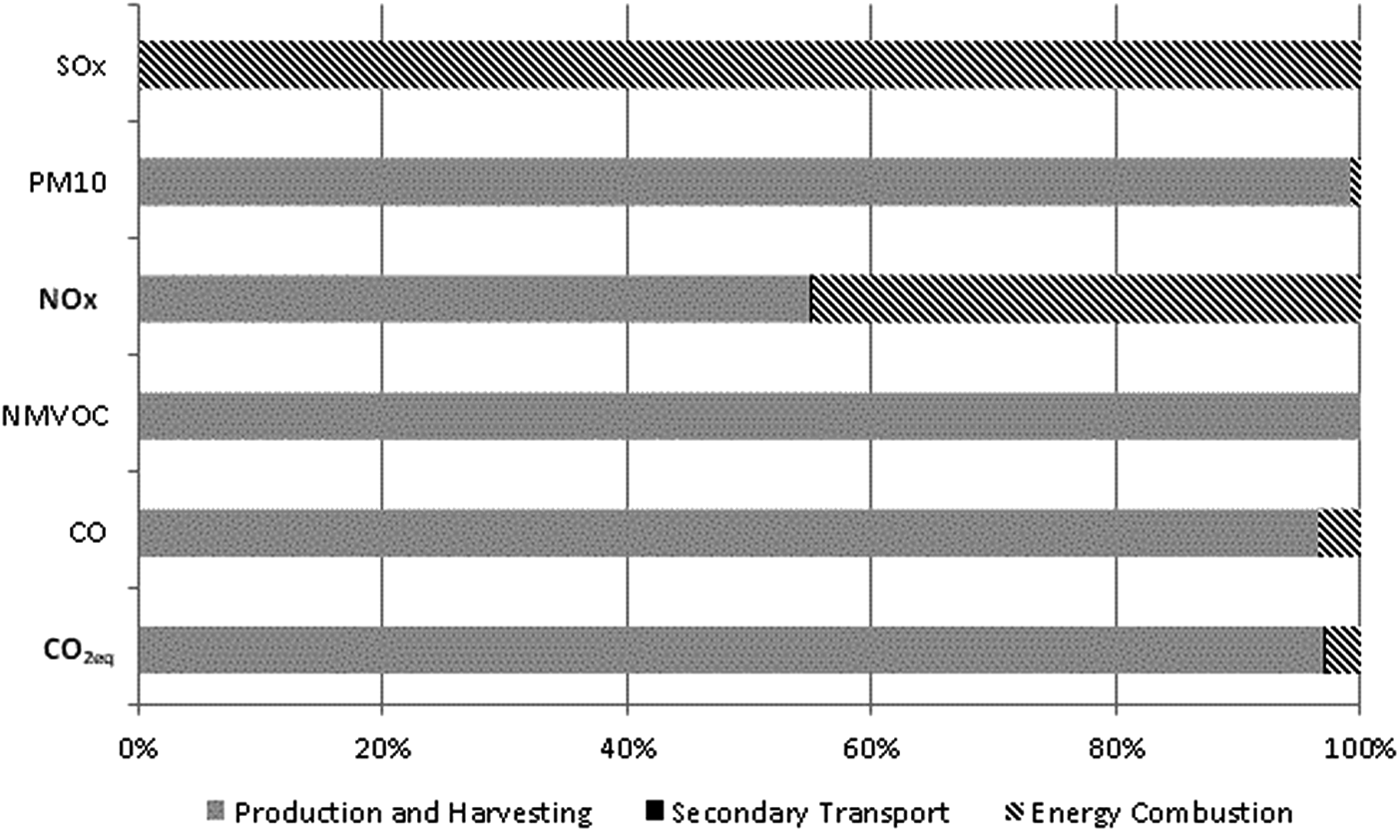
Share of the emissions from several activities, in percentage, in the overall biomass energy supply chain.
On the other hand, and despite the FBR being poor in sulfur content, the energy conversion process is the main culprit for the SO2 emissions, since the fossil fuels consumed in Europe and used in the production/harvesting and transport process have a maximum sulfur content of 10 ppm (0.001wt%), around 50–200 times less than the value found in the FBR (around 0.05 wt% to 0.20 wt% sulfur on a dry basis) (Rafael et al., 2015). In addition, this process is also responsible for the emission of large amounts of NOX (NO+NO2) (around 50% of the total emitted in the FBR supply chain), and for a percentage (around 10%) of the emissions of CO and CO2eq. The lower combustion efficiencies of FBR explain the CO and NOX emissions.
Regarding the magnitude of the values (Table 4), it is clear that the production/harvesting process presents the highest emission values, with the SO2 emissions being the only exception. However, for a better understanding of the influence of the Portuguese energy policy on air pollution, a comparative analysis is performed in terms of emissions related to the energy conversion process between this renewable source (FBR) and a fossil fuel (coal).
Focusing the analysis on the energy conversion process, it is observed that CO is the pollutant emitted in higher amounts. CO is related to the incomplete combustion of the fuel and represents a loss on the overall efficiency of the thermal plants. The emission of CO is dependent on the combustion technology applied, operating conditions (temperature, stoichiometry, residence time, and turbulence), and fuel characteristics (Tarelho et al., 2011). The CO emissions can vary widely among combustion installations (Demirbas et al., 2005; Tarelho et al., 2011); the obtained results are a consequence of the application of a general emission factor to installations with distinct characteristics, and they should be interpreted in this context. Compared with coal, FBR have a higher volatile content and therefore need more residence time in the freeboard to completely burn the volatiles. On the other hand, significant methane formation is common in small-scale combustion, but occurs rarely in well operating large furnaces (Tsupari et al., 2007).
NOX are estimated as those with the second highest emission. These compounds can be produced from both oxidation of nitrogen present in the fuel and nitrogen present in combustion air. It is recognized that for low operating temperatures (lower than 1000°C), for example those observed during biomass combustion in bubbling fluidized-bed technology, the contribution of the nitrogen in air is of minor importance to the total NOX compounds formed; also the conversion of the fuel nitrogen to NOX seems to be limited, thus allowing low emissions of this group of compounds (Werther et al., 2000; Tarelho et al., 2011). The compounds grouped as NOX are recognized as having some effects on the air quality, due to their role in the photochemical reactions in the atmosphere.
N2O emissions occur in combustion at low temperatures (<950°C) and are affected by fuel type and various other conditions, such as the fraction of excess air or catalytic activity of char and mineral matter (Kilpinen and Hupa, 1991; Kramlich and Linak, 1994; Löffler et al., 2002). Both the amount of nitrogen in fuel and the fuel-O/fuel-N ratio have an effect on N2O emissions (Hämäläinen and Aho, 1996). N2O is formed not only from volatile nitrogen species (e.g., HCN) originating from fuel nitrogen but also from nitrogen of char and by heterogeneous reactions on the char surface (Bonn et al., 1995). Therefore, N2O formation can also take place, especially in fluidized-bed combustion, by the reduction of the initially formed NO by the char particles (Jones and Thomas, 1995). It is possible that more oxygenated char will yield higher N2O on combustion, and this may be more significant for biomass combustion in fixed and fluidized beds. Nitrous compounds can only be formed when there is unburned hydrocarbon present and NO can interact with hydrocarbon-free radicals, but usually this only takes place in unconfined flames.
SOx includes the group of compounds SO2 and SO3; the emission of these species is related to the oxidation of the sulfur present in the biomass fuel (S-fuel); it is recognized that only a fraction of the S-fuel appears as SOx in the flue gases from biomass combustion, with the remaining part being absorbed by the alkaline solid particles (such as the ash) in the combustion system. Using FBR to generate power typically produces lower SO2 emissions than using coal, as a result of the different sulfur content; coal presents a sulfur content of around 2 wt% to 3 wt% (on a dry basis), around 15–30 times more than the sulfur content of FBR. Nitrogen oxide emissions should also generally be lower for FBR, due to lower fuel nitrogen content and the higher volatile fraction of FBR versus coal. Use of FBR fuels produces lower emissions than coal-fired plants, so to the extent that biomass replaces coal use, air quality will be beneficial (McNeil Technologies, 2003).
NMVOC include a variety of gaseous hydrocarbon compounds related to incomplete combustion of the fuel, and similar to CO, these compounds represent a loss on the overall efficiency of the thermal plants; however, the estimated emission of these compounds (Table 4) is much lower (over 35 times less) than that estimated for CO. Similar to CO, the emissions of NMVOC are dependent on the combustion technology applied (for example, grate furnace or fluidized bed), operating conditions (temperature, stoichiometry, residence time, and turbulence), and fuel characteristics.
Particulate matter is related to the inorganic content of the biomass (the ash), unburned solid carbon, and also some organic gaseous compounds (e.g., hydrocarbons) condensed on the particle surfaces (Jenkins et al., 1998). The emissions of the particulate matter are dependent on the combustion technology applied, for example, grate furnace or fluidized bed, operating conditions (temperature, stoichiometry, residence time, turbulence) and fuel characteristics. Additionally, these emissions are directly related to the use of the best available technologies. The industrial thermal plant in analysis (see Study Case section) has flue gas treatment with an electrostatic precipitator and a particle matter removal efficiency of 99% was considered. The use of the best available technology ensures that particulate emissions are kept extremely low (<1 mg/m3 in the flue gas).
Modern and high-efficiency biomass boilers, operating at full output, may produce total particulate emissions in the range of 10–70 mg/MJ (for the case study, the value obtained was around 38 mg/MJ), which is 2–12 times less than the value emitted by the use of coal as a fuel (120 mg/MJ), being significantly higher for larger and older equipment (Ohlstrom et al., 2006; CPCB, 2007).
In the case of GHG balance, the results should be analyzed in a perspective of the emissions avoided with the use of FBR as a fuel, since the carbon released to the atmosphere is uptake through photosynthesis phenomena. Applying Equation (5), it is noticed that the exploration processes contributes to an annual emission of 965 ktCO2eq. In addition, the FBR combustion (energy conversion process) emits around 13.4 ktCO2eq annually. As a result, the GHG balance is negative, since 81.6 kt CO2eq from the combustion of fossil fuels is avoided within the operation of Aveiro's thermal power plant. This value represents around 1/12 of the CO2eq emitted from coal combustion (1060 ktCO2eq/yr), for the same amount of energy produced.
Despite these results, when considering that growing plants capture an amount of carbon equivalent to that released to the atmosphere during biomass combustion, leading to zero net carbon emissions, the sustainability factor cannot be ignored. It takes years or even decades for tree tops and branches to capture the CO2 released during FBR combustion. In contrast, during FBR combustion, the carbon stored in the wood is instantaneously released into the atmosphere. Furthermore, there is a difference of many years, or even decades, between the immediate emissions from burning FBR and, for example, the slow evolution of carbon from natural decomposition, if the FBR is left to decompose on the forest surface. In addition, in a context of sustainability, it should be guaranteed that the amount of forest biomass extraction for energy purposes is not higher than the natural level of production of the ecosystem.
On the other hand, and despite the use of FBR to energy being considered in the Portuguese Strategy for Forests as a measure to reduce the risk of forest fires, increased biomass harvesting will obviously increase nutrient removal (nitrogen, phosphorus, potassium, calcium, magnesium, and sulfur) in those areas, a fact that should be considered. FBR is vital to supply rapid nutrient release on decomposition for plant uptake, guaranteeing sustainable forest productivity.
Conclusion
With growing concerns regarding global warming, increasing energy demand, and depletion of fossil fuels, the interest in FBR as possible replacements for fossil fuels has also increased. According to several studies, FBR are a favorable choice for fuel consumption due to their renewability, biodegradability, and, simultaneously, generating an acceptable quality of exhaust gases. However, this is an issue that has caused major differences of opinion in the scientific and political communities. In this context, this study aimed at increasing the understanding of the impact of the main operations involved in the FBR to energy supply chain on air pollution, based on a Portuguese case study.
Results showed that a set of pollutants are emitted during the biomass energy supply chain, being related to the fuel characteristics, combustion technology, and operating conditions. According to the methodology followed, the net CO2 emissions from a biomass power plant are clearly lower than those from a fossil fuel plant, but under current production practices, biomass power is not a zero net carbon process. This happens because other carbon flows are involved in biomass power production, including CO2 emissions from fossil fuel burning during harvesting and transport processes (around 965 t/yr), and GHG emissions related to the energy conversion process (CH4 and N2O–218 and 29 t/yr, respectively). Pollutant emissions, such as SO2 and NOX, are also significantly lower when compared with coal-fired plant emissions; therefore, the conclusions of this work are valid when the FBR replaces coal in the energy sector. Considering distinct operations in the FBR to the energy chain, it is concluded that the production and harvesting and the energy conversion of FBR at the thermal plants are the main culprit for the atmospheric emissions (with a weight between 80% and 100%); whereas the transport operations represent a minor contribution. It is important to state that the operation of FBR chipping was not evaluated in this study. The sustainability of this energy supply chain, in terms of emissions, will depend on the improvement of the technologies' efficiency.
Recognizing the importance of FBR to the economic and environmental development of Portugal, it is necessary to guarantee the sustainability of the Portuguese forest. Therefore, the use of biomass (FBR) to energy should be integrated within the framework of policies for the forest sector, through the territorial implementation of forest planning tools, namely the Regional Plans of Forestry Planning and Forest Management Plans, allowing the regional implementation of the national guidelines and the monitoring of sustainable forest management, as well as the coordination with other environmental policies that ensures the different services provided by forest ecosystems.
Footnotes
Acknowledgments
The authors acknowledge the financial support of the BIOGAIR project (PTDC/AAC-AMB/103866/2008; FCOMP-01-0124-FEDER-008587), supported by European Funds through COMPETE and by National Funds through the Portuguese Science Foundation (FCT) within project PEst-C/MAR/LA0017/2013. The authors also acknowledge the Portuguese “Ministério da Ciência, da Tecnologia e do Ensino Superior” for the Master grant of Sandra Rafael (BI/UI88/6288/2012) and the post-doc grant of Alexandra Monteiro (SFRH/BPD/63796/2009).
Author Disclosure Statement
No competing financial interests exist.