




Abstract
Abstract
The electrochemical treatment of biotreated landfill leachate was carried out using a Ti/SnO2-Sb2O5-IrO2 anode and a porous carbon nanotube-containing cathode. The ideal pollutant removal has been achieved by the electrochemical treatment evaluated by the decay of total organic carbon (TOC), chemical oxygen demand (COD), ammonia nitrogen (NH3-N), and total nitrogen (TN). The influences of cathodic potential and external addition of Fe2+ on TOC decay evidenced that both electro-Fenton oxidation and anodic oxidation were accounted for pollutant degradation. Cl− can play an important role in the removal of NH3-N and TN. The determination of dehydrogenase activity and BOD5/COD showed that the leachate toxicity became weaker and the biodegradability was enhanced after the electrochemical treatment. These results suggest that the electrochemical process may present a promising alternative for the advanced treatment of biotreated landfill leachate.
Introduction
I
Membrane technologies, including microfiltration (MF), ultrafiltration (UF), nanofiltration (NF), and reverse osmosis (RO), have been developed into the most popular methods for wastewater treatment (Escobar, 2005; Luo et al., 2010). In recent years, almost all the newly built processes of landfill leachate treatment in China have employed MF or UF for the prefiltration, followed by NF or RO for the advanced filtration. However, apart from the high treatment cost, there is another drawback for NF and RO technologies. While the high-quality effluent is produced by NF or RO, 15–25% of the feed water is converted into a concentrate waste containing most of the dissolved salts and recalcitrant organics, which needs to be treated by the more complex processes (Bagastyo et al., 2013). Therefore, research efforts are still required to develop low-cost and easy operation methods to deal with the biotreated landfill leachate.
Over the past decade, there has been an increased interest in electrochemical advanced oxidation processes (EAOPs) for wastewater treatment. EAOPs are mediated electrochemical oxidation processes, which mainly include anodic oxidation characterized by the generation of ·OH through water oxidation at the surface of anode and electro-Fenton oxidation characterized by H2O2 electrogeneration through O2 reduction and using Fe2+ as the catalyst generating ·OH (Brillas et al., 2009; Panizza and Cerisola, 2009; Duan, et al., 2012). EAOPs have been applied to treat many industrial wastewaters (Brillas and Casado, 2002; Alves et al., 2012; El-Ghenymy et al., 2013). EAOPs have also been studied for landfill leachate treatment over the past 20 years (Cossu et al., 1998; Feki et al., 2009). The reported results show that EAOPs are able to effectively remove chemical oxygen demand (COD), ammonia nitrogen (NH3-N), and color from landfill leachate if taking no account of electricity consumption (EC).
It is well known that the cathode material, which has a high H2O2 production ability, is the key factor for the oxidation power of electro-Fenton system. In addition, the cathodic reduction of NO3− may also be very important for the cathode to efficiently remove total nitrogen (TN) from landfill leachate by the electro-Fenton oxidation process. Among various cathodes, carbon-polytetrafluoroethylene has a porous structure leading to fast O2 reduction and presents the strong ability of H2O2 production (Brillas et al., 2009; Vahid and Khataee, 2013; Khataee et al., 2014), but its contribution to TN removal has not been reported.
Although the treatment of landfill leachate by EAOPs has been studied for a long time, the focus of these studies was put on pollutant removal, whereas the evolution of various organic compounds and the variation in toxicity during the electrochemical treatment failed to be emphasized. The present study investigated the treatment performance of biotreated landfill by the electrochemical system using a Ti/SnO2-Sb2O5-IrO2 anode and a porous carbon nanotube-containing cathode (PCC). The change in toxicity was studied by the determination of dehydrogenase activity (DHA), and the biodegradability enhancement was evaluated by the BOD5/COD ratio.
Materials and Methods
Chemicals and landfill leachate
The multiwalled carbon nanotube (>99% purity) was supplied by Nanjing Xianfeng Co. Ltd. The other chemicals were analytical or chromatographic pure grade reagents and were used as received. All solutions were prepared with ultrapure deionized water (conductivity <0.8 μS/cm).
The landfill leachate used in this study was collected from a landfill site in the Shandong province of China, which was subjected to the coupled anaerobic–aerobic and MF treatment. The main properties of this biotreated landfill leachate are characterized by the following parameters: pH of 9.8, conductivity of 2.25 mS/cm, Cl− of 1,560 mg/L, total iron ions of 3.6 mg/L, NH3-N of 7.0 mg/L, TN of 68.4 mg/L, COD of 590 mg/L, and total organic carbon (TOC) of 287 mg/L. The leachate pH was adjusted to 2.8 with H2SO4 solution before the electrochemical treatment.
Electrolytic system and electrodes
The electrolytic experiments were performed in an open and undivided tank reactor containing 200 mL of landfill leachate. The PCC was used as the work electrode and its potential was controlled by a CHI760D electrochemical workstation (Shanghai Chenhua Instrument Co. Ltd.). The Ti/SnO2-Sb2O5-IrO2 anode was prepared by the thermal decomposition method and the PCC was prepared by the process described in the previous study (Chu et al., 2013). The cathode was fed with an air-flow rate of 40 mL/s to continuously electrogenerate H2O2. The geometric area in contact with the landfill leachate was 36 cm2 for the anode and 80 cm2 for the cathode. The distance between the anode and cathode was 15 mm. In all electrolytic experiments, a saturated calomel electrode was used as the reference electrode. The diagram of experimental apparatus is shown in Fig. 1.

The diagram of experimental apparatus.
Electrochemical treatment
For each run, 200 mL of the biotreated landfill leachate (pH 2.8) was used. FeSO4·7H2O was added to the solution before starting the electrolysis. At appropriate time intervals, samples were taken for chemical analysis. Before each experiment, the cathode was subjected to a hot treatment at 330°C for 60 min and then washed by deionized water. All experiments were performed at least twice at 20°C±1°C.
DHA variation of activated sludge
The activated sludge from a municipal sewage treatment plant was aerated with air for 600 min and then condensed to a solid concentration of 9,500 mg/L through gravity settlement. A small amount of Na2SO3 (<30 mg/L) was added into the landfill leachate. This landfill leachate of 200 mL contained in a 500-mL jar was adjusted to pH 7.0 using NaOH solution, followed by the addition of 100 mL activated sludge, and then aeration was presented to supply O2. Thirty milliliters of the mixed liquor was withdrawn for the DHA determination at 0, 120, 240, 360, 480, and 600 min, respectively.
Analytical methods
The pH value was monitored with a pHS-25C acidity meter. The TOC was measured using the TOC-VCPH analyzer. The COD was measured by the potassium dichromate method (China national standard: GB 11914-89). NH3-N was measured by the Nessler's reagent colorimetric method (China national standard: HJ 535-2009). The TN was measured by the alkaline potassium persulfate digestion-UV spectrophotometric method (China national standard: HJ 636-2012). The DHA was determined by the colorimetric method based on the reduction of 2, 3,5-triphenyl tetrazolium chloride generating triphenyl formazan (TF). Biological oxygen demand of 5 days (BOD5) was determined by the dilution and seeding method (China national standard: HJ505-2009).
Results and Discussion
Leachate treatment performance and mechanism
The influence of cathodic potential on TOC decay was examined with 28.0 mg/L Fe2+. Figure 2a shows that an increase in TOC removal with cathodic potential becomes negative from −0.6 to −1.0 V by the electrochemical treatment of 600 min. This enhancement is mainly associated with a greater electrogeneration of H2O2 from oxygen reduction [Eq. (1)], leading to the generation of a higher amount of hydroxyl radicals (·OH) in bulk solution from the Fenton reaction [Eq. (2)). Although −1.0 V is more suitable for H2O2 generation (Chu et al., 2013), an approximate TOC removal was obtained at −1.2 V by the treatment of 600 min. This is because the anodic oxidation power will get greater at −1.2 V.
It is very interesting to observe that the TOC concentration does not decrease continuously, but increases at a certain time and then decreases once again in the following time (Fig. 2). This result can be explained by a peculiar experiment phenomenon that some green precipitation is formed and adsorbed on the PCC surface. It is inferred that the organic substances contained in precipitation can redissolve in the leachate during the electrochemical treatment leading to an increase in the TOC concentration at a certain time. The formation of precipitation may be associated with the destabilization of humic substances by the electrochemical action.
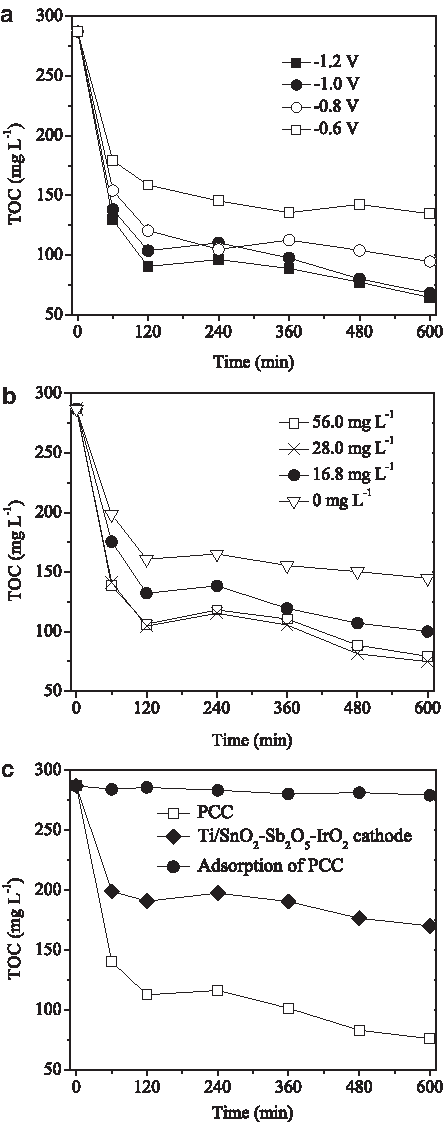
Total organic carbon (TOC) decay with electrochemical treatment time at various cathodic potential
The influence of Fe2+ on TOC decay was investigated by an external addition of FeSO4·7H2O at −1.0 V. Figure 2b shows that Fe2+ can play a key role in the leachate treatment. In the absence of external Fe2+, only 47% of TOC removal was obtained by the 600-min treatment. In contrast, 65% and 74% of TOC removal were obtained when the external Fe2+ concentration was increased to 16.8 and 28.0 mg/L, respectively. However, further increase in the Fe2+ concentration to 56.0 mg/L did not bring about further improvement in TOC removal. It has been reported that an excess of Fe2+ would consume ·OH, reducing the oxidation power of the electro-Fenton process (Brillas et al., 2007). Consequently, 28.0 mg/L Fe2+ has been used for the subsequent experiments.
Generally, the anodic oxidation can be considered as the main mechanism for organic degradation in the absence of external Fe2+. In fact, in this case, the electro-Fenton oxidation has also been accounted for the degradation due to the presence of total iron ions, including Fe2+ and Fe3+ (3.6 mg/L), in the biotreated leachate. Fe2+ can take part in the Fenton reaction directly, while Fe3+ can be reduced to Fe2+ by the PCC promoting the Fenton reaction indirectly (Chu et al., 2013).
After the PCC was dipped into the leachate, samples were drawn at a given time for TOC analysis to learn about the influence of PCC adsorption on TOC removal. Figure 2c shows that the TOC decay resulting from the PCC adsorption is so weak that its influence can be neglected. Furthermore, the two comparative experiments of electrochemical treatment were conducted to test the performance of PCC with 28.0 mg/L Fe2+ under a similar current condition. In one experiment, the PCC and Ti/SnO2-Sb2O5-IrO2 anode were used, while in another experiment, Ti/SnO2-Sb2O5-IrO2 was used for both the anode and cathode. It is observed from Fig. 2c that the former can offer a faster TOC decay than the latter. Because H2O2 cannot be electrogenerated by O2 reduction at the Ti/SnO2-Sb2O5-IrO2 electrode, there was no electro-Fenton oxidation for pollutant degradation. In contrast, when the PCC was used, both electro-Fenton oxidation and anodic oxidation were accounted for pollutant degradation.
Figure 3 shows the decay of COD obtained at −1.0 V with 28.0 mg/L Fe2+. The COD concentration was reduced from 590 to 116 mg/L by the electrochemical treatment of 600 min. The technical feasibility of the electrochemical treatment is evaluated in terms of pollutant removal performance, while economic feasibility is usually determined by the EC (Brillas et al., 2009). It is defined as the amount of energy consumed per unit mass of COD removed. The cumulative EC during the treatment is also shown in Fig. 3. The EC increases upon prolonged treatment time and further COD removal requires higher EC. The treatment of 600 min presented an EC value of 52.5 kwh/(kg COD), lower than most results reported under the conditions of approximate wastewater characteristics (Szpyrkowicz et al., 1995; Panizza and Cerisola, 2009; Zhu et al., 2009).

Chemical oxygen demand (COD) and electricity consumption (EC) variation during the electrochemical treatment at −1.0 V with 28.0 mg/L Fe2+.
An obvious change in leachate color was observed during the electrochemical treatment. The quick color decay has been achieved from the original yellow color to a colorless level. The yellow color of the biotreated leachate is from some organic compounds (Zouboulis et al., 2004), including humic substances (Qi et al., 2012), so the color decay indirectly shows the efficient degradation of organic pollutants.
The NH3-N and TN concentration decay obtained at −1.0 V with 28.0 mg/L Fe2+ is shown in Fig. 4a. Before the treatment, NH3-N of 7.0 mg/L and TN of 68.4 mg/L were contained in the biotreated landfill leachate, while the difference of 61.4 mg/L mainly represented the amount of organic nitrogen and nitrate nitrogen (NO3—N). The NH3-N and TN concentration values drop to 0.1 and 27.8 mg/L, respectively, by the treatment of 600 min, indicating that this electrochemical process is able to efficiently eliminate various types of nitrogen from the landfill leachate during the organic pollutant degradation. Some studies have reported that the presence of Cl− can enhance NH3-N removal by the electrochemical oxidation due to the generation of hypochlorous (HClO) and hypochlorite ion (ClO−) (Zhu et al., 2009; Anglada et al., 2010), which was confirmed in this work. This enhancement can be explained by the following reactions:
A comparative experiment was conducted using the leachate containing 3,000 mg/L Cl− by the addition of NaCl, leading to the more rapid decay of NH3-N and TN (Fig. 4b). Figure 4 shows that the decay speed of NH3-N is slower in 60–240 min than that of any other time, which can be explained by the conversion for organic nitrogen. During the electrochemical treatment, organic nitrogen is usually converted to NH4+ and NO3−, whereas the generated NO3− can be efficiently reduced to NH4+ at the PCC. Thus, NH4+ can be considered as the final product of organic nitrogen conversion, followed by the oxidation of HClO leading to TN removal in the acid leachate.

Concentration evolution of NH3-N and total nitrogen (TN) during the treatment of biotreated landfill leachate at −1.0 V using 28.0 mg/L Fe2+ with a Cl− concentration of 1,560 mg/L
Toxicity decay
The DHA has been widely used to test the toxicity of wastewaters or soils (Diamantino et al., 2001). In this work, the toxicity of landfill leachate was evaluated by the DHA of activated sludge. Three leachate samples prepared by the electrochemical treatment of 120, 240, and 360 min at −1.0 V with 28.0 mg/L Fe2+ and one untreated sample were provided for the DHA analysis.
Figure 5 shows that the contact time of activated sludge and leachates has a significant effect on the DHA values. For the untreated leachate, the DHA of activated sludge rapidly decreases to 82.8 from 356.0 mg TF/(L• h) in 120 min, and finally decreases to 9.4 mg TF/(L• h) at 600 min. This result shows that the raw biotreated landfill leachate has a higher toxicity and can pose a strong inhibition on the microbial activity. In contrast, the decrease in speed of DHA caused by leachates treated with the electrochemical process is relatively slower. A longer electrochemical treatment can lead to less decay of DHA. More importantly, the DHA does not decrease continuously, but increases after 360 min, which exhibits that the microorganism contained in the activated sludge gradually adapts to the leachate environment. From the above results, it can be concluded that the electrochemical oxidation has evidently reduced the toxicity of landfill leachate.
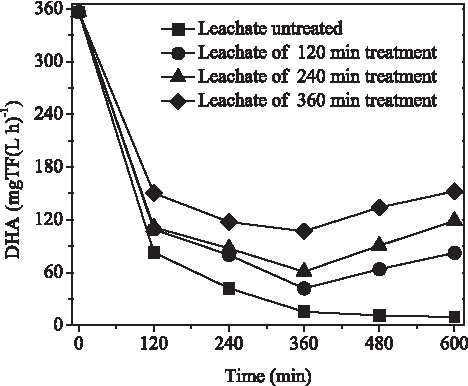
Effect of the electrochemical treatment on the dehydrogenase activity (DHA) of activated sludge.
The variation of BOD5/COD ratio during the electrochemical treatment is shown in Fig. 6. Before the treatment, the BOD5/COD ratio is ∼0.04 indicating a poor biodegradability for the biotreated landfill leachate. However, the ratio increases notably with the prolonged treatment and the final ratio of 0.37 was achieved by the treatment of 480 min. The presented electrochemical treatment has enhanced the biodegradability of the leachate. Generally, apart from salinity, the biodegradability of wastewater is associated with their toxicity and the characteristics of organic pollutants. The decay in toxicity by the electrochemical treatment is one of the reasons for the enhancement in biodegradability. On the other hand, the poor biodegradability of the biotreated landfill leachate is partly due to its higher content of humic substances. Therefore, the enhancement in biodegradability also indicated the destruction of those humic substances.
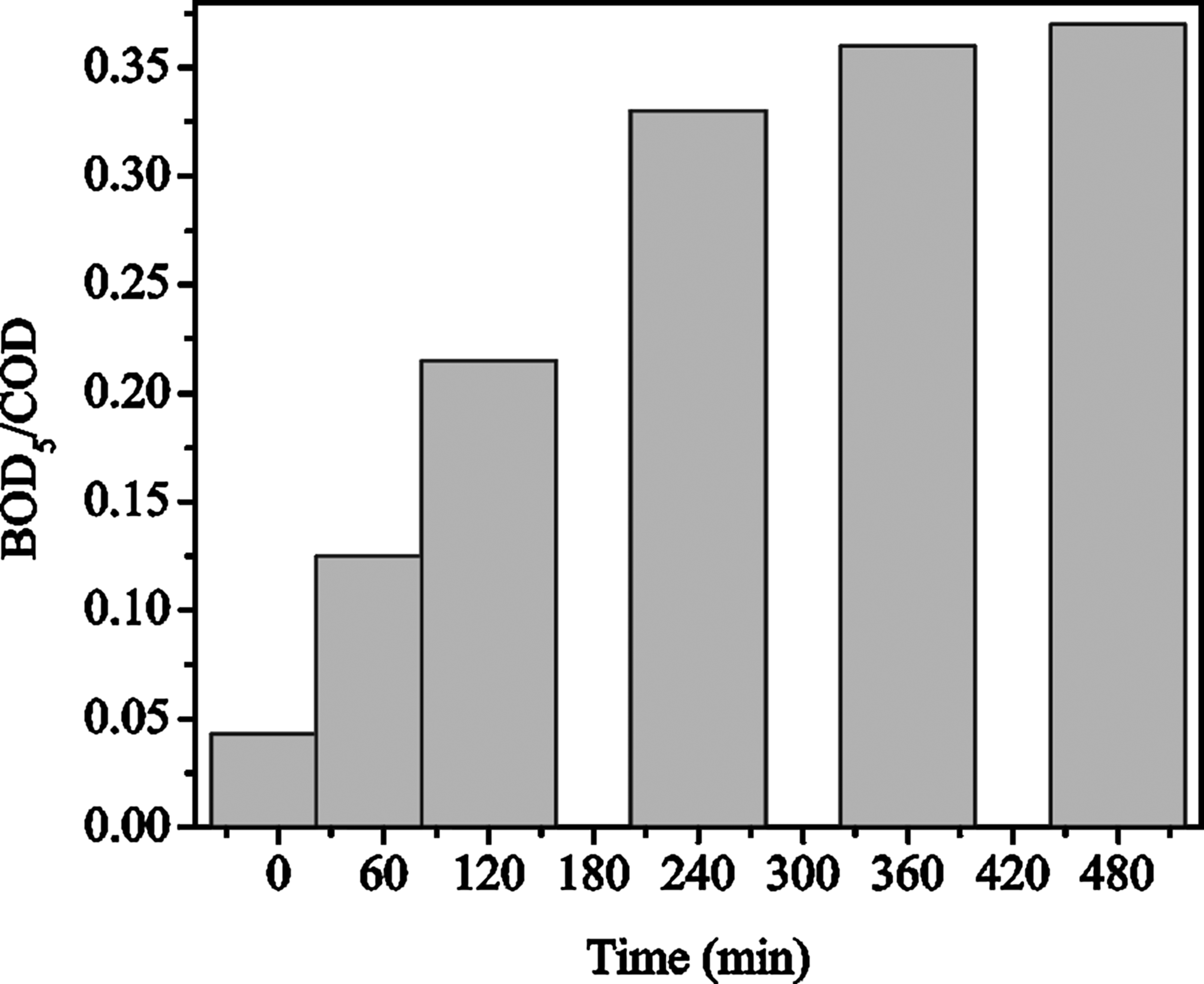
Variation of BOD5/COD ratio during the treatment under the same conditions as Fig. 5.
Conclusions
The electrochemical oxidation process with the Ti/SnO2-Sb2O5-IrO2 anode and PCC is able to efficiently remove organic and inorganic pollutants from the biotreated landfill leachate. In this electrochemical process, the anodic oxidation and electro-Fenton oxidation simultaneously play key roles in the degradation of organic compounds. The presence of Cl− is in favor of NH3-N and TN removal in the acid leachate. The electrochemical treatment of 600 min carried out at −1.0 V with 28.0 mg/L Fe2+ is able to present 74% TOC removal, 80% COD removal, as well as nearly complete NH3-N and color removal. The electrochemical treatment is able to bring the decrease in toxicity. The biodegradability can be enhanced by the electrochemical treatment due to the decrease of leachate toxicity and generation of readily biodegradable compounds; therefore, the electrochemical treatment followed by the aerobic biological treatment might be a possible process to deal with the biotreated landfill leachate.
Footnotes
Acknowledgment
This research was funded by the National Natural Science Foundation of China under grant No. 50808103.
Author Disclosure Statement
The authors declare that no competing financial interests exist.