




Abstract
Abstract
A novel type of adsorptive material, sodium dodecylbenzenesulfonate (SDBS)-citrate-layered double hydroxide (LDH), was synthesized by modifying Mg-Al LDH with both SDBS and citrate using the ion-exchange method for the first time. Modified LDH was characterized by powder X-ray diffraction, Fourier transform infrared spectroscopy, low-temperature N2 adsorption, and elemental analysis. Results indicated that DBS− and citrate3− anions were intercalated in the LDH interlayers, and surface hydrophobicity increased after modification. SDBS-citrate-LDH can simultaneously adsorb p-cresol and Cu2+ (or Cd2+) from the mixed solution. p-Cresol adsorption was attributed to a partition retention mechanism (adsolubilization of p-cresol into the interlayer three-dimensional organic phase formed by DBS− anions). Cu2+ (or Cd2+) adsorption was dominated by formation of complexes between Cu2+ (or Cd2+) and citrate3− anions in the interlayer of modified LDH. Negative values of ΔGo and ΔHo observed for p-cresol, Cu2+, and Cd2+ adsorption confirmed the spontaneity and exothermic nature, respectively, of the removal process. Negative value of ΔSo revealed decreased randomness after adsorption. All results indicated potential application of SDBS-citrate-LDH in treating wastewater containing both organic compounds and heavy metals, which are frequently encountered together.
Introduction
W
Layered double hydroxides (LDHs), also known as anionic clays or hydrotalcite-like compounds, are bidimensional solids with a structural positive charge. The structure of LDHs is shown in Fig. 1 (Goh et al., 2008). LDHs consist of octahedral double hydroxyl layers that are isostructural to the brucite layer [Mg(OH)2] with exposed positive surface charges and interlayer anions (Du and Qu, 2006; Hu et al., 2007). The general formula of an LDH can be expressed as [M2 + 1-xM3+ x (OH)2]x+(An−x/n)x−·mH2O, where M2+ and M3+ are divalent and trivalent cations, respectively, occupying the octahedral central positions within the hydroxide layers, and An− is the interlayer anion balancing the positive charges on the layers. The application of LDHs has been successful for binding hydrophilic organic and inorganic anionic contaminants from water because of their structural positive charge. LDHs have also been intercalated with different ligands, that is, diethylenetriaminepentaacetate (Pavlovic et al., 2009), ethylenediaminetetraacetate (Tarasov et al., 2003; Pérez et al., 2006), nitrilotriacetate (Kaneyoshi and Jones, 1999), and organic acids (Kameda et al., 2008) to customize the scavenging action of these solids to metal cations. Moreover, LDHs intercalated with anionic surfactants have enhanced their adsorptive capacity for organic pollutants (You et al., 2002; Klumppa et al., 2004; Kameda et al., 2005; Costa et al., 2008; Zhang et al., 2012). We have shown that LDH modified with both sodium dodecylsulfate and ethylenediaminetetraacetate (SDS-EDTA-LDH) can adsorb simultaneously Cu2+ and p-cresol (Li et al., 2013). However, there is still insufficient information of simultaneous removal of heavy metal and organic pollutants using modified LDHs.

Schematic crystal structure of layered double hydroxides (LDHs).
In this work, Mg-Al LDH modified with both sodium dodecylbenzenesulfonate (SDBS) and citrate (SDBS-citrate-LDH) was synthesized. The aim is to study the simultaneous uptake process of heavy metal cation and organic compounds by SDBS-citrate-LDH using Cu2+ (or Cd2+) and p-cresol as metallic cation and organic compound models, respectively. Cu2+ and Cd2+ were selected as metallic cation models based on the stability of the chelates formed between citrate and many metals. The simultaneous adsorption behavior and mechanism of heavy metal cation (Cu2+ or Cd2+) and p-cresol in the mixture solution on SDBS-citrate-LDH were investigated. The results provided evidence that SDBS-citrate-LDH can be used to treat wastewater containing both organic and heavy metal pollutants.
Experimental
Materials
All the reagents were of analytical grade (Shanghai Jingchun Scientifical Co.). Distilled water was used and decarbonated by boiling and bubbling N2 before application in all synthesis steps.
Modification of Mg-Al LDH with dodecylbenzenesulfonate and citrate
The Mg-Al LDH sample was prepared by the coprecipitation method (Qiu and Hou, 2009), in which Mg(NO3)2, Al(NO3)3 (molar ratio of Mg2+/Al3+ is 2), and ammonia were used. The SDBS-citrate-LDH nanocomposite was obtained by the ion-exchange method as follows. Aqueous solution of SDBS was prepared by dissolving the calculated amount (50% theoretical anion-exchange capacity [TAEC] of LDH) of SDBS in distilled water. The synthesized Mg-Al LDH was added to 0.1 M SDBS solution with a solid/solution ratio of 1 g per 50 mL, and the pH of the suspension was maintained at 10 by adding NaOH solution. The suspension was shaken at 200 r/min on a reciprocal shaker for 24 h at 293 K. Subsequently, the calculated amount of sodium citrate (more than 50% TAEC of LDH) was added into the above suspension, and the pH was maintained at 10. The dispersion was bubbled with N2 gas during the whole process. After 24 h, the suspension was centrifuged, and the supernatant solution was decanted. The solid material was washed thrice with distilled water and oven-dried at 338 K until a constant weight and SDBS-citrate-LDH was obtained.
For comparison, SDBS-LDH (Mg-Al LDH modified with SDBS) and citrate-LDH (Mg-Al LDH modified with citrate) nanocomposites were also obtained by the ion-exchange method (You et al., 2002), which was similar to the preparation method of SDBS-citrate-LDH, and only SDBS or sodium citrate amount of 50% TAEC of LDH was used.
Characterization
The structure and physicochemical properties of LDH, SDBS-LDH, citrate-LDH, and SDBS-citrate-LDH samples were characterized by powder X-ray diffraction (XRD), Fourier transform infrared (FTIR) spectroscopy, low-temperature N2 adsorption, and elemental analysis.
XRD patterns of powder samples were recorded at room temperature under air conditions on a Rigaku D/max-γB diffractometer with Cu Kα radiation.
FTIR spectra were obtained on a Nicolet 380 FT-IR in the range of 400–4,000 cm−1 using the KBr disc technique.
Specific surface areas of samples were determined using a sorptiometer (Autosorb-iQ; Quantachrome Co.). Samples pretreated by heating at 333 K under a vacuum for 2 h were used to determine the surface areas at 77 K using N2 as the adsorbate. Specific surface area was calculated by the BET equation.
Elemental chemical analyses for Mg and Al of the samples were determined by atomic absorption spectrometry (Z-2000; Hitachi Co. Ltd.). Samples were dissolved in concentrated HCl. The Mg content was determined by adding strontium chloride to suppress the effect of Al interference. Elemental compositions (C, N, and S) of the samples were determined using a Vario EL cube CHNSO elemental analyzer (Elementar) through the dry combustion method.
Batch adsorption studies
Batch adsorption experiments were conducted by contacting 25 mL of mixed solution containing 10–200 mg/L of heavy metal ion (Cu2+ or Cd2+) and 5–100 mg/L of p-cresol with 50 mg of SDBS-citrate-LDH sample as an adsorbent at 200 r/min and fixed temperature for 240 min to ensure apparent equilibrium. The initial pH of the system was fixed at 5.5 by adding HCl solution. When the equilibrium was obtained, the suspension was separated by centrifugation (12,000 r/min for 15 min), and the supernatant solution was analyzed for residual Cu2+, Cd2+, and p-cresol concentrations. After reaching the adsorption equilibrium, the final pH of suspensions was maintained around 5.7. Therefore, the adsorption of Cu2+ or Cd2+ was not attributed to the formation of (Cu2+ or Cd2+) the precipitate. The concentrations of Cu2+ and Cd2+ in the supernatant were measured by flame atomic adsorption spectrometry with a Hitachi Z-2000 atomic absorption spectrometer. The p-cresol concentration in the supernatant was determined by UV adsorption on a Hitachi U-3900 UV/Vis spectrophotometer at a wavelength of 277 nm and all the pH values of p-cresol solution were adjusted to 8.0 by using a buffer before each determination, after which the adsorbed amount was calculated. The quantity adsorbed was plotted against the respective equilibrium Cu2+, Cd2+, or p-cresol concentration.
A preliminary kinetic investigation was performed over 600 min, and the adsorption equilibrium time was 200 min. Therefore, 240 min was selected in the adsorption thermodynamic experiment mentioned above.
For comparison, the adsorption behavior of LDH, SDBS-LDH, and citrate-LDH for p-cresol (Cu2+ or Cd2+) at 293 K was investigated.
The effect of temperature (293–313 K) on SDBS-citrate-LDH adsorption for Cu2+ (or Cd2+) and p-cresol from the mixed solution was also studied.
Results and Discussion
Sample characterization
XRD patterns of LDH, SDBS-LDH, citrate-LDH, and SDBS-citrate-LDH samples are shown in Fig. 2. The XRD pattern of the synthesized Mg-Al LDH consisted of both sharp and symmetrical peaks at (003), (006), and (009), as well as some high-angle asymmetrical peaks, which provided evidence of a well-crystallized LDH (Ulibarri et al., 2001). In general, the d003 value is represented as the size of interlayer spacing of the samples. The d003 values of LDH, citrate-LDH, and SDBS-LDH were 0.87, 1.15, and 2.94 nm, respectively. The basal spacing (d003) of 0.87 nm showed the interlayer of NO3− species. The increasing basal spacing values for citrate-LDH and SDBS-LDH were attributed to the replacement of NO3− interlayer anions with citrate3− and DBS− anions, respectively, and these results were consistent with those reported by You et al. (2002) and Zhang et al. (2004). The XRD pattern of the SDBS-citrate-LDH sample was similar to that of SDBS-LDH because the molecular size of citrate3− anions (Zhang et al., 2004) is smaller compared with the DBS− anions, and the basal spacing increase resulted from the intercalation of the latter.
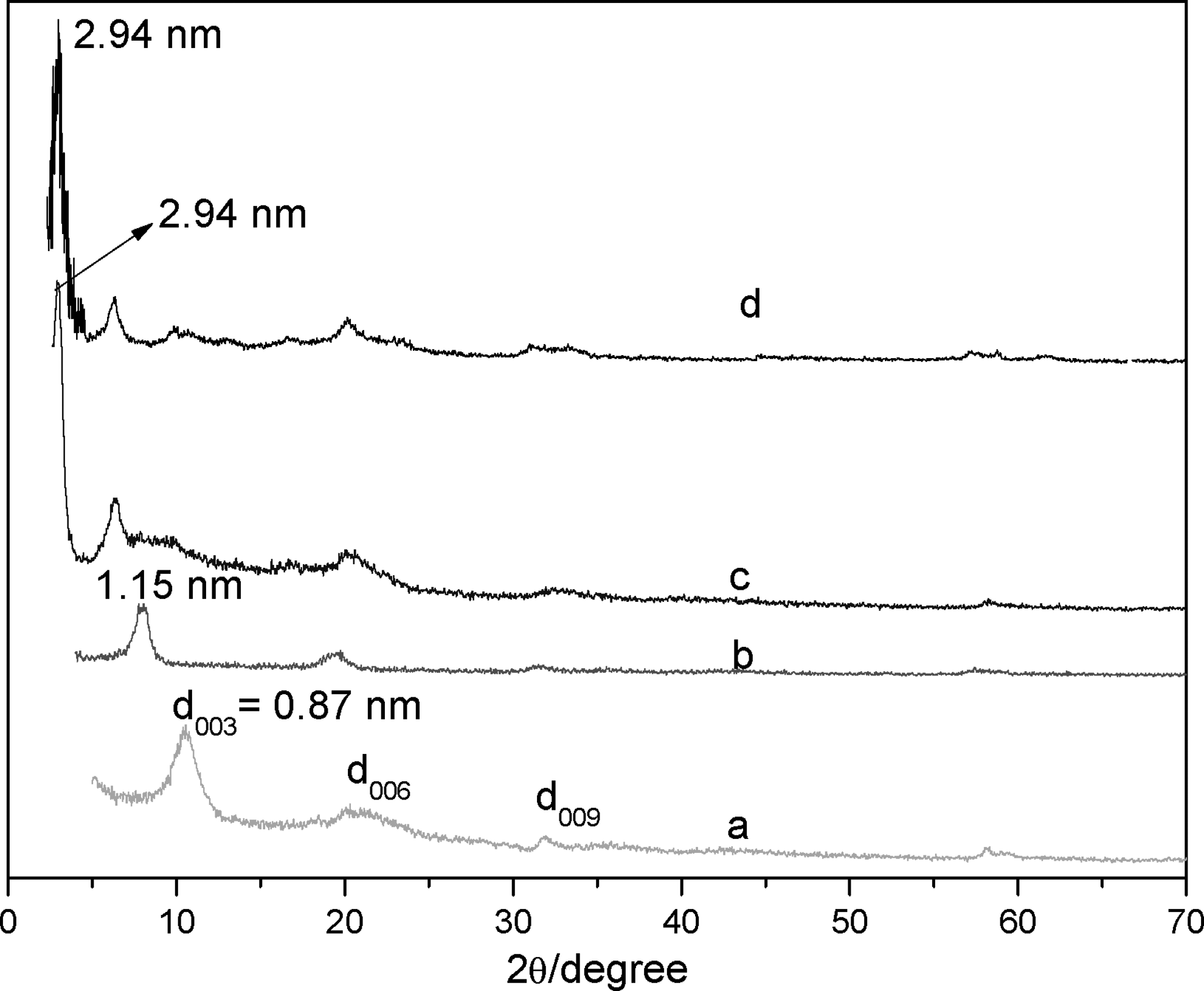
X-ray diffraction patterns of LDH (a), citrate-LDH (b), sodium dodecylbenzenesulfonate (SDBS)-LDH (c), and SDBS-citrate-LDH (d).
Figure 3 shows the FTIR spectra of LDH, SDBS-LDH, citrate-LDH, and SDBS-citrate-LDH. The FTIR spectrum of LDH showed the broad absorption bands at ∼3,500 cm−1 arising from the stretching mode of −OH groups in the brucite-like layer and physisorbed water (Cavani et al., 1991); the band at 1,382 cm−1 was ascribed to NO3− stretching vibration (Yang et al., 2006) and the band at 670 cm−1 to M-O and M-O-H stretching vibrations related to LDH layers (Reis et al., 2004). The FTIR spectrum of SDBS-LDH could be roughly attributed as follows (Zhao and Nagy, 2004): (1) C–H stretching vibrations (2,850–2,965 cm−1); (2) C–H bending vibrations (1,467 cm−1); and (3) vibration of the −SO3 group (1,039 and 1,130 cm−1). For citrate-LDH, indicatives of citrate intercalated in the LDH interlayer were clearly observed: the two bands at 1,605 and 1,393 cm−1 were caused by the asymmetric and symmetric stretching vibrations of the −COO− group (Rojas et al., 2009). The FTIR spectrum of SDBS-citrate-LDH displayed the absorption bands characterized by both DBS−− and citrate anions.

Fourier transform infrared spectra of LDH (a), SDBS-LDH (b), citrate-LDH (c), and SDBS-citrate-LDH (d).
Specific surface areas and chemical analyses of LDH, SDBS-LDH, citrate-LDH, and SDBS-citrate-LDH are listed in Table 1. The modification of Mg-Al LDH decreased the specific surface area, and the specific surface area decreased in the order of LDH>citrate-LDH>SDBS-LDH>SDBS-citrate-LDH. The decrease of specific surface area resulted from blocking the pores of aggregates and increasing the aggregation of particles after intercalation, and similar phenomena have been reported by You et al. (2002) for intercalation of anion surfactants into LDH.
LDH, layered double hydroxide; SDBS, sodium dodecylbenzenesulfonate.
Chemical analysis results (Table 1) indicated that the Mg/Al molar ratio values of LDH, SDBS-LDH, citrate-LDH, and SDBS-citrate-LDH were in good agreement with the expected results (very close to the values in the starting solution), and the slightly decreased Mg/Al ratio suggested a preferential dissolution of Mg(OH)2 octahedral (pKPs (Mg(OH)2)=10.7, pKPs (Al(OH)3)=32.7, Speight, 2005). For SDBS-LDH (or citrate-LDH), the DBS− (or citrate3−) anions compensated 47% (or 51%) of the total charge in the interlayer and the other positive charge was compensated by NO3− anions, which existed in the original LDH. For SDBS-citrate-LDH, the citrate3− and DBS− anions compensated 54% and 46% of the total charge, respectively, because the amount of sodium citrate added later was overdosed and almost all remaining NO3− anions in the interlayer can be replaced by citrate3− anions.
Isotherms of adsorption
Adsorption of p-cresol on SDBS-citrate-LDH
Figure 4 displays the adsorption isotherm curves of p-cresol on LDH, citrate-LDH, SDBS-LDH, and SDBS-citrate-LDH. In the range of p-cresol concentration studied, the equilibrium adsorption amount (qe, mg/g) increased with the increasing equilibrium p-cresol concentration (ce, mg/L), and the adsorption amount of p-cresol was ranked as LDH<citrate-LDH<<SDBS-LDH<SDBS-citrate-LDH.
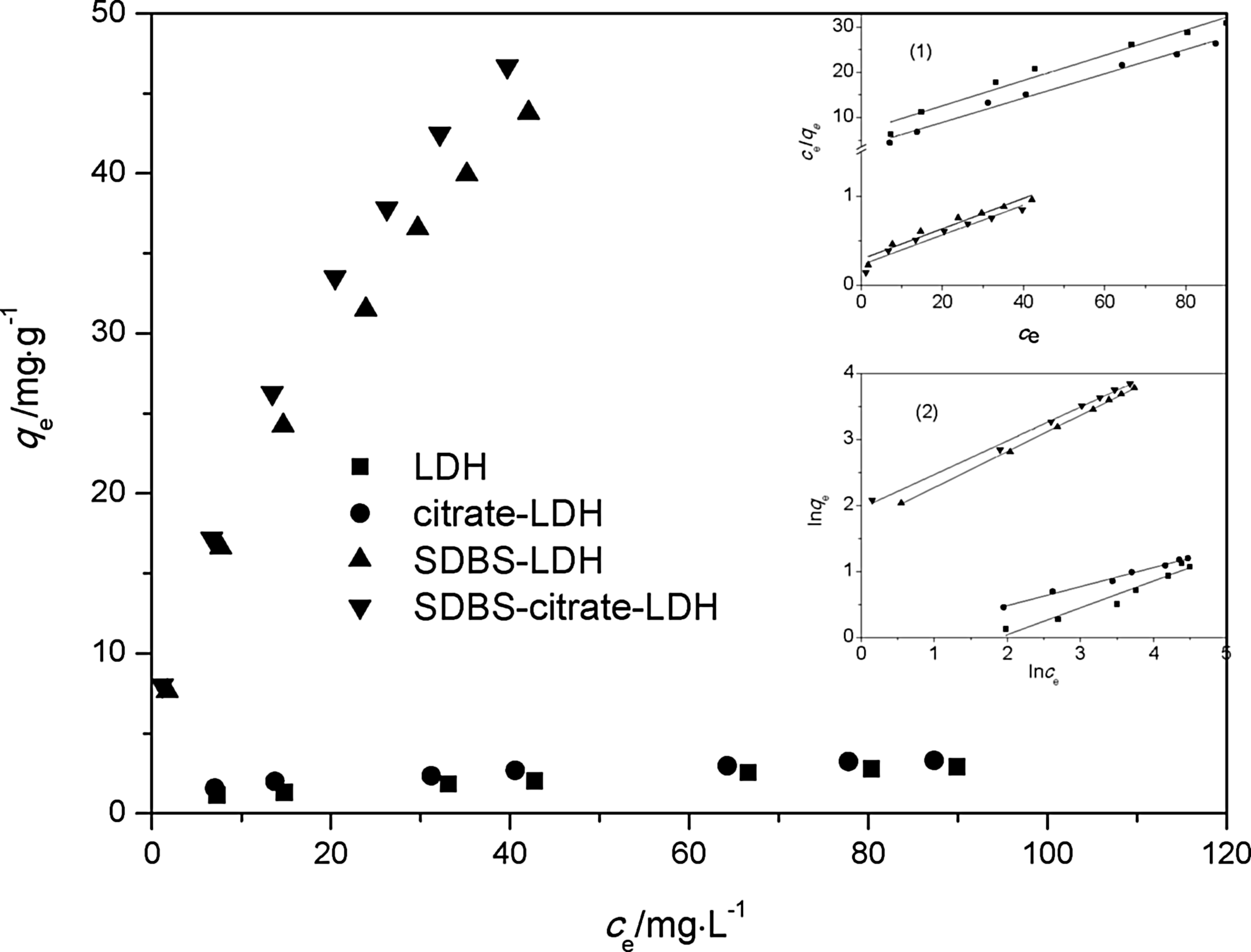
Adsorption isotherms of p-cresol at 293 K (conditions: adsorbent dosage=2 g/L; pH=5.5). Inset is linearized isotherm plots for the adsorption: (1) Langmuir isotherm; (2) Freundlich isotherm.
Langmuir and Freundlich isotherms have been widely used for the fitting of adsorption data. The Langmuir isotherm assumes monolayer coverage of the adsorbate over a homogeneous adsorbent surface, while the Freundlich isotherm is not restricted to the formation of a monolayer. These two isotherm models are described as Equations (1) and (2), respectively:
where qe (mg/g) and ce (mg/L) are the concentrations of the adsorbate in the solid and liquid phases at equilibrium time; KL is the Langmuir constant; qm (mg/g) is the maximum loading capacity of adsorbents; and KF and n are Freundlich constants of adsorption capacity and intensity. The value of n indicates a favorability of adsorption when higher than 1.0, and a larger KF value reflects a larger overall adsorption capacity. Equations (1) and (2) can be rearranged as follows:
Sum of the squares of the differences between the experimental and calculated adsorption amount is a common error function. Therefore, the validity of the models was determined by calculating the standard deviation (SD, %), which was calculated using the following equation:
where the subscripts exp and cal refer to the experimental and the calculated qe, and n is the number of data points.
Langmuir and Freundlich constants of the adsorption of p-cresol on LDH, SDBS-LDH, citrate-LDH, and SDBS-citrate-LDH were calculated from the slopes and intercepts of the plots of ce/qe versus ce [inset (1) in Fig. 4] and lnqe versus lnce [inset (2) in Fig. 4] and are summarized in Table 2. From Table 2, we can conclude the following: (1) The adsorption data of p-cresol on the LDH were well-fitted by the Langmuir isotherm model, as demonstrated by the higher correlation coefficient (R2) and lower SD values compared to those of the Freundlich isotherm. (2) For citrate-LDH, SDBS-LDH, and SDBS-citrate-LDH, the Freundlich isotherm showed better fit to the adsorption. The magnitude of the exponent n (>1.0) suggested that SDBS-LDH and SDBS-citrate-LDH had favorable adsorption abilities for removing p-cresol in the aqueous solution. The KF value of SDBS-citrate-LDH was higher compared with SDBS-LDH, indicating that the former had a larger overall adsorption capacity for p-cresol.
SD, standard deviation.
LDH was less effective at binding hydrophobic p-cresol (1-methyl-4-hydroxybenzene, CH3(C6H4)OH) because LDH is hydrophilic. The adsorption data of p-cresol on the LDH were well-fitted by the Langmuir isotherm, which might be due to the monolayer adsorption of p-cresol onto the LDH surfaces. It is well known that nonpolar groups in organic compounds can produce hydrophobic interactions with nonpolar groups in other organic compounds. When citrate3− and (or) DBS− anions were intercalated into the LDH layers, a three-dimensional organic phase can be formed, and the surface hydrophobicity increased. The surface areas of modified LDHs (citrate-LDH, SDBS-LDH, and SDBS-citrate-LDH) were decreased after modification (Table 1), but their adsorption capacities for p-cresol were higher compared with LDH. That is, the surface area and adsorption capacity of modified LDHs were not significantly correlated, suggesting that p-cresol adsorption was unrelated to the surface area, but a partitioning adsorption process. The partition retention mechanism involved adsolubilization of p-cresol into the interlayer three-dimensional organic phase rather than on the external surface of the modified LDHs. Therefore, the Freundlich isotherm showed better fit to the adsorption of p-cresol on citrate-LDH, SDBS-LDH, and SDBS-citrate-LDH. The lower hydrophobicity of citrate-LDH resulted in a relative lower adsorption capacity. When DBS− anions were intercalated into the LDH layers, the hydrophobicity was enhanced dramatically and the adsorption capacities of SDBS-LDH and SDBS-citrate-LDH for p-cresol increased significantly. In addition, the surface property of SDBS-citrate-LDH was the most hydrophobic because of the intercalation of both DBS− and citrate anions, which led to the highest adsorption amount.
Adsorption of heavy metal ions on SDBS-citrate-LDH
Figure 5a and b display the adsorption isotherm curves of Cu2+ and Cd2+, respectively, on LDH, SDBS-LDH, citrate-LDH, and SDBS-citrate-LDH.
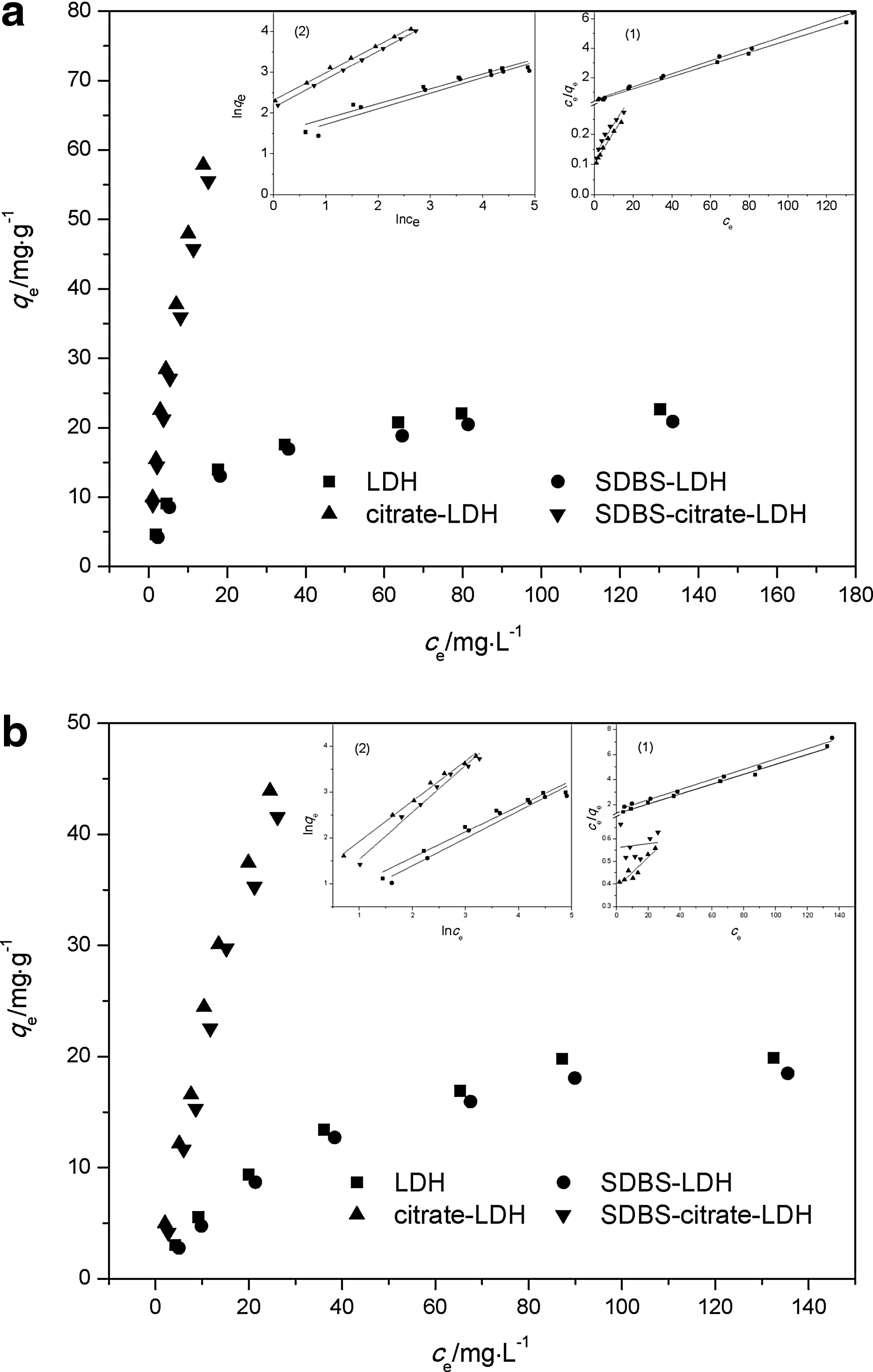
Adsorption isotherms of Cu2+
Adsorption amounts of modified LDH for Cu2+ and Cd2+ increased in the order of SDBS-LDH<LDH<<SDBS-citrate-LDH<citrate-LDH. The adsorption data were fitted to the Langmuir and Freundlich model equations [inset (1) and (2) in Fig. 5a or b, respectively], and the calculated isotherm parameter values, correlation coefficient R2, and SD are listed in Tables 3 and 4. From Tables 3 and 4, we can conclude the following: (1) For LDH and SDBS-LDH, the Langmuir isotherm showed better fit to the adsorption. (2) For citrate-LDH and SDBS-citrate-LDH, the Freundlich isotherm showed better fit. Both citrate-LDH and SDBS-citrate-LDH had favorable adsorption ability for removing Cu2+ and Cd2+ in the aqueous solution, and the former had a larger overall adsorption capacity than the latter.
LDH was a less effective adsorbent for Cu2+ and Cd2+ because of its structural positive charge. When DBS− anions were intercalated into the LDH interlayers, the adsorption capacity of SDBS-LDH for Cu2+ and Cd2+ decreased because of its increased hydrophobic property caused by the intercalation of DBS− anions. For citrate-LDH, the high adsorption capacities for Cu2+ and Cd2+ were attributed to the function of citrate3− anions intercalated in the LDH interlayers. It can also be stated that citrate3− can form chelate complexes ([Cu(C6H5O7)]− or [Cd(C6H5O7)]−) with Cu2+ (or Cd2+) ions. Due to the smaller ionic radius (0.72 Å) and larger electronegativity (1.8) of Cu2+ than those (0.97 Å and 1.5) of Cd2+ (David, 1998; Cornell and Schwertmann, 2003), the coordinating ability of citrate3− anion with Cu2+ is stronger than that with Cd2+ and the chelate formation constants are 5.9 and 3.7 for Cu2+ and Cd2+ (Sillen and Martell, 1964; Smith and Martell, 1989), respectively. Therefore, the adsorption amount of Cu2+ on citrate-LDH was higher compared with Cd2+ at the same concentration. Similarly, the adsorption amount of Cu2+ on SDBS-citrate-LDH was also higher compared with Cd2+ at the same concentration, suggesting the adsorbent preferred to take up Cu2+ over Cd2+. The adsorption capacities of SDBS-citrate-LDH for Cu2+ and Cd2+ were a little lower compared with citrate-LDH due to the stronger hydrophobic property of SDBS-citrate-LDH.
Effect of temperature
The isotherm data of p-cresol, Cu2+, and Cd2+ adsorption by SDBS-citrate-LDH at different temperatures (293, 303, and 313 K) were also collected to investigate the effects of temperature on the adsorption process (Fig. 6a–c). For p-cresol, Cu2+, or Cd2+, the KF value (Table 5) and adsorption amount (qe) slightly decreased as the temperature increased. Each adsorption could be a temperature-dependent process, which demonstrated a remarkable decrease in KF and qe values as temperature increased, suggesting that the adsorption was exothermic in nature.
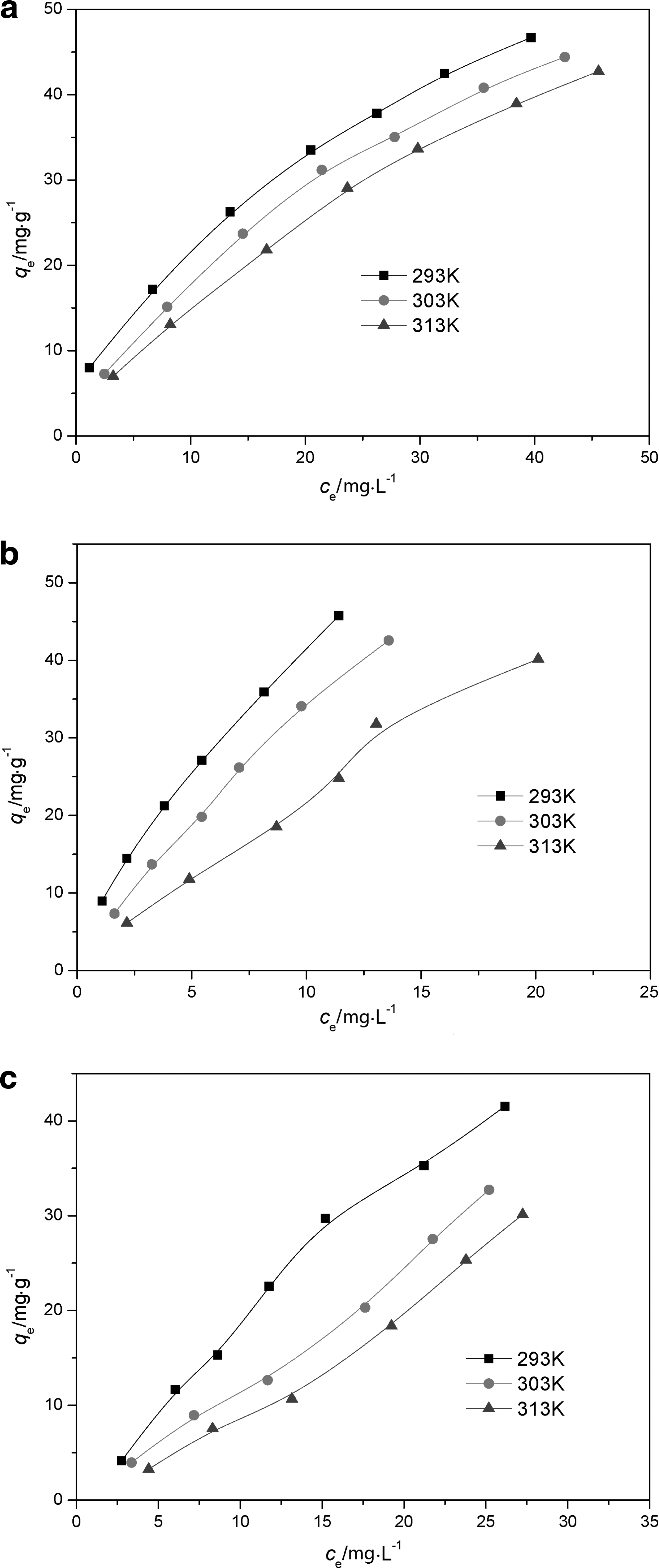
Effect of temperature on SDBS-citrate-LDH adsorption of p-cresol
Temperature dependence of adsorption was related to changes in the thermodynamic parameters, namely, Gibbs free energy (ΔGo), standard enthalpy (ΔHo), and entropy (ΔSo). These three parameters were calculated with the following equations and van't Hoff plot (Di Vincenzo and Sparks, 2001):
where T is temperature (K), Kd is the distribution coefficient (L/g), and R is the standard molar gas constant (8.314 J/mol/K). ΔHo and ΔSo were obtained from the slope and intercept of plots (lnKd vs. l/T). The free energy (ΔGo, kJ/mol) at different temperatures was calculated by Equation (7). The thermodynamic parameters obtained from the line are presented in Table 6. For p-cresol, Cu2+, and Cd2+, the negative values of ΔGo and ΔHo indicated the spontaneity and exothermic nature of the adsorption process, implying that the hydrophobic force and coordination were strong enough to break the potential and drive the p-cresol, Cu2+, and Cd2+ into the interlayer region of SDBS-citrate-LDH. The more negative value of ΔGo with decreasing temperature showed that the adsorption favored under lower temperature. The negative value of ΔSo indicated the decreased randomness after adsorption.
Comparison with other adsorbents
Results of Tables 2, 3, and 4 show that most of the correlation coefficients (R2) for Langmuir isotherms ranged between 0.940 and 0.999, representing a comparatively good fit of observed data. Therefore, the maximum adsorption capacities (qm) obtained by the Langmuir isotherm of SDBS-citrate-LDH for p-cresol (Cu2+ and Cd2+) were compared with those of other adsorbents previously studied, and the results are listed in Table 7. As can be seen, the p-cresol (Cu2+ and Cd2+) adsorption capacities of SDBS-citrate-LDH were much higher than those of LDH studied in this article. Furthermore, these values were also higher than other adsorbents listed in Table 7. Such comparison suggested that SDBS-citrate-LDH may be an effective adsorbent for simultaneous removal of p-cresol and Cu2+ (or Cd2+) from contaminated water. It is also encouraging to note that the LDH can be prepared easily, and the synthesis process of SDBS-citrate-LDH is comparatively simple and is expected to be relatively inexpensive.
In addition, we have reported that SDS-EDTA-LDH can simultaneously adsorb Cu2+ and p-cresol in our previous study (Li et al., 2013), and the adsorption capacities of SDBS-citrate-LDH for p-cresol and Cu2+ were compared with those of SDS-EDTA-LDH. Because the fitted results by the Freundlich isotherm model in two studies were in good agreement with the experimental data, the KF values were compared to describe the adsorption capacity. The KF values of SDS-EDTA-LDH for p-cresol and Cu2+ were 2.31 and 11.43 and those of SDBS-citrate-LDH were 7.10 and 8.45, respectively. That is, the adsorption capacity of SDBS-citrate-LDH for p-cresol (or Cu2+) was higher (or lower) compared with SDS-EDTA-LDH, which was attributed to the higher hydrophobicity of SDBS than SDS or the lower coordination ability of citrate than EDTA with Cu2+. Similarly, the adsorption capacity of SDBS-citrate-LDH for Cd2+ was lower compared with ZnAl-EDTA-LDH (Pérez et al., 2006) because of the higher coordinating ability of EDTA with Cd2+.
Conclusions
SDBS-citrate-LDH was synthesized by the ion-exchange method. LDH was a less effective adsorbent for p-cresol, Cu2+, and Cd2+. Citrate-LDH had high adsorption capacity for Cu2+ and Cd2+, but less for p-cresol. SDBS-LDH was an effective adsorbent for p-cresol, but a less effective adsorbent for Cu2+ and Cd2+. SDBS-citrate-LDH could adsorb both p-cresol and Cu2+ (or Cd2+) from the mixed solution. p-Cresol adsorption was attributed to a partition retention mechanism. Cu2+ (or Cd2+) adsorption was dominated by the formation of complexes between Cu2+ (or Cd2+) and citrate3− anions in the interlayer. The present study clearly implies the potential of SDBS-citrate-LDH in simultaneously adsorbing organic pollutants and heavy metals, which are frequently encountered together in wastewater. In addition, to get more information about the adsorption mechanism, the effects of pH, metal speciation, and phenol ionization on the adsorption will be studied in our further research.
Footnotes
Acknowledgments
This work was supported by the Natural Science Foundation of the Shanxi Province of China (2013011040-8), the Scientific and Technological Innovation Programs of Higher Education Institutions in Shanxi (2013159), the National Training Programs of Innovation and Entrepreneurship for Undergraduates (201310122002), and the Training Programs of Innovation and Entrepreneurship for Undergraduates in Shanxi (2013358).
Author Disclosure Statement
No competing financial interests exist.