Sedimentation Behavior of Dispersions Composed of Large and Small Charged Colloidal Particles: Development of New Technology to Improve the Visibility of Small Lakes and Ponds
Available accessResearch articleFirst published online June, 2015
Sedimentation Behavior of Dispersions Composed of Large and Small Charged Colloidal Particles: Development of New Technology to Improve the Visibility of Small Lakes and Ponds
In this study, we treat the dirty (small) and the adsorbing (large) particles, which are both of approximately micron-order or smaller, as charged and oppositely charged spheres and investigate the behavior of these particles under the gravity field by means of Brownian dynamics simulations. We have here mainly discussed the dependence of the adsorption rate on the particle diameter ratio, the volumetric fraction of large particles, and the input amount of large particles. Large particles adsorb much more small particles, per large particle, but the total number of small particles adsorbed by the large particles more significantly increases for large particles with smaller diameter if the same input amount of adsorbing agents (large particles) is used. This is because large particles with small diameter more actively perform random motion and move more extensively to adsorb small particles, although the surface area of large particles increases with decreasing diameter, leading to more opportunity to contact small particles. Hence, it is seen that putting numerous adsorbing particles with smaller diameter into water is more effective for removing suspended substances or dirty particles. Even if the input amount of large particles is increased, an adsorption performance cannot significantly be improved because the number of inefficient large particles that do not contribute to the adsorption performance increases. From these results, we understand that an optimal input amount of adsorption agents, from a commercial point of view, should be determined by various factors in the application of the adsorption technique to actual situations.
Introduction
Clean rivers, lakes, or ponds are a very important factor for more significantly enhancing the quality of tourism resources. To obtain such beautiful and attractive water tourism sites, it is indispensable to improve the visibility of small rivers, lakes, or ponds. For example, Kenrokuen in Kanazawa city is one of the most beautiful traditional Japanese gardens in Japan, and this garden is laid out with a variety of gardening techniques around a beautiful pond. Kenrokuen is a water-based Japanese traditional garden; another type of Japanese traditional garden is based on sands. There are numerous water-based tourism sites in Japan, and therefore maintaining water tourism resources in a beautiful state (i.e., good visibility of water) is significantly important for continuously attracting tourists. This study is motivated by this kind of tourism resources circumstances in Japan. It should, therefore, be noted that the present technique for improving the visibility of water is not orientated toward the application to large-scale lakes or rivers with fast flow, but to small lakes, ponds, or creeks with quite slow flow. In Kenrokuen, the bottom of the pond is regularly cleaned by removing the mud sedimented at the surface of the bottom: the main part of the bottom, the shallow sites and the inlet and outlet water path of the pond are regularly cleaned about every 12 years, 3 years, and 2 weeks, respectively. Similar cleaning tasks should be conducted in famous water tourism sites in Japan. Here, we briefly summarize various techniques that are used for developing a water cleaning system.
The fluorescence and absorbance spectroscopy have been applied for estimating organic pollution in polluted rivers (Knapik et al., 2014). Electrochemical methods may be a useful technique for removing organic or other pollutants from water in certain circumstances (Barrera-Diaz et al., 2008; Vasudevan and Lakshmi, 2012). In this study we address the development of a technique improving the visibility of water in small lakes and ponds, and various methods regarding this application field including rivers have already been developed. For example, the method of urging the self-cleansing action of a river by aeration (Okai et al., 2007), the adsorption method that uses an adsorption action of the porous material represented by activated carbon and zeolite (Takami et al., 2000; Ismadji and Bhatia, 2001; Gauden et al., 2006), the filtering method (Wotton, 2002), and the coagulating sedimentation using a flocculant (Adachi et al., 1999). An appropriate method may be chosen according to many factors such as a degree of water pollution and a volume of water to be treated. We here focus on the adsorption method and the coagulating sedimentation method. These methods have been studied mainly from a chemical approach, but a few of works have been conducted from a physical approach, in which diffusion and sedimentation phenomena of dirty particles should be investigated. The behavior of the particles must be clarified to develop a sophisticated adsorption or coagulating sedimentation method.
There are numerous number of studies regarding sedimentation phenomena of particle suspensions (Barker and Grimson, 1990; Buscall, 1990; Wedlock et al., 1990; Petsev et al., 1993; Vissers et al., 1997) and these works were mainly conducted from the viewpoint of clarifying the sedimentation mechanism such as dependence of the sedimentation speed on various factors.
In the previous study (Satoh and Taneko, 2009), we investigated the behavior of the adsorbing particles that capture dirty particles under the circumstance of the gravity field by means of Brownian dynamics simulations. In this study, adsorbing particles were modeled as porous materials that can adsorb dirty particles in the porous holes at the surface and inside. In general, however, dirty particles are charged in a real situation and therefore in addition to the previous porous materials, a new technique using oppositely charged particles as adsorbing agents may be significantly effective. The technique will certainly lead to the development of a more effective method of removing dirty particles from small lakes and ponds.
In this study, we treat the dirty and the adsorbing particles as charged and oppositely charged spheres, respectively, to investigate the behavior of these particles under the gravity field by means of Brownian dynamics simulations. As an interaction between the particles, we take into account a repulsion by an electrical double layer formed around each particle. Capturing particles perform Brownian motion, adsorb dirty particles by the electrical interaction, and sediment in the gravity field direction. Therefore, an adsorption performance will be clarified under various situations of the amount of adsorbing particles and other factors such as ratio of particle diameters. As already pointed out in the regular cleaning tasks in water tourism sites in Japan, these sedimented capturing particles will regularly be removed together with mud from the bottom of the lakes or ponds.
Brownian Dynamics Method
Particle model
A variety of clay materials and other materials such as corrupt plants may be considered as dirty particles that worsen the visibility of lakes and ponds. Actual dirty particles are supposed to be mixtures of these materials, which are strongly dependent on individual local circumstances of lakes and ponds. Hence, exact material quantities including the shape will be determined when we concretely tackle visibility problems of water in a local lake or pond.
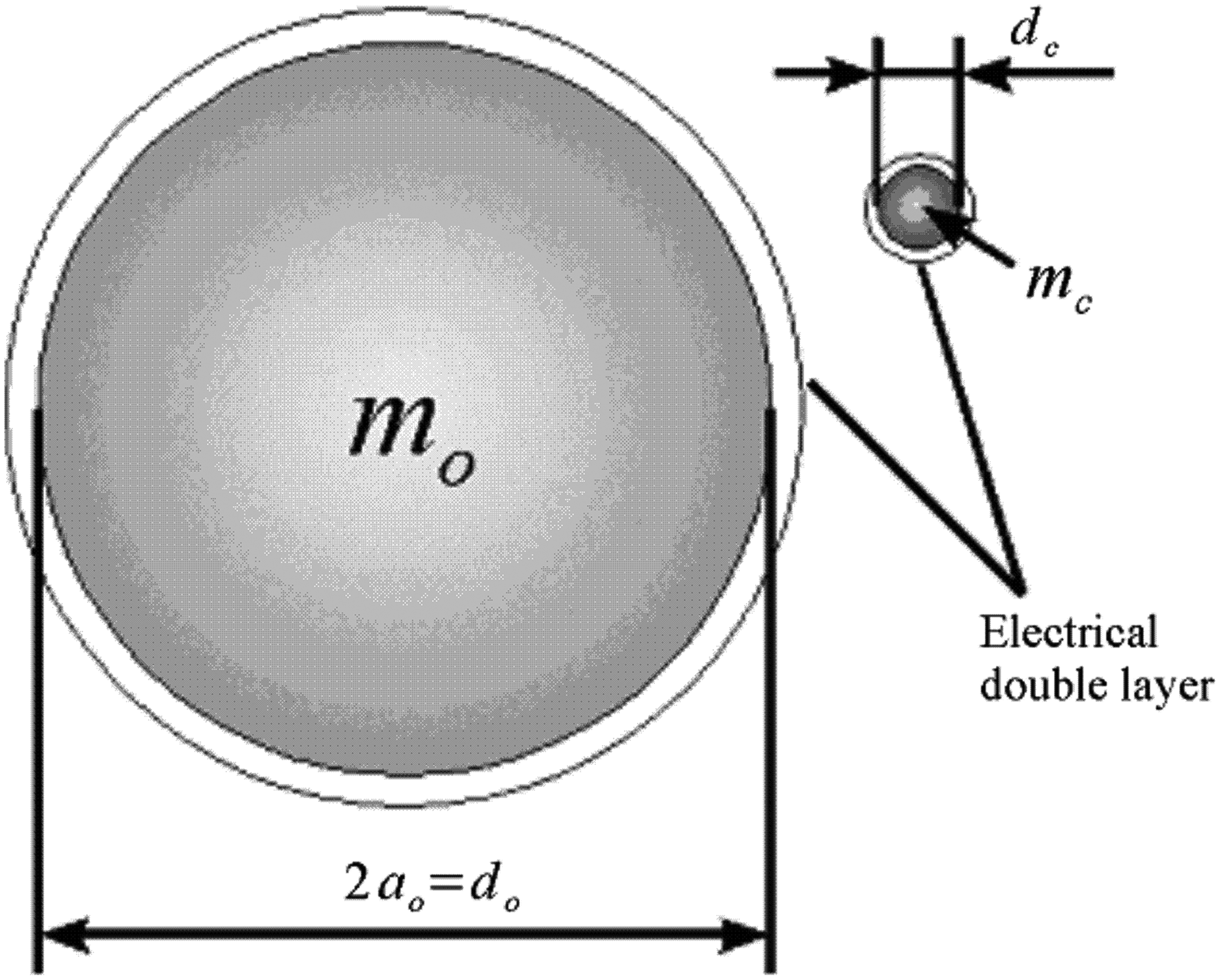
In this study, dirty particles (called small particles below) are modeled as a charged small spherical particle and adsorbing particles (called large particles below) are done as an oppositely charged large spherical particle, as shown in Fig. 1. These particles are assumed to be both of approximately micron-order or smaller, and therefore the Brownian motion of the particles have to be taken into account in simulations. Here, subscripts c and o are used for denoting quantities of charged small spherical particles and oppositely charged large spherical particles, respectively. Dirty particles with diameter dc have a mass mc and adsorbing particles with diameter do have a mass mo. The Derjaguin-Landau-Verwey-Overbeek (DVLO) theory and the hetero aggregation theory (Kitahara and Watanabe, 1972; Tachibana et al., 1981; Kitahara, 1994) are used for electrical particle–particle interactions, denoted by VR. Moreover, the van der Waals interaction energy is taken into account, denoted by VA; this interaction is not due to electrical properties of particles. The net interaction energy Vnet between two charged particles will be the sum of the electrical and the van der Waals interaction energies, that is, Vnet=VR+VA. The expressions of these energies will be shown below.
Particle model.
Interaction energy due to overlap of electrical double layers
DLVO theory and the hetero aggregation theory (Kitahara and Watanabe, 1972; Tachibana et al., 1981; Kitahara, 1994) are based on the diffuse double layer model that was presented by Gouy-Chapman. In this diffuse double layer model, ions are assumed to be a point charge and the density of ions around each dispersed particle is assumed to be followed by the Boltzmann distribution, in which the solvent is treated as a continuum medium with fixed dielectric constant. This model enables one to express an electric potential distribution near a plate as a solution of the Poisson-Boltzmann equation. Since the basic equation, however, is nonlinear, the solution is obtained by introducing Debye-Hückel approximation, which yields the linearized equation. In addition, the Derjaguin approximation gives rise to an interaction energy for the two spherical particles. We now show these expressions in the following paragraph.
For the same kind of spherical particles, for example, for two small particles, an expression for the interaction due to the overlap of the electrical double layers, \documentclass{aastex}\usepackage{amsbsy}\usepackage{amsfonts}\usepackage{amssymb}\usepackage{bm}\usepackage{mathrsfs}\usepackage{pifont}\usepackage{stmaryrd}\usepackage{textcomp}\usepackage{portland, xspace}\usepackage{amsmath, amsxtra}\pagestyle{empty}\DeclareMathSizes{10}{9}{7}{6}\begin{document}
$$V_{c - c}^R$$
\end{document}, is expressed as (Kitahara and Watanabe, 1972; Tachibana et al., 1981; Kitahara, 1994)
\documentclass{aastex}\usepackage{amsbsy}\usepackage{amsfonts}\usepackage{amssymb}\usepackage{bm}\usepackage{mathrsfs}\usepackage{pifont}\usepackage{stmaryrd}\usepackage{textcomp}\usepackage{portland, xspace}\usepackage{amsmath, amsxtra}\pagestyle{empty}\DeclareMathSizes{10}{9}{7}{6}\begin{document}
\begin{align*}V_{c - c}^R = 2 \pi \varepsilon a_c \psi_c^2 \; {
\rm ln} \left[ 1 + { \rm exp} \{ - \kappa ( r - 2 a_c ) \}
\right] \tag{1}\end{align*}
\end{document}
in which
\documentclass{aastex}\usepackage{amsbsy}\usepackage{amsfonts}\usepackage{amssymb}\usepackage{bm}\usepackage{mathrsfs}\usepackage{pifont}\usepackage{stmaryrd}\usepackage{textcomp}\usepackage{portland, xspace}\usepackage{amsmath, amsxtra}\pagestyle{empty}\DeclareMathSizes{10}{9}{7}{6}\begin{document}
\begin{align*}\kappa = \sqrt { \frac { 2000e^2 z^2 N_A C } {
\varepsilon k_B T } } \tag { 2 } \end{align*}
\end{document}
An expression for the two large particles is obtained by replacing subscript c with o in Equation (1). In Equations (1) and (2), r is the center-to-center separation between the two particles, ɛ is the dielectric constant of the solvent, ac is the radius of the small spherical particles, ψc is the surface potential of the small spherical particles, and κ is the Debye parameter (the reciprocal number 1/κ corresponds to the thickness of the electrical double layer). Also, e is the elementary electric charge, z is the ionic valency, NA is the Avogadro number, C is the concentration of the electrolyte, kB is Boltzmann's constant, and T is the temperature of the suspension.
For different kinds of particles, an interaction energy \documentclass{aastex}\usepackage{amsbsy}\usepackage{amsfonts}\usepackage{amssymb}\usepackage{bm}\usepackage{mathrsfs}\usepackage{pifont}\usepackage{stmaryrd}\usepackage{textcomp}\usepackage{portland, xspace}\usepackage{amsmath, amsxtra}\pagestyle{empty}\DeclareMathSizes{10}{9}{7}{6}\begin{document}
$$V_{c - o}^R$$
\end{document} due to the overlap of the electrical double layers was given by Hogg et al. (1966) as
\documentclass{aastex}\usepackage{amsbsy}\usepackage{amsfonts}\usepackage{amssymb}\usepackage{bm}\usepackage{mathrsfs}\usepackage{pifont}\usepackage{stmaryrd}\usepackage{textcomp}\usepackage{portland, xspace}\usepackage{amsmath, amsxtra}\pagestyle{empty}\DeclareMathSizes{10}{9}{7}{6}\begin{document}
\begin{align*}\begin{split}V_{c - o}^R = & \frac {\pi \varepsilon\; a_c\; a_o\; (
\psi_c^2 + \psi_o^2 )} {a_c + a_o} \\ & \times \ \bigg \{ \frac {2
\psi_c \psi_o} {\psi_c^2 + \psi_o^2} { \rm ln} \left( \frac {1 + {
\rm exp} \{ - \kappa ( r - ( a_c + a_o ) ) \}} {1 - { \rm exp}
\{ - \kappa ( r - ( a_c + a_o ) ) \} } \right) \\ & + { \rm ln} [
1 - { \rm exp} \{ - 2 \kappa ( r - ( a_c + a_o ) ) \} ] \bigg \}
\end{split} \tag { 3 } \end{align*}
\end{document}
van der Waals interaction energy
The van der Waals force is of short range order in such a way that the potential energy is inversely proportional to the 6th power of the inter-atomic distance. However, the summation of all interactions between constituent atoms of the two particles leads to a relatively long-range order interaction between the two dispersed particles. Hamaker showed an expression of the interaction energy \documentclass{aastex}\usepackage{amsbsy}\usepackage{amsfonts}\usepackage{amssymb}\usepackage{bm}\usepackage{mathrsfs}\usepackage{pifont}\usepackage{stmaryrd}\usepackage{textcomp}\usepackage{portland, xspace}\usepackage{amsmath, amsxtra}\pagestyle{empty}\DeclareMathSizes{10}{9}{7}{6}\begin{document}
$$V_{c - c}^A$$
\end{document} between the same kinds of two particles as (Kitahara and Watanabe, 1972; Tachibana et al., 1981; Kitahara, 1994)
\documentclass{aastex}\usepackage{amsbsy}\usepackage{amsfonts}\usepackage{amssymb}\usepackage{bm}\usepackage{mathrsfs}\usepackage{pifont}\usepackage{stmaryrd}\usepackage{textcomp}\usepackage{portland, xspace}\usepackage{amsmath, amsxtra}\pagestyle{empty}\DeclareMathSizes{10}{9}{7}{6}\begin{document}
\begin{align*}V_ { c - c } ^A = - \frac { A } { 6 } \left[ \frac
{ 2a_c^2 } { r^2 - 4a_c^2 } + \frac { 2a_c^2 } { r^2 } + { \rm
ln } \left( \frac { r^2 - 4a_c^2 } { r^2 } \right) \right] \tag {
4 } \end{align*}
\end{document}
and for the case of the different kinds of particles, the interaction energy \documentclass{aastex}\usepackage{amsbsy}\usepackage{amsfonts}\usepackage{amssymb}\usepackage{bm}\usepackage{mathrsfs}\usepackage{pifont}\usepackage{stmaryrd}\usepackage{textcomp}\usepackage{portland, xspace}\usepackage{amsmath, amsxtra}\pagestyle{empty}\DeclareMathSizes{10}{9}{7}{6}\begin{document}
$$V_{c - o}^A$$
\end{document} is expressed as
\documentclass{aastex}\usepackage{amsbsy}\usepackage{amsfonts}\usepackage{amssymb}\usepackage{bm}\usepackage{mathrsfs}\usepackage{pifont}\usepackage{stmaryrd}\usepackage{textcomp}\usepackage{portland, xspace}\usepackage{amsmath, amsxtra}\pagestyle{empty}\DeclareMathSizes{10}{9}{7}{6}\begin{document}
\begin{align*}\begin{split}V_{c - o}^A = & - \frac {A} {6} \bigg[
\frac {2a_c a_o} {r^{2}-( a_c + a_o )^2} + \frac {2a_c a_o} {r^{2}
- ( a_c - a_o )^2} \\& + {\rm ln} \left( \frac {r^{2} - (a_c +
a_o )^2} {r^{2} - (a_c - a_o)^2} \right) \bigg]\end{split}
\tag{5}\end{align*}
\end{document}
in which A is the Hamaker constant. In the present suspension, the effective Hamaker constant has to be evaluated by taking into account the effect of the solvent molecules. We now use the notation Ac-c for the Hamaker constant of the interaction between the two small particles, Ao-o for the interaction between the two large particles, and A(w) for the characteristic of water; it is noted that Ac-c and Ao-o are for the case of no water. Employing this notation, under the circumstance of solvent medium (water), the Hamaker constants \documentclass{aastex}\usepackage{amsbsy}\usepackage{amsfonts}\usepackage{amssymb}\usepackage{bm}\usepackage{mathrsfs}\usepackage{pifont}\usepackage{stmaryrd}\usepackage{textcomp}\usepackage{portland, xspace}\usepackage{amsmath, amsxtra}\pagestyle{empty}\DeclareMathSizes{10}{9}{7}{6}\begin{document}
$$A_{c - c}^{ ( w ) }$$
\end{document}, \documentclass{aastex}\usepackage{amsbsy}\usepackage{amsfonts}\usepackage{amssymb}\usepackage{bm}\usepackage{mathrsfs}\usepackage{pifont}\usepackage{stmaryrd}\usepackage{textcomp}\usepackage{portland, xspace}\usepackage{amsmath, amsxtra}\pagestyle{empty}\DeclareMathSizes{10}{9}{7}{6}\begin{document}
$$A_{o - o}^{ ( w ) }$$
\end{document}, and \documentclass{aastex}\usepackage{amsbsy}\usepackage{amsfonts}\usepackage{amssymb}\usepackage{bm}\usepackage{mathrsfs}\usepackage{pifont}\usepackage{stmaryrd}\usepackage{textcomp}\usepackage{portland, xspace}\usepackage{amsmath, amsxtra}\pagestyle{empty}\DeclareMathSizes{10}{9}{7}{6}\begin{document}
$$A_{c - o}^{ ( w ) }$$
\end{document} for the interaction between small particles, between large particles, and between small and large particles, respectively, are expressed as
\documentclass{aastex}\usepackage{amsbsy}\usepackage{amsfonts}\usepackage{amssymb}\usepackage{bm}\usepackage{mathrsfs}\usepackage{pifont}\usepackage{stmaryrd}\usepackage{textcomp}\usepackage{portland, xspace}\usepackage{amsmath, amsxtra}\pagestyle{empty}\DeclareMathSizes{10}{9}{7}{6}\begin{document}
\begin{align*}
\begin{split}A_{c - c}^{ ( w ) } = & \left( \sqrt{A_{c - c}} -
\sqrt{A^{ ( w ) }} \right) ^2 , \\ A_{o - o}^{ ( w ) } = &
\left( \sqrt{A_{o - o}} - \sqrt{A^{ ( w ) }} \right) ^2 , \\ A_{c
- o}^{ ( w ) } = & \left( \sqrt{A_{c - c}} - \sqrt{A^{ ( w ) }}
\right) \left( \sqrt{A_{o - o}} - \sqrt{A^{ ( w ) }}
\right).\end{split}
\tag{6}\end{align*}
\end{document}
It is noted that the values of the Hamaker constant of various materials are already listed in the typical textbook of colloidal dispersion, and are usually of the order of 10−20 ∼10−19 J.
Kinetic equation of particles
Both the small and the large particles perform Brownian motion in a real situation, and therefore the Brownian dynamics method (Satoh, 2003, 2010) is here employed to simulate these particles under the situation of the gravity field. As already mentioned in the Introduction, we focus on the improvement of the visibility of small lakes or ponds, so that we treat the sedimentation phenomenon in a quiescent flow situation of the ambient liquid. Moreover, it is assumed that the temperature is constant in the whole system because we address the sedimentation phenomenon in a significantly simplified system that is modeled for representing a small and shallow lake or pond.
In the present spherical particle system, the translation motion is a governing factor of the sedimentation phenomenon of particles, so that we do not taken into consideration the rotational motion of particles; the main objective of this study is to investigate the influence of the activity of translational Brownian motion of the large particles on the performance of the adsorption rate. If nonspherical particles such as rod-like or plate-like particles are used as large particles, rotational Brownian motion is expected to become an important factor in addition to the translational Brownian motion.
Since it is quite difficult to treat multi-body hydrodynamic interactions among particles even for a spherical particle suspension, we here neglect these hydrodynamic interactions; this simplified approach is frequently employed as the first approximation for investigating the physical phenomenon of interest in the field of simulation-based researches, in particular for the case of nonspherical particle suspensions. If the velocity vector of an arbitrary small particle i is denoted by vci, the nonhydrodynamic force by \documentclass{aastex}\usepackage{amsbsy}\usepackage{amsfonts}\usepackage{amssymb}\usepackage{bm}\usepackage{mathrsfs}\usepackage{pifont}\usepackage{stmaryrd}\usepackage{textcomp}\usepackage{portland, xspace}\usepackage{amsmath, amsxtra}\pagestyle{empty}\DeclareMathSizes{10}{9}{7}{6}\begin{document}
$$\textbf{\textit{{F}}}_{ci}^p$$
\end{document} and the random force by \documentclass{aastex}\usepackage{amsbsy}\usepackage{amsfonts}\usepackage{amssymb}\usepackage{bm}\usepackage{mathrsfs}\usepackage{pifont}\usepackage{stmaryrd}\usepackage{textcomp}\usepackage{portland, xspace}\usepackage{amsmath, amsxtra}\pagestyle{empty}\DeclareMathSizes{10}{9}{7}{6}\begin{document}
$$\textbf{\textit{{F}}}_{ci}^B$$
\end{document}, then the equation of motion of particle i (similarly, of large particle j) is expressed as (Satoh, 2003, 2010)
\documentclass{aastex}\usepackage{amsbsy}\usepackage{amsfonts}\usepackage{amssymb}\usepackage{bm}\usepackage{mathrsfs}\usepackage{pifont}\usepackage{stmaryrd}\usepackage{textcomp}\usepackage{portland, xspace}\usepackage{amsmath, amsxtra}\pagestyle{empty}\DeclareMathSizes{10}{9}{7}{6}\begin{document}
\begin{align*} { m } _c \frac { d \boldsymbol{\nu } _ { ci } } { dt }
= - \xi_c \boldsymbol {\nu} _ { ci } + \textbf{\textit{F}} _ { ci
} ^P + \textbf{\textit{F}} _ { ci } ^B \tag { 7 }
\end{align*}
\end{document}\documentclass{aastex}\usepackage{amsbsy}\usepackage{amsfonts}\usepackage{amssymb}\usepackage{bm}\usepackage{mathrsfs}\usepackage{pifont}\usepackage{stmaryrd}\usepackage{textcomp}\usepackage{portland, xspace}\usepackage{amsmath, amsxtra}\pagestyle{empty}\DeclareMathSizes{10}{9}{7}{6}\begin{document}
\begin{align*} { m } _o \frac { d \boldsymbol{\nu} _ { oj } } { dt }
= - \xi_o \boldsymbol{\nu} _ { oj } + \textbf{\textit{F}} _ { oj }
^P + \textbf{\textit{F}} _ { oj } ^B \tag {8}\end{align*}
\end{document}
in which mc is the mass of the particles, and ξc is the friction coefficient, expressed as ξc=3πηdc (η is the liquid viscosity); it is noted that subscripts i and k are used for small particles, and j and l are for large particles in the following expressions. Moreover, \documentclass{aastex}\usepackage{amsbsy}\usepackage{amsfonts}\usepackage{amssymb}\usepackage{bm}\usepackage{mathrsfs}\usepackage{pifont}\usepackage{stmaryrd}\usepackage{textcomp}\usepackage{portland, xspace}\usepackage{amsmath, amsxtra}\pagestyle{empty}\DeclareMathSizes{10}{9}{7}{6}\begin{document}
$$\textbf{\textit{F}}_{ci}^p$$
\end{document} is the sum of the force exerted by the ambient particles and the force by the external forces of gravity and buoyancy, and \documentclass{aastex}\usepackage{amsbsy}\usepackage{amsfonts}\usepackage{amssymb}\usepackage{bm}\usepackage{mathrsfs}\usepackage{pifont}\usepackage{stmaryrd}\usepackage{textcomp}\usepackage{portland, xspace}\usepackage{amsmath, amsxtra}\pagestyle{empty}\DeclareMathSizes{10}{9}{7}{6}\begin{document}
$$\textbf{\textit{F}}_{ci}^B$$
\end{document} is the random force inducing the particle Brownian motion. The inertial term is generally negligible for a colloidal dispersion, and therefore Equations (7) and (8) reduce to the following equations:
\documentclass{aastex}\usepackage{amsbsy}\usepackage{amsfonts}\usepackage{amssymb}\usepackage{bm}\usepackage{mathrsfs}\usepackage{pifont}\usepackage{stmaryrd}\usepackage{textcomp}\usepackage{portland, xspace}\usepackage{amsmath, amsxtra}\pagestyle{empty}\DeclareMathSizes{10}{9}{7}{6}\begin{document}
\begin{align*} \boldsymbol{\nu} _ { ci } = \frac { 1 } { \xi_c } (
\textbf{\textit{F} } _ { ci } ^P + \textbf{\textit{F}} _ { ci } ^B
) \tag { 9 } \end{align*}
\end{document}\documentclass{aastex}\usepackage{amsbsy}\usepackage{amsfonts}\usepackage{amssymb}\usepackage{bm}\usepackage{mathrsfs}\usepackage{pifont}\usepackage{stmaryrd}\usepackage{textcomp}\usepackage{portland, xspace}\usepackage{amsmath, amsxtra}\pagestyle{empty}\DeclareMathSizes{10}{9}{7}{6}\begin{document}
\begin{align*} \boldsymbol{\nu} _ { oj } = \frac { 1 } { \xi_o } (
\textbf{\textit {F}} _ { oj } ^P + \textbf{\textit{F}} _ { oj } ^B
) \tag { 10 } \end{align*}
\end{document}
The finite difference equation governing the particle position after a time interval Δt is obtained from Equations (9) and (10) as
\documentclass{aastex}\usepackage{amsbsy}\usepackage{amsfonts}\usepackage{amssymb}\usepackage{bm}\usepackage{mathrsfs}\usepackage{pifont}\usepackage{stmaryrd}\usepackage{textcomp}\usepackage{portland, xspace}\usepackage{amsmath, amsxtra}\pagestyle{empty}\DeclareMathSizes{10}{9}{7}{6}\begin{document}
\begin{align*}\textbf{\textit{r}} _ { ci } ( t + \Delta t
) = \textbf{\textit{r}} _ {ci} ( t ) + \frac { 1 } { \xi_c }
\Delta t \textbf{\textit{F}} _ { ci } ^P + \Delta r_ { ci } ^B
\tag { 11 } \end{align*}
\end{document}\documentclass{aastex}\usepackage{amsbsy}\usepackage{amsfonts}\usepackage{amssymb}\usepackage{bm}\usepackage{mathrsfs}\usepackage{pifont}\usepackage{stmaryrd}\usepackage{textcomp}\usepackage{portland, xspace}\usepackage{amsmath, amsxtra}\pagestyle{empty}\DeclareMathSizes{10}{9}{7}{6}\begin{document}
\begin{align*}\textbf{\textit{r}} _ { oj } ( t + \Delta t
) = \textbf{\textit{r}} _ { oj } ( t ) + \frac { 1 } { \xi_o }
\Delta t \textbf{\textit{F }}^{P}_ {oj} + \Delta
\textbf{\textit{r}} _ { oj } ^B \tag { 12 } \end{align*}
\end{document}
in which \documentclass{aastex}\usepackage{amsbsy}\usepackage{amsfonts}\usepackage{amssymb}\usepackage{bm}\usepackage{mathrsfs}\usepackage{pifont}\usepackage{stmaryrd}\usepackage{textcomp}\usepackage{portland, xspace}\usepackage{amsmath, amsxtra}\pagestyle{empty}\DeclareMathSizes{10}{9}{7}{6}\begin{document}
$$\Delta \textbf{\textit{r}}_{ci}^B$$
\end{document} and \documentclass{aastex}\usepackage{amsbsy}\usepackage{amsfonts}\usepackage{amssymb}\usepackage{bm}\usepackage{mathrsfs}\usepackage{pifont}\usepackage{stmaryrd}\usepackage{textcomp}\usepackage{portland, xspace}\usepackage{amsmath, amsxtra}\pagestyle{empty}\DeclareMathSizes{10}{9}{7}{6}\begin{document}
$$\Delta \textbf{\textit{r}}_{oj}^B$$
\end{document} are the random displacements inducing the Brownian motion of small and large particles, respectively. These quantities are related to the system temperature and the viscosity in a stochastic manner, as shown in Equations (23) and (24); it is noted that the random displacement is larger with increasing system temperature and decreasing particle diameter. These expressions in Equations (11) and (12) are the basic equations for simulating the translational Brownian motion of the particles in the situation where multi-body hydrodynamic interactions among particles are neglected and a macroscopic flow of the ambient liquid can be regarded as negligible.
The force \documentclass{aastex}\usepackage{amsbsy}\usepackage{amsfonts}\usepackage{amssymb}\usepackage{bm}\usepackage{mathrsfs}\usepackage{pifont}\usepackage{stmaryrd}\usepackage{textcomp}\usepackage{portland, xspace}\usepackage{amsmath, amsxtra}\pagestyle{empty}\DeclareMathSizes{10}{9}{7}{6}\begin{document}
$$\textbf{\textit{F}}_{ci}^G$$
\end{document} and \documentclass{aastex}\usepackage{amsbsy}\usepackage{amsfonts}\usepackage{amssymb}\usepackage{bm}\usepackage{mathrsfs}\usepackage{pifont}\usepackage{stmaryrd}\usepackage{textcomp}\usepackage{portland, xspace}\usepackage{amsmath, amsxtra}\pagestyle{empty}\DeclareMathSizes{10}{9}{7}{6}\begin{document}
$$\textbf{\textit{F}}_{oj}^G$$
\end{document} due to both gravity field and buoyancy are expressed as
\documentclass{aastex}\usepackage{amsbsy}\usepackage{amsfonts}\usepackage{amssymb}\usepackage{bm}\usepackage{mathrsfs}\usepackage{pifont}\usepackage{stmaryrd}\usepackage{textcomp}\usepackage{portland, xspace}\usepackage{amsmath, amsxtra}\pagestyle{empty}\DeclareMathSizes{10}{9}{7}{6}\begin{document}
\begin{align*}\textbf{\textit{F}}_{ci}^G = { m}_c
\textbf{\textit{g}} - \rho_f V_c \textbf{\textit{g}}
\tag{15}\end{align*}
\end{document}\documentclass{aastex}\usepackage{amsbsy}\usepackage{amsfonts}\usepackage{amssymb}\usepackage{bm}\usepackage{mathrsfs}\usepackage{pifont}\usepackage{stmaryrd}\usepackage{textcomp}\usepackage{portland, xspace}\usepackage{amsmath, amsxtra}\pagestyle{empty}\DeclareMathSizes{10}{9}{7}{6}\begin{document}
\begin{align*}\textbf{\textit{F}}_{oj}^G = { m}_o
\textbf{\textit{g}} - \rho_f V_o \textbf{\textit{g}}
\tag{16}\end{align*}
\end{document}
in which g (g=| g |) is the gravitational acceleration, Vc is the volume of a small particle, and ρf is the density of the fluid. The force due to the electrical interaction between the small particles i and k, \documentclass{aastex}\usepackage{amsbsy}\usepackage{amsfonts}\usepackage{amssymb}\usepackage{bm}\usepackage{mathrsfs}\usepackage{pifont}\usepackage{stmaryrd}\usepackage{textcomp}\usepackage{portland, xspace}\usepackage{amsmath, amsxtra}\pagestyle{empty}\DeclareMathSizes{10}{9}{7}{6}\begin{document}
$$\textbf{\textit{F}}_{ci - ck}^R$$
\end{document}, and the force due to the van der Waals interaction, \documentclass{aastex}\usepackage{amsbsy}\usepackage{amsfonts}\usepackage{amssymb}\usepackage{bm}\usepackage{mathrsfs}\usepackage{pifont}\usepackage{stmaryrd}\usepackage{textcomp}\usepackage{portland, xspace}\usepackage{amsmath, amsxtra}\pagestyle{empty}\DeclareMathSizes{10}{9}{7}{6}\begin{document}
$$\textbf{\textit{F}}_{ci - ck}^A$$
\end{document}, are expressed as
\documentclass{aastex}\usepackage{amsbsy}\usepackage{amsfonts}\usepackage{amssymb}\usepackage{bm}\usepackage{mathrsfs}\usepackage{pifont}\usepackage{stmaryrd}\usepackage{textcomp}\usepackage{portland, xspace}\usepackage{amsmath, amsxtra}\pagestyle{empty}\DeclareMathSizes{10}{9}{7}{6}\begin{document}
\begin{align*}\textbf{\textit{F}} _ { ci - ck } ^R = 2 \pi
\varepsilon \;a_c \psi_c^2 \kappa \;\textbf{\textit{t}} _{r} \frac
{ { \rm exp } [ - \kappa ( r - 2a_c ) ] } { 1 + { \rm exp } [ -
\kappa ( r - 2_ { a_c } ) ] } \tag { 17 } \end{align*}
\end{document}\documentclass{aastex}\usepackage{amsbsy}\usepackage{amsfonts}\usepackage{amssymb}\usepackage{bm}\usepackage{mathrsfs}\usepackage{pifont}\usepackage{stmaryrd}\usepackage{textcomp}\usepackage{portland, xspace}\usepackage{amsmath, amsxtra}\pagestyle{empty}\DeclareMathSizes{10}{9}{7}{6}\begin{document}
\begin{align*}\textbf{\textit{F}} _ { ci - ck } ^A = \frac
{ A_ { c - c } ^ { ( w ) } } { 6 } \textbf{\textit{t}}_r \left[ -
\frac { 4 a_c^2 r } { ( r^2 - 4 a_c^2 ) ^2 } - \frac { 4 a_c^2 }
{ r^3 } + \frac { 2 r } { r^2 - 4a_c^2 } - \frac { 2 } { r }
\right] \tag { 18 } \end{align*}
\end{document}
in which for simplification of expressions, the position vector of particle i relative to particle k (rik=|rik|) is denoted by r without subscripts (r=|r|); this simplified notation is employed for relative position vectors in the following expressions. It is therefore noted that tr=r/r in Equation (18) implies trik=rik/rik.
For the case of the large particles, these expressions are written as
\documentclass{aastex}\usepackage{amsbsy}\usepackage{amsfonts}\usepackage{amssymb}\usepackage{bm}\usepackage{mathrsfs}\usepackage{pifont}\usepackage{stmaryrd}\usepackage{textcomp}\usepackage{portland, xspace}\usepackage{amsmath, amsxtra}\pagestyle{empty}\DeclareMathSizes{10}{9}{7}{6}\begin{document}
\begin{align*}\textbf{\textit{F}} _ { oj - ol } ^R = 2 \pi
\varepsilon \;a_o \psi_o^2 \kappa \ \textbf{\textit{t}}_r \frac {
\exp [ - \kappa ( r - 2a_o ) ] } { 1 + \exp [ - \kappa ( r - 2a_o
) ] } \tag { 19 } \end{align*}
\end{document}\documentclass{aastex}\usepackage{amsbsy}\usepackage{amsfonts}\usepackage{amssymb}\usepackage{bm}\usepackage{mathrsfs}\usepackage{pifont}\usepackage{stmaryrd}\usepackage{textcomp}\usepackage{portland, xspace}\usepackage{amsmath, amsxtra}\pagestyle{empty}\DeclareMathSizes{10}{9}{7}{6}\begin{document}
\begin{align*}\textbf{\textit{F}} _ { oj - ol } ^A = \frac
{ A_ { o - o } ^ { ( w ) } } { 6 } \textbf{\textit{t}} _r \left[
- \frac { 4a_o^2 r } { ( r^2 - 4 a_o^2 ) ^2 } - \frac { 4 a_o^2 }
{ r^3 } + \frac { 2 r } { r^2 - 4a_o^2 } - \frac { 2 } { r }
\right] \tag { 20 } \end{align*}
\end{document}
in which Δt is the time interval for simulations, I is the unit tensor, and \documentclass{aastex}\usepackage{amsbsy}\usepackage{amsfonts}\usepackage{amssymb}\usepackage{bm}\usepackage{mathrsfs}\usepackage{pifont}\usepackage{stmaryrd}\usepackage{textcomp}\usepackage{portland, xspace}\usepackage{amsmath, amsxtra}\pagestyle{empty}\DeclareMathSizes{10}{9}{7}{6}\begin{document}
$$\langle - \rangle$$
\end{document} is the time or ensemble average.
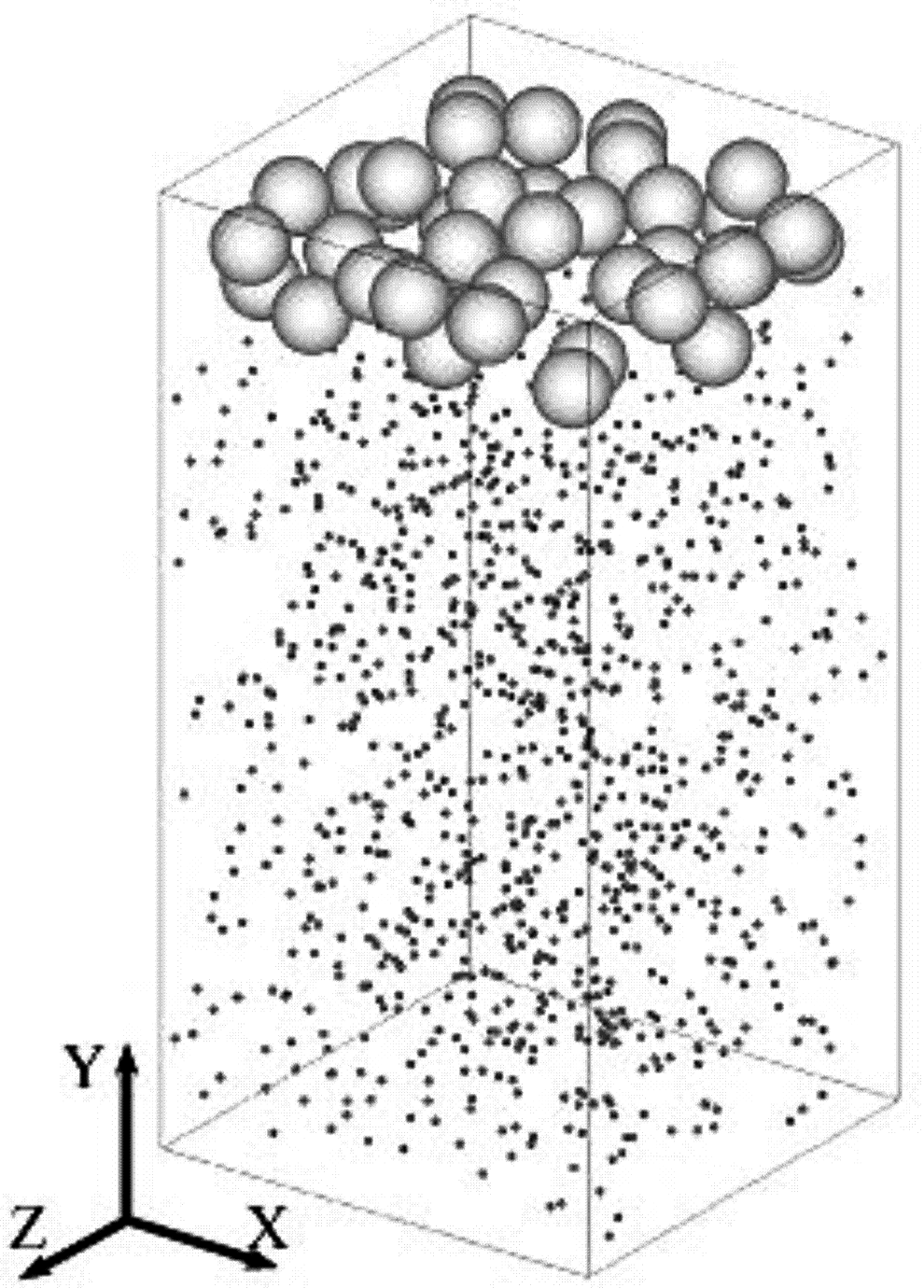
We now briefly describe the boundary conditions that were employed in the present Brownian dynamics simulations. In the x- and z-directions shown in Fig. 2, the usual periodic boundary condition is used; if a particle crosses the x- or z-plane, this particle is made to enter the simulation region from the opposite x- or z-plane. At the top and bottom boundaries of y-direction, particles collide with these boundary surfaces in a secular reflection manner.
Example of the initial position of particles for Rd=10 and b(th)=20.
Finally, we address the following point. In sedimentation of non-Brownian particles, a slow macroscopic flow may be induced in the upward direction especially in a flow problem in a vessel. However, in this study, we do not address a flow problem in a vessel but in a small lake or pond, and focus on the situation where the characteristic time of the Brownian motion is sufficiently shorter than that of the particle sedimentation under the gravity field, so that this effect on the adsorption procedure is expected to be almost negligible.
Nondimensionalization of Equation of Motion
A nondimensional system is usually employed for performing numerical simulations, and it is obtained by expressing each physical quantity as nondimensionalized quantity times the corresponding representative quantity. To nondimensionalize each quantity, the following representative values are used: 2ac=(dc) for distances, kBT/2ac for forces, \documentclass{aastex}\usepackage{amsbsy}\usepackage{amsfonts}\usepackage{amssymb}\usepackage{bm}\usepackage{mathrsfs}\usepackage{pifont}\usepackage{stmaryrd}\usepackage{textcomp}\usepackage{portland, xspace}\usepackage{amsmath, amsxtra}\pagestyle{empty}\DeclareMathSizes{10}{9}{7}{6}\begin{document}
$$k_BT / 12 \pi \eta a_c^2$$
\end{document} for velocities, and \documentclass{aastex}\usepackage{amsbsy}\usepackage{amsfonts}\usepackage{amssymb}\usepackage{bm}\usepackage{mathrsfs}\usepackage{pifont}\usepackage{stmaryrd}\usepackage{textcomp}\usepackage{portland, xspace}\usepackage{amsmath, amsxtra}\pagestyle{empty}\DeclareMathSizes{10}{9}{7}{6}\begin{document}
$$24 \pi \eta a_c^3 / k_B T$$
\end{document} for time. Nondimensionalized quantities are denoted by superscript * in the following expressions.
It is noted that the nondimensional parameters have appeared in the above nondimensionalized equations. That is, Rd (=do/dc) is the diameter ratio, and Rψ=ψo/ψc is the surface potential ratio. Moreover, the following nondimensional parameters imply the strength of each factor relative to the thermal energy (or force). \documentclass{aastex}\usepackage{amsbsy}\usepackage{amsfonts}\usepackage{amssymb}\usepackage{bm}\usepackage{mathrsfs}\usepackage{pifont}\usepackage{stmaryrd}\usepackage{textcomp}\usepackage{portland, xspace}\usepackage{amsmath, amsxtra}\pagestyle{empty}\DeclareMathSizes{10}{9}{7}{6}\begin{document}
$$R_E \left( = 2 \pi \varepsilon a_c \psi_c^2 / k_B T \right)$$
\end{document} is the magnitude of the electrical potential of the small spherical particles, RG(=2acmcg/kBT) is the magnitude of the gravitational force, \documentclass{aastex}\usepackage{amsbsy}\usepackage{amsfonts}\usepackage{amssymb}\usepackage{bm}\usepackage{mathrsfs}\usepackage{pifont}\usepackage{stmaryrd}\usepackage{textcomp}\usepackage{portland, xspace}\usepackage{amsmath, amsxtra}\pagestyle{empty}\DeclareMathSizes{10}{9}{7}{6}\begin{document}
$$R_{c - c}^{ ( w ) } ( = A_{c - c}^{ ( w ) } / k_BT ) , \ R_{o -
o}^{ ( w ) } ( = A_{o - o}^{ ( w ) } / k_BT ) $$
\end{document}, and \documentclass{aastex}\usepackage{amsbsy}\usepackage{amsfonts}\usepackage{amssymb}\usepackage{bm}\usepackage{mathrsfs}\usepackage{pifont}\usepackage{stmaryrd}\usepackage{textcomp}\usepackage{portland, xspace}\usepackage{amsmath, amsxtra}\pagestyle{empty}\DeclareMathSizes{10}{9}{7}{6}\begin{document}
$$R_{c - o}^{ ( w ) } ( = A_{c - o}^{ ( w ) } / k_BT )$$
\end{document} are the magnitude of the Hamaker constants. The initial mass ratio m*o=mo/mc can be expressed using the diameter ratio Rd and the density ratio Rdens as \documentclass{aastex}\usepackage{amsbsy}\usepackage{amsfonts}\usepackage{amssymb}\usepackage{bm}\usepackage{mathrsfs}\usepackage{pifont}\usepackage{stmaryrd}\usepackage{textcomp}\usepackage{portland, xspace}\usepackage{amsmath, amsxtra}\pagestyle{empty}\DeclareMathSizes{10}{9}{7}{6}\begin{document}
$$m_o^* = R_{dens} \cdot R_d^3$$
\end{document}, in which ρo and ρc are the initial density of the small and the large particles, respectively.
Parameters for Simulations
There are numerous parameters governing the phenomenon of interest, and so we are required to focus on some typical cases for each parameter to derive important results from the present Brownian dynamics simulations. As shown in Fig. 2, a rectangular parallelepiped with square bottom is used as a simulation region: the size of the simulation box is unchanged and taken as \documentclass{aastex}\usepackage{amsbsy}\usepackage{amsfonts}\usepackage{amssymb}\usepackage{bm}\usepackage{mathrsfs}\usepackage{pifont}\usepackage{stmaryrd}\usepackage{textcomp}\usepackage{portland, xspace}\usepackage{amsmath, amsxtra}\pagestyle{empty}\DeclareMathSizes{10}{9}{7}{6}\begin{document}
$$\left( L_x^* , L_y^* , L_z^* \right) = \left( L_x^* , 2L_x^* , L_x^* \right)$$
\end{document}. In the present technique, adsorbing agents will be put in the lake or pond of interest from the surface and therefore large particles will start to sediment from a layer around the lake or pond surface. Hence, it may be reasonable that the large and small particles are randomly located in the upper and the reminder lower region of the simulation box, respectively; the large particles are located in the layer of width b(th) with the volumetric fraction of large particles, ϕ(th), which is defined by \documentclass{aastex}\usepackage{amsbsy}\usepackage{amsfonts}\usepackage{amssymb}\usepackage{bm}\usepackage{mathrsfs}\usepackage{pifont}\usepackage{stmaryrd}\usepackage{textcomp}\usepackage{portland, xspace}\usepackage{amsmath, amsxtra}\pagestyle{empty}\DeclareMathSizes{10}{9}{7}{6}\begin{document}
$$\phi^{ ( th ) } = ( N_{large} V_o / V_{large}^b )$$
\end{document} where Nlarge and Vo are the number of large particles in the upper layer and the volume of a large particle (as already defined), respectively, and \documentclass{aastex}\usepackage{amsbsy}\usepackage{amsfonts}\usepackage{amssymb}\usepackage{bm}\usepackage{mathrsfs}\usepackage{pifont}\usepackage{stmaryrd}\usepackage{textcomp}\usepackage{portland, xspace}\usepackage{amsmath, amsxtra}\pagestyle{empty}\DeclareMathSizes{10}{9}{7}{6}\begin{document}
$$V_{large}^b$$
\end{document} is the volume of the upper layer. An appropriate volumetric fraction of the large particles, ϕ(th), may be dependent on many factors such as material costs and the performance of the adsorption, and therefore the range of the volumetric fraction from 0.01 to 0.3 seems to be reasonable from the actual use for improving the visibility in lakes or ponds. Typical results were obtained under the condition that the thickness of the initial layer of large particles was b(th)=20, the volumetric fraction of small particles was ϕVss=0.001; the volumetric fraction of small particles, ϕVss, is defined by \documentclass{aastex}\usepackage{amsbsy}\usepackage{amsfonts}\usepackage{amssymb}\usepackage{bm}\usepackage{mathrsfs}\usepackage{pifont}\usepackage{stmaryrd}\usepackage{textcomp}\usepackage{portland, xspace}\usepackage{amsmath, amsxtra}\pagestyle{empty}\DeclareMathSizes{10}{9}{7}{6}\begin{document}
$$\phi_{Vss} = ( N_{ss} V_c / V_{small}^b )$$
\end{document} where Nss and Vc are the number of small particles in the reminder layer and the volume of a small particle (already defined), respectively, and \documentclass{aastex}\usepackage{amsbsy}\usepackage{amsfonts}\usepackage{amssymb}\usepackage{bm}\usepackage{mathrsfs}\usepackage{pifont}\usepackage{stmaryrd}\usepackage{textcomp}\usepackage{portland, xspace}\usepackage{amsmath, amsxtra}\pagestyle{empty}\DeclareMathSizes{10}{9}{7}{6}\begin{document}
$$V_{small}^b$$
\end{document} is the volume of the reminder layer in the initial setting. Also, the number of small particles is Nss=1,000, the initial density ratio is Rdens=1.01, and the value of the time intervals is Δt*=0.00005.
As already mentioned in the description regarding the particle model, actual dirty particles are supposed to be mixtures of clay materials and other materials such as corrupt plants, carcasses of insects, and bird droppings. Hence, specification of material properties will be able to be determined by actually tackling visibility problems of the lake or pond of interest. Moreover, the choice of appropriate adsorbing particles is also dependent on individual local circumstances of lakes and ponds. However, we have to determine the material quantities of small and large particles for performing the present Brownian dynamics simulations. If we take into account that this study generally treats these problems from a physics point of view, it seems to be reasonable that we here employ the values of kaolinite, which is a common clay material, for the small particles and those of the allophene, which is also a clay material, for the large particles (Clark and McBride, 1984; Novich and Ring, 1984; The Cray Science Society, 1987; Schroth and Sposito, 1997; Kitagawa et al., 2001; Adachi and Iwata, 2003). However, it should be noted that in this study, adsorbing agents (large particles) are not necessarily developed using materials based on allophone alone, also dirty particles (small particles) are not pure kaolinite, as already mentioned above. We expect that it may be desirable to develop adsorbing agents using local soil, volcanic ash, or composites of these materials that frequently include allophone component in Japan; volcanic ash is usually included in soil in almost all areas in this country.
In the reference (Adachi and Iwata, 2003), the detailed characteristics including the shape and electrical properties regarding kaolinite and allophone are described and this study requires the electric characteristics of these components for conducting simulations. According to this reference book, the zeta potential of the kaolinite is usually negative and in contrast, the allophone exhibits a complex dependence of the zeta potential on the value of pH, from positive to negative, with increasing values of pH (Clark and McBride, 1984). The experimental results (Kitagawa et al., 2001) show that the zeta potential of kaolinite is −2, −22, and −24 mV at pH 4.0, 7.0, and 9.0, respectively, and that of allophone is +75, +32, −20, and −50 mV at pH 3.0, 5.0, 6.0, and 7.0, respectively. The values of the zeta potential of kaolinite and allophone were slightly dependent on the circumstances under which the experiments were carried out, although the above-mentioned qualitative features dependent on the value of pH is common in results obtained by different researchers. From the above data of allophone, it is seen that adsorbing agents may be developed by modifying the material based on allophone or using composite materials of allophone and other components or using completely different materials that are electrically positive in the water circumstance.
Hence, we employed the following values for small particles: the particle diameter is 0.6 μm, the density is 2.68×10³ kg/m3, Hamaker constants are \documentclass{aastex}\usepackage{amsbsy}\usepackage{amsfonts}\usepackage{amssymb}\usepackage{bm}\usepackage{mathrsfs}\usepackage{pifont}\usepackage{stmaryrd}\usepackage{textcomp}\usepackage{portland, xspace}\usepackage{amsmath, amsxtra}\pagestyle{empty}\DeclareMathSizes{10}{9}{7}{6}\begin{document}
$$A_{c - c}^{ ( w ) } = 3.1 \times 10^{ - 20}$$
\end{document} J and \documentclass{aastex}\usepackage{amsbsy}\usepackage{amsfonts}\usepackage{amssymb}\usepackage{bm}\usepackage{mathrsfs}\usepackage{pifont}\usepackage{stmaryrd}\usepackage{textcomp}\usepackage{portland, xspace}\usepackage{amsmath, amsxtra}\pagestyle{empty}\DeclareMathSizes{10}{9}{7}{6}\begin{document}
$$A_{c - o}^{ ( w ) } = 2.2 \times 10^{ - 20}$$
\end{document} J (Novich and Ring, 1984; The Cray Science Society, 1987; Adachi and Iwata, 2003). Large particles have the density 2.70×10³ kg/m3, and Hamaker constant, \documentclass{aastex}\usepackage{amsbsy}\usepackage{amsfonts}\usepackage{amssymb}\usepackage{bm}\usepackage{mathrsfs}\usepackage{pifont}\usepackage{stmaryrd}\usepackage{textcomp}\usepackage{portland, xspace}\usepackage{amsmath, amsxtra}\pagestyle{empty}\DeclareMathSizes{10}{9}{7}{6}\begin{document}
$$A_{o - o}^{ ( w ) } = 1.5 \times 10^{ - 20}$$
\end{document} J (The Cray Science Society, 1987; Iwata et al., 1995; Kitagawa et al., 2001). Also, we employ the zeta potential as −12 and +30 mV for small and large particles, respectively, and the diameter of large particles as 5dc∼20dc. Employing these material quantities, reasonable values of the nondimensional parameters can be adopted as Rd=10, 15, and 20, RE=47.7, \documentclass{aastex}\usepackage{amsbsy}\usepackage{amsfonts}\usepackage{amssymb}\usepackage{bm}\usepackage{mathrsfs}\usepackage{pifont}\usepackage{stmaryrd}\usepackage{textcomp}\usepackage{portland, xspace}\usepackage{amsmath, amsxtra}\pagestyle{empty}\DeclareMathSizes{10}{9}{7}{6}\begin{document}
$$R_{c - c}^{ ( w ) } = 7.7$$
\end{document}, \documentclass{aastex}\usepackage{amsbsy}\usepackage{amsfonts}\usepackage{amssymb}\usepackage{bm}\usepackage{mathrsfs}\usepackage{pifont}\usepackage{stmaryrd}\usepackage{textcomp}\usepackage{portland, xspace}\usepackage{amsmath, amsxtra}\pagestyle{empty}\DeclareMathSizes{10}{9}{7}{6}\begin{document}
$$R_{o - o}^{ ( w ) } = 3.7$$
\end{document}, \documentclass{aastex}\usepackage{amsbsy}\usepackage{amsfonts}\usepackage{amssymb}\usepackage{bm}\usepackage{mathrsfs}\usepackage{pifont}\usepackage{stmaryrd}\usepackage{textcomp}\usepackage{portland, xspace}\usepackage{amsmath, amsxtra}\pagestyle{empty}\DeclareMathSizes{10}{9}{7}{6}\begin{document}
$$R_{c - o}^{ ( w ) } = 5.3$$
\end{document}, Rψ=−2.5, and κ*=13.9.
It is noted that a thin electrical double layer (i.e., a larger value of κ*) may lead to the sedimentation of small particles after the aggregation of small particles without the aid of large particles. This mechanism is usually used for adjusting the pH of a suspension as a chemical approach for improving the purification of water. Since we here consider a physical approach for developing the technology of improving the visibility of water, it is reasonable to address only the case of κ*=13.9, where there is a high energy barrier for preventing the small particles from aggregating and sedimenting; in other words, in this situation the Brownian motion of the large particles plays a significantly important role for determining the performance of the sedimentation of small particles.
For reference, the potential curves for small-small particles, large-large particles and small-large particles are shown in Fig. 3. It is seen from Fig. 3a and b that the net potential energy steeply increases with decreasing particle-particle separation, which implies that there is a high energy barrier in the vicinity of a contact area for preventing particles from aggregating for both the cases of the small-small and the large-large particles. In contrast, for the case of small-large particles, as shown in Fig. 3c, the net potential energy steeply decreases with decreasing particle-particle separation and therefore a contact situation of two particles gives rise to a much more stable system. This implies that significant aggregate formation of small and large particles are surely expected when large particles approach small particles in a nearly contact situation.
To translate dimensionless quantities shown below into dimensional ones, the values of the representative quantities, which were used for nondimensionalizing each quantity before, may be useful. These values are as follows: 0.6 μm for representative distance, 0.50 s for representative time, and 1.20 μm/s for representative velocity. This study, therefore, will consider the physical phenomenon with approximately these orders of time and length range.
The usual periodic boundary condition is used for the x- and z-axis directions, and the specular reflection condition is used for the y-axis direction, as already mentioned.
Results and Discussion
Snapshots of the sedimentation and the adsorption process
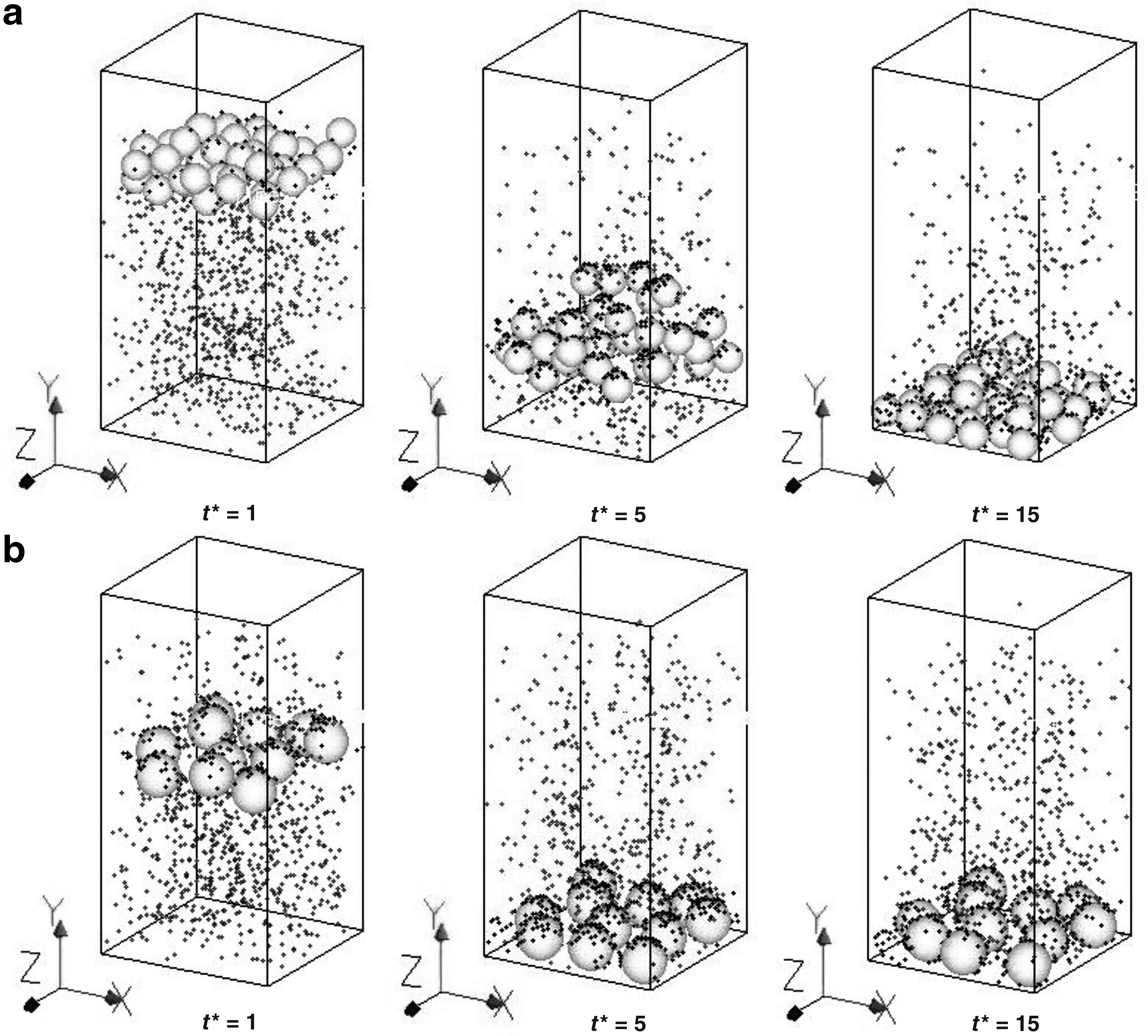
We discuss the influence of the particle diameter ratio Rd=(do/dc) on the sedimentation process. Figure 4 shows the results of snapshots for ϕ(th)=0.25 and b(th)=20: Fig. 4a and b are for Rd=15 and 10, respectively. It is noted that a smaller value of the particle diameter implies a more numerous number of large particles in the system for a given set of the values of ϕ(th) and b(th).
Sedimentation process with adsorption of charged small particles for ϕ(th)=0.25 and b(th)=20: (a)Rd=15 and (b)Rd=10.
It is seen from the snapshots that for both cases of the particle diameter, the large particles sediment with adsorbing larger number of small particles at the surface of each large particle with advancing time. Also, it is seen that the large particles with smaller diameter, shown in Fig. 4b, tend to adsorb small particles more significantly as a whole. Even in the case of large particles with smaller diameter, however, relatively large number of small particles remain without being adsorbed and fluctuate in the liquid; small particles that are not adsorbed by large particles require extraordinarily much longer time for sedimentation than large particles, so that they can be regarded as fluctuating in the liquid without sedimentation in the present simulation time. The potential curve shown in Fig. 3c clearly exhibits that adsorbed small particles are unable to dissociate from their large particles because there is a significantly deep energy valley in the net potential curve in a contacting situation of two particles, leading to a strong attractive interaction acting between the large and small particles. We consider the common characteristics of the adsorption process in Fig. 4a and b in more detail. If we see the distribution of the adsorbed small particles on the particle surface, it is seen that the small particles are largely located at the upper side of each particle surface, which is clearly observed in the snapshots at t*=5. On the other hand, the adsorbed small particles at the particle surface at t*=15 are observed to be scattered in the larger area than those at t*=5. This may be explained in the following manner. First, for the following discussion, we have to take into account the fact that the potential curve in Fig. 3c exhibits that the small particles attached at the surface of the large particles do not dissociate from the large particles because a significantly strong attractive interaction acts on these small particles. Moreover, as mentioned above, small particles are assumed to be sufficiently small and therefore they do not sediment but strongly tend to fluctuate in the whole simulation area. During the sedimentation process of large particles, small particles are first adsorbed at the contact point, and these small particles move to the upper areas of the large particles while the large particles are sedimenting. Since a strong attractive interaction acts between large and small particles, it is not possible for adsorbed small particles to dissociate from the large particle. However, random forces still act on these adsorbed particles at the surface of the large particles because random forces arise from the motion of the ambient solvent molecules. If random forces do not act on the small particles, it is reasonable for the adsorbed small particles to stay at the adsorbed point of the surface of the large particle. In the present situation, the movement of the adsorbed small particles is induced by the random force acting on those small particles. Also, we have to take into account the assumption that only the center-to-center interactions are employed between two particles. This implies that there are no friction forces acting on the adsorbed small particles that move along the surface of the large particle due to the random forces. We now discuss why the adsorbed small particles move to the upper areas of the surface of the large particles. The movement of the small particles at the surface arises due to the difference in the inherent sedimentation time scales between the small and the large particles. That is, the adsorbed small particles attempt to sediment together with the large particles, but the large particles inherently sediment much faster than the adsorbed small particles. As already mentioned, the adsorbed small particles cannot dissociate from the large particles due to the electrical interaction and therefore they move to the upper areas of the large particles due to the influence of the random forces, which are clearly seen in Fig. 4a and b at t*=5. After the small particles arrive at the upper areas of the large particles, they will sediment together with the large particles, staying at the upper areas. After the arrival to the bottom wall, the adsorbed small particles in the upper area tend to scatter in the side area of the surface due to the influence of the random forces and the repulsive interaction between the adsorbed particles, which is seen at the snapshots at t*=15, leading to less dense small particles in the snapshots at t*=15 than at t*=5. Large particles sediment faster for Rd=15 (Fig. 4a) than for Rd=10 (Fig. 4b). This is because larger particles have a larger mass and these particles are more significantly influenced by the gravitational force. Equation (38) suggests that the random displacement becomes shorter with increasing diameter of the large particles, which implies that the particle Brownian motion is not sufficiently activated. Hence, the large particles are seen to sediment faster without significantly performing Brownian motion. It is also seen that the large particles in Fig. 4a adsorb much more small particles, per large particle, than in Fig. 4b, but the total number of small particles adsorbed by the large particles is much larger for Rd=10 than that for Rd=15 in the situation of the same input amount (volume) of large particles. From these results, we may derive a conclusion that putting numerous adsorbing particles with smaller diameter into water is more effective for removing the suspended substances or dirty particles if the same input amount of adsorbing agents is used.
Finally, it is noted that large particles become slightly heavier with increasing number of adsorbed small particles, but this effect may not significantly appear in the adsorption performance, because we focus on the large particle diameter ratio such as 10, 15, and 20 in the present simulations and also because the random forces still act on the adsorbed particles. Moreover, it is noted that in the application of the present technique, as already mentioned in the Introduction, the deposited large particles adsorbing small particles will be regularly removed from the surface of the bottom of the lake or pond of interest.
Time change in adsorption rate
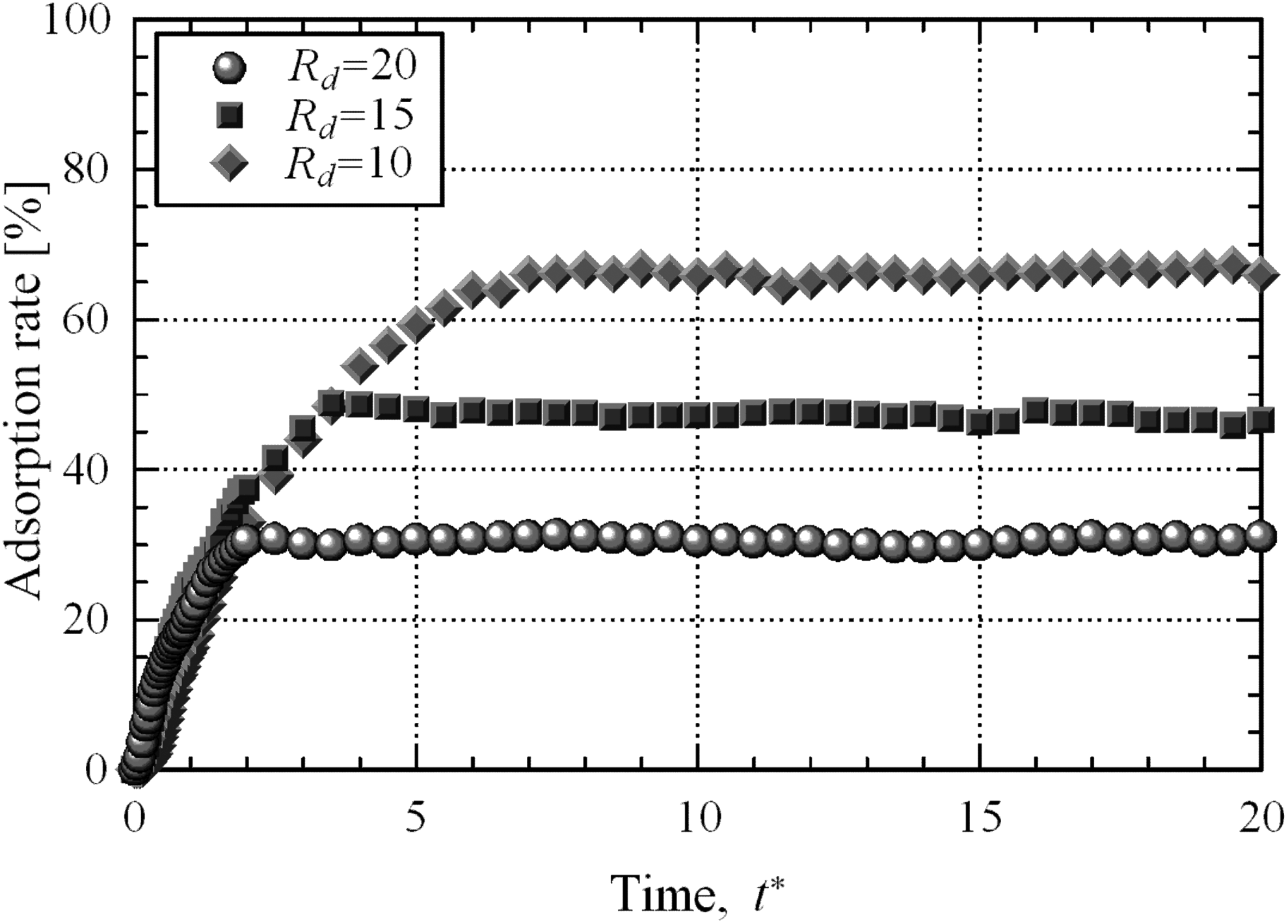
We next make a quantitative discussion by focusing on the time change in the adsorption rate N(ads)/Nss, which is the ratio of the number of adsorbed small particles, N(ads), to the total number of small particles in the system, Nss. Figure 5 shows how the adsorption rate changes with time for ϕ(th)=0.25 and b(th)=20: three curves are plotted for the cases of the particle diameter, Rd=10, 15, and 20. It is seen from these curves that for all the cases of the particle diameter, the adsorption rate increases with advancing time and a more significant performance can be obtained during a longer period for a smaller diameter case: the adsorption rate first exhibits a steep increase, then a gradually slower increase, and finally no increase with advancing time, which is a common feature among the three cases of the diameter. These characteristics of the adsorption rate can be explained in the following lines. The steep curve in the first stage of adsorption corresponds to the adsorption of the surrounding small particles almost freely. Why the adsorption curve gradually becomes gentler with advancing time is that the number of the ambient small particles around large particles gradually decreases in the adsorption process and also the adsorbed particles at the particle surface become an obstacle for other ambient small particles being adsorbed. In the final stage, all the large particles attain to the bottom wall, leading to actually no adsorption performance. The reason why the large particles with smaller diameter can maintain an adsorption performance during a longer period is that such large particles perform the Brownian motion more significantly and therefore remain in the water for a longer time, which yields a higher and longer adsorption performance; an increase in the total surface area of large particles with decreasing diameter may be another factor for providing more opportunity to contact with small particles. A gentle approach to a final adsorption rate for Rd=10 is due to the fact that the Brownian motion induces the large particles to collide with the bottom surface and to repeatedly attach to and detach from the surface; as already mentioned, the specular collision model was used for the boundary condition at the bottom surface.
Time variation of the adsorption rate for ϕ(th)=0.25 and b(th)=20.
Influence of amount of oppositely charged large particles
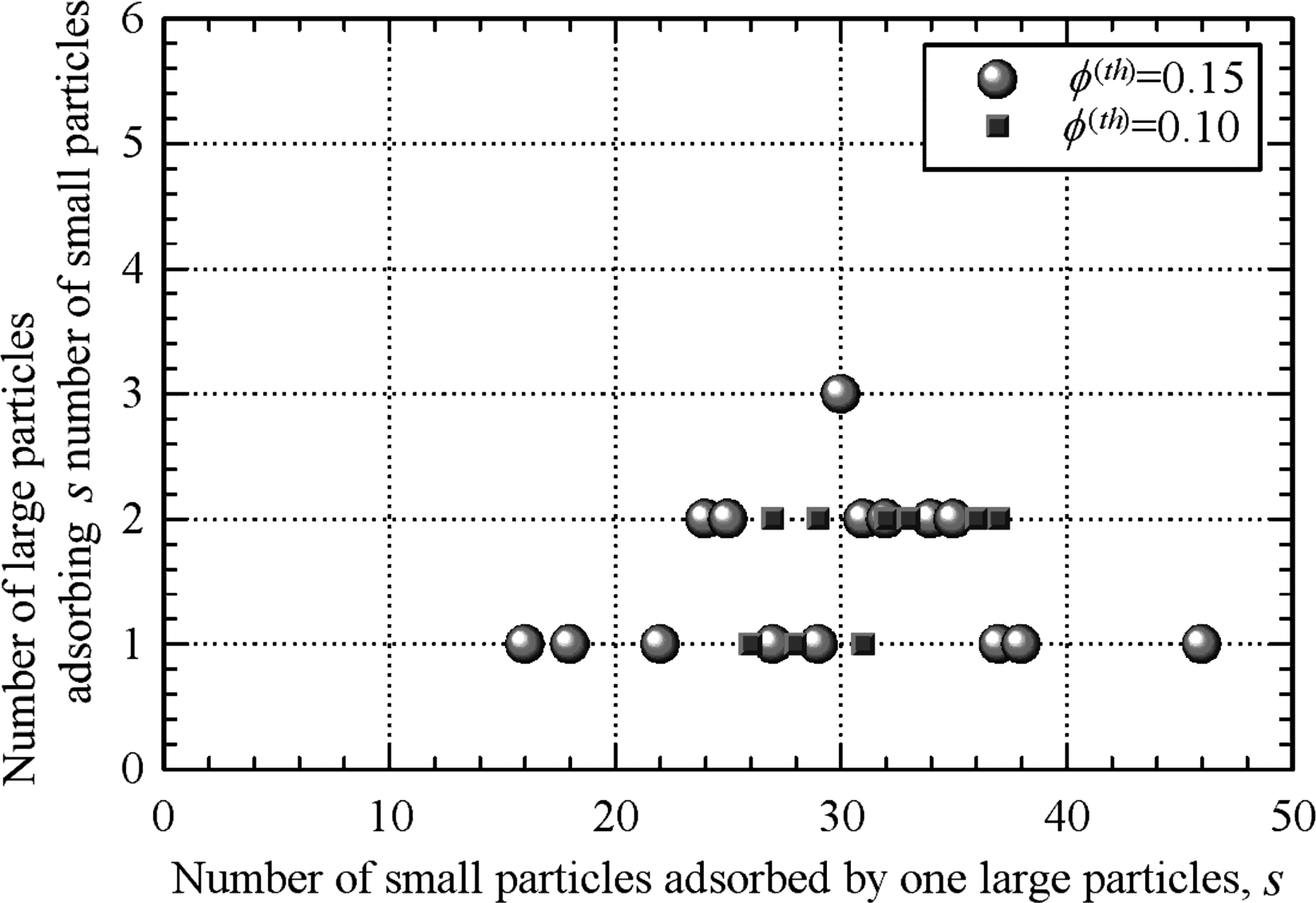
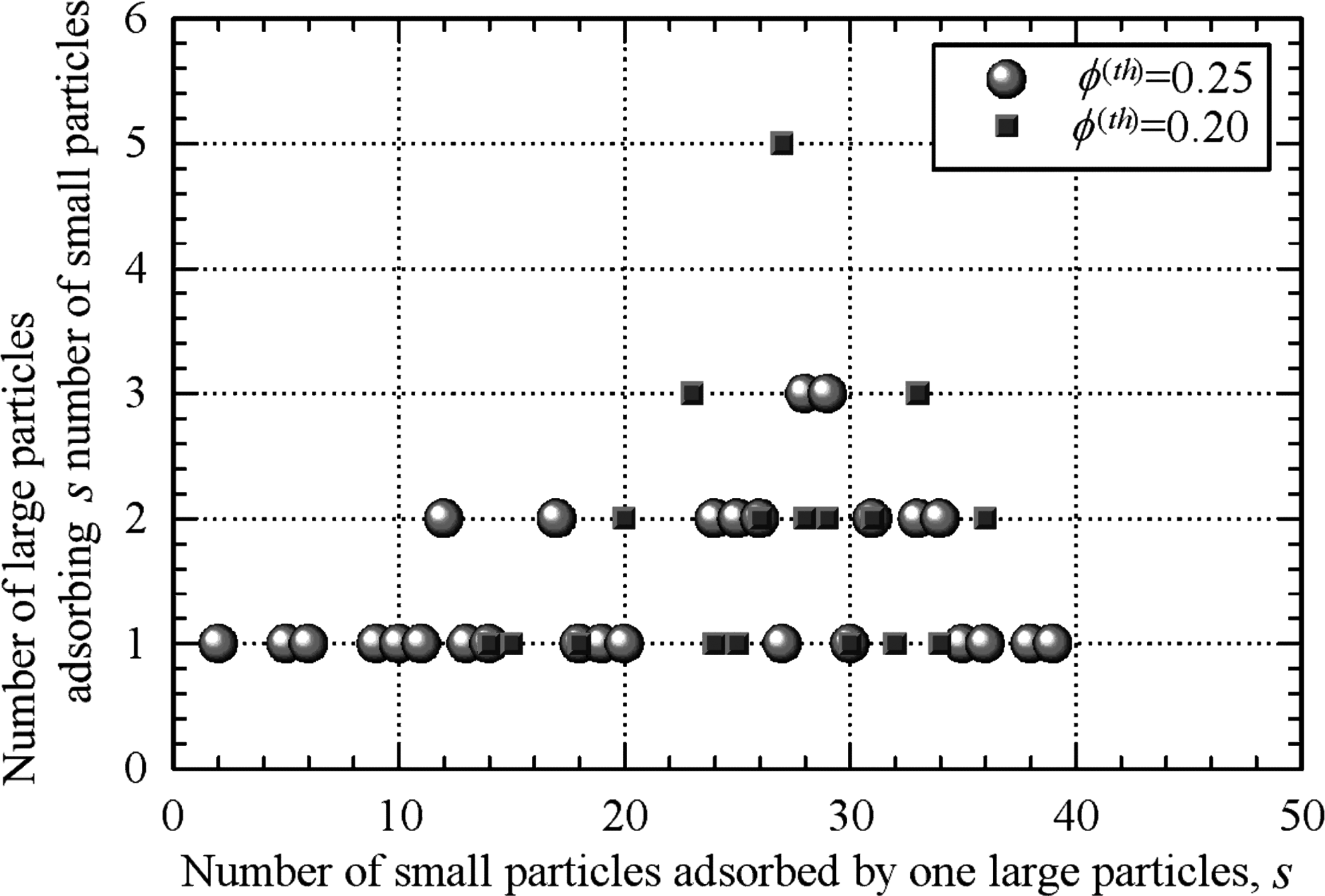
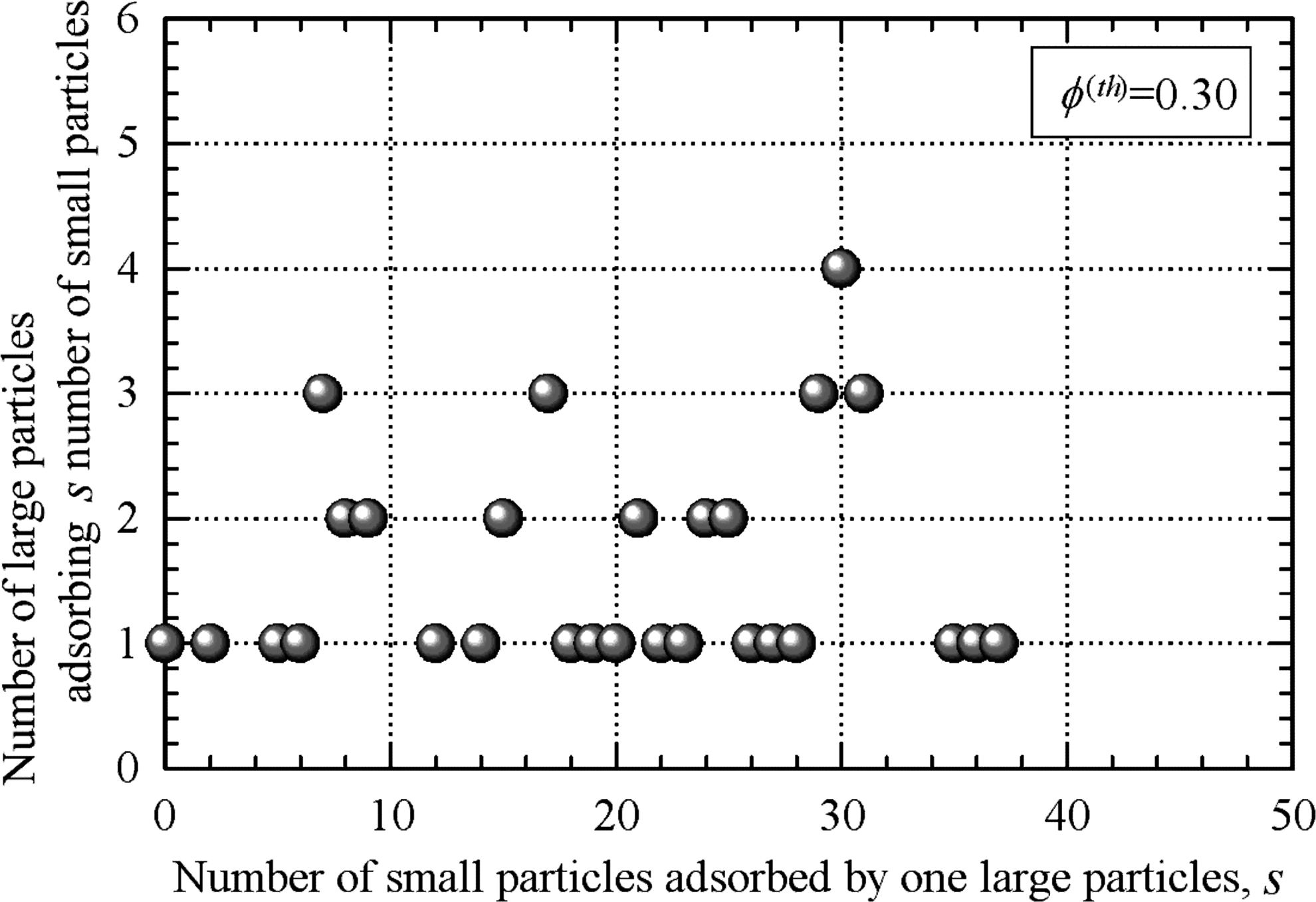
Finally we discuss how many large particles we should use to adsorb small particles more efficiently. To do so, we concentrate on the dependence of the adsorption rate on the input amount of large particles. If an extraordinarily large amount of large particles are unnecessarily used, many large particles just sediment to the bottom wall without adsorbing small particles. This leads to a poor performance of adsorption in a commercial meaning. Hence, we here consider the results of the adsorption rate for the various cases of the volumetric fraction ϕ(th) of large particles under the condition of one set of the particle diameter ratio and the thickness b(th) of the layer of large particles, (b(th), Rd)=(20,10); the value of ϕ(th) was taken as ϕ(th)=0.10, 0.15, 0.20, 0.25, and 0.30. The other parameters are the same as in the case of Rd=10 in Figs. 5 and 6. Figure 6 shows the time change of the adsorption rate for the various cases of the volumetric fraction of large particles, and Figs. 7–9 show the relationship between the number of adsorbed small particles and the number of the large particles adsorbing such small particles.
Time variation of the adsorption rate for Rd=10 and b(th)=20.
Distribution of number of large particles adsorbing small particles with the number in the abscissa for ϕ(th)=0.10 and 0.15.
Distribution of number of large particles adsorbing small particles with the number in the abscissa for ϕ(th)=0.20 and 0.25.
Distribution of number of large particles adsorbing small particles with the number in the abscissa for ϕ(th)=0.30.
Figure 6 shows the time change in the adsorption rate for the five cases of the volumetric fraction of large particles. It is seen from Fig. 6 that a larger adsorption rate can finally be obtained for a larger volumetric fraction, although the period of the adsorption process functioning is almost independent of the volumetric fraction. This may be a physically reasonable result since the input amount of large particles increases with the volumetric fraction. On the other hand, it is seen that the effect of the increase in the input amount of large particles becomes more inefficient; in other words, the maximum adsorption rate is not proportional to the input amount. This suggests that there is an appropriate input amount of large particles for obtaining the best adsorption performance in a commercial meaning. Therefore, we discuss the adsorption performance. Before that discussion, we consider why the adsorption curve for ϕ(th)=0.10 slightly decreases after passing the maximum point at time t*≃7. It is noted that this characteristic is not observed for the other cases of the volumetric fraction. Hence, we may understand that in a dilute situation of large particles, there are sufficient possibilities for small particles to be adsorbed in a subtle manner, which implies that small particles may be adsorbed in a noncontact situation that may be made by the already adsorbed small particles at the surface of the large particles. This subtle configuration may come to appear more frequently when a sufficient number of small particles cover the surface of the large particles. These indirectly adsorbed small particles are not strongly combined with the large particles, so that the change in the situation at the surface of the large particles induces the dissociation of the small particles. However, another sophisticated study is necessitated to conclude the reason for the above-mentioned characteristic of the adsorption curve for ϕ(th)=0.10.
Figures 7–9 show the relationship between the number of adsorbed small particles per large particle, s, and the number of the large particles adsorbing s number of small particles. For the case of small volumetric fractions, shown in Fig. 7, the data are almost plotted in the center and right-side areas, so that each large particle adsorbs many small particles during the sedimentation. This implies that almost all large particles function effectively as an adsorption agent. For the case of relatively large volumetric fractions, shown in Fig. 8, the data are plotted in the center and left-side areas and therefore several large particles that adsorb only a few small particles come to appear in this situation. For the case of a large volumetric fraction, shown in Fig. 9, the number of large particles that adsorb none or only several small particles significantly increases. This implies that even if the input amount of large particles is increased, an adsorption performance cannot significantly be improved; the number of inefficient large particles that do not contribute to the adsorption performance increases. From these results, we understand that there is an optimal input amount of adsorption agents from a commercial point of view.
Conclusion
In this study, we have treated the dirty (small) and the adsorbing (large) particles as charged and oppositely charged spheres to investigate the behavior of these particles under the gravity field. To do so, Brownian dynamics simulations have been conducted. Here, we have mainly discussed the dependence of adsorption rate on particle diameter ratio, volumetric fraction of large particles, and input amount of large particles. The main results obtained here are summarized as follows. The adsorption process is explained in the following manner. During sedimentation, large particles first adsorb small particles almost freely, and these adsorbed small particles are moved to the upper area of the surface due to the influence of the random forces. After the arrival to the bottom wall, the adsorbed small particles at the upper area scatter in the side area of the surface, leading to dense small particles in the upper area of the particle surface. The large particles adsorb numerous small particles, per large particle, but the total number of small particles adsorbed by the large particles more significantly increases for large particles with smaller diameter if the same input amount of large particles is used. Hence, it is seen that putting numerous adsorbing particles with smaller diameter into water is more effective for removing the suspended substances or dirty particles. If the adsorption process during a short period is necessary, large particles with large diameter should be used, but in this case the number of small particles without being adsorbed increases. If the adsorption rate is regarded as an important factor even if a long period of the performance is necessitated, then large particles with small diameter should be used, and in this case smaller particles are more significantly adsorbed than in the previous case. Even if the input amount of large particles is increased, an adsorption performance cannot significantly be improved; the number of inefficient large particles that do not contribute to the adsorption performance increases. From these results, we understand that an optimal input amount of adsorption agents, from a commercial point of view, should be determined by various factors in the application of the present adsorption technique to actual situations. Finally, it is noted that the present technique is applicable to a quiescent flow situation in small lakes and ponds, and therefore other effects on the adsorption performance such as a turbulence of the liquid flow are necessitated to be investigated for extension to a flow field situation such as rivers with high speed flow.
Footnotes
Author Disclosure Statement
No competing financial interests exist.
References
1.
AdachiY., and IwataS. (2003). Soil Colloid Science. Tokyo: Japan Scientific Societies Press. (In Japanese.)
2.
AdachiY., TanakaY., and OoiS. (1999). The structure of a kaolinite floc coagulated with aluminium salt. Trans. Agric. Eng. Soc. Jpn, 67, 593.
3.
BarkerG.C., and GrimsonM.J. (1990). Theory of sedimentation in colloidal suspensions. Colloid Surf., 43, 55.
4.
Barrera-DíazC., BilyeuB., Roa-MoralesG., and Balderas-HernándezP. (2008). A comparison of iron and aluminium electrodes in hydrogen peroxide-assisted electrocoagulation of organic pollutants. Environ. Eng. Sci., 25, 529.
5.
BuscallR. (1990). The sedimentation of concentrated colloidal suspensions. Colloids Surf., 43, 33.
6.
ClarkC.J., and McBrideM.B. (1984). Cation and anion retention by natural and synthetic allophone and imogolite. Clays Clay Miner., 32, 291.
7.
GaudenP.A., TerzykA.P., and KowalczykP. (2006). Some remarks on the calculation of the pore size distribution function of activated carbons. J. Colloid Interface Sci., 300, 453.
8.
HoggR., HealyT.W., and FuerstenauD.W. (1966). Mutual coagulation of colloidal dispersions. Trans. Faraday Soc., 62, 1638.
9.
IsmadjiS., and BhatiaS.K. (2001). Characterization of activated carbons using liquid phase adsorption. Carbon, 39, 1237.
10.
IwataS., TabuchiT., and WarkentinB.P. (1995). Soil-Water Interactions: Mechanisms and Applications, 2nd ed. New York: Marcel Dekker.
11.
KitagawaY., YarozuY., and ItamiK. (2001). Zeta potentials of clay minerals estimated by an electrokinetic sonic amplitude method and relation to their dispersibility. Clay Sci., 11, 329.
12.
KitaharaF. (1994). Fundamentals of Interface and Colloid Chemistry. Tokyo: Koudansha Scientific. (In Japanese.)
13.
KitaharaF., WatanabeM. (eds.). (1972). Electrical Interfacial Phenomena: Fundamentals, Measurements and Applications. Tokyo: Kyoritsu Shuppan. (In Japanese.)
14.
KnapikH.G., FernandesC.V.S., AzevedoJ.C.R, and PortoM.F.A. (2014). Applicability of fluorescence and absorbance spectroscopy to estimate organic pollution in rivers. Environ. Eng. Sci., 31, 653.
15.
NovichB.E., and RingT.A. (1984). Colloid stability of clays using photon correlation spectroscopy. Clays Clay Miner., 32, 400.
16.
OkaiT., SasadaY., KominoS., and TanakaS. (2007). Improvement of water quality and control of blue-green algae growth by aeration. Annual Report of Kagawa Prefectural Research Institute for Environmental Sciences and Public Health, 6, 29.
17.
PetsevD.N., StarovV.M., and IvanovI.B. (1993). Concentrated dispersions of charged colloidal particles: Sedimentation, ultrafiltration and diffusion. Colloids Surf. A, 81, 65.
18.
SatohA. (2003). Introduction to Molecular-Microsimulation of Colloidal Dispersions. Amsterdam: Elsevier Science.
19.
SatohA. (2010). Introduction to Practice of Molecular Simulation: Molecular Dynamics, Monte Carlo, Brownian Dynamics, Lattice Boltzmann and Dissipative Particle Dynamics. Amsterdam: Elsevier.
20.
SatohA., and TanekoE. (2009). Brownian dynamics simulations of a dispersion composed of two types of spherical particles: For development of new technology to improve the visibility of rivers and lakes. J. Colloid Interface Sci., 338, 236.
21.
SchrothB.K., and SpasitoG. (1997). Surface charge properties of kaolinite. Clays Clay Miner., 45, 85.
22.
TachibanaT., MeguroK., KitaharaF., MorimotoT., WatanabeM., YoshizawaK., and SenooM. (1981). Colloid Chemistry: Its New Expansion. Tokyo: Kyoritsu Shuppan. (In Japanese.)
23.
TakamiY., MurayamaN., OgawaK., YamamotoH., and ShibataJ. (2000). Water purification of zeolite synthesized from coal fly ash. J. Mining Mater. Process. Inst. of Jpn, 116, 789.
24.
The Cray Science Society. (1987). Cray Handbook. Tokyo: Gihodo Shuppan. (In Japanese.)
25.
VasudevanS, and LakshmiJ. (2012). Process conditions and kinetics for the removal of copper from water by electrocoagulation. Environ. Eng. Sci., 29, 563.
26.
VissersJ.P.C., LavenJ., ClaessensH.A., CramersC.A., and AgterofW.G.M. (1997). Sedimentation behaviour and colloidal properties of porous, chemically modified silicas in non-aqueous solvents. Colloids Surf. A, 126, 33.
27.
WedlockD.J., FabrisI.J., and GrimseyJ. (1990). Sedimentation in polydisperse particulate suspensions. Colloids Surf., 43, 67.
28.
WottonR.S. (2002). Water purification using sand. Hydrobiologia, 469, 193.