




Abstract
Abstract
The feasibility of using sodium dodecyl sulfate (SDS) foam and solution to deliver nanoscale zero-valent iron (nZVI) in unsaturated porous media was investigated. Three main results were found. First, batch experiments showed that the foam quality and capability to carry nZVI improved with increased agitator stirring speed. However, the distribution of nZVI in foams gradually became nonuniform with increased nZVI concentration. Presence of nZVI did not reduce foam stability. Second, column experiments revealed that fractions of injected nZVI exiting the column for SDS-nZVI suspension and nZVI-laden foams were higher than that for bare nZVI suspension. Thus, the SDS solution and foams were promising vehicles for nZVI delivery. Finally, tank experiments were conducted to study the migration and distribution characteristics of nZVI carried by the three vehicles. Compared with those of bare nZVI suspension, influence regions of nZVI in porous media for SDS-nZVI suspension and nZVI-laden foams were significantly improved. Further study showed that foam delivery dramatically increased the lateral delivery distance and distribution homogeneity of injected nZVI particles compared with the vehicle of SDS solution. Therefore, migration of nZVI in porous media was greatly facilitated by the vehicle of SDS foams. This research not only focuses on the nZVI delivery in one-dimensional scale but also gives a comprehensive analysis on the spatial distribution of nZVI carried by three vehicles, especially on the feature of the distribution homogeneity and lateral migration, which were not extensively studied before. Results from this study can provide a theoretical support for the technical installation and operation of foam-assisted transport of amendment in soil remediation.
Introduction
N
To overcome the problems associated with nZVI particle aggregation in the subsurface, numerous polyelectrolytes, such as polystyrene sulfonate, carboxymethyl cellulose (CMC), polyvinylalcohol-co-vinyl acetate-co-itaconic acid (PV3A), poly (acrylic acid) (PAA), soy proteins, triblock, and xanthan gum, have been studied to stabilize nZVI particles. These polyelectrolytes could alter the nZVI surface properties of electrostatic and repulsive electrostatic forces (He and Zhao, 2007; Berge and Ramsburg, 2009; Comba and Sethi, 2009; Dalla et al., 2009; Phenrat et al., 2009). Jiemvarangkul et al. (2011) used three polyelectrolytes (PV3A, PAA, and soy proteins) as stabilizers to reduce the particle size of nZVI and to generate a negatively charged surface. They found that PV3A results in significant electrosteric stabilization, which promotes nZVI dispersion in water. Lin et al. (2011) used PAA and CMC to synthesize two types of stabilized nZVI. The stabilizer was bound to particle surfaces in the form of bidentate bridging through the carboxylic group, which could provide both electrostatic and steric repulsion to prevent particle aggregation. Li et al. (2013) used sucrose to modify the nZVI surface and concluded that bare nZVI settles within a few minutes without sucrose, whereas nZVI stability significantly increases with the addition of sucrose. In addition, polyelectrolytes that enhance nZVI stability can inhibit the aggregation of nZVI particles (Li et al., 2013; Tosco et al., 2013).
A vehicle is a carrier that strongly binds and transports the reactive reagent, which could facilitate reagent particle delivery in porous media. Vehicles are important elements for successful remediation using nZVI technology. Schrick et al. (2004) introduced a novel delivery vehicle concept for environmental remediation and used PAA as the vehicle to deliver nZVI in porous media. Kanel and Choi (2007) used an anionic polymer as the mobile delivery vehicle and studied the factors of flow rate, surfactant concentration, and porous media depth on nZVI transport. The results indicated that the maximum transport of nZVI in porous media was achieved at an optimal concentration of polymer, that is, 6 g/L, and at the optimum Darcy velocity of 0.0068 cm/s. Moreover, some laboratory studies (Enzien et al., 1995; Jeong et al., 2000; Jeong and Corapcioglu, 2003) used surfactant foam as the vehicle to deliver microspheres and demonstrated that injection of surfactant foam enhanced the transport efficiency of microspheres, in contrast to surfactant solution in heterogeneous porous media systems, which results in more uniform sweeping throughout the contamination zone and higher contaminant removal. Zhong et al. (2009) found that mobilized Cr(VI) is reduced to 10% of the total Cr(VI) in the sediment when reductant calcium polysulfide is delivered by foams, whereas more than 75% of Cr(VI) in the sediment is mobilized when the reductant is delivered in the form of a solution. Shen et al. (2011) used foam to overcome the intrinsic challenges presented by vertical transport, preferential flow, and contamination spreading associated with the solution-based delivery of reactants to the vadose zone. Therefore, the enhanced delivery of microspheres by foams indicated that foam transport could significantly increase the influence region of injected microspheres for remediation.
Although the results of previous studies on facilitating the transport of nZVI particles and overcoming intrinsic challenges are promising, further investigations on the delivery properties of nZVI in porous media and the spatial distribution of nZVI particles under two-dimensional flow conditions are needed for practical application. In this work, a series of batch, column, and tank experiments were conducted to study the delivery properties of nZVI particles in porous media for the bare nZVI suspension, sodium dodecyl sulfate (SDS)-nZVI suspension, and nZVI-laden foam. The major objectives of this study are as follows: (1) to investigate foam stability with or without nZVI particles and foam carrying capability for nZVI particles; (2) to study the influences of different vehicles, such as water, SDS solution, and foam, on the delivery of nZVI particles in columns; and (3) to determine the fate and transport of bare nZVI and stabilized nZVI particles in porous media and further clarify the regularity of the migration and distribution of nZVI particles in two-dimensional tanks for bare nZVI suspension, SDS-nZVI suspension, and nZVI-laden foam injection.
Materials and Methods
Materials and experimental setup
All of the chemicals used in the experiments were of analytical grade. Chemicals, such as SDS (C12H25NaO4S), ferrous sulfate heptahydrate (FeSO4·7H2O), polyvinyl pyrrolidone-30 [(C6H9NO)n], potassium thiocyanate (KSCN), and ammonium persulfate [(NH4)2S2O8], were purchased from the Beijing Chemical Plant of China. Potassium borohydride (KHB4) and hydrochloric acid (HCl) were obtained from Tianjin Baishi Reagent and Guangming Reagent Factories of China, respectively. The nitrogen (N2) had high purity of 99.999% and was purchased from the Changchun Juyang Gas Limited Responsibility Company. Quartz sand with size ranging from 0.5 to 0.9 mm was used as the porous medium and prepared by soaking in a hydrochloric acid (V/V=1:1) solution for 12 h, washing with deionized water, and naturally drying before use.
The foam generation method and column testing setup used in this study were specifically described in our previous work (Su et al., 2014). A peristaltic pump (Model BT100-2J; Longer Pump Factory, Baoding, China) was used to deliver the surfactant solution and the Darcy velocity of the liquid was maintained at 1.59 cm/min for bare nZVI suspension, SDS-nZVI suspension, and nZVI-laden foam injection. It is worth mentioning that the injected rate of foam was calculated according to the foam quality and the Darcy velocity of 1.59 cm/min liquid. At the start of each experiment, nitrogen controlled by an LZB-4 flow meter was piped through the column for at least 15 min to eliminate air from the system.
The schematic diagram of a Plexiglas tank (50 cm length, 40 cm height, and 2.5 cm width) is shown in Fig. 1. Twenty sampling ports (10 mm diameter) were arranged in four rows on the face of the soil chamber. The location of the injection point of bare nZVI and SDS-nZVI suspensions was 15 cm from the left end and 12 cm from the upper end of the tank. The nZVI-laden foam injection point was located at 25 and 22 cm from the left and upper ends, respectively. Quartz sand (8 kg) was carefully and consistently packed into the tank. The density of packed sand in the tank is 1.47 g/cm3. The sand was added to a total height of 39 cm in separate 4-cm-thick layers. Each layer was packed and stamped to mix with the previous layer, thereby resulting in a relatively homogeneous soil appearance with minor horizontal layering because of the individually packed layers. The tank experiments were conducted in unsaturated conditions. The air in the tank was displaced by nitrogen. The influent flow of suspension and foams was controlled with a peristaltic pump, and the liquid flow was controlled at 17 mL/min for bare nZVI suspension, SDS-nZVI suspension, and nZVI-laden foam injection.

Schematic of tank experiment setup.
Experimental methods
Synthesis of nZVI
nZVI was prepared by the reduction reaction of ferric sulfate heptahydrate and potassium borohydride. Equal volumes of 0.4 M KBH4 and 0.1 M FeSO4 were quickly mixed in a batch reactor. The detailed procedure on the nZVI synthesis was described previously (Sun et al., 2006; Su et al., 2014). The finished nanoparticles were washed with ethanol, purged with nitrogen, and refrigerated in a sealed polyethylene container under ethanol (<5%) until use (Zhong et al., 1999).
Capabilities of foam to carry the nZVI particle
The capabilities of the foam to carry nZVI particles were determined by comparing the nZVI particle concentration in foams with that in the stock SDS-nZVI suspension used to generate the foams. Foams were generated by stirring the SDS-nZVI suspension using an agitator. The stirring speeds were 2,000, 3,000, and 4,000 r/min with SDS concentrations of 0.2%, 0.25%, 0.5%, and 1%. The foams (5 mL) were collected, and 1 mL of methanol was added to the foams as the defoaming agent. Following digestion by HCl (V/V=1:1), the iron concentrations in the solution and stock suspension were determined using thiocyanate colorimetric assay method at 480 nm wavelength.
Stabilities of foam with and without nZVI particles
The stability of foam was measured in terms of half-life time, which is defined as the necessary time for the initial volume of the liquid phase to be reduced to half because of the unstable foam rupture. Foam stability depends on the foam quality, the property of surfactant, and the dispersed solid particle phase within the foaming liquid (Zhong et al., 2009). In this work, foams were generated using SDS (concentration=0.2%, 0.25%, 0.5%, 1%) with and without nZVI particles, and the concentration of nZVI was ∼2.8 g/L. The foams were then collected using test tubes (22 cm long and 1 cm diameter), and the time for the initial liquid to reach half height was recorded.
nZVI delivery in porous media by three different vehicles in column experiments
The pore volume (PV) of the column and the porosity of the packed quartz sand were 26 mL and 0.38, respectively. Column experiments were performed to examine the effects of different vehicles, such as water, SDS solution, and foams (SDS concentration=0.2%, 0.25%, 0.5%, and 1%), on the nZVI delivery in porous media. The suspensions and foams were pumped upward through the column, and the Darcy velocity was controlled at 1.59 cm/min. The effluent stream was collected using a fraction collector at selected time intervals of 2.6 min. For each experiment, 7 PVs of suspension were injected into the columns. After injecting the suspensions and foams, the iron concentration in each aqueous effluent sample was determined by using a thiocyanate colorimetric assay.
After the experiment, the column was dismantled and the sands were divided equally (10 g) from the bottom to the top along the column length. Retained nZVI particles in porous media were recovered by placing sand in 10 mL of HNO3 (V/V=1:1) for 24 h, followed by iron concentration measurement in HNO3 solution. The overall recovery of nZVI was determined by adding the percentages of nZVI particles that exited and those that were retained in the column.
nZVI delivery in porous media by three different vehicles in tank experiments
The PV of the tank and the porosity of the packed quartz sand were 1,900 mL and 0.38, respectively. The delivery properties and influence regions of nZVI particles by different vehicles were investigated. The injection volume of liquid was 285 mL, whereas the SDS concentration was 0.25%. The suspensions and foams were injected in the horizontal direction at a flow rate of 17 mL/min.
At the end of the transport experiment, the packed tank was dissected into a 2×2 cm square grid to obtain the mass of the iron distributed in the tank. The recovery method of retained nZVI particles was the same as that used in the column experiment. The spatial distribution of nZVI particles was determined by measuring the total iron mass in HNO3 solution for each example.
Results and Discussion
Characteristics of nZVI particles
Characterization of nZVI particles has been published in previous work. The X-ray diffraction pattern of the nZVI nanoparticles in a previous study showed that the nanoscale iron obtained through this method is primarily α-Fe0. In addition, most of the particles were in the size range of 20–100 nm through the transmission electron microscopy (TEM) images reported in the previous studies (Su et al., 2014). The TEM images showed that SDS serves as an agent preventing nZVI particles from aggregation. The SDS surfactant has a reactive functional group, which adsorbs on the nZVI particle surface through electrostatic bonding, thereby increasing the distance between nZVI particles. Besides, the cladding layer is negatively charged, so both the electrostatic repulsion and steric repulsion are all increased, thereby enhancing dynamic stability of nZVI particles (Wan et al., 2005; Phenrat et al., 2008).
Foam stability with and without nZVI and foam capability to carry nZVI particles
The stabilities of foams generated from the SDS solution with different SDS doses at various stirring speeds significantly differed. As illustrated in Table 1, when the SDS concentration was 0.25%, the foam qualities were 71%, 78.5%, and 87.5% at stirring speeds of 2,000, 3,000, and 4,000 r/min, while the nZVI concentrations in foams were 2.33, 2.48, and 3.07 g/L at the three stirring speeds, respectively. The foam quality and the carrying amount of nZVI increased with increasing stirring speed. However, the nZVI distribution in foams became nonuniform with the increase in loading amount because the concentrations of nZVI in foams (2.89, 3.07, 3.62, and 2.92 g/L) at 4,000 r/min dramatically exceeded the intrinsic concentrations (2.65, 2.47, 2.72, and 2.79 g/L, respectively) (Table 1). The nZVI contents in foams at a stirring speed of 3,000 r/min were similar to the intrinsic contents of SDS-nZVI suspension at different SDS doses. Given that the optimal foam capability to carry nZVI and the uniformity of nZVI in foams were observed at 3,000 r/min stirring speed, such speed was used in the subsequent experiments. Moreover, the SDS concentration did not affect the foam quality. For the foams without nZVI particles, the half-lives increased, and the stabilities were enhanced with increasing stirring speed. In addition, foam half-lives with nZVI particles were not statistically different from those without nZVI particles. These results indicate that the presence of nZVI particles does not degrade foam stability.
Undetected.
Intrinsic concentration of nZVI in SDS-nZVI suspensions.
nZVI, nanoscale zero-valent iron; SDS, sodium dodecyl sulfate.
Bare nZVI and SDS-nZVI suspensions and nZVI-laden foam transport in columns
Figure 2a and b show photographs of the columns after injection of the bare nZVI suspension, SDS-nZVI suspension, and nZVI-laden foams at 0.5 and 1 PVs. As shown in Fig. 2a, most of the nZVI was deposited at the bottom section of the column for the bare nZVI suspension. The distance of nZVI was obviously showed through the black lines. For the bare nZVI suspension, the nZVI particles were separated from the nZVI suspension in the process of migration and water was transported faster than nZVI particles. For the SDS-nZVI suspension, the SDS solution and black nZVI particles quickly moved upward through the column together. Compared with that in the SDS-nZVI suspension, the black nZVI moved upward more quickly for nZVI-laden foams, and the entire column was covered with nZVI particles quickly at 0.4 PV (data not shown). Under the injection of nZVI-laden foams for 0.5 PV, some nZVI particles eluted the column. Figure 2b shows that nZVI particles moved upward to half the distance of the column from the entrance end for the bare nZVI suspension. Meanwhile, nZVI particles moved out of the column for the SDS-nZVI suspension and nZVI-laden foams. Therefore, the delivering distance of nZVI in porous media under the same liquid injection volumes is in the following order: nZVI-laden foams>SDS-nZVI suspension>bare nZVI suspension.
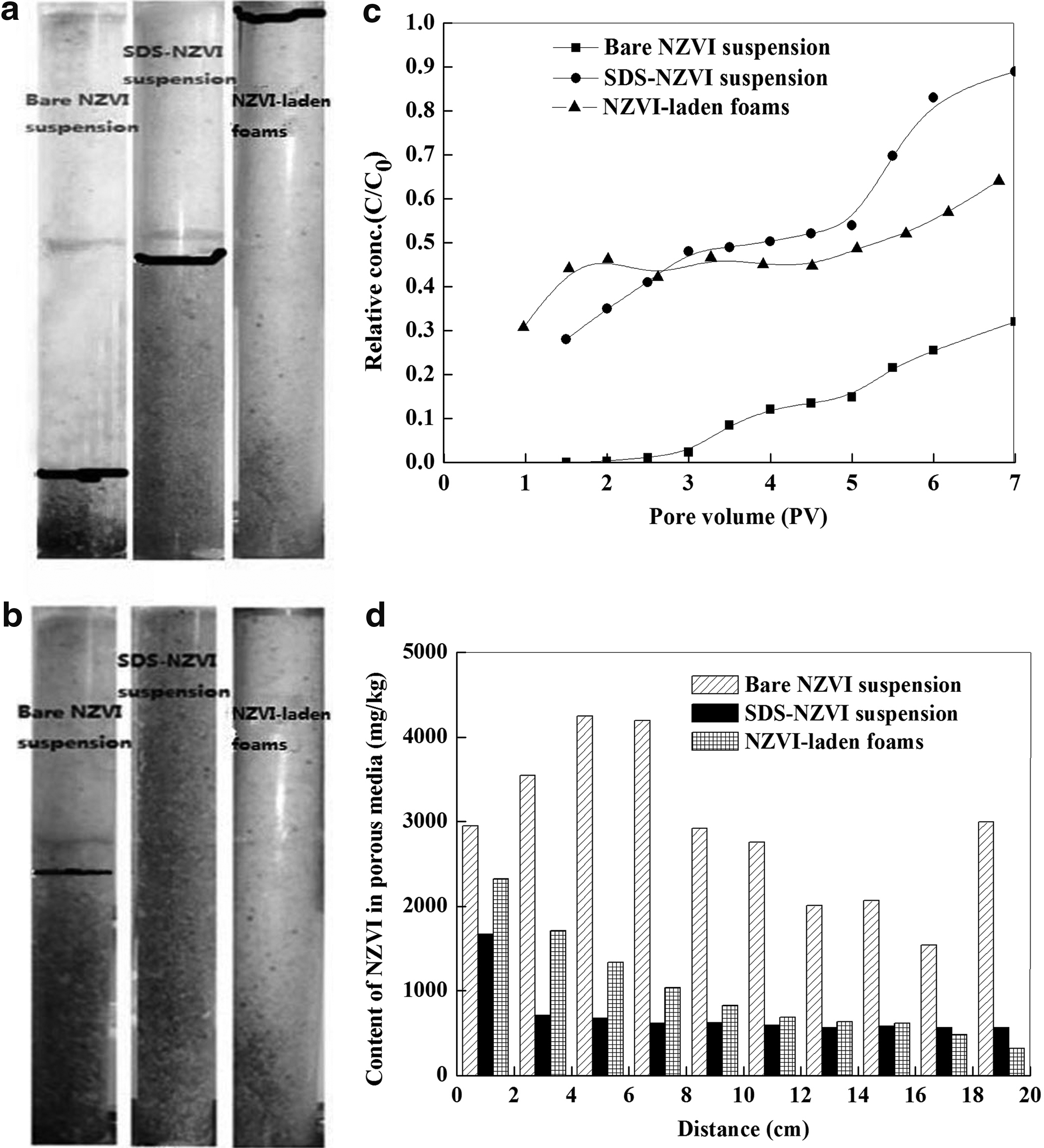
Figure 2c shows the relative concentration of iron in the effluent for the bare nZVI suspension, SDS-nZVI suspension, and nZVI-laden foams at 0.25% SDS concentration. For the SDS-nZVI suspension and nZVI-laden foams, iron concentrations in the effluent reached 89% and 64% of the influent level (C/C0=0.89 and 0.64) at 7 PV injection, respectively. By contrast, the C/C0 in the effluent for the bare nZVI suspension was less than 0.3 at 7 PV, thereby suggesting that most of the bare nZVI was retained in the column. Assuming that the retention rate of nZVI particles is constant over the transport distance, C/C0 would decrease to less than 10% at a distance of only 0.76 m for bare nZVI suspension injection. However, the concentrations of nZVI in the effluent would be 10% of influent concentrations at the distance of 2.73 and 4.4 m for the nZVI-laden foams and SDS-nZVI suspension injection, respectively. The result was similar to a previous research conclusion (Shen et al., 2011). However, different laboratory studies suggested that bare nZVI was retained within a few centimeters, and field studies have shown that even with surface modification, nZVI was retained within a few centimeters to 2 m (He et al., 2010; Johnson et al., 2013; Su et al., 2013). In our study, the medium was coarse sand, and the reasons for the increased distance of SDS-nZVI delivery with the coarse sand could be as follows: (1) finer sand has larger specific surface area available for deposition than coarser sand such that blocking is more likely in finer sand than in coarser sand; and (2) the single-collector contact efficiency (η0) was changed with average sand grain size. Raychoudhury et al. (2014) suggested that η0 increased from 0.0173 to 0.0473 as the sand size decreased from 775 to 150 μm. Therefore, the injection of the SDS-nZVI suspension and nZVI-laden foams is effective for a number of remediation scenarios, such as source zone reduction of dense nonaqueous phase liquids and heavy metal immobilization (Kanel and Choi, 2007).
The result can be further used to calculate the dimensionless attachment efficiency factor (α) for nZVI transport using the following equation:
where dc is the diameter of the single spherical collector, θ is the porosity of the medium, L0 is the filter medium packed length, C/C0 is the normalized particle concentration obtained from the breakthrough curve, and η0 is the predicted clean bed single-collector efficiency.
In our study, dc is 0.8 mm, θ is 0.38, and L is 20 cm. For SDS-nZVI suspension injection, it is assumed that C/C0=0.89 is the normalized relative concentration, and η0 is estimated according to the work of Tufenkji and Elimelech (2004). Hence, the attachment efficiency factor is ∼0.0289. The value matches the low-end value of natural colloids of less than 0.05 (Jiemvarangkul et al., 2011). In other words, the stabilized nZVI is indeed more stable in SDS solution than in pure water, and the delivery capability is significantly improved.
Numerous important factors that affect the transport of nZVI have to be identified. These factors include electrostatic and van der Waals interactions between colloid and grain surfaces, the size and aggregation state of the nanoparticles, the drag force emanating from fluid flow, and the tension at the air–water interface (under unsaturated conditions). The tension at the air–water interface retains the colloids, whereas the drag force drives the colloid down gradient. In this work, the interfacial tension between water and air was reduced by SDS, thereby resulting in reduced residues of nZVI in the media. Although the liquid content in foams and the interfacial tension between water and air are reduced, the drag force in the media promotes the migration of nanoparticles because the velocity of gas in foams is greater than that of liquid (Shen et al., 2011).
As shown in Fig. 2d, ∼51.12% of the initial nZVI was deposited at the bottom section for 6 cm for bare nZVI suspension injection, and the content of nZVI particles reduced gradually from 2 to 14 cm of the column from the entrance end. However, an abnormal point appeared on top of the column because of the increased resistance in the outlet caused by the changing pipe diameter. The total retained rate of nZVI particles was 78.97% of the total influent content for bare nZVI suspension injection. By contrast, for nZVI-laden foams and SDS-nZVI suspension injection at an SDS concentration of 0.25%, the total retained rates were ∼39.53% and 24.49% of the total influent content, respectively (Table 2).
The nZVI particles started to break through the columns after a small volume of nZVI-laden foam injection. As shown in Fig. 2a, a significant breakthrough of nZVI particles occurred after injecting the suspension for 0.4 PV. This breakthrough can be attributed to the formation of a large volume of foams by small volumes of the solution. Under this condition, the nZVI particles carried by foams could reach the contaminant zones away from the injection point within a short time. Figure 3a shows the relative iron concentration in the effluent as a function of influent PV for SDS-nZVI suspension injection. For the SDS-nZVI suspension at an SDS concentration of 0.25%, the iron concentrations in the effluent reached 89% of the initial total iron mass (C/C0=0.89) at 7 PV. However, the relative concentrations of iron over 7 PVs at SDS concentrations of 0.2%, 0.5%, and 1% were smaller than that of iron under an SDS concentration of 0.25%. Therefore, the increase in the SDS dosage did not enhance iron transport out of the column.
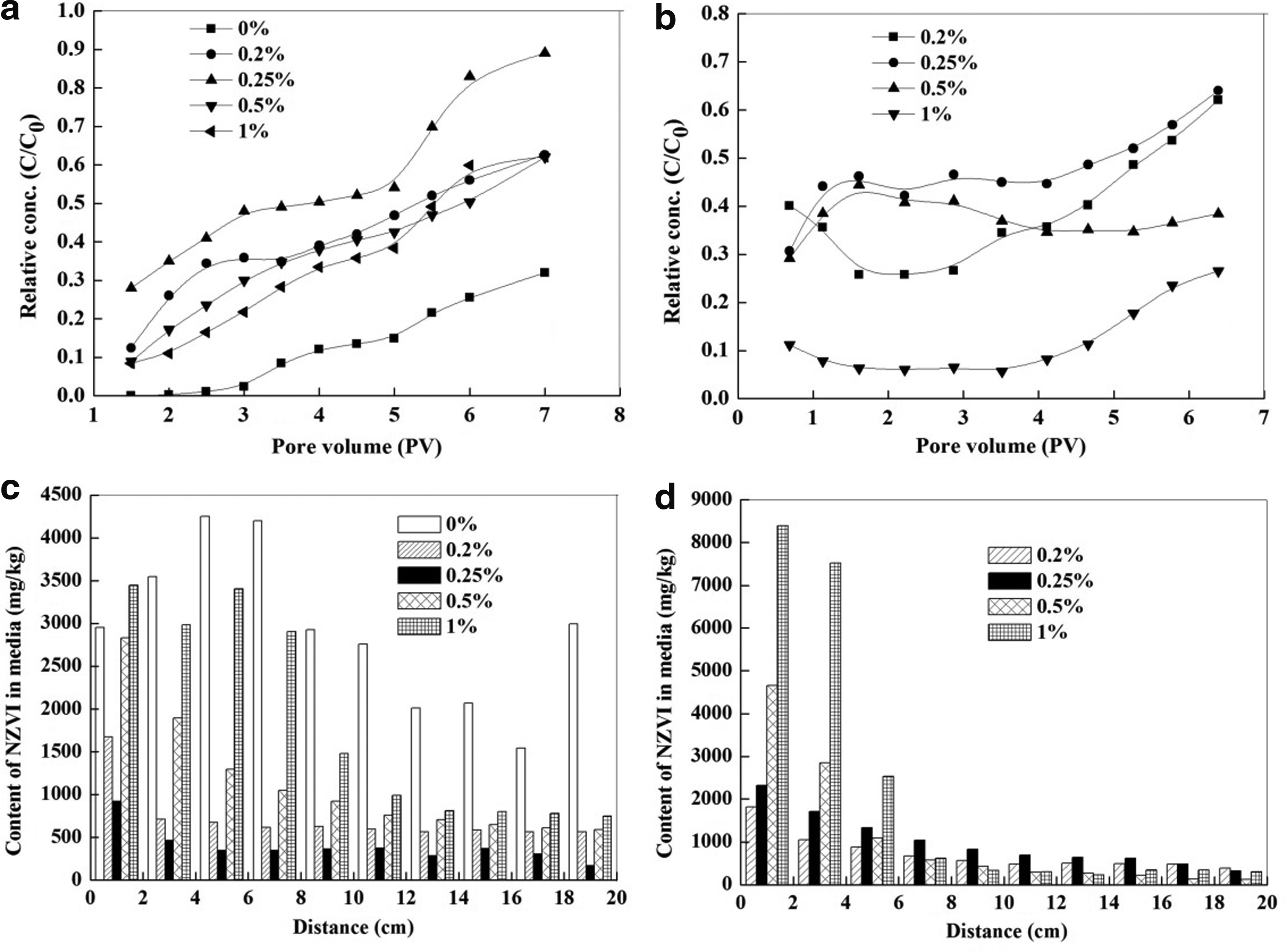
Nanoparticle transport in the porous media is mainly dependent on the particle size, suspension stability, and particle charge (Kanti Sen and Khilar, 2006). As shown in the TEM images (Su et al., 2014) reported in our previous work, bare nZVI particles without SDS aggregated and formed a group structure. For the SDS dosages of 0.2% and 0.25%, the TEM images show that SDS serves an agent preventing nZVI aggregation. However, with SDS dosages of 0.5% and 1%, chain-like clusters of nZVI were formed. The chain-like clusters caused by weak attractive forces have been reported in extensive studies of bare nZVI (Lien et al., 2007). With the addition of SDS, a more stable suspension of nZVI was achieved. However, a higher concentration of SDS (0.5% and 1%) may result in greater attachment around nZVI particles and may induce cluster structure transformation. By contrast, a low SDS concentration (e.g., 0.2%) may be insufficient to encapsulate nZVI thoroughly (Kanel and Choi, 2007). Therefore, the relative concentrations of nZVI in the effluent for an SDS concentration of 0.25% were greater than that of iron under the other three SDS concentrations.
As shown in Fig. 3c, 80% of nZVI particles (8 cm) are blocked at the bottom of the column at an SDS concentration of 1%. In addition, when the SDS concentration was 0.25%, the distribution of nZVI in the column was more uniform. Hence, 0.25% SDS not only promoted the nZVI migration in porous media but also enhanced the distribution uniformity of nZVI particles in porous media. For SDS-nZVI suspension injection, the exit rate was 70.96% at an SDS concentration of 0.25%, whereas the exit rates of nZVI were 68.71%, 62.14%, and 43.63% when the concentrations of SDS were 0.2%, 0.5%, and 1%, respectively (Table 2).
Figure 3b and d show the relative concentrations of nZVI in the effluent and the content of nZVI in media for nZVI-laden foam injection at SDS concentrations of 0.2%, 0.25%, 0.5%, and 1%. The foams with SDS concentrations of 0.2%, 0.25%, and 0.5% promoted nZVI particle delivery through the column. Nevertheless, the foams with SDS concentration of 1% inhibited nZVI transport in porous media. This phenomenon is attributed to the rapid bursting of the foams upon entering the column because of their contact with the media, which facilitates the formation of a multilayer cladding coating around nZVI particles. The gas drag force of foam bubbles could not overcome the blocking retardation produced by high SDS concentration. In addition, some slurry had formed in the latex tube at the bottom of the column with the injection of foams. A portion of nZVI was then retained in the slurry, whereas the other portion of nZVI was transported with foams. Therefore, the colloidal structures may have been changed, thus resulting in a significant reduction in the carrying capability of foams. Under this condition, a serious impediment to the process of nZVI delivery was found. As shown in Table 2, the total retained rate of nZVI reached 81.13% of the total influent content. Results indicated that the total exiting rate of nZVI content is in the following order: 0.25% >0.2% >0.5% >1%.
Nanoparticle transport in porous media is often described by the colloid transport model that accounts for the advection, dispersion, and deposition of colloids on the collector surface (Tufenkji and Elimelech, 2005). Numerous researchers highlighted that an attachment and straining model can be successfully used to fit the breakthrough curves of colloids in unsaturated media (Gargiulo et al., 2007). For nZVI-laden foam injection, the straining of nZVI particles serves a more important function through the nZVI transport process than what can be ascribed to physicochemical deposition because of the significantly higher deposition near the injection point in Figs. 2d and 3d.
Bare nZVI and SDS-nZVI suspensions and nZVI-laden foam transport in tanks
To the best of our knowledge, no data set that demonstrates the transport behavior of stabilized nZVI particles by SDS solution and foam in a two-dimensional setting in the porous media is available in the published literature. Figure 4(a) shows the images of tanks after completing the injection of bare nZVI suspension over 285 mL. Most of the nZVI was deposited near the inlet point, and the water separated from the bare nZVI suspension was transported predominantly in the vertical direction and accumulated at the bottom of the sand box. During bare nZVI suspension injection, the maximum lateral spreading distance of nZVI was ∼9 and 7 cm for the left and right sides, respectively. The maximum distance nZVI was transported vertically was ∼8 cm upward from the injection point and 20 cm downward because of gravity (Fig. 4[d]). The impact region of nZVI particles covered ∼12.8% of the total area. The maximum concentration of nZVI in media decreased from 5,800 to 0 mg/kg in less than 20 cm distance because of the aggregation of nZVI particles and the inhibition of nZVI delivery. As a result, the distribution of nZVI in porous media was nonuniform for bare nZVI suspension injection. The bare nZVI particle is expected to have a positive charge at neutral pH, whereas the porous medium will be negatively charged. Therefore, nZVI particles can attach to the porous medium and become immobilized because of charge interactions (Kanel et al., 2007).
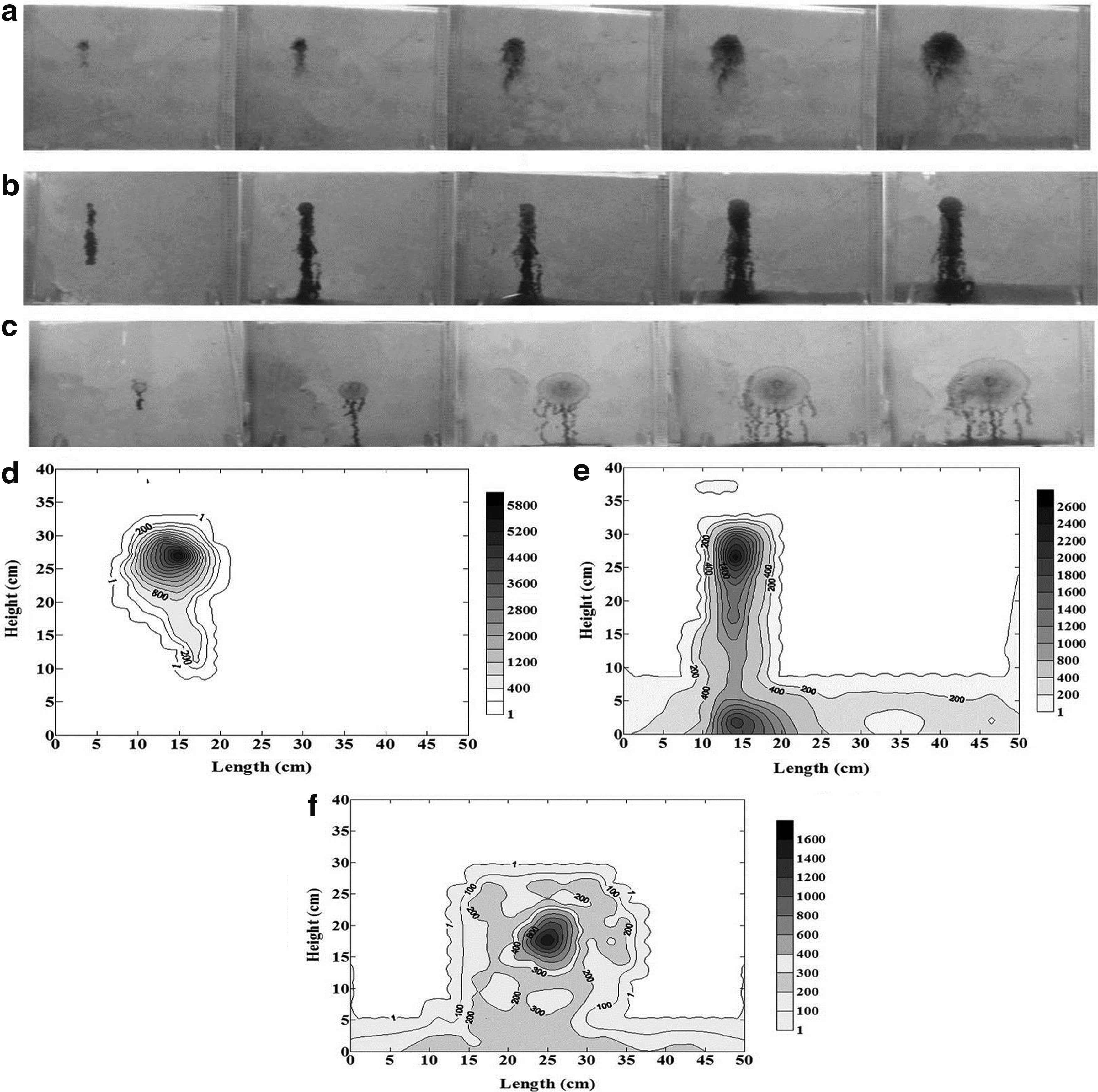
For the SDS-nZVI suspension (Fig. 4[b]), the SDS solution and nZVI particles were transported together in the vertical direction, whereas the nZVI particles were deposited below the injection point, and then accumulated at the bottom of the tank. During SDS-nZVI suspension injection, the region at the bottom of the tank was saturated with the suspension, and some nZVI particles migrated laterally at the bottom of the tank. The maximum lateral delivery distance of nZVI was only 5 and 7 cm for the left and right sides, respectively. However, the distribution of nZVI was nonuniform. For example, a vertical strip with high nZVI concentration was formed in a straight line from the injection point, and the impact region of nZVI covered ∼33.5% of the total area. This value was much larger than 12.8% for the bare nZVI suspension (Fig. 4[e]). The higher mobility of SDS-nZVI particles can be explained by the association of the hydrophobic part of the SDS with nZVI and the hydrophilic part toward the aqueous phase (Kanel and Choi, 2007). Furthermore, unlike the bare nZVI particles that are positively charged, the SDS-stabilized nZVI particles will be negatively charged at neutral pH because of stabilization using an anionic surfactant (Schrick et al., 2004; Kanel and Choi, 2007).
By contrast, nZVI particles were delivered to the sand box in both the lateral and vertical directions using the nZVI-laden foam. As shown in Fig. 4(c), during nZVI-laden foam injection, the migration region of the foam is circular and nZVI particles spread to the surrounding foams. In the process of nZVI-laden foam injection, the outermost foams burst initially, and then formed the SDS-nZVI suspension, which was transported predominantly in the vertical direction and accumulated at the bottom of the tank. Compared with bare nZVI suspension and SDS-nZVI suspension injection, foam injection spreads nZVI faster in the lateral direction, although the liquid volume was the same. nZVI delivery distance in the lateral direction is ∼25 cm. The impact region of nZVI covered ∼42.5% of the total area (Fig. 4[f]). The foam-enhanced transport investigation showed that foam delivery could significantly increase the lateral delivery distance and total impact region of injected nZVI particles. The main reason causing the difference between solution delivery and foam delivery is the driving force for the fluid and amendment spreading. In solution-based delivery, gravity is the major driving force, while in foam-based delivery, pressure is the dominant driving force that results in much improved lateral spreading (Zhong et al., 2011). The tank experiments indicated that foam transport enhanced nZVI delivery in porous media.
Conclusions
Large specific surface area and potent reducing power have enable nZVI to have promising environmental applications. However, both laboratory and field data show that nZVI aggregation in porous media and intrinsic problems, such as preferential flow and gravity flow, would limit the use of nZVI in contamination remediation. We examined SDS as a stabilizer to form the SDS-nZVI suspension and nZVI-laden foams for enhanced nZVI transport in continuous packed columns and tanks. Based on the experimental results, the following conclusions can be drawn:
(1) SDS dosage affects the stability of nZVI, but no definite rule exists. The foam quality and the carrying amount of nZVI increased with increasing stirring speed. However, nZVI distribution in foams became nonuniform with increasing amount of nZVI loading. The presence of nZVI particles does not reduce foam stabilities. (2) Column experiments with SDS-stabilized nZVI demonstrated the effect of SDS concentration on nZVI delivery in porous media. For the SDS solution and foam vehicles, the total exiting content of nZVI is in the following order: 0.25% >0.2% >0.5% >1%. The delivering distance of nZVI in porous media under the same liquid injection volumes is in the following order: nZVI-laden foams>SDS-nZVI suspension>bare nZVI suspension. (3) Foam-enhanced transport investigation in a two-dimensional tank shows that foam delivery could significantly increase the lateral delivery distance and total influencing region, as well as enhance the distribution uniformity of nZVI particles in porous media. The SDS foam is a promising vehicle for nZVI particle delivery in porous media for remediation.
Footnotes
Acknowledgments
This work was supported by the Natural Science Foundation of China (NSFC) #1 under grant number 41302183, the Postdoctoral Science Foundation #2 under grant number 2013M530987, the Doctoral Fund of Colleges and Universities #3 under grant number 20130061120085, and the Graduate Innovation Fund of Jilin University #4 under grant number 2014097.
Author Disclosure Statement
No competing financial interests exist.