




Abstract
Abstract
Biochars generated from peanut straw (PS) and rice straw (RS) were modified using Fe(III), which were then evaluated for As(V) adsorption in batch experimental systems. Results indicated that noncrystalline Fe hydroxides formed on the biochars during modification, reducing the negative charge on the biochar surface, and consequently the electrostatic repulsion to As(V) adsorption. Adsorption capacities of unmodified biochars for As(V) were low, but Fe(III) modification considerably enhanced As(V) adsorption by the biochars. The Langmuir isotherm fit the adsorption data well and could be used to describe As(V) adsorption by the Fe(III)-modified biochars. Maximum adsorption capacities for As(V), calculated using the Langmuir equation, were 33.7 g/kg for Fe(III)-modified PS biochar and 27.0 g/kg for Fe(III)-modified RS biochar at pH 5.0. As(V) adsorption capacities of both Fe(III)-modified biochars were much greater than that for goethite (13.1 g/kg) at pH 5.0. As(V) was mainly adsorbed by the Fe(III)-modified biochars through the formation of inner-sphere complexes on the surfaces of the biochars. Adsorption of As(V) by the Fe(III)-modified biochars increased as the solution pH fell, meaning that they could be efficient adsorbents to remove As(V) from acidic water. Fe(III)-modified PS biochar was more efficient than Fe(III)-modified RS biochar for adsorption of As(V). This is the first report of Fe(III)-modified crop straw biochars as adsorbents for As(V). The findings obtained in the present study are of practical significance in developing new low-cost adsorbents to remove arsenate and other anion pollutants from water.
Introduction
A
In China, the standard for As discharge in industrial effluent is 0.5 mg/L (GB 8978–1996). However, a lower limit of 0.01 mg/L for drinking water is suggested by the World Health Organization (WHO, 2011) and the Chinese Ministry of Health (GB 5749–2006). Therefore, removing As from water still needs to be investigated. Many existing treatment methods for As, for example, filtration or coagulation, have disadvantages, such as high costs or low removal efficiencies (Bang et al., 2005; Mohan and Pittman, 2007). However, the removal of As through adsorption is a simple and low-cost method.
In recent years, biochars from pyrolysis of plant-derived biomass have been used as low-cost sorbents to remove heavy metal cations from aqueous solutions (Mohan et al., 2007; Cao et al., 2009; Chen et al., 2011; Kong et al., 2011; Tong et al., 2011; Inyanget al., 2012; Kolodyńska et al., 2012) because they have a large negative charge, many oxygen-containing functional groups on their surfaces (Yuan and Xu, 2012), and a large adsorption capacity for heavy metal cations (Tong et al., 2011). Although the adsorption of As(III) by biochars has been previously reported (Mohan et al., 2007), the arsenate anion repulsion by the negatively charged biochar surfaces means that fewer than expected arsenate anions are actually adsorbed by the biochars (Qian et al., 2013).
Recent studies have shown that Al(III) modification can enhance the adsorption capacity of As(V) by straw-derived biochars (Qian et al., 2013). Fe-modified bamboo charcoal and Fe3O4-loaded activated carbon also have considerable arsenate adsorption capacities (Liu et al., 2010, 2012). Fe3+ can form stable complexes with oxygen-containing functional groups on the surfaces of biochars and Fe3+ hydrolysis leads to the formation of iron hydroxide precipitates on biochar surfaces. These two reactions change the biochar surface charges, and thus the adsorption characteristics for anions, such as arsenate [As(V)].
Previous research has shown that iron oxides are efficient sorbents (Fendorf et al., 1997; Catalano et al., 2007; Blanchard et al., 2012). Therefore, Fe(III) modification should enhance the adsorption of As(V) by crop straw biochars. However, as far as can be ascertained, there have been no previous studies on As(V) adsorption by Fe(III)-modified crop straw biochars.
The objectives of this study were to examine the adsorption capacities of Fe(III)-modified crop straw biochars for As(V) and to elucidate the mechanisms involved.
Materials and Methods
Preparation of unmodified and Fe(III)-modified biochars
The peanut straw and rice straw (PS and RS, respectively) were collected from Nanjing, China. The straws were air dried at room temperature and ground until they passed through a 1-mm sieve. Ceramic crucibles were filled with the ground straw samples, covered with a fitted lid and pyrolyzed in a muffle furnace. The pyrolysis temperature was raised to 350°C, at ∼20°C/min, and held at a constant 350°C for 225 min (Chun et al., 2004; Yuan et al., 2011). Following this, the biochar samples were allowed to cool to room temperature and then ground until they passed through a 1-mm sieve.
To modify the biochar, 10 g of the biochar was added into 100 mL of 0.3 M Fe3+ (as FeCl3) solution and magnetically stirred. The suspension pH was adjusted to 7.0 with 0.5 M NaOH and the samples left to stand for 2 h. Then the suspensions were dispersed ultrasonically for 2 h at 25°C ± 1°C in a bath-type sonicator at a frequency of 40 kHz and at 300 W. After standing for 24 h at 25°C, the reaction vessel temperature was raised to 75°C. The water in the suspension was evaporated off until ∼10–20% of the water remained. This step took ∼12 h. The Fe(III)-modified biochar was washed with deionized water once, and then with ethanol to remove all chloride ions (tested by 0.1 M AgNO3). The Fe(III)-modified biochar was then air dried and ground until it passed through a 1-mm sieve.
Measurement of unmodified and Fe(III)-modified biochar properties
X-ray diffraction (XRD) analysis was undertaken using a computer-controlled diffraction meter (D/max-III C; Rigaku), operated at 40 kV and at 20 mA. The data were collected over a 2θ range of 0°–50° using Cu Kα radiation and a scan rate of 2°/min.
In the scanning electron microscope (SEM) analysis, the samples were coated with a thin layer of gold and mounted on a copper slab using double-stick carbon tape and then scanned by a LEO 1530 VP SEM equipped with an energy dispersive spectrometer (EDS) (LEO Corporation, Germany). The EDS spectra of the Fe-modified biochars were recorded in the SEM image mode.
In Fourier transform mid-infrared (FTIR) analysis, 1 mg of the slightly ground biochar was gently mixed with 200 mg of oven-dried (at 105–110°C) KBr and the mixture was then pressed into a pellet. The FTIR spectrum of the biochar was recorded using a Nicolet 380 spectrophotometer (Thermo Fisher Scientific), scanning from 4,000 to 400 cm−1 at a resolution of 4 cm−1.
As adsorption experiment
A stock solution, containing 0.1 M As(V), was prepared using reagent-grade NaH2AsO4. Then a concentration series of As(V) solutions (0.1, 0.2, 0.4, 0.6, 0.8, and 1.2 mM) were prepared by successive dilution. All test solutions contained 0.01 M NaNO3 as the background electrolyte.
Duplicate samples (0.025 g) of the biochars were weighed into 100-mL plastic bottles and 25 mL of As(V) solution was added to each bottle. The pH of the suspensions was adjusted to 5.0 with HNO3 and NaOH and then the suspensions were shaken in a constant-temperature water bath at 25°C ± 1°C for 2 h. During this period, the suspension pH was adjusted several times until it stabilized. After standing overnight, the suspension pH was measured and then the suspensions were filtered to separate the solution from the solid phase. The amount of As(V) adsorbed by the biochars was calculated as the difference between the total amount added and the amount remaining in the equilibrium solution.
To investigate the effect of pH on As(V) adsorption by the biochars, 25 mL of 0.6 mM As(V) solution was placed in a 100-mL plastic bottle and 0.025 g of one of the biochars was added to the solution. The suspension pH was adjusted to different values within the range 3.7–6.7 using NaOH and HNO3. Then the same procedure to that mentioned above was adopted to obtain the As(V) adsorption values for the biochars at the different pH values.
After the adsorption experiments, the filter paper containing the solid phase was washed with deionized water three times to remove the retained solution. Then 20 mL of 1 M NaNO3 solution was used to desorb the adsorbed As(V). This step was repeated five times. The leachates were collected in 100-mL volumetric flasks.
As(V) concentrations in the solutions were determined by hydride generation–atomic fluorescence spectrometry using an AFS 9700 (Beijing KCHG Instrument Ltd.). Fresh sodium borohydride solution (10 g/L) was supplemented daily with 0.1 M NaOH and 1.2 M HCl was used as the carrier.
Zeta potential determination
For zeta potential determination, 0.050-g samples of biochar, which had passed through a 0.054-mm sieve, were weighed into 250-mL polyethylene bottles that contained 200 mL of 0.05 mM NaNO3 and 0.05 mM NaH2AsO4. A solution that only contained 0.05 mM NaNO3 was used as the control. The suspensions were dispersed ultrasonically for 1 h and then divided into six subsamples, which were then individually poured into 100-mL plastic bottles. The pH of the suspensions was adjusted using NaOH or HNO3 so that they were within the pH range 4.0–6.5. After the pH had stabilized, the suspensions were allowed to stand overnight. Then the zeta potential was measured using a ZetaPlus 90 (Brookhaven Instruments).
Results and Discussion
Fe(III)-modified biochar properties
SEM images of the biochars derived from RS and PS showed that the biochars consisted of irregular plates and had a porous structure before Fe(III) modification (Fig. 1). The Fe(III) particles attached themselves to the biochar surfaces, which suggested that Fe oxides formed on the surfaces (Fig. 1). XRD spectra of the Fe(III)-modified biochars indicated that crystallized calcium oxalate and quartz were present in the biochars, but no crystallized Fe (hydr)oxides were found in the biochars (Fig. 2). This suggested that the Fe (hydr)oxides that had formed on the biochars were noncrystalline.
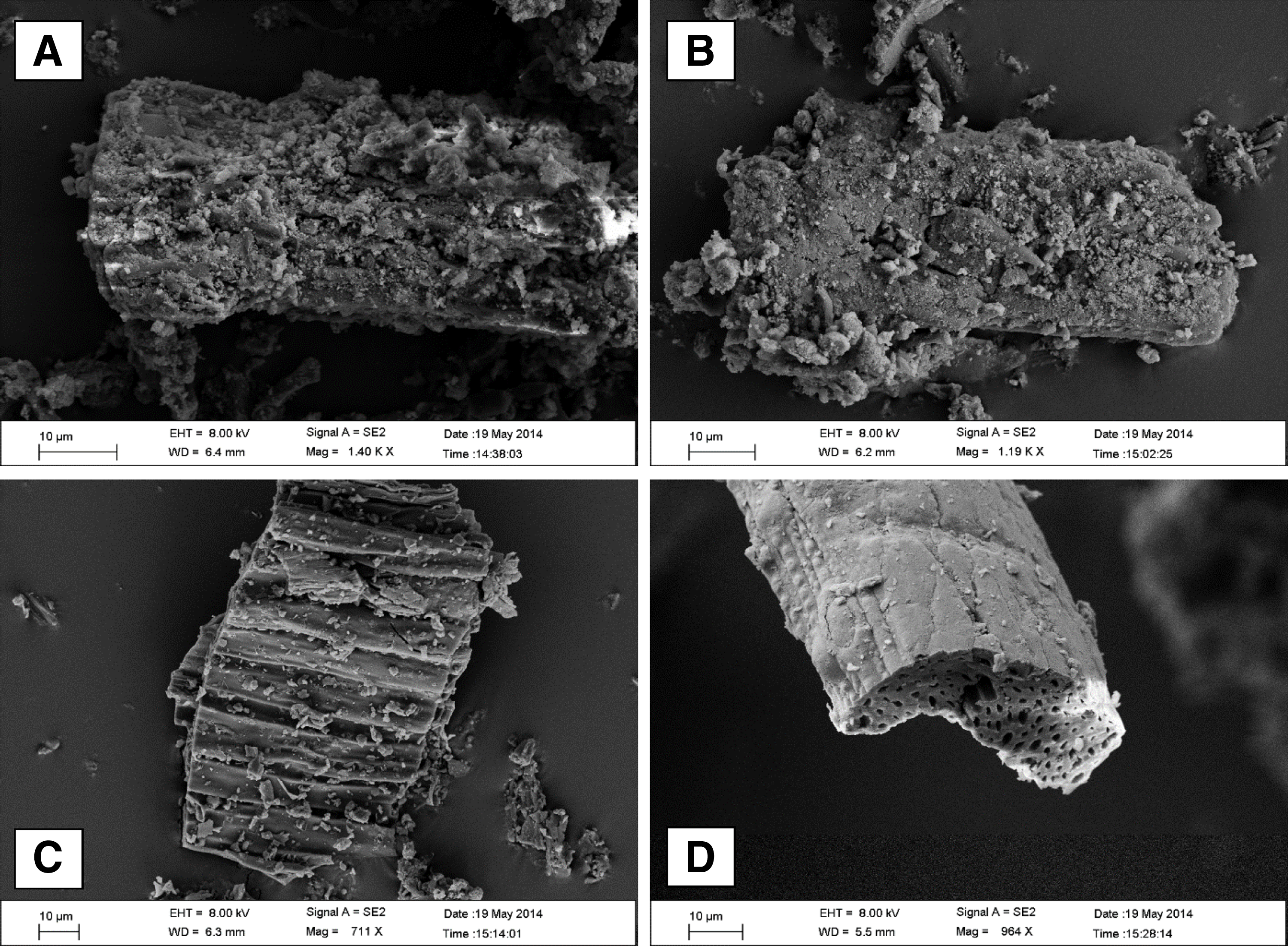
Scanning electron microscope photographs of unmodified and Fe(III)-modified biochars.

X-ray diffraction spectra of Fe(III)-modified biochars. Ca, crystallized calcium oxalate; Q, quartz.
In the FTIR spectrum of RS biochar (Fig. 3), the absorption peak at 3,420 cm−1 was assigned to hydroxyl stretching; the peak at 2,928 cm−1 was assigned to −CH2 symmetric stretching; the peak at 1,615 cm−1 to the carboxylate (−COO−) antisymmetric stretching; the peak at 1,100 cm−1 was assigned to the out-of-plane bending for carbonate; and the peak at 780 cm−1 to the carboxylate deviational vibration. After the biochar was modified by Fe(III), the peak at 3,420 cm−1 shifted to 3,400 cm−1, suggesting that complexation between Fe(III) and hydroxyl on the biochar occurred or there was production of hydroxyl on Fe oxides. The intensity of the peaks at 2,928, 1,615, 1,100, and 780 cm−1 decreased greatly due to the coating of Fe hydroxide on the biochar.
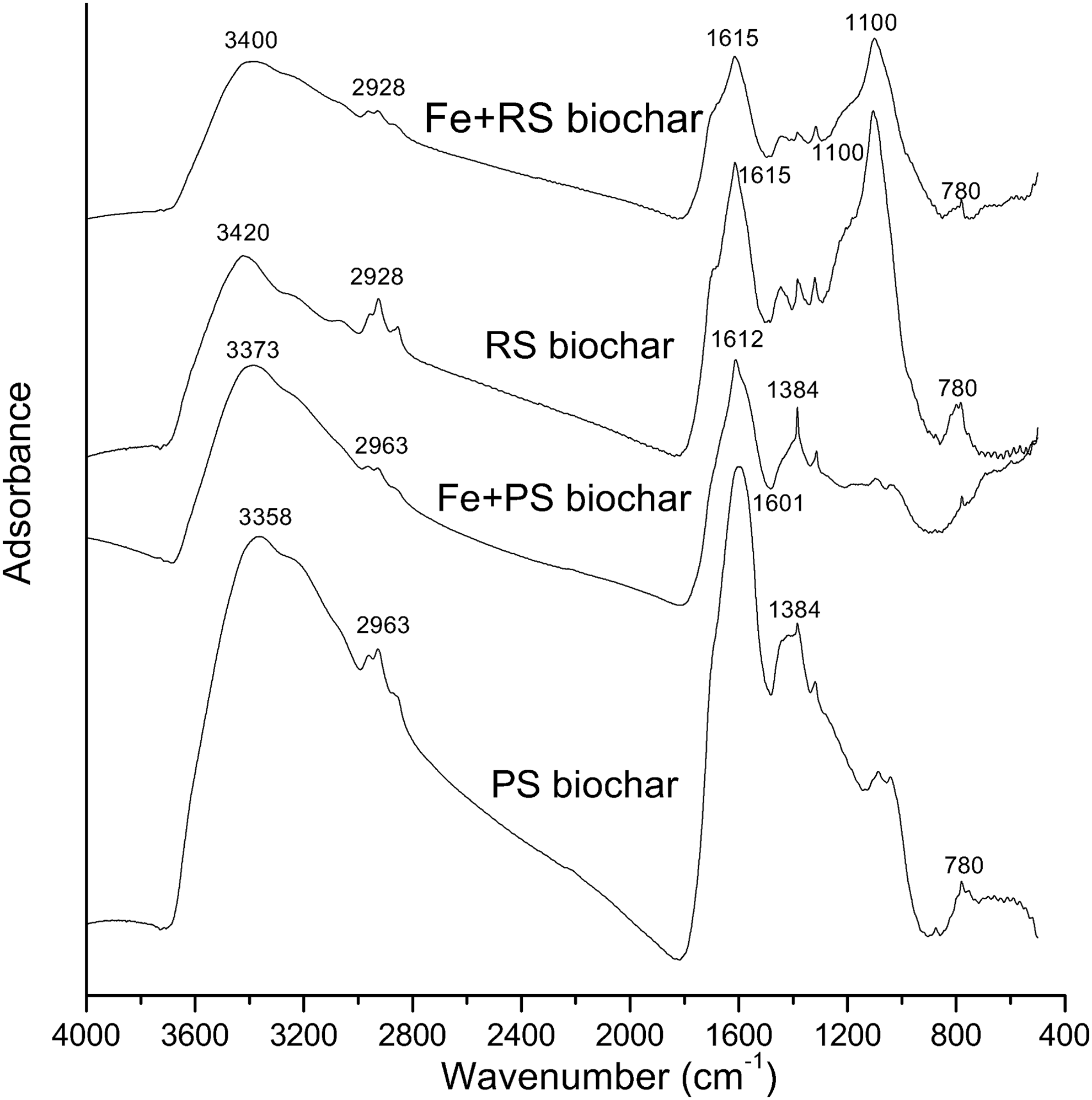
Fourier transform mid-infrared spectra of biochars and Fe(III)-modified biochars.
Similarly, the peaks at 3,358, 1,601, and 780 cm−1 in the spectrum of PS biochar were assigned to hydroxyl stretching, carboxylate antisymmetric stretching, and carboxylate deviational vibration, respectively. The peaks at 2,963 and 1,384 cm−1 were assigned to the symmetric stretching and symmetric deformation of −CH3. After the biochar was modified by Fe(III), the peak at 3,359 cm−1 shifted to 3,373 cm−1 due to the complexation between Fe(III) and hydroxyl on the biochar or the production of hydroxyl on Fe hydroxide. The peak at 1,601 cm−1 shifted to 1,612 cm−1 and its intensity decreased. The intensity of peaks at 2,963 and 780 cm−1 also decreased greatly after the biochar was modified by Fe(III) due to the coating of Fe oxides.
Zeta potential is the potential in the sliding plane of colloidal particles and its value and sign are related to the surface charge of the particles (Hunter, 1981). Protonation and deprotonation of functional groups can create a net charge on the surfaces of the solid particles. This can form an electrical double layer in the solution phase near the surfaces (Hunter, 1981). Zeta potential values were measured, as a function of solution pH, for PS biochar and Fe(III)-modified PS biochar (Fig. 4). The zeta potential of the PS biochar at pH 3.8–7.0 ranged from −28 to −37 mV, which indicated that the biochar carried negative charges on its surface. The zeta potential of the biochars became more negative as the pH rose, suggesting that the number of negative charges on the biochars had increased.

Zeta potential of PS biochar before and after Fe(III) modification.
When the PS biochar was modified with Fe(III), its zeta potential shifted in a positive direction, which was more pronounced as the pH increased (Fig. 4). The isoelectric point (IEP; i.e., pH when zeta potential is zero) of the Fe(III)-modified PS biochar was 4.2. There was a similar change in zeta potential for the Fe(III)-modified RS biochar (IEP = 4.1). The changes of zeta potentials of the biochars after they were modified by Fe(III) were consistent with the FTIR observation (Fig. 3). During the modification of the biochars, Fe hydroxide coated on biochars masked the functional groups on the biochars and thus decreased the negative charge on the biochars. Additionally, the protonation of the hydroxyl on Fe hydroxide created positive charge on Fe(III)-modified biochars. The changes in biochar surface charges induced by Fe(III) modification improved arsenate anion adsorption from the aqueous solution onto the biochar surfaces.
Adsorption isotherms for As(V)
As(V) adsorption isotherms for the unmodified and Fe(III)-modified biochars at pH 5.0 are shown in Fig. 5. As(V) adsorption by the unmodified and modified biochars increased as the As(V) concentration in the equilibrium solution rose. However, the amount of As(V) adsorbed by the unmodified biochars was very low (0.19–3.86 g/kg) (Fig. 5). The increased arsenate anion repulsion by the negatively charged unmodified biochar surfaces was one of the main reasons for the negligible As(V) adsorption. However, Fe(III)-modified biochars adsorbed much more As(V) than the unmodified biochars.
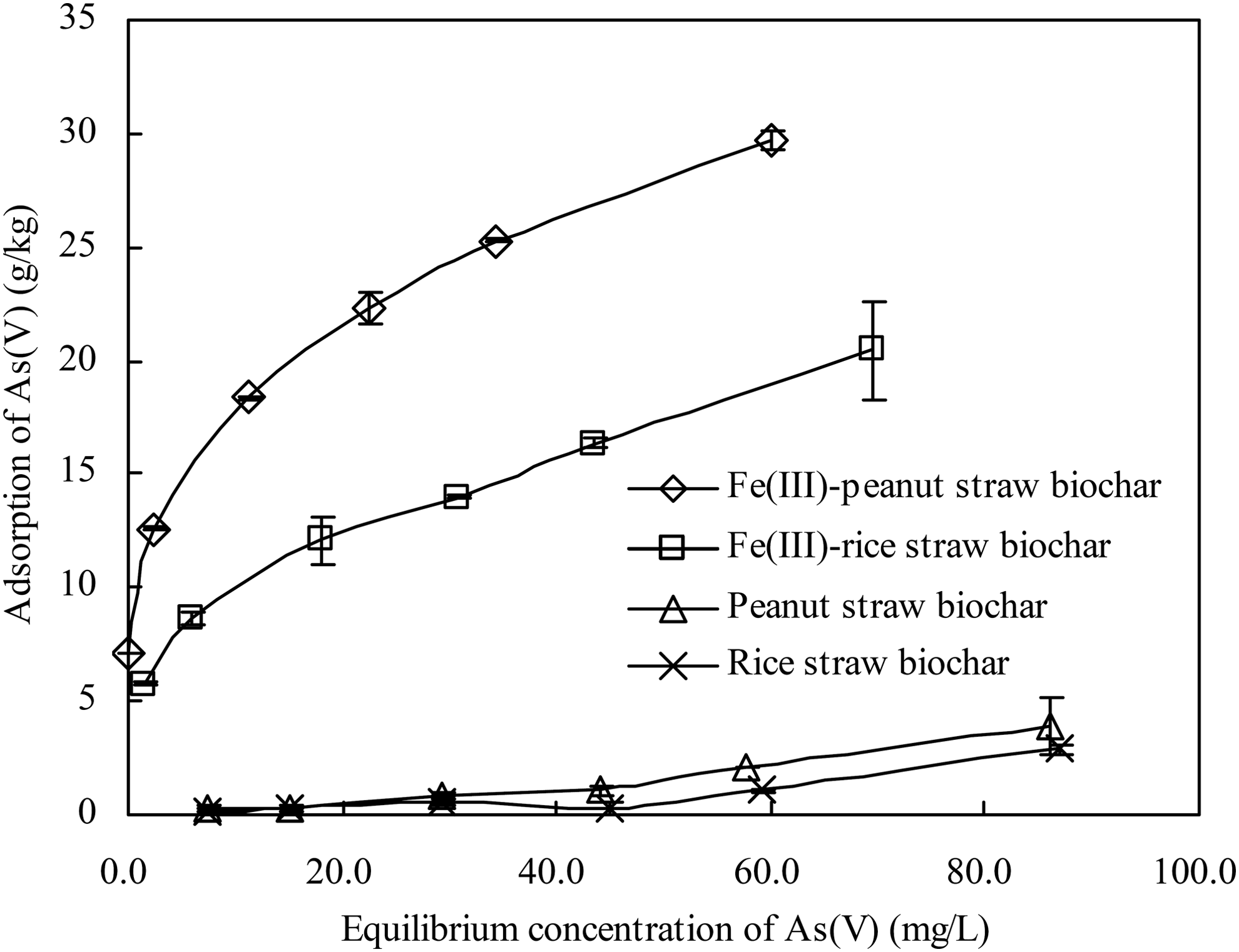
As(V) adsorption isotherms by unmodified and Fe(III)-modified biochars at pH 5.0.
Surface modification of the biochars by Fe(III) reduced the negative surface charge on the biochars, which decreased arsenate repulsion by the biochar surfaces. In addition, the formation of amorphous Fe hydroxide on biochar surfaces during modification by Fe(III) provided large adsorption sites for arsenate. These two factors enhanced As(V) adsorption by Fe(III)-modified biochars. Similar enhanced arsenate adsorption was also recorded for Al(III)-modified biochars (Qian et al., 2013).
When the two biochars were compared with each other, the adsorption capacity of the Fe(III)-modified PS biochar for As(V) was greater than the Fe(III)-modified RS biochar and this was related to the number of Fe hydroxide molecules formed on the biochar surfaces during the modification procedure. EDS semiquantitative analysis showed that the weight and atomic percentages for Fe in Fe(III)-modified PS biochar were 18.19% and 5.21%, respectively, which were much higher than the corresponding values for Fe(III)-modified RS biochar of 11.34% and 3.19% (Fig. 6 and Table 1). These results suggested that more Fe hydroxide molecules formed on PS biochar than on RS biochar during biochar modification by Fe(III) and that this was responsible for the greater As(V) adsorption by the Fe(III)-modified PS biochar.

Energy dispersive spectrometer spectra of the Fe(III)-modified PS biochar
SEM-EDS, scanning electron microscope–energy dispersive spectrometer; Nd, not detected; PS, peanut straw; RS, rice straw.
The Langmuir equation was used to describe the observed data and its linear form is:
where, Qm is the maximum amount of As(V) adsorbed by a biochar (g/kg), K is the constant associated with adsorption energy (L/g), Q is the amount of As(V) adsorbed by a biochar (g/kg), and C is the concentration of As(V) in the equilibrium solution (mg/L). The Langmuir equation fitted the adsorption data well. All correlation coefficients (R2) were >0.91, meaning that the equation could be used to describe As(V) adsorption by Fe(III)-modified biochars (Table 2).
Qm is the maximum adsorption capacity; K is the constant associated with adsorbing energy; R is correlation coefficient.
The Qm of the Fe(III)-modified biochars were calculated from the Langmuir equation fitting parameters (Table 2) and were less than Qm for Al(III)-modified biochars at pH 5.0 (more than 48.3 g/kg) (Qian et al., 2013), but much greater than the goethite As(V) adsorption capacity (13.1 g/kg) at the same pH (Violante and Pigna, 2002). Therefore, the Fe(III)-modified biochars can be used as adsorbents to remove As(V) from aqueous solutions. Further, the Fe(III)-modified PS biochar As(V) adsorption capacity was greater than the Fe(III)-modified RS biochar, thus the Fe(III)-modified PS biochar was more efficient at As(V) removal.
Activated carbons are normally used as adsorbents to remove pollutants from water. However, their adsorption capacities for As(V) are very low (Tuna et al., 2013; Arcibar-Orozco et al., 2014), similar to these of unmodified biochars reported in the present study (Fig. 6). After activated carbons were modified by Fe(III), their adsorption capacities for As(V) also increased greatly (Tuna et al., 2013; Arcibar-Orozco et al., 2014).
Effect of pH on As(V) sorption and potential sorption mechanisms
As(V) adsorption capacities of Fe(III)-modified biochars decreased as the pH rose (Fig. 7), which was similar to the As(V) adsorption by Fe/Al oxides (Arai et al., 2001). The surface charge on the Fe(III)-modified biochars also became more negative as the pH increased (Fig. 4), which led to more electrostatic repulsion of As(V) by the Fe(III)-modified biochars, and decreased their As(V) adsorption capacities. Under acidic conditions, the Fe(III)-modified biochars had relatively high adsorption capacities. However, the unmodified biochars had negligible As(V) adsorption capacities. Therefore, Fe(III)-modified biochars were effective As(V) adsorbents at low pH and could efficiently remove As(V) from acidic waste water. For the pH of 3.7–6.7, As(V) adsorption by Fe(III)-modified PS biochar was much greater than Fe(III)-modified RS biochar (Fig. 7), consistent with the adsorption isotherm results (Fig. 5).
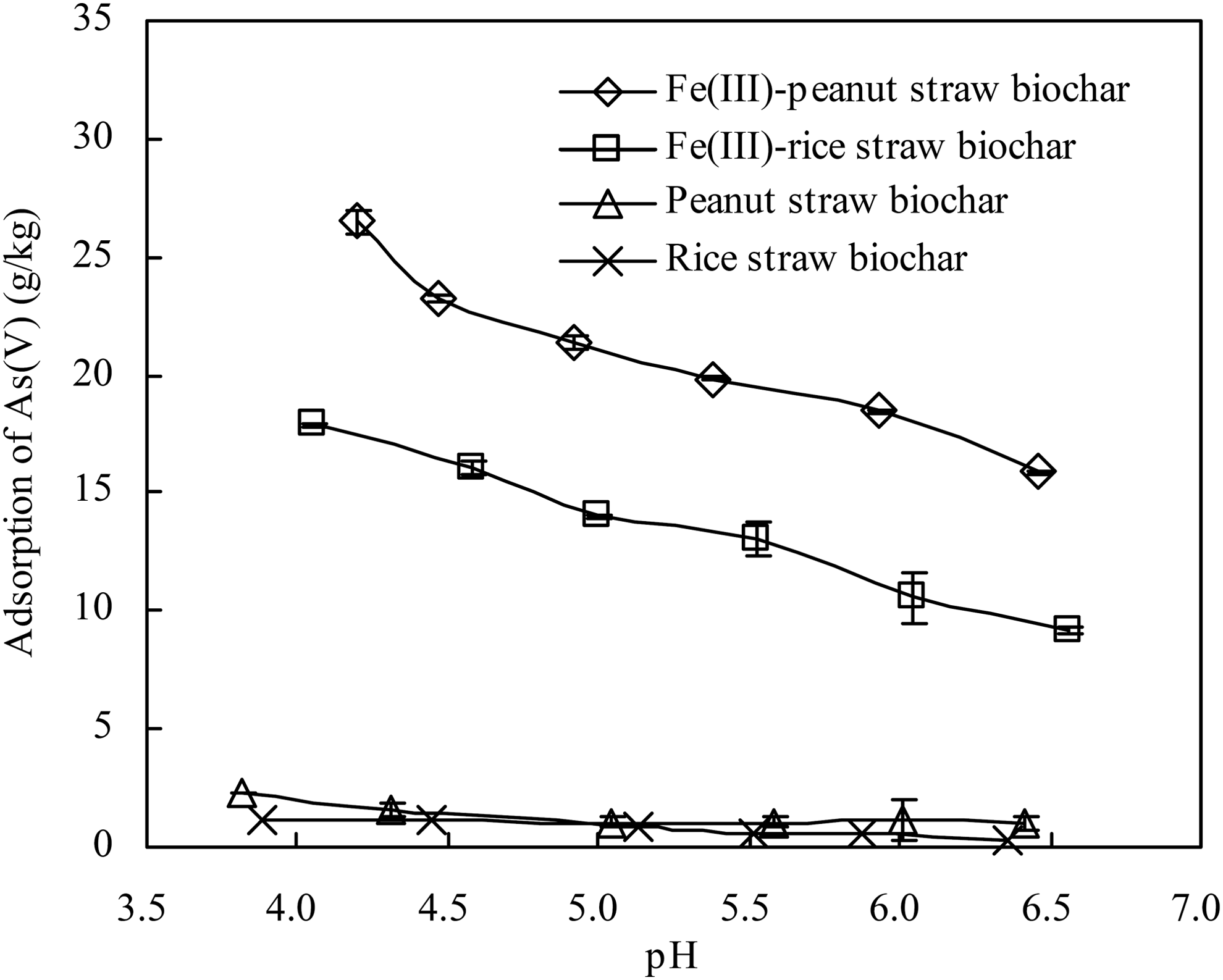
Effect of pH on As(V) adsorption by unmodified and Fe(III)-modified biochars.
After the adsorption experiments, 1 M NaNO3 solution was used to desorb the adsorbed As(V). The As(V) desorbed by NaNO3 represented the As(V) electrostatically adsorbed by Fe(III)-modified biochars. The percentage of As(V) desorbed by NaNO3 represents the contribution of the electrostatic mechanism to As(V) adsorption by Fe(III)-modified biochars. Within the pH range shown in Fig. 7, the As(V) desorption percentage was 3.8–8.7% for Fe(III)-modified PS biochar and 7.7–14.0% for Fe(III)-modified RS biochar. Therefore, As(V) was not primarily adsorbed by the Fe(III)-modified biochars through the electrostatic mechanism, but mainly through nonelectrostatic mechanisms.
The effect of As(V) adsorption on the zeta potential of Fe(III)-modified biochars was investigated to study the Fe(III)-modified biochar As(V) adsorption mechanisms. As(V) adsorption onto the Fe(III)-modified biochars shifted their zeta potentials in a negative direction (Fig. 8), suggesting that the surface charge on the Fe(III)-modified biochars became more negative due to As(V) adsorption. The shift in zeta potential induced by As(V) adsorption for both Fe(III)-modified biochars became more evident as the pH decreased, consistent with As(V) adsorption trend with pH, and suggested that increases in As(V) adsorption by the biochars led to greater shifts in their zeta potentials. These observations implied that specific adsorption of As(V) occurred on the surfaces of the Fe(III)-modified biochars.

Zeta potentials of Fe(III)-modified biochars before and after As(V) adsorption.
During adsorption, As(V) strongly bound to the surfaces of the Fe(III)-modified biochars and transferred some of the negative charge from the anion to the surfaces of the biochars. However, if arsenate was adsorbed electrostatically, the negative charges would be in the diffuse layer of the electric double layer on the Fe(III)-modified biochars and, therefore, would not change the surface charge and zeta potential of the Fe(III)-modified biochars. Changes in zeta potential and surface charge on Fe/Al oxides induced by the adsorption of As(V) were reported previously (Jain et al., 1999; Arai et al., 2001) and are consistent with the Fe(III)-modified biochar observations in the present study.
This study's results suggested that As(V) was adsorbed by Fe(III)-modified biochars through a similar mechanism to that in pure Fe/Al oxide systems. The formation of chemical bonds between arsenate and Fe and Al oxides has been confirmed through X-ray absorption in fine structure spectroscopic studies (Fendorf et al., 1997; Arai et al., 2001; Catalano et al., 2007). In this study, the As(V) adsorbed by the Fe(III)-modified biochars mainly reacted with Fe hydroxides and formed inner-sphere complexes with the Fe hydroxides formed on the biochar surfaces.
FTIR spectra of Fe(III)-modified biochars with As(V) adsorbed provided evidence for the mechanisms of As(V) adsorption. After As(V) adsorption, the peak at 3,400 cm−1 in the spectrum of Fe(III)-modified RS biochar shifted to 3,387 cm−1, and the peak at 3,373 cm−1 in the spectrum of Fe(III)-modified PS biochar shifted to 3,358 cm−1 (Fig. 9). These results suggested that the chemical reaction occurred between the hydroxyl on Fe(III)-modified biochars and arsenate during the adsorption of arsenate. The new peaks at 820 and 826 cm−1 in the spectra of the Fe(III)-modified RS and PS biochar were assigned to As-O-Fe groups (Fig. 9) (Goldberg and Johnston, 2001), which suggested that arsenate covalently bound to Fe in Fe(III)-modified biochars through ligand exchange reaction with hydroxyl on the Fe(III)-modified biochars, and consequently the As-O-Fe bond was formed.

Fourier transform mid-infrared spectra of Fe(III)-modified biochars before and after As(V) adsorption.
Stability and lifetime of Fe(III)-modified biochars
Biochars are stable and difficult to decompose. After modification by Fe(III), the Fe in the biochars was also stable. At pH >4.0, the amount of Fe released from Fe(III)-modified biochars during the adsorption experiments was <1.7% of the total Fe in the biochars and was 0.3% at pH >5.0. Therefore, the Fe(III)-modified biochars were stable adsorbents for As(V).
As(V) was adsorbed specifically by the Fe(III)-modified biochars and would be difficult to directly recycle. However, biochars are biofuel and Fe(III)-modified biochars with As(V) adsorbed can be burned and the Fe and As recycled from ash.
Conclusions
Fe(III) modification greatly enhanced As(V) adsorption onto the biochars because the modification process reduced the negative surface charge on biochars, which reduced biochar electrostatic repulsion to As(V). The Langmuir equation fitted the adsorption isotherms well and could be used to describe the adsorption of As(V) by the Fe(III)-modified biochars. The maximum adsorption capacities for As(V), calculated using the Langmuir equation, were 33.7 g/kg for Fe(III)-modified PS biochar and 27.0 g/kg for Fe(III)-modified RS biochar at pH 5.0. The As(V) adsorption capacities of both Fe(III)-modified biochars were much greater than that of goethite (13.1 g/kg) at pH 5.0.
As(V) was mainly adsorbed by the Fe(III)-modified biochars through the formation of inner-sphere complexes on the biochar surfaces and As(V) adsorption by the Fe(III)-modified biochars increased as the pH fell. Therefore, Fe(III)-modified biochars would be efficient adsorbents to remove As(V) from acidic water and our results showed that Fe(III)-modified PS biochar was more efficient at As(V) removal than Fe(III)-modified RS biochar.
Footnotes
Acknowledgments
This study was supported by the National Natural Science Foundation of China (41230855) and the National Key Technology R&D Program of China (2012BAJ24B06).
Author Disclosure Statement
No competing financial interests exist.