




Abstract
Abstract
In this work, rice straw was modified by succinic acid to improve its adsorption ability for uranium. Infrared analysis indicated that carboxylic acid groups and ester groups were grafted on rice straw surface. Scanning electron microscope showed that the appearance of rice straw had become thinner, more dispersed, and rolled-up like dead leaves after modification, implying that its structures got looser and its inner pores increased, resulting in its reactive surface area being notably extended. Effects of reaction time, adsorbent dosage, temperature, pH, and initial uranium concentration on adsorption of uranium were also investigated. Results showed that the adsorption efficiency of modified rice straw increased from 55% to 95% at 10 mg/L uranium solution, adsorption equilibrium was achieved within 1.5 h, and kinetic data could be well described by pseudo-second-order kinetic model. Adsorption isotherms followed the Langmuir and Freundlich models, and maximum adsorption amount of uranium onto the rice straw calculated from Langmuir equation rose from 19.7628 to 24.0385 mg/g at 35°C after modification. In addition, infrared analysis depicted that the adsorption of uranium by modified straw mainly depended on the complexation of carboxylic acid groups and ester groups with uranium.
Introduction
N
Traditional methods such as evaporation, ion exchange, coagulation precipitation, and oxidation reduction method for uranium-containing wastewater treatment have received more and more attention. Whereas to some degree, these methods are often complicated, costly, and difficult to operate (Akhtar et al., 2007). Except for these methods, adsorption by biological materials for treating radioactive wastewater is increasingly attracting researchers' attention due to its comprehensive sources, fast adsorption rate, good selectivity, wide applicative range for pH, and temperature (Khani et al., 2008; Rodrigues-Silva et al., 2009; Vijayaraghavan et al., 2010; Xu et al., 2012). For these reasons, nowadays many waste crop materials such as areca catechu, orange waste, coir pith, chestnut shell, chaff, Ananas comosus peel, Parkia speciosa pods, Psidium guajava peel, and Olive pomace have been used in treating wastewater containing heavy metals (uranium, cadmium, copper, lead, etc.) (Pagnanelli et al., 2003; Dhakal et al., 2005; Harshala et al., 2005; Han et al., 2006; Chakravarty et al., 2010; Yao et al., 2010; Foo et al., 2012; Haloi et al., 2013).
China regarded as one of the world's largest rice producers produces a great deal of rice straw. Because rice straw is widely available and exceedingly low cost in China, it is always treated as agricultural waste and burned in situ, which not only wastes natural resource but also releases pollutants such as smoke dust and carbon dioxide. Actually, rice straw is supposed to be a kind of very promising adsorption material for uranium. Since its interior structure has a large number of vascular bundle sheaths, medullary cavities, intercellular canals, and other porous tissue, furthermore, its main chemical compositions are hydrophilic cellulose, hemicellulose, and lignin that contain a large number of OH groups to undergo esterification with organic acid (Seo and Sakoda, 2014), rice straw has a very large surface area to adsorb UO22+.
To some degree, some obvious treatment effects have been obtained; however, these raw waste crop materials generally performed a limited adsorption capacity to uranium-containing wastewater, which limited their practical application in wastewater treatment (Wang and Chen, 2009; Wang et al., 2009). Unfortunately, only few modifications have been made to improve the adsorption capacity of waste crop materials.
It is reported that the oxygen-containing groups and ester groups both have very strong effect on coordinating with UO22+ (Suzanne and Karsten, 2008; Sun et al., 2013). Interestingly, the succinic acid could coordinate with U(VI) to form complexes (Lucks et al., 2012). Thereby, if these crop wastes could be modified by succinic acid and grafted on carboxylic acid groups and ester groups, its adsorption capacity could be strengthened significantly.
In this study, the rice straw was evolved as a typical crop waste. It was modified by acidification using succinic acid to graft functional carboxylic acid groups and ester groups. The properties of modified rice straw were characterized by Fourier transform infrared (FT-IR) and scanning electron microscopy (SEM). Their adsorption behavior to uranium was investigated by bath experiments. The adsorption isotherm and kinetic models were conducted to investigate the special adsorption ability of the group-grafted rice straw. The study will make a foundation for the use of biological material adsorption technology in treatment of uranium-containing wastewater.
Experimental Section
Materials and reagents
Rice straw was collected from Maoming City of Guangdong Province, called Xianyou No. 602 Rice. U3O8 was guarantee reagent. Other chemical reagents used were of analytical grade. Uranium stock solution of 1 g/L was prepared by dissolving U3O8 in hot solution of 10 mL concentrated hydrochloric acid, 3 mL 30% H2O2, and two drops of concentrated nitric acid. The stock solution was kept in the acidic condition and the working solution [U(VI)] = 1–1,000 mg/L was prepared by appropriate dilution of the stock solutions immediately.
Rice straw modification
By the pretreatments of crushing and screening, the straw samples with particle size from 1.180 to 0.425 mm were gained. In the following stage, with the 25 g crushed straw being put into 300 mL 10% KOH solution at 45°C for 1 h and then washed to pH = 8 and dried later, subsequently the alkaline straw was obtained. In the third stage, 20 g alkaline straw was put into 200 mL 15% succinic acid solution at 45°C for 1 h, then dried, and the acid straw was obtained. Finally, 20 g acid straw, 30 g succinic acid, and 4 g p-toluene sulfonic acid were put into 300 mL acetone, meanwhile being heated and refluxed for 3.5 h at 75°C, and then the sample was washed to pH = 4.0 and dried, after that the desired products called modified straw were made. The reaction process is as follows:

Adsorption experiments
Adsorption experiments were carried out using batch method. According to research purpose, the pH values of uranium stock solution were first adjusted to preselected values using a pH meter (SevenMulti; Mettler Toledo) with HCl solution and NaOH solution, and then solution of uranium (from 10 to 200 mg/L) was contacted with selected amount of rice straw or modified straw in 500 mL conical flasks. The conical flasks were shaken in water bath with the speed of 145 revolution/min for preselected period of time at preselected temperature. Then they were filtered and the uranium concentration of the filtrate was measured by Br-PADAP spectrophotometric method. The adsorption efficiency (AE, %) and adsorption capacity (Qt, mg/g) of uranium were calculated using Equations (2) and (3):
where C0 is the initial uranium concentration (mg/L). Ct is the uranium concentration at the moment t (mg/L). V is the volume of uranium aqueous solution (mL). mP is the mass of adsorbent (g).
Pseudo-second-order kinetic model is expressed as the following Equation (4):
where t presents reaction time (min). KF presents the second order rate constant (g/[min/mg]). Qe presents the equilibrium adsorption amount (mg/g). Qt presents the adsorption amount at the moment t (mg/g).
Langmuir and Freundlich adsorption isotherms have been frequently used to describe experimental data of adsorption. Langmuir isotherm describes monolayer adsorption based on the assumption that the adsorption process is in homogenous system and all the adsorption sites have equal adsorption affinity and that the adsorption at one site does not affect an adjacent site (Li et al., 2013).
The linear form of Langmuir isotherm is given as Equation (5):
where KL is the Langmuir equilibrium constant, L/mg, Qe is the equilibrium adsorption amount in various initial uranium concentrations, mg/g, Ce is the uranium concentration in various initial uranium concentrations, mg/L; and Qm is the maximum adsorption amount, mg/g.
The linear form of Freundlich isotherm is given as Equation (6):
where KF presents the Freundlich equilibrium constant, which is a measure of the adsorption capacity, L/g, Qe presents the equilibrium adsorption amount in various initial uranium concentrations, mg/g, Ce presents the uranium concentrations in various initial uranium concentrations, mg/L, and n presents the nonlinear coefficient.
Analysis method
FT-IR spectra were recorded using KBr pellets by Nexus-870 spectrometer within the range 400–4,000 cm−1. SEM images were recorded using a JEOL JSM-6330F-mode Field Emission Scanning Electron Microscope (HITACHI S-570) operated at an accelerating voltage of 15 kV. The concentration of uranium was determined by Br-PADAP spectrophotometric method (Jia and Yin, 1986).
Results and Discussion
Characteristics of original and modified rice straw
As shown in Fig. 1, four obvious adsorptive peaks were observed at 665, 1,045, 1,510, and 3,406 cm−1; they are assigned to C—OH group (Nyquist et al., 1996). It means that there are a lot of OH groups, which could be used for esterification with acid in rice straw.

Infrared spectra of untreated straw, alkaline straw, and modified straw.
Compared with the curve of untreated straw, many absorptive peaks illustrated some descents in the range of 3,600–1,100 cm−1 in the curve of alkaline straw and there were even some significant descents between 1,100–1,030 cm−1, 1,740–1,690 cm−1, and 3,570–3,050 cm−1.What could serve as reasons for the phenomena was presumably that a lot of hemicellulose, pectic substances, and other impurities have been dissolved after alkalization of straw (Jin and Chen, 2007; Gupta and Parkhey, 2014).
In addition, compared with the curve of untreated straw, in the curve of modified straw, there were two obvious adsorption peaks of OH groups of carboxylic acid at 1,427 and 3,405 cm−1, respectively, a significantly absorptive peak of C—O groups of carboxylic acid at 1,716 cm−1. At the same time, there were also obviously absorptive peaks of C—O groups of ester groups at 1,720 cm−1 and other two absorptive peaks of C—O—C groups of ester groups at 1,161 and 1,190 cm−1. What could lead to the phenomena was that the carboxylic acid groups and ester groups had been linked to the straw after esterification or modification.
From the Fig. 2, the SEM of Fig. 2a revealed that the main part of untreated straw was flat, while its surface was connected with irregular substances, which may be the crystalline solid of pectic substances or hemicellulose, lipids, and other carbohydrates. The SEM of Fig. 2b indicated that the straw became smooth and got some folds on its surface after alkalization, due to the dissolution of some hemicellulose, pectic substances, and other carbohydrates and the swelling or deformation of straw in alkaline solution. The SEM of Fig. 2c demonstrated that the appearance of the straw had became thinner, more dispersed, and rolled-up like dead leaves after modification, which meant its structures got looser and its inner pores increased so that its reactive surface area had been extended notably and it had been more easy to expose its effective groups in uranium solution.
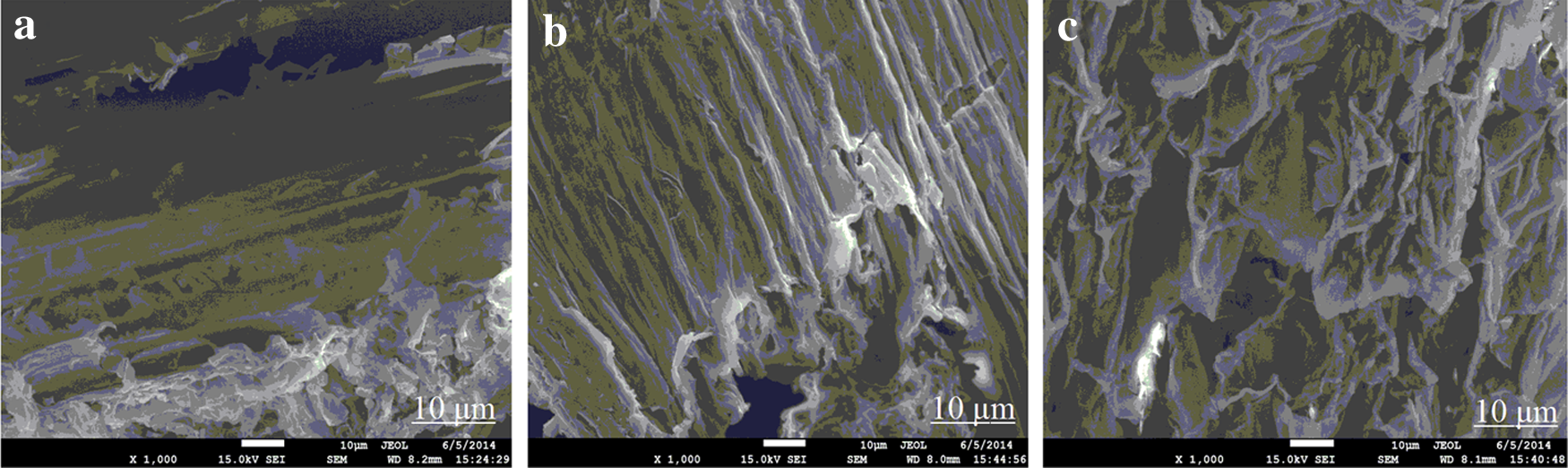
Scanning electron microscope of
Based on the results of infrared spectra (Fig. 1) and SEM (Fig. 2), the chemical compositions of straw and the modified flow chart of rice straw can be described in Fig. 3. It is clearly seen that the straw is mainly composed of cellulose, lignin, hemicelluloses, and pectin substances. A lot of hemicellulose, pectin substances, and other carbohydrates had been dissolved after being alkalized. Thus, the effective groups of cellulose and lignin could be exposed, and the straw had been deformed by expansion. When being acidified, the residual alkali had been neutralized in the last step and an acidic environment had been created. The water produced in the reaction of alkali with succinic acid could be avoided. The OH group in alcohols in the straw is activated. Finally, the carboxylic acid groups and ester groups had been attached to the straw due to esterification, resulting in the fact that the specific surface area of straw had been extended notably.
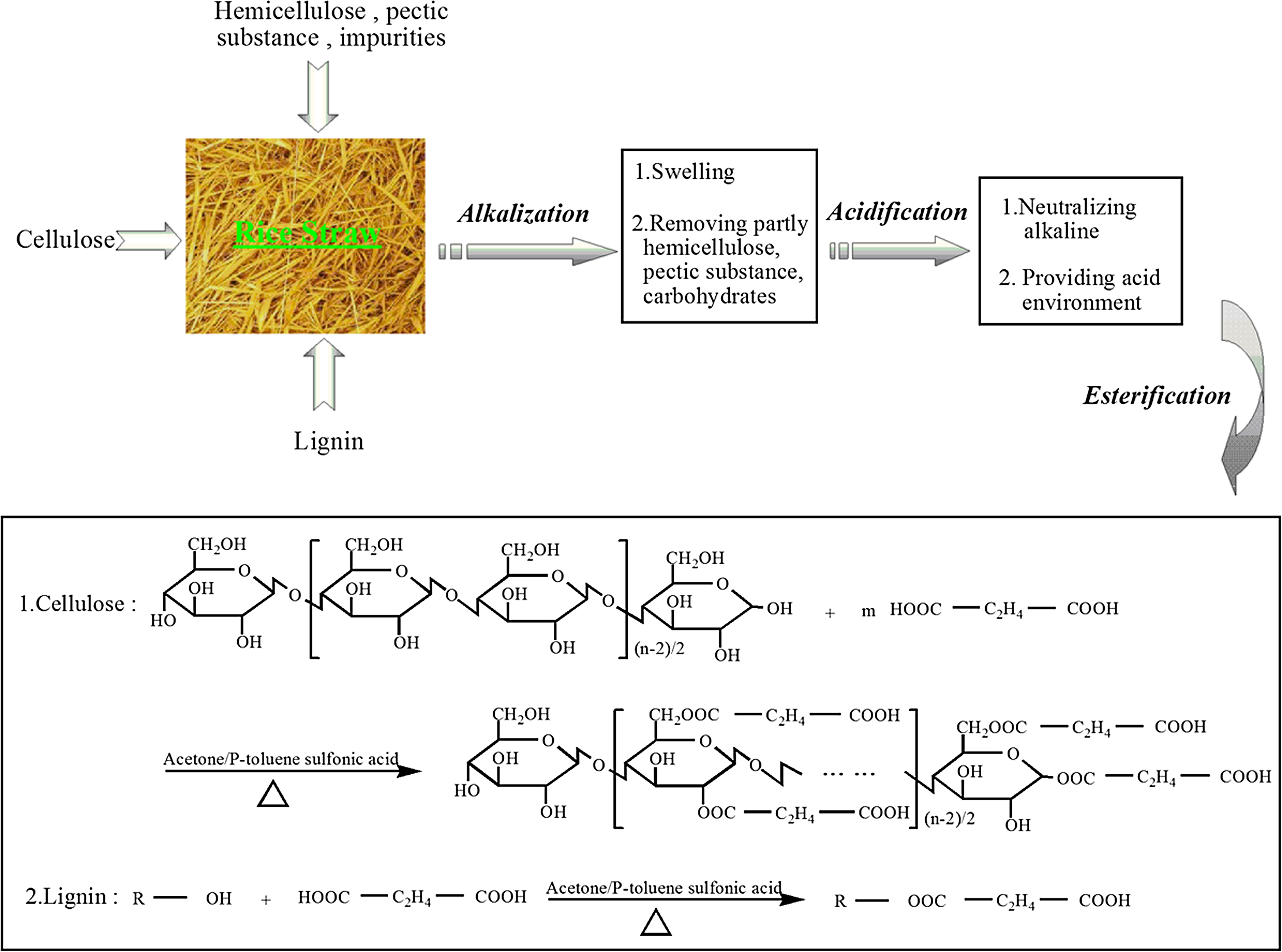
Flowchart of modification procedure of rice straw.
Adsorption kinetics
As seen from Fig. 4a, over 80% of uranium was adsorbed in 10 min, which was a rapid process. The AE of uranium by modified straw increased from 83% at 10 min to about 95% at 90 min and then almost did not increase any more, which meant that the adsorption reaction of modified straw may have reached equilibrium at 90 min. What deserved the most attention was that the AE of straw after modification was raised 40%, which indicated that modification could significantly enlarge the adsorption ability of rice straw.

Pseudo-second-order kinetic model was applied to these experimental data seen from Fig. 4b. It was clear that the regression correlation coefficients of pseudo-second-order kinetic model were more than 0.99, so that the adsorption kinetic could be well described by pseudo-second-order kinetic equation. The confirmation of pseudo-second-order kinetics indicated that the adsorption rate was determined by the concentrations of both adsorbate (uranium) and adsorbent (rice straw). According to the two correlation equations, y = 0.2888x + 0.63 and y = 0.1731x + 0.4422 and Qt, the numerical values of Qe and KF can be inferred (Tale 1). Moreover, from Table 1, the Qe of straw after modification was much larger compared with the straw before modification in initial uranium concentration of 10 mg/L, and the KF for the adsorption of uranium onto straw before and after modification was different obviously, which meant that the features of straw in adsorption kinetics had been converted.
Effect of dosages of straw and modified straw on adsorption of uranium
As seen from Fig. 5a, the AE of uranium by rice straw rose from 10% to 45% with the increase of straw amount from 0.15 to 0.50 g, then kept steadily from 0.50 to 0.55 g, the AE of uranium by modified straw increased quickly from 75% at 0.15 g to nearly 85% at 0.25 g, and then increased slowly to 99% at 0.55 g. The AE of modified straw was higher compared with the straw by almost 45% in this experiment and the uranium concentration in solution after adsorption by modified straw can be lower than the 1 Bq/kg of the wastewater discharged standard of China when the added dosage of straw was 0.55 g, which indicated that modification of straw can not only enlarge the adsorption capacity significantly but also can improve the abilities in treatment of wastewater with low content of uranium.

Effect of
Effect of pH on adsorption of uranium
As seen from Fig. 5b, the AE of uranium by straw rose from ∼13% at pH = 2.0 to about 70% at pH = 5.5. Owing to the fact that when the pH was low, the dissociation of active groups in the straw before modification would be blocked and the main functional groups of rice straw like OH groups, which would accept the H+, be transformed into OH2+ groups. It is well known that the uranium ion exists in the form of (UO2)2+ at pH < 5 and then the surfa of straw could only produce repulsion for (UO2)2+ and hinder the adsorbing of (UO2)2+ onto straw. Once the pH is ranged from 5.0 to 7.0, the primary distribution species are UO2OH+, (UO2CO3)0, and (UO2)3(OH)5+; thus the hinder effect of sorption process of U(VI) is weakened and the surface coordination is enhanced (Zong et al., 2015). So that increase of the pH in solution was advantageous to the improvement of adsorption rates of uranium.
It can be seen that the AE of uranium by modified straw increased rapidly from 19% to 90% with pH from 2.0 to 3.5, then increased slowly to 95% when pH from 3.5 to 4.5, and kept almost a plateau around 95% from pH = 5.0 to 5.5. One main reason was that when the pH was low, the dissociation of active groups in the modified straw by cation would be blocked and the main functional groups of rice straw like COOH, COOC, and OH groups would accept H+ to transform into COOH2+, COOC · H+, and OH2+ groups (Nyquist et al., 1996), which could produce repulsion for UO22+ to be adsorbed by modified straw, which was why to increase the pH of solution was advantageous to improvement of AE of uranium. When the pH was higher than 4.5, some UO22+ would be hydrolyzed and converted into UO2(OH)n, which could influence the adsorption of uranium when the AE had reached a very high level already, which may fairly explain why there appeared a stabilization in this curve.
Furthermore, the AE of straw depicted marked increase at various lower pH values after modification, and the modified straw was suitable for treatment in much wider range of pH values.
Effect of reaction temperature on adsorption of uranium
Seen from Fig. 5c, there was a rise of AE from about 43% to around 80% and, subsequently, falling to nearly 75%. When reaction temperature was below 65°C, the increase of reaction temperature was more favorable to adsorption of uranium; when the reaction temperature was over 65°C, the increase in reaction temperature was more advantageous to desorption of uranium, so that the adsorption illustrated a slight decrease from 65°C to 75°C. However, the AE of uranium by modified straw just depicted a small fluctuation between 88% and 95% with improvement of temperature, meaning that the adsorption of uranium onto straw had became more insensitive to reaction temperature after modification.
Effect of initial concentration of uranium on adsorption of uranium
Seen from Fig. 5d, the equilibrium adsorption amount of uranium by original straw demonstrated a fast-speed growth from just 1.8 mg/g to nearly 16 mg/g and then there was a slow increase to about 20 mg/g with the increasing initial concentration of uranium; the equilibrium adsorption amount of uranium by modified straw just demonstrated a quick growth from just 2.5 mg/g to above 20 mg/g and then there was a slow increase to about 24 mg/g with the improvement of initial concentration of uranium. Compared with the two curves, it is obvious that the adsorption amount of straw had increased by almost 4 mg/g after modification and the gap of adsorption amount between modified straw and original straw expanded as the increase of initial concentration of uranium.
Adsorption isotherms
Langmuir and Freundlich adsorption isotherms of rice straw and modified straw are shown in Fig. 6. The constant values of Qm, KL, KF, n, and R2 are summarized in Table 2. Besides, from Table 2, the Qm of modified straw was larger compared with the original straw, which indicated that the adsorption sites of straw had increased after modification. In addition, from Table 2, the values of n−1 of straw before and after modification were both <1, which indicated that the straws before and after modification were both easy to adsorb uranium; and KF of straw after modification is much larger compared with straw before modification, which meant that the adsorption capacity of straw after modification was much stronger compared with straw before modification.
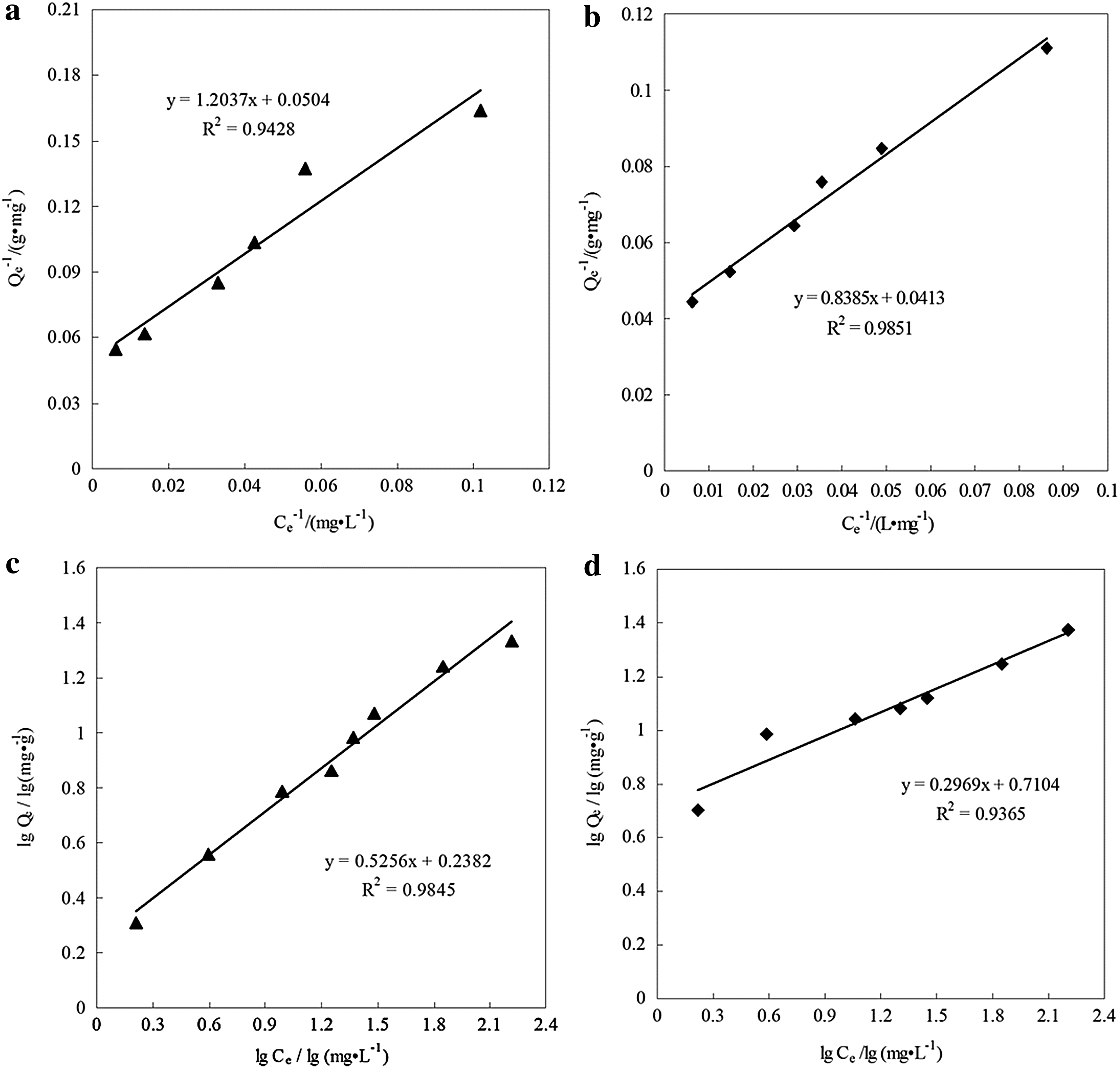
Langmuir adsorption isotherm model of uranium onto
Infrared spectrum of modified straw before and after adsorption of uranium
As indicated by the FT-IR spectrum shown in Fig. 7, there were many absorptive peaks to illustrate distinct falls at 3,405, 1,716, 1,720, 1,427, 1,161, and 1,190 cm−1 (Stuart, 2007). These absorptive peaks belonged to the adsorption peaks of carboxylic acid groups and ester groups. In addition, the appearance of an obvious peak at 923 cm−1 and changes in peak positions and intensity around 550–1,000 cm−1 region could be assigned to asymmetric stretching vibration of v3 UO22+ and stretching vibrations of weakly bonded oxygen ligands with uranium (Cejka, 1999). These phenomena indicated that the adsorption of uranium by modified straw mainly depended on the complexation of carboxylic acid groups and ester groups with uranium.
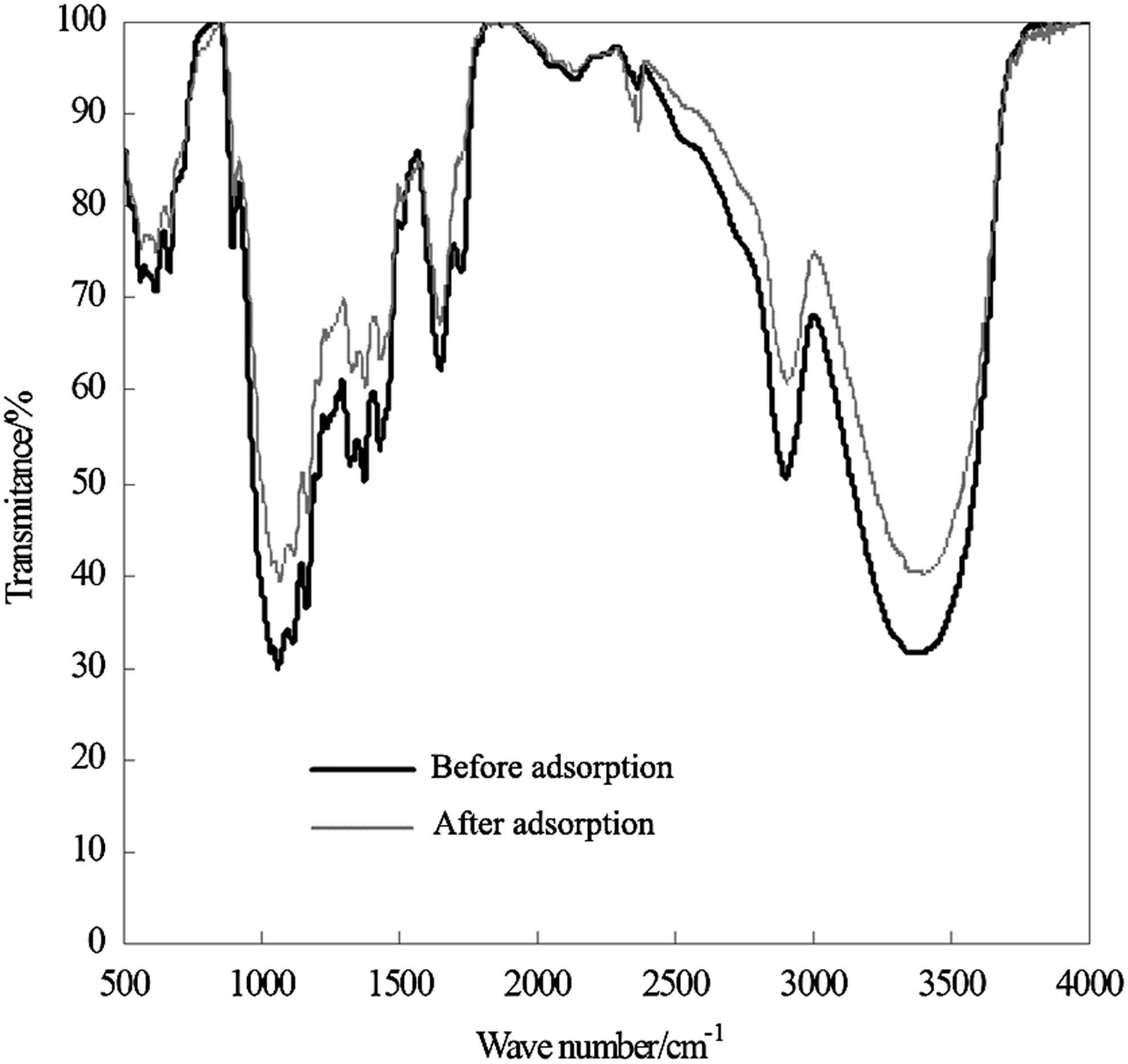
Infrared spectra of modified straw before and after adsorption of uranium.
Conclusion
Carboxylic acid groups and ester groups had been grafted onto the cellulose and lignin ingredients of rice straw after modified by succinic acid, resulting in the increase in the electronegative groups. The AE of uranium of rice straw increased from 55% to 95% at 10 mg/L initial uranium concentration, and the adsorption equilibrium was achieved within 1.5 h. The kinetic data could be well described by pseudo-second-order kinetic equation, and the adsorption isotherm followed the Langmuir and Freundlich models. According to Langmuir equation, the maximum adsorption amounts of uranium onto original and modified rice straw were 19.7628 and 24.0385 mg/g at 35°C at pH = 4.0, respectively. The strengthened adsorption capacity for uranium is ascribed to its modified properties.
Footnotes
Acknowledgments
The authors gratefully acknowledge the Natural Science Foundation of China for financial support (4137264, 51508116, U1501231), the Nature Science Foundation of Guangdong Province (2016A030310265), the Science and Technology Research Programs of Guangzhou City (201607010311), Chief Scientist Project of Guangzhou City (12A007S), and the Project of Guangdong Province Radioactive Pollution Control and Resource Reuse Key Laboratory (2012A061400023).
Author Disclosure Statement
No competing financial interests exist.