




Abstract
Abstract
This study investigated the effects of nitrification inhibitors (NIs) on the degradation of two selected surfactants, an anionic surfactant, linear alkylbenzene sulfonates (LAS), and a nonionic surfactant, Brij 30, in soils. Soils were treated with different NIs, mixed with LAS or Brij 30 and incubated. Results revealed that the addition of NIs, such as thiourea (TU), dicyandiamide (DCD), and hydroquinone (HQ), could significantly inhibit the degradation of surfactants and expand their half-lives in soil. When the initial concentration of NIs was 2.5 mmol/kg soil, their inhibition effects followed the order of HQ > TU > DCD for LAS and HQ > DCD ≈ TU for Brij 30. In addition, significant differences between nonsterile and sterile treatments demonstrated that microorganism activity degradation plays a major role in the degradation of surfactants. Degradation efficiency of surfactants in soils varied with initial NIs concentration and environmental factors such as culture temperature and soil moisture. Inhibition effects of NIs on the degradation of LAS and Brij 30 were reduced without exception in alkaline soil. This study could provide the scientific basis for the reasonable evaluation and management of these agrochemicals.
Introduction
S
Surfactants in the environment are primarily degraded through microbial activity and their biodegradation characteristics are of high importance. Studies have shown that most surfactants can be degraded by microbes, but certain types of surfactants, such as linear alkylbenzene sulfonate (LAS), may persist under anaerobic conditions (Ying, 2006). Many factors contribute to the biodegradation of surfactants, including surfactant chemical structure, microbial activity, and physicochemical conditions of the environmental medium (Chen et al., 2005).
Nitrification inhibitors (NIs) are often used in addition to urea or NH4+ fertilizers to increase the efficiency of nitrogen use and improve agricultural production under specific conditions (O'Callaghan et al., 2010). Information regarding the mechanisms and benefits of these products is extensive; however, few studies have addressed the widespread environmental impacts arising from their application (Cuttle, 2008). NIs, such as dicyandiamide (DCD), reduce the activity of nitrifying bacteria, which could delay NH4+-N oxidation and reduce the NO3− losses from soil and limit the increase of the pH of the soil (Di et al., 2007). Based on the evidence that application of NIs causes changes in soil microbial function, O'Callaghan et al. (2010) stated that the effects of these chemicals on the microbial community must be considered. Furthermore, the changes in the activity and diversity of soil microorganisms, derived from the presence of NIs, can consequently affect the biodegradation of surfactants in soil leading to an accumulation of surfactant pollution.
In this study, LAS, the typical anionic surfactant mentioned previously, and Brij 30, a nonionic surfactant, were selected as model compounds to investigate the short-term effects of different NIs on the degradation of surfactants in soils. Thiourea (TU), DCD, and hydroquinone (HQ) were selected as the representative NIs. Several factors (initial NIs concentration, soil moisture, and culture temperature) were studied to determine their influence on LAS and Brij 30 degradation. Influence of soil microorganisms was also evaluated. The information gained in this study could provide a valuable reference for the surfactant bioremediation and the effects of NIs on the degradation of organic pollutants in the environment.
Materials and Methods
Soil sampling preparation
Surface soil samples (0–20 cm) were collected from a vegetable garden in the suburb of Changsha, Hunan Province (soil I), a research field in the College of Resources and Environment, Hunan Agricultural University (soil II), and a vegetable garden in the suburb of Taiyuan, Shanxi Province (soil III). The soils were air-dried, cleaned of evident plant residue and gravel, and crushed and passed through a 2-mm sieve. Selected properties of the final soils are listed in Table 1.
CEC, cation exchange capacity.
Soil samples were sterilized in a steam sterilizer. Twenty grams of soil was transferred to an Erlenmeyer flask and sterilized at 126°C at high vapor pressure for 2 h. Additional sterile water was added every 2 days to keep the soil moisture constant by weight.
Degradation experiments
At the beginning of the experiment, the soil I was treated with a urea solution (20 mmol/kg soil) and different NIs. The pH of soil I was 4.40 ± 0.14. Final NIs concentrations were equivalent to 2.5 mmol/kg soil, which were determined by lots of preliminary experiments. A series of microcosms consisting of sterile 150-mL flasks were prepared. Each microcosm contained 20 g of dry soil that was artificially contaminated with 600 mg/kg LAS or with 400 mg/kg Brij 30. For the artificial contamination, the surfactants were dissolved in sterilized distilled water and 1 mL of this solution was trickled into the soil with a syringe. One microcosm was not initially treated with the NIs and was treated only with the surfactant to serve as a control. That is, flasks were allocated into two groups, with each group receiving one of four treatments: (1) LAS control: LAS + DCD; LAS + TU; LAS + HQ; (2) Brij 30 control: Brij 30 + DCD; Brij 30 + TU; Brij 30 + HQ. Additional sterilized, distilled water was added to bring the soil moisture content to 80% of the water holding capacity. All microcosms were incubated in an artificial climate incubator at 28°C for 0, 1, 2, 4, 7, 11, 15, 20, and 30 days. All experiments were conducted in triplicate.
To establish the role of microorganisms in the degradation of surfactants in soils, nonsterile and sterile soils were compared. Triplicate soil samples (20 g) were treated with 600 mg/kg LAS or 400 mg/kg Brij 30. The soils, including controls, were thoroughly mixed and incubated as described earlier.
Effects of initial NIs concentration, soil moisture, pH, and culture temperature on surfactant degradation in soils were also studied. In the soil moisture experiment, the microcosms were covered by parafilm with stomata to prevent evaporation of water. Effects of soil water content on surfactant degradation after 15 days of incubation were tested by adding 0, 0.1, 0.2, 0.3, and 0.4 mL/g sterilized distilled water, respectively, to the treatments. After samples were treated, the flasks were incubated for 15 days. Unless special explanations, all experiments were carried out under the condition that the initial concentration of NIs was 2.5 mmol/kg soil, soil moisture content was 80% at a culture temperature of 28°C.
After incubation, samples from each treatment were removed for surfactant determination. The surfactants were extracted from the soil with 20 mL of anhydrous ethanol, followed by shaking for 2 h at room temperature. The suspension was filtered through a 0.45-μm filter, and the concentrations of LAS and Brij 30 in the filtrates were determined.
Sample analysis
Concentrations of LAS in the prepared extracts were analyzed through HPLC (1200 Series high-performance liquid chromatography; Agilent), with a C18 reversed-phase column (250 × 4.6 mm, 5 μm particles; Agilent), a diode array detector, and an autosampler controlled with a ChemStation data acquisition software. The measurement was performed in a methanol/water = 80:20 (v/v) mobile phase with a flow rate of 0.8 mL/min and a detection wavelength of 225 nm (Ou et al., 1997).
Residual Brij 30 concentrations in soils were determined at 500 nm wavelength using a UV/Vis spectrophotometer (WFZ800-D3B). Before the analysis, the filtrates containing Brij 30 were treated with KI-I2 solution (2% KI, 0.2% I2) and colored for 30 min.
The degradation rates of LAS and Brij 30 were analyzed by the paired sample t-test. A probability value of ≤0.05 indicates a significant difference. SPSS version 12.0 for Windows (SPSS, Inc.) was used for statistical analysis of the data.
Results and Discussion
Effect of NIs on the degradation of surfactants
To demonstrate the effects of NIs, the time course profiles for degradation of surfactants are shown in Fig. 1 for soil I. Compared to the control, degradation of LAS and Brij 30 was inhibited in the presence of all three NIs (DCD/TU/HQ) within 30 days of incubation. In the initial 15 days, the degradation rates of LAS that occurred with DCD, TU, and HQ treatments were 0.021, 0.018, and 0.0074 d−1, respectively. Compared to the control (0.065 d−1), soils added with NIs showed obviously lower degradation rates of LAS due to the NIs influence. After 15 days, degradation of LAS almost remained constant in the DCD and TU treatments, with the removal rates of 0.20 and 0.18 d−1, whereas only 0.0047 d−1 was observed in the HQ treatment in the same time. In case of Brij 30 (Fig. 1b), its degradation rates in DCD, TU, and HQ treatments in the first 15 days were 0.11, 0.10, and 0.039 d−1, respectively, which were lower than the control (0.14 d−1). This phenomenon clearly demonstrated that NIs can significantly inhibit the degradation of surfactants. However, from incubation days 15 to 30, the degradation rate of Brij 30 decreased in all the treatments. Nearly no degradation took place for DCD and TU treatments during the last 15 days. Potential causes of the observed effects could be that the application of NIs to the soil results in a change of soil environment that is disadvantageous to the soil enzyme and microbial activity (O'Callaghan et al., 2010; Tindaon et al., 2012). Furthermore, the relatively lower concentration of Brij 30 in the soil after 15 days was unfavorable for its degradation. When DCD, TU, and HQ were added to the soils, LAS removal reduced by about 23.24%, 32.77%, and 51.75%, respectively, compared to the control at 30 days; in the same time frame, the removal of Brij 30 was 2.61%, 3.29%, and 44.86% lower compared with the control, respectively. Our findings revealed that the surfactant degradation was negatively influenced by the presence of all three NIs. The differences between the NIs and the control groups were statistically significant (p ≤ 0.05). In addition, the order of half-life of NIs in soil was TU > DCD > HQ (Verschueren, 1980; Bronson et al., 1989; Amberger and Germann-Bauer, 1990), which was not consistent with the aforementioned results. It was implied that the relative stability of NIs might not be the key factor relating to their inhibition effects in this study.
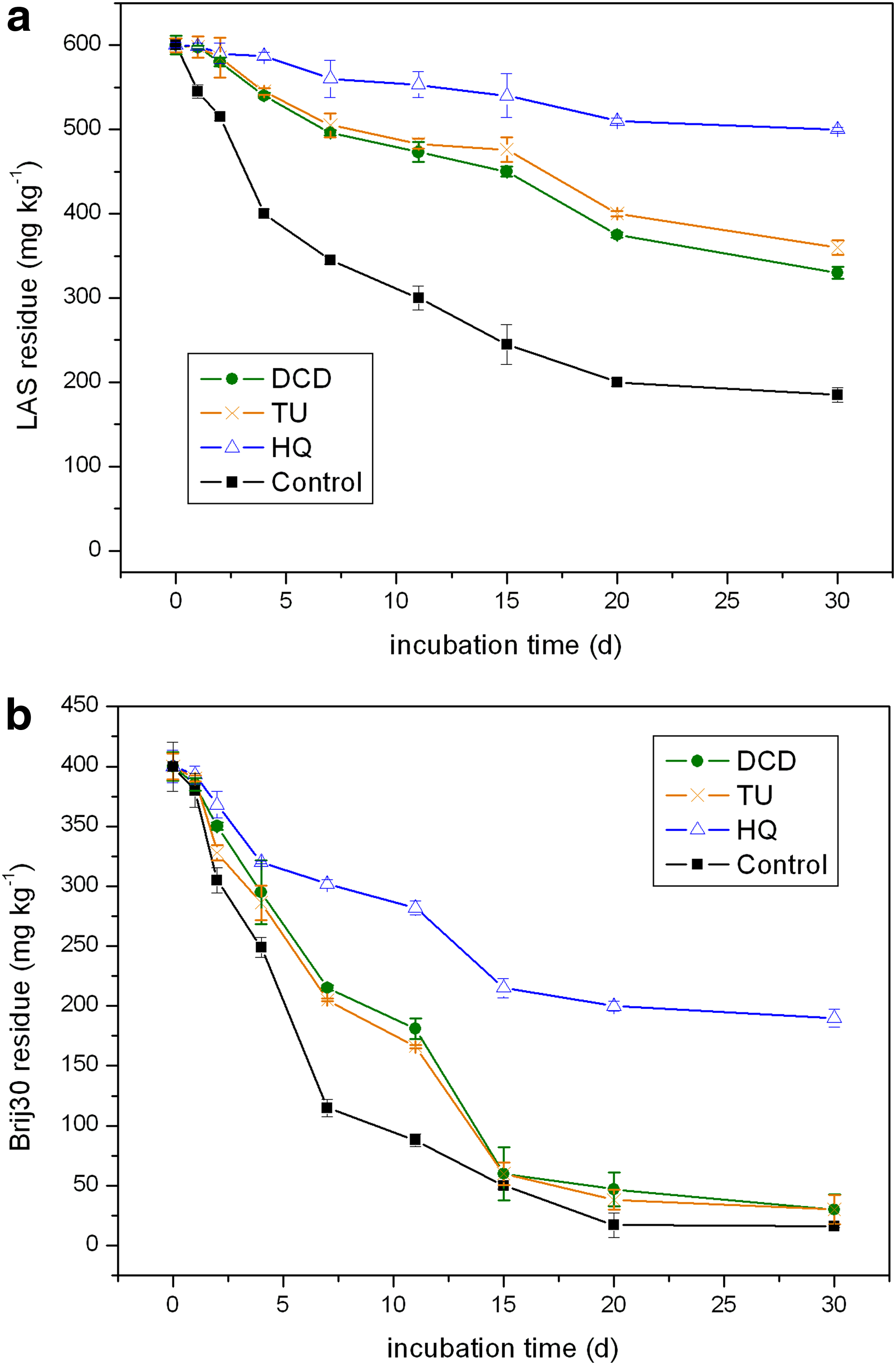
Effect of three nitrification inhibitors (NIs) on linear alkylbenzene sulfonates
Degradation curves of each surfactant were fitted to the exponential decay model to estimate the degradation rate constant k (d−1) and half-life t1/2 (d). As shown in Table 2, most of the fits were excellent with correlation coefficients R2 > 0.90, suggesting that the degradation of selected surfactants in soils could be well described with a first-order exponential decay model. Comparative experiments showed that the difference of the half-lives between DCD/TU treatments and the control was less than half a day, whereas the addition of HQ caused obvious inhibition of Brij 30, whose half-life was approximately four times that of the control group. In addition, half-lives of LAS in DCD, TU, and HQ treatments were prolonged by 5.29, 8.05, and 26.61 days, respectively, compared to the control.
DCD, dicyandiamide; HQ, hydroquinone; LAS, linear alkylbenzene sulfonates; TU, thiourea.
Role of microorganisms on degradation of surfactants
Experiments conducted in nonsterilized and sterilized soils show that the sterilization treatment resulted in a decrease of the degradation efficiencies of the surfactants (Fig. 2). The inhibition by sterilization suggested that microbial activity contributed to the degradation of surfactant(s) in the soils.
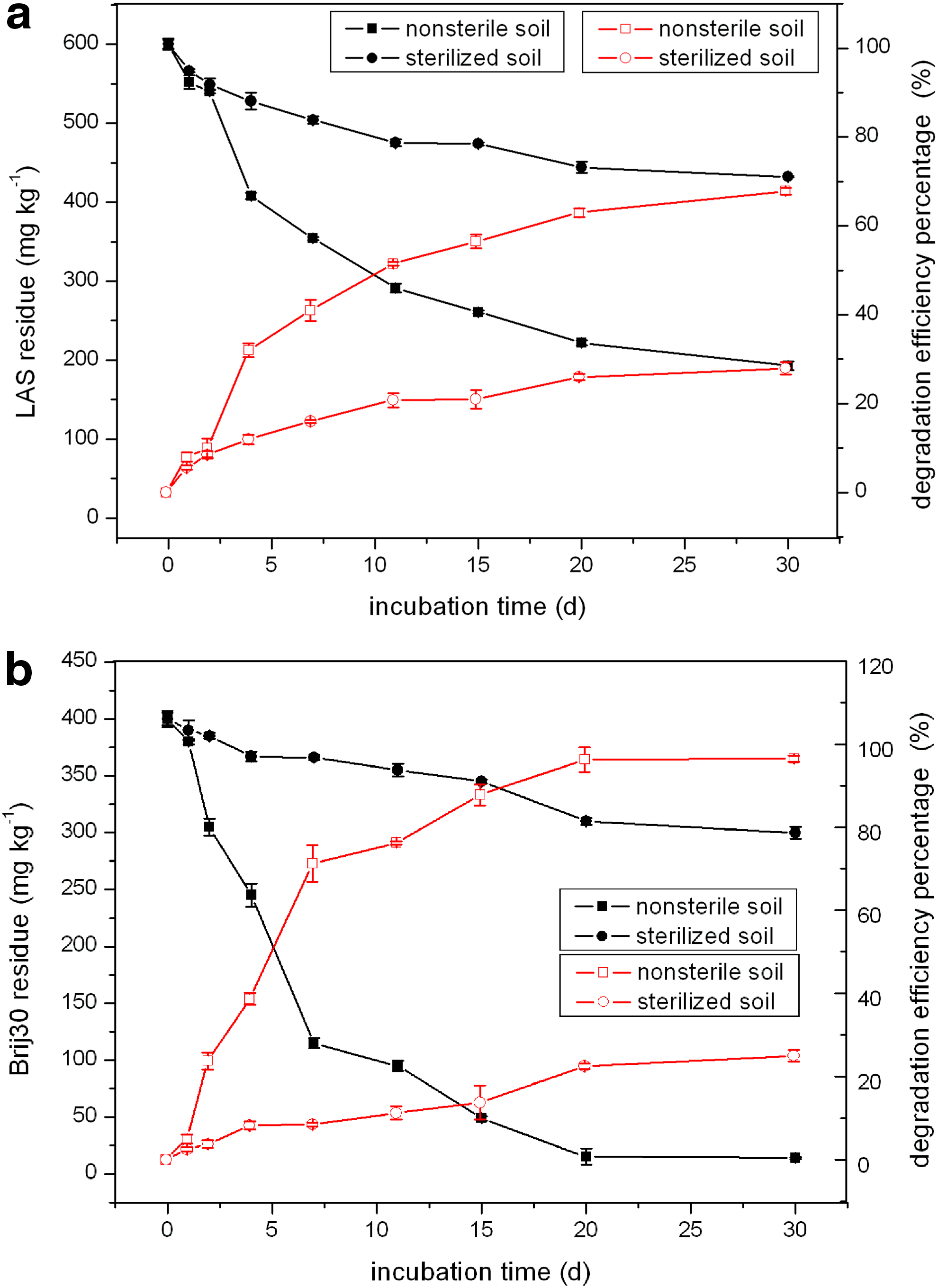
Concentration (black trace) and degradation rate (red trace) of LAS
Results showed that there was a lag phase for both surfactants in their degradation kinetic curves. The degradation efficiencies of LAS and Brij 30 were slow in the initial 2 and 1 days, respectively. It has been suggested that the acclimation period during degradation of xenobiotics reflects the time required for multiplication of a small active population to a certain level that is sufficient to rapidly degrade the xenobiotic in question (Chen and Alexander, 1989). After this acclimation period, the degradation of surfactants in the nonsterile soil was clearly enhanced. This could potentially be due to soil microorganisms utilizing surfactants as a substrate and the multiplication of microbial population, resulting in accelerated degradation of surfactants. After incubation for 30 days, the fractions of degraded LAS in nonsterile and sterilized treatments were 67.81% and 27.96%, respectively. In addition, almost all Brij 30 were degraded in nonsterile soil, but only 25.04% of the initial concentration was degraded in the sterilized soil. This pronounced difference between nonsterilized and sterilized treatments demonstrates that the degradation of surfactants in soils was the result of a combination of biodegradation and nonbiodegradation (such as hydrolysis, chemical degradation, photodegradation, etc.). Moreover, microorganism activity played a major role in the surfactant degradation process.
Factors effecting the degradation of surfactants in NIs treatments
It is reported that the effectiveness of NIs is influenced by their concentration, in addition to a number of soil properties and environmental factors (Guiraud and Marol, 1992; Puttanna et al., 1999; Di and Cameron, 2004). Therefore, various parameters that affect the degree of surfactant degradation, such as initial NIs concentration, soil moisture, culture temperature, and soil pH, were investigated.
Initial NIs concentration
The effect of initial concentrations of three NIs, HQ, TU, and DCD, on surfactant residues is shown in Fig. 3. Three different initial concentrations of NIs, 1, 2.5, and 5 mmol/kg, were examined. The inhibition effects of NIs on the surfactant degradation rate were as follows: for LAS, HQ > TU > DCD and for Brij 30, HQ > DCD≈TU. Even at a low concentration (1 mmol/kg), the inhibition of NIs was obvious. However, there was no noticeable influence of the concentration of HQ and DCD within the studied range. The only decrease was for TU treatment. A different pattern was observed for Brij 30 and its degradation rates decreased with increasing the initial NIs concentrations, indicating that the inhibition effect of NIs was enhanced. In treatment with the highest initial HQ concentration, that is 5 mmol/kg, the degradation rate of Brij 30 was relatively low (44.83%), significantly lower compared with the control (94.54%).
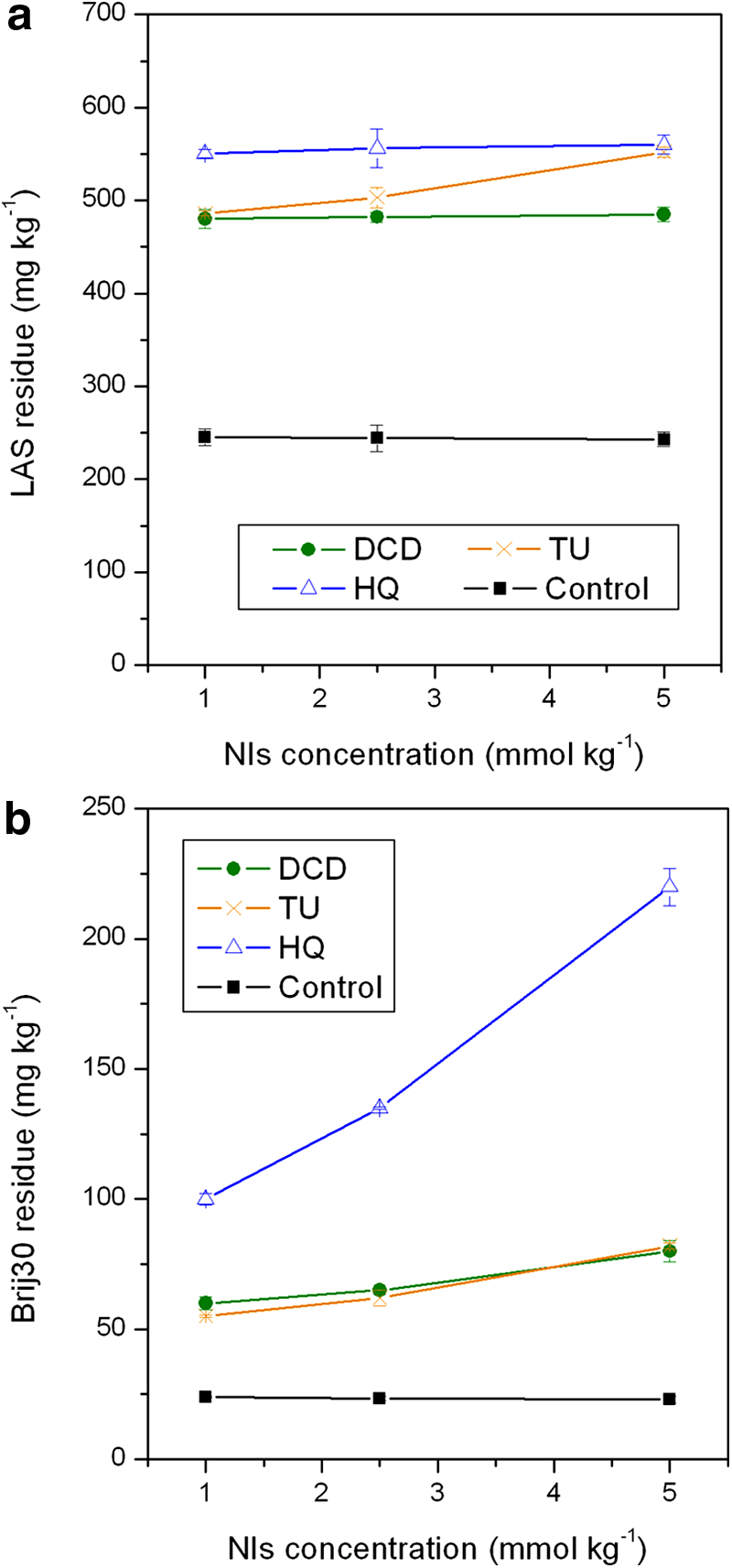
Variation of LAS
Soil moisture
Persistence of NIs in soil varies with NIs concentration and environmental conditions, in particular temperature and moisture (Kelliher et al., 2008). The results are shown in Fig. 4. For LAS, the lowest residue appeared at a moisture content of 0.1 mL/g with DCD and HQ treatments, whereas in the TU treatment, the lowest amount of LAS residue appeared at a soil moisture content of 0.2 mL/g. In addition, the LAS concentration in soils elevated significantly with decreasing or increasing the soil moisture in both the DCD and TU treatments, but no remarkable change was observed in the HQ treatment. At a moisture content of 0.3 and 0.4 mL/g, DCD and TU treatments degraded the LAS at a slower rate than the HQ treatment. These results indicate that the inhibitive effect of DCD and TU to LAS degradation was more sensitive to the soil moisture compared with HQ. As for Brij 30, the largest degradation in soils added with three NIs also occurred at a soil moisture content of 0.1 mL/g, whereas it appeared at 0.2 mL/g in the control group. When the soil water content was more than 0.1 mL/g, Brij 30 degradation efficiencies were decreased. Such phenomenon shows that the higher the soil moisture, the stronger the inhibition of Brij 30 degradation. However, the enhanced extent of Brij 30 residues in soils was modest in the TU treatment, illustrating that soil moisture was not the key environmental factor affecting inhibition of TU to Brij 30 degradation.

Variation of LAS
All three NIs reduced the surfactant degradation with the variation of water contents in soils. The optimal soil moisture for degradation of surfactants in soils that contain NIs was ∼0.1 mL/g. Either too low or too high soil moisture was unfavorable to the degradation of surfactants. This might be because the soil moisture can alter the effectiveness of NIs, the oxygen level, and microbial activity in soils, and also change the distribution of surfactants at the solid–liquid interface. Therefore, the soil moisture is an important factor that must be considered in the study of the inhibition of the surfactant degradation by NIs.
Culture temperature
In addition to soil moisture content, soil temperature is also an important factor to determine the effectiveness of NIs, microbial activity, and soil enzyme activity (Puttanna et al., 1999). A series of surfactant degradation tests were carried out at various culture temperatures from 15°C to 45°C (Fig. 5). After 15 days of incubation, the amount of LAS residues in HQ treatments decreased with increasing soil temperature when the temperature was less than 35°C; when the temperature was equal to 35°C, LAS degraded to reach the minimum amount (479.36 mg/kg), indicating the lowest inhibiting rates of HQ. After this inflexion point, the LAS concentration was enhanced significantly at 45°C. A similar pattern for LAS was obtained in DCD treatments; however, the addition of DCD in soils accelerated the degradation of LAS when compared to the control. In the TU treatments, the residues of LAS showed fluctuating changes with the culture temperature and TU was the only one of the three NIs that promoted the degradation of LAS in soils at 15°C. Furthermore, degradation of LAS was inhibited by the addition of TU at 25°C and 45°C.

Variation of LAS
The residues of Brij 30 declined steadily as the soil temperature increases in the HQ treatments, indicating that the degradation rate of Brij 30 increased with the soil temperature. From 15°C to 35°C, the addition of HQ strongly inhibited the degradation of Brij 30, but at 45°C, HQ promoted Brij 30 degradation. Brij 30 concentrations in the TU treatments had a downward trend with 15–35°C soil temperature followed by a sharp increase above 35°C. TU presented consistent inhibition of Brij 30 degradation in the temperature range of the experiments. In the DCD treatments, the trend was similar to the TU treatments. Residues of Brij 30 decreased with soil temperature of 15–25°C and then increased gradually with increased temperature about 25°C, and at 45°C, DCD enhanced the degradation of Brij 30. The minimum concentration of Brij 30 (51.36 mg/kg) was obtained at 25°C, which was the optimum temperature for Brij 30 degradation in soil containing DCD.
Results indicate that the influence of NIs on the surfactant degradation under different temperatures was complicated. In the few treatments, degradation of LAS and Brij 30 was accelerated by the addition of NIs in soils. However, the inhibition effect of NIs played a dominant role. It has been reported by other studies that NIs are highly sensitive to the temperature (Guiraud and Marol, 1992; Prasad and Power, 1995; Kelliher et al., 2008). The concentration of NIs in soils could be significantly reduced with rising temperature by degradation and volatilization. Accordingly, the inhibition of NIs to surfactant degradation was reduced. At the same time, the degradation rates of LAS and Brij 30 were also affected by rising temperature. Thus, the effect of culture temperature on surfactant degradation was a complicated and multifactor-influencing issue, and it will be investigated in our next work.
Soil pH
One important factor, which influences the degradability of compounds, is pH (Cirelli et al., 2008; Anwar et al., 2009; Syafruddin et al., 2010). The surfactant degrading ability was studied at three different pH conditions: acidic soil I (4.40), acidic soil II (4.90), and basic soil III (7.69). The results are shown in Table 3. The degradation of LAS and Brij 30 was both inhibited by NIs at all tested pH levels. For basic soil, the degradation efficiencies of LAS and Brij 30 in DCD and TU treatments were comparable to the control group, which indicates that the addition of DCD and TU did not affect the degradation of surfactants under alkaline conditions. Moreover, LAS was nearly not degraded in the HQ-treated soils, implying the strong inhibition effect of HQ to LAS degradation. The degradation efficiencies of surfactants in three soils containing NIs followed the following order: soil III>soil I>soil II. There were significant differences among the three treatments (p ≤ 0.01). The degradation of LAS and Brij 30 was more efficiently inhibited by NIs at acidic soil. It is possible that the enzymatic activity of some key enzyme(s) responsible for surfactant degradation can be more easily suppressed by NIs at a low pH.
Conclusions
In our study, the significant inhibition effects of NIs (DCD, TU, and HQ) on surfactant degradation were detected. LAS and Brij 30 have different chemical properties, and results show that the addition of NIs inhibited LAS degradation more effectively. The inhibition effect on surfactant degradation rate was HQ > TU > DCD for LAS degradation and HQ > DCD≈TU for Brij 30 degradation. Moreover, a number of factors, including NIs concentration, soil moisture, culture temperature, and soil pH, were shown to correlate with the inhibition effect of NIs on the selected surfactant degradation in this study. With the increase of initial NIs concentration, the inhibition to surfactant degradation was enhanced. The higher the soil moisture and culture temperature, the higher the degradation rates of surfactants. Compared to basic soil, the degradation of LAS and Brij 30 was more efficiently inhibited by NIs in acidic soil conditions. Therefore, the extensive use of NIs in agriculture soils can be expected to prevent rapid degradation and prolong the half-life of such surfactants, potentially contaminating soil resources. This research suggests that NIs should be chosen and applied with care because of concerns for unknown and potentially harmful environmental impacts.
Footnotes
Acknowledgments
The authors greatly acknowledge the National Natural Science Foundation of China (No. 41301338), Hunan Provincial Natural Science Foundation of China (No. 13JJ4069), and Scientific Research Staring Foundation for the introduced talents of Hunan Agricultural University (No. 12YJ12).
Author Disclosure Statement
No competing financial interests exist.