




Abstract
Abstract
Pidgeon magnesium slag (PMS) is produced during the production of metallic magnesium by the Pidgeon reduction process, and the disposal of PMS causes serious environmental problems. In this study, the physicochemical characteristics and solubility of PMS were comprehensively investigated. Use of Fourier transform infrared to characterize PMS and the synthesis of a slow-release K fertilizers using PMS as raw material were reported for the first time. Major chemical composition of PMS was determined to be 52.57% CaO, 26.31% SiO2, 6.89% MgO, 1.44% Al2O3, and 3.32% Fe2O3. Major constituent phases were 23.6% β-Ca2SiO4, 53.7% γ-Ca2SiO4, 6.6% periclase, 4.5% free-CaO, and 11.6% the rest phase; minor phases were Ca(OH)2, Mg(OH)2, CaCO3, and MgCO3. PMS was bound within a stable crystalline phase, as occurs in natural ore deposits; heavy metal content and the average values of IRa and Ir of PMS were lower than the limit values of organic−inorganic compound fertilizer (GB 18877-2009) and national standard limit values (GB 6566-2010), respectively; hence, it could be reutilized safely. Fertilizer synthesized using PMS and K2CO3 showed slow-release characteristics. Data obtained provide insight that may be helpful for finding alternative uses for PMS.
Introduction
M
Chemical constituents of the residue are linked to their properties and play a key role for practical utilization. PMS is mainly constituted of dicalcium silicate (2CaO·SiO2), which can be reused as cement and mineral admixture (Oliveira et al., 2004; Tong et al., 2009; Wang et al., 2011; Djokic et al., 2012a). It can be used as a desulfurizer and soil conditioner due to the CaO and MgO content, accounting for 50–60% of PMS (Araújo, 1997; Fan et al., 2013). Several previous studies on PMS focused mainly on technology for its reuse (Araújo, 1997; Tong et al., 2009; Wang et al., 2011; Djokic et al., 2012a; Fan et al., 2013), but accurate knowledge of the morphological and mineralogical characteristics of PMS is necessary to further utilize it safely, which will help to alleviate the environmental hazard associated with slag stockpiling and reuse strategies.
The aim of this work was to investigate the morphological and mineralogical characteristics of PMS. The chemical composition and the content of natural radionuclide, physical properties, mineralogical composition, microstructure, and morphology were the subjects of analysis. This study may further enhance our understanding of PMS and provide data to support its reuse and environment risk assessment.
Materials and Methods
Materials
PMS was obtained after exiting the furnace and cooled by air. A total of 20 PMS samples were collected from four plants producing metallic magnesium by the Pigeon process, located in north China's Shanxi Province. (The magnesium yield in Shanxi province is 80% of China's total output.) All samples were homogeneous before testing. The chemical composition and the particle size distribution of 20 PMS samples were determined and analyzed; the PMS samples for other measurements were the mixture of equal amounts for 20 PMS samples. The standard reagents (Agilent Technologies Co., Santa Clara, CA) were of guarantee reagent. Potassium carbonate (K2CO3) was industrial grade reagent (the purity ≥99%), and other chemical reagents used were of analytically pure reagent.
Measurement method
Physical properties
After the samples were milled to granules of size ≤3 mm, the apparent density was determined according to standard GB/T 14684-2011 (General Administration of Quality Supervision, Inspection and Quarantine [AQSIQ] of China, 2012). The specific surface area, pore diameter, and pore volume were conducted using a Micromeritics ASAP 2020 automatic adsorption instrument (BET analysis). The particle size distribution experiment was carried out according to standard GB/T 21524-2008 (AQSIQ, 2008c).
The chemical composition and the content of natural radionuclide
Sample PMS was ground to obtain a powder with particle size ≤147 μm and homogenized. Elemental analysis of C, N, S, and H was performed using a Perkin-Elmer 2400 elemental analyzer (EA). The chemical composition of PMS was determined by X-ray fluorescence (XRF) spectroscopy (PANalytical, Almelo, The Netherlands). The F content in PMS was determined according to standard GB/T 6730-2006 (AQSIQ, 2006). Loss on ignition was determined according to standard GB/T 176-2008 (AQSIQ, 2008b). The specific activity of radioactive nuclide 226Ra, 232Th, and 40K were measure by low background multichannel gamma-ray spectrometry (LTSM-4000, Beijing, China) according to the standard GB 6566-2010 (AQSIQ, 2010).
Solubility test of PMS
Solubility of PMS was detected based on the solid waste-extraction procedure for leaching toxicity, also known as the horizontal vibration method (HJ test) (HJ557-2010) (Ministry of Environmental Protection of The People's Republic of China, 2010). In this experiment, 10 L deionized water per kilogram PMS (particle size was ≤5 mm) was used as leaching medium. A 100 g sample of PMS was mixed with 1,000 mL leaching fluid in 2,000 mL polyurethane bottles. Then, the bottles were fixed into a horizontal shaker and shaken at 110 ± 10 times/min for 8 h at 23°C ± 2°C, afterward standing for 16 h. The leachates and the leached residue were obtained by vacuum filtration, and the leached residue was named MSW. The pH value of leachates was determined using a Denver Ub-7 pH meter (Denver Instruments, Co., Arvada, CO); the chemical composition and mineralogical composition of MSW were determined by XRF, EA, and D2 advance X-ray diffractometer (XRD; Bruker Corporation, Billerica, MA) to assess solubility of PMS. The F content in MSW was determined according to standard GB/T 6730-2006.
Mineralogical composition
Mineralogical composition was determined using XRD, operating at 45 kV and 40 mA, using Cu Kα radiation, adjusted interval 10°–80° (2θ), and step size 0.02°. Fourier transform infrared (FTIR) spectra was obtained with a Perkin-Elmer FTIR spectrometer, using the KBr pellet technique. Thermogravimetry (TG) analysis was carried out using a Perkin-Elmer Pyris1 TG analyzer; 5–10 mg samples were heated in platinum crucibles under argon atmosphere at 10°C/min from 50°C to 1,000°C.
Microstructure and morphology
Morphology of the slag was studied using a JSM7001F scanning electron microscope coupled with a BRUKER QX200 energy dispersive spectrometer (SEM-EDS).
Results and Discussion
Physical properties
PMS is in powder form or lump. The apparent density, BET surface area, mean pore volume, and pore size were 1.49 ± 0.21 g/cm3, 1.543 m2/g, 0.0042 cm3/g, and 14.16 nm, respectively. As surface area and pore volume of PMS are so low, suggesting it is not porous material, it is generally not suitable for absorbing materials but for building materials. The slag generally consisted of granules <2,000 μm. A particle size of <147 μm was determined for 64.1% of the slag while particles <60 μm constituted 24.7% (Fig. 1). Due to its form, fine grains of PM10 and total suspended particles, under stable weather conditions, the dust concentration was over the maximum allowable concentration up to 1,400 m from the deposit area for the magnesium slag (Djokic et al., 2012b). It was concluded that serious dust pollution could be induced by stockpiling of PMS.
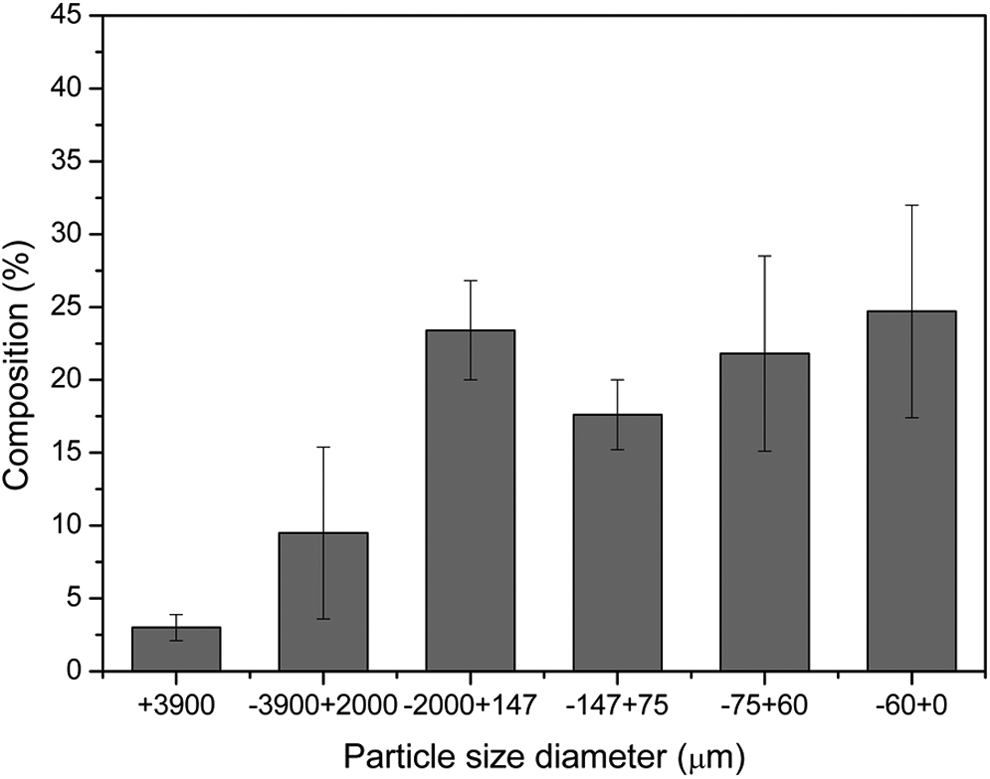
Size diameter distribution of Pidgeon magnesium slag (PMS).
The chemical composition
The contents C, S, and H in MSW and PMS were extremely similar, but the content of N in MSW was obviously lower than that in PMS (Table 1). This was attributed to the fact that PMS contains a small amount of Mg3N2, which could release ammonia by reacting with water (Zan et al., 2007). The chemical composition of MSW was found to be analogous to that of PMS by XRF analysis, indicating that there was no significant dissolution of major constituents in PMS under neutral conditions, as they were probably bound within stable crystalline phase, as occurs in natural ore deposits. Due to the toxicity of F, the F contents in PMS and MSW were of particular interest. F contents in PMS and MSW were 0.954% and 0.946%, respectively, which indicates that 80 mg of F can be leached from 1 kg of PMS. These results agree with those previously reported in the literature (Han et al., 2012; Wu et al., 2013). The amount of F leaching from PMS was higher than the 10 mg/kg limit for inert waste but lower than the 150 mg/kg limit for nonhazardous waste of the Directive 1999/31/EC II (Official Journal of the European Communities, 2003). Therefore, PMS was considered nonhazardous waste, the potential pollution risk of PMS was little.
MSW, Pidgeon magnesium slag after leaching in water; PMS, Pidgeon magnesium slag.
The main constituents of the slag samples were Ca, Si, Mg, Al, and Fe compounds, and the total composition of SiO2 and CaO constituted about 80% of the PMS (Table 2). Existing studies have shown that the mole ratio of CaO to SiO2 (CaO/SiO2) was an important factor for the silicate mineralogical composition (Oliveira et al., 2004; Hou et al., 2008). Since CaO/SiO2 of PMS was about 1.76–2.21, the silicate in PMS could exist in the form of Ca2SiO4. The contents of MgO in PMS varied from 2.96% to 13.35%, attributing to the differences of raw materials and production technology. Because of instability and expansibility, the content of MgO is very important for producing cement using PMS; the standard for magnesium slag Portland cement (GB/T 23933-2009) (AQSIQ, 2009a) states the content of MgO in PMS should be lower than 8%.
SD, standard deviation.
The content of heavy metal and natural radionuclide
Heavy metal contents of PMS were compared with content limits of heavy metals for standard organic–inorganic compound fertilizers (GB 18877-2009) (AQSIQ, 2009b) and Grade II standard of environmental quality for soil in agricultural land (GB 15618-2008) (AQSIQ, 2008a) (Table 3). Cr and Ni were presented in higher contents than other heavy metals. The contents of all of the presented heavy metals were lower than that of the standard GB 18877-2009 limit. Contents of Cr and Ni were higher than the standard GB 15618-2008 limits (120 and 60 mg/kg, respectively) in acid soil, while the contents of Pb and Cu were higher than that of the standard GB 15618-2008 limits (50 mg/kg) for vegetable soil. Nevertheless, the potential environmental risk of heavy metals would be exaggerated if it was evaluated only by the total content of heavy metal (Liu et al., 1996). Zn, Ni, Cd, Pb, Hg, and As contents of MSW were the same as that of PMS; Cu and Cr contents in MSW were slightly lower than that of PMS (Table 3). According to the data shown in Table 3, among all the detected heavy metals, only 0.15 mg Cr and 0.43 mg Cu can be leached from 1 kg PMS. Therefore, the leaching amounts of all the heavy metals are lower than the limit value of the Directive 1999/31/EC II for inert waste (Official Journal of the European Communities, 2003), indicating that the PMS could be agriculturally utilized with little pollution risk.
ND, not detected.
The leaching solution of PMS was alkaline (pH ∼12.4) due to the hydrolysis of Ca and Mg compounds, and it was lower than the limit of identification standards for hazardous wastes-identification of corrosivity (GB 5085.1-2007) (AQSIQ, 2007). There was high capacity to neutralize strong acid media for the suspensions of PMS, thus, PMS can be used as an acid soil conditioner, but PMS's corrosivity caused by its alkalinity was noted.
PMS is mainly used as building materials, which accounts for about 80% of its total utilization. Analysis for the content of natural radionuclide in PMS can provide evidence for rational utilization and estimate possible radiological hazards. The specific activity of radioactive nuclide 226Ra (CRa), 232Th (CTh), and 40K (CK) measured were 79.5 ± 18.1, 34.2 ± 8.4, and 908.7 ± 131.6 Bq/kg, respectively, which were lower on average than the representative value of world building materials (226Ra: 87.42 Bq/kg, 40K: 950.2 Bq/kg) recommended in a 1993 report by the United Nations Scientific Committee on the Effects of Atomic Radiation. Internal exposure index (IRa = CRa/200) and external exposure index (Ir = CRa/370 + CTh/260 + CK/4,200) were 0.39 and 0.54, respectively, both lower than the national limit values (GB 6566-2010). The results indicate that there is little radiological hazard for PMS used as construction material.
Mineralogical composition
PMS is a heterogeneous material that consists of a mixture of crystalline phases (Fig. 2). The pattern of XRD indicates that the major constituent phases include β-Ca2SiO4, γ-Ca2SiO4, periclase (MgO), and free-CaO. However, it was difficult to identify the minor constituent phases such as Fe, Al, F, and heavy metal phases due to the detection limits of XRD. The contents of the major constituent phases were determined to be 23.6% β-Ca2SiO4, 53.7% γ-Ca2SiO4, 6.6% periclase, 4.5% free-CaO, and 11.6% the rest of phase. However, β-Ca2SiO4 begins transforming into γ-Ca2SiO4 at temperatures below 500°C after exiting the furnace for cooling (Juckes, 2003). This transformation produces volumetric expansion of up to 10%, causing crystals to break, resulting in a significant amount of dust. For this reason, PMS was a fine powder and generally consisted of granules smaller than 200 μm (Fig. 1). The total content of dicalcium silicate accounted for 77.3% of PMS, in accordance with that of Magnet magnesium slag, but 5% melilite and 8% merwinite in Magnet magnesium slag were not observed in PMS (Minic et al., 2008).
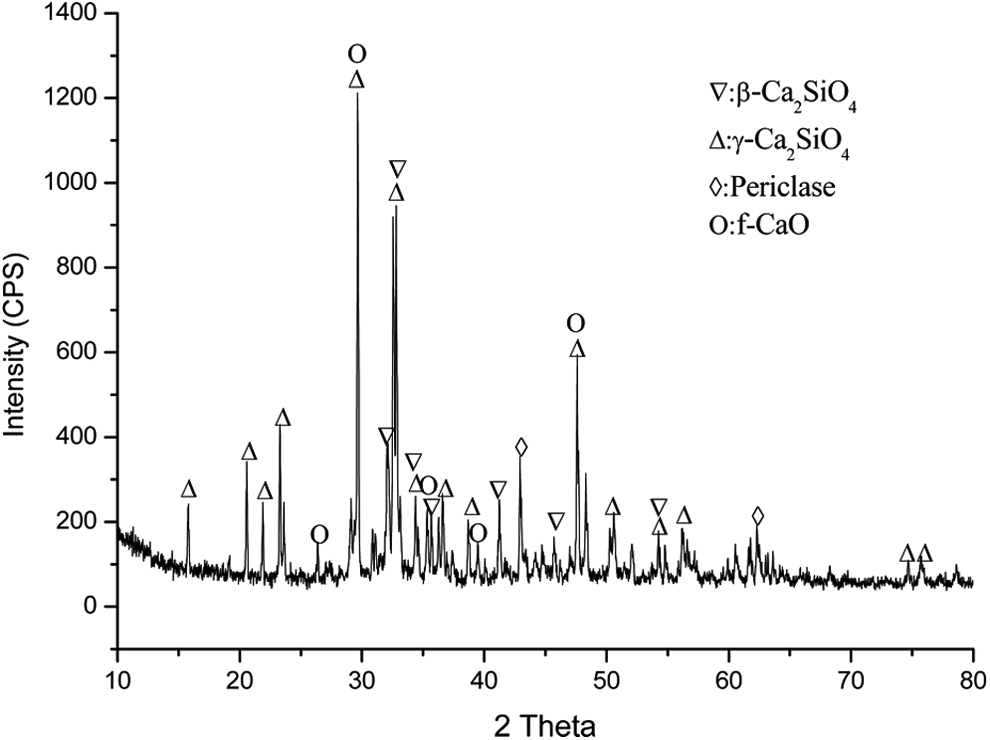
X-ray diffraction pattern for PMS.
FTIR spectra of PMS provided valuable information regarding structure, which could not be detected by XRD, for example, addressing critical evidence on the nature of the functional groups in the crystal lattice. As shown in Fig. 3, the bands at 3693 and 3643 cm−1 were hydroxyl stretching from calcium hydroxide (Frost et al.1998, 2004), and the band at 961 cm−1 corresponded to hydroxyl deformation (Navarro et al., 2010). Due to the overlap of the hydroxyl stretching region of the different constituents, it was difficult to confirm the phase of PMS by the adsorption region alone. The broad band of 3000–3600 cm−1 could be hydroxyl stretching from hydrated carbonates and was adsorbed or coordinated with water molecules (Queralt et al., 1997). The bands at 1442 and 1795 cm−1 corresponded to C-O stretching mode of CO32−, and the bands of 857 and 715 cm−1 could be deformation vibration modes of C-O (Mayo, 2004). The adsorption bands between 910 and 1100 cm−1 showed the characteristic of Si-O stretching from silica and silicates. Adsorption between 450 and 600 cm−1 was a feature of hard dissoluble oxide, such as MgO, CaO, ferrite, and metallic oxides. The bands at 495, 519, and 561 cm−1 represented deformation vibration from SiO42− in Ca2SiO4 (Yang and Hai, 2000). Therefore, the major component phases of PMS were Ca2SiO4, periclase, and free-CaO detected by XRD, and the minor constituent phases were Ca(OH)2, Mg(OH)2, CaCO3, and MgCO3, which were not detected by XRD.
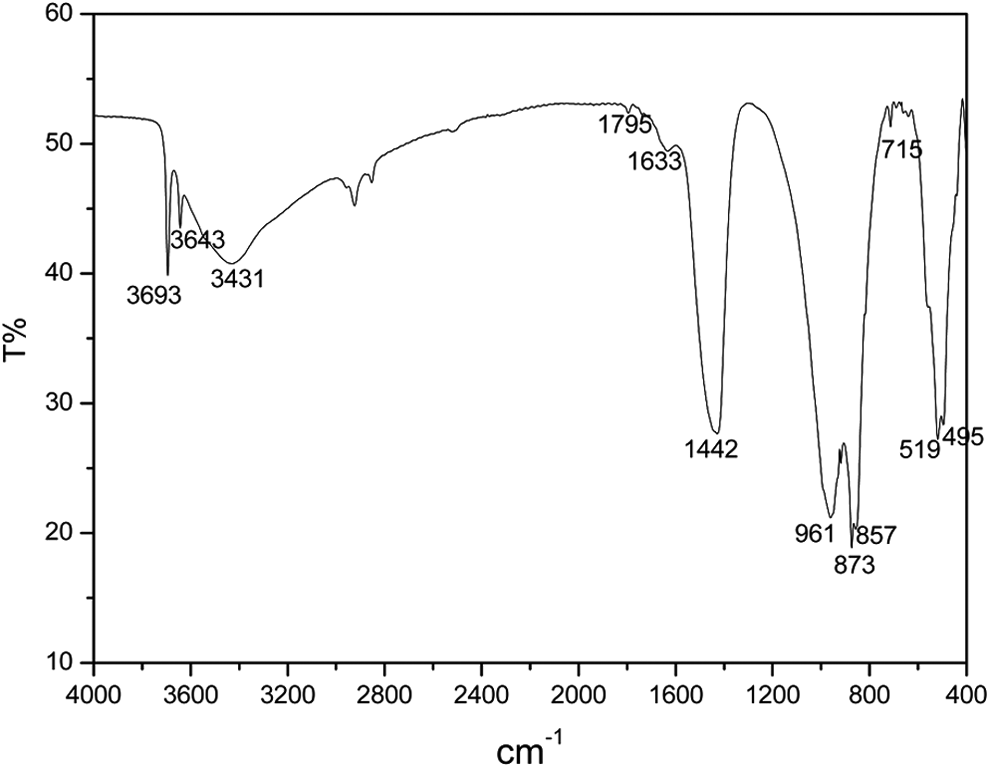
Fourier transform infrared spectrum of PMS.
Thermogravimetry (TG) and differential thermogravimetry (DTG) curves of sample PMS are shown in Fig. 4. The total mass loss was 2.5%. A mass loss of 0.18% in 50–138.3°C was observed in the first stage due to the evaporation of free water, and a mass loss of 0.33% occurred in the second stage between 138.3°C and 292.7°C caused by the removal of crystal water and structural H2O (MiKhail and Turcotte, 1995). In the third stage, a mass loss of 0.20% was attributed to dehydration of Mg(OH)2 between 292.7°C and 370.2°C. A mass loss of 0.41% in the fourth stage was caused by dehydroxylation of Ca(OH)2 at 370.2–442.7°C (Minic et al., 2008). In the fifth stage, a mass loss of 1.27% was caused by decomposition of MgCO3 at 442.7–617.8°C. In the last stage, a mass loss of 0.11% was caused by decomposition of CaCO3 at 646.9–795.3°C. The TG analysis further verified the presence of minor constituent phase Mg(OH)2, Ca(OH)2, MgCO3, and CaCO3; this is in accordance with the results of FTIR analysis. The mass loss at every stage indicates that PMS constitutes 0.65% Mg(OH)2, 1.69% Ca(OH)2, 2.43% MgCO3, and 0.25% CaCO3. By comparison to the data in Table 2, the amounts of Mg(OH)2 and MgCO3 (as MgO) accounted for 6.51% and 16.79% of total MgO in PMS, respectively, and the amounts of Ca(OH)2 and CaCO3 (as CaO) accounted for 2.43% and 0.27% of total CaO in PMS, respectively. Other undetected constituents containing Ca and Mg need to be further studied.

Thermogravimetry (TG)/Differential thermogravimetry (DTG) curve of PMS.
Microstructure and morphology
As shown in Fig. 5, PMS was heterogeneous and mainly existed in the form of rod, lamellar, granular aggregates, and binding phase in the crystal particles. Cracks were visible in the surface of the crystals; this was attributed to the volume expansion in the process of the polymorph transformation from β-Ca2SiO4 to γ-Ca2SiO4. Ca and Si existed in the same regions, in different concentrations (Fig. 6), which suggests that Ca and Si in PMS may combine in the form of a silicate phase. A large amount of Mg was present in the regions where Ca, Si, Al, and Fe were not observed. That could be the Mg existing in the form of periclase (MgO), in accordance with the results of XRD analysis. Distribution maps of Al and Fe show that there were small amounts of each in the sample PMS. Line scanning (Fig. 7) of sample PMS further confirmed that the major mineralogical compositions of PMS were Ca2SiO4, periclase (MgO), and free-CaO. However, it was very difficult to determine the mineralogical compositions of Fe and/or Al due to the lower content. EDS micro-scanning of sample PMS (Fig. 8) showed that the morphology of Ca2SiO4 was rod-like, rounded, and irregular, while the shapes of periclase and free-CaO were diverse. In addition, phases of metallic Mg, anorthite, and SiO2 could be identified by EDS micro-scanning, but need to be further confirmed.

Scanning electron microscope (SEM) micrographs of PMS.
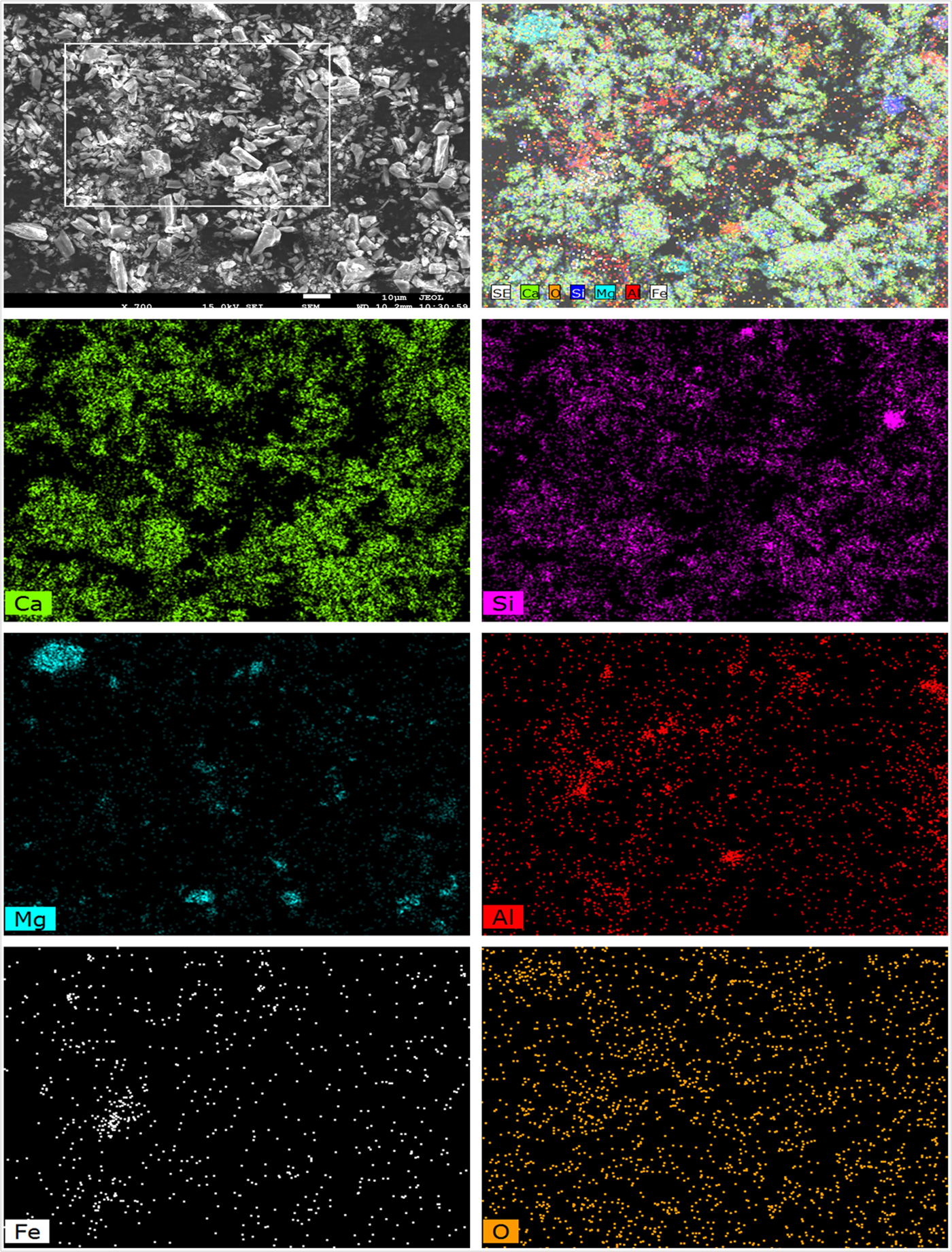
Characteristics micro- structure of PMS with the elements distribution map. The square is the scanning area by energy dispersive spectrometer (EDS).

Microstructure of PMS with line scanning.

SEM micrographs of PMS (×700). A, Ca2SiO4; B, MgO; MgOH or metallic Mg; C, SiO2; D, anorthite; E, free-CaO.
Agricultural utilization of PMS
PMS contains Ca, Mg, and Si, which are important elements for plant growth; hence, PMS can be used to produce silicon fertilizer (Yasuko et al., 2003; Xia and Chen, 2011). PMS reacted with K2CO3 (80% PMS and 20% K2O) at 1,300°C to synthesize a slow release K fertilizer. The synthesized fertilizer existed in crystalline phase, which was constituted by Ca1.917K0.166SiO4, K2MgSiO4, K4CaSi3O9, and Ca2SiO4 and noncrystal phase (Fig. 9), while K dissolution rates in the water and citric acid were tested according to the method proposed by Trenkel (1997). The initial release rates of K at the first day were 29.9% and 52.2% in the water and citric acid, respectively; after 28 days, the accumulated release rates of K were 67.4% and 96.1% for the two cases, which indicated that the synthesized fertilizer exhibited slow-release characteristics (Fig. 10).

X-ray diffraction pattern of synthesized fertilizer by PMS.

Dissolution rate of potassium for the synthesized fertilizer in water or citric acid.
Conclusions
Chemical, mineralogical, and morphological properties of PMS were investigated for its further utilization and treatment. The main constituents of the slag samples were Ca, Si, Mg, Al, and Fe compounds, and the silicate in PMS existed in the form of Ca2SiO4. The main mineral phases in PMS samples include β-Ca2SiO4, γ-Ca2SiO4, periclase (MgO), and f-CaO, and minor phases are Ca(OH)2, Mg(OH)2, CaCO3, and MgCO3. PMS was bound within a stable crystalline phase, as occurs in natural ore deposits. The heavy metal contents of PMS were lower than the limit values of organic−inorganic compound fertilizer (GB 18877-2009), and the average values of IRa and Ir were lower than the national limit values (GB 6566-2010). PMS could be used to synthesize a slow release K fertilizer with potassium carbonate under the condition of high temperature, and the synthesized fertilizer showed slow-release characteristics, which can minimize fertilizer nutrient loss and environmental problems.
Footnotes
Acknowledgments
The work was supported by National 863 High-Tech Research and Development Program of China (2012AA061602) and Coal-Base Scientific and Technological Key Project of ShanXi Province (MC2014-06).
Author Disclosure Statement
No competing financial interests exist.