




Abstract
Abstract
Infant powdered milk (i.e., infant formula) is a rich and convenient source of nutrients, substituting for human breast milk in many countries. Moreover, it is the basic foodstuff for the infants because of its mineral and protein content, which is essential for growth and development. However, there are still limited data on radioactivity levels in infant powdered milk around the world, including Malaysia, for radiological health risk assessment. Thus, it is important to assess the radioactivity levels and the associated dose in the widely consumed powered infant milk. As a result, activity concentrations of 226Ra, 232Th, 40K, and 137Cs were determined in 14 brands of powdered milk consumed by Malaysian infants, which are imported from various regions around the world. Mean activities of 226Ra, 232Th, 40K, and 137Cs were 3.05 ± 1.84, 2.55 ± 2.48, 99.1 ± 69.5, and 0.27 ± 0.19 Bq/kg, respectively. Among the analyzed milk samples, the brand from Philippines (Lactogen) showed low level of radioactivity, while a Singaporean brand (S26 SMA Gold) showed the highest. The artificial radionuclide, 137Cs, is virtually not detected in most of the brands investigated. Estimated mean annual effective doses due to consumption of powdered milk were 635.13 and 111.45 μSv/year for infants ≤1 year and infants 1–2 years old, respectively. The obtained dose value is significantly higher (in case of infants ≤1 year old) and lower (in case of infants 1–2 years old) compared to the UNSCEAR reported value (290 μSv/year) for the general population. In general, values are lower than the FAO/WHO and ICRP recommended limit of 1.0 mSv/year for all ages.
Introduction
H
Irrespective of natural or anthropogenic origin, internal exposure to humans is majorly through ingestion and, to some extent, through inhalation of radionuclides (UNSCEAR, 2008). Once ingested, radionuclides, such as 226Ra, 232Th, and their progenies, are easily assimilated into the soft body tissues, resulting into complex health-threatening issues, which could be for the entire lifetime. Moreover, long-term exposure to low-intensity radiation, particularly due to 222Rn and its short-lived alpha-emitting decay products, 218Po and 214Po, may cause lung cancer (William et al., 2000). Thyroid cancer is a major consequence of radionuclide ingestion (mostly by the artificial 131I) and, in acute cases, it can cause some changes in genes or disorders in reproductive function, heart problems, etc. Note that due to the short lifetime 131I (T1/2 = 8.0252 days), radionuclide decay before detailed contamination surveys could be performed. As a result, 137Cs deposition density is the primary measure to determine the accidental contamination of a specific area (Stepanenko et al., 2004). Thus, the assessment of radioactivity in foodstuffs is essential for adequate monitoring of the radiation levels to which humans are exposed.
Milk is an important ingredient used to make cookies, ice cream, yogurt, chocolate, powdered chocolate, and many other foodstuffs. As an important component of the food chain and a major source of nutrients in the daily human diet, milk is consumed in a significant amount, particularly by infants <1 year old and children, since its minerals and proteins are essential for their growth and development. Apart from this, infant formula is mostly produced from purified cow's milk and other rich protein sources. Infant formulas are liquids or reconstituted powders fed to infants and young children and serve as substitutes for breast milk and play a significant role in baby diets. Since the first year of life is a very sensitive period in the development of human nervous, reproductive, digestive, respiratory, and immune systems, detail study on the composition of baby foods (especially concentration of radionuclides) is crucial to ensure the safety and suitability of these foods (Pandelova et al., 2012). Although breast feeding is the best feeding choice during infancy (WHO, 2008), but due to many reasons and the possibility of certain body toxins being transferred to the infants through human milk, an increasing number of mothers are limiting the breast feeding to their infants and replacing it with industrially processed infant formula (Cattaneo, 2004). As a result, some infant populations may be more at risk when consuming contaminated milk since industrially processed infant formula may represent a source of intake of certain contaminants, including radionuclides, leading to prolonged health effects. It has been reported that children are more susceptible to exposure (Tripathi et al., 2001) because of their greater intestinal absorption than adults and a lower threshold for adverse effects (Cambra and Alonso, 1995). These pollutants may arise from the raw materials, poor quality of production process, subsequent pooling and the storage of milk, adulteration of infant foods (Fein and Falci, 1999), and through the soil–grass–cow milk pathway, especially when cows have fed on hay and silage in higher natural radioactivity areas. In the recent time, several studies have been conducted on milk and milk products consumed in different countries for adequate radiological assessment to forestall unnecessary radiation exposure to humans, particularly the infant population above the limiting index (Osibote et al., 1999; Navarrete et al., 2007; Afshari et al., 2009; Ababneh et al., 2010; Shanthi et al., 2010; Giri et al., 2011; Al-Zahrani, 2012; Alamoudi, 2013). In Malaysia, no surveys of radiation dose through the consumption of infant formula have been carried out and no baseline data of naturally occurring and anthropogenic radionuclides have been reported, considering the fact that over 90% of powdered milk consumed by Malaysian infants (<2 years old) is just being packed locally, but their origins are either Australia or New Zealand. As a result, the influence of environmental factors of the country of origin and the raw materials involved in the processing of the infant formula, as well as the conditions under which it is produced, cannot be overemphasized in radioactivity contents of the infant formula. It is therefore important to have an accurate knowledge of radioactivity content in the varieties of powdered infant milk consumed in the country since distribution of natural radioactivity is completely heterogeneous with respect to various regions of the world and the human activities in respective regions. In addition, milk is also considered to be a sensitive indicator of fallout contamination, which is a result of deposition of radioactive particles on the grass, soil, and earth surface following nuclear weapon detonation or nuclear accidents (such as Chernobyl and Fukushima nuclear reactor accidents). This is because 137Cs (or 90Sr) is easily transferred to the milk through the grass–cow–milk pathway due to its relatively high mobility in the soil–plant ecosystem (Nisbet and Woodman, 2000). Therefore, the activity concentrations of some long-lived natural radionuclides (226Ra, 232Th, and 40K) and artificial radionuclide, 137Cs, have been measured and the annual effective dose due to the intake of radionuclides is estimated for radiological risk assessment to the Malaysian infant population. Note that other studies such as Giri et al. (2011) have successfully applied such data to generate risk estimates. The values reported in this study will serve as reference data for natural and artificial radioactivity in the widely consumed powdered infant milk in Malaysia.
Materials and Methods
In this study, 14 brands of powered infant milk imported from different countries and also produced in Malaysia were collected from major supermarkets within Selangor, Malaysia (Table 1). Sample selections were made based on the information gathered from the sales departments of those supermarkets (i.e., higher selling rate) and assumed that these are the widely consumed powdered infant milk among the available brands in Malaysia. It should be noted that this work represents a cross-sectional survey, but not a generalizable study due to the involvement of limited samples. The collected samples were weighed and packed (without previous treatment) in their natural state, or in the form they are usually imported, into Marinelli beakers of 500 mL sizes (after washing and rinsing the beakers with diluted H2SO4 to avoid contaminations) with masses varying between 23.5 and 160 g. A total of 28 samples were prepared from the collected brands, two samples per brand. The samples were then stored for at least 6 weeks in a shielded area before analysis to ensure attainment of secular equilibrium between the parent nuclides and their respective short-lived progenies. The radioactivities of the sampled milk were determined using γ
ND, not detected; SD, standard deviation.
where N is the net counts per second under corresponding photopeak, ɛγ is the detection efficiency, Iγ represents the intensity of γ-ray, and Ws is the sample weight in gram. Meanwhile, the detection efficiency used in activity determination was fitted by the polynomial fitting function previously described in Khandaker et al. (2013). The final activity concentration was obtained using a weighted mean approach by combining the different values obtained for the individual γ-ray energy. By this, the uncertainty in the derived values is considered to be reduced compared with the use of a single transition.
Statistical analyses of the obtained results were performed using the TIBCO Spotfire S+ software package to find the existing relationship between the investigated radionuclides. The data of activity concentrations of the investigated radionuclides in the powdered infant milk are presented as mean ± standard deviation.
The estimation of uncertainties was similar to our previous report (Amin et al., 2013). However, it estimates the uncertainties in this measurement and we considered four independent uncertainties, which were added in quadrature. These are statistical uncertainties of the γ-ray counting having the relative standard deviation (RSD) range of 0.5%–10%, uncertainties in the efficiency calibration of the detector (RSD = ∼4%), uncertainties in sample weight (RSD = ∼1.5%), and uncertainty in gamma-ray intensity (RSD = ∼1%).
Determination of minimum detectable activity (MDA) of the measurement system was done following the procedure laid out elsewhere (Xhixha et al., 2013; Olatunji et al., 2014) as shown below:
where B is the background count for the region of interest of a certain radionuclide, and ɛγ, Iγ, and Ws retain their usual meanings as defined in Equation (1). Any activity concentration below MDA (0.103, 0.363, 0.033, 0.064, 0.097, 1.43, and 0.024 Bq/kg for 214Pb, 214Bi, 212Pb, 208Tl, 228Ac, 40K, and 137Cs, respectively) is considered below detection limit.
Results and Discussion
Measured activity concentrations of 226Ra, 232Th, 40K, and 137Cs found in the powdered infant milk are presented in Table 1. In all the sampled brands, the mean activity concentration of 226Ra in the infant milk with respect to the country of origin shows a range of values with the lowest being from Philippines (Lactogen) (1.36 ± 0.14 Bq/kg) and the highest from Singapore (SMA Gold) (7.06 ± 0.84 Bq/kg) and a mean of 3.05 ± 1.84 Bq/kg (all brands). Since the passage of radionuclides to organisms is through the food chain (Licata et al., 2004), the relatively high concentration of 226Ra obtained in the Singaporean milk as well as in Thailand, Spain, and Malaysia could be attributed, probably in part, due to the radium content of the environments, which is being transferred to the milk through the grass–cow–milk pathway. The radium-226 content in soils of these areas has been reported in several environmental studies: Saat et al. (2010) reported a range of 61.92–141.68 Bq/kg in Malaysia and similar values are found in the review work of Ahmad et al. (2015) in Malaysian soils, 8–310 Bq/kg in Spanish soils (Quîndós et al., 1994), and 55.3–65.2 Bq/kg in Thai soils (Santawamaitre et al., 2011), but no such data are available in the literature about Singaporean soils based on our knowledge. In any case, it is worth mentioning that one of the sources of Singaporean milk/formula is soy; hence, the production of soy and processing to infant formula may enhance the activity level. Note that in the global marketplace, many industrial facilities import materials from different supply chains around the world. It is very possible that the final manufacturing step in making these products includes raw materials from other regions, and thus, the detected activity of the investigated infant formula might be the result of raw materials imported from elsewhere in the world. However, the variation in the radium content in the sampled powdered infant formula is not significant from one brand to another. The obtained mean activity of radium-226 has been compared with the available literature data (Table 2). It shows that the mean activity of 226Ra in powdered infant milk available to the Malaysian infant population is higher than in Slovenia (Štrok and Smodiš, 2011), Iran (Hosseini et al., 2006), Poland (Pietrzak-Flis et al., 1997), India (Shanthi et al., 2010), Jordan (Ababneh et al., 2010), and Saudi Arabia (Al-Zahrani, 2012) with the exception of 9.64 Bq/kg reported by Alamoudi (2013), but significantly lower than the reported data from Nigeria (Osibote et al., 1999).
BDL, below detection limit; ND, not detected; —, not reported.
With regard to the 232Th (an indicator for 228Ra) activity in the sampled infant milk brands, the activity ranged between 0.31 ± 0.10 Bq/kg (Anmum) and 8.57 ± 2.11 Bq/kg (SMA Gold) with an average value of 2.55 ± 2.48 Bq/kg (all brands). Again, the imported infant milk brand from Singapore shows the highest value of 232Th activity, which supports the earlier fact that the raw materials involved in processing the infant formula are normally obtained from different supply chains around the world. However, this is limited, in that the global economy necessitates the use of materials imported from all around the world. Meanwhile, the nature of the soil–plant ecosystem and particular food (e.g., silage, hay) intake by different organisms/animals (cow in this case) may influence the radioactivity level in the infant formula/milk (Pietrzak-Flis et al., 1997; Giri et al., 2011; Štrok and Smodiš, 2011). Apart from this, the method of food processing and preparation to some extent contributes to the radionuclide redistributions (Jibiri et al., 2007); this could be another reason for the level of radioactivity in this brand of infant milk under consideration. However, the present study does not investigate the method of milk processing and preparation, but could be considered for the future research. Meanwhile, several reports in the past have attributed infant deaths and illnesses to some unhealthy manufacturing processes of infant formula (Solomon, 1981; Mount, 1985; Lonnerdal and Hernell, 1998; WHO, 2003; Abbott Press Release, 2010). Thus, it can be assumed that the reported incident was not due to radioactive compounds, but due to chemical contamination. With an exception to SMA Gold brand from Singapore, the obtained data from other brands show similar low values of 232Th activity, which could be attributed to the poor mobility of this radionuclide within the environmental compartments and consequently low transfer through the soil–plant/grass–cow–milk pathway. On the other hand, the obtained Th-232 activity is compared with the data from other countries. As shown in the Table 2, the mean activity of all milk brands is similar to those reported from Brazil (Melquiades and Appoloni, 2001, 2002), but relatively higher than the data from Jordan (Ababneh et al., 2010), India (Shanthi et al., 2010), Saudi Arabia (0.09–0.76 Bq/kg; Al-Zahrani, 2012, exception is 6.77 Bq/kg reported by Alamoudi, 2013), Israel (Lavi et al., 2006), and Iran (Hosseini et al., 2006), and considerably lower compared with the data from Nigeria (Osibote et al., 1999).
In respect to the activity of 40K in the powdered infant milk under investigation, it shows a range of relative high values. This is expected as potassium is an essential element for the body metabolism and widely dispersed in the environment, thus it can easily be transferred through the food chain. Hence, the activity ranged between 40.3 ± 2.10 Bq/kg (Lactogen from Philippines) and 254 ± 12.8 Bq/kg (Sustagen from Thailand) with a mean activity being 99.1 ± 69.5 Bq/kg (all brands). With respect to countries, the infant milk sample from Singapore gives the highest mean activity, followed by those from Thailand, but a sample from Philippines shows the least mean value (Table 2). When compared with the literature, the activity of 40K obtained in the present study show a mixed behavior: lower than the data reported from Brazil (Melquiades and Appoloni, 2001, 2002), Nigeria (Osibote et al., 1999), Hong Kong (Yu and Mao, 1994), Jordan (Ababneh et al., 2010), and IAEA milk powder reference material (Altzitzoglou and Bohnstedt, 2008); higher than the data reported from India (Shanthi et al., 2010), Saudi Arabia (Alamoudi, 2013), and Iran (Afshari et al., 2009); similar to Al-Zahrani (2012), and lie within the values reported from Syria (Al-Mastri et al., 2004) and Israel (Lavi et al., 2006).
To understand the additional radiation exposure to humans from environmental pollution such as the nuclear accidents (Chernobyl and Fukushima accidents in particular) resulting in the deposition of radionuclides on soil/grass and transfer to infant milk through the soil–grass–cow–milk pathway, the activity of artificial radionuclide (137Cs) has been measured in the present study. It shows that although the sampled infant milk brands are mostly produced in the countries within the vicinity of Japan where the recent Fukushima nuclear accident occurred, the obtained results (mean activity 0.27 ± 0.19 Bq/kg) indicate that 137Cs is virtually not present in the powdered infant milk, which also suggests less impact of the recent nuclear accident on the neighboring environments or country of origin of the investigated milk brands. This observation may not be unconnected to the proactive programs of Japan in reducing the environmental contamination from Fukushima. However, the present results are higher than the obtained result in milk imported from various European countries and consumed in Nigeria, 10 years after the Chernobyl accident (Osibote et al., 1999), but less than the reported data from Jordan (Ababneh et al., 2010), in dairy milk powder from New Zealand (Hermanspahn, 2011), dairy milk products from Brazil (Melquiades and Appoloni, 2001, 2002), and IAEA-152 milk powder reference material (Altzitzoglou and Bohnstedt, 2008). It is, however, important to stress that the relative ranks may not be considered as representative if there is likely high variability in the measures as, for instance, a small sample size (two samples only for each brand) is involved in the present study, which makes it difficult to generalize the findings.
Annual effective dose to different infant age groups through ingestion
The annual effective dose, D (μSv/year), to individual infant population due to the ingestion of radionuclides through the consumption of powdered milk is estimated using the Equation (3) taken from the UNSCEAR (2000) report:
where A is the activity concentration of radionuclides in the studied milk (Bq/kg), I is the annual intake of radionuclide representing the average milk consumption by the infants, which depends on the age group (for infants ≤1 year old is 22.4 kg/year and infants 1–2 years old is 15 kg/year according to ICRP reports) (International Commission on Radiological Protection, 1996), and E is the dose conversion factor of the radionuclides of interest (Table 3) taken from the UNSCEAR (1993). The estimated annual committed effective dose due to the ingestion of 226Ra, 232Th, 40K, and 137Cs shows that 226Ra is the major contributor to internal radiation dose received by the infant population through consumption of powdered milk (Table 4), but this can be justified by the high-dose conversion factor of this radionuclide compared with the others. The percentage contribution of dose by country shows that the Singaporean milk brand contributed the highest (34% for infants ≤1 year old and 31% for infants 1–2 years old) to the annual effective dose and the least contributors are the milk brands from Australia and Philippine (6%, respectively) (Fig. 1). Meanwhile, the obtained 40K dose in this study is used only for comparison purposes. This is because potassium is an essential element strictly under homeostatic regulation in the body and not influenced by variation of environmental levels, thus the dose from 40K within the body is constant. In case of 137Cs, the dose due to this artificial radionuclide is of no significant value (Table 4) and hence shows less 137Cs contamination in the investigated milk. The results here agreed with the fact that naturally occurring radionuclides are the major contributors to internal radiation dose received by humans as earlier stated, while artificial radionuclides are less and, in some cases, they make only an insignificant contribution. However, the obtained total mean of annual effective dose based on the age group is estimated to be 635.13 μSv/year and 111.45 μSv/year for infants ≤1 year and infants 1–2 years old, respectively. Again, the results obtained here are due to the cross-sectional survey (due to the involvement of limited samples), which may not be considered as the representative of the commonly consumed infant formula throughout the country. However, the estimated dose value is higher (for infants ≤1 year old) compared with the UNSCEAR (2008) reported value of 290 μSv/year through ingestion of radionuclides. The guidelines of the Codex Alimentarius Commission (FAO/WHO, 1995) stipulated the intervention level of 1 mSv per food group, above which it is considered a public health risk for such food. Note that this limit is similar to the new recommendation of ICRP (2007).

Contribution by country of origin of investigated infant milk brands to annual effective dose.
Statistical analysis
Detailed analysis of the results from the individual measurement was further performed using the S+ software package to find the correlation among the radionuclides and their significant differences at 95% confidence level. Table 5 shows the degree of association existing among the measured radionuclide parameters for the investigated powdered infant milk. Figures 2 and 3 exhibit that 40K makes a strong positive correlation with 226Ra (r = 0.898) and 232Th (r = 0.710). Similarly, 232Th and 226Ra are positively correlated (0.842) as seen in Fig. 4, which indicates that both thorium and radium are part of the same decay chain. Hence, the individual results of one nuclide can be used to predict the individual results of the two others.

226Ra versus 40K concentrations in the brands of infant formula.
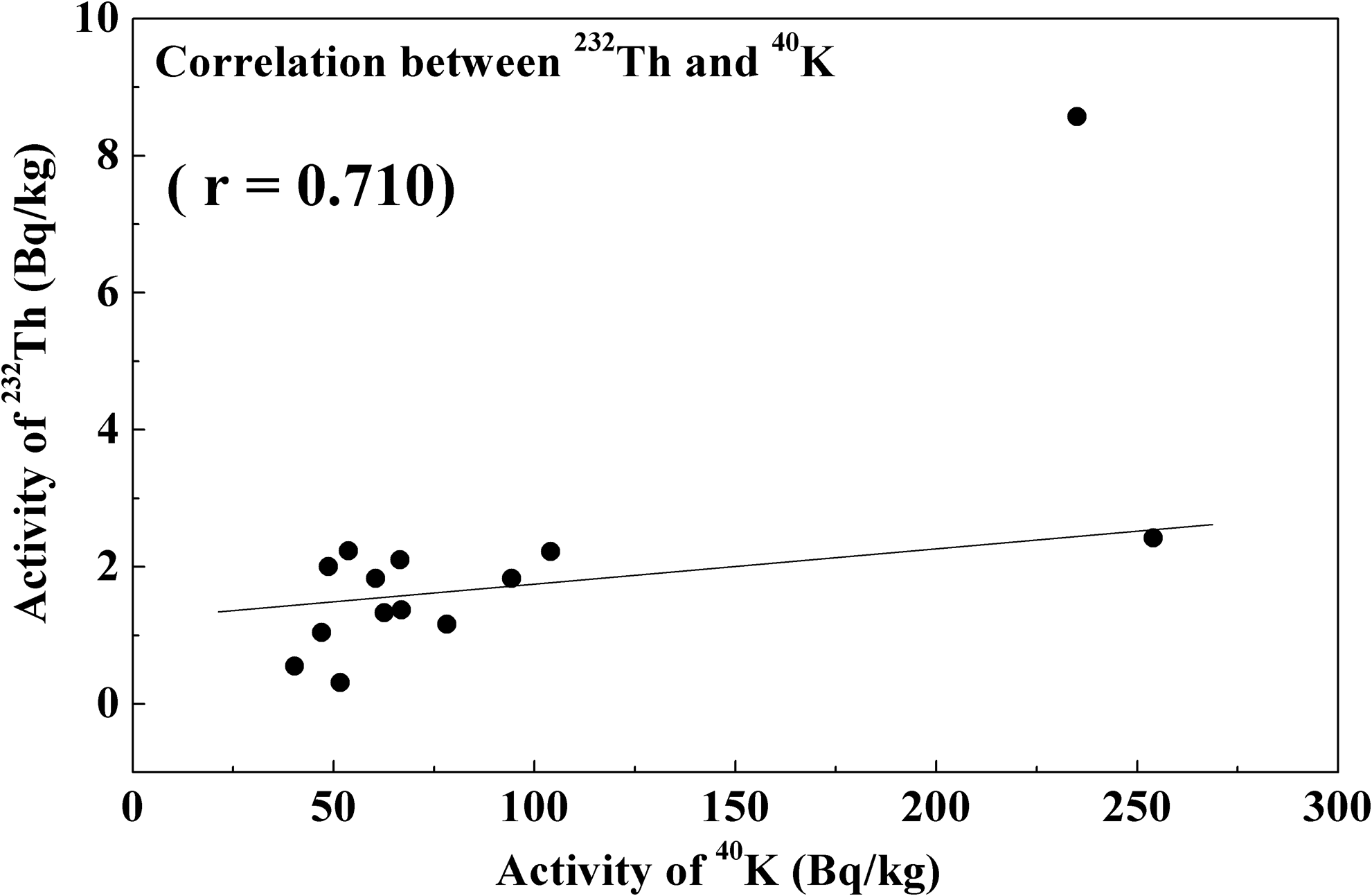
232Th versus 40K concentrations in the brands of infant formula.
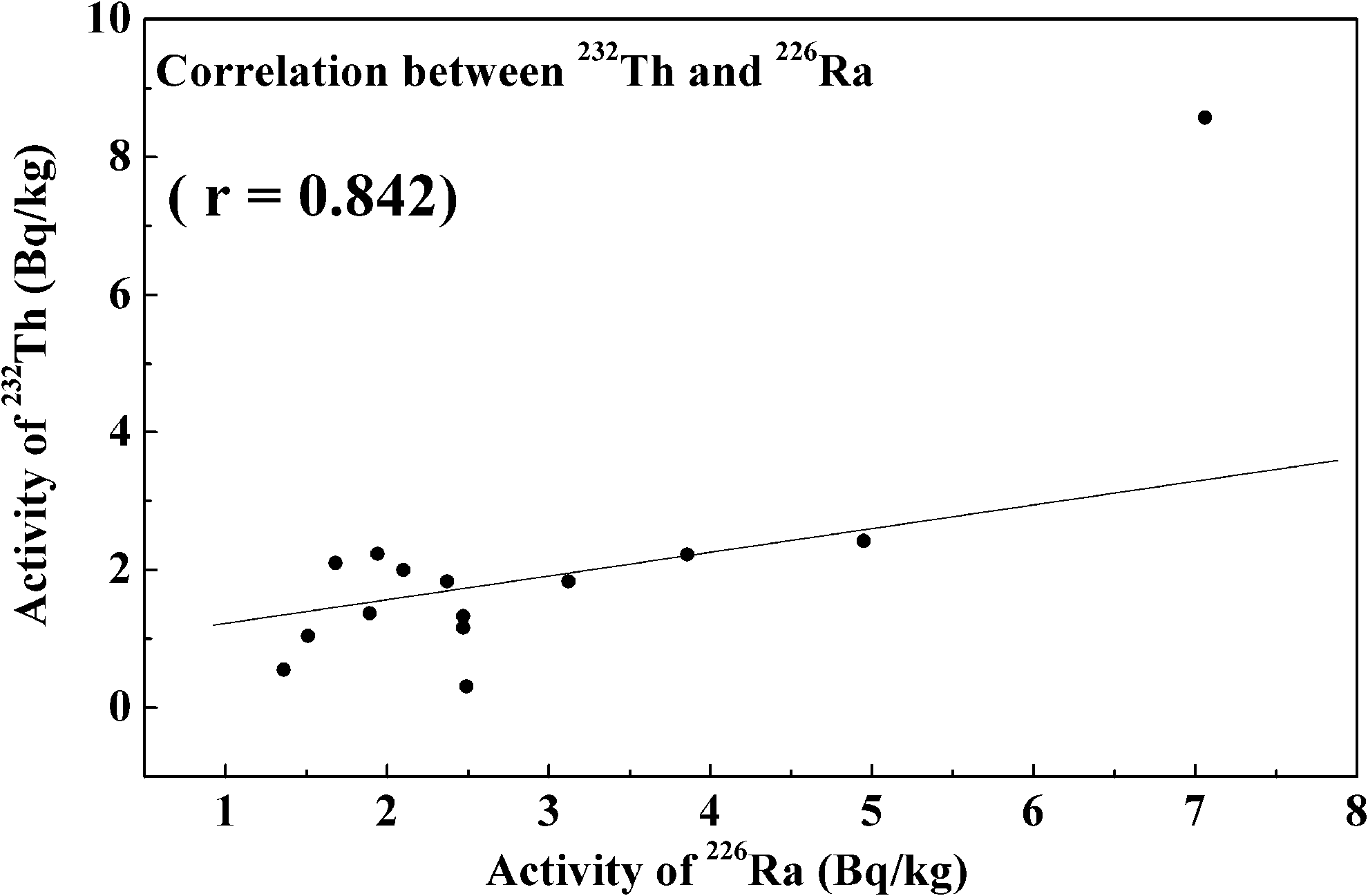
232Th versus 226Ra concentrations in the brands of infant formula.
AED, annual effective dose.
Radiological risk analysis
Risk assessment due to the ingestion of radionuclides through infant milk was estimated for the age groups (infants ≤1 year old and infants 1–2 years old) using the calculated effective dose. The essence is to have an idea of total risks from all of the investigated radionuclides compared with the lifetime risk from overall exposure to radionuclides coming through different pathways to the whole body for the typical duration of human life (70 years). The following Equation (4) (Giri et al., 2011) was used to estimate the risk:
where SF = slope factor (morbidity risk coefficient) obtained from the US EPA (1993) expressed in activity/risk (pCi/risk; 1 Bq = 27 pCi) and it is specific for each radionuclide (Table 6). Duration of infant exposure was considered as 365 days for each age group. Table 6 shows the estimated risk for the age groups to be 3.22 × 10⁻⁶ and 2.16 × 10⁻⁶ for infants ≤1 year old and infants 1–2 years old, respectively. These values are within the recommendation of the excess lifetime cancer risk of 1 × 10⁻⁶ and 1 × 10⁻⁴ by US EPA (1991).
Conclusion
Activity concentrations of naturally occurring radionuclides (226Ra, 232Th, and 40K) and artificial 137Cs in widely consumed powdered milk (i.e., infant formula) in Malaysia have been determined by HPGe γ-ray spectrometry. Due to the involvement of small sample numbers, this study represents a cross-sectional survey, but not a generalized one. The activity of 226Ra, 232Th, 40K, and 137Cs in all of the brands of infant milk ranged from 1.36 ± 0.14–7.06 ± 0.84 Bq/kg, 0.31 ± 0.10–8.57 ± 2.11 Bq/kg, 40.3 ± 2.10–254 ± 12.8 Bq/kg, and ND−0.73 ± 0.47 Bq/kg, respectively. With regard to the country of origin of the studied milk brands, the brand (Lactogen) from Philippines shows low levels of radioactivity, while the brand from Singapore (S26 SMA Gold) depicts relatively higher values. It is possible that the detected activity might be the result of raw materials imported from elsewhere in the world. The present results lie within the literature data measured from different brands of milk around the world. Meanwhile, the mean annual effective dose due to the ingestion of radioactivity through powdered infant milk was estimated and found to be above the UNSCEAR reference value. As far as our concern, this is the first study (i.e., it can also be considered a pilot study) for the radioactive content of powdered infant milk consumed by Malaysian infants. The data reported here might be useful to establish a baseline for natural and artificial radioactivity in milk and help to develop future guidelines in the country for radiological protection for the relevant population.
Footnotes
Acknowledgment
This work was supported by the University of Malaya Research Grant nos. RP006D-13AFR and IPPP PG065-2014A.
Author Disclosure Statement
No competing financial interests exist.