




Abstract
Abstract
Depleted uranium dioxide has been proposed as an inert material to fill spent nuclear fuel canisters in geological repositories. Sorption capacity of this material to retain radionuclides released from the fuel was determined. Radiocesium is one of the radionuclides of concern in case of a nuclear accident or in a high-level nuclear waste repository and is highly mobile in aquatic systems. Results obtained in this work show that sorption of cesium on UO2 is a fast process (the equilibrium is reached in less than 1 h at pH 9).
Introduction
D
Cesium, a fission product present in radioactive wastes, is a radionuclide of concern because of different reasons. On one hand, it has two harmful isotopes that contribute to the radiation hazard of nuclear waste:135Cs (half-life: 3×10⁶ years) and 137Cs (half-life: 30 years). On the other hand, most cesium-containing solid phases have a very high solubility product and the cesium-predominant species in solution is the Cs+ ion, which is highly mobile in aqueous media (Comans et al., 1989; Avery, 1996; Flury et al., 2002), facilitating its involvement in the hydrological cycle (Carlton et al., 1992; Steefel et al., 2003).
For these reasons, in the safety analysis of a high-level nuclear waste repository or in the case of a nuclear accident, as it happened in Fukushima Daiichi nuclear power plant on March 11, 2011, where large amounts of seawater got in contact with irradiated fuel, cesium is one of the main radionuclides considered from the standpoint of long-term external and internal radiation exposure (Funaki et al., 2014).
In this work, the kinetics of sorption of cesium on uranium dioxide as well as the variation of the sorption capacity with cesium concentration in solution (sorption isotherms) and with ionic strength were studied through batch experiments. The main objective was the knowledge of the sorption mechanism as well as the maximum sorption capacity of the UO2 for cesium. From the sorption data obtained, a calculation of the weight of depleted UO2 needed as filling material was made.
Experimental Protocols
Solid phase
Crystalline uranium dioxide with a particle size between 50 and 100 μm was obtained from a UO2 pellet supplied by ENUSA (Empresa Nacional del Uranio S.A.). The composition of the bulk of the solid was UO2.01, determined by X-ray diffraction analysis. The surface area of the solid was determined by the Brunauer–Emmett–Teller (BET) method, the result obtained was 0.019±0.002 m2/g.
Before the experiments and to dissolve fines and oxidized fractions, UO2 was submerged in a 1×10⁻³ mol/dm3 HCO3− solution. After this step, the solid was filtered and dried under N2 atmosphere.
Methodology
Sorption experiments were carried out inside a glovebox filled with N2 (g), avoiding the presence of O2 (g) and CO2 (g), which could either oxidize UO2 or modify the UO2 solubility by the formation of carbonate complexes in solution, respectively. Temperature was 25°C±1°C.
A known amount of UO2 (∼0.05 g) was added to a known volume (20 cm3) of cesium solution in stoppered polystyrene tubes. The initial cesium concentration ranged from 7.0×10⁻⁴ to 1.4×10⁻⁸ mol/dm3. Considering that the maximum sorption of cesium on other uranium solids occurred at pH>pHzpc, and that the pHzpc of the UO2 was determined to be 7.7±0.4 (Clarens et al., 2003), in this work the pH was kept at 9.2±0.3 by adding HClO4 or NaOH when necessary. This pH is considered high enough to neglect the effect of pH in the sorption, but still a pH that could be found in the groundwater of a deep geologic repository [for example: Grimsel groundwater pH=9.7 (Missana et al., 2003)].
The tubes were continuously stirred by using an end-over-end stirrer. At the end of the experiment, aqueous samples were filtered through 0.20-μm MICROPORE pore size filters and acidified with concentrated HNO3. Cesium and Uranium concentrations were determined using ICP-MS (Agilent 7,500 cx). Uranium concentration was analyzed only to detect an unexpected dissolution of UO2. The average concentration of uranium in all the samples was (2.73±2.87)×10−7 mol/dm3, meaning that only 0.003% of the UO2 was dissolved. The pH of the solutions was monitored with a CRISON pH Meter GLP22 before the addition of the UO2 solid to the solutions and at the end of the experiments, when the equilibrium was reached.
The concentration of cesium sorbed onto the solid in moles of Cs per m2 of dry solid, {Cs}s, was calculated by subtracting the final concentration, [Cs]
eq
in mol/dm3, to the initial concentration of cesium added to the solution, [Cs]0 in mol/dm3, and normalizing with the volume (V) to the surface area (SA) ratio:
The main objectives of this work were to determine the UO2 sorption capacity for Cs as well as to improve the knowledge of the mechanism of the sorption process to evaluate its suitability for cesium retention in a high-level nuclear waste repository.
To reach these objectives, three different sets of experiments were carried out: (1) sorption kinetics (with a constant cesium concentration, 10−5 mol/dm3); (2) sorption isotherms (with [Cs]0 ranging from 1.5×10⁻⁷ to 7.7×10⁻⁴ mol/dm3); and (3) the effect of ionic strength (in the same range of cesium concentrations in the sorption isotherm experiments).
Results and Discussion
Cesium sorption as a function of time
The variation of Cs sorption as a function of time is shown in Figure 1. As it can be seen, sorption is very fast under the experimental conditions with equilibrium values reached in 2 h. The percentage of sorption at equilibrium calculated as 100{Cs}s/[Cs]0 is 21%.

Variation of cesium sorbed onto uranium dioxide as a function of contact time. Experiments carried out with 0.05 g of UO2, [Cs]0=6.1×10⁻⁵ mol/dm3 in the presence of 0.1 mol/dm3 NaClO4 at pH=9. Very fast sorption can be observed.
Since the kinetics of the sorption is very fast, modelization of the experimental data cannot provide any additional information, and therefore, no models were used.
Isotherms of cesium sorption: influence of ionic strength
The concentration of cesium sorbed on UO2(s) as a function of cesium remaining in solution at equilibrium is shown in Figure 2, at the two ionic media studied in this work: 0.01 and 0.1 mol/dm3 fixed by using NaClO4. In the case of ionic strength 0.01 mol/dm3, the shape looks linear, but in the case of ionic strength 0.1 mol/dm3, the shape tends to a maximum of cesium sorbed into the solid, which is the typical trend of a monolayer sorption. In the case of ionic strength 0.01 mol/dm3, only the linear model was fitted.

Sorption isotherm of cesium sorbed onto UO2. Experiments carried out with 0.05 g of uranium dioxide, at 0.1 and 0.01 mol/dm3 NaClO4. See the difference between the ionic strengths.
The parameter gamma, Γ, is defined as the cesium concentration sorbed on the UO2 at equilibrium (mol/m2), and the Kd is the linear constant of sorption (dm3/m2). The Kd has a value of 6.61±0.08 dm3/m2 and the fitting has a correlation coefficient of 0.999.
Regarding the samples with 0.1 mol/dm3 ionic strength, the experimental data were fitted to three different models: Lineal, Langmuir, and Freundlich.
Since the isotherm is not linear, the linear model is the one with the worst fitting (Fig. 3). The Kd value is 2.24±0.28 and the correlation factor is 0.926.
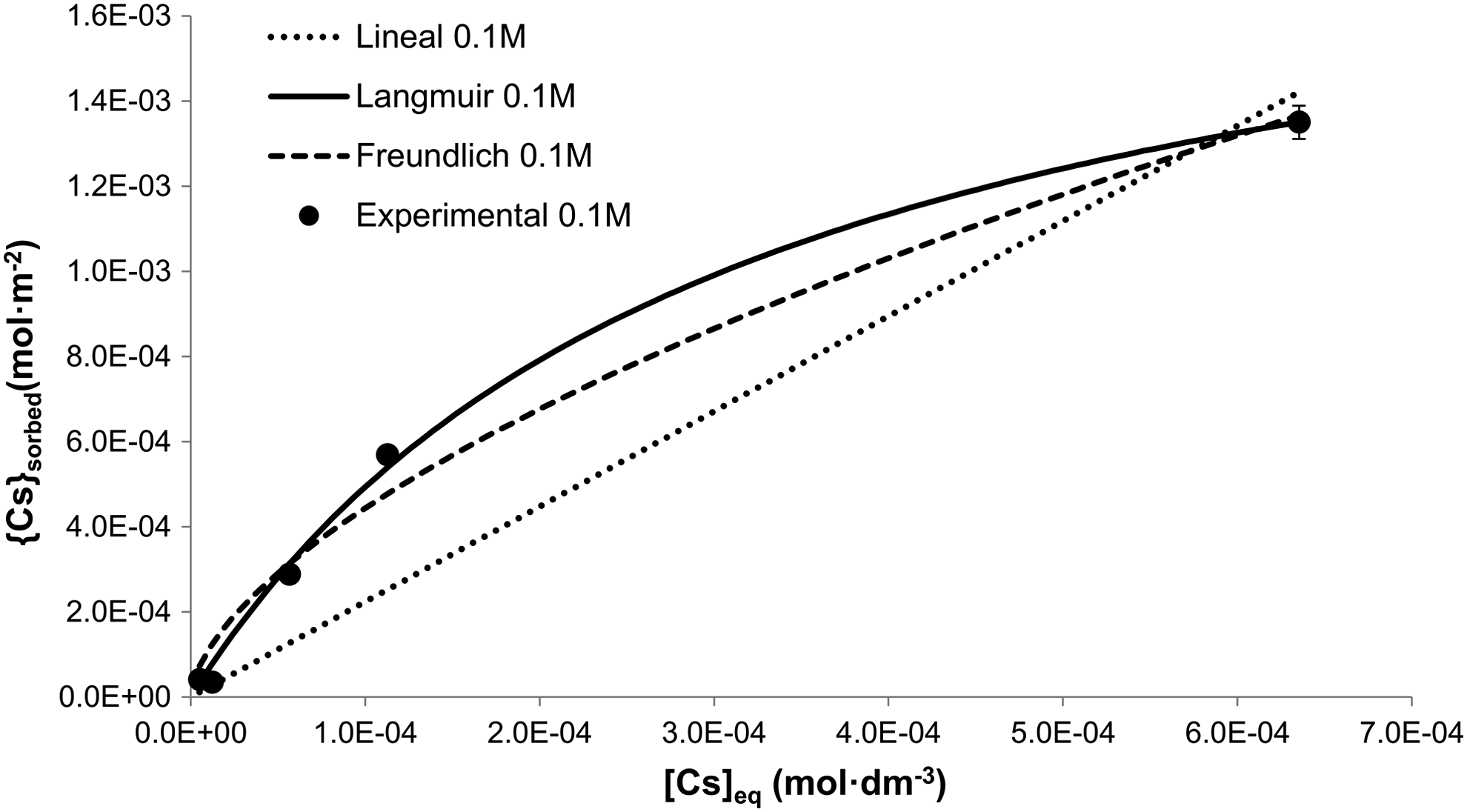
Sorption isotherm of cesium sorbed onto UO2. Experiments carried out with 0.05 g of uranium dioxide, at 0.1 mol/dm3 NaClO4. Fitting of the Linear, Langmuir, and Freundlich models. Note that the Langmuir model is the one that best fits.
The noncompetitive Langmuir isotherm model has the following expression:
KL is the Langmuir constant (dm3/mol), Γmax is the maximum cesium sorption (mol/m2), and [Cs] is the concentration (mol/dm3) of cesium at equilibrium.
The Langmuir isotherm is the one that best fits the experimental data (Fig. 3), which corroborates monolayer coverage on the UO2 surface. The Γmax has a value of (2.00±0.12)×10−3 mol/m2 and the KL is (3.27±0.44)×103 dm3/mol. The correlation factor is 0.996.
The characteristics of the Langmuir isotherm may be expressed by the separation factor, RL, defined as:
If the value of RL is 0, the sorption is irreversible; a value between 0 and 1 indicates that the sorption is favorable; RL=1 indicates that the sorption is linear and, finally, if the value is higher than 1, the sorption is unfavorable. The RL values were between 1.00 and 0.23. For cesium concentrations above 5×10⁻⁶ mol/dm3, the isotherm loses its linearity and RL values are lower than 1.
The Freundlich isotherm takes into account the interactions between the adsorbed molecules and the exponential decrease in the sorption energy with the increase in occupied sorption sites.
The Freundlich isotherm is an empirical model that has the following form:
The Freundlich constant Kf (mol sorbed/mol in equilibrium) is considered the adsorption coefficient, the quantity of sorbate sorbed per unit of sorbate concentration in equilibrium. The heterogeneity factor 1/n can be used to measure the deviation from linearity of the sorption isotherm. The linear model would have an n of 1. If the sorption process occurs due to chemical factors, then, the n is lower than 1. If the adsorption is produced by a favorable physical process, then, the n is higher than 1.
The fitting of the Freundlich isotherm can be seen in Figure 3. The correlation factor is 0.979. Kf has a value of (1.20±0.62)×10−1 mols/moleq and n is 1.64±0.18. With this heterogeneity factor, the Freundlich model suggests that the sorption of cesium onto UO2 is due to a favorable physical process.
A decrease in the sorption of Cs into UO2 is observed when the ionic strength increases (Fig. 2). This dependence is common of the outer-sphere complexes based in electrostatic bonds, which corroborates a cesium sorption on UO2 governed by electrostatic interactions between cesium and the surface of the solid.
Retention of cesium by UO2(s) used as inert material in spent nuclear fuel canister
The data obtained allow the calculation of the weight of depleted UO2 that would be necessary to sorb cesium released from the spent nuclear fuel. In the calculations shown below, only cesium is considered. In future calculations, with more information on other radionuclides sorption on UO2, competition processes must not be discarded, producing a decrease in the surface sites available for cesium sorption. In these calculations, a continuous flow of water was supposed as a transport system for the Cs released, therefore, the Cs that has escaped the fuel matrix does not contact the fuel matrix again and the mass of UO2 of the fuel itself cannot be subtracted from the mass of depleted UO2 necessary to adsorb the Cs.
The total cesium released from the spent nuclear fuel might be calculated considering the cesium inventory in the fuel. Cesium inventory in a pressurized water reactor (PWR) and UO2 spent nuclear fuel with a burn-up of 50 MWd/kgU were calculated by using KORIGEN code (Wiese and Schwenk-Ferrero, 2007). The total cesium release obtained from the total fuel matrix was 0.15% for both 133Cs and 137Cs, which corresponds to 1.52 g of 133Cs plus 1.48 g of 137Cs per kg of UO2.
For final disposal of spent fuel, a canister with four PWR assemblies is being designed (Puig et al., 2008), each assembly containing 523.4 kg of UO2. The total quantity of cesium released from the resulting 2093.6 kg of UO2 fuel will be 3.18 kg (23.9 mol) of 133Cs and 3.10 kg (22.6 mol) of 137Cs.
Mass of depleted UO2 necessary to adsorb all the cesium released from the fuel, wD-UO2 (kg), can be calculated by:
Where molCs are the total moles of cesium released from the fuel (46.1 mol); Qmax is the maximum sorption capacity, obtained from the sorption isotherms (2×10⁻³ mol/m2 at 0.1 mol/dm3 ionic strength was chosen to be conservative. At 0.01, the sorption capacity was much higher.); and S is the surface area of the depleted UO2 (0.0019 m2/g if a UO2 with the same surface area is considered).
The value obtained is wD-UO2=1223.7 kg. Considering the void space in a PWR canister, 1.343 m3 (1), and the UO2 density, 10,970 kg/m3, the weight calculated could be easily introduced in the void space of the canister, which indicates that the canister could contain enough weight of depleted UO2 to incorporate the cesium released from the fuel. It was proved that depleted UO2 would be a good filling material to retain Cs released from the spent nuclear fuel.
Conclusions
From the sorption data obtained, it was concluded that the sorption of cesium on UO2 is a relatively fast process.
At 0.01 mol/dm3 ionic strength, the sorption isotherm was linear. The sorption at 0.1 mol/dm3 ionic strength was based on electrostatic interactions and followed a monolayer coverage, which could be modeled considering a Langmuir isotherm. The maximum sorption capacity determined was 2.00×10⁻³ mol/m2.
From the maximum sorption capacity of the UO2 at 0.1 mol/dm3 ionic strength and the total inventory of cesium in the spent nuclear fuel, it was determined that the total amount of depleted UO2 contained in the canister would be able to retain the cesium released from the fuel.
Footnotes
Acknowledgments
Aurora Martínez-Esparza is acknowledged for her interest in this work. This work is supported by ENRESA and Ministerio de Economía y Competitividad (Spain) project CTM2011-27680-C02-01 and the associated FI scholarship (A.M.-T.).
Author Disclosure Statement
No competing financial interests exists.