




Abstract
Abstract
Microwave peroxide oxidation (MPO) has been demonstrated as an energy-efficient and low-GHG emission technology for destroying hazardous organic compounds in solid waste. The objective of this article was to study the degradation feasibility of endocrine-disrupting chemicals (EDCs) in hazardous wastes using MPO treatment with selected acid combinations. Three EDCs, nonylphenol (NP), bisphenol A (BPA), polychlorinated dibenzo-p-dioxins/dibenzofurans (PCDDs/Fs), contained in different hazardous wastes (i.e., fly ash, soil, and sludge cake) were adopted in this work. Over 85% of the EDCs, including the persistent PCDDs/Fs in raw wastes could be degraded in 60 min at the temperature of 450 K using the MPO treatment. One of the most interesting findings is that nearly all NPs and BPAs, over 99%, in hazardous wastes could be degraded in 20 min at the temperature of 450 K. Degradation efficiency in order was NP, BPA, and PCDDs/Fs. It is concluded that MPO with selected acid combination provided the potential to destroy the EDC contents in hazardous wastes down to a low level as a function of the treatment time. Some problems caused by the MPO method are also delineated in this article.
Introduction
A
In spite of numerous studies carried out on EDCs reduction in the wastes of concern, one deficiency of these technologies is long treatment time for practical engineering applications. Many researchers in the world have begun to study more innovative treatment technologies than conventional methods for EDCs contaminant solid wastes like soil and sludge cakes. As Chou et al. (2009) mentioned, microwave treatment is one potential, ecological pretreatment method known to solve toxicity because it intrinsically poses low carbon emission and energy-saving features. Microwave peroxide oxidation (MPO) is a versatile pretreatment method due to its rapid heating advantages to eliminate pore resistance and increase surface reaction, low reagent, and energy consumption. However, few published articles have explored EDCs degradation for hazardous wastes using MPO. There is a lack of information about EDC degradation in hazardous solid wastes using MPO with an acid combination. For a better understanding of microwave and oxidation combination effects using MPO in toxic degradation, the objective of this article is to explore the degradation feasibility of EDCs in hazardous wastes in a specific H2SO4/HNO3 solution.
Materials and Methods
To approach a practical condition, this work selected three real-site samples containing PCDDs/Fs, BPA, and NP, respectively. The PCDD/F-containing fly ash was sampled from a large-scale commercial municipal solid waste incinerator. The NP-containing sludge cake was sampled from a domestic commercial detergent factory. The BPA-containing soil was taken from a waste landfill site. Because acid solutions with different species or concentrations produce different oxidation and hydrogen-releasing capabilities, some studies have been aimed at avoiding using HCl, HClO4, and HF in coal or coal ash digestion (Rodushkin et al., 2000). This study developed MPO without using hydrofluoric or Cl-based acids. Before this work, acid combination and condition options were evaluated and tested among many options. Table 1 lists the analysis methods quoted and properties of the three samples and reagents used. Through a number of analyses, the PCDDs/Fs, BPA, and NP contents in untreated samples were identified as 42.6 ng/g (1.98 ng-ITEQ/g), 175, and 250 ng/g (dry weight basis), respectively.
95% confidence level.
International toxicity equivalent quantity.
BPA, bisphenol A; MSWI, municipal solid waste incinerator; NP, nonylphenol; PCDDs, polychlorinated dibenzo-p-dioxins.
An upgraded Microwave Digestion System (MDS, MARS-Xpress/230/60, CEM Corporation) was used for the MPO treatment in this study. A HF100 vessel type (4.5 cm i.d., 15 cm depth) consisted of a fluoropolymer liner and ceramic vessel jacket was adopted. This type of vessel permitted a maximum temperature of 500 K and a maximum pressure of 10 MPa. Ten vessels can be mounted simultaneously on the rotor in the MDS. Two grams of sample was premixed in each clean vessel with a mixture of 5.2 mL HNO3 and 2.8 mL H2SO4. Four milliliters of H2O2 was then added into the vessel in which the liquid/solid ratio was equivalent to 6.1 (w/w). After that the mixture in the vessels was installed in the MDS to treat the EDCs in the hazardous wastes. Before analysis, the original samples were filtered through 0.7 μm and dried in an oven at 310 K. The resulting solids were ground slightly to mix. These dried samples, untreated and treated by MPO were extracted from the solutions required by standard methods using an accelerated solvent extractor (ASE200, DIONEX) for 18–24 h. The samples were conserved by immediate addition of 1–2% formaldehyde and stored in the dark at 277 K if not instantaneously analyzed. The EDCs were analyzed by High Resolution Gas Chromatography/High Resolution Mass Spectrometry (HRGC/HRMS). The HRGC used was a Hewlett Packard 6970 series gas chromatograph, where chromatographic separation was achieved with a DB-5 (J&W Scientific) fused silica capillary column. The HRMS used was a Micromass AutoSpec Ultima mass spectrometer with a positive electron impact (EI+) source (Chang et al., 2013).
The work included blank tests, which were conducted without any oxidants, acid reagents, and microwave-assisted heating. The lost amount was less than 1% (w/w) in our study. The loss amount was also included in the relevant calculation to avoid accuracy error. The recovery efficiency required a minimum 75% and the method detection limit was 0.0012 mg/L for BPA and NP, and 0.00051 ng/L for PCDDs/Fs, respectively. Quality control and quality assurance application measures were conducted for whole experiments in this work, (Taiwan EPA, 2015). The degradation efficiency (η) of EDC is defined as: η = 1−([EDC content]treated/[EDC content] raw) by comparing the EDC content between raw sample and treated sample.
Results and Discussion
Both in solid phase sample and liquid solution, analytes analyses were carefully carried out, and they were counted in mass balance. As a typical case as shown in Figure 1, this work found that almost all of the reduced EDCs in the hazardous waste or soil were degraded, not removed in acid solution by the MPO process. The maximum degradation efficiencies of PCDDs/Fs, NP, and BPA are up to 85.1%, 99.5%, and 99.3%, respectively as shown in Figure 2 with first-order reaction rate constants. It elucidates that the EDCs in hazardous waste can be degraded using MPO with the HNO3 and H2SO4 acid combination. In other words, EDC degradation in solid wastes is feasible, and a significant EDC degradation efficiency was achieved. Almost no EDCs degradation was found in the blank test without both peroxide and acids at room temperature; however, in the line of 298 K shown in Figure 2, the finding shows that there is EDCs degradation in the presence of acid peroxidation, but no microwave irradiation. In the case of 450 K treatment temperature, only 30% of the NP and BPA could be degraded in 10 min of treatment time. However, degradation will approach 100% in 60 min. Nearly all of the NP and BPA and 99% in the raw wastes could be degraded in 60 min at the temperature of 450 K. However, in the case of 450 K, only 50% of the PCDDs/Fs could be degraded in 10 min of treatment time, and only 85% degradation could be achieved in 60 min of treatment time.
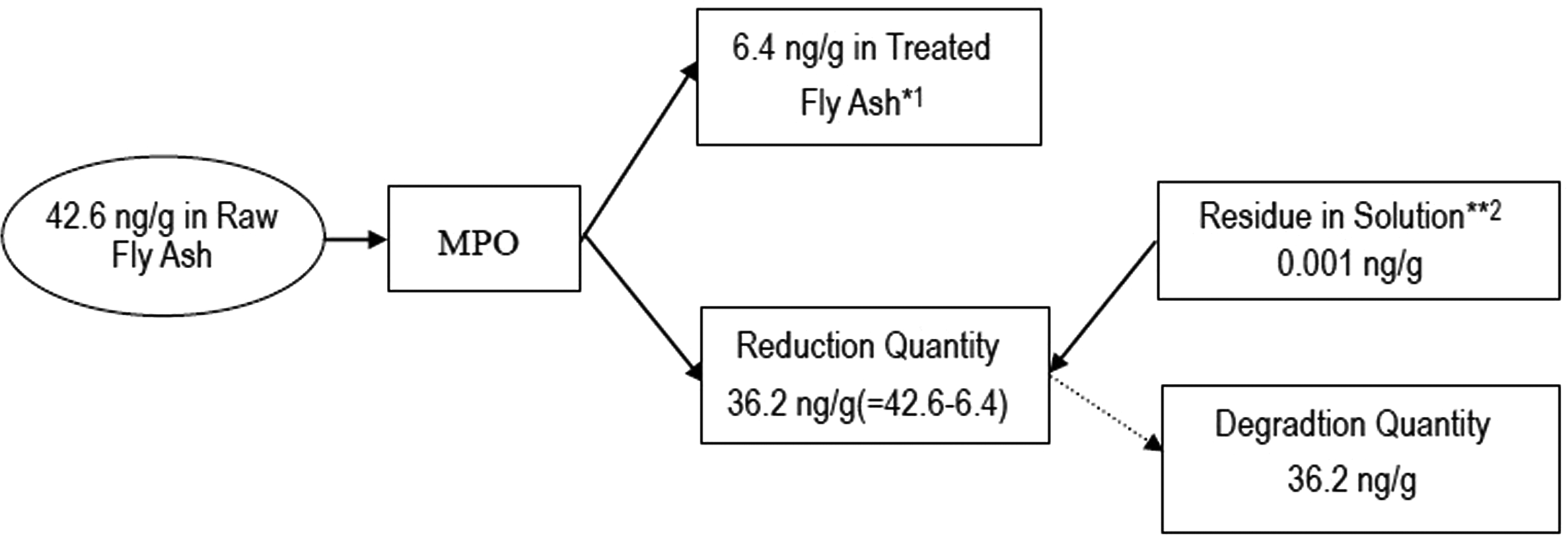
Mass flow diagram of PCDDs/Fs in the case of 60 min, 450 K (dry weight basis) *1Including 0.1 of filter cake when recycling spent acid solution (6.4 = 6.3 + 0.1) *2Including filtrate, total solution discharge quantity = 0.096 L/g of fly ash sample, measured concentration =0.011 ng/L.
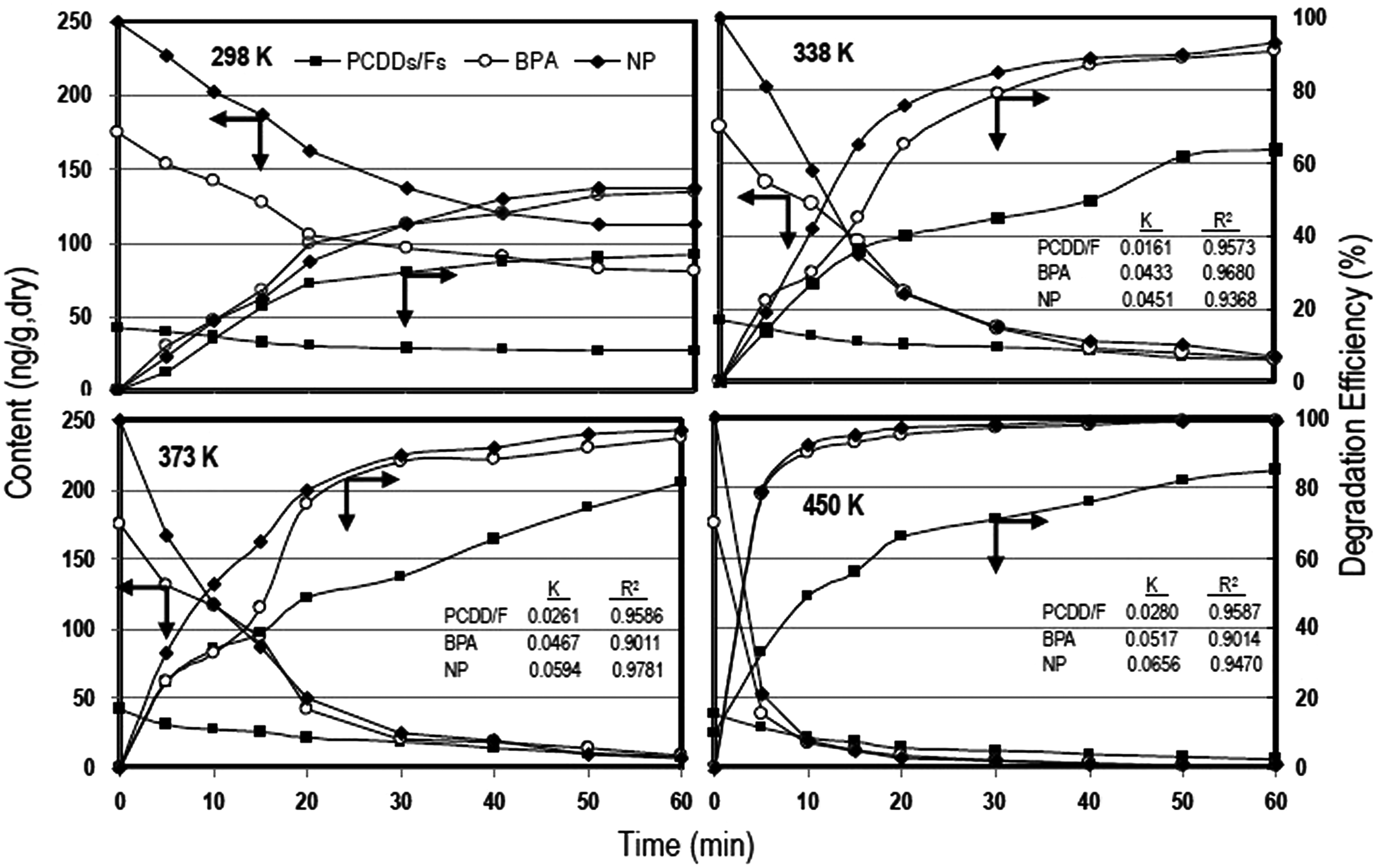
Effect of treatment time on EDC degradation. EDC, endocrine-disrupting chemical; PCDDs/Fs, polychlorinated dibenzo-pdioxins/dibenzofurans; BPA, bisphenol A; NP, nonylphenol.
Based on the consistent first-order reaction to compare degradation rate with rate constants (k‐values) shown in Figure 2, the PCCDs/Fs degradation efficiency less than those of NP and BPA could imply that the chloride-containing aromatic EDC is more difficult to be destroyed than nonchloride-containing aromatic EDCs using MPO. This work also found that the degradation efficiency increases significantly during the early treatment period at higher temperature, like 450 K. Due to larger concentration gradient between inner and outside of EDC-containing waste in the early treatment period, the EDC molecules contained in the waste will diffuse out fast and then be degraded by the oxidant in acid solution (Bird et al., 2006). However, the EDCs in the remaining waste residues were reduced making the EDC content decrease if the treatment time is longer. With increasing treatment time, the EDC content declines gradually and the EDCs in the treated wastes become relatively stable at low concentration making them relatively difficult to decompose by MPO. This result implies that a significant degradation in EDC content is feasible using MPO at higher temperatures. If sufficient microwave energy is applied to promote a balance between acid concentration and energy, the microwave degradation reaction will process very quickly with good EDC degradation within a short time (Chang et al., 2015). However, the degradation efficiency was still relatively low with increasing treatment time in the case of 298 K treatment temperature. It was only about 37–55% even when the treatment time was a few hours. There is no significant increase in degradation efficiency with an increase of treatment time without microwave-assisted heating. The result shows that microwave heating does provide necessary driving force for EDC compounds to diffuse out the inner pore of solid particle, and consequently improvement for the degradation reaction rate (Nascimento and Azevedo, 2013).
The treatment temperature was an important factor in reducing the EDC content in hazardous wastes using the MPO method. As shown in Figure 3, the EDC content variation has a downward trend with an increase in treatment temperature. The EDC degradation efficiency would reach over 85% at the treatment time of 60 min when the treatment temperature is increased to 450 K from 298 K. Microwave heating is transferred deeply into the solid waste sample through radio wave penetration, and accelerates the temperature rising rate in the waste without relying on heat convection or conduction. The rising treatment temperature also increases the pressure in a closed vessel that promotes molecular diffusion processing. The collision frequency between EDC molecules and the acid matrix will increase with increasing temperature, thus making the EDC molecules react more with the oxidant in the acid solution, thus increasing the degradation efficiency, even to promote the degradation efficiency of PCDDs/Fs. However, the increase of temperature also increases the waste salt dissolution in high-concentration acid combination. The work found and suggested the treatment temperature would be not over 450 K for the EDCs treated by MPO.

Effect of treatment temperature on EDC degradation.
The weight loss problem due to salt dissolution in high-concentration acid solution would be of concern in engineering applications. About 25–35% (w/w) of the original waste was lost in these experiments. It would include inorganic carbon compounds (i.e., carbonate) and organics in sample loss as CO2, HCO3− due to oxidation. If recycling acid liquid waste by the posttreatment of neutralization, coagulation, sedimentation, and filtration, it would be possible to recover some of the lost material. A typical test in this work showed that this loss can be reduced down to 5% of the original waste (Chang et al., 2013). The net consumption of H2O2-containing acid solution is estimated to be about 200 g for each kilogram of raw EDC-containing waste if recovering the spent acid as a part of acid feed. Prior application into engineering, a rough treatment cost should be estimated dependent on economic capacity and removal performance of EDCs. Otherwise, there would be no interest if the industrial scale cost is too high.
As four typical EDCs are selected in this work, it would still not be clear or even of controversy if these results are applied to the other EDCs not used in this study. An additional important aspect with liquid–solid transfer phenomena is the differences in molecular diffusion and dechlorination or hydrogenation reaction among the EDC congeners. Many factors affect the congener distribution profile in EDC-containing wastes. It is difficult to conclude degradation deviation among individual EDC congeners using limited data. A detailed description regarding the degree of EDC congener or homologue degradation in solid wastes is not to be addressed from the results obtained in this article. So far, this article aims at an overall or apparent degradation of EDCs and suggests its results applicable to the EDCs of chemical properties similar to those used in this work. More intensive study on other conditions excluded in this work, like waste characteristics, kind and partition of combined acid, recycling ratio of spent acid, are proposed to verify the results obtained in this article.
Conclusion
This study verified that EDC degradation in hazardous waste is feasible using the MPO treatment method with H2SO4/HNO3 combination. Over 85% of the EDCs, including the persistent PCDDs/Fs in the raw wastes can be degraded in 60 min at the temperature of 450 K. One of the most interesting findings is that nearly all NPs in sludge cakes and BPAs in soil can be degraded in 20 min at the temperature of 450 K. The experimental results show that polychlorinated EDCs could be more difficult to degrade than nonchlorinated EDCs because the degradation efficiency order was NP, BPA, and PCDDs/Fs. It is concluded that MPO with a properly selected acid combination provides the potential to degrade the EDC contents in hazardous wastes to a low level as a function of the treatment time. However, the spent acid liquid recycling, as well as raw waste material loss in high acid solution, is of concern in engineering application. About 25–35% (w/w) of the original waste was lost in these experiments. By recycling acid liquid waste by posttreatments, the lost can be reduced down to 5% of the original waste.
Footnotes
Author Disclosure Statement
No competing financial interests exist.