




Abstract
Abstract
Sulfate-reducing bacteria (SRB) can beneficially be applied to domestic wastewater treatment. In general, formed sulfide will stay in liquid phase, resulting in an elevated sulfide content, which might have inhibiting effects on the SRB. To study effects of environmental conditions on the SRB resistance against sulfide, two sequencing batch reactors fed with artificial domestic wastewater were operated at sulfate-reducing conditions. Required sulfide concentration within the reactor was achieved by adding 400 or 800 mg COD/L (acetate and propionate), the latter resulting in proportionally more sulfide production. Batch tests revealed that sulfide inhibited the rate of sulfate reduction by 50% at a concentration of 200 mg/L sulfide for biomass from the reactor fed with 400 mg COD/L. After adaptation to a feed of 800 mg COD/L, resulting in higher sulfide exposures, sulfide was less inhibitive to SRB. Complete COD removal was achieved in the reactor fed with 800 mg COD/L, and the SRB population changed from one (Desulfotalea arctica) to two (Desulfobacter postgatei and Desulfocapsa sulfexigens) dominant species. Results indicate that SRB are capable of adapting to higher sulfide exposure. Therefore, the SRB can also be applied to treat wastewater with higher COD levels, blackwater for instance.
Introduction
S
SRB can be applied beneficially for the treatment of saline wastewater (Lens et al., 1998; Lens and Kuenen, 2001; van den Brand et al., 2015). Benefits of applying SRB in wastewater treatment are as follows: (1) minimal sludge production (Lens et al., 2002), (2) reduced quantity of coliforms (Abdeen et al., 2010), (3) removal of heavy metals (Lewis, 2010), and (4) the ability of SRB to granulate (Lens et al., 2002). A good example of the beneficial application of SRB in wastewater treatment is its key role within the Sulfate reduction, Autotrophic denitrification, and Nitrification Integrated (SANI) process (Lau et al., 2006; Wang et al., 2009; Lu et al., 2012). In general, it is important to avoid sulfide losses from the liquid phase to the gas phase as this leakage causes odor problems (Lens et al., 2002). Another reason to keep the sulfide into the liquid phase is that autotrophic denitrification requires this sulfide as a part of the SANI process. As a result, the sulfide concentration in the liquid can become high, and the activity of SRB at high sulfide exposures is not well studied.
Sulfide can be present in the liquid in various states, of which undissociated H2S has the strongest inhibitory effect due to its ability to permeate the cell membrane and resulting in denaturation of enzymes and interference with the assimilatory metabolism of sulfur (Lens et al., 1998). The quantity of H2S in wastewater is determined by the pH (Rintala and Puhakka, 1994). At the regular pH of wastewater (7.5), a considerable amount of the H2S form of sulfide is expected. At this pH, only minor losses of sulfide to the gas phase will occur, resulting in a significant presence of sulfide in the liquid phase.
To assure SRB activity in a wastewater treatment process, SRB should tolerate high levels of sulfide. For instance, a wastewater with 400 mg COD/L can potentially lead to 200 mg H2S/L. Some studies have been dedicated to the sulfide inhibitory effects on SRB, but they showed contradictory results, indicating that the environmental conditions or specific population present are determining the sulfide inhibition (Colleran et al., 1995). The long-term effect of sulfide on SRB under similar operational conditions had not been investigated before. This long-term practice is especially of interest since microbial communities have an adaptation capacity and new environmental conditions can lead to another dominant SRB population. Most of the studies have been done at relatively high temperatures (>30°C) compared to temperatures common for municipal wastewater facilities in moderate climates (10–20°C).
The main objective of this research was to investigate whether SRB can be active at elevated sulfide exposures (200 to 400 mg/L) at moderate temperatures. These higher sulfide levels could be a result of the general COD fluctuation in the influent of wastewater but could also result from treating blackwater (containing concentrated toilet wastewater). In the present article, a long-term reactor was operated with different COD levels in the influent, resulting in different sulfide levels inside the reactor. The adaptation of SRB to sulfide within this reactor was especially monitored by studying effluent quality and growth. Furthermore, population analyses were performed to investigate whether the same sludge can adapt to a higher sulfide exposure or a new SRB species can become dominant. Sulfide toxicity profiles were used not only to characterize the sulfide inhibition on each sludge but also to distinguish the effect of sulfide on acetate and propionate consumption.
Materials and Methods
Experimental setup
One reactor was sequentially operated at two different conditions; in the first 123 days, the influent contained 400 mg COD/L, and thereafter, it continued for 71 days at 800 mg COD/L in the influent. A detailed description of the reactor performance is given by van den Brand et al. (2014), except for the COD levels in the influent, which were 400 and 800 mg/L. The reactor was operated as a sequencing batch reactor with cycles of 6 h: 5 h and 20-min feed and reaction, 20-min settling, and 20-min effluent discharge. During the feed and reaction phase, the following parameters were controlled: temperature (20°C), dissolved oxygen (DO) (0%), and pH (7.6 ± 0.2). The solid retention time (SRT) was kept constant at 15 days. The SRT was corrected for biomass losses during sampling and maintenance, for instance. The average hydraulic retention time (HRT) was 10 h.
Inoculum
To supply a variety of SRB species, a mixture of two different inoculum sources was used: activated sludge from the WWTP Amsterdam West and sediment from a pond in the ecological garden of the KWR Watercycle Research Institute. The microbial diversity in the reactor was weekly boosted by addition of inoculum of 5 v/v%.
Synthetic media
The reactor was fed with synthetic saline wastewater with a COD content of 400 mg/L, followed by another operation in sequence with 800 mg COD/L in the influent, resulting in a COD/SO42− ratio of 0.27 and 0.53 g/g, respectively. The carbon source comprised acetate (3.57 or 7.14 mM NaCH3COO..3H2O) and propionate (1.53 or 3.06 mM NaC3H5O2) as these two compounds are the main volatile fatty acids present in domestic wastewater (Mino et al., 1998; Chen et al., 2004; López-Vázquez et al., 2008). Furthermore, the composition of synthetic wastewater (feed) was 0.22 mM K2HPO4, 0.10 mM KH2PO4, 7.14 mM NH4Cl, 0.46 mM MgCl2.6H2O, 0.53 mM CaCl2, and 1 mL/L trace elements solution, as published by Lau et al. (2006). A sulfate concentration of 1500 mg/L was achieved by adding 21 g/L aquarium salt.
Batch test (short-term)
Several types of batch tests were performed to gain more insight into the sulfide inhibition, also as a function of the carbon source. The detailed description of this method is elaborated by van den Brand et al. (2014). In short, 30 mL sludge from the reactor was added to 50 mL prepared media, similar to synthetic media, and made anaerobic by 2 min of N2 flushing. Periodical sulfide measurements were used to determine the sulfate reduction rate. Addition of sulfide (Na2S) to investigate the effect of initial sulfide presence caused a significant pH increase (10). A pH correction was performed, by adding drops of 1 M HCl until a pH of 7.6 was reached, to investigate the sole inhibitory effect of sulfide. The H2S concentration was calculated based on the total sulfide concentration, as given in Equation 1. The batch test was also performed with three carbon source compositions: (1) acetate, (2) propionate, and (3) acetate and propionate.
Analytical methods
Analyses of the reactor consisted of measurements of organics (COD), sulfide and sulfate of the effluent, and the determination of volatile suspended solids (VSS) and total suspended solids (TSS) and were performed at least weekly. The fraction of organics was determined by means of a standard test kit (Hach Lange LCK 414), first after the sulfide had been removed. For sulfide measurements, however, it is crucial to avoid losses during sampling and treatment, and therefore immediately, a drop of NaOH was added to the sample, after which it was analyzed by spectrophotometer (Hach Lange LCK 514). The sulfate concentration was determined by means of a spectrophotometrically standard test kit (Hach Lange LCK 514) as well.
To analyze the growth of the biomass, samples were taken from the reactor just before settling (reactor completely filled and homogeneously mixed) and from the effluent. The samples were filtered with 2.7-μm glass microfiber filters (Sartorius, FT-3-1101-047) and incubated at 105°C (TSS), followed by 550°C (VSS), according to the method described by APHA (1995). The diameter of the granules was determined through microscopic analyses. More analytical details can be obtained in the article by van den Brand et al. (2014).
Population analyses
Terminal restriction fragment length polymorphism (TRFLP) and sequencing techniques were applied to determine the microbial population differences between the sludge from two reactors compared to the inoculum. DNA was isolated with the Power Biofilm DNA Isolation Kit. TRFLP was performed as described by Santillano et al. (2010), with the primer set DR1334R and DSR1Fmix specific for the dsrA gene, except that a twofold PCR amplification cycle was run. For sequencing, the amplified samples were cloned with the pGEM®-T Easy Vector Kit, picked, and analyzed by Macrogen.
Results
Long-term reactor operation
Effluent quality of the sequencing batch reactor operated at first with 400 mg COD/L in the influent and continued with 800 mg COD/L in the influent is shown in Fig. 1. The sudden increase in COD in the influent caused incomplete COD removal (∼50%), but this recovered to a removal of 92% within 2 weeks, resulting in a COD level of 62 mg COD/L in the effluent (Table 1). This consisted of solely acetate. The increase in COD level in the influent resulted in higher sulfide (376 mg/L) and comparatively lower sulfate levels (342 mg/L). The sulfate reduction rate increased from 1.41 to 2.23 (mmol SO42−/[gVSS·h]) by increasing the COD level in the influent. Throughout the operation of the reactor, the COD and sulfur balance were, on average for both reactors, 97% and 98%, respectively. No methane was observed in the off-gas.
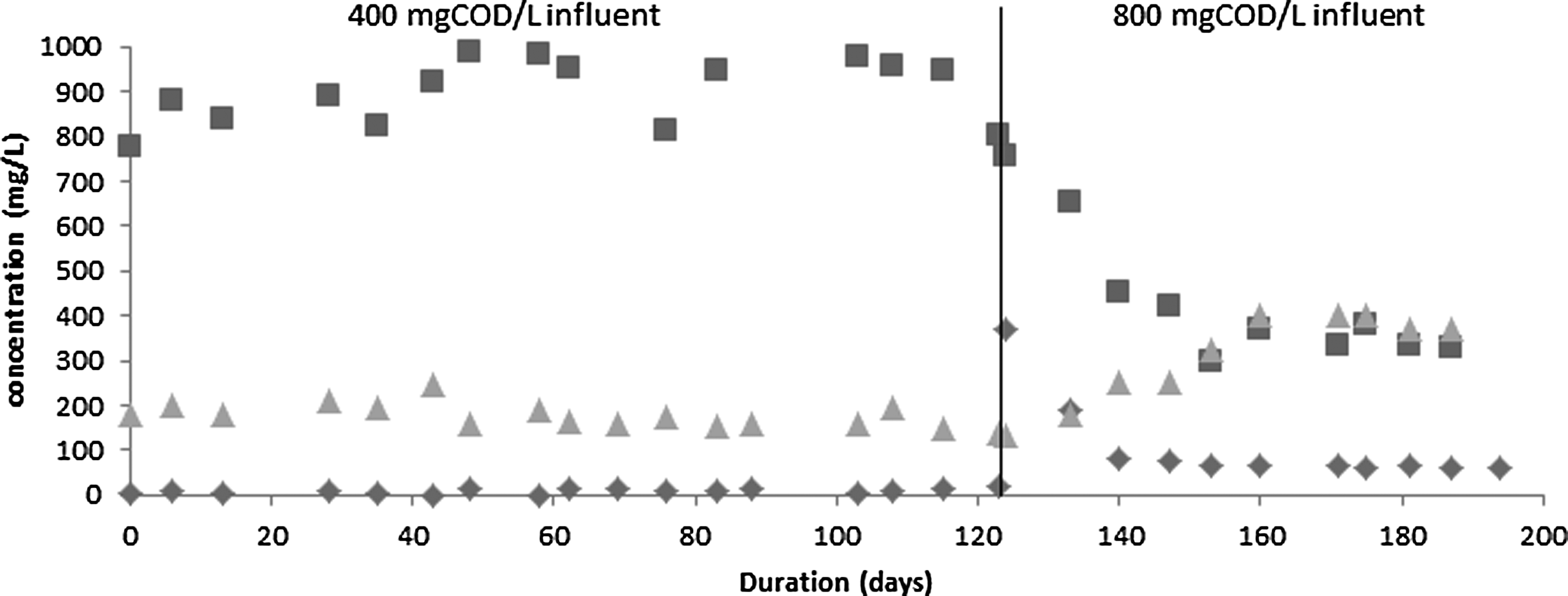
Effluent quality of a sulfate-reducing sequencing batch reactor when shifted from low to high influent COD in terms of COD (♦), sulfate (■), and sulfide (▲) concentrations. The influent contained 400 mg COD/L from day 1 to day 123, and thereafter, the influent contained 800 mg COD/L.
The reactor was operated at 20°C, pH 7.6, SRT of 15 days, and a COD/SO42- ratio of 0.27 and 0.53 g/g, respectively. SRT, solid retention time.
As a result of the twice as high COD level in the influent after day 123, the VSS concentration in the reactor also doubled from 1.5 to 3.1 g/L, while the amount of sludge produced per day increased from 34 to 76 mg COD/day (Table 1). The VSS concentration in the effluent increased by a factor of three. A difference in production rate and amount of VSS in the effluent, caused a need to change the amount of sludge to be removed each cycle, as such the SRT remained 15 days. The difference in growth yield was minimal, and therefore, it was concluded that the growth yield was equal for both conditions.
Morphology
At both influent conditions, the diameter of the aggregates increased up to 100 μm after an adaptation period of at least three SRTs. The sludge aggregates from the reactor operated at 800 mg COD/L had a larger diameter but, moreover, showed a more dense structure, and their appearances were less fluffy (Fig. 2). Under both conditions, the sulfate reduction rate was of the same order (Table 1). The VSS/TSS ratio decreased for operation with higher COD content in the influent (Table 1).
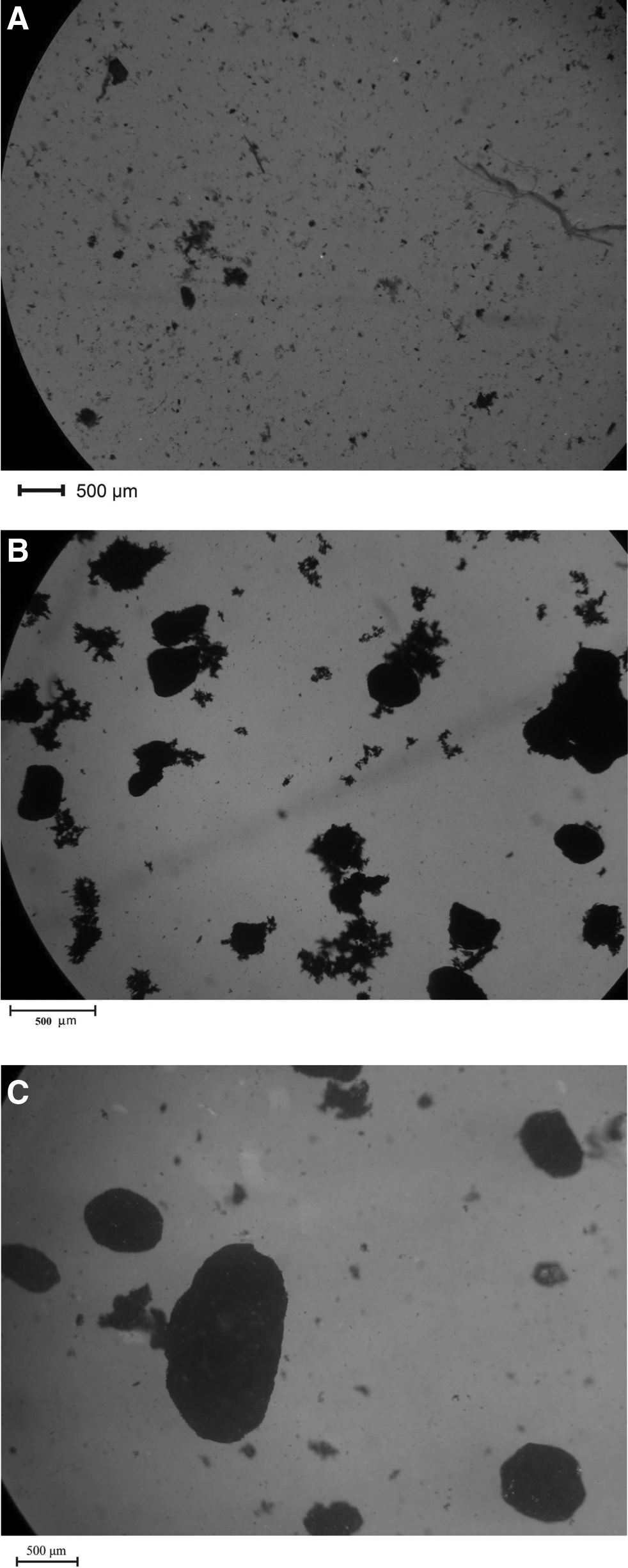
Morphology of the inoculum
Population analyses
The SRB population was strongly enriched during the sequencing batch reactor operation, which was also indicated by only 18% similarity in SRB population between the inoculum and the reactors. A relatively small change in SRB population occurred from changing the feed composition from 400 to 800 mg COD/L as the population was for 81% similar (Fig. 3). The sequencing results, however, showed that the dominant SRB population was different in these two stages. The dominant population occurring in each stage of reactor operation did not closely relate to any cultured SRB species. Only 1 SRB species was dominant in the reactor fed with 400 mg COD/L, of which Desulfotalea arctica (79%) was the first related cultured SRB strain. In the reactor fed with 800 mg COD/L, two SRB species were dominant for which the closest related cultured SRB strains were Desulfobacter postgatei (92%) and Desulfocapsa sulfexigens (80%) based on nucleotide BLAST (Table 2).

TRFLP profile of the SRB population in the sludge from the inoculum (WWTP Amsterdam West and KWR ecological garden sludge) and under both reactor conditions; first, a feed procedure of 400 mg COD/L, followed by 800 mg COD/L in the influent. TRFLP, terminal restriction fragment length polymorphism; SRB, sulfate-reducing bacteria.
All sequences that appeared twice or more from 25 analyzed clones of each sample.
From protein BLAST, it was found that the closest related cultured species were Desulforhopalus singaporensis (92%) and D. postgatei (95%) in the reactor fed with 800 mg COD/L (Table 2), while for the reactor fed with 400 mg COD/L, the protein BLAST indicated Desulforhopalus singaporensis (89%) as the dominant species. The protein-based BLAST for the two sequences found in the reactor fed with 800 mg COD/L (accession numbers KJ546430 and KJ546431) was 99% related to an uncultured species obtained from a salt marsh in moderate climates [AY741558, Bahr et al. (2005)] and sludge from an ethanol-fed reactor, which was shown to degrade the intermediate acetate [HQ640652, Kousi et al. (2011)]. The species KJ546430, dominant in the reactor fed with 400 mg COD/L, seems highly related to KF983327 (90% and 97%, respectively, for nucleotide and protein BLAST) based on the partial sdrA and sdrB sequence present, which is the second most dominant SRB population in the reactor fed with 800 mg COD/L.
Sulfide inhibition
Sludge from the reactor adapted to a COD level of 400 mg/L was used for testing sulfide toxicity (Fig. 4). A stronger sulfide toxicity was observed in batch tests without pH correction compared to the test in which all batches were performed at pH 7.6. In the tests without pH correction, the pH increased up to 8.9 for tests with higher initial sulfide concentrations. A higher pH will influence the equilibrium and result in a lower H2S concentration. Since H2S is the toxic compound at a pH of 7.6, the actual presence of H2S in each batch test was calculated, and these values were used to compare the H2S toxicity in the batch tests. Clearly, pH had a strong effect on the sulfide reduction rate. Under a constant pH, a good relationship between sulfate reduction rate and actual H2S concentration was observed.
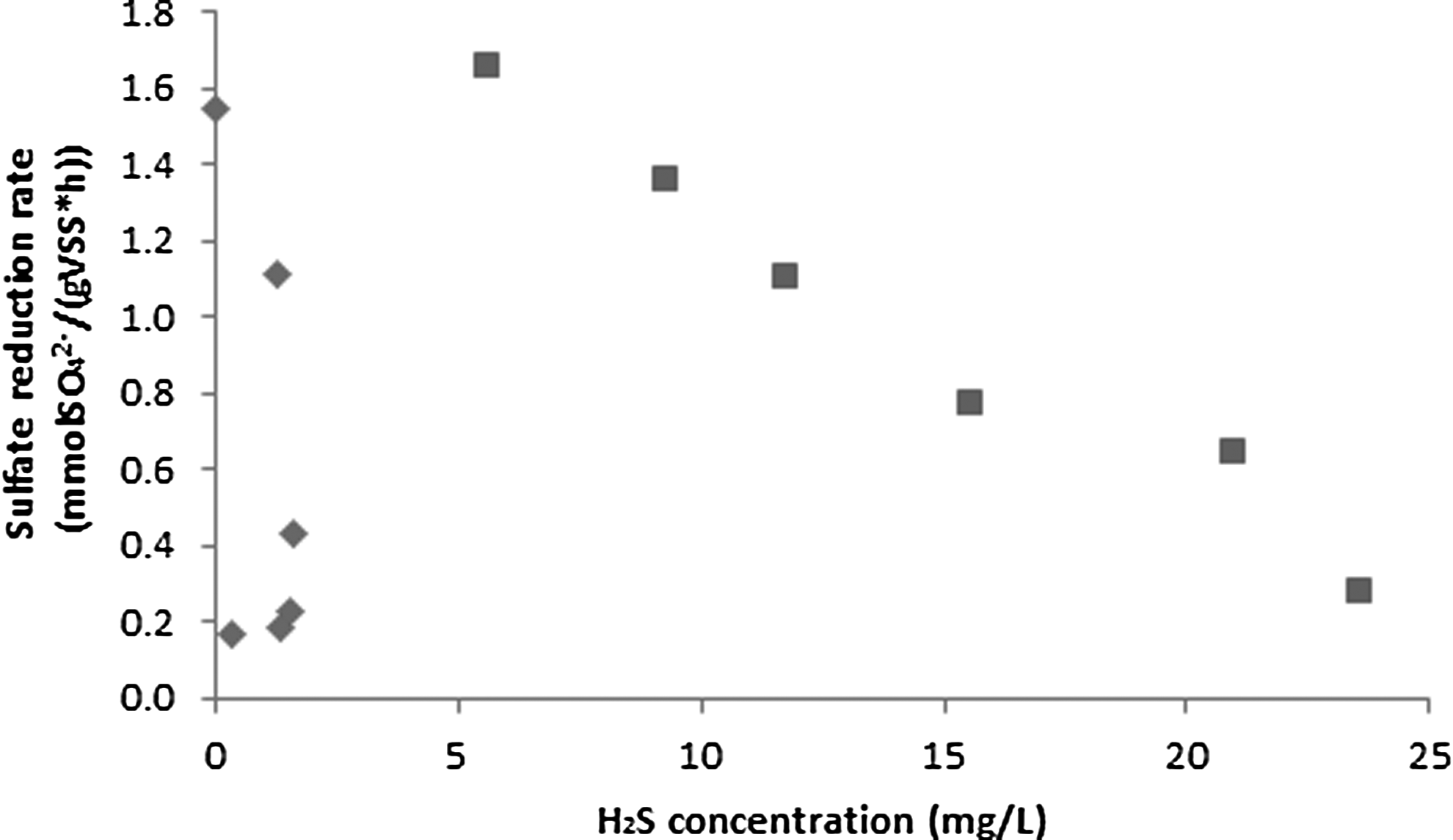
Sulfide inhibition profile of sludge from the reactor with 400 mg COD/L initiated with different sulfide concentrations, uncontrolled (♦) or controlled (■) pH at 7.6. In the batch test series, without pH correction after extra sulfide addition, the pH varied from 7.6 to 8.9. Since H2S is the inhibiting compound and the pH affects the ratio HS−:H2S, the sulfide concentration at the x-axis is the calculated concentration of H2S present.
The maximum sulfate reduction rate was approximately 1.5 times higher for sludge adapted to high COD levels (roughly 800 mg COD/L, resulting in 400 mg/L sulfide) (Table 1). Increasing sulfide concentration had a negative effect on sulfate reduction rates. The relationship between sulfide concentration and sulfate reduction rate was linear, and the slope of this relationship was similar between the sludges from each feeding stage of the reactor (Fig. 5).

Effect of sulfide concentration at the start of the batch operation on the maximum sulfate reduction measured in the batch test for sludge adapted to a feed procedure with 400 mg COD/L (♦) and 800 mg COD/L (■).
In the sequencing batch reactor, the sulfide concentration was low when the feed–reaction phase started and increased gradually during this phase. The sulfide concentration evolution in time within this feed–reaction phase is indicated in Fig. 6. In the course of time, a decrease in sulfate reduction rate was observed since the slope decreased. For each point, the sulfate reduction rate was determined, as well as the actual sulfide concentration (Fig. 6), demonstrating that there is a linear relationship between the sulfate reduction rate and the actual sulfide concentration. Different feed compositions resulted in different rates: The sum of reaction rates observed in tests with only acetate or propionate equals the rate in a test fed with both acetate and propionate. The slope of the relationship between the sulfate reduction rate and the actual sulfide concentration was similar for acetate, propionate, and both substrate consumptions.

As sulfate reduction couples sulfide production to COD removal, the decrease in sulfate reduction rate during the cycle can also be caused by depletion of COD, apart from that by the production of sulfide. Therefore, extra batch tests with increased COD content were performed. The increase in COD level in the batch test did not result in an increased or faster sulfide formation (Fig. 7). The decrease in activity must therefore be solely associated with an increased sulfide concentration.
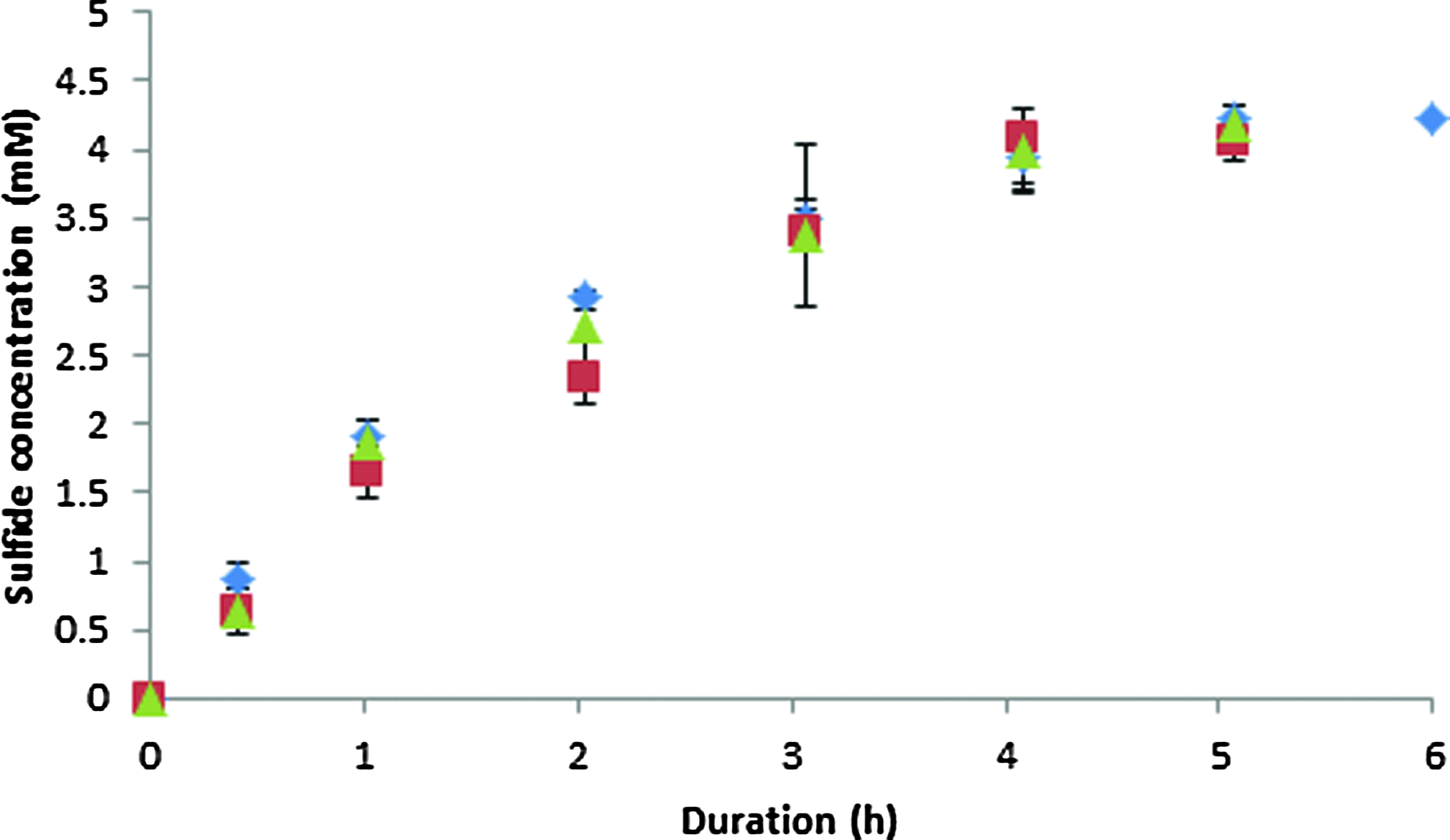
Accumulated sulfide production profile in batch tests fed with 400 (♦), 1000(■), and 4000(▲) mg/L COD consisting of a mixture of acetate and propionate in a molar ratio of 7:3 on sludge, obtained from the reactor fed with 400 mg COD/L.
Figure 8 shows the alteration of sulfate reduction rate for sludge adapted to a feed of 400 or 800 mg COD/L. Three different feed procedures in batch modus were applied: 400 mg COD/L containing both acetate and propionate, 228 mg COD/L acetate, and 171 mg COD/L propionate. Higher sulfide concentrations and higher sulfate reduction rates were achieved by the sludge adapted to 800 mg COD/L for all feed procedures (Table 3).

Effect of adaptation of sulfate-reducing bacteria to sulfide inhibition. Batch tests were inoculated with sludge adapted to 400 mg COD/L (open symbol) and 800 mg COD/L (filled symbol) in the influent. Three types of feed procedures were applied: (1) 400 mg COD/L of acetate and propionate mixture (■), (2) 228 mg COD/L acetate (♦), and (3) 171 mg COD/L propionate (▲).
Discussion
Adaptation to sulfide
Both Table 1 and Fig. 1 demonstrate that immediately after increasing the COD level in the influent of the reactor (day 123), no complete COD removal was achieved and that the sulfide concentration remained approximately 200 mg/L, that is, the sludge was operating roughly at its maximum capacity. The amount of COD removed per cycle increased during the first 2 weeks, resulting in complete COD removal and a sulfide concentration of approximately 400 mg/L in the effluent.
The SRB population of sludge under both conditions was relatively very similar (81%, Fig. 3). Sequencing results, however, demonstrated that the dominant population went from one to two species and that also an alteration in dominant species was observed. This suggests that SRB species more tolerant to sulfide became dominant in the sequencing batch reactor. Despite the fact that the dominant species in each reactor were related (90% and 97% identical based on nucleotide and protein BLAST, respectively, Table 2), it was concluded that the sludge from the bacterial population adapted to the higher sulfide concentrations due to a shift in the SRB population present in the reactor. Partly, the extra biomass content contributed to the increased volumetric conversion. The exact mechanism leading to less sulfide toxicity and higher specific rates is unknown.
Population analyses
TRFLP analyses revealed that the operation procedure in the sequencing batch reactors favored certain SRB as the inoculum samples and the species in the reactors were very different (Fig. 3). Furthermore, also, more variety in clones was noticed for the inoculum samples than for the samples from the reactor. The nucleotide BLAST showed that the dominant species from each reactor (KF983327 and KJ546430) were also the closest mutually related SRB species (90%). Since the nucleotide BLAST showed a similarity of only 90%, it is likely that a different SRB species became dominant after changing the feed composition from 400 to 800 mg COD/L. Probably, the higher sulfide concentration in the reactors is the main reason for this population shift since the acetate concentrations inside both reactors were low due to a slow feeding procedure. For Desulforhopalus singaporensis, it has been documented that it is active in the presence of salt and can oxidize propionate but not acetate (Lie et al., 1999). D. postgatei is known for efficient acetate uptake (Widdel and Pfennig, 1981), completing the removal of organics from the influent.
Morphology
Flocs of the sludge present in the reactor altered by changing the condition from 400 to 800 mg COD/L in the influent (Fig. 2). Flocs from the reactor fed with 400 mg COD/L show irregular and also some smooth flocs, while the sludge, fed with 800 mg COD/L, showed granules with a smooth structure. This suggests that the adaptation to higher sulfide exposures might be achieved by the formation of more dense biomass structures, which is in accordance with the observation of Lens et al. (1998). The increased floc size could be achieved by increasing the COD load per day, resulting in a higher biomass content.
pH effect on sulfide inhibition
The pH plays a key role in the inhibitive effect of sulfide on SRB (Oleszkiewicz et al., 1989; Colleran, Finnegan et al., 1995). Especially the undissociated form of sulfide (H2S) is very toxic to microorganisms as neutral molecules can easily penetrate the cell membrane (Speece, 1983). For a pH above 7.5, the H2S fraction of the total sulfide concentration is minimal (Rintala and Puhakka, 1994). Thus, for sludge operated at a pH above 7.5, the total sulfide determines the inhibition to microorganisms (Koster et al., 1986; Visser et al., 1996). In the tests with uncontrolled pH, a pH above 8 seemed to be inhibitive in itself. Many studies on the toxicity of sulfide for microorganisms do not mention anything regarding the actual pH. This study demonstrates the necessity to monitor the pH and provide this information in scientific publications.
Sulfide inhibition versus COD depletion
Decrease in sulfate reduction rate observed during the batch experiment could theoretically be caused by sulfide toxicity or COD depletion. According to the Monod equation, the sulfate reduction rate will reduce at decreased COD levels (Monod, 1949). However, even an excessive level of COD, applying even feeding with 1,000 or 4,000 mg/L COD instead of 400, did not increase the total amount of sulfide production (Fig. 7), indicating that the decrease in sulfate reduction over time is caused by sulfide production and is not due to COD depletion. Moreover, the addition of extra sulfide directly at the start of the batch resulted in a rate decrease as well (Fig. 5). Clearly, in the reactor system, the rates were limited by sulfide inhibition and not by substrate limitation.
Acetate and propionate consumption
Feed composition of the influent determined the sulfate reduction rate profile of the sludge (Fig. 6). The highest rates were observed when the sludge was fed with a mixed composition, followed by batches fed by solely acetate or propionate. These experiments were performed in parallel, and therefore, it was assumed that the population in these tests is similar.
Since the rate is lower in batches fed with a pure substrate than in those with both acetate and propionate, it is assumed that two different species are active: a species degrading acetate and another one oxidizing propionate. This assumption is underlined by the fact that two dominant SRB species were detected in the reactor fed with 800 mg COD/L, which is in accordance with the suggestion and observation by van den Brand et al. (2014). For that reason, the inhibitory effect of sulfide and the ability to adapt were separately analyzed for acetate and propionate (Fig. 8).
The slopes of the linear relationship between sulfate reduction rate and sulfide concentration in Fig. 6 were similar for all three types of batch tests. Therefore, our findings are in contrast to studies by Uberoi and Bhattacharya (1995) and Omil et al. (1997) who observed that acetate oxidation was the most sensitive to sulfide inhibition. This study demonstrates that sulfide has the same inhibitory effect on acetate- and propionate-consuming SRB. Since a similar linear relationship was observed for sludge with different feed procedures, acetate and propionate, solely acetate, and solely propionate, no distinct sulfide inhibition for acetate or propionate consumption can be observed. The regular fluctuations of acetate and propionate thus have no effect on the sulfide inhibition of SRB.
In the present study, the interlinked increase in COD and sulfide concentration on SRB was evaluated. The main conclusions drawn from the current study are as follows: (1) an increase in sulfide level causes a decrease in sulfate reduction rate, (2) although in one reactor it seemed that two different SRB were responsible for acetate and propionate oxidation, respectively, the formation of sulfide had an equal inhibitory effect on acetate and propionate consumption rates, and (3) an adaptation period of at least 2 weeks assures that SRB adapt to higher sulfide exposures, although nonetheless still some inhibitory effect was shown. Overall, it was concluded that SRB could adapt well, and therefore, the application of SRB in wastewater treatment is very promising. They also can be applied in wastewater with higher influent COD levels (such as blackwater), resulting in a higher sulfide production.
Footnotes
Author Disclosure Statement
No competing financial interests exist.