




Abstract
Abstract
UV/Fenton process was employed to remove clopyralid; meanwhile, various UV-based oxidation processes were compared, such as UV irradiation, UV/H2O2, and UV/Fe(II). Results illustrated that UV/Fenton exhibited the highest degradation rate, and UV irradiation alone hardly affected degradation of clopyralid. Rate constants, T1/2 (half-time) and EEO (electrical energy per order) were calculated to evaluate degradation rate and energy consumption among all these approaches. Some influencing factors, such as pH, irradiation time, and molar concentration ratio of hydrogen peroxide to ferrous ions, were studied to obtain an optimal degradation condition for UV/Fenton process. To evaluate the efficiency of UV/Fenton process applied for clopyralid degradation in aqueous solution, change of chemical oxygen demand in solution after UV/Fenton treatment was measured. Ion chromatograph was used to analyze formation of inorganic ions and short-chain carboxylic acids during photodegradation process. It was found that concentrations of chloride and ammonium were increased with irradiation time, and some short-chain carboxylic acids were detected.
Introduction
S
3,6-dichloropyridine-2-carboxylic acid, also known as clopyralid (CLP), is a herbicide registered by US-EPA and California for exterminating annual and perennial broadleaf weeds in certain lawn turf and crops, which is popular due to its efficiency. Table 1 shows some chemical and physical properties of clopyralid. According to the data from PANNA (Pesticide Action Network North America), clopyralid is rated as a potential groundwater contaminant, which means that it meets the California Department of Pesticide Regulation criteria. Indeed, the characters shown in Table 1 inform that clopyralid may easily leach into groundwater and cause a potential threat to human body (Corredor et al., 2006). As reported in water detection research, this herbicide was found in surface drinking water with the detection level of μg/L (Donald et al., 2007). Therefore, it is necessary to investigate the efficient removal methods for clopyralid and optimize the processes to meet the economic feasibility.
A series of processes based on the advanced oxidation technologies (AOTs) have been applied to eliminate herbicides, including clopyralid. AOTs are effective for treating the organic pollutants that are resistant to biodegradation, and ·OH radicals are considered as the most oxidative species to organic pollutants [reactions (1)–(3)] (R. Bauer and Fallmann, 1997). Among these AOTs, an electron beam was applied to degrade clopyralid and exhibited a decent effect on the removal (Xu et al., 2011). Photocatalytic degradation (Abramovic et al., 2007; Sojic et al., 2009, 2010; Tizaoui et al., 2011) and noncatalytic photodegradation (Eyheraguibel et al., 2009; Xu et al., 2013; Orellana-García et al., 2014) showed that photolysis was a feasible way to degrade the herbicide clopyralid. The classic Fenton process was also used to remove clopyralid from water (Ozcan et al., 2010; Westphal et al., 2013).
All these AOTs have achieved a high degradation rate of clopyralid, however, the treatment cost of different processes also needs to be taken into consideration. For instance, the production of high energy electron beam costs a lot of electric energy; novel heterogeneous photocatalytic degradation of clopyralid requires a complex process for preparing the synthetic catalysts; and the traditional simple Fenton process needs to consume numerous oxidants. Hence, an efficient and low-cost method is necessary for treating high concentration of clopyralid in actual situation.
With this background, the objectives of this work were to compare the effectiveness of UV/Fenton process on the removal of clopyralid with other UV-based AOTs, such as UV/Fe(II) system, UV/H2O2, and UV irradiation alone. Reaction rate constants (k), half-life (T1/2), and electrical energy per order (EEO) were calculated to evaluate the degradation rate and energy consumption. The effects of pH values and initial mole–mass ratios of hydrogen peroxide to ferrous ions were investigated to optimize the reaction conditions. The variation of chemical oxygen demand (COD) during degradation process was used to express the improvement of water quality. Inorganic ions and short-chain carboxylic acid were determined to obtain the information of the low molecular weight byproducts and intermediates.
Experimental Materials and Methods
Reagents and materials
Clopyralid was purchased from Matrix Scientific with 99% purity. Acetonitrile, isopropanol, and methanesulfonic acid of high-performance liquid chromatography (HPLC) grade were obtained from CNW. The pH of solution was adjusted with sodium hydroxide or sulfuric acid. Ferrous sulfate heptahydrate (FeSO4·7H2O) was used as the catalyst, and H2O2 (30%, w/w) was used as the source of oxidant. H3PO4 was added into the water during the HPLC determination to improve the peak pattern. Unless otherwise specified, all chemicals and reagents were of analytic grade and were purchased from Shanghai Chemical Reagent Co. Ltd. The HPLC-grade water used during the analysis and solutions preparation were obtained from filtering through a Milli-Q-Plus ultra-pure water system (resistance >18.2 MΩ) from Milipore (Sartorius 611).
Photoreactor and experimental procedures
All the photodegradation experiments were conducted in an 80-mL capacity merry-go-round photochemical reactor (Sidongke Electric Plant) equipped with a max of 12 quartz tubes. The concentrated UV light (λ = 253.7 nm) was emitted by a 300 W high-pressure mercury lamp. The temperature inside the reactor was kept constant (21°C) by a set of circulated water equipment and an air cooling device. An electrical control system was used to set the irradiation time.
The volume of clopyralid aqueous solutions used for the experiment was 50 mL. The initial concentration of clopyralid was 0.1 mM in all the experiments except COD analysis. After a selected time, a given mass of sample solutions was taken from the tube for HPLC, LC/MS (1 mL), IC (6 mL), and COD (10 mL) analyses. The dark control experiments were also carried out in HPLC-grade water, and no loss of clopyralid was observed.
Chemical analysis
Measurement of pH was employed with a desk-type pH/ISE ion concentration measuring instrument (Thermo Fisher scientific, Orion Star A). The concentrations of clopyralid before and after the UV irradiation were determined by a high-performance liquid chromatography (HPLC, Agilent 1200 series), coupled with a reversed-phase column (C18 column, 150 × 4.6 mm) and an autosampler with the volume injection set to 10 μL. A UV-Vis detector set to 225 nm was used. The mobile phase was a mixture of acetonitrile and water (30%:70%, v/v) at a flow rate of 0.8 mL/min, and the water was acidified with 0.1% H3PO4.
The concentrations of chloride, nitrate, nitrite ions, and organic acids released from the degradation process were measured by ion chromatography (IC, Dionex ICS1100) with an anion-exchange column. The mobile phase was a mixture of Na2CO3 (4.5 mM) and NaHCO3 (1.4 mM) with a flow rate of 1.2 mL/min. For ammonium determination, a cation-exchange column was used and the mobile phase was 20 mM methanesulfonic acid at a flow rate of 1.0 mL/min. All the injection volumes were 10 μL.
COD analyses of the initial and irradiated solutions were performed using the dichromate method (ISO 2012); 10 mL sample solutions were taken from the quartz tube at a certain reaction interval time and transferred into an Erlenmeyer flask. Clopyralid aqueous solutions were oxidized by potassium dichromate in the presence of concentrated sulfuric acid, mercury sulfate was added to eliminate the interference effect of chloridion, and silver sulfate was used as a catalyst. Then, the temperature of the mixed solutions was raised to 165°C over a 2-h period. After a 2-h heating reflux, 45 mL pure water was added into the cooled solutions. O-phenanthroline solutions were mixed with the clopyralid aqueous solutions as an indicator. The following processes were chemical titration and calculation of value of COD. The value of COD was calculated by the following equation:
The Vblank and Vsample represented the quantity of potassium dichromate needed during the titration process in pure water and sample solutions, respectively. Vstandard was the quantity of potassium dichromate needed during the second time titration on pure water.
Results and Discussion
Degradation of clopyralid through different processes
Degradation rates of clopyralid by five AOTs were investigated individually and comparatively, including UV/Fe(II), UV/H2O2, Fenton, UV/Fenton, and UV irradiation alone. The effects of ferrous ion and H2O2 concentration on the degradation of clopyralid were also studied separately. Isopropanol was added into the clopyralid aqueous solutions before reaction to confirm that ·OH radicals were the main factor in the Fenton degradation process [as literature reported that isopropanol is a kind of characteristic ·OH radical scavenger (Li et al., 2009)]. C/C0 values were used to represent the degradation rate, where C0 was the initial concentration of clopyralid and C was the current concentration of clopyralid within the degradation process.
UV/Fe(II) system
In some respects, the UV/Fe(II) system was a part of UV/Fenton. Few researchers reported the degradation of clopyralid by the UV/Fe(II) system. Hence, it was necessary to study whether ferrous ion had an effect on the degradation of clopyralid under UV irradiation. A sequence of experiments was conducted by adjusting ferrous ion concentrations from 0.05 to 0.4 mM. Results are depicted in Fig. 1, a notable degradation of clopyralid was achieved with the presence of Fe(II) in the solutions. The enhancement of degradation rate was attributed to the process of Fe(II) to Fe(III) [reaction (5)], which could supply plenty of H2O2 and ·OH radicals [reactions (6) and (7)] (Andreozzi et al., 2011; Khan et al., 2013). Under UV irradiation, H2O2 would further decompose into ·OH radicals [reaction (8)] (Xu et al., 2009; Antoniou et al., 2010; Chu et al., 2011). The attack initiated by ·OH radicals led to the destruction of clopyralid molecule. The degradation rate increased, accordingly, with the increase of irradiation time, and the decay trend of clopyralid fitted well with an exponential decay. In addition, irradiation of clopyralid aqueous solutions with the additive ferrous ion concentration of 0.05, 0.1, 0.2, 0.3, 0.4, and 0.6 mM for 270 min resulted in removal ratios of 60%, 75%, 78%, 79%, 78%, and 70%, respectively. When the concentration of ferrous ion was below 0.3 mM, the degradation rate increased with the ferrous ion concentration, whereas promoting the concentration of iron above 0.3 mM had an adverse effect on the degradation rate. Such a phenomenon implied that there was a critical ferrous ion concentration. If the concentration was higher than the critical one, extra ferrous ions may consume ·OH radicals [reaction (9)] (Çatalkaya and Şengül, 2006; Du et al., 2009; Ghodbane and Hamdaoui, 2010; Liu et al., 2015). Consequently, the optimum concentration of Fe(II) was 0.3 mM under the experimental conditions. The results above informed us that an optimum ferrous ion concentration is very important for using the UV/Fe(II) system to degrade clopyralid aqueous solutions.
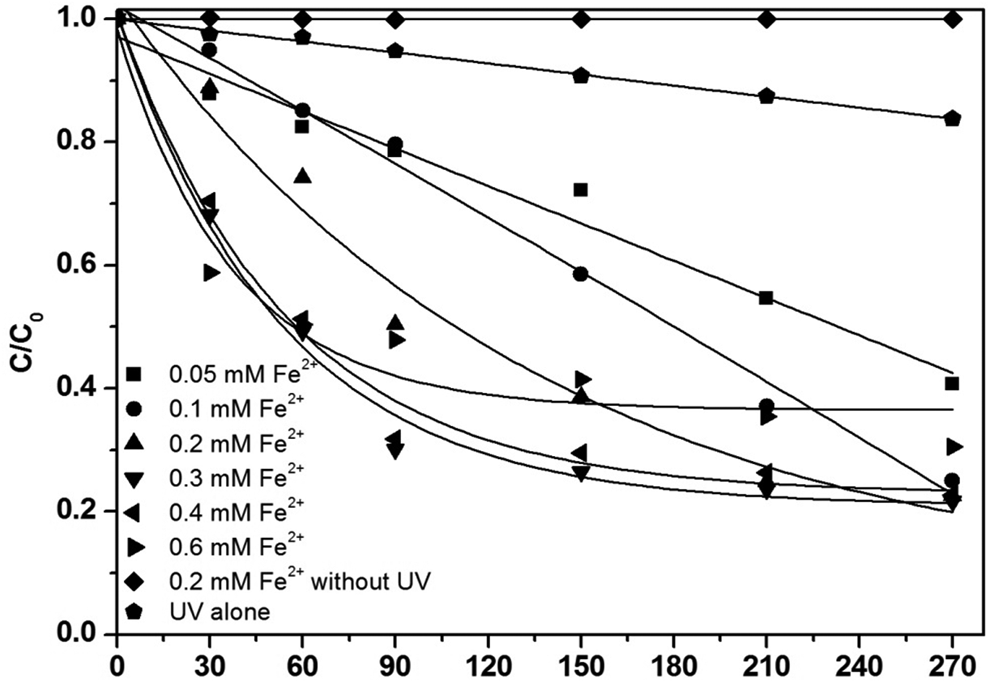
Effects of ferrous ion concentration on the degradation of clopyralid by the UV/Fe(II) process. Reaction conditions: [Clopyralid]0 = 0.1 mM, pH 4.13, 21°C.
UV/H2O2 system
To distinguish between the clopyralid degradation efficiencies by UV/Fenton and UV/H2O2, at the premise of without containing ferrous ion, a series of experiments were performed by varying the H2O2 concentration from 0.1 to 0.4 mM. As shown in Fig. 2, the degradation rate increases with the increase of H2O2 dosage. When the concentration of H2O2 was 0.4 mM, clopyralid was completely degraded after 210 min in the UV/H2O2 system. The primary and principal step for UV/H2O2 degradation has been postulated as the initial attack by UV photons and the formation of ·OH radicals [reaction (8)]. The ·OH radical was able to oxidize organic compounds by hydrogen abstraction [reaction (1)]. At the same time, higher the concentration of hydrogen peroxide, the more hydroxyl radicals were generated. However, excessive hydrogen peroxide would impede the hydroxyl radicals reacting with target compounds because of the scavenging effect of H2O2 [reaction (10)] and the self-quenching of hydroxyl radicals [reaction (11)] (Buxton et al., 1988). However, aforesaid interfering reactions did not happen in the present study. This might be because the concentration of clopyralid was too low relative to the concentration of hydrogen peroxide. As a consequence, all the clopyralid molecules were destroyed by hydroxyl radicals before the scavenging effect of H2O2 and the self-quenching of ·OH radicals.
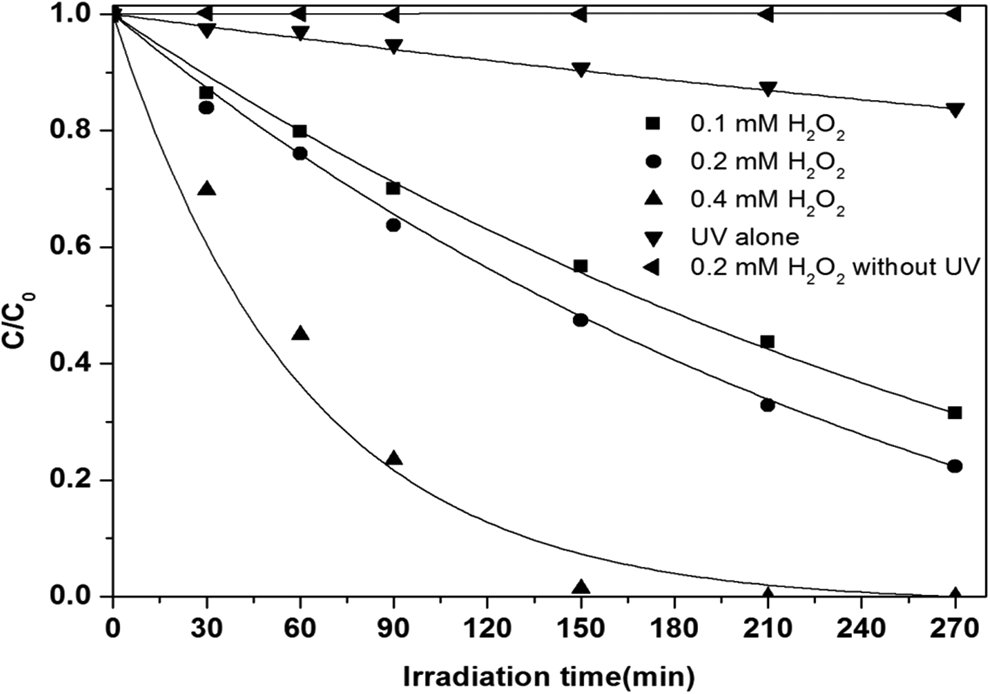
Effects of hydrogen peroxide concentration on the degradation of clopyralid by the UV/H2O2 process. Reaction conditions: [Clopyralid]0 = 0.1 mM, pH 4.13, 21°C.
UV/Fenton and Fenton processes
After preliminary investigations of UV/Fe(II) and UV/H2O2 system, the studies about UV/Fenton and Fenton processes were conducted as well.
The degradation trends were found to be significantly different at the earlier stages (Fig. 3a) and long-term stages (Fig. 3b). As shown in Fig. 3a, the degradation curve of clopyralid by Fenton process was a smooth decline, but it was almost steady in the later stage as shown in Fig. 3b. According to the Haber-Weiss mechanism [reaction (7)] (Pignatello et al., 2006; Zimbron and Reardon, 2009; Ozcan et al., 2010), this was due to the fact that the production of hydroxyl radicals has used up all the hydrogen peroxide. Thus, the degradation process of clopyralid was ceased. A similar situation was found in the UV/Fenton process; after the initial hydrogen peroxide was exhausted, the degradation process halted. Because of the presence of ferrous ion, the UV/Fenton system finally would evolve into UV/Fe(II) system. Despite the fact that the degradation rate decreased with the increase of time, it was still noted that the degradation effect of clopyralid was vastly enhanced by UV irradiation combined with hydrogen peroxide and ferrous ion. Only if enough H2O2 concentration and sufficient reaction time were provided, the vast majority of the organic compounds may be finally transformed into CO2 and H2O (Alfano et al., 2001). The main reason for employing the UV/Fenton process to degrade organic pollutant was that the degradation rate would be raised substantially compared to the UV/H2O2 and UV/Fe(II) system, therefore, it could save much reaction time and reduce electrical consumption. When compared to the Fenton process, except for a slight increase of the degradation rate caused by the direct photolysis of UV, a photosensitization of ferric ion would produce more hydroxyl radicals and a conversion of ferric ions to ferrous ions [reaction (12)] during the UV/Fenton process (Chen and Pignatello, 1997). These ferrous ions could react with H2O2 [reaction (7)] to generate more ·OH radicals.
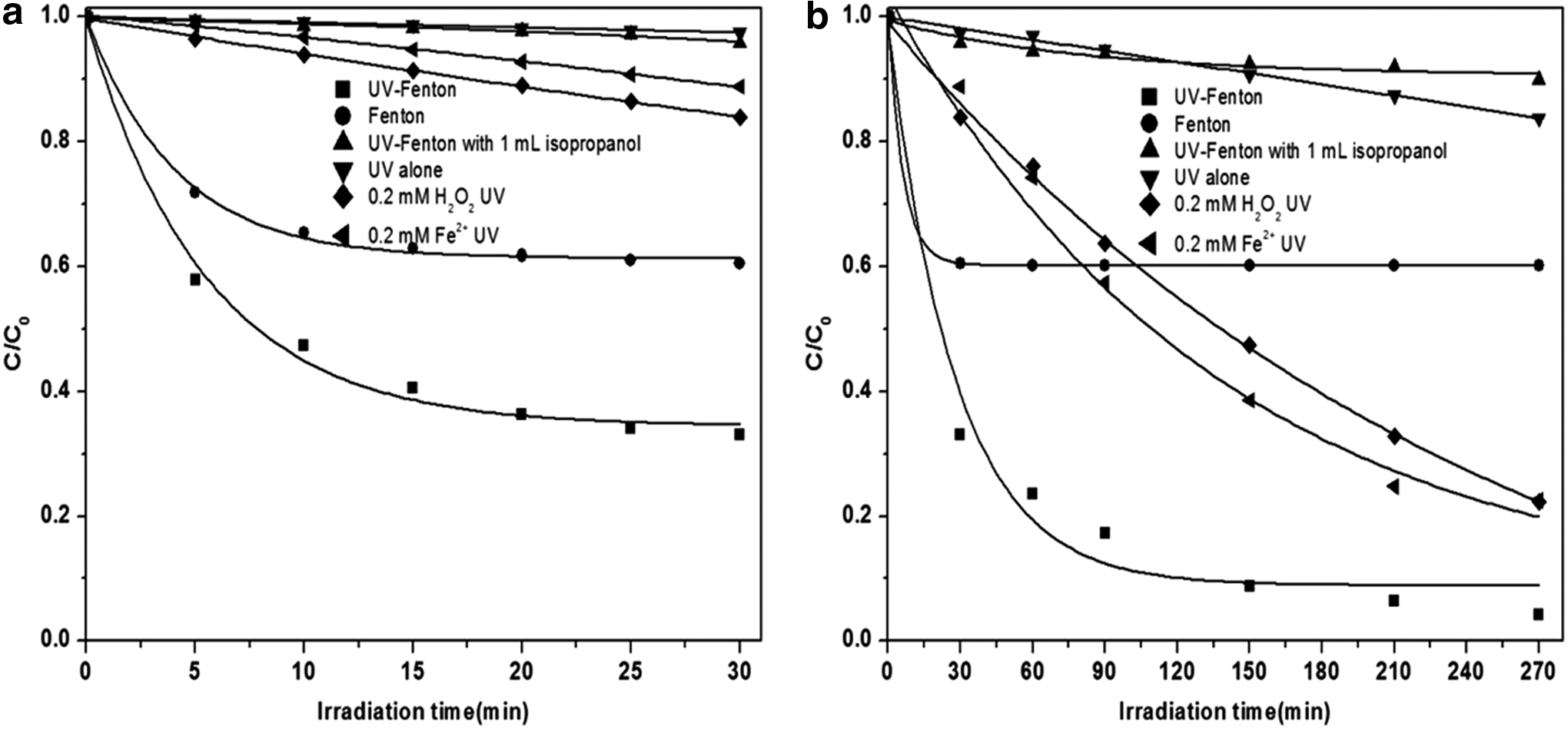
Moreover, to clarify the dominant role of ·OH radicals during the UV/Fenton process, 1 mL isopropanol was added into clopyralid aqueous solutions to play the role of ·OH radical scavenger. It was found that the clopyralid degradation rate by the UV/Fenton process with isopropanol downgraded to the level of UV irradiation alone. The results indicated that ·OH radicals were the pivotal factors in the degradation of clopyralid by the UV/Fenton process.
Estimation of half-life and electrical energy consumption
To quantitatively investigate the degradation rate of clopyralid, the degradation kinetics was simulated by plotting the ln(C0/C) versus irradiation time. The results showed that all the degradation processes followed the pseudo-first-order reaction model, and the correlative reaction rate constants are listed in Table 2. Rate constants were calculated to deduce some parameters about the degradation efficiencies of various AOTs methods, such as T1/2 and EEO. T1/2 was the half-life of clopyralid under various treatment methods, which was calculated according to the following equation:
All the data used for calculating the rate constants of Fenton (UV/Fenton) process were taken from the initial period (15 min) of the degradation course. Because the Fenton (UV/Fenton) process is based on the existence of H2O2 and Fe2+, when the irradiation time was more than 15 min, H2O2 almost was used up.
T1/2: Half-life of clopyralid under different advanced oxidation technologies.
Parameters for calculating EEO are as following: P–300 W. T - Duration time when the clopyralid concentration decreased to 10% of initial concentration. V − 50 mL. Ci−19.2 mg/L.
The parameters in Table 2 illustrate that the T1/2 of clopyralid was the shortest among all these processes when it was treated by the UV/Fenton process. During the UV irradiation process, lots of electrical energy would be consumed. To better understand the electrical cost of different processes, EEO (electrical energy per order, kWh·m−3·order−1) was used to compare their energy consumption. According to the proposal of Photochemistry Commission of International Union of Pure and Applied Chemistry (IUPAC), at the situation of organic concentration lower than 100 mg/L, the energy consumption of UV-based AOTs can be measured with the EEO, which is defined as the number of kWh of electrical energy required to reduce the concentration of a pollutant by one order of magnitude (90%) in 1 m3 of contaminated water or air (Bolton et al., 2001; Kasiri and Khataee, 2011; Tan et al., 2013). EEO could be calculated using current kinetic results by the following equation (Tan et al., 2013).
Where, P is the UV lamp rated power (W); T is the irradiation time (min); V is the volume of the treated water (L); Ci and Cf are the initial and final clopyralid concentrations (mM); and k is the pseudo-first-order rate constant (min−1) for the decay of the pollutant concentration.
EEO values for UV/H2O2, UV/Fe(II), and UV/Fenton processes are also listed in Table 2. It is noted that smaller the EEO value, the better economical the process is. Thus, compared with other processes, the UV/Fenton process uses less electrical energy. The result was instructive for selecting the appropriate way to reduce cost in industrial treatment. If the cost of the electricity, in Shanghai, is 0.1539 $ per kWh for industrial electricity, the contribution to treatment cost from electrical energy will be 989.30 and 10.15$ per m3 for degradation treatment of clopyralid by UV alone and UV/Fenton processes, respectively. In the meantime, the cost for UV lamp replacement was also needed to be taken into cost accounting. Thus, the UV/Fenton exhibits a competitive advantage in energy conservation.
Parameter optimization of UV/Fenton process
Many researchers suggested that an optimum operating condition could enhance the degradation efficiency through the UV/Fenton process (Kiwi et al., 1994; Xu et al., 2009; Karci et al., 2013; Khan et al., 2013; Affam et al., 2014). Usually, the pH and mole–mass ratio of hydrogen peroxide to ferrous ion are important factors exhibiting obvious influences on the degradation.
pH value
The effects of pH on the degradation of organic compounds were investigated previously (Kim et al., 2008; Ozcan et al., 2010; Li et al., 2014), which indicated that an acidic condition was suitable for the Fenton system. To acquire an accurate pH condition, which was beneficial to enhance the degradation efficiency of clopyralid by the UV/Fenton process, the pH values of solutions ranging 2.04–10.07 were studied. As depicted in Fig. 4, the fastest degradation of clopyralid was achieved at pH 3.04 and 4.13, either an increase or decrease of pH value leads to the decrease of degradation rate. First, the lifetime of H2O2 is highly affected by pH, and the acidic condition contributes to prolonging the reactivity of H2O2 (Jung et al., 2009). The self-decomposition of H2O2 [reaction (15)] in alkaline conditions would lead to the decrease of ·OH radical formation (Aleboyeh et al., 2005). Second, in alkaline solution, ferrous ion would form ferric oxyhydroxide precipitation, which could obstruct the reaction of Fe3+ with H2O2 to regenerate Fe2+ (Lin and Lo, 1997); this situation was experimentally confirmed by the presence of turbidity in the experiments carried out at pH 10.07. On the other hand, when the pH decreased further, the relatively high concentration of H+ played a role of radical scavengers (Tang and Huang, 1996) and the production rate of hydroxyl radical was retardant at a very low pH (Gallard et al., 1998). The degradation rates were almost the same at pH 3.04 and 4.13, but the natural pH of 0.1 mM clopyralid aqueous solutions prepared with deionized water was 4.13; in view of simplifying the experimental procedure, pH 4.13 was selected to be the optimized pH value. Therefore, all the following experiments were conducted in the situation without adjusting the pH of the initial solutions.
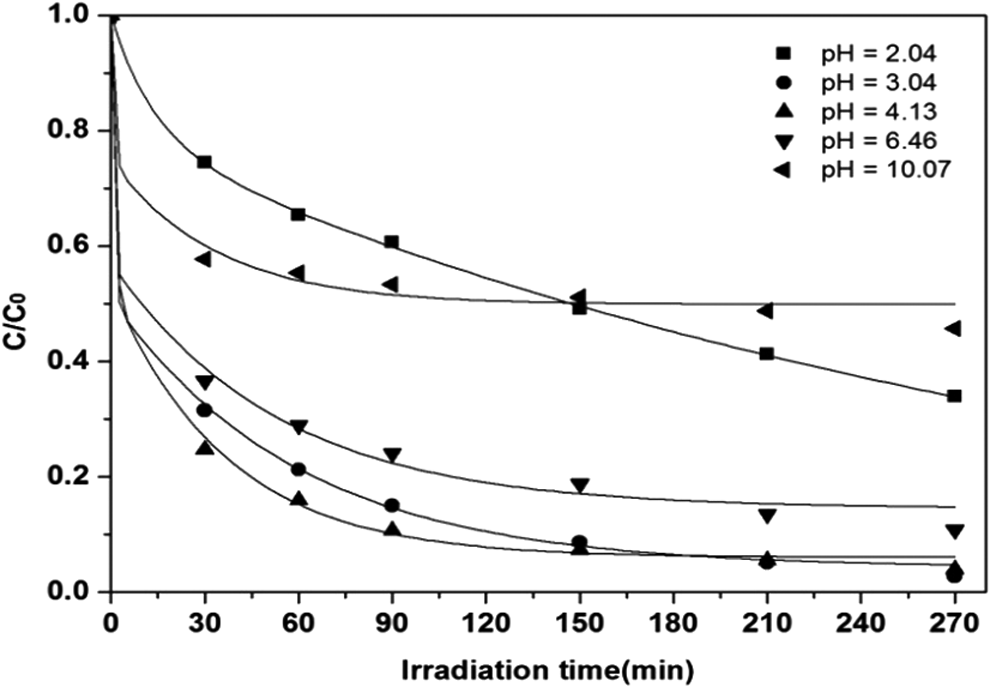
Effects of pH value on degradation of clopyralid by the UV/Fenton process. Reaction conditions: [Clopyralid]0 = 0.1 mM, [Fe2+] = 0.2 mM, [H2O2] = 0.2 mM, 21°C.
The mole–mass ratio of H2O2 to Fe2+
Although the degradation rate of clopyralid was enhanced by the UV/Fenton process as shown in Fig. 3X, however, complete degradation was not achieved after 270 min irradiation with the mole–mass ratio of hydrogen peroxide to ferrous adjusted as 1:1 (0.2 mM:0.2 mM). The dosage of oxidant was not enough with such an additive amount, thus, the quantity of hydrogen radicals was insufficient to destroy all the target compounds. For achieving an absolute degradation, a higher concentration of hydrogen peroxide was required. Therefore, gradient concentrations of H2O2 were added into the clopyralid aqueous solutions to verify the above consideration. When the concentration of ferrous ion was fixed, the degradation rate of clopyralid increased with the increase of H2O2 additive amounts (as shown in Fig. 5). However, an opposite tendency reflected in the effects of ferrous ion concentration on the degradation of clopyralid by the UV/Fenton process. When the concentration of ferrous ion was increased, the degradation rate of clopyralid declined, as shown in Fig. 6. It was due to the competitive reaction (9) mentioned above. As a result, the optimum mole–mass ratio of hydrogen peroxide to ferrous ion was 4:1 (0.4 mM:0.1 mM) under the experimental conditions used.
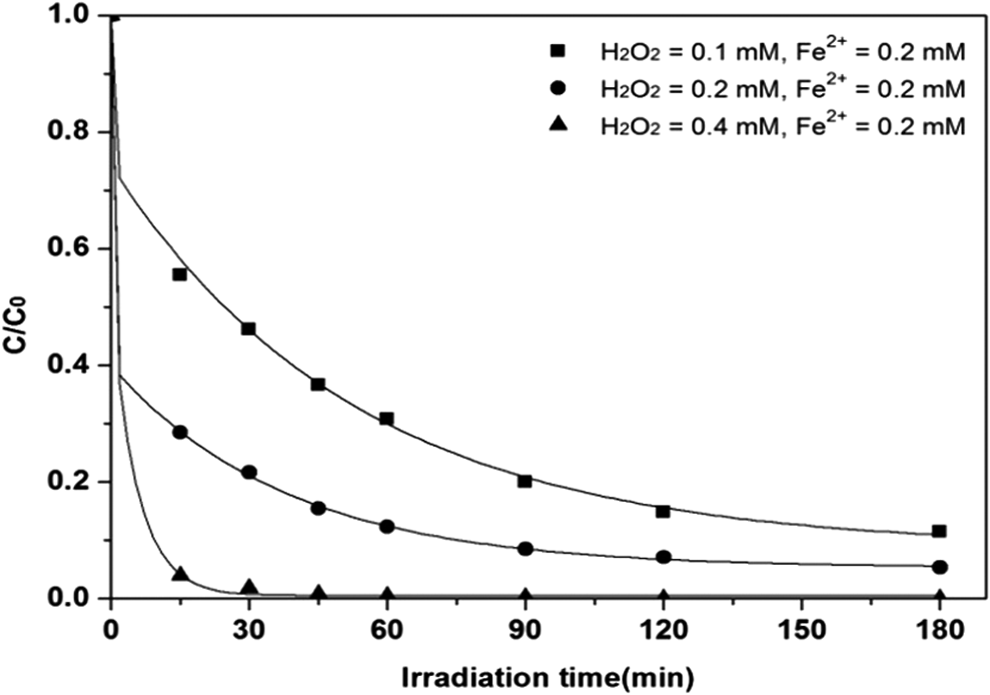
Effects of hydrogen peroxide concentration on degradation of clopyralid by the UV/Fenton process. Reaction conditions: [Clopyralid]0 = 0.1 mM, pH 4.13, 21°C.

Effects of ferrous ion concentration on degradation of clopyralid by the UV/Fenton process. Reaction conditions: [Clopyralid]0 = 0.1 mM, pH 4.13, 21°C.
Variation of COD during UV/Fenton process
COD determines the amount of oxygen required to oxidize an organic matter and inorganic compounds using strong oxidizing agent such as K2Cr2O7 for a few hours. Herein, COD indirectly analyzes the amount of organic compounds present in the homogeneous aqueous solution and its change reflects the improvement of the water quality during the UV/Fenton process.
The COD of clopyralid aqueous solutions was found to be a smooth decline as illustrated in Fig. 7. After a 3-h treatment, the value of COD decreased from 250 mg O2 L−1 to 82.7 mg O2 L−1. According to the results, a complete mineralization of highly concentrated clopyralid aqueous solutions could be achieved by prolonging the reaction time and providing more oxidant. Some probable reasons for explaining why the COD did not decrease to a very low level after the 3-h UV/Fenton treatment were that a relatively high concentration of ferrous ions existed in the solutions due to reaction (12). Excessive ferrous ions would be oxidized by K2Cr2O7, and the generated short-chain acids and trace residual H2O2 would increase the COD tested. Hence, a higher COD value was measured than the actual value referring to clopyralid concentration.
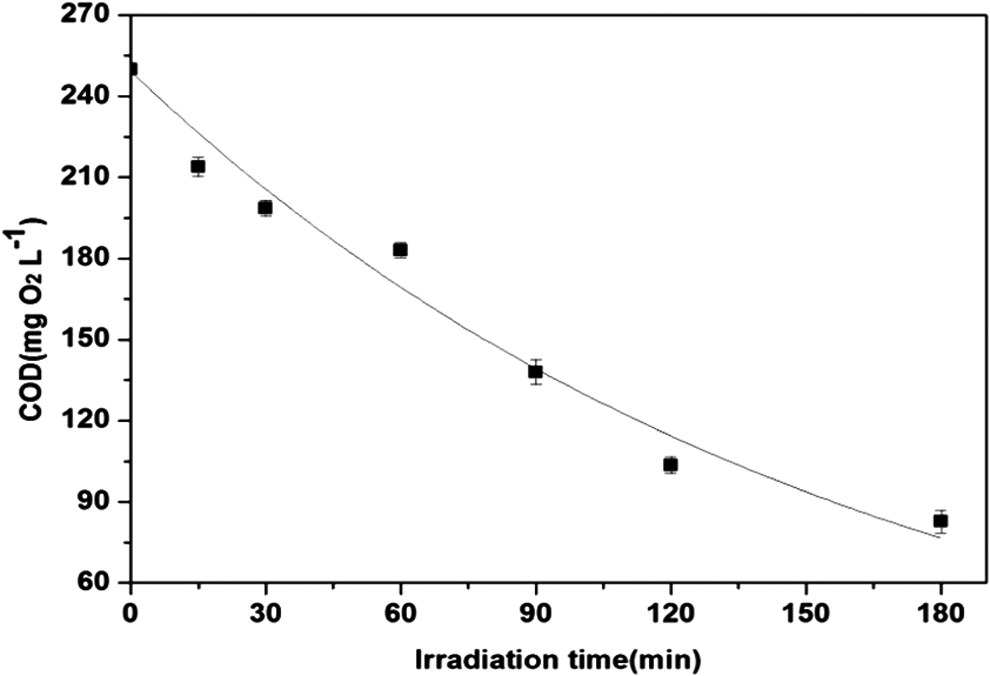
Time-course of chemical oxygen demand contents of 2 mM aqueous clopyralid solutions during the UV/Fenton process. Reaction conditions: [H2O2] = 8 mM, [Fe2+] = 2 mM, pH 2.93(without adjustment), 21°C.
To systematically investigate the mineralization of clopyralid aqueous solutions during the UV/Fenton process, some other approaches should be carried out as well, for instance, the toxicological studies of intermediates, TOC, BOD5, et al. These investigations should be conducted in the future.
Analyses of the low molecular intermediates
A complete mineralization of organic compounds finally leads to the generation of inorganic ions, CO2 and H2O, but some organic acids would be formed as intermediates during the mineralization process. Therefore, IC was used to determine the concentrations of inorganic ions and short-chain carboxylic acids.
The release of chloride ion from pyridine ring with irradiation time is illustrated in Fig. 8. Under the UV/Fenton process, the concentration of Cl− increased rapidly and reached the maximum value of 7.2 mg/L after 150 min. This result indicated that all of the organic chlorine on the clopyralid structure was broken away from the pyridine ring. On the contrary, direct photolysis of clopyralid through UV can hardly initiate dechlorination in this case. Comparing the dechlorination rate of UV/Fenton process to other approaches, it was obvious that the UV/Fenton process presents the highest efficiency.
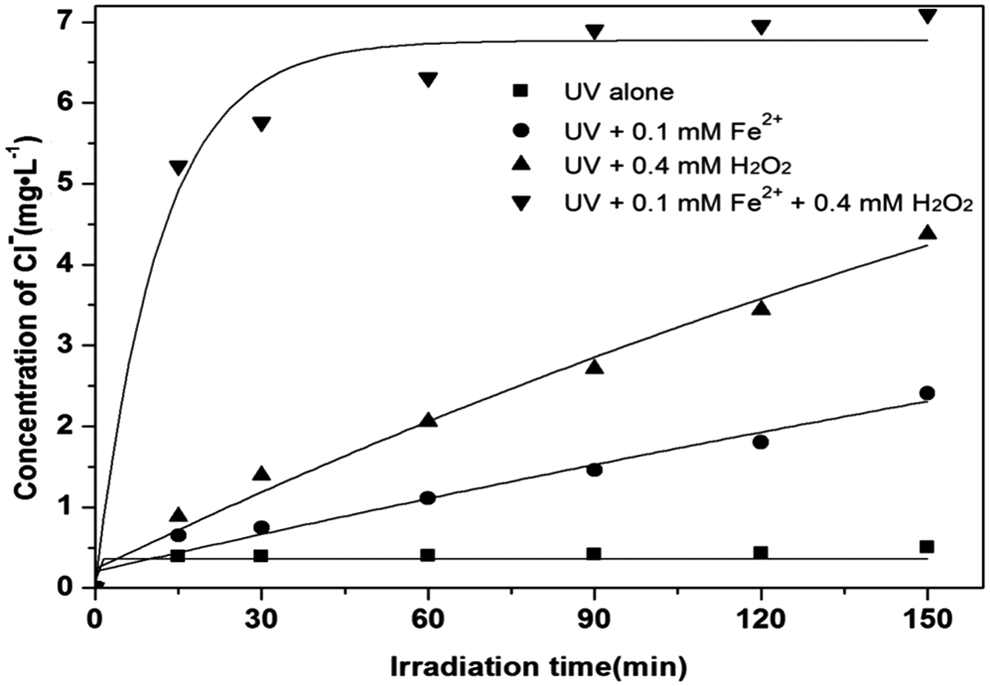
Time-course of chloridion concentration in clopyralid aqueous solutions during four degradation processes. Reaction conditions: [Clopyralid]0 = 0.1 mM, pH 4.13, 21°C.
To study the whereabouts of nitrogen atoms, three typical nitrogen compounds, ammonium, nitrate, and nitrite were determined. As seen from Fig. 9, the concentration of ammonium was 1.79 mg/L after 6 h of irradiation, implying that the nitrogen that existed in the form of ammonium almost accounted for 99% of the initial nitrogen. Coincidentally, only traces of nitrite and nitrate were detected in irradiated solutions. Therefore, it could be conjectured that the organic nitrogen mineralization was mostly achieved. Because of lack of enough oxidant, NH4+ had not been oxidized into NO3− (Malato et al., 2003).

Time-course of intermediates and products during the UV/Fenton process. Reaction conditions: [Clopyralid]0 = 0.1 mM, [Fe2+] = 0.1 mM, [H2O2] = 0.4 mM, pH 4.13, 21°C.
Besides, some short-chain carboxylic acids, such as formic acid, acetic acid, oxalic acid, were detectable during the UV/Fenton process. Formic acid was found to be the predominant organic acid intermediate whose concentration was 2.1 mg/L at 60-min irradiation. According to Fig. 9, formic acid could be decomposed gradually along with the irradiation time. All the oxalic acid was completely mineralized after 300 min of treatment, but the concentration of acetic acid seems to be steady under the present experimental condition. It may be due to the contribution of the strong C-C bond, which is likely greater than for oxalic acid and does not exist for formic acid. A similar result about the persistence of acetic acid was observed in the treatment of clopyralid by the UV/H2O2 process (Xu et al., 2013).
Conclusions
Degradation of clopyralid by direct UV, UV/Fe(II), and UV/H2O2 processes was investigated and contrasted with the UV/Fenton process. Results showed that the UV/Fenton presents the best degradation and energy efficiency for clopyralid degradation comparing with other AOTs. No obvious degradation was found in the sample solutions which added 1 mL isopropanol, implying that ·OH radical was the main factor during the UV/Fenton degradation process. The reaction rate constant of UV/Fenton process was higher than other methods at the same experimental conditions. Moreover, cost accounting for electrical energy among various AOTs demonstrated that UV/Fenton exhibited the most energy savings.
A complete degradation of clopyralid through the UV/Fenton process was achieved after 1 h UV irradiation with the optimal experimental condition, which was the pH of initial clopyralid aqueous solutions at 4.13 and the mole–mass ratio of hydroxyl peroxide to ferrous ion adjusted as 0.4 mM:0.1 mM. The COD analysis was used to check the improvement of the aqueous quality, and the results indicated that a significant decrease of the COD value was achieved. However, it may be due to the existence of ferrous ions that the final COD did not decrease to a very low level. The concentration of inorganic ions and short-chain carboxylic acids was detected by IC to evaluate the mineralization degree during the degradation course; the results indicated that a complete mineralization was realized for chlorine and nitrogen.
Footnotes
Acknowledgments
The authors thank the National Natural Science Foundation of China (Nos. 11025526, 11175112, 41430644, 11305099, and 41573096) and the Program for Innovative Research Team in University (No. IRT13078) for their financial support.
Author Disclosure Statement
No competing financial interests exist.