




Abstract
Abstract
Prior research has established that pyrolysis temperature during charcoal production is the primary variable influencing adsorption capacity. The first objective of this work was to monitor thermal conditions during charcoal production within three common traditional kiln models. Then, a programmable laboratory furnace pyrolyzer was used to generate chars from eucalyptus, pine, and longan woods and bamboo under a similar range of thermal conditions as identified in the field study. Using chars produced from the furnace, the second objective of this study was to investigate the influence of biomass feedstock and grain size, peak pyrolysis temperature, and duration of thermal treatment on 2,4-D herbicide sorption capacity. A third objective was to determine if chars produced in the laboratory furnace using thermal profiles similar to those observed in the horizontal drum kiln would exhibit similar adsorbent characteristics to kiln charcoals. Field observations revealed significant variability in temperature profiles during pyrolysis in traditional charcoal kilns, and laboratory experiments indicated corresponding variability in equilibrium 2,4-D uptake from surface water ranging from virtually no adsorption to around 10% of the adsorption capacity of commercial activated carbon. Increasing pyrolysis temperature or duration increased 2,4-D adsorption capacity, whereas feedstock did not affect adsorption capacity for the materials studied. Similar herbicide adsorption capacity was observed for furnace chars and kiln charcoals generated using similar thermal profiles. The difficulty of achieving precise temperature control with traditional charcoal production systems contributes to wide thermal variability within and between batches, which translates to wide variability in adsorption of organic compounds.
Introduction
A
Biomass chars such as charcoals produced from traditional kiln systems are promising carbonaceous adsorbents for the removal of organic micropollutants from drinking water in resource-poor areas of the world. The production of charcoal using small-scale traditional kilns is a long-standing and widespread practice. This is particularly the case throughout Africa, Asia, and South America where the charcoal sector employs millions of people (Mwampamba et al., 2013). Charcoal constitutes the primary urban fuel in many developing countries and in Africa in particular (Pennise et al., 2001; UNDP/UNEP, 2009). A broad fuel switch from firewood to charcoal is occurring today in many developing countries driven by rapid urbanization, providing 50–80% of urban household cooking energy (Mwampamba et al., 2013). The United Nations Food and Agriculture Organization (UN-FAO, 2015) estimates that world charcoal production in 2013 (the most recent year for which data exist) was ∼50.6 million tons (Mt), having risen steadily at a rate just over 2% per year from around 16.4 Mt in 1961. Ninety-seven percent of world charcoal production takes place in tropical and developing countries, with Africa accounting for 61% of the total and Asia and South America each contributing 18% (UN-FAO, 2015).
The ubiquity of charcoal produced for use as a household cooking fuel throughout the developing world suggests that it is worthwhile to study its properties and to identify possible beneficial ancillary applications for charcoals produced from traditional kiln systems. Use of charcoal in water treatment is an ancient practice (Mason, 1918) still in use today in lesser industrialized regions. Because charcoal can exhibit adsorption properties approaching that of activated carbon, it might be effective for controlling modern synthetic organic chemical contaminants such as agrichemical and pharmaceutical residues in water (Zhang et al., 2013b; Ahmad et al., 2014; Anyika et al., 2014; Kearns et al., 2014a, 2014b, 2015; Mohan et al., 2014; Nartey and Zhao, 2014; Shimabuku et al., 2015; Tan et al., 2015; Xie et al., 2015). The development of adsorbent properties in biomass chars is primarily dependent upon peak pyrolysis temperature and, to a lesser extent, is influenced by the characteristics of the biomass precursor (Antal and Gronli, 2003; Tan et al., 2015; Xie et al., 2015). One objective of this study was to monitor the range and variability of thermal treatment typified in traditional charcoal kiln production systems. This article and accompanying Supplementary Data present novel detailed thermal observations within three common traditional kiln types during pyrolysis. A second objective of the study was to quantify the batch mode equilibrium adsorption capacity for the prevalent herbicide and trace level water contaminant, 2,4-dichlorophenoxyacetic acid (2,4-D), by chars produced from different common feedstocks using (1) a traditional kiln system and (2) a laboratory pyrolyzer programmed to model the thermal conditions within traditional kilns. The influence of biomass precursor (eucalyptus, longan, and pine woods and bamboo), peak pyrolysis temperature, and duration of thermal treatment on the capacity to adsorb 2,4-D from a surface water matrix was assessed. Additional objectives were (1) to assess the variability in adsorption capacity of charcoal samples collected from different kiln zones where temperatures can vary substantially over the course of firing and (2) to investigate the influence of feedstock grain size over a range typically used for traditional charcoal production on adsorption capacity. Field observations reported here revealed significant variability in pyrolysis conditions within traditional charcoal kilns, which translates to wide variability in adsorption of organic compounds. This variability presents challenges to utilization of traditional charcoals in engineered applications such as water and wastewater treatment where precision production control and consistency in adsorbent properties are often required. However, traditional charcoal production systems are a long-standing and widespread technology and, in some cases (i.e., rural, remote, and resource-poor settings), might provide the only feasible option for adsorbent char generation.
Materials and Methods
Traditional charcoal production: brick and mud beehive kilns, horizontal drum kiln
During December 2009–January 2010, a collaboration was undertaken with the Wood Energy Research Centre administered by the Royal Forestry Department in Saraburi Province, Thailand, to perform novel detailed thermal monitoring of prevalent traditional charcoal production systems. The charcoal production research facility at the Centre features several kiln sizes and styles broadly representative of designs employed primarily for village-scale cooking charcoal production throughout South/Southeast Asia and Japan, sub-Saharan Africa, and Brazil/Amazonia. The Centre has been the locus for research by international scholars investigating the manufacturing processes, products, and by-products of biomass fuels (Smith et al., 1999). A previous study (Smith et al., 1999) spot measured temperature of gases emerging from kilns at a sampling port, but did not conduct continuous in situ temperature measurements in spatial zones within kilns during charcoaling as presented here.
Photographs and dimensional schematics of the beehive-style traditional kilns made from brick and mud used in this study are provided in Supplementary Fig. S1. Detailed textual description of kiln operation is provided in Supplementary Data. Briefly, during the study period, two charcoaling runs were completed with the brick beehive kiln, and one charcoaling run was completed with the mud beehive kiln. Both kilns were loaded with large pieces (12–20 cm diameter, 80–100 cm long) of eucalyptus roundwood and fired by combusting split eucalyptus logs. High temperature K-type thermocouple probes connected to dataloggers recording the temperature at 5-min intervals were installed at 7–10 locations throughout the kilns in upper/lower, front/rear, left/right, and center zones. The brick beehive kiln was fired for a period of 3–4 days in each case, and the mud beehive kiln was fired for around 5.5 days; kilns were then sealed with mud and allowed to cool over several days before removing the charcoal. For the two charcoal-making sessions, 260–290 kg of charcoal was produced from ∼1,000 kg of feedstock and ∼100 kg of charge wood using the brick beehive kiln. For the mud beehive kiln, 160 kg of charcoal was produced from ∼650 kg of feedstock and ∼50 kg of charge wood. This study observed firing durations about twice as long as those observed in a previous study (Smith et al., 1999) using the same type of kilns at the Wood Energy Research Centre. In both studies, however, similar mass yields of charcoal, ∼25%, were obtained (mass yield = kgcharcoal/kgfeedstock + fuelwood) (Supplementary Table S1). These values are typical of traditional kiln systems worldwide that exhibit mean wood-to-charcoal conversion of about 20% (Chidumayo and Gumbo, 2013) with ranges varying from 10% to 30% (Bailis, 2009).
The three charcoaling runs monitored during the study period were conducted by three different operators, and artisanal nuances probably exerted an influence on the process and products. Sequential charcoaling runs can vary considerably even given the same kiln and operator. Observations from this study are congruent with other researchers who found that globally there is great variability in both kiln sizes and construction methods. Furthermore, even given the same kiln type, kiln behavior is largely dependent on operator technique. This can vary greatly by locale as well as for the same operator during different sessions of making charcoal (Smith et al., 1999).
Horizontal drum kiln
A horizontal drum kiln was constructed on a private ranch in Colorado, United States, using a 200-L steel drum affixed in a rectangular housing made from earthen (mud) bricks and buried in the sand. A manifold made from threaded steel pipe nipples was inserted into the kiln to house nine K-type thermocouple probes for recording temperature in front/rear, upper/lower, left/right, and center zones within the kiln. Photographs and diagrams of kiln construction and the temperature measurement apparatus are provided in Supplementary Fig. S1. This kiln was used to generate several batches of charcoal made from eucalyptus, pine, and longan woods split to firewood size pieces (5–10 cm thickness, 30–40 cm length) and bamboo poles cut to the length of the kiln interior (∼75 cm). Feedstocks were packed into the kiln horizontally. Pine wood was combusted at the firing port of the kiln for a period of 7–8 h until the smoke turned very clear, indicating completion of feedstock carbonization—then the kiln was sealed with mud and allowed to cool overnight.
Batches yielded 7–12 kg of charcoal each; feedstock and fuelwood mass data were not obtained, but similar drum kilns are typically loaded with around 50 kg of feedstock. Based on temperature observations, one representative batch of charcoal from each feedstock was selected for further processing and analysis. Pine and eucalyptus charcoals removed from the kiln were separated into front and rear batches of approximately equal mass, whereas bamboo and longan charcoals from the front and rear of the kiln were combined into single batches. Individual batches (bamboo, longan, pine-front, pine-rear, eucalyptus-front, and eucalyptus-rear) were coarsely crushed using a jaw crusher and homogenized by hand mixing in a large tub. Composite samples of eucalyptus and pine charcoals were created by blending equal masses of the front and rear coarsely crushed charcoals. Representative samples of the coarsely crushed mixtures were taken for further characterization and adsorption testing.
Furnace char production
Temperature data from charcoal production using the three kiln models were used to develop protocols for controlled char generation using a programmable laboratory furnace (VWR Model No. 30620–106, chamber interior dimensions ∼30 × 30 × 45 cm) located at the University of Colorado-Boulder. Wood and bamboo feedstocks used in the furnace were selected from the same batches used in the horizontal drum kiln. Eucalyptus, longan, and pine woods were cut into slats (15 × 10 × 1 cm) and bamboo poles of wall thickness ∼1 cm were cut to 15 cm in length and split lengthwise. Feedstocks were then placed in a metal bin (25 × 25 × 40 cm), covered with about 15 kg of sand to exclude oxygen, and heated in a laboratory furnace over the desired temperature programs. Based on the horizontal drum kiln temperature observations, three analogous furnace protocols were developed representing high (850°C), intermediate (700°C), and low (550°C) peak temperature scenarios capturing the approximate breadth of thermal conditions achieved in the horizontal drum kiln. Feedstocks were heated to the target peak temperatures at a rate of ∼2°C/min and allowed to cool over several hours such that for ∼8 h, feedstock temperatures were above 200°C. To investigate the effect of feedstock size, one large block (15 × 10 × 10 cm) of longan wood and several small blocks (1 × 1 × 1 cm) were pyrolyzed over ∼8 h to a peak temperature of 700°C.
Based on the brick and mud beehive kiln temperature observations, one high and one low peak temperature scenario were modeled using the furnace. In the high temperature case, eucalyptus slats were slowly heated to 600°C over 3 days, held at temperature for 4 h, and allowed to cool over several hours. In the low temperature case, eucalyptus slats were slowly heated to 350°C over 4 days, held at temperature for 4 h, and allowed to cool over several hours. Due to logistical and transport constraints for obtaining representative composite samples of charcoals from the beehive kiln study in Thailand, these furnace chars were investigated as surrogates that capture the approximate breadth of best and worst-case scenarios from a pyrolysis temperature perspective for charcoal making using these kilns.
Char preparation, characterization, and batch mode adsorption testing
All furnace and horizontal drum chars were ground by hand with a mortar and pestle to pass a US standard 200-mesh sieve (0.074 mm) and dried overnight at 105°C before characterization and batch experiments. To measure ash content, around 1 g of each char was accurately weighed in a prewashed ceramic crucible and combusted at 550°C for 6 h, cooled to room temperature in a desiccator, and reweighed. Reported values are averages taken of triplicate measurements for each char sample. Elemental (C, N, H) analyses of each char sample were completed by the Analytical Services Laboratory at North Carolina State University using a CHN Elemental Analyzer (Perkin-Elmer model 2400) calibrated with an acetanilide standard. A reference coal (NIST, 1632c standard reference material trace elements in coal–bituminous) was included as a calibration standard. Oxygen content of each sample was estimated as the remainder of mass after subtraction of C, N, H, and ash components. BET (Brunauer, Emmett, and Teller) surface areas were determined at the USGS Federal Center (Denver, CO) from N2 gas adsorption using a Micromeritics Gemini 2360 surface area analyzer.
2,4-Dichlorophenoxyacetic acid (2,4-D) was chosen as a target compound because of its environmental relevance as one of the most widely used herbicides worldwide and one of the most commonly detected pesticides in environmental waters (Gilliom et al., 2006; Parsons et al., 2008), as well as for its human health implications as a potential carcinogen, suspected endocrine disruptor, and toxicant to kidneys, liver, and reproductive and developmental systems (Gilliom et al., 2006; Parsons et al., 2008; PAN, 2013). 2,4-D occurs predominantly in the anionic form at typical pH values and thus is very water soluble. Batch sorption experiments were conducted with char doses ranging from 20 to 200 mg/L in simulated natural water at pH 7 (maintained throughout using 20 mM phosphate buffer: 1.6 g/L KH2PO4 and 1.1 g/L Na2HPO4) containing background dissolved organic matter (DOM) isolated from a surface water source near Big Elk Meadows, Colorado, United States. This watershed is not impacted from a standpoint of agricultural runoff or wastewater discharge. A DOM concentration of 4 mg/L total organic carbon was used and is representative of many surface waters. To determine 2,4-D herbicide uptake at environmentally relevant levels, 100 μg/L of 3H-labeled 2,4-D (American Radiolabeled Chemicals, Inc.) was introduced to the initial DOM solution matrix and later quantified by liquid scintillation counting (method detection limit 1 μg/L). The USEPA maximum contaminant level for 2,4-D in drinking water is 70 μg/L (EPA, 2009), while the WHO guideline value is 30 μg/L (WHO, 2006). All suspensions were agitated for 2 weeks to reach adsorption equilibrium (contact time to equilibrium established previously) (Kearns et al., 2014b) and filtered through prefired glass fiber membranes (1.2 μm Whatman GF/C) to remove the char before 2,4-D analysis. Identical batch tests were carried out using granular activated carbon (GAC, Norit 1240, N2 BET-specific surface area 890 m2/g, ground to <0.074 mm) and powdered activated carbon (PAC, Calgon WPH, N2 BET-specific surface area 715 m2/g, used as supplied by the manufacturer, over 90% <0.045 mm) using adsorbent doses of 2–8 mg/L. Norit 1240 GAC and Calgon WPH PAC were selected as widely used and highly effective bituminous coal-based activated carbons to provide an adsorption benchmark familiar to most activated carbon researchers for comparison of 2,4-D adsorption by kiln charcoals and furnace chars.
Results and Discussion
Thermal conditions during traditional charcoal production: brick and mud beehive kilns
Temperature series data for two charcoal-making sessions with the brick beehive kiln and one charcoal-making session with the mud beehive kiln are given in Supplementary Fig. S2 along with detailed textual interpretation in Supplementary Data. Briefly, both the brick and mud beehive kilns exhibit substantial temperature variability with upper zones reaching higher temperatures than middle zones and middle zones reaching higher temperature than lower zones. During firing, temperatures in upper and lower spatial zones varied by as much as 300–400°C. Overall, the upper zone of the kilns heated first and the thermal front proceeded downward over time during the firing period (Supplementary Fig. S2). Temperatures recorded by probes in lower zones converged with temperatures recorded in the upper zones after a few days of firing and differed by ∼100°C at the time of kiln closure.
The progress of carbonization is observed by operators as changes in smoke color and thickness over time. From an operational perspective, ideally, sufficiently high temperatures are achieved throughout the kiln before closure so that all wood is fully carbonized, as indicated by thin/clear smoke appearance. In less than ideal circumstances, sufficient temperatures are not reached throughout the kiln—particularly in the lower zone where wood is dried and partially charred, but not fully carbonized. The operator may choose to close the kiln before full carbonization is achieved to save labor time and/or fuelwood. Moisture content of the feedstock also exerts an important influence on this process (Smith et al., 1999; Pennise et al., 2001; Antal and Gronli, 2003). Another factor that contributes to thermal variability within kilns is the development and evolution of preferential flow paths during firing. The observed temperature profiles (Supplementary Fig. S2) suggest that preferential flow paths formed to channel hot air and combusting gases through the kiln, resulting in variable temperature regimes within different spatial zones. Throughout the carbonization process, as the feedstock changed in size and shape and decreased in structural integrity, shifting occurred within the kiln—this shifting is expected to alter gas flow patterns during the burn period. Timing of the accelerator opening closure, chimney arrangement, and other operator-specific nuances probably also influence gas flow patterns and heating dynamics during firing. Altogether, these phenomena could contribute to variability of temperature treatment within the kiln during a given session and between subsequent charcoaling sessions, as has been reported by other researchers (Antal and Gronli, 2003).
Thermal conditions during traditional charcoal production: horizontal drum kiln
Temperature data from charcoal generation using the horizontal drum kiln are presented in Supplementary Fig. S3. Observations indicate that the horizontal drum kiln achieves a more consistent pyrolysis environment compared with the beehive kilns (Supplementary Fig. S2) regardless of the feedstock. In each case, the firing period lasted from 6.5 to7.5 h, heating at ∼2°C/min over this period to a plateau of about 600–700°C. Firing was discontinued and the kiln sealed when the smoke virtually disappeared—this point coincided with all kiln zones heated to or above ∼500°C. The temperature data indicate that front (adjacent to the firing port) and upper zones heated first and most during firing, and rear/lower zones lagged by 200–300°C during the heating period and by 100–200°C at the peak temperature plateau. The kiln cooled rapidly when sealed so that over the course of the burn, contents were above 200°C for ∼8 h.
Characterization of kiln charcoals and furnace chars
Surface area, ash content, and elemental analysis data are presented in Fig. 1, and the raw data are provided in Supplementary Table S2. For a given feedstock, the trends of increasing surface area (Rutherford et al., 2005; Keiluweit et al., 2010), increasing C content, and decreasing H:C and O:C ratios (Spokas, 2010; Schimmelpfennig and Glaser, 2012; Enders et al., 2012) with increasing pyrolysis temperature agree with other research. In addition, for a given feedstock, as pyrolysis temperature increased, the decrease in the H:C molar ratio suggests increased char aromaticity and the decrease in the O:C and N:C ratios suggests a reduction in the amount of polar functional groups. These trends are in agreement with spectroscopy studies that indicate a significant presence of noncarbonized aliphatic organic moieties (volatile matter) in low temperature chars that are mostly or completely absent in highly aromatized high temperature chars (Chen et al., 2008; Keiluweit et al., 2010).

Carbon content
Herbicide adsorption by furnace chars and kiln charcoals
Figure 2 shows 2,4-D herbicide remaining in solution at equilibrium after contact with varying doses of bamboo, eucalyptus, longan, and pine chars generated in the laboratory furnace and composite charcoal samples taken from the horizontal drum kiln. As indicated in Fig. 2 and in agreement with other studies (Chun et al., 2004; Chen et al., 2008; Uchimiya et al., 2010; Ahmad et al., 2012; Graber et al., 2012; Uchimiya et al., 2012; Han et al., 2013; Wu et al., 2013; Zhang et al., 2013a; Zheng et al., 2013), adsorption increases with increasing pyrolysis temperature. A systematic influence of feedstock identity upon 2,4-D adsorption is not observed for the furnace chars studied here. As noted above, using traditional kiln methods, it is difficult to achieve precise and uniform temperature control within and between batches. Thus, unlike the programmable laboratory furnace, it is not feasible to compare the influence of temperature on adsorption independently using kiln charcoals.
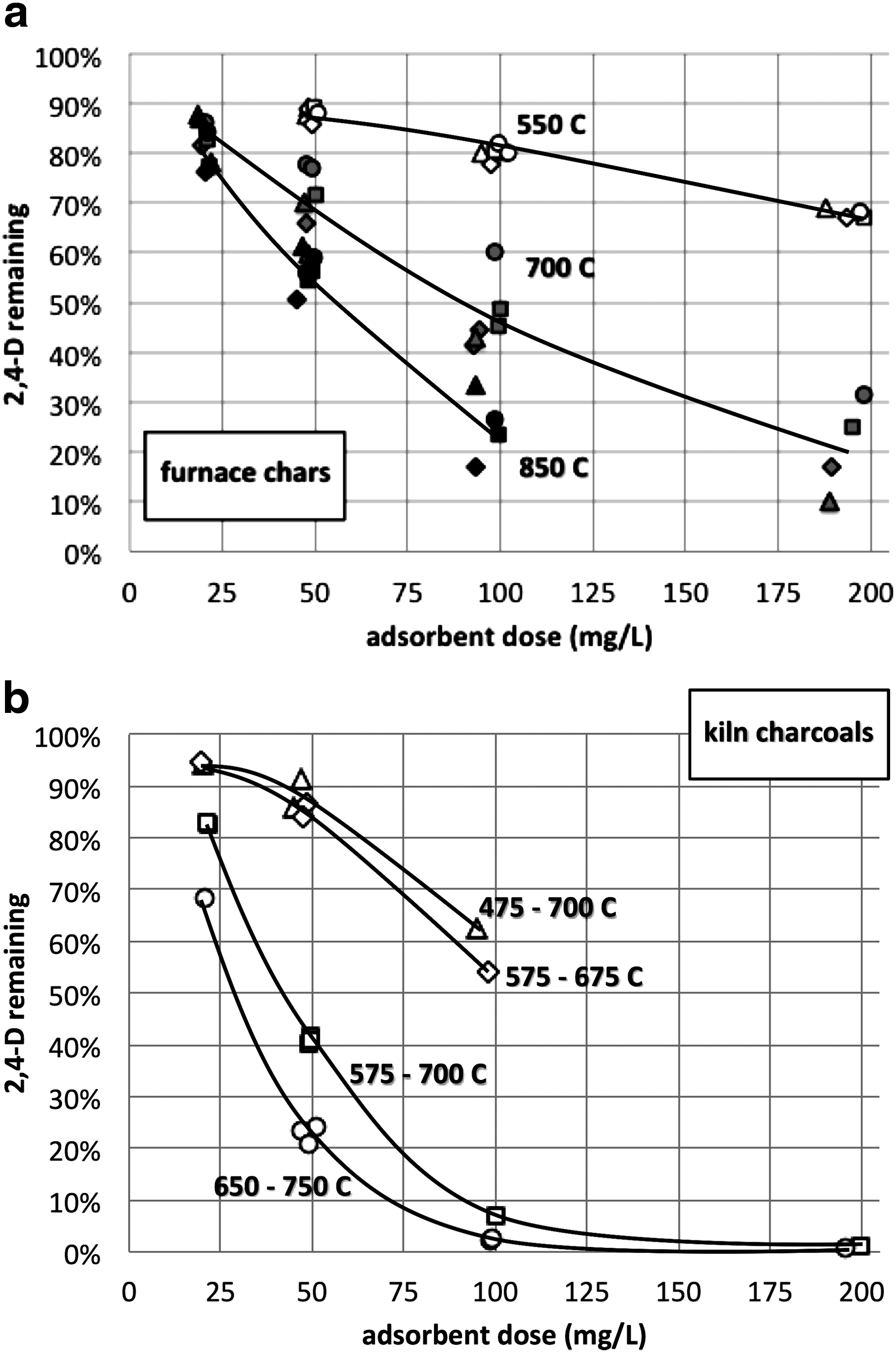
2,4-D herbicide remaining in solution at equilibrium after contact with varying doses of bamboo (diamonds), eucalyptus (circles), longan (triangles), and pine (squares) chars generated in the laboratory furnace over 8 h of heating
Figure 3 shows 2,4-D herbicide remaining in solution at equilibrium after contact with varying doses of eucalyptus chars generated in the furnace pyrolyzer over thermal regimes corresponding to the range of horizontal drum and beehive charcoal kiln peak temperatures and heating durations observed in the field study. As expected, results indicate increase in 2,4-D herbicide adsorption capacity with increasing peak temperature. Similar 2,4-D adsorption capacities are observed for the char heated to 850°C over 8 h and the char heated to 600°C over 3 days, suggesting that thermochemical kinetics play an important role in the development of char properties in this temperature range. The char made by heating to 350°C over 4 days exhibited very little 2,4-D uptake over the adsorbent dose range employed in this study, suggesting the existence of an effective thermochemical threshold below which favorable adsorption properties (e.g., microporosity) fail to develop (Kearns et al., 2014b). For most traditional charcoal production scenarios, heating for longer than several days to a week would be impractical and uneconomical. Furthermore, the 350°C char was observed to release native organic compounds into solution—for example, a char dose of 1 g/L increased the absorbance of UV light at 254 nm (UVA254) of the batch test solution from the initial level of 0.115–0.200 cm −1 at equilibrium. This release, in addition to negligible herbicide adsorption capacity, would probably preclude the use of very low temperature chars in water treatment applications. None of the other furnace chars or kiln charcoals caused an increase in UVA254 during batch tests, and the highest temperature chars decreased UVA254 by up to 25% at an adsorbent dose of 1 g/L.
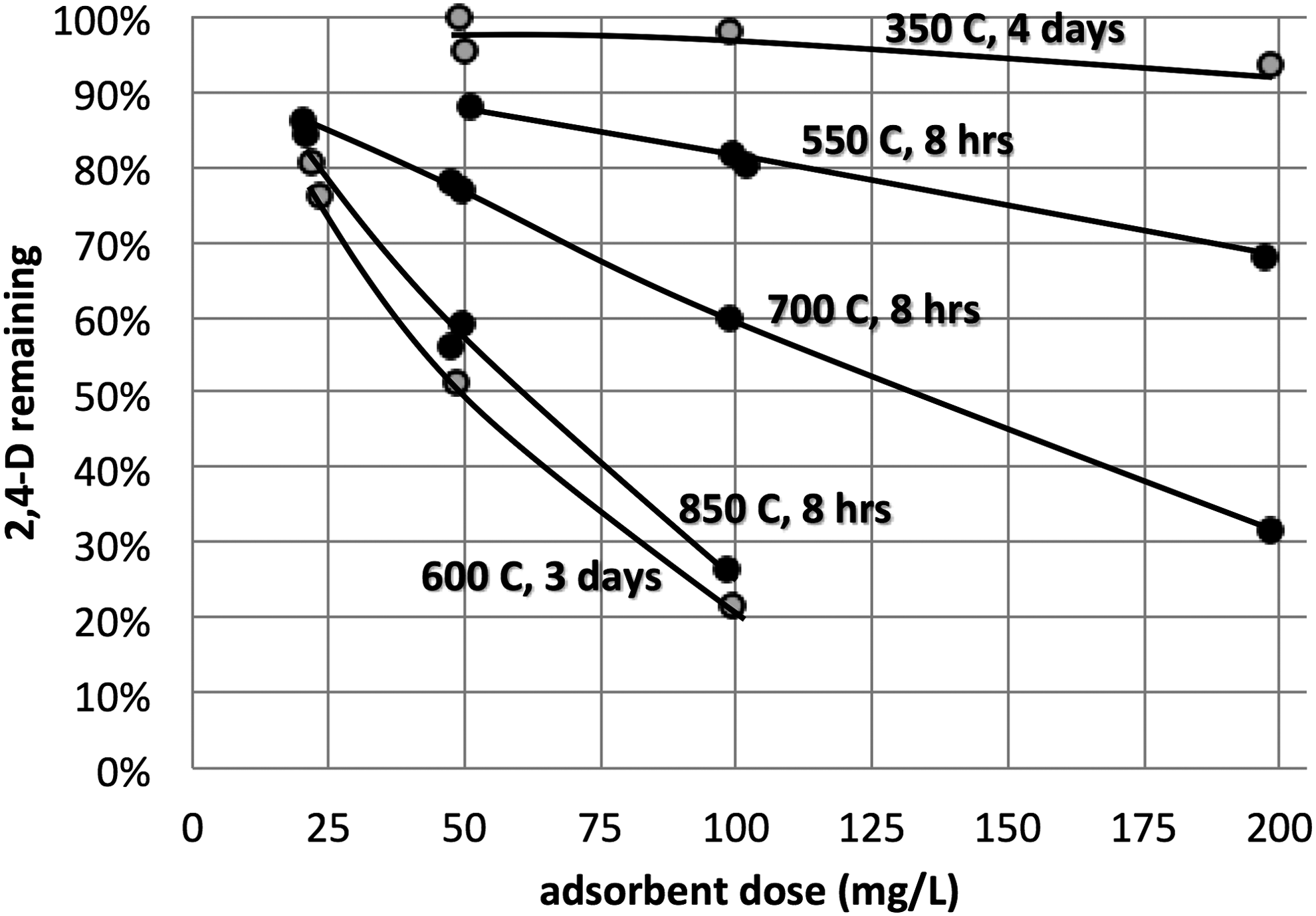
2,4-D herbicide remaining in solution at equilibrium after contact with varying doses of eucalyptus char generated in the furnace pyrolyzer.
Figures 2 and 3 indicate that for an adsorbent dose of around 100 mg/L, 2,4-D uptake ranged from negligible to ≥90%, depending upon the adsorbent. This underscores the wide variability in organic compound adsorption expected for charcoals generated by traditional kiln technologies originating from the variability in thermal treatment inherent in the design and operation of these systems.
One objective of this study was to determine if chars produced in the laboratory furnace using thermal profiles similar to those observed in the horizontal drum kiln would exhibit similar adsorbent characteristics to kiln charcoals. Data displayed in Fig. 2 indicate that furnace chars exhibited similar 2,4-D adsorption capacity to kiln charcoals generated at similar pyrolysis temperatures. However, the highest temperature kiln charcoals—made from eucalyptus and pine—exhibited moderately enhanced 2,4-D adsorption relative to furnace chars. For example, at an adsorbent dose of 50 mg/L, eucalyptus and pine kiln charcoals exhibited about twice the 2,4-D adsorption capacity of their thermally corresponding furnace chars (Fig. 2). The greater adsorption capacity of these kiln charcoal samples might be explained by a synergistic effect between elevated temperatures and the greater gas flows that can occur during kiln charcoal production in comparison with furnace char generation. In this study, furnace chars were generated from feedstocks buried in sand—conditions that inhibit the inflow of air and the exiting flow of pyrolysis gases from the feedstock. In contrast, during kiln charcoal generation, air and hot gases flowed through the kiln from the firing port and exited by the chimney. Prior research (Antal and Gronli, 2003) has established that low gas flows can provide increased opportunities for reactive volatile matter to interact with the solid carbonaceous residue of pyrolysis and to decompose on the surface of char, producing secondary char. This material has been shown to block micropores and thereby reduce micropore volume and surface area of chars (Mackay and Roberts, 1982a, 1982b; Antal and Gronli, 2003; Yamashita and Machida, 2011), which could be expected to concomitantly reduce organic compound adsorption capacity. In this study, however, the explanation that greater gas flows led to decreased secondary char formation and thereby increased adsorption capacity of eucalyptus and pine kiln charcoals can only be inferred because ratios of primary to secondary charcoal in adsorbents and the relative contributions of these carbonaceous phases to 2,4-D uptake were not quantified.
A general conclusion from this work is that furnace pyrolysis yielded chars with similar 2,4-D adsorption capacities as horizontal drum kiln charcoals generated from similar thermal profiles. This similarity is particularly apparent, for example, when comparing 2,4-D uptake by chars/charcoals with the substantially greater adsorption capacities exhibited by commercial adsorbents such as activated carbon (discussed in final section). Modest enhancement of adsorption capacity might occur under some kiln conditions where high temperatures and high gas flow co-occur; however, it may be difficult to consistently achieve this effect using traditional charcoal production systems.
Adsorption variability of kiln charcoal samples collected from different thermal zones
One objective of this study was to assess the variability in adsorption capacity of charcoal samples collected from different kiln zones where temperatures were observed to vary substantially over the course of firing. In the case of the horizontal drum kiln, thermal variability was obvious between front (nearest the fire inlet) and rear (nearest the chimney) zones (Supplementary Fig. S2). Figure 4 shows 2,4-D herbicide remaining in solution at equilibrium after contact with varying doses of pine and eucalyptus charcoals taken from the front and rear of the horizontal drum kiln. Composite samples are equal mass basis blends of front and rear charcoal samples. Charcoals from the front of the kiln (peak temperature ∼700–750°C) exhibit up to about four times greater 2,4-D adsorption capacity as charcoal from the rear (peak temperature ∼575–650°C) of the kiln. Elemental content and surface area data follow corresponding trends (Fig. 1 and Supplementary Table S2). Thus, the horizontal drum kiln exhibits a moderate to high degree of within batch variability of thermal treatment and consequent charcoal properties influencing adsorption. 2,4-D adsorption by composite samples appears to be dominated by the presence of the higher adsorbing charcoal generated in the front of the kiln.

2,4-D herbicide remaining in solution at equilibrium after contact with varying doses of pine
Feedstock size influence on adsorption variability
Other objectives of this study were to assess the variability in adsorption capacity (1) within one large piece of char and (2) between chars made from large versus small feedstock pieces. In this study, large indicates the size on the order of whole or split logs (tens of cm in all dimensions), as opposed to small or chopped feedstocks (one to a few cm in any dimension). In this study, it was hypothesized that the large feedstock pieces (very often, whole logs) used in traditional charcoal manufacture might exert a retarding effect on heat and mass transfer during pyrolysis that would influence adsorption characteristics of the product. Indeed, the process of GAC often involves crushing the feedstock before carbonization and activation to improve heat and mass transfer thermochemistry (Summers et al., 2011). Furthermore, a review of the literature (Antal and Gronli, 2003) showed that the use of thicker charcoaling feedstocks results in a greater extent of secondary char formation (and thus reduced microporosity and diminished capacity for adsorption of organics as discussed above) due to hindered escape of volatiles during pyrolysis relative to finer-grained feedstock materials. Figure 5 shows 2,4-D herbicide remaining in solution at equilibrium after contact with longan chars made in the furnace pyrolyzer from a large feedstock block (10 × 10 ×15 cm)—both a representative composite sample of this material (large) and a sample taken from the central interior of the pyrolyzed block (interior). Figure 5 also shows 2,4-D adsorption by char made from small (1 × 1 × 1 cm) longan blocks (small). The data in Fig. 5 indicate a modest enhancement in herbicide adsorption capacity using the smaller feedstock pieces and that the adsorption capacity of a representative composite of the large feedstock char is influenced by the presence of the slightly higher capacity exterior surface char. These results suggest that a modest amount of variability in organic adsorption capacity can be expected from charcoals produced by traditional means that employ varying, but predominantly thick (several cm to a few tens of cm in diameter), feedstocks.
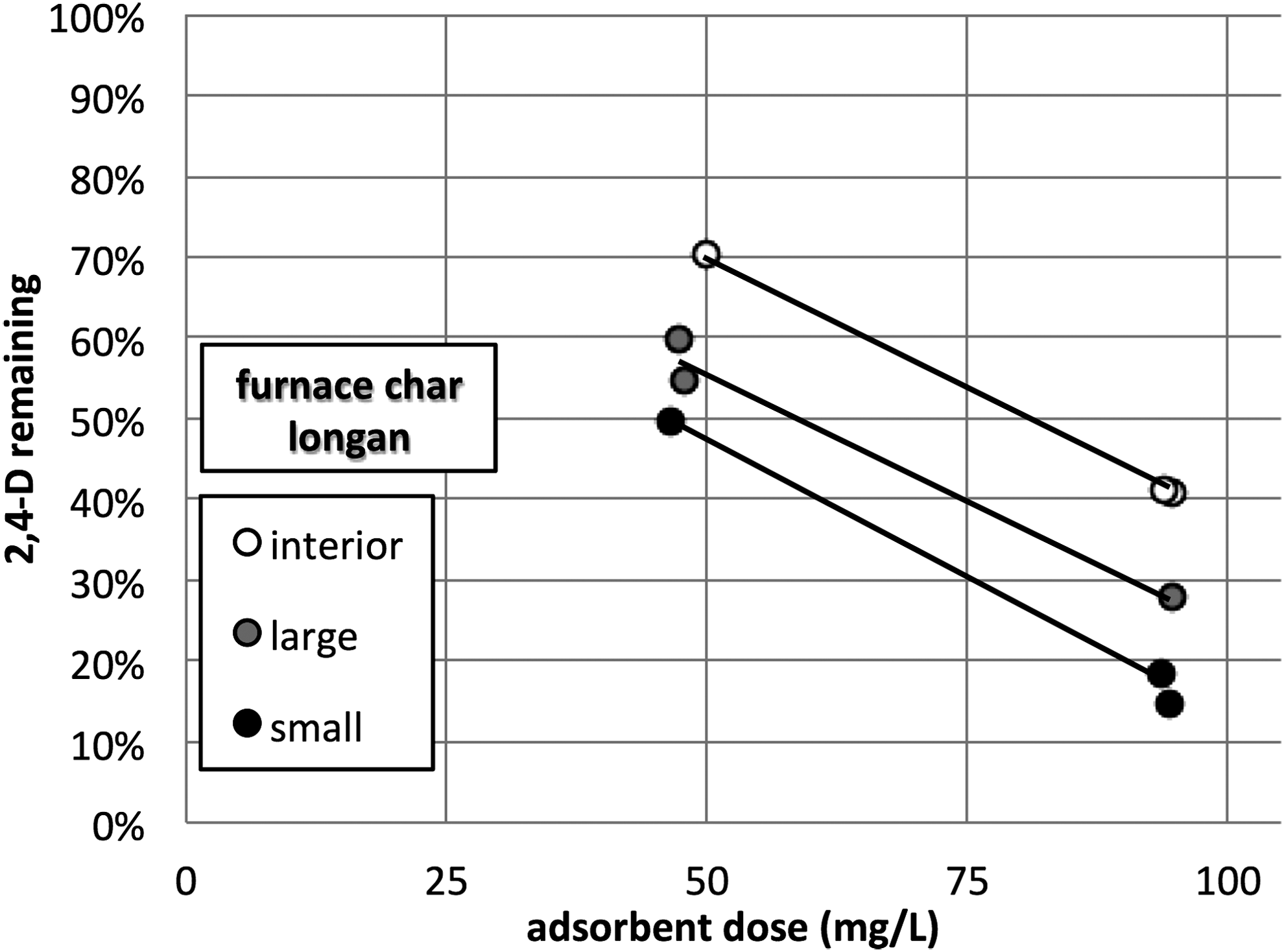
2,4-D herbicide remaining in solution at equilibrium after contact with varying doses of longan chars generated from large and small feedstock pieces in the furnace pyrolyzer.
Charcoal adsorbent efficacy in comparison with activated carbon
Figure 6 displays equilibrium solid-phase concentrations (qe, mg/g) of 2,4-D as a function of equilibrium liquid-phase concentration (Ce, mg/L) for kiln charcoals, furnace chars, and PAC and GAC. Figure 6 illustrates that the furnace char generation protocol developed here using similar heating profiles (i.e., peak temperature and duration of heating) observed for traditional kiln systems provided a relatively close indicator of the magnitude and range of 2,4-D adsorption performance observed for traditional charcoals, particularly when compared with optimum commercial adsorbents such as AC.
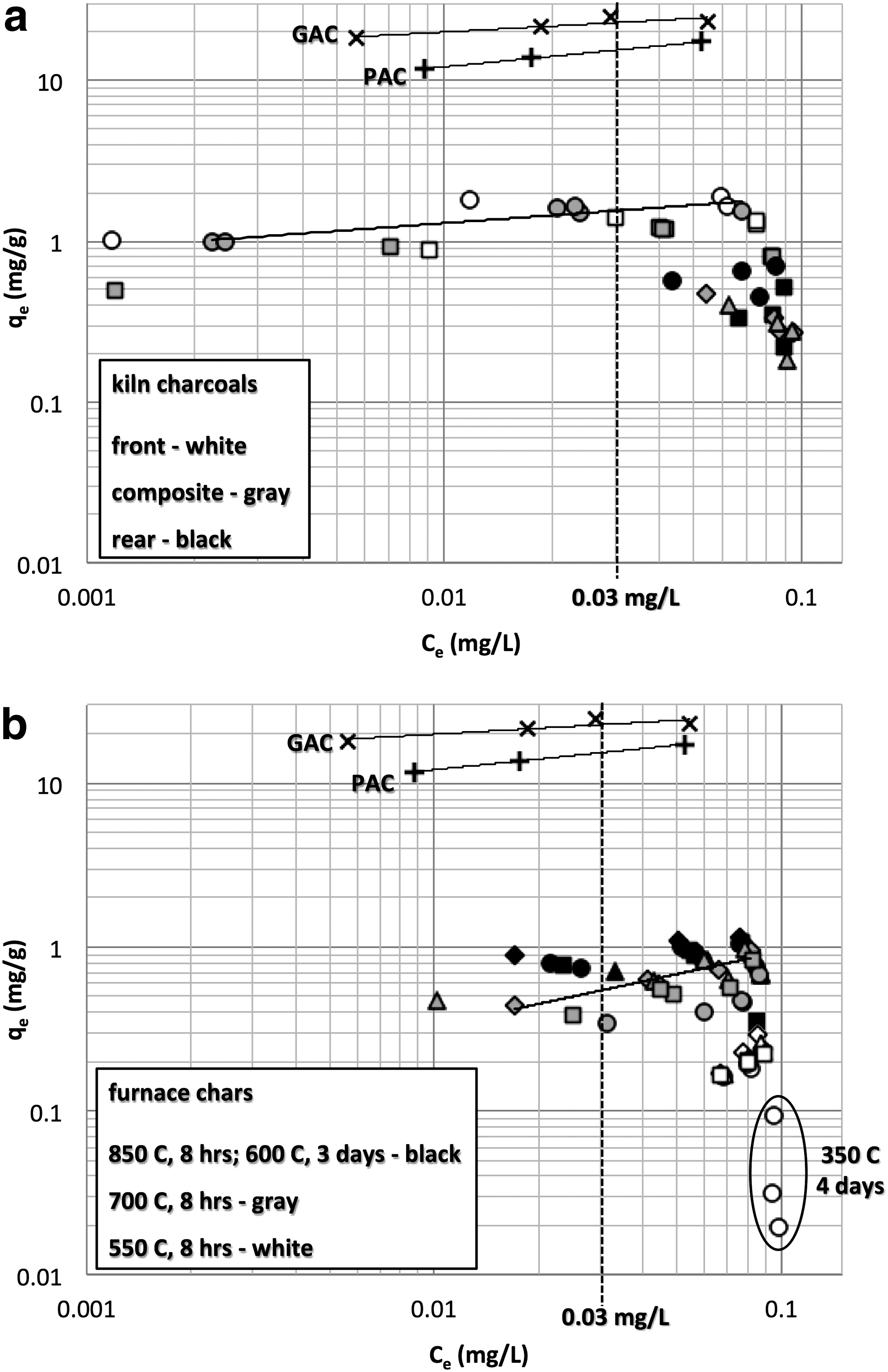
Equilibrium solid-phase concentrations (qe, mg/g) of 2,4-D as a function of equilibrium liquid-phase concentration (Ce, mg/L) for kiln charcoals
For comparing adsorbent efficacy, the data in Fig. 6 are used to estimate surface loading of 2,4-D at an equilibrium liquid concentration (Ce) of 30 μg/L (qe 30, in mg/g). An equilibrium concentration of 30 μg/L was chosen since it corresponds to the World Health Organization guideline maximum value for 2,4-D in drinking water (WHO, 2006). For activated carbons (ACs) and chars where sufficient adsorption data were available, the Freundlich isotherm model [Eq. (1)] fitted to experimental data was used to calculate qe 30 for Ce = 30 μg/L:
where KF is the Freundlich capacity parameter in units of (mg/g) (L/μg)1/n and 1/n is the Freundlich exponent (unitless). Representative isotherm fits are shown in Fig. 6 for eucalyptus (composite) kiln charcoal and bamboo furnace char heated to 700°C over 8 h; other isotherm lines are omitted to reduce clutter.
Figure 7 shows qe 30 estimates for the adsorbents studied. Over the range of adsorbent doses used in this study (20–100 mg/L in most cases), chars exhibiting modest to low adsorption capacity (bamboo, longan, eucalyptus [rear], and pine [rear] kiln charcoals; furnace chars generated at or below 550°C) did not achieve sufficient 2,4-D removal to construct robust isotherms. Extrapolation from the dose–response data trends in Figs. 2 and 4 suggests that qe 30 for these adsorbents is likely ≤0.4 mg/g in the case of kiln charcoals and ≤0.2 mg/g in the case of furnace chars (denoted by broken line borders in Fig. 7). For the furnace chars made from eucalyptus and longan woods heated to 850°C over 8 h, scatter in the data resulted in isotherm fits with very low coefficients of correlation (R2 values ≅0.05). For these adsorbents, interpolation from data shown in Fig. 2 was used to estimate qe 30 values (denoted by an asterisk in Fig. 7).
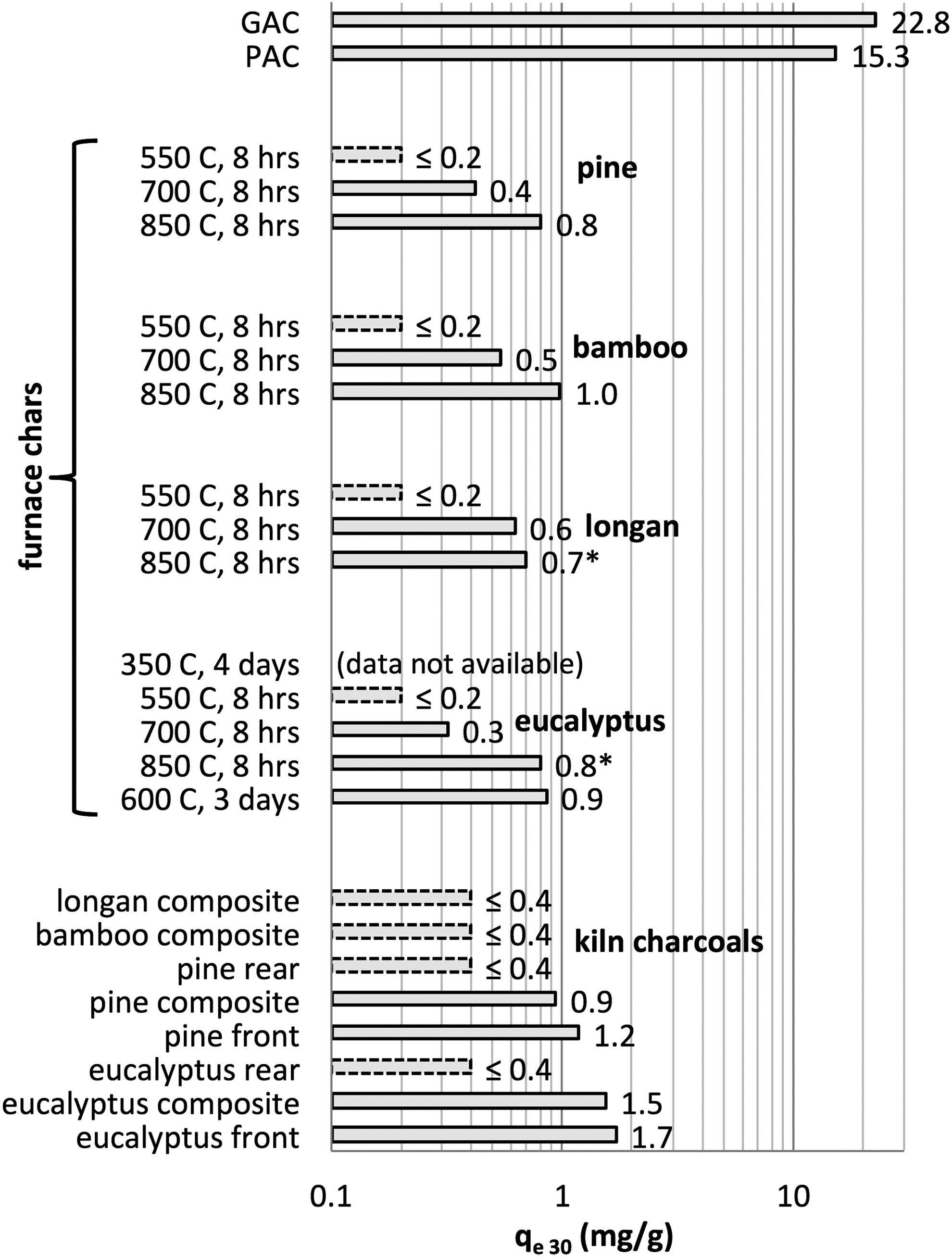
2,4-D surface loading estimates (qe 30) at equilibrium liquid concentration (Ce) 30 μg/L for kiln charcoals, furnace chars, and activated carbons. For some adsorbents, extrapolation from dose-response data trends (Figs. 2 and 4) was necessary to estimate qe 30 values—these are denoted by broken line borders. For other adsorbents, interpolation from dose-response data (Fig. 2) was necessary to estimate qe 30 values—these are denoted by an asterisk.
Using qe 30 values as an indicator of adsorbent efficacy for 2,4-D uptake, it can be concluded that charcoals produced using traditional kiln technologies can achieve low to moderate performance compared with commercial adsorbents such as AC. Under the conditions studied, charcoals achieved qe 30 values ranging from ≤0.2 to 1.7 mg/g compared with 15.3 and 22.8 mg/g for PAC and GAC, respectively. Thus, with the exception of the lowest temperature furnace char that showed negligible 2,4-D uptake, the furnace chars and kiln charcoals exhibited roughly 1–10% the effectiveness for 2,4-D adsorption as the commercial activated carbons. Adsorption efficacy between the different char/charcoal adsorbents (again excepting the lowest temperature furnace char) varied by about one order of magnitude.
Conclusions
Use of charcoal in water treatment is an ancient practice. However, achieving precision control over pyrolysis conditions using traditional charcoal production technologies is probably not feasible. The various kiln systems evaluated in this study exhibited substantial thermal treatment variability over the low to intermediate temperature range (350–750°C) in time and space within and between batches. The resulting variability in the physicochemical properties of the charcoal product leads to a wide range of adsorption capacities for organic compounds. Overall, traditional charcoals exhibited low to modest adsorption performance compared with commercial activated carbon. Low temperature (∼350°C) charcoal exhibited the release native organic compounds into solution. Thus, there are challenges to effective utilization of traditional kiln charcoals as adsorbents in engineered applications such as water and wastewater treatment where precision production control, high temperatures (≥850°C), extensive microporosity, and consistency in physicochemical properties within and between production batches are often required. However, in many resource-poor settings, traditional kilns may be the only feasible technology for adsorbent charcoal generation. In circumstances where advanced pyrolysis technologies and temperature monitoring are not feasible, it might be possible to (1) reserve the driest feedstocks for making charcoal intended for water treatment and/or (b) collect charcoal from front and upper kiln zones where the highest temperatures are typically achieved during firing of a given batch. Because charcoal can be generated locally and at relatively low cost, modest trace contaminant adsorption capacity could possibly be offset through larger contactors and/or more frequent replacement.
Footnotes
Acknowledgments
The authors would like to thank Chirapong Kuhakanchana at the Royal Forestry Department Wood Energy Research Centre (Saraburi, Thailand) for fieldwork support, Kyle Shimabuku at the University of Colorado-Boulder for assistance with horizontal drum kiln construction, and David Rutherford at USGS Denver for analytical services. This work was funded, in part, by grants from the Charles A. and Anne Morrow Lindbergh Foundation, the iBoP-Asia Partnership between the Ateneo School of Government (Philippines) and the International Development Research Centre (Canada), the University of Colorado Chancellor's Fellowship for Research, the University of Colorado Excellence in Engineering Fund, the EPA Science To Achieve Results (STAR) Graduate Research Fellowship program, and Aqueous Solutions, a United States and Thailand-based not-for-profit appropriate technology water and sanitation research collaboration ( ).
).
Author Disclosure Statement
No competing financial interests exist.
References
Supplementary Material
Please find the following supplemental material available below.
For Open Access articles published under a Creative Commons License, all supplemental material carries the same license as the article it is associated with.
For non-Open Access articles published, all supplemental material carries a non-exclusive license, and permission requests for re-use of supplemental material or any part of supplemental material shall be sent directly to the copyright owner as specified in the copyright notice associated with the article.
