




Abstract
Abstract
Phosphated residue (PR), a common solid waste generated from iron and steel plants, was directly reused for removing Pb2+ from wastewater by adsorption. Effectiveness and mechanism of Pb2+ removal by PR were investigated by batch experiments. The toxicity characteristic leaching procedure (TCLP) test confirmed that PR was a nonhazardous material and could be used as an adsorbent for subsequent experiments. Studies of pH impact showed that the optimum pH for Pb2+ adsorption on PR was 5.2 ± 0.2. Kinetic studies illustrated that the sorption behavior of Pb2+ could be described better by pseudo-second order model with high correlation coefficient (0.9999). Sorption equilibrium data could be appropriately fitted by the Langmuir model and the maximum adsorption capacity of Pb2+ obtained from Langmuir equation was 151.2 mg/g. Results of X-ray diffraction (XRD) and scanning electron microscopy–energy dispersive spectrum (SEM-EDS) analysis indicated that dissolution and precipitation mechanism predominated for the sorption. For fixed column experiments, PR was capable of reducing not only the high Pb2+ level, but also low concentration and it could be kept effective before contact time was 4,200 min at pH = 5. In addition, an interesting finding was that PR could reduce the mobility of Pb in the soil media. The above shows that PR has significant potential in Pb2+ removal from real wastewater.
Introduction
A
Nowadays, a large number of articles found in the literature report the removal of Pb2+ using different kinds of adsorbents. Hamza et al. (2013) prepared a sugarcane bagasse/multiwalled carbon nanotube composite for adsorbing Pb2+ in aqueous solution. Yang et al. (2014) analyzed the effect of Pb2+removal by synthesizing Fe3O4@HAP nanocomposite. Goel et al. (2005) reported that activated carbon prepared from biomass materials could remove Pb2+ effectively, and so on. These adsorbents, however, urgently require financial support and technical assistance which restrict their widespread applications. Therefore, an available, low-cost, easily prepared and environmentally friendly material is extremely essential to be found to solve this problem.
In the steel industries, to provide an effective and sustainable stainless steel production, most steel plants choose aggressive acids involving nitric acid, hydrofluoric acid, phosphoric acid (Li et al., 2005; Schmidt et al., 2007; Regel-Rosocka, 2010; Rogener et al., 2012), and so on to remove the several adherent oxides. Especially when using H3PO4, a great deal of phosphated residue (PR) is produced in this process. PR, as the common solid waste from steel plants, may induce potential hazard to the natural environment, such as despoiling plenty of land, polluting natural water, and so on. However, most of the plants select landfill to treat PR negatively, thus finding an appropriate method to recycle PR may be an economically valuable solution to this problem.
Up to now, little research has been conducted to reuse PR as an adsorbent for wastewater treatment, especially for wastewater contamination with Pb2+. Therefore, the aim of this study was to investigate the feasibility of using PR for the adsorption of Pb2+ from aqueous solutions. The adsorption performances, such as pH influence, adsorption kinetics, and isotherms, were systematically examined. Furthermore, fixed column experiments were carried out at different pH conditions and initial Pb2+ concentrations to assess the sequential application of PR in water treatment. Additionally, the instrument analysis was induced for investigating the mechanisms of Pb adsorption on PR in depth.
Experimental Section
Materials
PR was collected from an iron and steel plant (China). The PR was washed thoroughly in deionized water to remove soluble salts and air dried, crushed, passed through a 200-mesh sieve and homogenized. The major composition of the adsorbent was identified as P2O5 (44.7 wt%), Fe2O3 (38.87 wt%), SiO2 (0.18 wt%), and CaO (0.03 wt%) using the X-ray fluorescence (XRF) spectrometer (Lab Center XRF-1800; Shimadzu).
Pb solution was prepared using nitrate salts (with >99.5% purity) purchased from Nanjing Chemical Reagent Company. All reagents used in this experiment were of analytical grade.
Batch adsorption experiments
Sorption kinetics and isotherms of Pb2+ adsorption onto PR were investigated by batch methods. The conical flasks containing 0.1 g adsorbent and 50.00 mL single-component metal solution at desired concentration and pH were placed on a constant temperature bath oscillator to vibrate at room temperature (25 ± 1°C) and a constant speed of 200 rpm. After a period of time, the mixtures were filtered through a 0.22-μm membrane filter and the filtrates were analyzed for residual metal concentration through an inductively coupled plasma atomic emission spectroscopy (ICP-OES, Optima 7000DV; PerkinElmer). The Pb2+ adsorption capacities at time t, qt (mg/g), were calculated according to Equation (1) (Yu et al., 2013):
where C0 and Ct (mg/L) are the Pb2+ concentration in the initial solution and at time t, respectively, V (L) is the volume of solution, and m (g) is the weight of the sample added to the solution.
To determinate the pH impact on adsorption, the initial pH values were adjusted from 2 to 6, using HNO3 or NaOH solution, in which the initial concentration of Pb2+ was 200 mg/L. The adsorption isotherms were investigated in the range of 50–500 mg/L for Pb2+ at the optimum pH. The kinetic study was carried out in the same way as the adsorption isotherms study, and the solution in the specified flask was filtered at a predetermined interval of time in which the initial concentration of Pb2+ was 200 mg/L.
Stability evaluation of Pb2+ in PR after adsorption
Tessier's sequential extraction method (Tessier et al., 1979) was used to determine the species and the stability of Pb2+ in PR after adsorption. The mixture was centrifuged at 5,000 rpm, then the supernatant was removed and the sediment was dried for sequential extraction and an aliquot was used to measure toxicity characteristic leaching procedure (TCLP) concentration of Pb2+ in PR to evaluate the leachability of Pb2+ and the potential toxicity of PR after adsorption from wastewater (Method 1311; US EPA, 1992).
Results and Discussion
Toxicity evaluation
Leachability of heavy metals from the PR was determined using the TCLP in accordance with the US EPA (1992) Method 1311 (Poon and Lio, 1997). The results are shown in Table 1, and it indicated that PR could be marked as a nonhazardous material and could be used as an adsorbent for the subsequent experiments considering that it had no excessive leaching toxic heavy metals compared with the US EPA TCLP standard.
PR, phosphated residue; TCLP, toxicity characteristic leaching procedure.
Sorption study
Effect of initial pH
It is well known that pH is an important factor for the adsorption of heavy metals, which was in the range of 2–6 in this study to prevent precipitation of Pb2+ in the form of metal hydroxides. The relationship between the initial pH values and the quantities of Pb2+ adsorbed on PR is presented in Fig. 1. When pH = 2–4, it showed that the Pb2+ adsorbed increased as pH increased, but the adsorption was lower comparatively, which was attributed to the fact that the activated sites reduced with the partial dissolution of PR in strongly acidic media and it existed in competition between H+ and Pb2+ for the available adsorption and the competition enhanced with the reduction of pH. When pH ≥ 4, the adsorption capacity of Pb2+ remained constant and the adsorption amount increased slightly. Therefore, pH = 4, 5, and 6 could be regarded as the favorable pH in the process of adsorption. Moreover, considering the initial pH condition of Pb2+ solution made in the laboratory, the optimum pH for adsorption of Pb2+ was determined as 5.2 ± 0.2 and selected for the subsequent experiment.

Influence of pH on adsorption of Pb2+ onto phosphated residue (PR).
Sorption kinetics
The results of sorption studies, carried out as a function of contact time, for Pb2+ are presented in Fig. 2a, which indicated that the uptake of Pb2+ by PR was time dependent. At the first 10 min the adsorption of Pb2+ was rapid, which could be attributed to the relatively large number of available vacant sites on the PR surface. Then the adsorption curve was smooth and continuous and the adsorption amount of Pb2+ increased slightly with the available vacant sites reducing gradually until exhaustion.
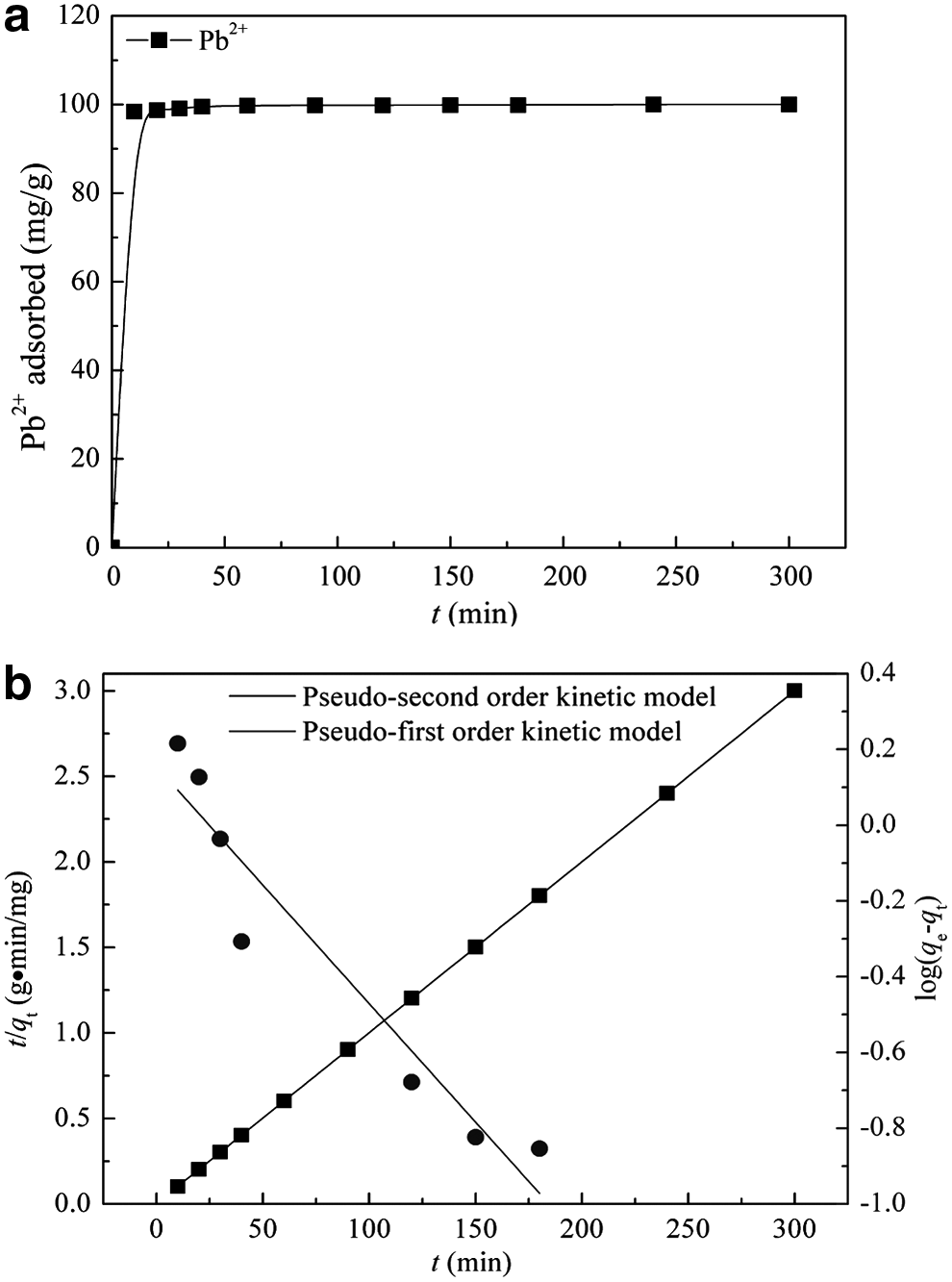
Kinetic models are proposed for a better understanding of the mechanism of adsorption (Wang et al., 2015). To explicate in depth the controlling mechanism of the adsorption process, two kinetic models (pseudo-first order kinetic model and pseudo-second order kinetic model) had been employed to fit the experimental data, as described here as Equations (2) and (3) (Ho and McKay, 1999; Kara et al., 2014; Yan et al., 2014a).
Pseudo-first order:
Pseudo-second order:
where qe and qt are the adsorption capacity (mg/g) at equilibrium and at time t (min), k1 (min−1) and k2 (g/[mg·min]) are the rate constants for the pseudo-first order and pseudo-second order, respectively.
The values k1, k2, and qe were calculated from intercept and slope of Fig. 2b. The magnitude of k1, k2, and the experimental and calculated values of qe are listed in Table 2. It inferred that the sorption behavior of Pb2+ could be described better by pseudo-second order model than pseudo-first order model by comparing the magnitude of correlation coefficients (R2) and adsorption capacities (qe). The R2 for the pseudo-second order model (0.9999) was much larger than that of pseudo-first order model (0.9107), and the values of qe obtained from pseudo-second order model (100.1 mg/g) correlated well with the values measured experimentally (102.5 mg/g). It also suggested that the adsorption processes were controlled by chemisorption (Hao et al., 2010).
Sorption isotherms
Effectiveness of metal–biomass interactions can be evaluated by sorption isotherm models, which can be utilized for optimization of adsorbent use (Malamis and Katsou, 2013). In this study, Langmuir, Freundlich, and Dubinin–Radushkevich (D-R) adsorption isotherm models were used to describe and understand the equilibrium data of adsorption from aqueous solution.
The Langmuir model is the well-known monolayer sorption isotherm, which assumes that adsorption occurs on a homogenous surface and there is no interaction between the adsorbed planes of the surface. The equation for the Langmuir isotherm is Equation (4) (Langmuir, 1916; Jia et al., 2014).
where qe and Ce are the adsorption capacity (mg/g) and equilibrium concentration of the adsorbate (mg/L), respectively, qm and b represent the maximum adsorption capacity of adsorbents (mg/g) and the Langmuir adsorption constant (L/mg).
The Freundlich isotherm is used to describe multilayer adsorption and adsorption on heterogeneous surfaces, which can be illustrated as Equation (5) (Freundlich, 1906; Yan et al., 2014c; Abdul et al., 2015).
where KF (mg/g[1/mg1/n]) and n are the Freundlich constants, which represent the adsorption capacity and the adsorption strength, respectively.
The fitting results are shown in Table 3. It indicated that the adsorption process was fitted better to the Langmuir model than the Freundlich model as the Langmuir model had larger correlation coefficient values (0.999 > 0.52), suggesting the homogeneous reactions on the surface of PR. The maximum adsorption capacity calculated from Langmuir model was 151.52 mg/g relatively higher compared with other adsorbents. For example, the qm of tea waste, peat, pretreated arca shell biomass, dried activated sludge for Pb2+ were 65.00, 27.80, 30.39, and 131.60 mg/g, respectively (Febrianto et al., 2009). It was implied that PR could be a promising adsorbent for removal of Pb2+ from wastewater. Additionally, a favorable adsorption tends to have the Freundlich constant 1/n between 0 and 1, and values of 1/n in this study was 0.147 indicating favorable adsorption and high affinity between PR and metals.
Furthermore, the dimensionless separation factor RL [Eq. (6)] calculated from the Langmuir adsorption constant b was also used to reflect the favorability and affinity of the adsorption process (Jain et al., 2013).
where C0 is the initial Pb2+ concentration. The values of RL between 0 and 1 interpret the adsorption process is favorable and when RL > 1, the process is unfavorable (Yan et al., 2014b). The plots of RL values in different initial concentrations are presented in Fig. 3. It could be seen that the values of RL varying from 0 to 0.07 were within the range of 0–1, which suggested that the favorable adsorption of Pb2+ onto PR occurred and it was uniform to the result of 1/n value calculated by Freundlich model. Moreover, the decreasing of RL values with initial Pb2+ concentration increasing indicated that the adsorption was more beneficial at a higher initial concentration.
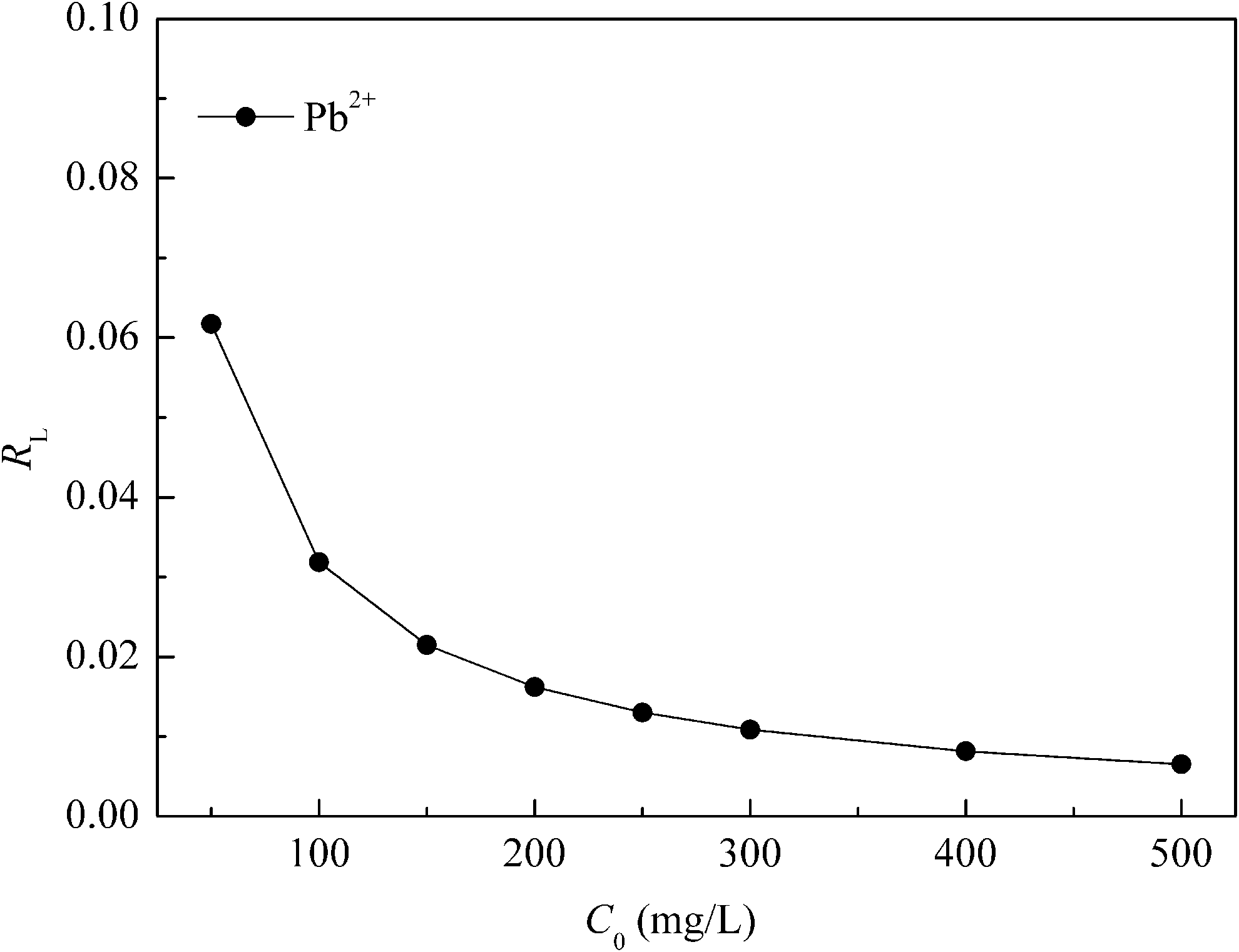
Separation factor RL of Pb2+ adsorption at different initial concentrations on PR.
Dubinin–Radushkevich model generally illustrates the mechanism of adsorption and suggests that the adsorption is either physisorption or chemisorption. The equation of the Dubinin–Radushkevich isotherm is Equations (7)–(9) (Dubinin, 1960; Hamayun et al., 2014).
where qe and Ce are the adsorption capacity (mg/g) and equilibrium concentration of Pb2+ (mg/L), respectively; qm is the theoretical saturation adsorption capacity (mg/g); β is the activity coefficient related to mean adsorption energy (mol2/kJ2); ɛ is the Polanyi potential; E (kJ/mol) is the mean free energy; R and T are the universal gas constants (8.3145 J/mol/K), and the absolute temperature in Kelvin (K), respectively.
The related parameters are shown in Table 3. The value of E is very useful in predicting the type of adsorption. When the value of E < 8 kJ/mol the adsorption occurs physically in nature, E between 8 and 16 kJ/mol, the adsorption is ion exchange, and E > 16 kJ/mol corresponds to a strong chemical process (Yan et al., 2014b). The value of E found in this study was 28.8 kJ/mol, and it stated that the adsorption of Pb2+ on PR was a stronger chemical reaction than ion exchange and it was consistent with the results of kinetic studies.
Sorption mechanism
To investigate the mechanism of Pb2+ adsorption onto PR, the crystalline structure, elemental composition, and formation of PR after sorption were determined by X-ray diffraction (XRD, D8 Advance; Bruker), and scanning electron microscopy–energy dispersive spectrum analysis (SEM-EDS, S-4800; Hitachi). The SEM images and EDS spectrum of PR before and after adsorption are shown in Fig. 4a, b. These figures showed that the shape of solid changed obviously after adsorption from flake-shaped to needle-shaped, which demonstrated that PR dissolved and new products generated; moreover, a strong peak of Pb was observed in related EDS spectrum implying that Pb was mostly loaded in the new products. The XRD patterns of PR before and after adsorption are shown in Fig. 4c. This result showed that the typical peaks of PR before adsorption were matched well with JCPDS file No. 33-0667, indicating the composition of PR was mainly FePO4·2H2O. However, after Pb2+ adsorption, the solid became Pb3(PO4)2 and Pb5(PO4)3OH, which were the new products referred by the results of SEM-EDS. In conclusion, as expected, it could be illustrated that the dominant mechanism maybe the formation of Pb3(PO4)2 and Pb5(PO4)3OH after dissolution of FePO4·2H2O.

Scanning electron microscopy–energy dispersive spectrum (SEM-EDS) analysis of PR before
Finally, the mechanism of this process was chemical adsorption predominantly by dissolution of FePO4·2H2O and formation of Pb3(PO4)2 and Pb5(PO4)3OH, and the result was confirmed by the E-value obtained from D-R isotherm and kinetic studies.
Stability evaluation of Pb2+ in PR after adsorption
Leached Pb concentration in the PR after adsorption according to TCLP was found to be 2.24 ± 0.02 mg/L, which was lower than the limit as specified by US EPA (5 mg/L) illustrating the PR after adsorption could be marked as a nonhazardous material and that could be disposed off safely in the surface landfill (Ghosh et al., 2014).
Tessier's sequential extraction includes five extracted fractions: exchangeable (EX), organic-bound (OB), carbonate-bound (CB), oxide-bound (OX), and residual (RS) fraction. EX fraction is the most readily mobile fraction in the sediment and it represents the part bioavailable to the organism, while RS phase is the least bioavailable and could be used to assess the stabilization of solid (Zhang et al., 2010). In this study, the proportions of each fraction were 0.27% (EX), 2.59% (CB), 1.92% (OX), 2.04% (OB), and 93.18% (RS), respectively. It was obvious from the result that the form of Pb in PR after adsorption was mainly composed of RS fraction following the order of RS > CB > OB > OX > EX. The reason of existing CB was that PR contained a small amount of carbon element and there were trace amounts of CO2 in water. The trace amounts of EX and large amounts of RS fraction indicated that the form of Pb was more stable and the bioavailable Pb in PR was reduced effectively after adsorption.
Implications
Immobilization of Pb2+ in real wastewater
The real wastewater contaminated by Pb2+ was collected in a sewage plant in China. The concentration of Pb2+ in real wastewater was about 10 mg/L analyzed by ICP-OES. To investigate the practical application of PR in adsorption Pb2+, fixed column experiments were tested. In fixed column experiments, glass columns (length 20 cm, inner diameter 1.5 cm) were separately packed with 3.0 g uniform PR particles (0.21–0.30 mm). Glass wool was used in the bottom and top of the column to avoid the adsorbent loss. The real wastewater was fed in upwards through the column by peristaltic pump, and then the effluent of each column was collected at defined time intervals and analyzed for the residual Pb2+ concentration by the ICP-OES. Two parameters were chosen for this study: pH and initial Pb2+ concentration.
The breakthrough time (Ct/Co = 0.05) (Apiratikul and Pavasant, 2008) and the discharge standard of pollutants for municipal wastewater treatment plants of the Chinese National Standard (GB18918-2002) (GB 18918-2002, China, 2002) (Pb2+ ≤ 0.1 mg/L) were selected to determine whether PR was useless or not at a defined time. The breakthrough curves of Pb2+ at different conditions are shown in Figs. 5a and b, respectively. Figure 5 showed that the breakthrough time occurred faster with lower pH and higher initial Pb2+ concentration. The time when the effluent concentration of Pb2+ complied with the criteria of GB18918-2002 (0.1 mg/L) continued longer at pH = 5 and Pb2+ C0 = 1 mg/L. The results suggested that PR could effectively immobilize the real wastewater and it could be used for a longer time at a suitable pH and lower initial Pb2+ concentration.

Breakthrough curves for Pb2+ adsorption on PR at different initial pH
Immobilization of Pb2+ in contaminated soils
Previous studies indicated that PR could remove Pb2+ effectively in wastewater. To broaden its application, Pb2+ immobilization by PR in contaminated soils were evaluated. Different amounts of PR varying from 0% to 20% of sediments were added to soils contaminated by Pb2+ (about 2,000 mg/kg) and the treated soil samples were cured for 4 weeks at 25°C. Then Tessier's sequential extraction method (Tessier et al., 1979) and TCLP method (Poon and Lio, 1997) were selected to evaluate the effectiveness of immobilization of PR (Yan et al., 2014d). The results are shown in Figs. 6 and 7, respectively. Figure 6 showed that with the increase of PR amounts, the EX, CB, OX, and OB fractions of Pb were reduced, whereas the RS fraction of Pb was increased. The results reflected that PR could immobilize Pb in soils and make them less available, and the form of Pb turned to be more stable. As can be found from Fig. 7, the soils without adding PR could be classified as hazardous soils because of the excessive TCLP-Pb (40.87 mg/L) compared with the US EPA regulatory level of 5 mg/L. The TCLP-Pb concentration changed obviously from 9.621 to 0.23 mg/L by adding different amounts of PR. Moreover, when the additions of PR were at more than 5% levels, the TCLP-Pb concentrations were below the US EPA regulatory level, which demonstrated that the immobilization using PR could reduce the leaching toxicity and environmental risk of soils, thus suggesting the potential application of PR. Meanwhile, the change of physical and chemical properties of soils before and after immobilization using PR should be deeply investigated.
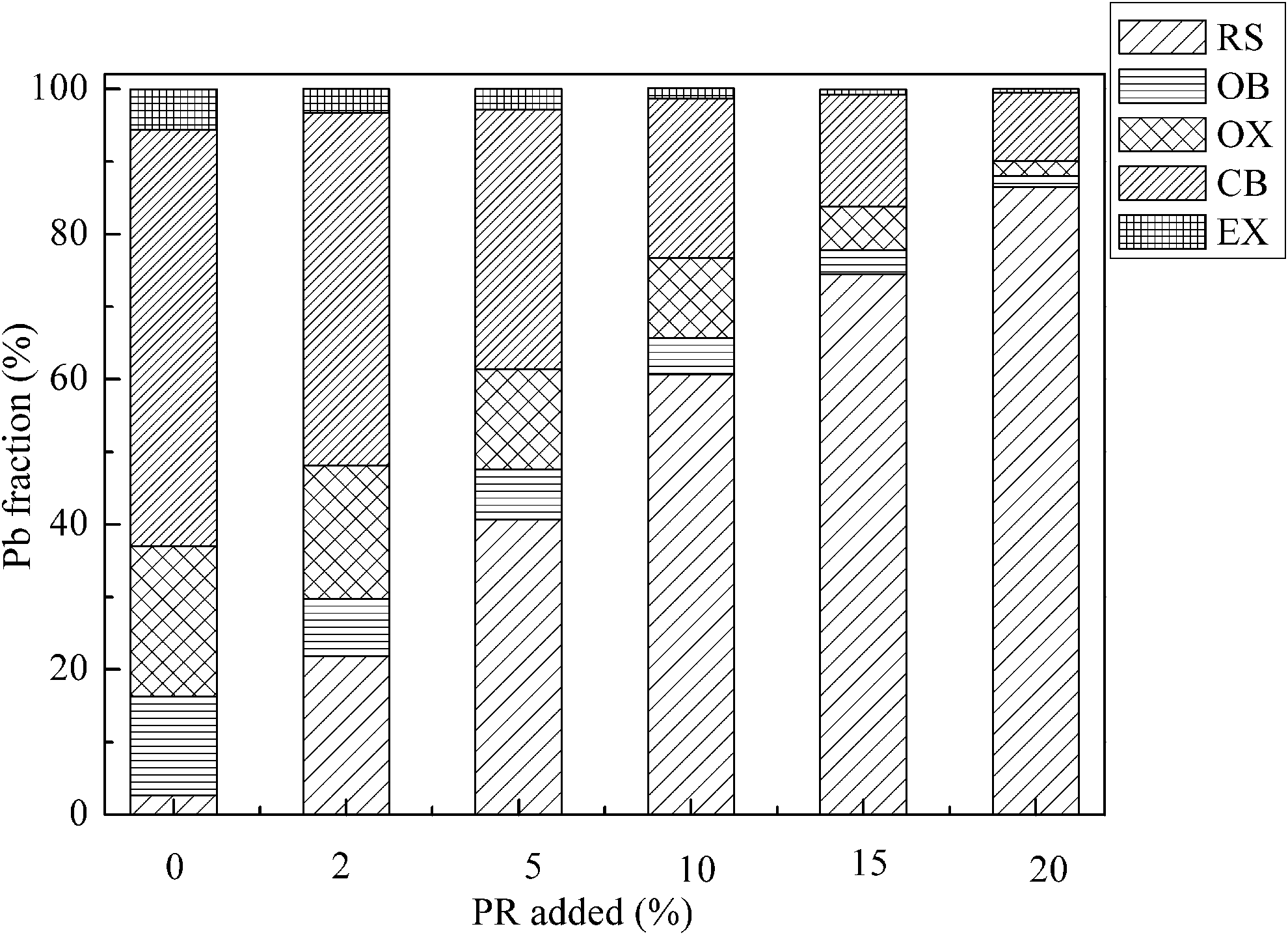
Extracted fractions of Pb in soils after adding PR. (exchangeable [EX], organic-bound [OB], carbonate-bound [CB], oxide-bound [OX], and residual [RS] fraction).
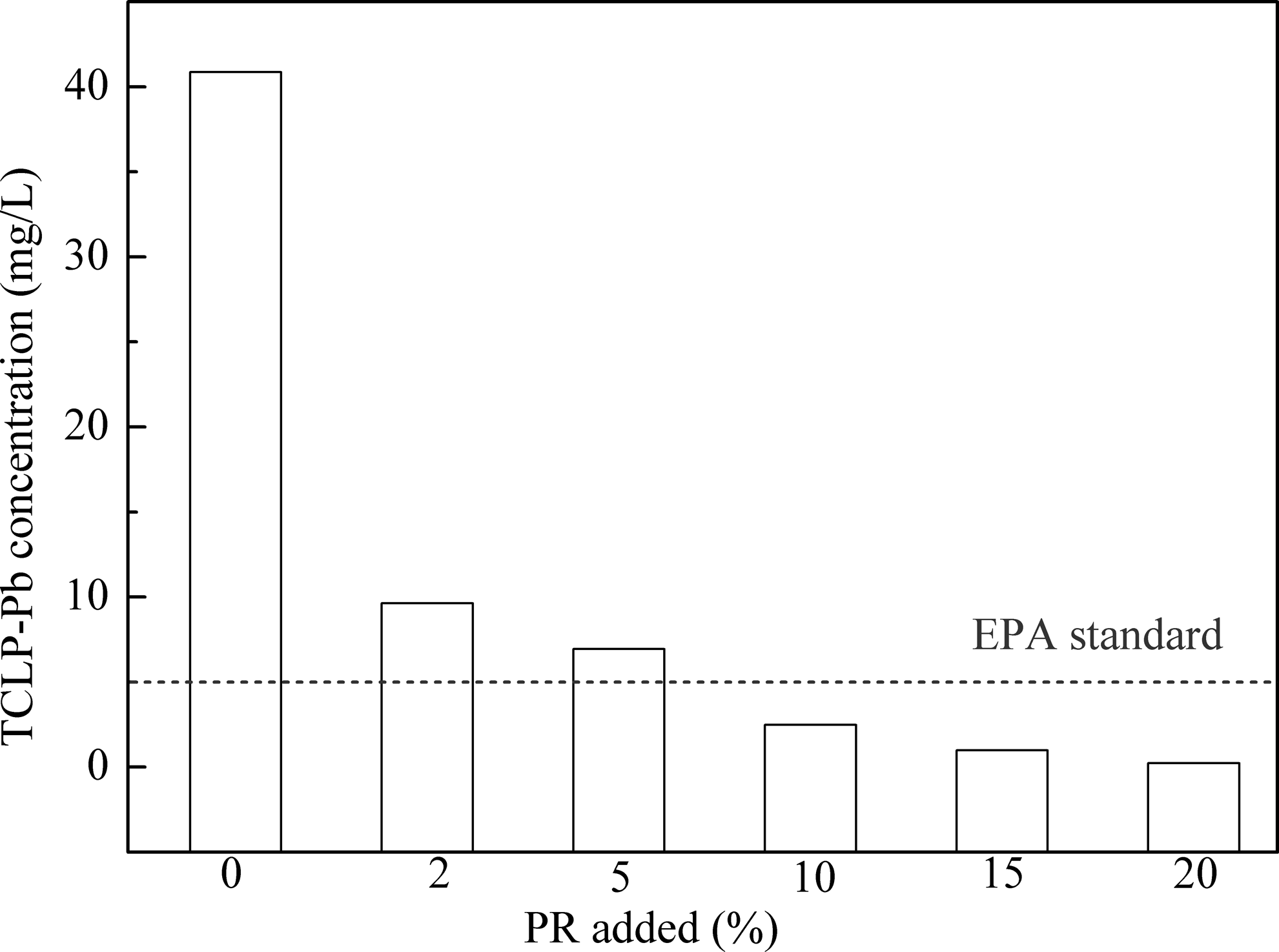
Toxicity characteristic leaching procedure (TCLP) concentration of Pb in soils after adding PR.
Summaries
Experimental results of the present work showed that Pb2+ could be removed effectively from wastewater using PR as adsorbent. It not only recycled the solid waste, but also proposed a new method for removing heavy metals reaching the purpose of environmental protection. The conclusions are summarized as follows:
(1) The initial pH could influence the effect of Pb2+ adsorption and the optimum pH was 5.2 ± 0.2 by batch pH studies. (2) The kinetic studies showed that the sorption behavior of Pb2+ could be described better by pseudo-second order model suggesting that the adsorption mainly occurred in the process of chemisorption. The sorption equilibrium data could be fitted better by the Langmuir model and the maximum adsorption capacity of Pb2+ obtained from Langmuir equation was 151.2 mg/g; The results of XRD and SEM-EDS analysis indicated that dissolution and precipitation mechanism predominated for the sorption. (3) The TCLP-Pb concentration in PR after adsorption was lower than US EPA standard and the form of Pb was mostly composed of RS fraction. (4) Fixed column experiments illustrated that the breakthrough time declined at lower pH and higher initial Pb2+ concentration. It also stated that PR could effectively immobilize the real wastewater and it could be used for a longer time at suitable pH and lower initial Pb2+ concentration. (5) The TCLP-Pb concentration in contaminated soil could be reduced more effectively after adding PR and the forms of Pb turned to be more stable reflecting the potential application of PR.
Footnotes
Acknowledgments
The authors gratefully acknowledge the financial support of the National Natural Science Foundation of China (No. 51278248) and the Jiangsu Provincial Education Ministry of China (No. KYZZ_0129).
Author Disclosure Statement
No competing financial interests exist.