




Abstract
Abstract
To remove polyvinyl alcohol (PVA) and improve the biodegradability of the desizing wastewater, the Fenton process was developed to treat the PVA-containing desizing wastewater. Effects of operational parameters (i.e., n (Fe2+):n (H2O2) molar ratio, H2O2 dosage, initial pH, and reaction time) on the treatment efficiencies of the Fenton process were investigated. Under the optimal conditions, the high chemical oxygen demand (COD) (i.e., 50.9%) and turbidity (i.e., 99.8%) removal efficiencies were obtained by the Fenton process. Meanwhile, PVA concentration in the wastewater was decreased from 326 ± 15 to 16 ± 2 mg/L, and its removal efficiency reached about 95.1%. According to results from two control experiments, it is clear that the high treatment efficiency was mainly attributed to the combination action of oxidation (hydroxyl radical, HO•) and coagulating sedimentation (Fe2+/Fe3+). In addition, the Fourier transform infrared spectroscopy analysis results showed that PVA was decomposed and transferred into the small molecule organic acids, which resulted in the rapid increase of BOD5:COD (B:C) ratio from 0.25 to 0.51 after 120-min treatment by the Fenton process. Therefore, the Fenton process was an effective method for pretreatment of desizing wastewater before biological treatment.
Introduction
F
Membrane separation (i.e., nanofiltration) can reduce the volume of wastewater generated, recover, and recycle valuable components (e.g., PVA) from the wastewater (Guo hua et al., 1997; Porter, 1998; Raval et al., 2012). However, this method suffers from high capitalized cost and membrane fouling, so it is still not applied to recover PVA from desizing wastewater in China. In addition, the refractory pollutants in wastewater are hard to be directly degraded by the conventional biological treatment process. In the literature, it has been reported that photo-Fenton (Giroto et al., 2006), electrochemical oxidation (Kim et al., 2003), catalytic thermal treatment (Mohammadesmaeili et al., 2010), supercritical water oxidation (Pérez et al., 2010), and adsorption (Behera et al., 2008) could be used to treat the desizing wastewater. However, all these methods suffer from low removal efficiency or high operation cost. To remove refractory pollutants in wastewater and improve its biodegradability, a cost-effective pretreatment should be adopted before the biological process.
To decompose or transfer the refractory PVA in desizing wastewater and improve its biodegradability, the advanced oxidation processes have been investigated to treat this wastewater. In particular, Fenton oxidation is particularly attractive because of its simplicity and high degradation or transformation of refractory organics. The typical Fenton process is usually carried out through the strong oxidative HO• generated from the catalytic oxidation reaction of H2O2 and Fe2+. Furthermore, the efficiency of Fenton process is mainly affected by the operational parameters of pH, Fe2+ dosage, and H2O2 dosage, and the optimal parameters can enhance the formation of HO• and inhibit the side reactions (Wei et al., 2013). In particular, the Fenton process is usually based on the generation of HO• from the decomposition of H2O2 in the presence of Fe2+ at acidic conditions [Eq. (1)]. In addition, the Fe3+ can react with HO• and regenerate the catalyst [i.e., Fe2+, Eq. (2)]. Furthermore, the Fenton process is much more complex and includes many other reactions, and the main reaction and a series of chain reactions involving Fe2+, Fe3+, H2O2, superoxide, and HO• are as follows (Wang and Xu, 2012; Munoz et al., 2015):
Removal of the organics mainly resulted from oxidation and coagulation in the Fenton process. Meanwhile, the COD removal attributed to the oxidation process was about 2–3 times of that from coagulation (Deng and Englehardt, 2006). The classical homogeneous Fenton oxidation has been used to treat the toxic refractory pollutants in wastewater (e.g., landfill leachate and trinitrotoluene) (Deng and Englehardt, 2006; Ayoub et al., 2010). However, there are a few reports about the application of Fenton oxidation to the pretreatment of the desizing wastewater. In addition, only the simulated desizing solution was investigated by the Fenton process (Lin and Lo, 1997).
In this study, the classical homogeneous Fenton process was used to pretreat the desizing wastewater generated from a printing and dyeing mill in China. Effects of n (Fe2+):n (H2O2) molar ratio, H2O2 dosage, initial pH, and reaction time on the removal of COD and turbidity were investigated. Meanwhile, the combined action between oxidation and coagulation in the Fenton process was investigated thoroughly. Finally, treatment efficiency of the desizing wastewater was further evaluated using the Fourier transform infrared spectroscopy (FTIR).
Materials and Methods
Chemicals
Sulfuric acid (H2SO4, 98%), sodium hydroxide (NaOH), ferrous sulfate (FeSO4·7H2O), iodine, potassium iodide, boric acid, and hydrogen peroxide (H2O2, 30% v/v) from Chengdu Kelong Chemical Reagent Factory were used in the experiment. All the chemicals used in this study were of analytical grade. Deionized water was used throughout the whole experiment process.
Characterization of raw wastewater
Wastewater used in this study was obtained from the desizing department of a printing and dyeing mill in Sichuan Province, southwest China. The characteristics of the desizing wastewater of this study are listed in Table 1. In particular, its high COD (3,822 ± 682 mg/L) and low B:C ratio (0.25 ± 0.03) show that there are toxic or refractory pollutants in the wastewater. In addition, its low biodegradability mainly resulted from PVA (326 ± 15 mg/L) and other unknown pollutants. In addition, it was an emulsion wastewater with a higher turbidity of 125 ± 18 NTU. Therefore, it is necessary to remove these pollutants and improve the biodegradability of the desizing wastewater.
BOD5, biochemical oxygen demand for 5 days; COD, chemical oxygen demand; B:C, BOD5:COD; PVA, polyvinyl alcohol.
Experimental procedure
All experiments were performed in a 500-mL batch reactor at an operating temperature of 25°C ± 1°C through water batch heating, and the slurry was mixed by a mechanical stirrer (200 rpm). The desired initial pH of wastewater was adjusted with H2SO4 solution (25%, w/w) and 5.0 M NaOH solution. In each batch experiment, the desired Fe2+ was dissolved in 300 mL desizing wastewater, and then, Fenton reaction was initiated by adding H2O2 solution (30%, w/w). Samples were withdrawn from the reactor after Fenton oxidation, and then, Fenton reaction was terminated by adjusting pH to 10.0, which could decompose the residual H2O2. Furthermore, the samples were settled for 30 min to remove the flocs. The supernatant was withdrawn for the analyses of COD, BOD5, turbidity, FTIR, and PVA concentration.
Analytical methods
FTIR analyses of the samples were carried out using a Perkin Elmer 100 FTIR spectrometer with a resolution of 4 cm−1 in the range of 400–4,000 cm−1. The samples were first dried in a vacuum drying oven and grinded before the FTIR analysis and were prepared with the discolor technique using a finely ground mixture of 6 mg sample and 300 mg KBr and then pressed into a pellet under 10 tons-force for 1 min (Wei et al., 2013). The PVA concentration in the desizing wastewater was determined using a Shimadzu Model UV-1800 spectrophotometer (Shimadzu) after addition of boric acid and iodine solutions according to the procedure described by Finley (1961). COD, BOD5, and turbidity of the samples were analyzed by COD analyzer (Lianhua), BOD5 analyzer (OxiTop IS12; WTW), and Turbidimeter (2100Q; Hach), respectively.
Results and Discussion
Effects of n (Fe2+):n (H2O2) molar ratios
Ordinarily, Fe2+ was used to catalyze the decomposition of H2O2 and generate HO• (Noubactep and Schöner, 2009; Ayoub et al., 2010). In addition, the optimal Fe2+ dosage should be confirmed according to the H2O2 dosage (Wang and Xu, 2012; Xu et al., 2013). In other words, the optimal n (Fe2+):n (H2O2) molar ratios should be investigated first. To determine the effects of n (Fe2+):n (H2O2) molar ratios on COD and turbidity removal efficiencies for the desizing wastewater, n (Fe2+):n (H2O2) molar ratios were varied from 0:5 to 5:5, and the other conditions were fixed (i.e., H2O2 dosage of 50 mM, initial pH of 6.0, and reaction time of 120 min).
Figure 1 shows that the COD removal efficiency significantly increased from 7.0% to 40.7% with the increase of n (Fe2+):n (H2O2) molar ratios from 0:5 to 0.5:5. Then, it gradually increased to the maximal value (i.e., 50.9%) when the n (Fe2+):n (H2O2) molar ratio reached 3:5. However, it began to decrease when the n (Fe2+):n (H2O2) molar ratio was above 4:5. The results suggest that too high n (Fe2+):n (H2O2) molar ratios could not facilitate the improvement of COD removal efficiency. The results might explain that the excess Fe2+ present in the solution would act as a HO• scavenger [Eqs. (3), (6), and (7)], which would reduce the degradation efficiency of pollutants in the desizing wastewater (Kang and Hwang, 2000; Gomathi Devi et al., 2009). Figure 1 also shows that the turbidity removal efficiency significantly increased to 99.8% with the increase of n (Fe2+):n (H2O2) molar ratios from 0:5 to 0.5:5. The results indicate that high demulsification effect and turbidity removal efficiency could be obtained with a low n (Fe2+):n (H2O2) molar ratio.

Effects of n (Fe2+):n (H2O2) molar ratios on removal of chemical oxygen demand (COD) and turbidity (initial pH of 6.0, H2O2 dosage of 50 mM, stirring speed of 200 rpm, reaction time of 120 min, and operating temperature of 25°C ± 1°C).
It is well known that the cost of reagents is one of the most important limiting factors for the industrial application. In addition, the excess Fe2+ can also limit the treatment efficiency of the desizing wastewater. From the commercial and effective points of view, therefore, the optimal n (Fe2+):n (H2O2) molar ratio of 3:5 was selected to optimize other operational parameters in the subsequent experiments.
Effects of H2O2 dosages
In the Fenton process, H2O2 dosage is the most important operational parameter because it is the parent of HO• and of the main operation cost of scale-up application (Ayoub et al., 2010; Wei et al., 2013). Effects of the H2O2 dosages (2.5–75 mM) on the COD and turbidity removal efficiencies were investigated at the optimal n (Fe2+):n (H2O2) molar ratio of 3:5. The other parameters were initial pH (6.0) and reaction time (120 min). Figure 2a shows the effects of the H2O2 dosages on the COD removal efficiencies. The COD removal efficiency increased rapidly to 30.3% with the H2O2 dosage increase to 5 mM, and then, the removal efficiency gradually increased to the maximum value (i.e., 50.9%) when the H2O2 dosage increased from 5 to 50 mM. Finally, it did not further increase when the H2O2 dosage was above 50 mM. The results were attributed to the following reasons. HO• quantity increased to the maximum value when the H2O2 dosage increased to 50 mM. In other words, the oxidation capability of the Fenton process was improved, and the high COD removal efficiency was obtained. However, the excess H2O2 would become a scavenger of Fe2+ and HO•, which would inhibit the improvement of oxidation capacity of the Fenton process (Wang and Xu, 2012; Wei et al., 2013). Thus, the optimal H2O2 dosage was 50 mM.
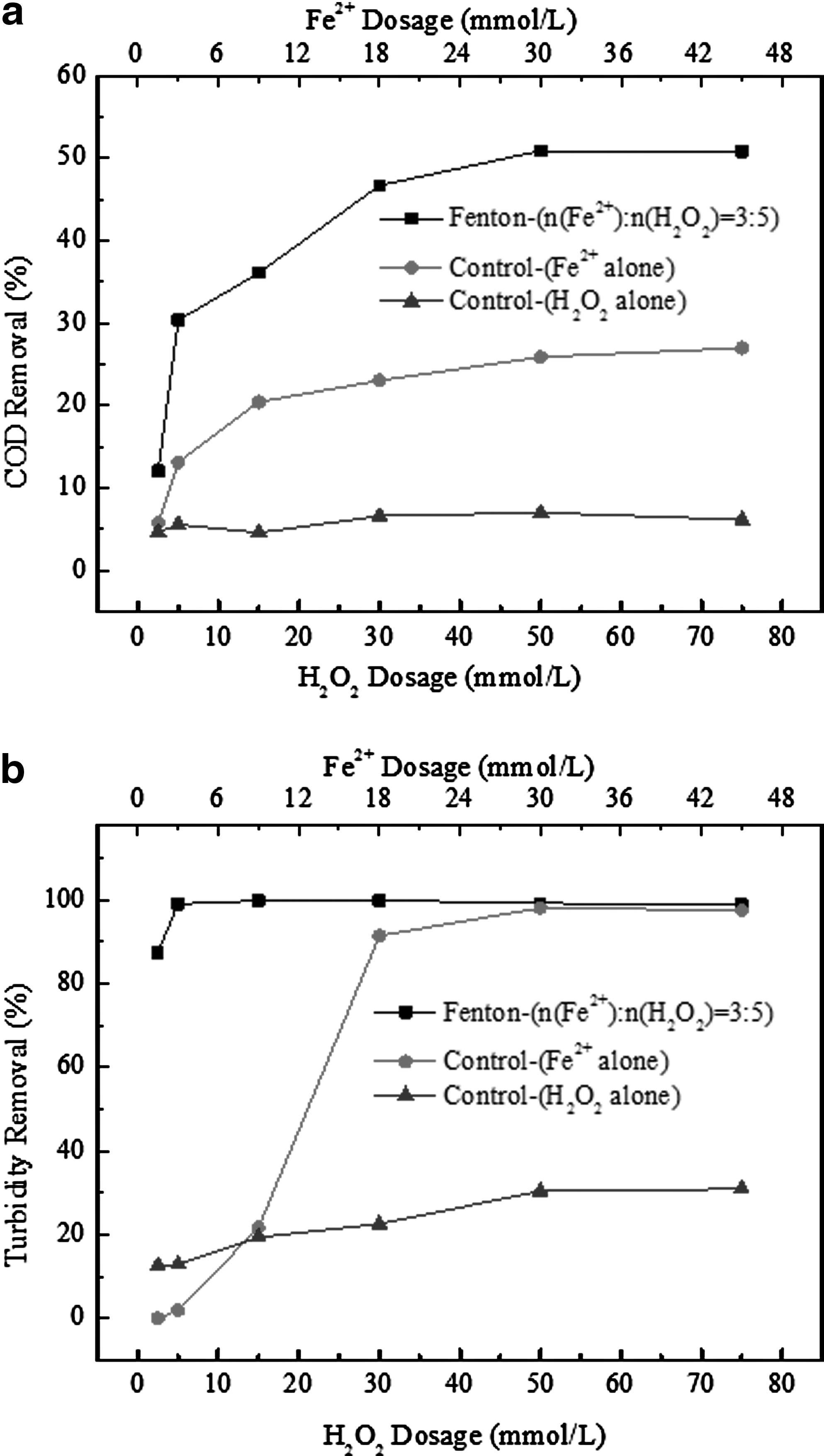
Effects of Fe2+ or H2O2 dosages on removal of
To confirm the mechanism of Fenton process, two control experiments were set up: (1) Fe2+ alone and (2) H2O2 alone. Figure 2a shows that COD removal efficiency obtained by the Fenton process was much higher than those of the two control experiments. In addition, COD removal efficiency obtained by the Fenton process (i.e., 50.9%) was much higher than the sum (32.9%) of the two control experiments under the optimal H2O2 dosage of 50 mM. The occurrence of this phenomenon was attributed to the following reasons. In the Fenton process, the COD removal mainly resulted from a combination of oxidation (HO•) and coagulating sedimentation (Fe2+/Fe3+). The pollutants were hard to be removed by H2O2 alone. In particular, the low COD removal efficiency (6.1%) was obtained by H2O2 alone even if a high H2O2 dosage (75 mM) was used.
In the Fenton process, a high turbidity removal efficiency (99.1%) was obtained by only adding 5 mM H2O2 (Fig. 2b). The results indicate that the demulsification of the desizing wastewater was easy to be performed by the Fenton process with a low H2O2 dosage (5 mM). Meanwhile, it was about 6.6 times of the sum (i.e., 14.9%) of two control experiments under the same conditions (i.e., H2O2 dosage of 5 mM and Fe2+ dosage of 3 mM). The results suggest that the high-effective removal of turbidity was mainly attributed to the combination of oxidation (HO•) and coagulating sedimentation (Fe2+/Fe3+). The similar results about the removal of PVA by the oxidation or flocculation have been reported in the literature. In particular, PVA can be degraded by the photo-Fenton (Giroto et al., 2006), and the coagulation of the desizing wastewater could be performed by adding FeCl3, polyaluminium chloride (PAC), or Fe2SO4 (Kumar et al., 2009). Although a high turbidity removal efficiency was obtained by the Fenton process with a low H2O2 dosage (5 mM), its COD removal efficiency was only about 30.3% (Fig. 2). Furthermore, the COD removal efficiency further increased to the maximum value (i.e., 50.9%) with the increase of H2O2 dosage (5–50 mM). The results also suggest that the COD removal mainly resulted from demulsification, sedimentation, and oxidative degradation.
Effect of initial pH
According to Equation (1), the hydroxyl ions (OH−) were generated in the Fenton action, which need to be neutralized by the hydrogen ions (H+). Thus, the initial pH was also a key parameter for the treatment efficiency of Fenton process. To confirm the effect of the initial pH on the COD removal efficiency, the initial pH was varied from 2.0 to 7.0, and the other conditions were fixed [n (Fe2+):n (H2O2) molar ratio of 3:5, H2O2 dosage of 5 mM, stirring speed of 200 rpm, reaction time of 120 min, and operating temperature of 25°C ± 1°C].
Figure 3a shows that at pH 6.0, the COD removal efficiency reached the maximum value (i.e., 50.9%) and then slightly decreased with the increase or decrease of pH value. In the literature, however, the optimal pH of Fenton process was ∼3.0 (Wang and Xu, 2012; Lin et al., 2014), which was much lower than that in this study. To investigate this difference, the effluent pH of each Fenton process with different initial pH (2.0–7.0) was determined. Figure 3b shows that the effluent pH of the Fenton process with different initial pH all decreased obviously. In particular, the effluent pH of the Fenton process with an initial pH of 6.0 was 2.8, while a lower effluent pH (≤2.6) was obtained when its initial pH was below 6.0. In addition, the effluent pH reached 4.8 if the initial pH (influent) was 7.0.
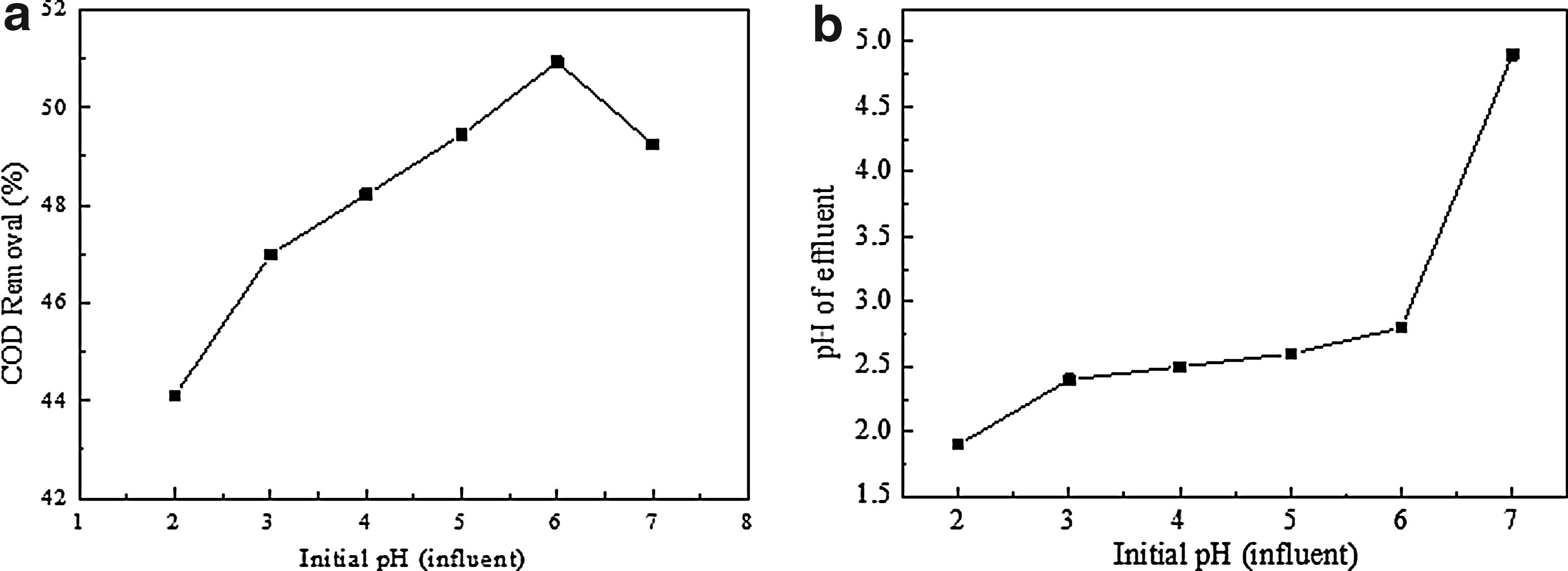
Effects of initial pH on COD removal efficiencies
The occurrence of this phenomenon was attributed to the following reasons. There are many hydroxyl groups (-OH) in the molecular structure of PVA, which was easy to be oxidized and generated many small molecule organic acids. Meanwhile, Zhang et al. (2013) also found that many organic acids (e.g., formic acid, oxalic acid, pentadecanoic acid, and hexadecanoic acid) were detected during the degradation process of PVA and desizing wastewater by the supercritical water oxidation. In the following FTIR analysis (Fig. 5), it is clear that a new band at 1,621 cm−1 (C = O stretching in carboxyls, acids, and ketones) is observed in the effluent, which suggests that the small molecule organic acids (e.g., carboxylic acid) were generated during the degradation of PVA. Furthermore, generated organic acids would cause the decrease of the effluent pH. In the Fenton process, however, the crucial decrease of pH (e.g., pH ≤ 2.6) would inhibit the Fenton reaction because the excess H+ would become a scavenger of HO• (Kang and Hwang, 2000; Ghauch, 2008). In contrast, the higher pH (e.g., pH > 4.0) would cause the formation of Fe(OH)3 or Fe(OH)2, which had a lower catalytic activity for the Fenton reaction (Liou et al., 2003; Fan et al., 2009). Therefore, the optimal initial pH of 6.0 was selected to optimize other operational parameters in the subsequent experiments.
Effects of reaction time
Effects of reaction time on the COD and turbidity removal efficiencies were investigated under the following conditions: initial pH of 6.0, H2O2 dosage of 50 mM, and n (Fe2+):n (H2O2) of 3:5. As shown in Fig. 4, the turbidity removal efficiency rapidly reached the maximum value (i.e., 99.7%) in the initial 10 min. In other words, the complete demulsification of the desizing wastewater could be performed in a very short time by the Fenton process. Figure 4 also shows that the COD removal efficiency rapidly increased to 45.6% in the initial 5 min and then slightly increased and reached the maximum value of 50.9% at 120 min. No further COD removal increase was observed with further prolonged reaction time. According to a contest of COD and turbidity removal efficiencies, it can be observed that the COD removal was performed at two phases: (1) in the initial 5 min, the rapid increase of COD removal efficiency was mainly attributed to the removal of insoluble materials by the rapid demulsification and precipitation, and (2) in the following 5–120 min, the slight increase of COD removal efficiency was mainly attributed to the oxidation of soluble materials by the generated HO•. As a result, it is clear that the optimal treatment time of Fenton process should be 120 min because COD removal efficiency does not further increase after the 120-min treatment.
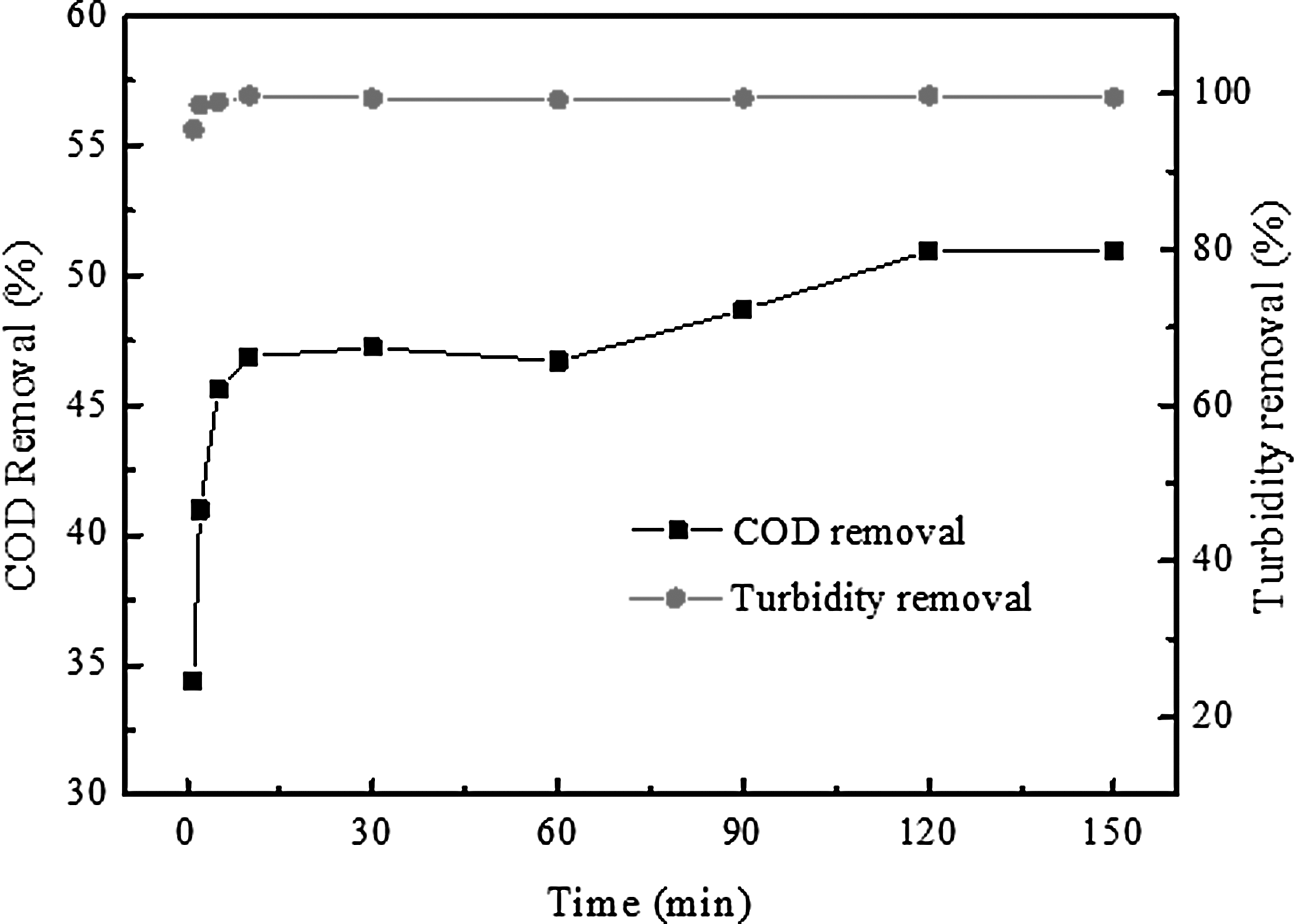
Effects of reaction time on removal of COD and turbidity (initial pH of 6.0, H2O2 dosage of 50 mM, n (Fe2+):n (H2O2) of 3:5, stirring speed of 200 rpm, and temperature of 25°C ± 1°C).
FTIR spectrum characteristics
To investigate the degradation of the pollutants in the desizing wastewater, FTIR analysis has been carried out. FTIR spectra of influent and effluent of the Fenton process under the above optimal conditions are shown in Fig. 5. The absorbance bands are interpreted by information from the prior reports (Stylidi et al., 2003; Droussi et al., 2009; Bouyakoub et al., 2011), and Table 2 lists the assignment of infrared absorption bands.

FTIR spectra of the 400–4,000 cm−1 region of
FTIR, Fourier transform infrared spectroscopy.
Figure 5a is the FTIR spectrum of the raw desizing wastewater (i.e., influent), and it is the same with the spectrum of pure PVA that was reported in the literature (Sudhamani et al., 2003). The results also suggest that PVA is one of the main pollutants in this wastewater. A broad band between 3,200 and 3,600 cm−1 is mainly attributed to O–H stretching of PVA; the band at 2,933 cm−1 is attributed to stretching of CH2; the band at 1,456 cm−1 is attributed to deformation of CH2 (Bouyakoub et al., 2011); the band at 1,133 cm−1 is attributed to C–O stretching (Droussi et al., 2009). The bands at 2,933, 1,456, and 1,133 cm−1 are the main characteristics of PVA.
Figure 5b is the FTIR spectrum of the effluent of the Fenton process under the optimal conditions. Compared with the FTIR spectrum of the influent, it can be observed that the ratios between main absorbance peaks (1,456/1,133) of FTIR spectra were decreased from 1.05 to 0.76 after 120-min treatment by the Fenton process. After the treatment by the Fenton process, the intensity of peak at about 1,133 cm−1 was increased, while the intensity of peak at about 1,456 cm−1 was decreased relatively. In addition, a new band at 1,621 cm−1 (C=O stretching in carboxyls, acids, and ketones) is observed in the effluent. The results suggest that the molecular structure of PVA in wastewater was broken, and it was transformed into the small molecule organic acids (e.g., carboxylic acid).
Improvement of biodegradability
In general, the biodegradability of wastewater was evaluated by B:C ratio, and it is considered to be biodegradable if its B:C ratio is above 0.4 (Cwiertny et al., 2007; Hu et al., 2010; Lai et al., 2012). With a B:C ratio of 0.25, the raw desizing wastewater could not be treated directly by the activated sludge process. Thus, it should be pretreated by the chemical method to improve its biodegradability, and the B:C ratio was used to evaluate the improvement of biodegradability. It is clear that its B:C ratio was increased from 0.25 to 0.51 after 120-min treatment by the Fenton process under the optimal conditions. In addition, PVA concentration in the wastewater was decreased from 326 ± 15 to 16 ± 2 mg/L, and its removal efficiency reached about 95.1%. Therefore, the removal of PVA and other refractory pollutants could improve the biodegradability of the desizing wastewater, and their intermediates were the small molecule organic acids according to the FTIR analysis. As a result, the Fenton process can be considered as a promising process for the pretreatment of the desizing wastewater.
Conclusions
In this work, a parametric study was carried out to evaluate the effects of n (Fe2+):n (H2O2) molar ratio, H2O2 dosage, initial pH, and reaction time on the COD or turbidity removal of the desizing wastewater by the Fenton process. The high COD (i.e., 50.9%) and turbidity (i.e., 99.8%) removal efficiencies were achieved under the optimal conditions [i.e., n (Fe2+):n (H2O2) molar ratio of 3:5, H2O2 dosage of 50 mM, initial pH of 6.0, and reaction time of 120 min]. In addition, since the PVA with many hydroxyl groups (i.e., -OH) was easy to be transferred into the small molecule organic acids, the initial pH (i.e., 6.0) in this study was much higher than that (e.g., 3.0) reported in the literature. After the Fenton treatment process, the B:C ratio of the desizing wastewater was increased from 0.25 to 0.51. In other words, the removal of PVA and other refractory pollutants could improve the biodegradability of the desizing wastewater. Meanwhile, their intermediates were the small molecule organic acids according to the FTIR analysis results. Therefore, the Fenton process is a promising process for the pretreatment of the desizing wastewater.
Footnotes
Acknowledgments
The authors would like to acknowledge the financial support from the National Natural Science Foundation of China (No. 21207094), Fundamental Research Funds for the Central Universities (No. 2015SCU04A09), and Special S&T Project on Treatment and Control of Water Pollution (No. 2012ZX07201-005).
Author Disclosure Statement
No competing financial interests exist.