




Abstract
Abstract
N-nitrosodimethylamine (NDMA) is a potent carcinogen, which is degraded by KrCl or xenon-fluorescent excimer lamps. Degradation rates using these lamps were found to be 10.8 cm2/J using a KrCl lamp and 4.2 cm2/J using a xenon-fluorescent excimer lamp. These values were significantly higher than the 2.3 cm2/J found using mercury ultra violet (UV) lamps as previously reported by Sharpless and Linden (2003). The impact of the water matrix was investigated using natural organic matter (NOM) and nitrate as representative water contaminants. Degradation efficiency of both lamps was reduced by the presence of NOM or nitrate, with degree of reduction less for the xenon-fluorescent lamp, indicating that this lamp performs more stably in varying water matrices. Generation of nitrite by-products was also investigated. Nitrite generation was almost half under the xenon lamp compared to the excimer lamp at the same UV fluence. It was found that the xenon-fluorescent lamp was more suitable than the KrCl lamp for NDMA degradation in practical applications.
Introduction
N
Several degradation and removal methods have been tested for NDMA. Reverse osmosis membrane treatment (Plumlee et al., 2008) and ozonation (Lee et al., 2007) were both tested, but were found to be ineffective resulting in removal rates of only about 50%. Biodegradation (Fournier et al., 2006) and chemical degradation using a column of iron and nickel (Gui et al., 2000) have also been studied, but such technologies would be difficult to apply in water-treatment processes. Ultraviolet (UV) irradiation is expected to be effective in degrading NDMA due to its absorption peaks at 227 and 332 nm in the UV region, with high quantum yields of 0.28–0.31 (Sharpless and Linden, 2003; Lee et al., 2005a, 2005b). Previous studies have investigated the degradation of NDMA by conventional mercury UV lamps. Stefan and Bolton (2002) demonstrated NDMA degradation using a medium-pressure (MP) mercury UV lamp; DMA, nitrite, nitrate, formaldehyde, and formic acid were identified as the degradation products. Sharpless and Linden (2003) conducted NDMA degradation experiments using low-pressure (LP) and MP mercury UV lamps and synthetic water containing dissolved organic carbon, nitrate, or other dissolved matter. Initial concentrations of NDMA of 1 μM were used in these experiments, and degradation rates of 2.3 (LP) and 2.4 cm2/J (MP) were observed, corresponding to a 1-log reduction after 1,000 mJ/cm2 of irradiation. Recently, Zhao et al. (2008) also found that NDMA concentrations decreased after UV treatment that imitated a water purification plant. Our group has also investigated the effect of conventional mercury UV lamps on NDMA degradation (Sakai et al., 2012). However, there are significant concerns about the use of UV lamps that contain mercury.
According to the World Health Organization (WHO), exposure to mercury, even in small amounts, may cause serious health problems, and mercury may have toxic effects on the nervous, digestive, and immune systems and on lungs, kidneys, skin, and eyes (WHO, 2013). The main route of human exposure is through methylmercury, an organic compound, ingested through eating fish and shellfish. In 1956, an outbreak of methylmercury disease at Minamata Bay in Japan caused serious nervous system disorders. The number of identified patients reached 54 at the end of the year, of which 17 had died. The number of certified patients reached 2,268 by the end of August 2007 (Minamata City, 2007).
Due to the hazardous nature of mercury, the use of the metal will be restricted by the year 2020, and several actions have been undertaken thus far to limit use (UNEP, 2013). In 2004, the world's largest mercury mine in Spain ceased primary mercury production. In 2005, the European Union (EU) Mercury Strategy was launched and a EU mercury export ban came into effect from 2011. In 2013, the United States also implemented a mercury export ban (UNEP, 2013). In October of the same year, the Minamata Convention was held in Japan and the Global Mercury Treaty signed. Ratification of this treaty committed to a number of actions on mercury to be taken by 2020. Under these considerations, the development of a UV lamp that does not contain mercury is essential for degradation of NDMA.
There are two potential concerns with respect to the application of UV technology to NDMA degradation. UV light is generally absorbed by dissolved matter in water, which can potentially reduce degradation efficiency. Organic matter and nitrates are two representative compounds that absorb UV light during water treatment. These compounds will prevent delivery of UV light to NDMA, resulting in lower degradation efficiency. A number of water compositions were created to investigate the extent of this reduction in degradation experimentally. Another concern is the development of by-products. After UV is absorbed into organic matter or nitrate, a series of reactions will degrade organic matter to a smaller size and convert nitrate to nitrite, which is a more toxic form of inorganic nitrogen (Mack and Bolton, 1999). Production of nitrite was investigated separately to establish the degree of conversion.
In this study, two mercury-free UV lamps were tested: a KrCl excimer lamp with a peak at 222 nm (222EX, hereafter) and a xenon-fluorescent excimer UV lamp with a broader emission between 220 and 280 nm (230 BB, hereafter). Kr and Xe are less hazardous than mercury, and no occupational exposure limits have been established for Kr (International Chemical Safety Cards [ICSC], 1998) or Xe (ICSC, 2007). There were three objectives in the present study. First, the capability of the lamps for degradation of NDMA was tested. Second, the impact of a range of water matrices was investigated, because UV light may be strongly absorbed by compounds in water; nitrate and natural organic matter (NOM) were used as representative components for this analysis. Third, generation of degradation by-products was evaluated, with nitrite chosen as a representative by-product. Using these objectives, the two mercury-free UV lamps were compared for their ability to degrade NDMA.
Materials and Methods
Reagents and solutions
Standard solutions of NDMA were purchased from Supelco (Bellefonte, PA). NDMA-d6 was purchased from Cambridge Isotope Laboratories (Tewksbury, MA). Other reagents used were of analytical grade and obtained from commercial suppliers. Solutions were prepared from ultrapure water obtained using a Milli-Q Integral 5 water purification system (Millipore, Billerica, MA).
UV exposure
A 222 nm KrCl excimer UV lamp (222EX) (Ushio, Inc., Tokyo, Japan) and a xenon-fluorescent UV lamp (230 BB) were used in this experiment. Emission spectra for both lamps are shown in Figure 1. UV fluence rates were measured by iodide/iodate actinometry (Goldstein and Rabani, 2008) and were found to be 0.17 mW/cm2 for 222 EX and 0.17 mW/cm2 for 230 BB, respectively.
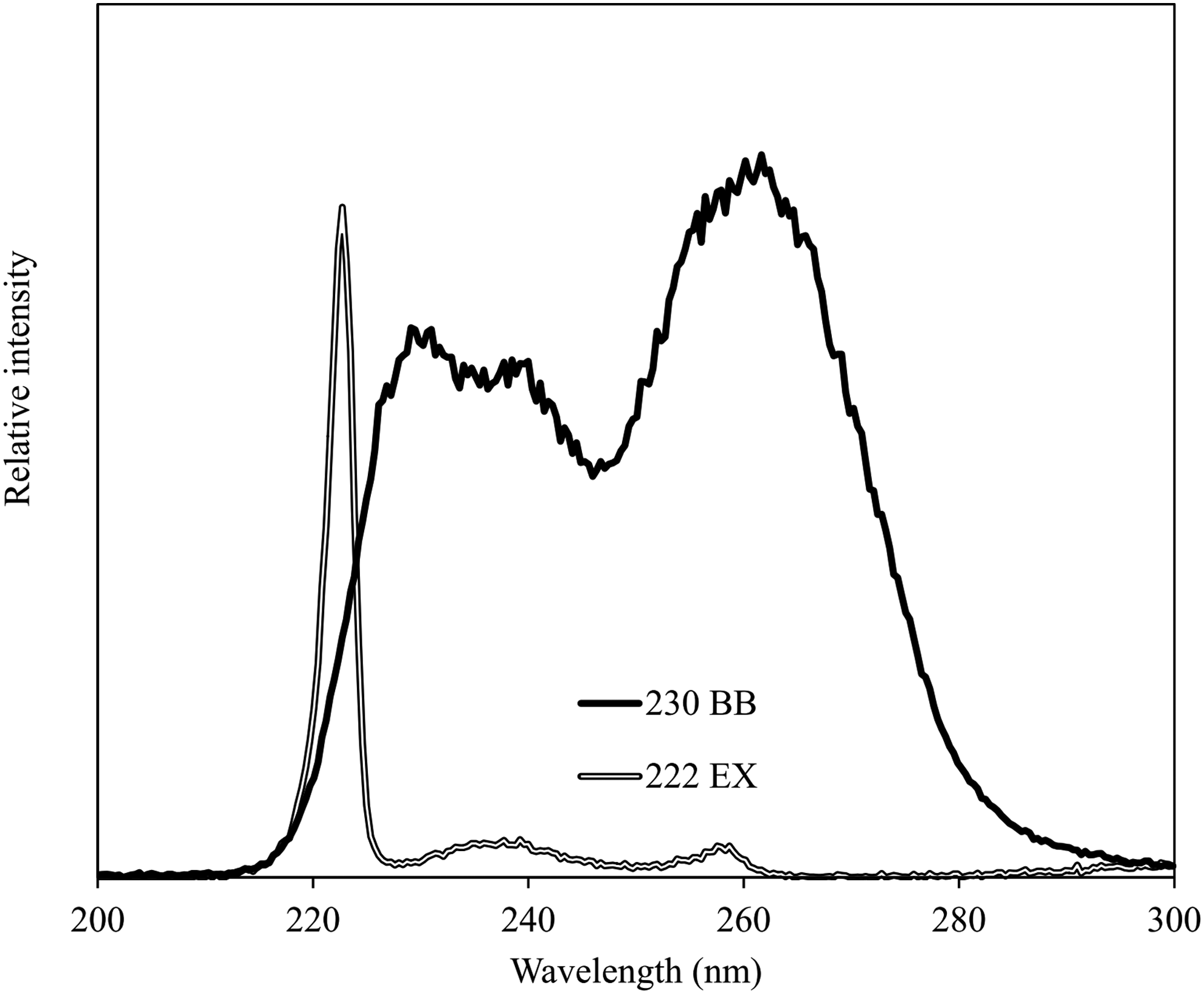
Emission spectrum of nonmercury excimer lamps.
For the NDMA degradation experiment, Milli-Q water was spiked with NDMA at an initial concentration of 100 μg/L. Our previous research indicates that initial concentration is irrelevant to degradation efficiency (Sakai et al., 2012, 2014), and 20 mL of NDMA solution was added into each Petri dish of diameter 56 mm. A 20 mL sample of each NDMA solution was exposed to each UV lamp and then 1 mL of NDMA in water sample was taken with time series. To investigate the effect of the water matrix, Suwannee river natural organic matter (SRNOM) and nitrate were added, because those compounds were expected to absorb UV light and hamper degradation efficiency. Two concentrations were used for each component: 1.5 or 3.0 mg C/L for SRNOM and 2.0 or 10.0 mg N/L for nitrate. Investigations were conducted in a tall beaker (height: 63 mm) to establish the effect of water composition on light absorption. Six water matrices were tested in total and denoted 1.5C, 3C, 2N, 10N, 1.5C2N, and 3C10N; 1.5C and 3C contained 1.5 and 3.0 mg C/L of SRNOM, respectively, and 2N and 10N contained 2 and 10 mg N/L of nitrate, respectively. Furthermore, 1.5C2N and 3C10N contained both SRNOM and nitrate at designated concentrations. The upper concentration of SRNOM and nitrate was set at the drinking water guideline value in Japan (3 mg C/L and 10 mg N/L, respectively), and the lower concentration was set at the average effluent value at a water treatment plant in Tokyo (1.5 mg C/L and 2 mg N/L, respectively). NDMA degradation rates were investigated in those solutions, as well as in Milli-Q water.
NDMA measurement
After exposure to the 222 EX or 230 BB UV lamp, 10 ng of NDMA-d6 (Cambridge Isotope Laboratories, Andover, MA) was added to 1 mL of sample solution. Water samples were analyzed using a UPLC-MS/MS (Acquity UPLC/TQD; Waters Corp., Milford, MA) operated in the electrospray/chemical positive ionization mode. A gradient mobile phase of 0.1% formic acid and acetonitrile was used. NDMA concentration was corrected using the recovery ratio of NDMA-d6. The quantification limit of this method was 1 μg/L. Details of UPLC-MS/MS analyses are described elsewhere (Asami et al., 2009).
Nitrite measurement
Nitrite formation during UV irradiation was assessed using both the 230 BB and 222 EX lamps. This experiment was conducted separately from the NDMA degradation experiment; 100 mL of nitrate solution was placed in a tall beaker and exposed to either the 230 BB or 222 EX lamp. After exposure to UV, 10 mL of solution was sequentially taken and provided for analysis by a colorimetric method using naphthylethylenediamine (Japan Water Works Association, 2011).
Results
Degradation of NDMA by excimer lamps
Degradation of NDMA by two excimer lamps was investigated, and the results are shown in Figure 2. Degradation by both lamps followed a pseudo-first-order reaction. Degradation rates of NDMA in Milli-Q water were found to be 10.8 cm2/J under the 222 nm UV lamp (222 EX) and 4.2 cm2/J under the xenon excimer UV lamp (230 BB). These values are much higher than those found for mercury UV lamps, of about 2.3 cm2/J (Sharpless and Linden, 2003; Sakai et al., 2012). This faster degradation could arise from the greater overlap between the wavelength range of the absorption spectrum of NDMA and the excimer lamps. NDMA has absorption peaks at 228 nm (ɛ = 7,378/M cm) and 332 nm (ɛ = 109/M cm) (Stefan and Bolton, 2002). Conventional mercury UV lamps emit at 254 nm, while KrCl excimer lamps (222 EX) emit at 222 nm and xenon-fluorescent lamps (230 BB) emit at 220–280 nm. Thus, in the case of Milli-Q water, it could be concluded that excimer lamps are suitable for NDMA degradation, as their emission wavelength range corresponds more closely to the NDMA absorption spectrum.
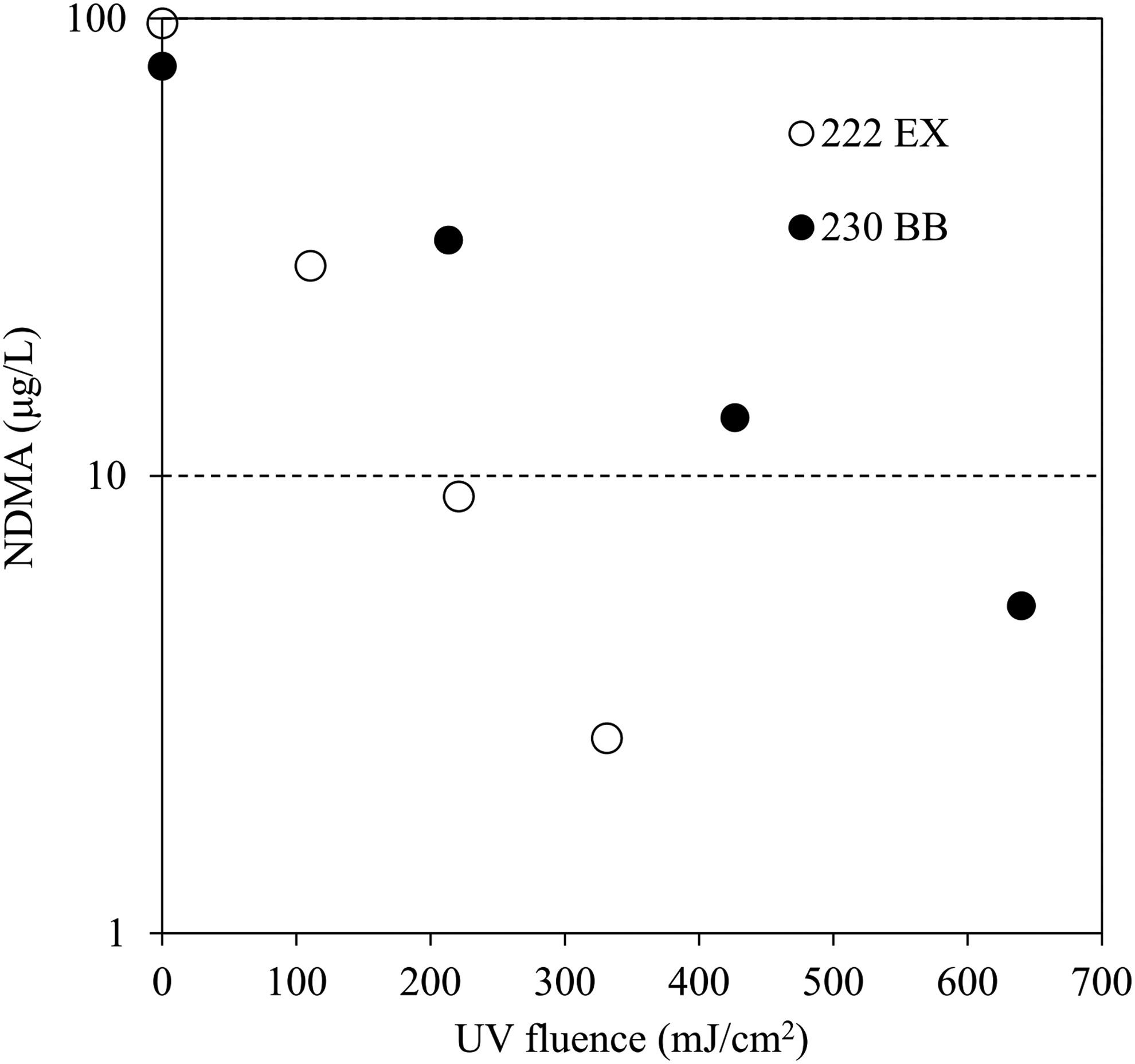
Degradation of NDMA by two excimer lamps. NDMA, N-nitrosodimethylamine.
Effect of water matrices
Components in water will affect the degradation rate of NDMA due to their absorption capacity. In monochromatic lamps, these effects can be calculated using absorption spectra; however, this cannot be easily predicted for polychromatic UV lamps because the contribution of each wavelength is unclear. Therefore, NDMA degradation was tested in water of various compositions; SRNOM and nitrate were used as representative water matrices. Two concentrations of each component were used: 1.5 and 3.0 mg C/L for SRNOM and 2.0 and 10.0 mg N/L for nitrate. Degradation rates were normalized to the rate in Milli-Q water and are shown in Figure 3.

Degradation ratio of NDMA in various water compositions by 230 BB lamp (•) or by 222 EX lamp (○).
The degradation rate was affected by SRNOM and nitrate in water. In the case of 222 EX, the degradation rate was affected significantly by components in water. In the solutions tested, the normalized degradation rate (rates in mixed solution per rate in Milli-Q water) dropped to less than 40%. Comparing SRNOM and nitrate, 222 EX performance was significantly affected by nitrate. Normalized rates were 37% and 28%, respectively, in the 1.5 and 3.0 mg C/L solutions. In the 2 and 10 mg N/L solutions, the rates were only 16% and 8.3%, respectively. In a mixed solution of 1.5C2N or 3C10N, the rates fell to 10% and 5% of the Milli-Q water, respectively.
Compared with the 222 EX lamp, rates did not decrease as significantly for the 230 BB lamp. It may be speculated that the smaller wavelength overlap between the 230 BB lamp and the nitrate absorption range caused this result. Degradation rates for the 230 BB lamp were less than the rate in Milli-Q water, although still greater than 48% in all solutions except 10N and 3C10N. Both SRNOM and nitrate affected degradation rates under the 230 BB lamp. The normalized rates in 1.5C and 2N were about 65%, showing similar inhibition by those two components at those concentrations. In a mixed solution of 1.5C2N, degradation rates dropped to 50%.
Absolute degradation rates are shown in Table 1. Compared to absolute values under both 222 EX and 230 BB lamps, 222 EX was superior to 230 BB only for Milli-Q water, 1.5C water, and 3C water. For the nitrate solution and mixed solutions, 230 BB showed larger degradation rates than 222 EX. Overall, 230 BB and 222 EX performance was affected by components in water. Comparing 230 BB with 222 EX, 230 BB had more stable performance and was affected less by water composition.
Nitrite formation
A particular UV wavelength can convert nitrate to nitrite, hence formation of nitrites may be an issue in the degradation of NDMA (Sharpless et al., 2003). Excess nitrite is a risk factor for methemoglobinemia, especially for infants. WHO drinking water guidelines propose a maximum nitrite concentration of 0.9 mg N/L (WHO, 2011), and Japanese drinking water standards (Ministry of Health, Labour, and Welfare, 2015) require a concentration of less than 40 μg/L. Thus, nitrite formation under degradation by both the 230 BB and 222 EX lamps was assessed for 2 mg N/L of nitrate. Results are shown in Figure 4. Degradation using 230 BB led to less nitrite formation compared to 222 EX, at the same UV fluence. Reduced nitrite production can be attributed to the smaller wavelength overlap between 230 BB and nitrate, compared to 222 EX. Thus, the 230 BB lamp is more suitable for water treatment. Within the UV fluence range investigated, nitrite concentrations of up to about 200 μg N/L were observed; this concentration did not exceed the WHO guidelines. Furthermore, nitrite can be converted to nitrate by exposure to chlorine—a conventional disinfectant. It should, however, be noted that nitrite production exceeded the 40 μg/L Japanese drinking water standard and that the nitrite concentration was less under the 230 BB lamp.

Nitrite production by excimer lamps by 230 BB lamp (•) or by 222 EX lamp (○).
Discussion
A knowledge of the key wavelength range for NDMA degradation is important. Our previous research (Sakai et al., 2012) on mercury UV lamps showed that a wavelength shorter than 250 nm would degrade NDMA significantly; in this study, the wavelength contributions of 230 BB and 222 EX lamps are discussed. Figure 5 shows the relationship between normalized UV irradiance and normalized degradation rate. Normalized degradation rates are the degradation rates divided by the rate in Milli-Q water, while normalized UV irradiance is the irradiance divided by the irradiance in Milli-Q water. UV fluence was calculated for two wavelength ranges as follows: (i) between 200 and 300 nm (Fig. 5a) and (ii) between 200 and 250 nm (Fig. 5b), in the same manner as in our previous research (Sakai et al., 2014). In this study, UV irradiance in mixed solutions was divided by that in Milli-Q water to calculate normalized UV irradiance. For a monochromatic 222 EX lamp, a correlation was observed between the normalized UV irradiance and the normalized degradation rate, with a determination coefficient of 0.87. For a polychromatic 230 BB lamp, the determination coefficient was 0.98 in the 200–250 nm wavelength range and 0.81 in the 200–300 nm range. This result clearly shows that the 200–250 nm wavelength range contributed to NDMA degradation more than the 250–300 nm wavelength.

Relationships between normalized irradiation energy and normalized degradation rate of 200–300 nm
Conclusions
This study investigated the performance of two mercury-free excimer UV lamps. Both lamps showed significantly improved performance in NDMA degradation compared to conventional mercury UV lamps. Moreover, the 222 EX lamp demonstrated a degradation rate four times faster than a conventional mercury UV lamp. The effect of the water matrix was also assessed, and it was found that SRNOM and nitrate affect the performance of the UV lamps, with a larger effect found with the 222 EX lamp. Considering the combined results for NDMA degradation, the effect of water matrices, and side reactions, 230 BB would be more suitable for water treatment. In contrast, 222 EX would be more appropriate for treatment of pure water.
Footnotes
Acknowledgment
The authors appreciate Ushio, Inc., for the use of xenon-fluorescent excimer UV lamp.
Author Disclosure Statement
No competing financial interests exist.