




Abstract
Abstract
While the historic Environmental Engineering and Science (EES) paradigm of limiting pollution discharges and reducing them where environmental harm has occurred has been highly beneficial to humanity and the planet, factors such as continued population and economic growth require new approaches. The new EES paradigm must implement proactive rather than reactive solutions, which focus on restoring the environment rather than simply remediating past pollution events. This paradigm will require implementation of integrated solutions that simultaneously address multiple media and create multiple benefits. Dramatically increased resource efficiency must become the norm. EES education, research, and practice must be integrated much more fully, both with one another and into society. This will require that new skills be more fully embedded into EES education, research, and practice. The profession can build on existing successes demonstrating how integrated solutions, delivered using an integrated education, research, practice model, can create additional value, while minimizing harm resulting from unintended consequences and restoring the environment. These successes can be used to create champions for this new approach, to gain increased public support, and to create increased demand for them. Practical successes can subsequently provide the basis for supporting policy changes. Professional associations can be key actors in this transformation by both synthesizing and defining best professional practice and engaging stakeholders outside of the EES profession. Creating this new paradigm will not be easy and requires leadership.
Introduction
T
History
One macroview of human history can be summarized as the human population consistently expanding to fill the carrying capacity of the planet. Since the carrying capacity is not constant, but is determined by both the natural and built infrastructure, the human population has increased dramatically over time in response to human technological developments, many of which are well recognized. Significant examples include the following: the invention of agriculture, which allowed previous hunter-gatherer societies to develop more secure food sources and facilitated the development of cities and civilizations; the industrial revolution, which mechanized many previously manual tasks; and the more recent green revolution, which greatly increased food production to support a burgeoning population. Figure 1 provides a perspective on how the human population has increased over the millennia.

Human population from 10,000 BC to 2,000 AD. Actual populations shown selectively on X-axis. Source: Wikipedia, 2014.
While Fig. 1 paints a picture of progressive development of the human population, punctuated with a few disasters such as plagues and wars, it is underlain by significant dynamic behavior as individual civilizations developed and then collapsed. The factors leading to collapse have been a topic of speculation (what caused the downfall of the Roman Empire?) as well as academic study (Tainter, 1988; Diamond, 2011; Acemoglu and Robinson, 2012). More recent analyses paint a picture of technological, economic, and social development that allowed population growth and resource consumption until resource consumption exceeded the natural carrying capacity, leading to rapid collapse. Collapse was often associated with natural fluctuations in climate occurring at a time when resource consumption stressed local resources (Weiss et al., 1993). Diamond (2011) offers many examples of this pattern, while both Diamond and Acemoglu and Robinson (2012) demonstrate that such collapses are not inevitable.
Collapses have generally been averted in recent history in the developed world, and EES has played a major role in this result. EES developed in response to water pollution problems created by the industrial revolution. Following the historical path (Sedlak, 2014), “Sanitary Engineering” developed in response to water supply needs and pollution in the industrial cities of Europe and the United States in the late 19th and early 20th centuries (see Schneider, 2011, for a highly instructive description). The first step was often water supply, which evolved in response to pollution of local water supplies by human and industrial waste, leading to severe health problems (e.g., typhoid and cholera epidemics). The delivery of unpolluted water from remote sources was, indeed, lifesaving. The transport of large volumes of fresh water into urban areas created the “problem” of sewage, which was addressed through wastewater collection, often coupled with further improvements in urban drainage to mitigate urban flooding. Wastewater treatment followed due to the localized mass discharge of pollutants (larger cities and increased industrial activity), resulting in unacceptable environmental degradation (Schneider, 2011; Daigger, 2014). The success of this approach to urban water management is illustrated by the fact that modern water and sanitation have been recognized by the medical profession as the single most significant contribution to public health over the past 150 years (British Medical Journal, 2007), and as one of the top ten engineering contributions to society in the 20th century (Constable and Somerville, 2003).
While hugely beneficial, approaches such as those developed to manage urban water in the late 19th and early 20th centuries are based on the implicit, or sometimes explicitly stated, paradigm that natural systems possess an inherent carrying (or assimilative) capacity. For example, although used (waste) water is treated, the quality of the product is degraded relative to the original. Consequently, the treated water cannot be safely returned to its origin or used again in the same manner and it is discharged back to the environment at a different location. The combination of treatment level and discharge location is specifically selected to minimize cost, reflecting the assumption that the natural environment can receive some contaminants. A discharge location is generally selected with maximum assimilative capacity (largest receiving water volume and maximum velocity for mixing and oxygen transfer), balanced by the costs for used water conveyance and treatment. Used water treatment is often not implemented until environmental degradation has occurred because discharges have exceeded the natural assimilative capacity, resulting in environmental degradation that must be remedied.
This “model” for pollution control has proved extremely successful in addressing a wide variety of societal problems, including air pollution, solid waste, and hazardous waste, and it forms the basis for the current EES profession, which evolved from sanitary engineering in the United States in the 1960's. It can be summarized as applying management and technology approaches to reduce environmental discharges to levels below the inherent environmental carrying capacity (which is often considered to be constant). This approach has contributed significantly to human well-being and increased the sustainable human population, however, it inherently assumes that control technologies and management approaches can be developed and deployed at least as fast as pollution loads develop. It generally does not internalize the resource requirements for pollution control, and it requires increasingly effective pollution control approaches to be applied, especially when the assimilative capacity of the environment is being fully utilized.
Current
Although there are important indications that change is upon us, the historical model continues to be the norm. The regulatory approaches to both water and air pollution control are based on allowable mass loadings of pollutants to the environment, within assumed assimilative capacity. For example, the U.S. Clean Water Act dictates that a total maximum daily load (TMDL) be established for water bodies that do not meet ambient water quality criteria. The allowable load of pollutants is then assigned to the relevant sources, and regulatory controls (limits) are placed on discharges from these sources. Control technologies and management approaches are then implemented to ensure that mass discharges from each source are below the assigned maximum load. It is generally assumed that control technologies and management approaches are available and can be applied, irrespective of other impacts and with few exceptions. Individual components of the hydrologic cycle are managed and regulated separately, thereby neglecting opportunities for synergistic, win–win, solutions. Water resources, drinking water, used water, and stormwater are managed by separate legislative and regulatory processes. Environmental burdens are also shifted from one medium to another. For instance, nutrient discharge reductions from point sources are being required, irrespective of the environmental consequences (such as greenhouse gas emissions) of the associated resources that must be consumed to do so (Falk et al., 2011). A similar approach is used to control sources of air pollutants. EES continues to play an essential role in this process, providing knowledge of the relevant environmental limits and impacts, sources of pollutants, control technologies and management approaches, and the associated professional practice to implement this knowledge. While one cannot doubt the effectiveness of current regulations, synergies inherent in more integrated approaches have seldom emerged from their application.
A growing number of factors suggest that the historic environmental management model described above is insufficient and will not suffice into the future. The global population has grown significantly over the past century and is expected to plateau at between 10 and 12 billion by the end of this century. The U.S. population is expected to increase to ∼400 million by 2,050 and 460 million by 2,100. Figure 2 summarizes recent population projections from the United Nations (2013), which belie significant demographic trends as the most significant population growth is expected in less developed countries (compared to the currently developed countries), along with significant population growth in the least developed countries. Recent analyses by the International Institute for Applied Systems Analysis (IIASA) question whether population growth will be quite as great as this (Lutz et al., 2014), but it is clear that the population will continue to grow during the first half of the 21st century and begin to plateau in the second half. Of course, it is also well recognized that the global population is increasingly living in urban areas (United Nations, 2014).
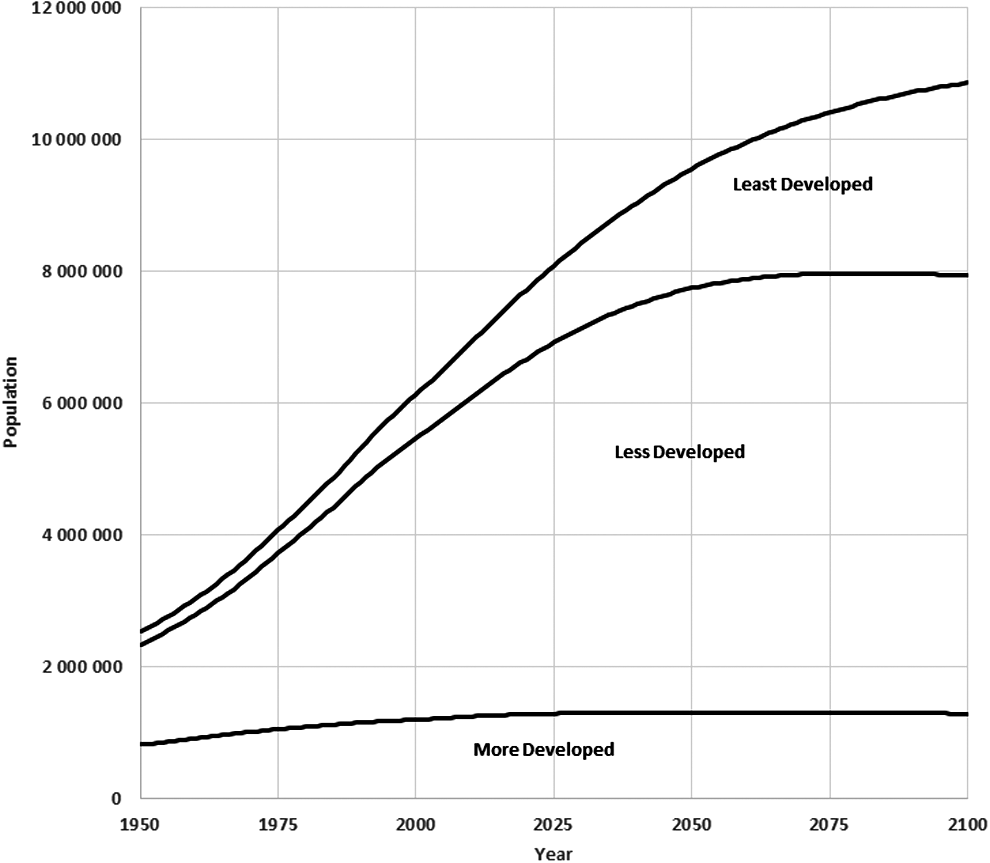
Historical global population 1950–2010 and projections to the end of the 21st century (data from UN, 2013).
While population growth is significant, economic growth is even faster. The global population grew by about 3 billion between 1970 and 2010 (from 3.7 to 6.9 billion), but the global economy roughly tripled. The global economy is expected to further quadruple between 2010 and 2050, even though population will only increase by about another 2 billion (OECD, 2012). Resource consumption has historically been coupled with economic growth (Fig. 3), and resource consumption is directly associated with environmental impacts (United Nations Environmental Programme [UNEP], 2011, 2014b; OECD, 2012). Figure 4 further illustrates the general relationship between economic activity and resource consumption by demonstrating that per-capita resource consumption generally increases with per-capita income, of course with important country to country variations. Global resource consumption is leading, further, to resource shortages (UNEP 2011, 2014a, 2014b).
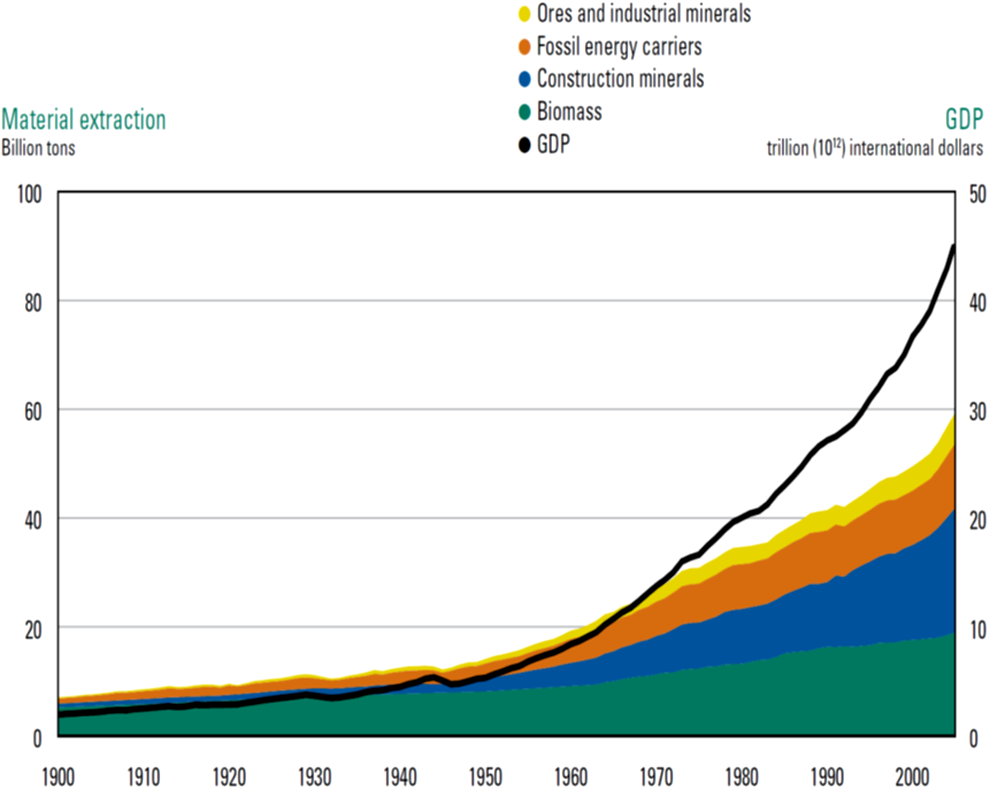
Relationship between economic growth (expressed as GDP) and material extraction between 1900 and 2005 (from UNEP, 2011). GDP, gross domestic product.

Relationship between resource use and income in 2000 for 175 countries (UNEP, 2011).
Global chemical production is another indicator of economic growth, and also a significant environmental concern (UNEP, 2013). As illustrated in Fig. 5, chemical production has grown progressively in developed regions and is projected to continue to grow. Growth in developing regions and countries with economies in transition has been even more significant in recent years, and is projected to exceed that of developed regions by 2020. Growth in the developing regions and countries with economies in transition is particularly significant because environmental controls are generally less effective there, leading to the potential for disproportionate adverse environmental impacts. Not only will the total volume of chemical production increase globally but also their number and diversity, leading to the potential for new environmental threats.
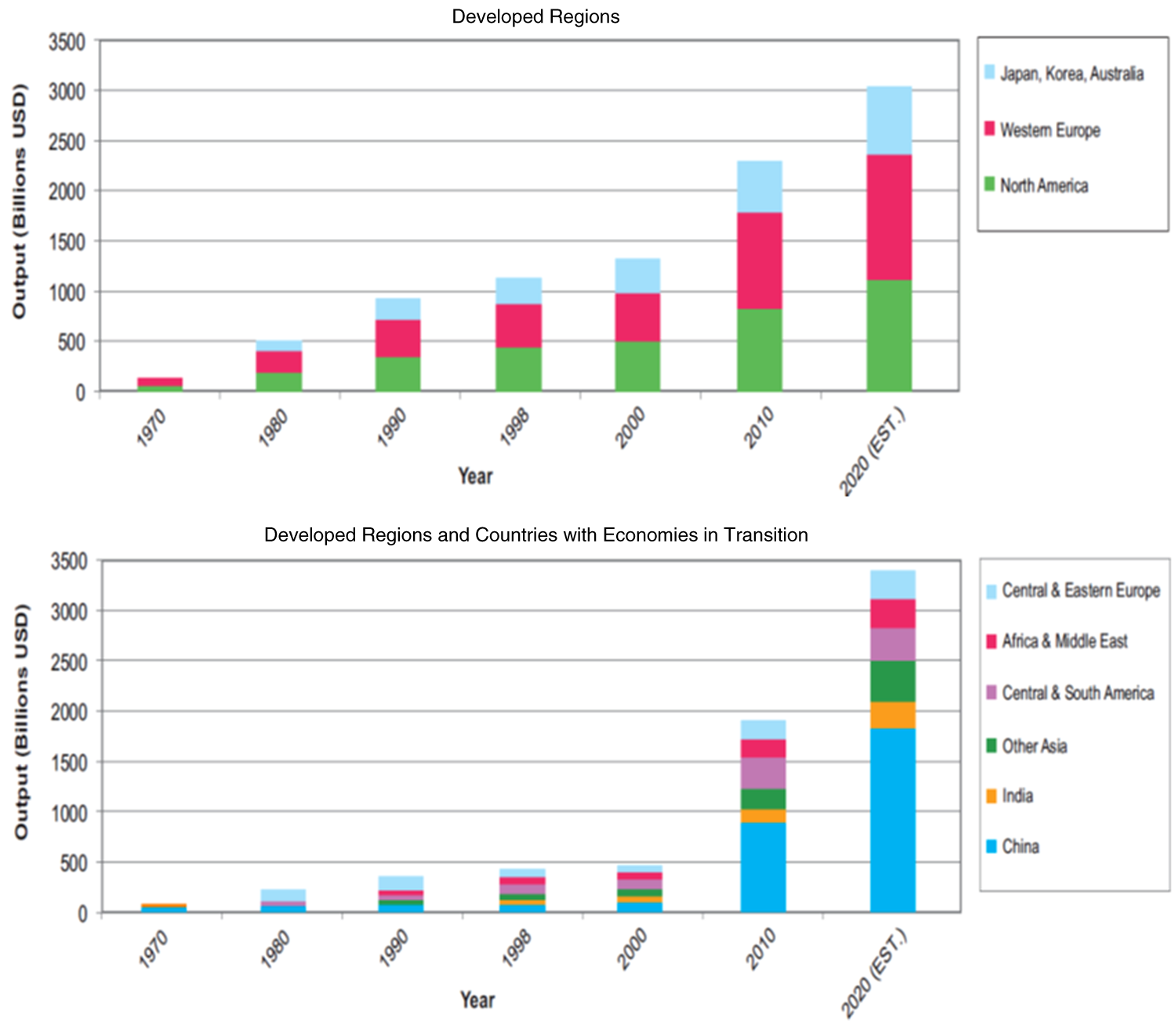
Historic and projected global chemical production (UNEP, 2013).
It is evident that the increased human activity is affecting the planet and its ability to support humankind. Climate change is, perhaps, the most widely recognized impact (IPCC, 2014). Rockstrőm et al. (2009), updated in Steffen et al. (2015), considered nine critical planetary systems, illustrated in Fig. 6, and concluded that three already exceed existing sustainable capacity, resulting in environmental degradation that threatens the future of humanity. The three not only include climate change, but also biodiversity loss and interference with global phosphorus and especially nitrogen cycles. Chemical pollution has not yet been quantified. Once a planetary boundary has been exceeded, the associated planetary carrying capacity may become vulnerable to reduction, resulting in a net decline. Thus, these boundaries must be respected, both to avoid harm to humanity and also retain them in their present capacity. Analyses such as these have led to numerous calls for increased resource efficiency, not only by environmental protection but also by environmental restoration (UNEP 2011, 2014a, 2014b; Brown, 2011).

Relationship between safe operating space (Green area) and current position (Red wedges) for nine planetary systems. Boundaries are exceeded for three systems: (1) biodiversity loss, (2) climate change, and (3) nitrogen cycle. From Rockstrőm et al. (2009).
It is apparent that the historical development paradigm of increased economic prosperity based on resource consumption will not be sufficient into the future. Significant economic, social, and political changes will be required to transition into a much more resource-efficient society with greatly reduced resource use and waste per unit of production. In fact, some suggest that converting from a consumptive to a resource recovery society will not only be necessary but also can spur further economic growth (McDonough and Braungart, 2002; Moody and Nogrady, 2010). These paradigms augment the historic one of developing technological solutions in response to social, economic, and environmental challenges so that historic patterns can continue. It appears clear, however, that technology alone will not be sufficient to sustain this paradigm into the future (Huesemann and Huesemann, 2011). Thus, the question that arises for EES is its role in a world with no (or much less) waste and in which technology, alone, is not the solution.
Future
The need for a new EES paradigm is evident, but what could it be and how can its implementation be accelerated? While we agree that a significantly more resource-efficient economy must be developed, we do not believe that waste will be totally eliminated. The concept of creating useful products from what has historically been considered to be waste is also certainly not foreign to EES. Considering the water cycle again, used water is currently reclaimed to produce waters of various qualities that can be used for a variety of purposes. Useful products such as energy and fertilizer/soil conditioning products are also extracted. The need is for actions such as these to become the norm, rather than the exception as they currently are. Components of this new paradigm are emerging, but they must be fully integrated into EES education, research, and especially practice. Deliberate actions to fully integrate EES education, research, and practice are needed to accelerate the needed changes. In this study, we outline a new paradigm, compared to the historic one, and the practices and supporting policies that can accelerate its implementation.
New Paradigm
The following are offered as essential elements of the new EES paradigm.
• Integrated solutions that simultaneously address multiple media and create multiple benefits will become the norm. As noted above, current approaches tend to result in different groups that subsequently focus on one issue, in one media, at a time. Such approaches are less efficient in creating overall benefits than integrated approaches, which consider a broader range of impacts and the potential for creating a wider range of benefits. The emerging concept of “one water,” where water resources such as irrigation water, water for energy, drinking water, used water, stormwater, and ecosystem flows are managed in an integrated manner, represents an excellent example. All water should be viewed as “one water” and water management solutions must not only reflect but also enhance the one water approach. The broader impacts of water management options on the air and the land must also be considered. While successful examples exist, significant institutional and regulatory barriers exist, which limit the current application of integrated approaches. Integrated approaches need to become the “first,” rather than the “last” approach adopted only when the problems created by the current “one issue at a time” approach become evident. New “smart water” concepts will help promote one water approaches through sensors, edge computing, big data, and artificial intelligence where multiple water resource systems are coordinated in an integrated near-seamless manner.
• Proactive rather than reactive solutions. Rather than reacting to “pollution” events, the focus will need to be on developing policies and incentives for integrated approaches that avoid rather than simply remediate environmental problems. One example would be policies and incentives that encourage development of green chemicals, for source reduction in use of chemicals, or for new approaches for their treatment before they result in harm. A dramatically more resource-efficient economy will lead to less waste and potentially less pollution. Commodity price increases associated with increasing scarcity will provide some motivation for increased resource efficiency, but should be coupled with early incentives to avoid the economic and social disruption such rapid price increases can create. The continued rapid expansion of science, which will certainly be an important component of the development of a more resource-efficient economy, can enable new constituents to enter the economy and potentially adversely impact the environment. EES must closely follow scientific and the associated economic developments, and anticipate and develop solutions before adverse impacts become evident. With continued exponential growth in the economy and the fixed (or declining) capacity of the environment to adsorb new insults, impacts must be anticipated and avoided rather than reacted to. Solutions that create useful products, rather than residuals to be disposed of, represent another example.
• Integrating EES practice within society. Successful solutions will require not only technological implementation but also societal involvement. Achieving this will require fundamental changes in EES education, research, and practice as it builds on its traditional technological strengths, while adding the knowledge and skills to engage much more fully with society (Guest et al., 2009). EES must not only be responsive to societal needs but also actively engaged in the discourse, which identifies relevant needs and defines societal agendas for addressing them. EES must be much more involved in the process of setting societal agendas and interact with relevant components of society as specific solutions are defined and implemented. This will require the development of a broad range of partnerships and collaborators outside of those traditionally developed by EES educators, researchers, and practitioners.
New Practices
Achieving this transformation of EES will require more than an increased knowledge. The paradigms articulated above must become thoroughly embedded in practice and fully supported by EES education and research. We suggest changes in three areas to accelerate this transformation:
1. Maximizing Value and Minimizing Harm 2. Restoring the Environment 3. Lifelong, Interdisciplinary and Multifunctional Education
Maximizing value and minimizing harm
As discussed above, the historic EES paradigm has been to reduce emissions to no more than the assimilative capacity of the environment. At the same time, problem solutions have generally focused narrowly and resulted in unintended consequences that negatively affect other portions of the environment. Finally, regulatory approaches generally address specific problems and provided little, if any, recognition for solutions providing broader benefits. To be fair, historic pollution issues were often so severe, and the solutions so obvious, that the benefits of implementing recognized solutions clearly out-weighed short-term negative impacts at that time. However, these issues have largely been addressed in the developed world, so those remaining require a different approach.
The first step is to focus on integrated systems to identify individual solutions, which can create a broad set of benefits throughout the entire system, for example, by reducing greenhouse gas emissions. Such solutions may not be the best to address narrow elements of the system, but would be the clear choice when viewed from an entire system perspective. Focusing on the entire water cycle, for example, rather than solving water resources, drinking water, and used water issues separately, is increasingly being recognized to be more efficient and effective because it provides multiple benefits (Daigger, 2009). Looking more broadly, addressing the water–food–energy nexus and looking at individual steps that create multiple benefits can lead to solutions that create additional value, while minimizing harm. A core operating principle might be to focus on efforts to achieve the greatest resource efficiency reasonably possible when conceiving of potential solutions and appropriately weighing the resulting benefits, when alternatives are being evaluated. This concept is present in EES education and research (consider, for example, industrial ecology and pollution prevention), but it needs to be brought more fully into the core EES practice. Existing regulatory approaches, which have evolved to address individual components of the entire system (considering water again, the Clean Water Act vs. the Safe Drinking Water Act and existing water resources legislation), will have to be modified to achieve this (Novak et al., 2015). Much can already be accomplished using the discretion inherent in individual legislative mandates, perhaps with some modest legislative modifications. The existing regulatory discretion must be fully used to both accelerate progress and identify changes in legislation and regulatory approaches that are truly needed.
At the same time, solution implementers (such as water utilities and air quality districts) need to receive “credit” for the net value they create, thereby creating incentives for them to pursue higher efficiency and integrated system options, and lowering barriers for those who are already so inclined. Increased resource efficiency often increases costs for solution implementers, while benefits are more broadly distributed. This maldistribution of costs and benefits can be a significant barrier to selecting and implementing options that provide the greatest societal value and minimum harm. Arrangements that allow solution implementers to more fully capture the value of all the benefits they create make sorely needed new sources of revenue available to them and further incentivize them to pursue such solutions. A further result would be increased incentives for solution implementers to invest in the development of higher value products, resulting in needed increased investment in EES research and education.
Greater uncertainties are generally associated with new solutions, as their experience base is smaller. Regulatory approaches should be modified to accommodate these greater uncertainties to reduce barriers to the implementation of higher value solutions. Uncertainty exists in many areas, including the requirements for successful implementation and the true nature and magnitude of potential value and harm. A number of approaches are available to manage risks associated with the implementation of new options. Systems analysis and risk identification and management tools are available, which can be applied as options are being evaluated and implementation plans are developed, and these tools can be more broadly applied to EES applications. Step-wise implementation reduces the inherent risks associated with each step, and allows learning from each step to be incorporated into those that follow. Such approaches provide rich opportunities for further research that can expand the understanding of social-environmental-economic-technical dynamics and allow further development of these tools. The rate at which higher value solutions are implemented and harm associated with unintended consequences is minimized could be dramatically accelerated.
Restoring the environment
The natural environment has already been degraded significantly, as noted above, which adversely impacts humanity. The adverse impacts of climate change, including increased droughts and floods, sea level rise encroaching on coastal areas, and impacts on agriculture, illustrate such impacts. A restored environment is able to provide increased environmental services and is more resilient to environmental shocks. Living as we do in the Anthropocene, many have noted that there are actually few truly “natural” environments remaining on the planet. Thus, restored environments will almost certainly be different from the ones that existed before human intervention. Indeed, ecological systems can exhibit a number of resilient states that provide essentially the same ecological functions, even though they appear structurally different from the original state. This brings an additional challenge as humanity must decide what type of environments it wants, and EES can lead in assisting society to make these critical decisions. A companion opportunity is offered as stressed systems can possess increased resilience and may, as a result, provide increased ecological services.
Environmental restoration entails more than simply reducing pollution discharges and includes making physical changes to the environment itself to allow an ecosystem to develop, which provides increased services and is more resilient to shocks. Restored environments are often more highly valued by the public. Thus, environmental restoration can not only provide highly valuable services to society but also increased public support, thereby creating a virtuous cycle of environmental restoration, creating increased demand for further restoration. The current increasing popularity of “green infrastructure” for stormwater management represents one example. Public value for restored environments can be expressed in monetary terms, for example, by increased property values, fishery, and recreational benefit. As with other broader benefits, increased monetary value is captured by society, but not by solution implementers, even though they bear the costs.
Approaches can be developed, however, to allow the wealth created by environmental restoration to be at least partially captured by solution implementers. These broader benefits are monetized for local, regional, and national governments in the form of increased taxes on the associated increased economic activity. That these benefits are created, at least partially, by environmental solution implementers could be recognized by transfer of a portion of these increased taxes to them, or through increased utility rates. Solution implementers can use past successes to quantify the broader benefit provided and “make the case” for further support. Such approaches make engagement of the public in the process of deciding what solutions to implement even more important. The challenge for EES is to develop and more routinely use practices to address public interests in the decision process. This entire area represents a rich research opportunity, with the potential to further advance EES practice and value to society.
Lifelong, interdisciplinary and multifunctional education
A focus on integrated solutions, which increase value production and reduce unintended consequences, and on environmental restoration, can increase public demand for the services that EES can provide, resulting in increased resources being made available. The potential results for society must be successfully delivered, however, and ideally within an accelerated timeframe, given the increasingly insistent nature of the problems faced by humanity. EES professionals will be working on broader problems, which require more diverse, interdisciplinary, and multifunctional teams, and the pace of learning will increase dramatically, making lifelong learning much more important. An integrated approach to EES education, research, and practice will be needed to meet the need.
Practice can advance rapidly only if research is an essential component of it. As a profession, we will be learning and improving practice as we proceed, and this can be done most effectively by integrating research more fully into leading edge practice. New partnerships between solution implementers, the practitioners that support them, and academia are needed. Fortunately, a wide variety of models to accomplish this goal exists, which can be more fully incorporated into EES practice. Every activity must be viewed as a learning experience and the associated learning subsequently incorporated rapidly into evolving practice. Professional associations can be essential partners in accomplishing this. Learning will be lifelong, of course, to match the rapid change in practice, meaning that formal education at the university level is only the start. Practitioners must be continuously reeducating themselves.
Current EES education, research, and practice are firmly based on the physical, chemical, and biological sciences. Grounding EES in these sciences will remain an essential feature of the discipline if we are to meet the needs listed above. Additional knowledge and skills are needed, however, as listed in Table 1. All these represent existing and evolving bodies of knowledge that can be accessed and brought into EES. For example, a theory and practice of ecological–social systems are developing, based on expanding the understanding of complex systems, along with an improved understanding of how more resilient systems can be developed (Walker and Salt, 2006; Meadows, 2008). The knowledge and skill areas listed in Table 1 could be incorporated into EES education and codified in the defined body of knowledge (American Academy of Environmental Engineers and Scientists [AAEES], 2009).
Formal knowledge acquired at the university must also be supplemented by a much wider range of knowledge and skills for students, which can be best accomplished by their direct engagement in practice early in their careers. Students could be engaged in practical, applied research as an essential component of their education, further reinforcing the functional relationship between education, research, and practice. One can envision a working environment where more seasoned professionals serve as on-the-job mentors to students, while these same students help update the seasoned professional on new scientific developments. The Water Environment & Reuse Foundation (WE&RF). Leaders Innovation Forum for Technology (LIFT) program represents one example where solution implementers are encouraged to partner with universities and create student educational opportunities through research.
New Policies
Significant progress can be made, within the current regulatory and policy framework, to implement the practices listed above and achieve the desired EES paradigm shift. Policy changes and changes to regulatory approaches can further facilitate these transitions, however, as suggested in Table 2. Many environmental regulations incorporate foresite-based components (consider the Safe Drinking Water Act and the Clean Water Act), and these provisions could be more fully utilized if supported by both public policy initiatives and those responsible for implementing the resulting actions (solution implementers). The foresite provisions of most environmental regulations, themselves, could also be strengthened.
Regulatory approaches could also be better integrated. The first step, again, is to more fully use the flexibility already provided in existing regulations and through the enabling legislation. A more integrated approach could be taken by the regulatory agencies themselves, which would likely require major changes to processes, procedures, and mindsets within the agency. Regulatory and legislative remedies could be further pursued when this approach is insufficient. Solution implementers and their supporters could take the lead in this, as described below, with successful experiences built on and incorporated into normal processes and procedures.
Turning to academia, the existing “science” model, which emphasizes publications and fundamental research rather than engagement in practice, is a barrier to implementing the integrated education, research, and practice model described above. Alternate academic models are available and could be applied for these more applied disciplines. Consider, for example, the model used to determine membership in the National Academy of Engineering that assesses professional, educational, and practice-related outcomes. Such a model would assess not only published research but also to what extent research results are translated into practice. It would also value practice-related contributions equally with relevant research contributions. The relative weight applied to advances in education and knowledge gained through research, scholarship, and advances in practice would be adjusted depending on their intended relative contribution by the individual academic.
Achieving these policy changes will require the concerted and collaborative efforts of regulators, solution providers, and the practitioners who support them, and academia. Policy changes take time and often require evidence of benefit before they are seriously considered and adopted. It is fortunate that the seeds for the necessary changes are already present, and in selected instances are being actioned. The first step is to create an additional demand for higher value integrated solutions and actions that restore the environment. Increased demand can result in resources to develop the necessary support systems, and they also provide the “living laboratory” necessary to ensure that these supporting systems align with practical realities. Solutions of this type are already being implemented, demonstrating that champions for these approaches exist, along with the needed competence to successfully deliver them. Solution implementers must lead these efforts, with strong support from other practitioners and academics. Professional associations can also be instrumental in this process by both providing the platform to synthesize and articulate the evolving professional practice, which underlies successful delivery of these higher value solutions, and as a platform to engage the profession more fully with potential partners outside of EES. All segments of EES, educators, researchers, and practitioners must engage in these efforts, with a commitment to transform the profession to meet the needs of the future. Changing fundamental paradigms is hard (Kuhn, 1970) and requires leadership (Kouzes and Posner, 2012). Acemoglu and Robinson (2013), referred to earlier, speak of “creative destruction.” Diamond (2011) speaks on how sustaining civilizations retain their core values, while adapting their practices to current realities. EES is founded on the basis of a clear and consistent set of values, but is at the stage where “creative destruction” is needed to recreate its practices.
Footnotes
Author Disclosure Statement
No competing financial interests exist.