




Abstract
Abstract
The simultaneous TiO2/UV photocatalytic degradation of 1,4-dioxane, n-nitrosodimethylamine (NDMA), tris-2-chloroethyl phosphate (TCEP), gemfibrozil (GEM), and 17β-estradiol (E2) in water at pH 5.0 and 1.5 g/L TiO2 using a 1-L slurry photoreactor was investigated. Intermediates originating from degradation of individual contaminants and interaction between them were evaluated and possible reaction pathways were suggested. Gas chromatography/mass spectroscopy analysis was used for identification of these intermediates. Results obtained showed that the compounds identified were mostly derived from 1,4 xylenol, a moiety from gemfibrozil. Isomerization and alkyl shift mechanisms were found to be responsible for formation of intermediates. Nitrogen compounds derived from NDMA degradation were reactive with other fragments and generated several other compounds such as pyridines, secondary amines, carbamate derivatives, and diazoles. Interaction between 1,4-dioxane and TCEP by-products was limited to formation of a few detected compounds. Some individual oxidation by-products of E2 were identified as estrogenic species such as testosterone and estrone. These findings are an important step to better understand the photocatalytic process applied to degradation of multiple organic contaminants in complex aqueous matrices.
Introduction
O
Advanced oxidation processes have been found to be effective treatment options to treat ECs in contaminated waters (Dionysiou et al., 2000; Esplugas et al., 2002; Lee et al., 2005b; Pignatello et al., 2006; Snyder et al., 2006; Li et al., 2007). In addition, some studies have investigated individual degradation pathways of ECs. Stefan and Bolton (Stefan and Bolton, 1998) identified intermediates from the degradation of 1,4 dioxane using H2O2/UV oxidation. Aldehydes, organic acids, and esters were identified as intermediates formed from this oxidation process. Mahendra and colleagues (Mahendra et al., 2007) identified 2-hydroxyethoxyacetic acid as one of the major intermediates from 1,4-dioxane degradation by monooxygenase-containing bacteria. Lee et al. (2005b) investigated the degradation of n-nitrosodimethylamine (NDMA) by TiO2 photocatalysis and found that methylamine (MA), dimethylamine (DMA), nitrate (NO3−), nitrite (NO2−), and ammonium (NH4+) were the main products found. Mechanisms of tris-2-chloroethyl phosphate (TCEP) degradation were investigated by Ruan et al. (2013), who identified monochloroacetic acid, monochloroacetaldehyde, formic acid, acetic acid, and phosphate ions as main intermediates of its degradation pathway. In a different study, Karpouzas and Singh (2006) assessed the microbial degradation of organophosphorous compounds and found that the degradation of these chemicals started with the hydrolysis of the ester bonds. Most of the literature regarding gemfibrozil's (GEM's) transformation cites its reaction with chlorine to form several chlorinated species in water treatment plants (Krkošek et al., 2011; Bulloch et al., 2012). In the case of 17β-estradiol (E2), even a small change in its structure may increase the estrogenic activity of the new compound formed. Ohko et al. (2002) found 10ɛ-17β-dihydroxy-1,4-estradien-3-one and testosterone species as intermediates of the photocatalytic oxidation process.
The objective of the present work was to suggest pathways for the formation of intermediates generated from the interactions among partial degradation of 1,4 dioxane, NDMA, TCEP, GEM, and E2 as a result of photocatalytic oxidation. By-products generated from direct degradation of the parent compounds and intermediates generated from random interactions were identified using gas chromatography/mass spectroscopy (GC/MS) analysis. The matrix evaluated represents a small fraction of contaminants that may typically be found in contaminated waters. However, the identified intermediates and suggested reaction pathways may contribute to a better understanding of the photocatalytic process and allow researchers to explore the potential risks associated with formation of by-products in real waters. The selection of compounds was based on their occurrence in water sources, their representativeness of contaminant subcategories, and their importance as part of the EPA Draft Contaminant Candidate List (CCL 4; EPA, 2015).
Experimental Section
Photocatalytic reactor
Experiments were performed in a 1-L water-jacketed batch photoreactor unit (510 mL effective capacity; Ace Glass). The reactor was provided with a double-walled quartz immersion well with removable inner cooling tube and equipped with a medium pressure, mercury-vapor lamp of 100 W nominal power (delivering ∼4.7 W of radiated energy in the UV range, 366 nm peak, not collimated). A refrigerated bath circulator unit (RTE-111 NESLAB™, Thermo NESLAB) was used to keep the temperature of the water inside the reactor at a constant temperature, 20°C ± 2°C. A constant oxygen flow rate of 3 ft3/min was sparged in the reactor, and a magnetic stirrer (Fisher Scientific) was set to 700 rpm to maintain complete mix of the aqueous sample.
Sample preparation and oxidation
Initial concentrations of each compound in the aqueous samples were ∼2 mg/L. From previous work (Alvarez-Corena, 2015), the optimal conditions for the degradation of the selected contaminants were found to be at pH 5.0 and 1.5 g/L TiO2 concentration. The aqueous samples were stirred for 10 min in a foil wrapped beaker before experiments. The UV lamp was operated for 10 min before experiments to achieve constant operating temperatures; this resulted in consistent UV power delivery to the aqueous solution. Then, the contaminated aqueous solutions were transferred to the reaction unit, and samples collected for analysis after predetermined reaction times (2 and 26 min). Control experiments (direct photolysis and TiO2 adsorption in darkness) were conducted to verify that none of the intermediates other than those formed from UV/TiO2 oxidation was identified as part of the photocatalytic process.
Chemicals and reagents
The following chemicals were used as received: titanium (IV) oxide nanopowder (Aeroxide P25, ≥99.5%), 1,4-dioxane (99.8%; Sigma-Aldrich), n-NDMA (98%; Sigma-Aldrich), TCEP (97%; Sigma-Aldrich), GEM (98%; Sigma-Aldrich), and E2 (≥98%; Sigma-Aldrich).
All reagents used for chromatographic analyses were HPLC grade: methylene chloride (99.9%; Fisher Scientific, Inc.) as solid-phase extraction (SPE) eluent, and chlorobenzene (99.9%; Sigma-Aldrich) as internal standard. Purified water was prepared using a Thermo Scientific Barnstead Nanopure Life Science UV/UF system with a TOC analyzer, for which effluent TOC was ≤5 mg/L.
Sample extraction
Samples (500 mL) were collected from the photoreactor at the predetermined reaction times, centrifuged at 4,500 rpm for 45 min (MARATHON 21000R; Fisher Scientific, Inc.), and then vacuum filtered using 0.45 μm, 47 mm GVS Maine nitrocellulose-mixed esters of cellulose membrane filters (Fisher Scientific, Inc.). The centrifuged and filtered samples were then passed through SPE cartridges (Supelclean™ ENVI-18; Supelco). The cartridges were placed in an SPE assembly unit Supelco-Visiprep 12-port flask manifold (Supelco). Elution extraction was performed using 3 mL of methylene chloride at 1 mL/min rate. The eluate was then evaporated to complete dryness under a gentle nitrogen stream at room temperature using a RapidVap evaporator (Labconco Corp.), then reconstituted to a final volume of 1.5 mL in methylene chloride, and finally stored in 1.5-mL glass vials at 4°C for analysis.
Identification of intermediates
GC/MS analyses were carried out using an Agilent 7890A gas chromatograph/mass spectrometer 5975C VL MSD with Triple Axis Detector (Agilent Technologies). Separation was conducted using a column, 30 m × 250 μm × 0.25 μm nominal film thickness column (HP-5MSUI–ultra inert). Helium was the carrier gas at 1.6 mL/min. Splitless injection mode (2 μL, 290°C) was used. The temperature program was set as follows: 32°C for 4 min with a hold time of 4 min, ramped to 50°C at 3°C/min, and finally ramped to 290°C at 8°C/min with a hold time of 3 min for a total run time of 42 min. Electron ion mass spectra was monitored from 30 to 400 m/z, 2.4 min solvent delay. The ion source and quadrupole temperatures were set at 230°C and 150°C, respectively. The instrument was operated in an electron ionization mode. As the main purpose of this work was the identification of intermediates as a result of photocatalytic oxidation, experiments were conducted at higher concentrations (mg/L) than the low range of typical environmental concentrations (ng/L) to allow for identification of by-products.
Results and Discussion
Photocatalytic treatment
It was found in a previous work (Alvarez-Corena, 2015) that degradation kinetics was the greatest at pH 5 and 1.5 g/L TiO2 concentration. GEM exhibited the fastest degradation rate among all the compounds of the matrix as shown in Fig. 1. This trend is favored by low solubility of GEM in water and the presence of a carboxyl group as part of its structure, which makes this molecule more prone to adsorption on the TiO2 surface (Alvarez-Corena, 2015). Conversely, TCEP exhibited the slowest degradation kinetics of all compounds evaluated due to the nature of its leaving groups.
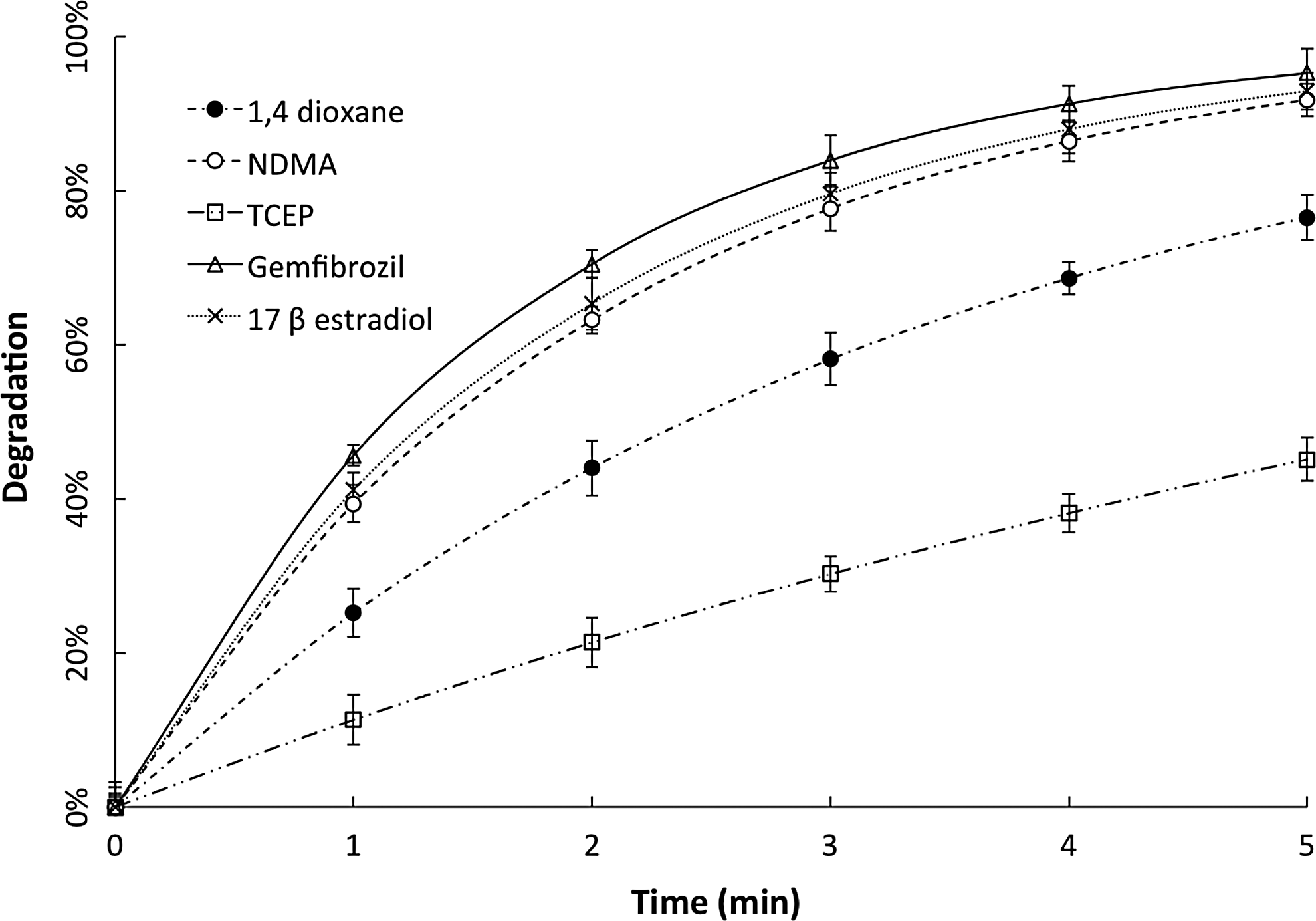
Photocatalytic degradation of five contaminants by TiO2/UV oxidation. Conditions: pH 5, 1.5 g/L TiO2 (Degussa), and 3 cfh O2. TCEP, tris-2-chloroethyl phosphate.
Identification of intermediates
The simultaneous photocatalytic degradation of five contaminants involved multiple reaction pathways, and the depletion of the parent compounds by oxidation was initiated at t = 0 min. Therefore, a wide variety of intermediates at early stages of the photocatalytic process were expected. Experiments to identify by-products were run for two different reaction times, 2 and 26 min, followed by intermediate identification using GC/MS analysis. At 2 min, 27 intermediates were identified, 21 from individual degradation of parent compounds and 6 from interaction of fragments of different compounds. Conversely, at 26 min, no intermediates were detected, however, there was the presence of pure TCEP and 1,4 dioxane at very low concentrations (ng/L range).
Two groups of degradation intermediates were suggested to come from two different sources: (1) as part of the sole degradation pathways of their respective parent compounds. Formic acid and oxalic acid were identified from 1,4 dioxane degradation. Methylamine and dimethylamine from NDMA degradation. Phosphoric acid, 2-chloroethanol, and 2-chloroacetic acid from TCEP degradation. Testosterone, 17β-dihydroxy-1,4-estradien-one, and 2-hydroxyestradiol from E2 degradation. The pathways for the individual degradation of these compounds have been described elsewhere by others (Stefan and Bolton, 1998; Ohko et al., 2002; Lv et al., 2013) and (2) random interactions among secondary compounds and fragments—these formation pathways were discussed in this work. Note that GEM intermediates have been studied much less than those generated from the other four compounds. In addition, the degradation of GEM played an important role in the formation of the majority of the intermediates detected in this work. Therefore, the sole degradation of GEM was elaborated as given below.
Gemfibrozil's intermediates
Most intermediates identified were derived from 2,5-dimethylphenol (p-xylenol), a GEM moiety. This behavior suggests that the GEM degradation pathway likely initiates with a heterolytic cleavage at the ether oxygen position dividing the molecule into two main fragments: p-xylenol (detected in this work) and 2,2-dimethyl-5-oxopentanoate, which is consistent with Yurdakal's work (Yurdakal et al., 2007). In addition to p-xylenol, nine derivatives that are thought to come directly from the p-xylenol structure were identified as follows: 2,3-dimethylphenol (o-xylenol), 2,6-dimethylphenol (m-xylenol), 3-hydroxy-4-methylbenzaldehyde, 3-hydroxy-4-methoxybenzyl alcohol, 2,5-dimethyl-1,4-benzonquinone, 3-methoxybenzaldehyde (m-anisaldehyde), 5-(hydroxymethyl)-2-methylphenol, 3-(hydroxymethyl)phenol, and limonene.
Transformation of the p-xylenol molecule to m-xylenol and o-xylenol isomers is proposed. This pathway may have undergone by alkyl shift mechanism based on electrophilic aromatic substitution due to hydroxyl radical attack (Johnson et al., 1951; Loebl et al., 1951) (Fig. 2). Photocatalytic isomerization of organic compounds has been previously studied by Kodama and Yagi (Kodama and Yagi, 1992), as well as xylene's isomerization over Friedel–Crafts (F-C) catalysts (Guisnet et al., 2000).
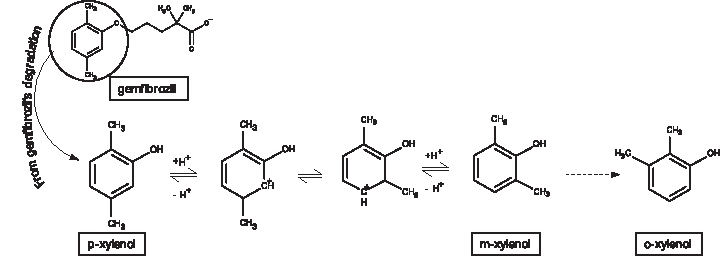
Suggested alkyl shift mechanism to the formation of p-xylenol's isomers: o-xylenol and m-xylenol.
Hydroxylation of any of the two methyl groups of the p-xylenol's molecule is favored by the action of the hydroxyl radical, which leads to the formation of 5-(hydroxymethyl)-2-methylphenol. Then, following the oxidation of the –OH group originating from the last step, the formation of 3-hydroxy-4-methylbenzaldehyde, as shown in Fig. 3, is suggested. In another reaction, (hydroxymethyl)-2-methylphenol can be potentially transformed into 3-hydroxy-4-methoxybenzyl alcohol by a substitution –O–CH3 of the methyl group, as shown in Fig. 3. Similar reactions were also reported by Riyas and colleagues (Riyas et al., 2008) for the photocatalytic degradation of toluene.

Suggested pathway formation of 3-hydroxy-4-methylbenzaldehyde and 3-hydroxy-4-methoxybenzyl alcohol.
Formation of 2,5-dimethyl-1,4-benzonquinone corresponds to a known conversion process from phenols to benzonquinones. In this study, it is likely that the conversion begins with the hydroxylation at the C4 of the benzene ring of the p-xylenol moiety as shown in Fig. 4, followed by protonation–deprotonation mechanisms until the formation of benzoquinone is complete. Similar results were obtained by Terzian and Serpone (1995), Ai et al. (2005), Huang et al. (2008), and Levchuk et al. (2015).

Suggested pathway of the 2,5-dimethyl-1,4-benzoquinone formation.
Finally, another intermediate from the degradation of GEM is 3-methoxybenzaldehyde (Fig. 5), which is likely to be formed from hydrodealkylation of p-xylenol to form 3-methylphenol and methane. Then, hydroxylation of the methyl group in the para position by the hydroxyl radical originates 3-(hydroxymethyl)phenol and subsequent oxidation of the –OH group that ends in the formation of an aldehyde. The final stage in the formation of 3-methoxybenzaldehyde is the alkylation with a methyl group by nucleophilic substitution of phenol at the alcohol group in the benzene ring.

Suggested pathway of 3-methoxybenzaldehyde formation.
Interaction among compounds
Several intermediates were identified as a result of random reactions among different products. Mechanisms were suggested to describe the synthesis of these compounds. A wide variety of different compounds were identified, such as carbamates, imidazoles, pyrrolidines, propanamides, acetophenone, furans, and long-chain hydrocarbons. Possible pathways of formation for some of these compounds are detailed below.
The majority of the intermediates found were thought to have originated from reactions involving GEM degradation by-products, as shown in the previous section. Interactions between the intermediates from the degradation of NDMA and GEM likely formed 3,5-dimethylphenyl N-methylcarbamate and N-(4,6-dimethoxypyrimidin-2-yl)-2-methylpropanamide. Also, reactions between the intermediates from NDMA and E2 degradation indicated the generation of 1-methylpyrrolidin-2-one and 2-methyl-4,5-dihydro-1H-imidazole. In addition to (5Z)-4-methyl-5-(2-oxopropylidene)-2,5-dihydrofuran-2-one, there were other intermediates identified, including testosterone, 17β-dihydroxy-1,4-estradien-one, and 2-hydroxyestradiol (not shown in Fig. 6). The presence of these intermediates is consistent with Zhao's findings (Zhao et al., 2008) where it was shown that the attack of reactive species mostly started at E2's aromatic ring moiety, leading to the formation of similar estrogenic intermediates by modifying the structure of the parent compound at early stages of the heterogeneous photo-Fenton reaction. 2-chloroethoxy ethane and acetophenone were formed as intermediates from the interaction of 1,4 dioxane and TCEP derivatives. A complete list of the intermediates detected in this work and the gas chromatography/mass spectroscopy chromatograph are shown in Supplementary Table S1 and Supplementary Figure 1, respectively.
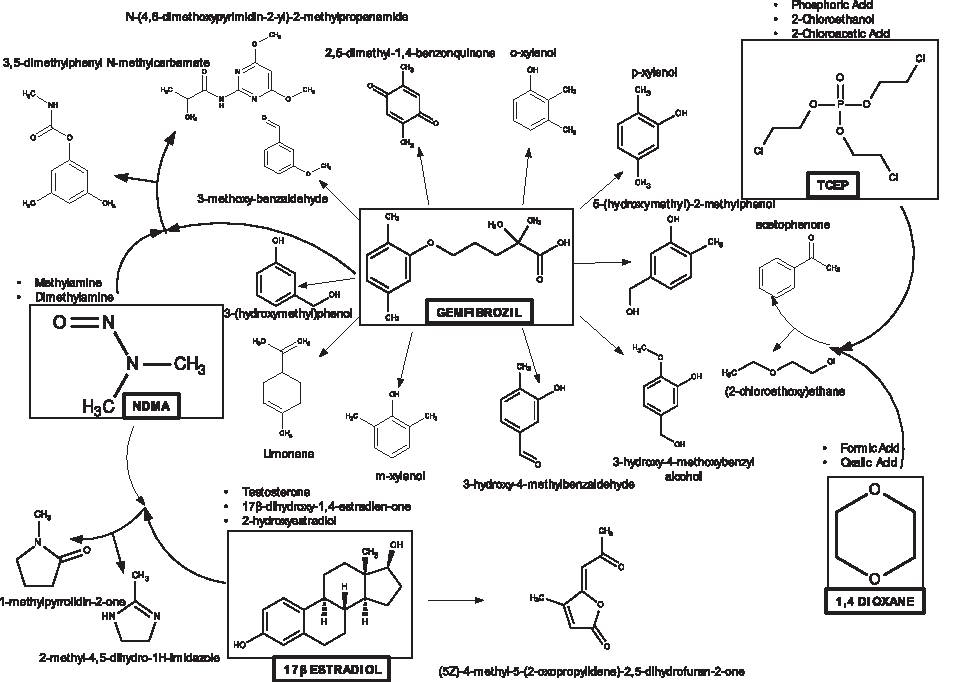
Identified intermediates and suggested formation dependence of selected compounds in the simultaneous UV/TiO2 oxidation of 1,4 dioxane, NDMA, TCEP, GEM, and E2. E2, 17β-estradiol; GEM, gemfibrozil; NDMA, n-nitrosodimethylamine. A complete list of the intermediate detected in this work is shown in Supplementary Table S1.
From the initial cleavage of GEM (Fig. 7), the p-xylenol moiety was attacked by an electron (possibly generated from the conduction band of the TiO2) at the –OH group (Park and Choi, 2005), and then due to thermal hydrodealkylation, the 1,4-xylene could have led to the formation of benzene. Parallel to the mentioned reaction, chloroacetic acid (Koenig et al., 2000) was also detected. It is a possible disinfection by-product (produced from TCEP) and acetic acid (a 1,4-dioxane minor intermediate) reactions, and may have reacted with benzene to produce acetophenone following the F-C acylation mechanism. A similar mechanism was studied by Afzal Pasha et al. (2006).

Suggested pathway of acetophenone formation.
Carbamic acids are compounds derived from the attachment of an acid group to an amine (Salvatore et al., 2001); the formation of methylcarbamic acid could occur through hydrochloric hydrolysis of the R-N = O structure of the NDMA molecule (Bruckner and Harmata, 2010). Then, o-acylation of 3,5 dimethylphenol and the unstable methylcarbamic acid takes place to form 3,5-dimethylphenyl-N-methylcarbamate as illustrated in Fig. 8.
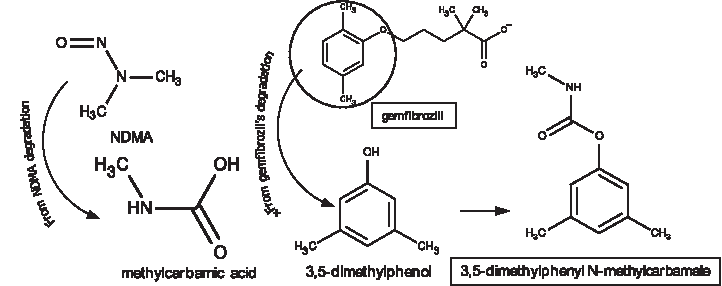
Suggested pathway of methyl carbamic acid and 3,5-dimethylphenyl N-methylcarbamate formation.
The formation of 2-methyl-4,5-dihydro-1H-imidazole was suggested from a two-step process that follows the Debus-Radziszewski imidazole synthesis and originates from the interaction of oxaldehyde, acetic acid, and ammonia, which are by-products of the oxidation of E2, 1,4 dioxane, and NDMA, respectively (see Fig. 9).

Suggested pathway of 2-methyl-4,5-dihydro-1H-imidazole formation.
Finally, compounds like N-(4,6-dimethoxypyrimidin-2-yl)-2-methylpropanamide were also detected. The pathway for this derivative involves several intermediates such as dimethyl malonate (a malonic acid derivative), guanidine (nitrosamine) and isobutyric acid (a suggested degradation product of GEM's pentanoate moiety) which come from 1,4 dioxane, NDMA and GEM, respectively. This pathway starts with a protonation of one of the carbonyl oxygen of the ester derivative by the double bonded amino group of the unstable guanimide, and then a proton transfer from the amino group takes place to link the two molecules. Consequently, the ring closure of the carbinolamine forms a diol structure followed by two successive eliminations and proton transfers to end with 2-amino-4,6-dimethoxypirimidine, which finally interacts with carboxylic acid to form the pyrimidine derivative (Fig. 10).

Suggested pathway of N-(4,6-dimethoxypyrimidin-2-yl)-2-methylpropanamide formation.
Conclusions
Several oxidation by-products were identified in this work. The formation pathways suggested here, although with some similarities to pathways reported by others, are reported for the first time. This contributes to the knowledge of advanced oxidation applied to water treatment. GEM's oxidation derivatives exhibited a high degree of reactivity and affinity to react with other compounds and fragments to form a wide variety of intermediates within the matrix of contaminants present.
On the basis of the results obtained, contaminants treated by TiO2 photocatalysis find a suitable environment for random interactions among their degradation intermediates. This lends the prediction of the intermediates difficult and illustrates the importance of controlling reaction times to ensure complete (or near complete) mineralization. Otherwise, partial degradations may occur and generate unexpected and possibly even more toxic intermediates. Hence, further analysis of by-product generation is needed to bolster our understanding of the photocatalytic degradation of a real matrix of compounds and should be performed to determine their toxicity and potential risks to public health and the environment.
Footnotes
Acknowledgment
Financial support was provided by the Stantec R&D Fund.
Author Disclosure Statement
No competing financial interests exist.
References
Supplementary Material
Please find the following supplemental material available below.
For Open Access articles published under a Creative Commons License, all supplemental material carries the same license as the article it is associated with.
For non-Open Access articles published, all supplemental material carries a non-exclusive license, and permission requests for re-use of supplemental material or any part of supplemental material shall be sent directly to the copyright owner as specified in the copyright notice associated with the article.
