




Abstract
Abstract
Dust collected from the off gas of cement kilns is usually recycled to the process. In some cases, especially when its chlorine content is higher, the cement kiln dust (CKD) has to be discharged. Generally in this study, the chemical composition of CKDs was in the range of reported concentration data. For the main components Ca, Mg, Si, Al, Fe, and C, concentrations were very similar for all samples, the relative standard deviation for the concentration was <10%. For concentrations of K and Cl−, a significant increase was found for the consecutive fields of the electrostatic precipitator (ESP). The enrichment factor for Cl− in the dust from the third field of the ESP was ∼4.0. Therefore, selective exclusion of the CKD from the last field from recycling can be used for Cl− discharge. For handling, transport, and storage of the dust, its mechanical properties are important. Mass median diameter of samples ranged from 1.7 to 2.6 μm, which is at the lower end of the reported size range for CKDs. Bulk density and the tapped bulk density of the samples decreased significantly from the first field of the ESP to the last field, whereas the angle of repose was nearly identical for all three samples. For the angle of internal friction and the wall friction angle of the CKDs, a slight increase was found to the last field of the ESP.
Introduction
E
Most of the cement kiln dust (CKD) produced is recycled back into the cement kiln as raw feed. Recycling this dust back into the kiln not only reduces the amount of CKD to be managed outside the kiln but also reduces the need for raw materials, which saves natural resources and helps conserve energy. CKD is also used for various types of commercial applications. These applications depend primarily on the chemical and physical characteristics of the CKD. Other beneficial uses of CKD include the stabilization/solidification of waste materials, agricultural soil improvement, stabilization/consolidation of soils, neutralization of waste water, and production of controlled low-strength materials (Sreekrishnavilasam et al., 2006; Adaska and Taubert, 2008; Lachemi et al., 2008; Mackie et al., 2010). The use of CKD in blended mixtures with cement is also described in the literature (Siddique, 2006; Maslehuddin et al., 2008). However, the addition is limited because of the chloride content of CKD. Higher rates of CKD would increase the chances of reinforcement corrosion (Maslehuddin et al., 2009)
CKD is a bulk material with a small grain size that has to be discharged safely from the hoppers of the ESPs, conveyed, and stored in silos. The mechanical properties of this by-product like the bulk density, the angle of repose, and the flowability are relevant for the design of the handling and storage facilities.
In several studies, the chemical composition of CKDs is described (Konsta-Gdoutos and Shah, 2003; Sreekrishnavilasam and Santagata, 2005; Lachemi et al., 2008; Maslehuddin et al., 2008; Peethamparan et al., 2008; Mackie et al., 2010). In contrast, there is very little information available on the mechanical properties of CKDs. Some results have been published for the particle size distribution of several CKDs (Konsta-Gdoutos and Shah, 2003; Sreekrishnavilasam and Santagata, 2005; Peethamparan et al., 2008; Mackie et al., 2010). However, the published results for the mass median diameter vary in a range from 3 to 50 μm. Some data for the bulk density of CKD are available (Agrawal et al., 2011; Marku et al., 2012). However, there is a wide scatter in the stated values (742 and 1,190 kg/m3) and no data were found in a literature search for flow-relevant properties like the angle of repose, the effective angle internal friction, or the wall friction angle.
The aim of this study was to characterize the dust collected in the various fields of the ESP with respect to its chemical composition and mechanical properties. The resulting data can help to improve the use of CKD, based on selective utilization of the dust collected in the different fields of the ESP. Furthermore, the mechanical property data can support the optimization of CKD handling and storage facilities.
Materials and Methods
Materials
Samples of CKD were collected from each field of the three-field ESP. The gas cleaned by the dust separators originates from a rotary kiln for cement production with a multistage cyclone preheating system and a chlorine bypass system. The exhaust gas was used in the raw mill of the plant for drying the raw material. At the outlet of the raw mill, the coarse fraction of the dust is separated by the cyclone preseparator before the exhaust gas is ducted to the ESP. Dust samples of ∼2 dm3 were collected from the discharge of each field of the ESP. In the laboratory, the sample volumes were reduced to a volume suitable for the various laboratory tests using sample dividers. (Haver & Boecker HAVER RT and Quantachrome Micro Riffler). If required, the sample dividers were applied repeatedly.
Chemical analysis
All chemical analyses of the dust samples were measured twice. In the results, the average values are presented. The moisture content of the dust samples was determined with an OHAUS, type MB45 moisture analyzer. In this system, the dust samples are dried at 105°C until the weight of the sample is constant.
Dust samples were dissolved by aqua regia digestion before analysis (ISO 11466, 1995). The concentration of most metals was measured by inductively coupled plasma optical emission spectroscopy using a Horiba Jobin Yvon Ultima 2. The concentration of alkali and earth alkali metals, fluoride, sulfate, and phosphate was measured by ion chromatography (IC) using a Dionex ICS-1000 system. Details to the analytical method can be found elsewhere (Lanzerstorfer, 2015a). The concentration of Si was analyzed gravimetrically according to EN ISO 439 (1994).
For analysis of the chloride concentration of a solid sample aqua regia digestion is not applicable. However, nearly all chlorides are highly soluble in water. Therefore, the chloride concentration in the dust samples was determined in an aqueous leachate. To aid the leaching process, the samples were placed in an ultrasonic bath. After leaching, the remaining solids were separated by filtration. The concentration of chloride was also measured by IC.
Total carbon content was determined with an Elementar Analysensysteme LiquiTOC system. The sample was heated in the presence of air. All carbon is transformed into CO2, which is subsequently analyzed.
Mechanical properties
Particle size distribution of the dust was measured using a Sympatec, type HELOS/RODOS laser diffraction instrument with dry sample dispersion. The calibration was checked using a Sympatec SiC-P600'06 standard with a target value for the mass median diameter x50 of 25.59 μm and an acceptable range of 24.82–26.36 μm. The measured value for the x50 was 25.62 μm. The spread of the distribution was calculated as the quotient of x90 and x10 (Rumpf, 1990). The x90 is the particle size with 90% of the mass of the material consisting of particles smaller than this size and 10% of the mass of the material consisting of larger particles. The x10 is defined in a similar way.
Bulk density of the dust samples was measured according to EN ISO 60 (1999). About 120 cm3 of dust stored in a funnel flows by gravity into the coaxial 100 cm3 measuring cylinder when the bottom cover of the funnel is removed. The excess material is removed by drawing a straight blade across the top of the measuring cylinder.
Tapped bulk density of the samples was determined using a graduated measuring glass (250 mL), which was affixed on the bottom plate of a laboratory sieve shaker operated for 1 min at an amplitude of 1 mm.
Angle of repose can be used as a simple indicator for the flow properties of granular materials (Geldart et al., 2006). These flowability indicators can be used to categorize the flowability. The categories according to the US Pharmacopeial Convention USP 29-NF24 (as cited in Stanley-Wood, 2008, p. 29) are “Very very poor/approximately nonflow” for and angle of repose >66°, “Very poor/very cohesive” for 56–65°, “Poor/cohesive” for 46–55°, “Passable” for 41–45°, “Fair” for 36–40°, “Good/free flow” for 31–35°, and “Excellent/very free flow” for 25–30°. The angle of repose of the dust samples was determined according to DIN ISO 4324 (1977). The base angle of a cone of dust is calculated from the diameter of the base plate and the height of the cone. The dust cone is obtained by passing a given volume of the dust through a special funnel placed at a fixed height above the level base plate.
The microscopic images of the dust samples were taken with a scanning electron microscope TESCAN, type VEGA LM.
For shear tests with the dust samples, a Schulze ring shear tester, type RST-XS with a 30 cm3 shear cell was used. The tests were performed according to the ASTM D 6773-08 (2008). The results of the shear test are the effective angle of internal friction and the flow factor ffc, which is the ratio of the consolidation stress σ1 to the unconfined yield strength σc (Schulze, 2008). The values for the vertical load during sample consolidation in the preshear step were 600, 1,200, 2,500, 5,000, 10,000, and 20,000 Pa. Structural steel S235JR (1.0038) samples were used as wall samples in the determination of the wall friction angle.
Quantitative characterization of the flowability of a bulk solid is possible with the flow factor (Schulze, 1996). The flow category “Not flowing” is for ffc < 1, “Very cohesive” is for 1 < ffc < 2, “Cohesive” for 2 < ffc < 4, and “Easy flowing for 4 < ffc < 10. For ffc > 10, the material is “Free flowing.”
Results and Discussion
Mechanical properties
Particle size distribution of the CKD samples from the three fields of the ESP is shown in Fig. 1. In comparison to the CKD used in the studies of Konsta-Gdoutos and Shah (2003) or Mackie et al. (2010), the grain size of the ESP dust samples investigated is considerably smaller. The reason for this could be the cyclone separator installed at the outlet of the raw mill upstream of the ESP, which separates the coarser particles. However, the CKD samples studied in Sreekrishnavilasam et al. (2006) were of a similar size range.
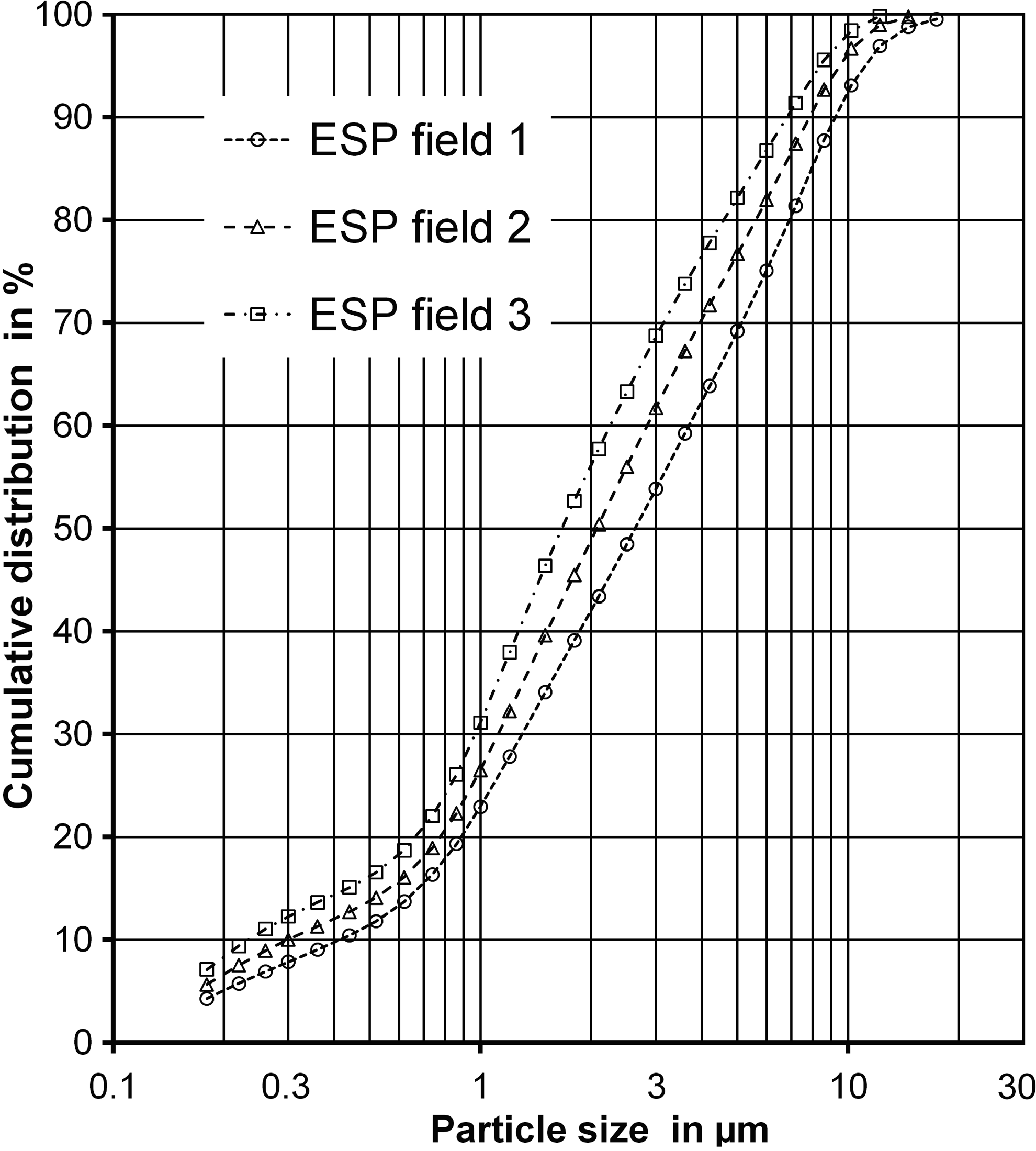
Particle size distribution of cement kiln dust (CKD) from the various fields of the electrostatic precipitator (ESP).
Grain size of the dust collected in the consecutive fields of the ESP decreased from field to field. This is true for the mass median diameter x50 as well as for the whole particle size distribution. Decreasing grain size of dust collected in consecutive ESP fields is typical (Ahn and Lee, 2006; Orava et al., 2006; Jaworek et al., 2013). According to Sanaev (2006), the decrease in the x50 of a dust collected in an ESP can be approximated by the function x50,rel = c2·exp(−c1·Lrel), where x50,rel is the ratio of x50 to x50,T, the mass median diameter of the total dust collected, and Lrel is the distance from the ESP inlet to the point of collection relative to the total length of the ESP fields. The constants c1 and c2 represent the dust characteristics. For the fly ash from coal combustion, the reported values for c1 were in the range from 1.24 to 1.45 (Sanaev, 2006). The calculated value of c1 for the investigated CKD was much smaller (0.644). This, too, is assumed to be a result of the cyclone preseparator that removed the coarser particles before the ESP.
Size distributions can be well described by an RRSB distribution. The characteristic coefficients of the RRSB distribution, the position parameter d′, and the parameter representing the spreads of the distribution n are summarized in Table 1. The size parameter d′ decreases from field to field, while the width parameter n is constant for all fields.
CKD, cement kiln dust; ESP, electrostatic precipitator.
Figure 2 shows microscope images of the dust samples. The nonspherical shape of most of the particles is due to their origin from the comminution of the feed material.
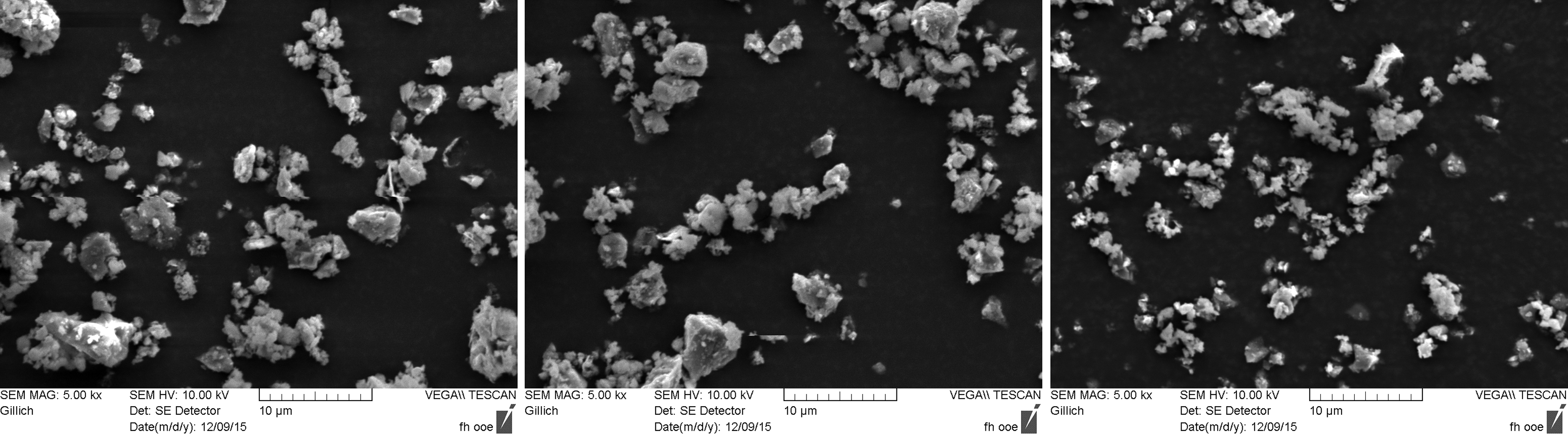
Scanning electron microscope images of the dust from ESP field 1 (left), ESP field 2 (middle), and ESP field 3 (right).
Mechanical data measured are summarized in Table 1. The bulk density for the dust collected in the first field was 500 kg/m3 and decreased to 380 kg/m3 in the third field, which is only 76% of the bulk density in the first field. The reduction of the tapped bulk density was in the same range. Decreasing bulk density in consecutive fields of the ESP is also reported for coal and biomass fly ashes (Jaworek et al., 2013). The measured values for the bulk density in this study are considerably lower compared to the values of 742 and 1,190 kg/m3, which are available from the literature (Agrawal et al., 2011; Marku et al., 2012). This may be due to the smaller grain size of the CKD investigated.
Surprisingly, the angle of repose of the dust did not increase for the dust from the first field to the dust from the third field, although the grain size of the dust decreased. The angle of repose was in the range of 48–50° for all dusts, which is equivalent to the flowability category “Poor/cohesive.” The shear tests revealed that the flowability of the dust strongly depends on the consolidation stress (Fig. 3). The higher the consolidation stress, the better the flowability. When the diagram is shown with logarithmic-scaled axes, this effect is better visible (Lanzerstorfer, 2015b). At low consolidation stress, all dust samples were in the flowability category “Very cohesive,” whereas at the highest consolidation stress, all samples were in the category “Cohesive.” The flowability of the ESP dust samples from the different fields showed little difference. This is consistent with the nearly constant angle of repose. At low consolidation stress, the flowability is worse compared to that indicated by the angle of repose.
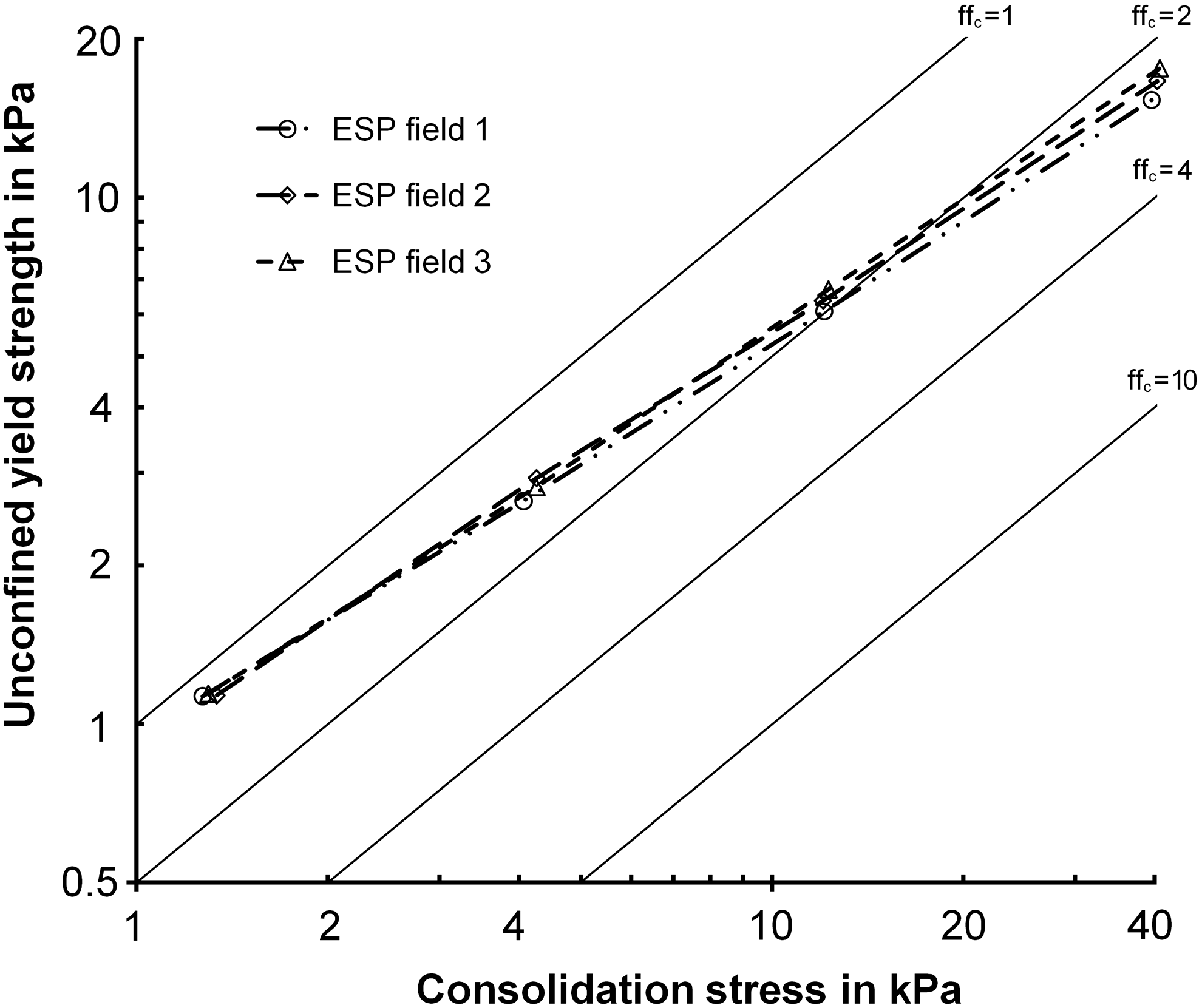
Flowability of the CKD from various fields of the ESP.
As shown in Fig. 4, the effective angle of internal friction of all dust samples decreases with increasing consolidation stress. This dependence is very strong at low consolidation stress. At higher consolidation stress this dependence is smaller. There is only little difference in the effective angles of internal friction between the ESP dust samples from the various fields of the ESP.
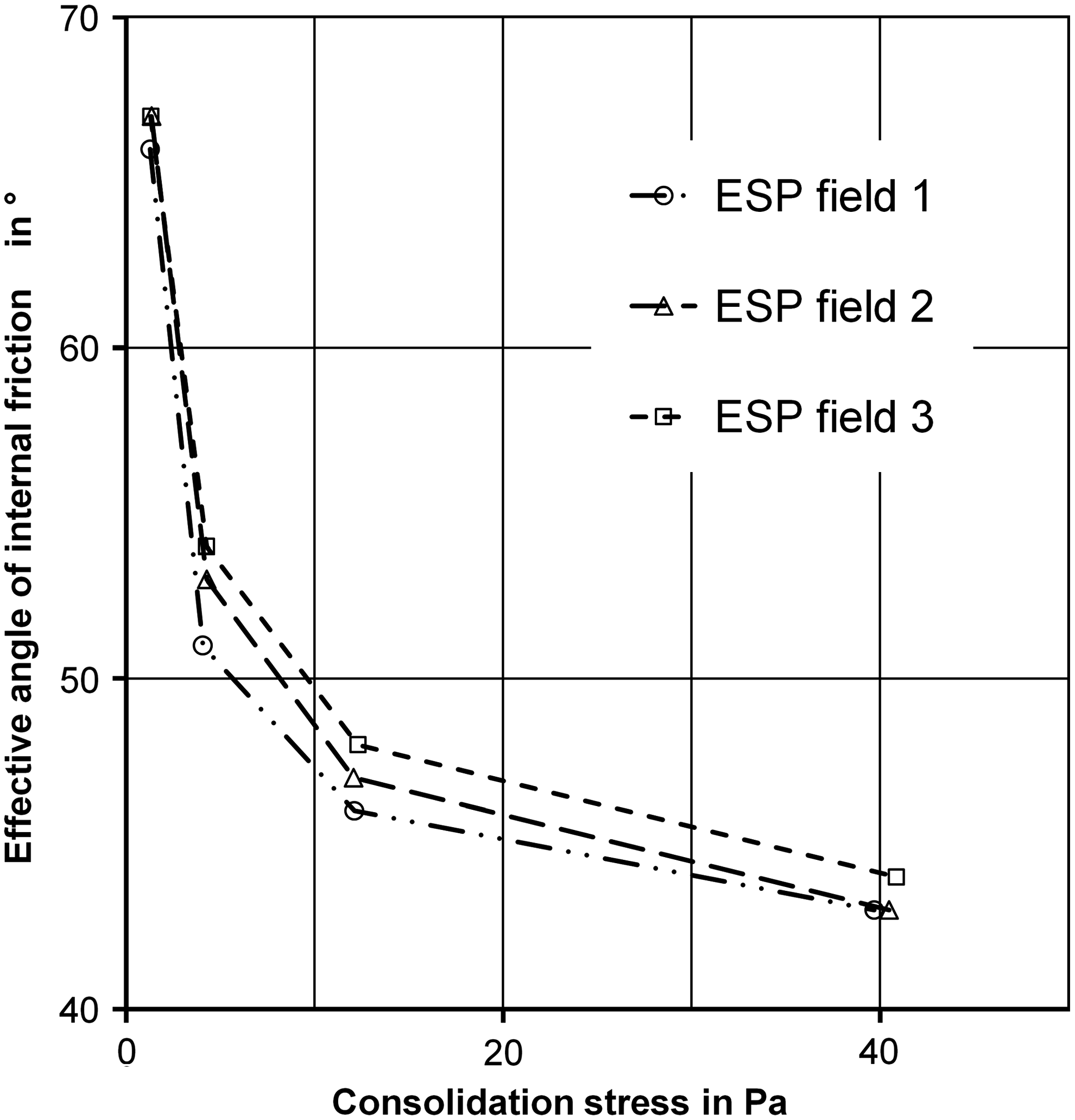
Effective angle of internal friction of CKD from the various fields of ESP.
The wall friction angle decreases with increasing wall normal stress (Fig. 5). There is no pronounced difference in the wall friction angles among the dust from the various fields of the ESP. At low wall-normal stress, the wall friction angles decrease with increasing stress. However, from a wall-normal stress of ∼5,000 Pa upwards, the wall friction angles increase slightly.

Wall friction angle with carbon steel S235JR of CKD from various fields of the ESP.
Chemical composition
Table 2 shows the concentrations of the main components in the CKDs from the various fields of the ESP. The content of these components is presented in the form of their oxides, except for carbon, fluorine, and chlorine. The composition of the CKDs is in the range of published data (Peethamparan et al., 2008; Mackie et al., 2010; Pavia and Regan, 2010).
All concentrations based on dry weight.
SD, standard deviation.
In Table 3, the concentrations of several heavy metals and other minor constituents are summarized. The elements Cd, Co, Cr, Mo, Ni, and V were also detected in the CKD samples. However, the concentrations of these elements were below the limit of quantification of the analytical method applied, which was 25 mg/kg.
All concentrations based on dry weight.
For the main components Ca, Si, Mg, Al, Fe, and C, the relative standard deviation of the content was very small. The concentration of these elements is very much the same in all CKD samples. In contrast, the highest values for the standard deviation of the concentration were found for K, Cl−, and P. The standard deviation of the concentration was also increased for Na, S, and F−. For all components with higher values for the relative standard deviation of the concentration, the content increases from ESP field to ESP field. The only exception is P, for which decreasing concentrations were measured. The maximum concentration ratio of the concentration in the dust from the third field divided by those of the dust from the first field was found for Cl−. The value was ∼4.0.
The concentrations of the main components compare well with the data published in several studies (Konsta-Gdoutos and Shah, 2003; Lachemi et al., 2008; Maslehuddin et al., 2008; Peethamparan et al., 2008; Mackie et al., 2010).
For the concentrations of the minor constituents and the heavy metals, only few data are available. The Ti content measured is similar to those reported by Maslehuddin et al. (2008) and Mackie et al. (2010), whereas Lachemi et al. (2008) found a Ti content in their study, which was five times higher. The Ba and Sr content reported by Maslehuddin et al. (2008) are also in the same range as the values measured in this study. The same is true for the Mn and the Sr content reported by Peethamparan et al. (2008). For Zn, Maslehuddin et al. (2008) reported a concentration, which is only approximately half the value measured in this study. The reported values for the Cr, Ni, and V concentration (Maslehuddin et al., 2008) are about three times the limit of quantification for these elements of this study.
The content of the minor constituents B and Ti and of the heavy metals As, Ba, Cu, Mn, Sb, and Sr was found to vary very little between the CKD samples. Only for the heavy metals Pb and Zn was the standard deviation of the concentration higher. Both heavy metals were enriched in the CKD with the smaller grain size of the last fields of the ESP.
Conclusions
Mechanical properties and chemical composition of CKD samples from the three fields of the ESP for cement kiln off-gas cleaning were investigated. The mass median diameter of all three samples was at the lower end of the reported size range of CKDs. The particle size, bulk density, and the tapped bulk density of the samples investigated decreased from the first field of the ESP to the last field of the ESP. However, the decrease in the mass median diameter of the dust over the length of the ESP was not as significant as reported for coal-fired power plants. A possible explanation for this could be the cyclone preseparator installed upstream from the ESP.
For the angle of internal friction and the wall friction angle of the CKD, a slight increase was found from field to field. The angle of repose and the flow factor ffc were nearly identical for all three CKD samples. Therefore, no significant differences have to be considered in the design of dust discharge and conveyors.
Chemical composition of samples was generally in the range of the reported concentration data. For the main components Ca, Mg, Si, Al, Fe, and C, the concentrations are very similar in the samples from all three ESP fields. For the concentration of K and Cl−, a significant increase was found for the consecutive ESP fields, while the P concentration decreased. The maximum enrichment in the dust from the third field was found for Cl−, the ratio was ∼4.0. The concentrations of Na, S, F−, Pb, and Zn also increased to a lesser extent from field to field. All other components analyzed showed no significant concentration trend.
If required, the increased concentration of Cl− in the dust from the last field of the ESP can be used for discharge of part of the Cl− from the product. This option only exists for dedusting with an ESP. When the ESP is replaced by a fabric filter for a reduction in the clean gas dust concentration, the CKD is not separated in such fractions.
Footnotes
Acknowledgments
This work was financially supported by the University of Applied Sciences Upper Austria (KSt. No. 8813). The laboratory work by B. Hadrian, preparation of scanning electron microscope images by M. Gillich, Si analyses by G. Kastner, and proofreading by P. Orgill are gratefully acknowledged.
Author Disclosure Statement
No competing financial interests exist.