




Abstract
Abstract
Monitoring of various enzymes' production throughout the process provides useful information on the dynamics of composting and is beneficial for understanding the transformations occurring during composting. In this study, aliphatic–aromatic copolyesters with different polyethylene terephthalate/poly(lactic) acid ratios were subjected to laboratory-scale and full-scale composting conditions. Activities of hydrolase (urease, protease, lipase, and cellulase) and dehydrogenase were monitored during 21 days to better understand the effect of polymer presence on enzyme production. After 7 days, a significant increase in lipase, protease, and cellulase activities in compost soil with polymer indicates qualitative and quantitative changes in the content of particular organic polymers, probably due to polymer degradation. This observation was more pronounced for copolyesters A and B and also for reference material—model aromatic oligomer. This result is in correlation with dehydrogenase activity, which reflected a higher microbial growth in compost soil containing polymer. Production of all monitored enzymes was significantly higher in a real compost pile when compared to laboratory composting conditions.
Introduction
P
Composting serving to biological stabilization of solid organic wastes is commonly considered as one of the most effective ways for polymer biodegradation due to microbial action in aerobic conditions (Garcıá-Gómez et al., 2005). However, bacteria and fungi occurring in compost do not have the ability to transport polymeric macromolecules directly into cytoplasm. Extracellular enzymes are the primary means, by which microbes degrade the insoluble macromolecules to smaller subunits before they can be taken up and metabolized by the microbial cells (Awasthi et al., 2015). These enzymes can exist in bound or free form within the compost. On the basis of the specific nature of the residual materials in compost, particular enzymatic features will be more significant in the biodegradation reactions. Nevertheless, general enzymatic systems involved in the transformation of main polymeric macromolecules always take part in the process. Consequently, metabolic activities, such as protein degradation, lipid modification, or even lignocellulose transformation, are associated with the composting process in relation to whatever the properties of the starting material are, since they are of universal distribution (López-González et al., 2014).
Thus, enzymatic activity was explored as a possible tool for composting process characterization (Mondini et al., 2004), and a high proportion of biodegradable matter may sustain high microbial activity (Gomez et al., 2006). Important enzymes involved in the composting process include the following: dehydrogenases, constituting an indicator of oxidation of simple organic sources of carbon and of respiratory activity of microorganisms, proteases, and ureases that participate in mineralization of nitrogen, and cellulases, which depolymerize cellulose and lipases, which are related to biodegradation of fats. Thus, enzymatic activities could apparently give interesting information on the rate of decomposition of organic matter and, therefore, on the product stability (Jurado et al., 2014).
A number of studies have focused on the monitoring of the enzyme activities as an indicator of the dynamic decomposition of agricultural wastes (Cayuela et al., 2008; Jurado et al., 2014). However, to date, only a few reports give evidence of the influence of polymer presence in compost on enzyme activities (Yang et al., 2004). It is therefore conceivable that the enzymatic approach may significantly contribute to knowledge of the biochemical factors controlling the polymer biodegradation and may greatly help in optimization of this process.
The aim of the present research was to evaluate the changes in microbial activity that took place in an organic fraction of municipal solid wastes (OFMSW) that has been amended with aliphatic–aromatic copolyesters of terephthalate and lactic acid over 3 weeks. The enzymatic activities of some enzymes (dehydrogenase, urease, protease, lipase, and cellulase) were measured in a laboratory-scale composting and obtained results were compared with real conditions in compost pile.
Materials and Methods
Polymers
Four poly(ethylene terephthalate-co-lactate) samples with different polyethylene terephthalate/poly(lactic) acid molar ratios (A–41/59, B–43/57, C–57/43, D–60/40 mol%) were prepared according to published procedure (Turečková et al., 2008). Concretely, these copolyesters were consisted from 41 mol% (sample A), 43 mol% (sample B), 57 mol% (sample C), and 60 mol% (sample D) of aromatic T units and corresponding aliphatic L units. The characterization of comonomers is given in detail in a study by Hermanová et al. (2015). The model aromatic oligomer (cMS), used as reference material, was prepared as given in a study by Hermanová et al.(2015) and consists of a monomer [BHET, bis (2-hydroxyethyl) terephthalate] and its dimer (50/50 mol%).
Procedures
Full-scale composting
Composting was performed in the Central Composting Plant in Brno, Czech Republic.
The company operates a regionally important facility processing biological waste in South Moravia in the south-east of the Czech Republic. The composting plant is used for the conversion of biologically degradable waste (bio-waste) from the city of Brno and its surroundings.
Copolyester samples were placed into frames, which are authors' utility models registered in Czech Industrial Property Office. The frames were designed and made by the authors themselves with wooden slats as follows: width = 900 mm, length = 600 mm, and height = 50 mm. A 1 × 1 mm polyester mesh was fixed onto the frames. Copolyester specimens in triplicate (2.206 g of copolyester A, 3.024 g of copolyester B, 3.099 g of copolyester C, and 3.208 g of copolyester D/per one sample) with dimension of 50 × 50 × 0.9 mm were installed at a height of 1 m from the upper side of the compost file and at 1.5 m from the lower side of the pile. The dimensions of the clamp, into which the compost pile was placed, were 6 × 36 m, and its height was approximately 2.5 m. Details about the composting conditions are summarized in Supplementary Data (Supplementary Fig. S1). The data on daily precipitation amounts and average daily air temperatures throughout the composting process (21 days) are presented in the diagrams (Supplementary Fig. S2). The meteorological data were kindly given from the branch of the Czech Hydrometeorological Institute (CHI) in Brno-Tuřany. The pH of soil in the compost pile was measured at different locations at the beginning of composting experiment and was in the range of 6–9.
Laboratory-scale composting
Composting (aerobic degradation experiment) in the laboratory scale was performed according to ČSN EN 14806 Norm (Standardization, 2006) in an air circulation oven (composting bioreactor - ECOCELL 22) at a constant temperature of 58.0°C (±2°C), and all details of the procedure are described in a study by Vaverková et al. (2012). After 3 weeks, all samples were removed from the compost, carefully rinsed with distilled water, and dried until constant weight under vacuum.
Enzymatic activity determination in compost soil
For the purpose of enzymatic activity assay, an adequate amount of compost soil in close vicinity of buried polymer samples was taken from laboratory compost at the beginning of experiment (0 days) and after 4, 7, 14, and 21 days.
Enzymatic activities were determined also in the compost pile (full-scale composting) before the sample was inserted and also after 21 days of composting in close vicinity to the samples.
Procedures were performed in the same way also for the cultivated control compost soil, where no copolymer was present. For each type of enzyme, the measurement was performed with 3 copies and standard deviation was evaluated. Enzyme activity was defined as mg or μg of the substrate converted to the product, per time unit and per 1 g of dry soil.
Protease activity
Protease activity was assayed by determining the amount of amino acids liberated after the compost soil (1 g) was incubated. This was done with 2.5 mL of casein solution as a substrate at 50°C for 2 h using Folin–Ciocalteu reagent, according to Ladd and Butler (1972).
Cellulase activity
Cellulase activity was assayed by determining the amount of reducing sugars released after incubating 1 g of the compost soil with carboxymethyl cellulose (1% (w/v) in a 50 mM acetate buffer (pH 5.4) at 50°C for 24 h (Nelson, 1944; Somogyi, 1952).
Urease activity
For urease activity, colorimetric determination of NH4+ ions released after the incubation of compost soil (1.0 g) was used according to Kandeler and Gerber (1988) with a urea solution at 37°C for 2 h.
Dehydrogenase activity
A reduction of 2,3,5-triphenyl-tetrazolium chloride (TTC) to triphenyl formazan was used to estimate the dehydrogenase activity after the incubation of 0.75 g of compost soil with 1.5 mL of TTC as the substrate at 37°C in the dark for 24 h (Tabatabai, 1994).
Lipase activity
The assay of lipase activity was done in an aqueous extract obtained after the extraction of 1 g of soil with 10 mL of distilled water. This was conducted according to a study by Farnet et al. (2010). The substrate p-nitrophenyl butyrate p-NPB (C4) was used for esterase and p-nitrophenyl laurate p-NPL (C12) for lipase activity determination.
Statistical analysis
All enzyme activities were carried out in triplicate and the mean values with a standard deviation are presented. One-way analysis of variance (ANOVA) was used to test significant effect (p < 0.05) of polyester addition on enzyme level in compost.
Results and Discussion
Enzymatic activity study performed in compost soil in a laboratory-scale composting
Microbes reproduced in the compost metabolize insoluble particles of organic matter by secreting different hydrolytic enzymes. These various hydrolytic enzymes are thought to control the degradation rates of different substrates, and they are the main mediators of various degradation processes (Tiquia, 2002). Extracellular enzymes constitutively produced (or induced by the presence of polymeric/oligomeric/monomeric species resembling their naturally occurring substrates) were evaluated in soil during the composting test.
Dehydrogenase activity
Dehydrogenases are involved in microbial oxidoreductase metabolism and significantly correlate with soil biomass C (Garcıá-Gil et al., 2000). The high dehydrogenase activity in the polymer-free compost soil at the beginning of the experiment reflected significant microbial activity connected with the production of energy in the form of ATP. This is through the oxidation of organic matter originally present (Fig. 1). Dehydrogenases produced intracellularly (in all intact viable microbial cells) can be used as a reliable index of microbial activity in the soil (Trevors, 1984; Tejada et al., 2008). For all composted copolymers and a mixture containing BHET and its dimer (cMS), the increase in dehydrogenase activity reflected greater microbial growth, which was probably connected to the presence of soluble degradation products. These results correlate well with a study by Pedrazzini and McKee (1984), as they ascribed increased dehydrogenase activity as largely due to available nutrients and higher amounts of organic carbon.

Changes in dehydrogenase activity determined in compost soil in laboratory conditions. Tested copolyesters were consisted from 41 mol% (sample A), 43 mol% (sample B), 57 mol% (sample C), and 60 mol% (sample D) of aromatic T units and corresponding aliphatic L units. Results are the mean of three replicates and error bars indicate standard deviation.
Lipase activity
Lipolytic activity (lipase, esterase) was monitored supposing that these enzymes play a dominant role in enzyme-catalyzed polyester bond scission. The high initial esterase activity (activity assay using p-NPB as a substrate) in the compost soil evidenced the presence of lower molecular lipid substrates, which were rapidly depleted by a microorganism (Fig. 2a). The activity of lipases (assayed according to p-NPL hydrolysis) increased during the latter period of the test due to the decomposition of fats naturally present. Furthermore, this observation confirms results published by Eastman and Ferguson (1981) that fermentation of lipids is strongly linked to predominance of methanogenesis. Both lipase and esterase activities measured for all compost soils with A-D samples followed the same pattern, where esterase activity was twofold higher than lipase activity for soil samples A, B, and C (Fig. 2a, b). The higher esterase activity of soil within sample A and B correlated well with the increase in their hydrophilic character due to the presence of large amounts of lactate units in copolyester.
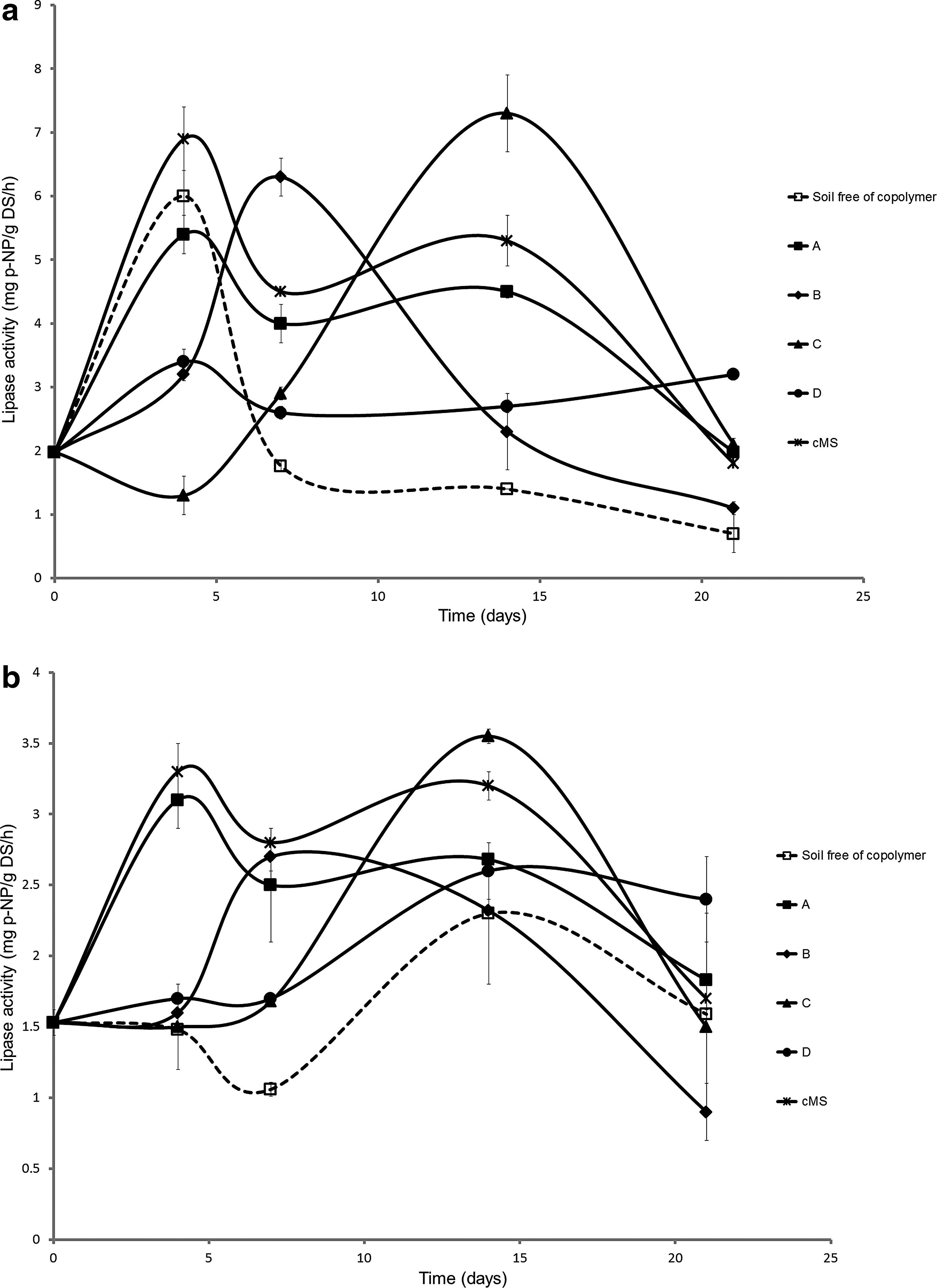
Lipases preferentially act on a cleavage of water-insoluble substrates, whereas esterases should hydrolyze short water-soluble acyl chain substrates, which may be oligomers and monomers resulting from the degradation of tested copolyesters. Due to the increased hydrophilic character (and chain mobility), samples A and B were easily available as substrates, as documented by the increase in lipase and esterase activity observed, compared with those measured for sample C (Fig. 2a, b). For sample D, the values measured were only slightly higher than those in the compost soil free of polymer. The soil sample containing BHET and dimer (50/50 mol%), cMS, showed both high lipase activity and esterase activity. This was even comparable with those measured for sample A (soil for the whole time period). Both BHET and its dimer are soluble or hydrolyzable under experimental conditions and could be degraded by enzyme action as was reported by Eberla et al. (2009).
Protease activity
Proteases as well as lipases are also related to biodegradation of PLA and its copolymers (Nampoothiri et al., 2010). The initial high production of proteases in the compost soil (independent of copolyester film presence) may be connected to the availability of naturally occurring oligo- and polypeptides (Castaldi et al., 2008). Proteases catalyze the hydrolysis of proteins into ammonia, and their activity is highly dependent on the substrate availability (Aira et al., 2007). In the case of the studied copolyesters, where introduced lactate units (Williams, 1981) or released intermediates rich in lactate units were assumed to be available for proteases attack, the monitoring of protease activity could serve as an indicator of the substrate decomposition level. In accordance with this assumption, a significant increase in protease activity was observed for composted copolyesters A and B up to 4.8 mg tyr/g DS/2 h and 3.7 mg tyr/g DS/2 h, respectively (Fig. 3). Lactic acid-based soluble degradation products served as substrates and may be rapidly utilized by microorganisms. This assumption correlated well with results of dehydrogenase activity (p < 0.05) and also with previously published results of weight losses of tested copolyesters (Adamcova et al., 2015). The protease activity values measured in soil from samples C and D were only slightly higher than those measured in polymer-free compost soil. Proteolytic activity in compost soil containing cMS fraction showed the same trend as in polymer-free compost soil (p > 0.05), which implies that the proteases are not participating in bond scission of BHET and its dimer.
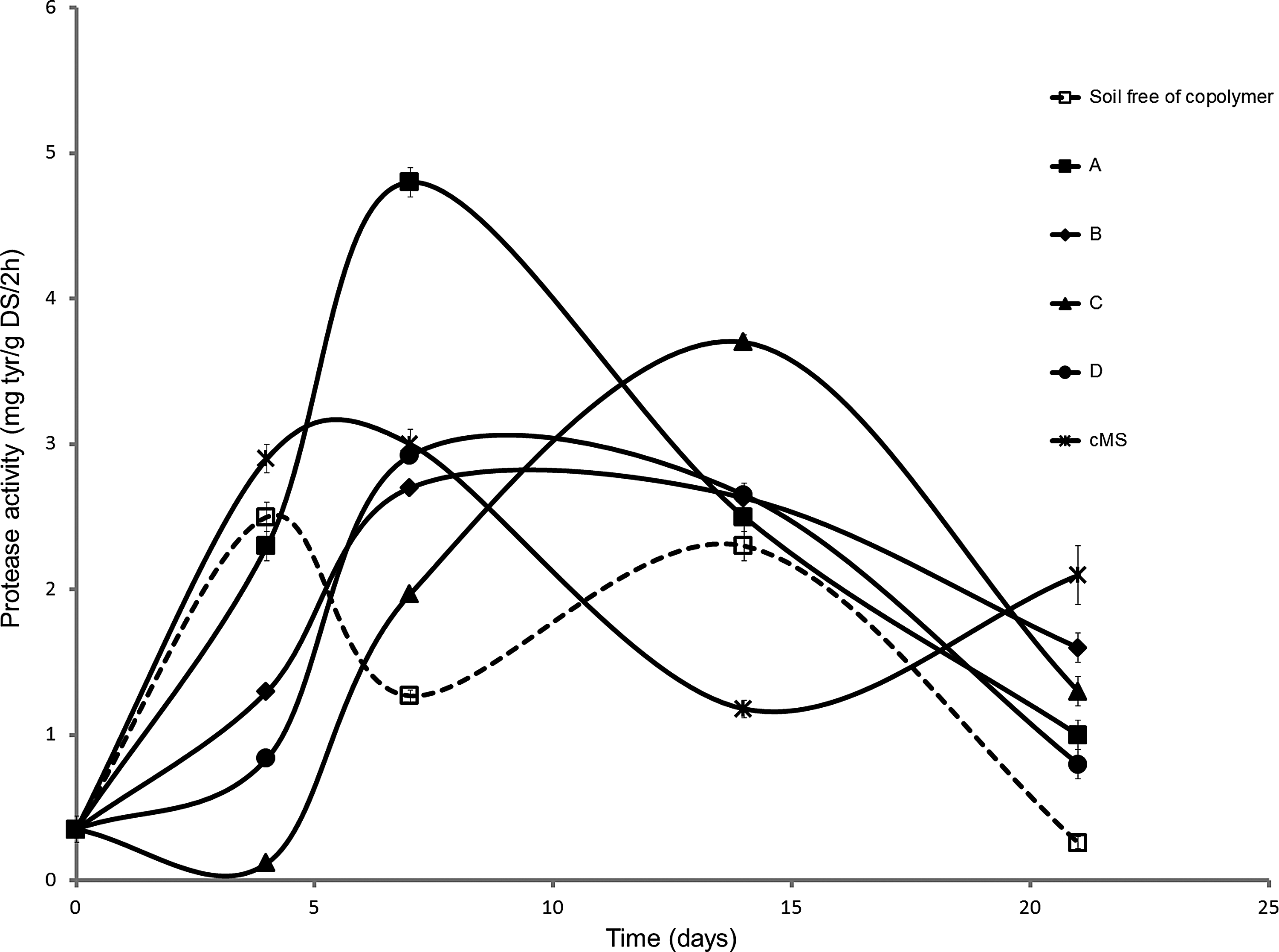
Changes in protease activity determined in compost soil in laboratory conditions. Tested copolyesters were consisted from 41 mol% (sample A), 43 mol% (sample B), 57 mol% (sample C), and 60 mol% (sample D) of aromatic T units and corresponding aliphatic L units. Results are the mean of three replicates and error bars indicate standard deviation.
Cellulase activity
Activity of cellulases, which catalyze the hydrolysis of cellulose to D-glucose, is dependent on the types of cellulolytic microorganisms present in the environment (Goyal et al., 2005) and correlates well with size of microbial biomass. In polymer-free compost soil, the highest cellulase activity was detected in the first phase of experiment due to the sufficient quantity of cellulose and hemicellulose as a main carbon source. Afterward, the decrease in cellulase activity measured (as a result of a reduction in microorganism growth) was due to nutrient depletion. In the soil samples with composted copolymers, the increase in cellulase activity at the latter phase is probably connected to higher microbial growth and the development of biomass. The trend in cellulase activity significantly correlated with dehydrogenase production (p < 0.001) for all tested copolyesters. The reason for this relationship could be that glucose, produced during hydrolysis of cellulose, is broken down by glycolysis and scission products and enters the respiratory cycle. For compost soil containing cMS fraction, the cellulase activity profile corresponded with that in polymer-free compost soil (Fig. 4) (p > 0.05).

Changes in cellulase activity determined in compost soil in laboratory conditions. Tested copolyesters were consisted from 41 mol% (sample A), 43 mol% (sample B), 57 mol% (sample C), and 60 mol% (sample D) of aromatic T units and corresponding aliphatic L units. Results are the mean of three replicates and error bars indicate standard deviation.
Urease activity
Secretion of ureases is closely related to the N cycle as it is involved in the hydrolysis of urea to ammonium and carbon dioxide. Urease activity rapidly decreased as the experiment proceeded for all tested samples and also for soil-free copolymer and model aromatic oligomer (Fig. 5). Such a decrease could be linked to the accumulation of N-NH4, as the product of microbial metabolism, which was also supported by alkaline pH developed during experimental period (Bohacz and Korniłłowicz-Kowalska, 2007).
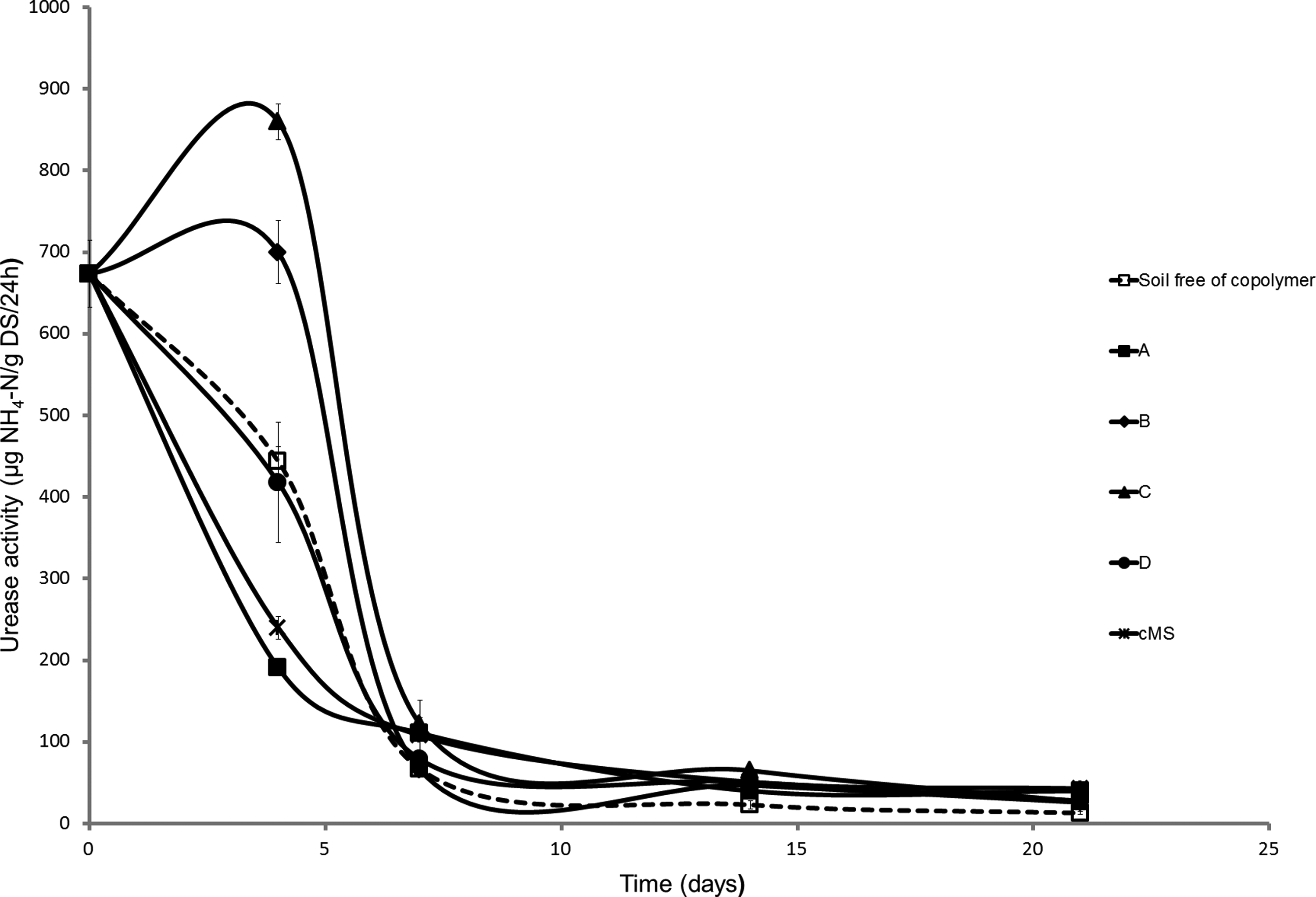
Changes in urease activity determined in compost soil in laboratory conditions. Tested copolyesters were consisted from 41 mol% (sample A), 43 mol% (sample B), 57 mol% (sample C), and 60 mol% (sample D) of aromatic T units and corresponding aliphatic L units. Results are the mean of three replicates and error bars indicate standard deviation.
Enzymatic activity study performed in compost soil in real composting conditions
Experiments in laboratory-scale composting can allow a high degree of control and replications, while using relatively small quantities of materials and other resources. However, this system may not always represent real full-scale composting conditions (duration of temperature and moisture profiles). Full-scale composting experimentation, on the contrary, can be both expensive and difficult to control and may limit replication and reproducibility.
For this reason, the comparison of enzymatic activities in real conditions (compost pile) after 21 days was performed. Enzymatic activities (lipase, esterase, protease, dehydrogenase, and cellulase) are higher in the real compost pile than those measured in the laboratory compost (Fig. 6). This observation can be connected with a greater diversity of microorganisms that occurred in real compost pile due to changing the mesophilic and thermophilic phase of composting (Mehta et al., 2014). Also, a higher amount of organic matter, associated with a higher growth of microorganisms, was developed.
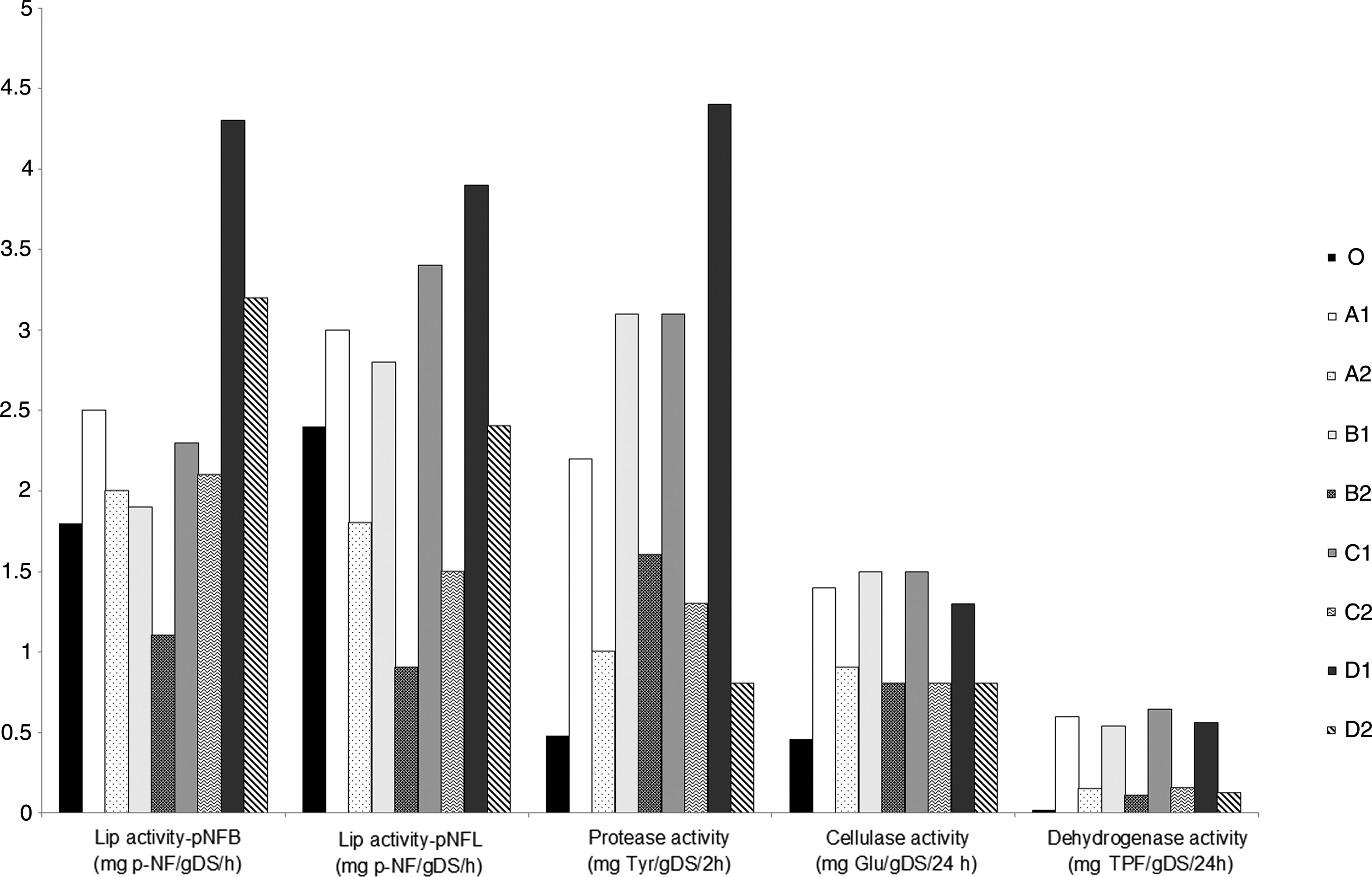
Comparison of enzymatic activities in full-scale (1) and laboratory (2) composting conditions after 21 days. Abbreviation 0 indicated soil free copolymer sample. Tested copolyesters were consisted from 41 mol% (sample A), 43 mol% (sample B), 57 mol% (sample C), and 60 mol% (sample D) of aromatic T units and corresponding aliphatic L units. Results are the mean of three replicates.
Summary
Evaluation of enzymatic activities during composting of synthetic copolyesters and model aromatic oligoester showed that this parameter could be used as suitable indicator of polymer degradability, and concurrently, the presence of aliphatic–aromatic polyesters in compost soil significantly influences production of enzymes. Enzymatic activities measured in soil samples containing polymer showed a different trend in comparison with polymer-free compost soil. Therefore, on the basis of the data above, it can be assumed that the differences in enzymatic profiles may be due to polymer presence and their decomposition during composting. This statement is also supported by correlation between protease and dehydrogenase activities.
The lowest enzyme activities occurred during laboratory-scale composting, compared with full-scale composting.
However, for supporting this assumption, further study on the monitoring of microbial level and diversity during polymer composting would be beneficial to conduct.
Footnotes
Acknowledgments
We thank Lenka Kotrchová and Soňa Hermanová from the University of Chemistry and Technology, Prague, for providing tested materials. This research has been financially supported by the Ministry of Education, Youth and Sports of the Czech Republic under the project CEITEC 2020 (LQ1601).
Author Disclosure Statement
No competing financial interests exist.
References
Supplementary Material
Please find the following supplemental material available below.
For Open Access articles published under a Creative Commons License, all supplemental material carries the same license as the article it is associated with.
For non-Open Access articles published, all supplemental material carries a non-exclusive license, and permission requests for re-use of supplemental material or any part of supplemental material shall be sent directly to the copyright owner as specified in the copyright notice associated with the article.
