




Abstract
Abstract
Although alternative methods for evaluating disinfection performance have been developed recently, the conventional CT value has been widely used due to its simplicity. This research proposes a simple, nondimensional variable chlorine disinfection index (CDI), which is derived from a chlorine decay constant, an inactivation rate constant, the initial dosage of chlorine, and the deadzone volume percentage, and investigates its possibility as a new disinfection indicator. To assess disinfection performance using CDI, 75 cases were created from each factor's value, based on previous research, and simulated using the computational fluid dynamics model. Results showed that CDI is linearly correlated with log inactivation of microorganisms, but that the relation varies with the value of the chlorine decay constant. Although the CT value is also correlated with log inactivation by linear regression, the relationship of the CT value to log inactivation is different with the inactivation rate being constant. Statistical values, such as the determination coefficient, p-value, and root mean square error value, showed that CDI is statistically more reliable, especially in the condition of less than five log. Although improvement with CDI is slight, CDI can be simply derived from steady-state simulation. Moreover, the CDI value is composed of independent values, and CDI is more convenient for design engineers when evaluating disinfection performance and calculating log inactivation due to its greater simplicity and the elimination of confusion regarding use.
Introduction
P
Disinfection performance by chlorine is affected by three types of factors. The first type consists of biochemical factors, including biological resistance and chlorine decay rate. Protozoan cysts, such as Entamoeba histolytica and Giardia lamblia, are more resistant to chlorine disinfection than viruses and bacteria (Gyürék and Finch, 1998; WHO, 2004). Therefore, to achieve a three-log inactivation of protozoan cysts, prolonged contact time at higher chlorine residual may be required. The free chlorine concentration will be reduced by biochemical reactions. The decreased residual concentration leads to decreased inactivation performance in relation to microorganism (Vasconcelos et al., 1997). The second group of factors is related to water quality and includes such things as temperature, pH, turbidity, and organic or inorganic matter concentration. Among the type of free chlorine, hypochlorous acid (HOCl) is a much stronger disinfectant than hypochlorite ion (OCl−). Because the chemical reaction rate varies with temperature and pH level, these factors can affect the composition ratio of HOCl and OCl−. Thus, low pH and high temperature are found to be favorable for achieving high levels of inactivation (Zhang et al., 2014b). Disinfection performance is negatively correlated with turbidity (LeChevallier et al., 1981), and the reactions between chlorine and organic or inorganic matter also have an important effect on the residual chlorine concentration and finally on log inactivation (Rauen et al., 2012). The last group consists of the hydrodynamic factors such as dead zone, turbulence, and mixing. These influence contact time and determine how long the microorganisms will be exposed to the chlorine (Greene et al., 2006; Lee et al., 2011; Saha et al., 2015). Turbulent flow usually enhances eddy flow, with high diffusivity and mixing, and can affect the transport of both disinfectants and microorganisms (Greene et al., 2006; Rauen et al., 2008). Thus, a description of the turbulence of flow is an important issue (Zhang et al., 2014b). Greene et al. (2006) also reported that the disinfection efficiency is affected by macromixing and micromixing and a description of mixing is important for estimating the disinfection performance.
CT value is widely used for the evaluation of disinfection performance. The CT value is typically derived by multiplying residual chlorine concentration by contact time, normally T10. However, many researchers have doubted the accuracy of this formula. Some researchers have reported that calculating the inactivation efficiency with the CT10 value can lead to either an overestimate or an underestimate (Carlson, 1999; Pfeiffer and Barbeau, 2014). Lawler and Singer (1993) criticized the blind application of the CT10 rule, and Thurston-Enriquez et al. (2003) also argued that a reevaluation of the CT10 value is necessary, because, despite the fact that viruses in water aggregate with organic or inorganic matter, the calculated CT10 value cannot ensure the inactivation of the viruses in these states. Greene et al. (2006) reported that the effect of the hydrodynamic conditions, such as micromixing, cannot be explained by the CT10 value. In recent research, new methods for calculating the CT value, such as the Eulerian CT and the Lagrangian CT value, have been suggested through the use of computational fluid dynamics (CFD) (Ducoste et al., 2005; Wols et al., 2010; Zhang et al., 2014a, 2014b). The Eulerian CT value is a scalar CT value acquired from a transport equation. The Lagrangian CT value can be measured by a particle-tracking method. However, Wols et al. (2010) reported that the Eulerian method does not adequately explain disinfection performance and, in particular, it does not predict the improved disinfection due to hydraulic adjustments. Although the Lagrangian method can predict disinfection well, this method is relatively difficult to implement through traditional CFD codes (Zhang et al., 2014b) and requires high computational costs (Wols et al., 2010). Therefore, to date, the CT10 value remains popular for the real design due to its simplicity.
This research will try to develop a new disinfection indicator through a simple method, derive relationships between the new indicator and inactivation efficiency for the estimation of disinfection performance, and search for the potential possibility of replacing the CT10 value. To accomplish these objectives, various factors, such as chlorine decay rate, inactivation rate, initial chlorine dosage, and the magnitude of deadzone, are considered when developing a CFD model, and the simulation results are statistically analyzed.
Methods
Description of CFD model and pilot scale contactor
The CFD model and the simulated pilot scale contactor in this research are identical to those of previous research (Lee et al., 2011). As shown in Table 1, a flow rate of 77.87 L/min was used with a theoretical retention time of 23.3 min in the pilot scale contactor. The pilot scale contactor was a rectangular basin with 1.725 × 3.45 × 0.305 m of width × length × water level. For the increase of retention time, baffles were installed with 1.42 × 0.01 × 0.305 m of width × length × water level. The shape of an inlet and an outlet is circular and each radius is 0.091 m. For the simulation, the standard k-ε model is used as a turbulence model, and the inlet and outlet faces are specified as normal velocity and pressure boundary as depicted in Table 1. However, water surface is given as the free-slip condition, and all walls are treated as a nonslip condition, as consistent with previous research. The new addition in this research is to apply a transport equation for chlorine and microorganisms, to use CFX 16.0v as a solver, and to apply higher maximum iterations of 7,000 for deriving exact results. Moreover, only steady-state simulation in the contactor is used in this research.
Because the hydrodynamic condition of this research is based on that of previous research, the verification was conducted by using the previous research results (Lee et al., 2011). In the previous research, the velocity map and its value measured by acoustic Doppler velocimetry were compared with those derived by steady-state simulation as shown in Fig. 1. The velocity map showed that a large vortex in both simulated and measured velocity profile was observed in the linear channel region, which is located between baffles. In both profiles, the velocity behind a baffle was commonly faster and water ahead of a baffle flowed in the opposite direction. Therefore, it can be concluded that water rapidly flowed toward the outlet behind baffles of the linear channel region, and the stagnant region can be presented with eddy flow in other part of the linear channel region. In the turning channel region, which is located between linear channel regions, velocity seemed to be irregularly ranged. Although velocity in the turning channel generally went toward the outlet, there was no specific trend in some turning channel regions. This is potentially because velocity greatly varies with the location of measuring points due to small area of turning channel and strong turbulence. Moreover, the previous research reported that comparisons of the magnitude and direction of velocity are statically valid with a determination coefficient of 0.825 and 0.894, despite possible errors such as the inconsistency of the exact location (Lee et al., 2011).

Velocity profile in pilot scale contactor by
Kinetics of chlorine and microorganisms
Consumption of residual free chlorine was determined by the reaction with organic and inorganic material, by the reaction with the biofilm on the wall, and by corrosion (Vasconcelos et al., 1997; Li et al., 2003). The kinetics of chlorine decay is normally expressed by the first-order differential equation as follows (Vasconcelos et al., 1997; Thurston-Enriquez et al., 2003; McClellan et al., 2009):
where,
The decay constant,
The Chick–Watson model is used to provide a description of the microorganism inactivation kinetics as in the following equation:
where,
Because the simplicity of the Chick–Watson model makes it attractive for design and is most appropriate for the evaluation of microbial inactivation (Haas and Karra, 1984; Gyürék and Finch, 1998), it is widely used for estimating disinfection performance, including the derivation of the CT10 value (Zhang et al., 2000; Greene et al., 2006; Angeloudis et al., 2014). The inactivation rate constant,
To apply the kinetics of chlorine decay and microorganism inactivation to the CFD simulation, kinetic equations such as Equations (1) and (2) are used in the source term of following transport equation:
where,
Diffusivity of each variable consists of the molecular diffusivity and the turbulent diffusivity as shown in Equation (3). Molecular diffusivity of each variable is defined as 1.0e-9 [m2/s], as described by Greene et al. (2006), and turbulent diffusivity is assumed to be the same with turbulent kinematic viscosity.
Simulation scenarios and derivation of dimensionless variables
To understand the characteristics of disinfection performance and develop new disinfection approaches, various scenarios have been simulated with four important impact factors: chlorine decay constant, inactivation rate constant, hydrodynamic characteristics, and initial dosage of chlorine. Although other factors such as temperature, pH, organic/inorganic matter concentration, and the type of microbe are not included, their effect is indirectly included in the variance of chlorine decay constant and inactivation rate constant. Because turbidity is greatly decreased in the primary chlorine disinfection of drinking water treatment systems due to the filtration process, the effect of turbidity on the disinfection performance may not be severe. As reported in previous research, deadzone volume percentage (DVP) can be an efficient and easy method for evaluating hydraulic efficiency irrespective of the geometry of the contact tanks (Lee et al., 2011). DVP is the ratio of the deadzone volume to the contactor volume, and deadzone is defined as the region where the direction of flow is opposite to that of the main flow. The procedure for calculating DVP is (1) to divide into each linear channel region and turning channel region according to flow direction, (2) to calculate elements' volumes of opposite flow in each region by using postprocessing work of CFX program (i.e., isovolume calculation technique), and (3) finally to divide the sum of calculated volume (i.e., deadzone volume) by the contactor's volume. It is acquired from a steady state, not a transient simulation or tracer test, and the computational loads and effort can be avoided. In addition, in that, turbulence is one of hydrodynamic factors affecting microorganism removal, and DVP includes hydrodynamic characteristics; the effect of turbulence is expected to be taken into account by DVP.
Table 2 shows the range of each factor used in this research. Five values for each factor were derived based on the results of previous research. As depicted in Table 2, the base values of chlorine decay constant, inactivation rate constant, DVP, and initial dosage are 2.77 e-4 [1/s], 2.0e-3 [L/(mg·s)], 0.394, and 2.0 [mg/L], respectively, and the range of each factor is determined by data provided from experimental and computational results. This means that the values are apt to be measured in the real world. For the evaluation of the effect of each factor, 17 cases are used by changing one factor and keeping the others at the base values and an additional 58 cases are randomly determined from the values of Table 2 for revealing the relationship between the disinfection indicator and performance.
DVP, deadzone volume percentage.
If minor effect factors, such as turbidity, are ignored, log inactivation of microorganisms can be derived as the function of four impact factors as follows:
where,
According to Buckingham's Pi theorem, two nondimension variables can be derived, and by using them, Equation (4) can be changed as follows:
By simplifying Equation (5), log inactivation can be expressed as follows:
Finally, log inactivation can be functioned by the nondimension variable, which is hereinafter referred to as chlorine disinfection index (CDI). By analyzing the simulation results, the CDI developed can be assessed as to whether it is suited for a new disinfection indicator.
Results and Discussion
Pattern of chlorine and microorganism concentration
Figure 2 presents contour diagrams showing the patterns of residual chlorine concentration and microorganisms as one of the CFD simulation results. The chlorine concentration gradually decreases as water flows from the inlet to the outlet. The lower concentration is observed in the deadzone right ahead of the baffles. This is because the water in the deadzone region has a longer retention time and its chlorine concentration keeps decaying. Finally, the pattern of chlorine concentration is similar to that of its velocity. In the case of the microorganism concentration, the contour is also similar to that of the residual chlorine concentration in that the concentration is lower right ahead of the baffles as described in Fig. 2. This is because microorganism inactivation is greatly related to residual chlorine concentration as shown in Equation (2). To estimate disinfection performance, the log inactivation is calculated from the comparison between the microbe concentrations at inlet and outlet.
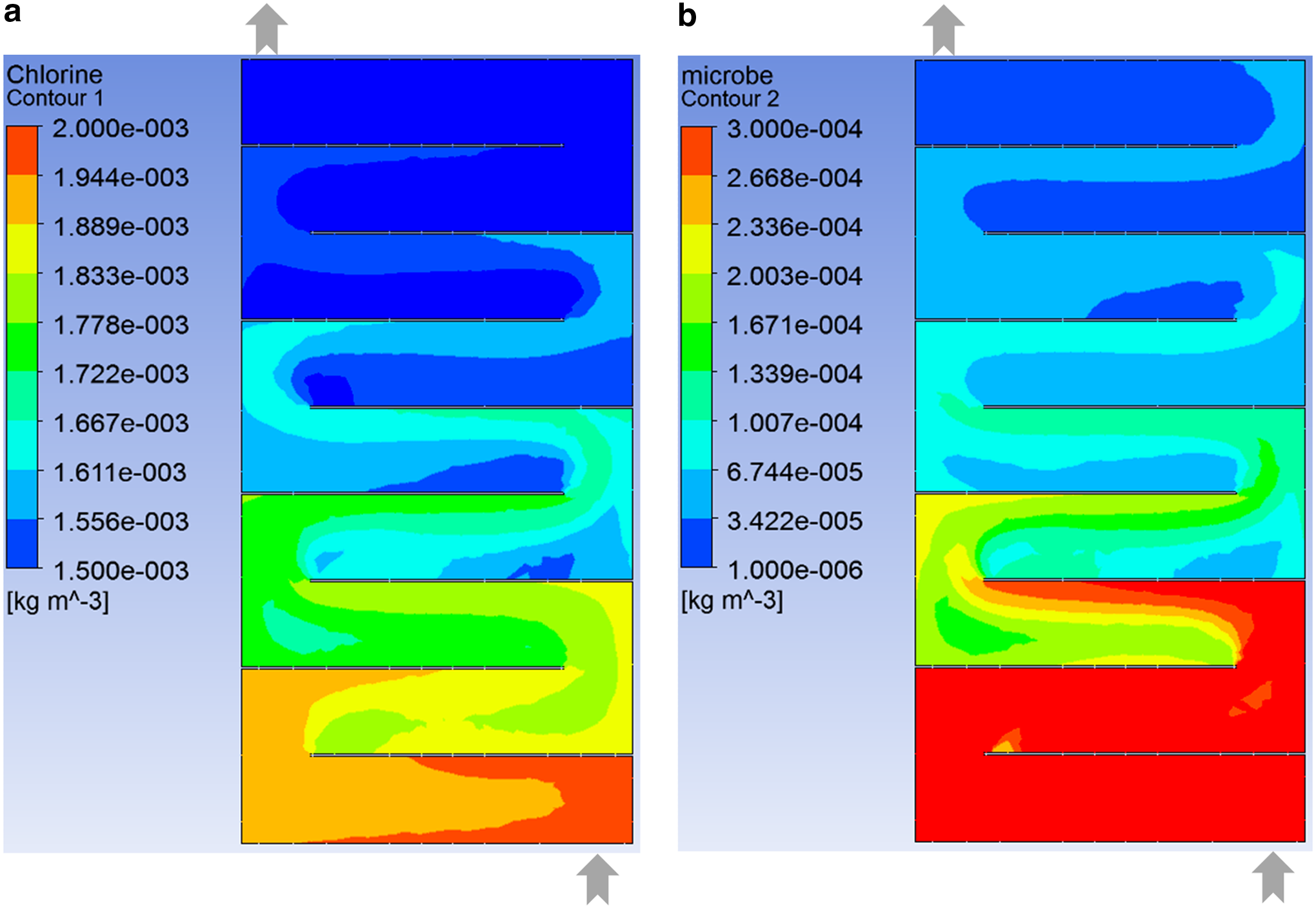
Contour diagram of
Effect of each factor on log inactivation and CDI
Figure 3 depicts the effect of impact factors, such as chlorine decay constant, inactivation rate constant, DVP, and initial dosage of chlorine, on the log inactivation. The x-axis of Fig. 3 shows the ratio of the variance of each factor to the base value. Namely, zero in the x-axis is equal to the base value of each factor and high positive and negative values depict maximum and minimum values, respectively. The y-axis describes log inactivation. As shown in Fig. 3, all factors are linearly correlated with log inactivation by the high determination coefficient (R2) and the low p-value. Because the R2 value of the linear regression curve is more than 0.95 and its p-value is lower than 0.005 in all cases, it is statistically valid. As the chlorine decay constant and DVP have a negative relationship, the log inactivation decreases with a high chlorine decay constant and DVP. Regarding the inactivation rate constant and the initial dosage, as they increase, log-removal efficiency also rises. The slopes of each regression curve are sharp in the order of initial dosage, inactivation rate constant, DVP, and chlorine decay constant, as shown in Fig. 3. This means that initial dosage is the most sensitive factor for disinfection and chlorine decay constant is less sensitive than the other factors. However, the initial dosage of chlorine is practically limited because too much initial dosage enhances the formation of disinfection by-products (Lee et al., 2011). Therefore, although the slope of the linear regression curve of the inactivation rate constant is smaller as 1.2776 compared with the initial dosage, it is practically the most powerful factor in disinfection.

Effect of each factor on log inactivation
The effect of each factor on CDI is reported in Fig. 4. The trends of the regression curve for each factor in Fig. 4 are similar to those of Fig. 3. However, in the case of the chlorine decay rate, the regression curve for CDI does not seem to be linear, unlike the regression curve for log inactivation. The slope of the regression curve in the smaller chlorine decay constant is much sharper. This explains how to calculate CDI when chlorine decay does not follow first-order kinetics. Although the first-order chlorine decay kinetic used in this research is typically accepted, it has recently been agreed that chlorine decay would be more accurately represented as the sum of two first-order reactions that describe the initially rapid decay, followed by the slower reactions (Brown et al., 2010; Rauen et al., 2012). Because the smaller chlorine decay constant has a strong effect on CDI, in the case with the sum of the two first-order reactions, a slow reaction kinetic is more critical and it is recommended that the slow reaction constant is used for calculating CDI. In addition, as previously explained, the log inactivation is less sensitive to the chlorine decay constant and thus consideration of the slow reaction constant is not critical for predicting log inactivation. In case of the effect of other factors on CDI, the regression curve is represented to be linear. The slopes of the inactivation rate constant, DVP, and initial dosage regression curve are similarly observed as 36.561, 32.008, and 36.561, respectively, and it can be concluded that their sensitivity is also similar.
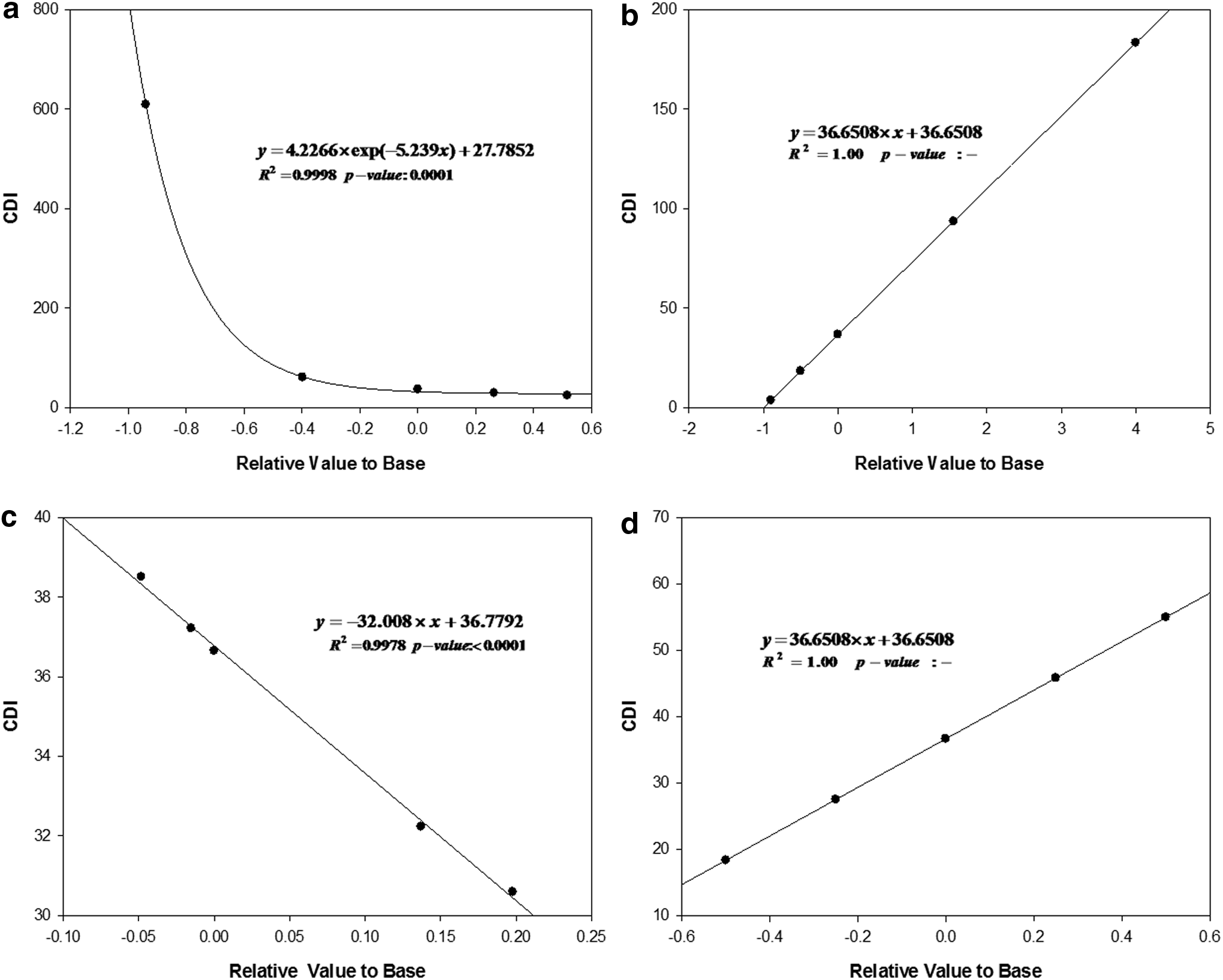
Effect of each factor on CDI
Relationship between log inactivation and CDI
Figure 5 presents the relationship of CDI with log inactivation. The x-axis and y-axis of Fig. 5 represent the calculated CDI and log inactivation, respectively. The graph is composed of 15 points for each chlorine decay constant value. Because there are five types of chlorine decay constant, as shown in Table 2, the total number of scattered points is 75. It appears that the scattered points are irregularly distributed and a specific trend cannot be discovered. This is because, as previously mentioned, CDI varies greatly with chlorine decay constant, and the scattered points must first be divided by the chlorine decay constant to derive the relationship of CDI to log inactivation. As depicted in Fig. 5, the points of each value of chlorine decay constant have a specific trend and their regression curve is linearly fitted as follows:
where,

Effect of CDI on log inactivation.
The
For the derivation of the functions of
Table 3 shows the statistical results of each prediction curve with the chlorine decay constant based on Equations (7)–(9). In all types of chlorine decay constant, the R2 values of the prediction curves are higher than 0.97. This means that a high correlation is observed between log inactivation and CDI. The maximum RMSE value is recorded as 0.562 in the case of a chlorine decay constant of 1.67E-05 [1/s], in which the minimum R2 value is observed. In addition, the p-value of each function is observed as much less than 0.0001, and Equations (11) and (12) are reliable with a significance level of 95%, which is normally identified as good scientific practice. Consequently, CDI can be used as the new index for estimating chlorine disinfection performance. The final equation for log inactivation is derived from CDI as follows:
RMSE, root mean square error.
In the next section, CDI is compared with CT10 value, with the aim of determining which of them is more reliable as a chlorine disinfection indicator.
Comparison between CDI and CT10 value
As previously mentioned, CT10 value is widely recommended as a disinfection indicator, but its reliability is suspected by many researchers (Carlson, 1999; Thurston-Enriquez et al., 2003; Pfeiffer and Barbeau, 2014). According to the CT10 table, which is used for deciding whether the target removal efficiency has been accomplished, the CT10 value varies with the type of microorganism, pH, and temperature. Assuming that the effect of pH and temperature are included in two types of constant, that is, chlorine decay constant and inactivation rate constant, the CT10 value can be classified according to the inactivation rate constant. To calculate the CT10 value, C and T are acquired from residual chlorine concentration at the outlet and the T10 value, respectively. Figure 6 shows the relationship of the CT10 value to log inactivation for each inactivation rate constant. As shown in Fig. 6, the regression curve of the CT10 value for each inactivation rate constant appears linear and is similar to those of CDI.
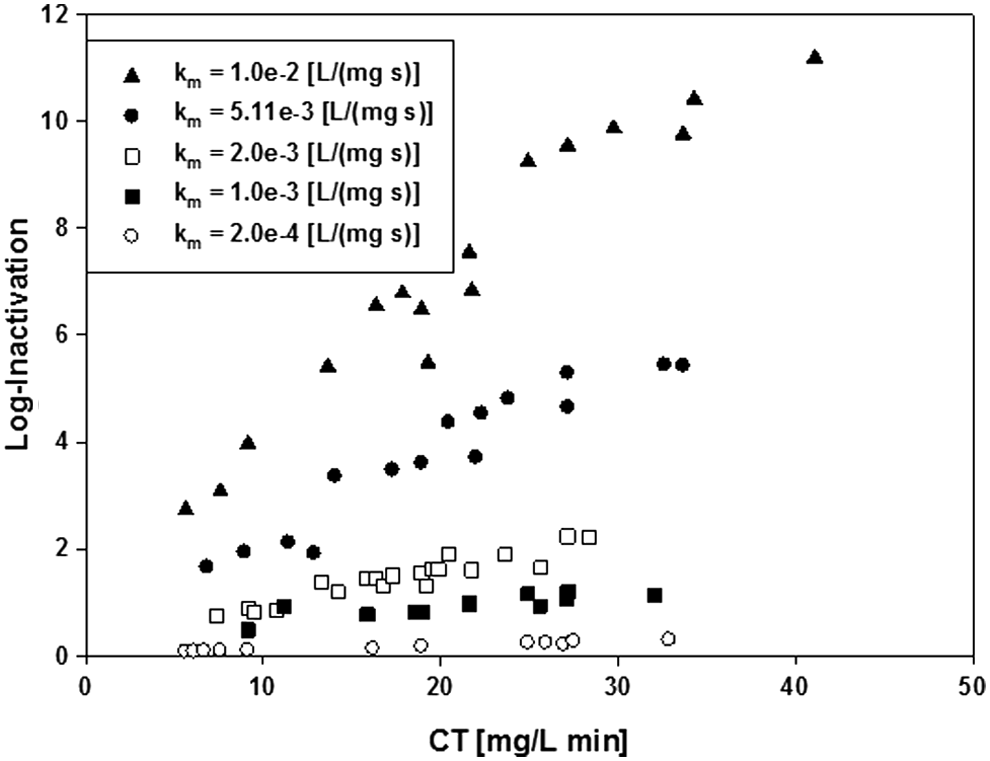
Log inactivation versus variance of CT10 value.
Therefore, the regression curve of the CT10 value to log inactivation is expressed linearly as follows:
where
Like
As with Equations (8) and (9), the log curve fits well with the variance of
Based on the
In Fig. 7a, all observed log-inactivation efficiencies from simulations are displayed with the predicted log inactivation calculated from Equations (7) and (11), to compare the results of CDI from log inactivation with those of CT10 values. The results show that both CDI and CT10 have high R2 values, with 0.988 and 0.984, respectively, while low RMSE values are recorded as 0.314 and 0.364. Although the relationship with CDI is a little stronger and more accurate, the two disinfection indicators (i.e., CDI and CT10) are reliable in predicting log inactivation. However, as shown in Fig. 7b, although the R2 value of CDI is observed as 0.983 under the condition of less than five log, and it is similar to the value on all data, the value of CT10 as 0.964 is less than the observed value on all data. The RMSE, as predicted by CDI and CT10, is observed as 0.160 and 0.233, respectively. Therefore, the error of CDI is smaller under conditions of less than five log. This implies that in terms of practical use, CDI is a more powerful tool for predicting disinfection performance than CT10. Although the prediction with CT10 is moderately effective and CDI does not bring huge improvement, the derivation from CDI has some merits. First, while a time-consuming tracer test or transient simulation is necessary for deriving the residual chlorine concentration (C) and contact time (T10), CDI needs only steady-state simulation. This means that CDI is the simpler method, saving time and effort. Second, for deducing the CT10 value, residual chlorine concentration and T10 value are necessary with an inactivation rate constant provided from a batch test. Because the residual chlorine concentration and T10 value are simultaneously affected by the geometry of the contactor, there is some relationship between them. This means that the CT10 value is composed of dependent factors. This creates much confusion for the design engineer when applying it. In contrast, DVP and the initial dosage, which are the components of CDI, do not have any relationship with each other. This implies that CDI is composed of independent parameters and is consequently more convenient for design engineers to use it.

Comparison between predicted and observed log inactivation
Although the new methodology to use CDI for the estimation of chlorine disinfection efficiency is limited by the range of the chlorine decay constant, the inactivation rate constant, and the initial dosage, as well as by pilot scale data, it is a very useful technique for supplementing and replacing the CT10 value. In a further study, the increase of the applicability of this methodology, with data drawn from a field scale chlorine contactor, will be estimated.
Conclusions
Despite the deficiency of the CT10 value, it is widely used for real design due to its simplicity. In this research, by simplifying the factors related to disinfection performance such as chlorine decay constant, inactivation rate constant, initial dosage of chlorine, and DVP, a nondimensional variable (CDI) is developed. To study the possibility of using CDI as a new disinfection indicator, each factor's effect on log inactivation and CDI is separately investigated. In addition to the sensitivity analysis, the relationship of CDI to log inactivation is classified and the function between both parameters is derived. Also, the prediction from CDI regarding disinfection performance is compared with that of the CT10 value. Through these investigations, the following conclusions are drawn:
• The analysis of each factor's effect on log inactivation shows that CDI is sensitive to disinfection in the order of initial dosage of chlorine, inactivation rate constant, DVP, and chlorine decay constant. However, in case of the effect of these factors on CDI, CDI greatly varies with the chlorine decay constant. Specifically, this means the less the chlorine decay constant, the greater the variation of CDI. • The relationship between CDI and log inactivation is expressed as a linear regression curve with the y-intercept, and the curves are functioned by the values of the chlorine decay constant. Because each regression curve has a high determination coefficient and a low p-value, the relationship can statistically be concluded to be valid. Finally, the function of CDI to log inactivation is expressed as follows:
• Similarly, the CT10 value is also related to log inactivation by linear regression. However, while the relationship of CDI to log inactivation varies with the chlorine decay constant, that of the CT10 value is determined by the inactivation rate constant. Although the CT10 value is also generally related to log inactivation, CDI is more reliable with a higher R2 value and a lower p-value, especially in the condition of less than five-log inactivation. • Although the improvement offered by CDI is not large, CDI can be more simply derived from steady-state simulation, and the CDI value is made up of values that are not affected by each other. CDI is therefore more convenient for design engineers in evaluating disinfection performance and calculating log inactivation as it is simpler to use and reduces the likelihood of confusion.
Footnotes
Author Disclosure Statement
No competing financial interests exist.