




Abstract
Abstract
The motion of particles induced by a pendant charged droplet was studied. Forces on particles during attraction were analyzed quantitatively. It was found that part of the particles bounced off the droplet surface after physical contact, which was related to their impact angle: nearly half of them rebounded when their impact angle was <85°. This could cause the decline of collection efficiency of the charged droplet. A two-dimensional numerical model was established to estimate the impact angle of particles influenced by the air flow. Numerical results showed that impact angle of particles increased by increasing the Coulomb number Kc or decreasing the Stokes number St. It was predicted that collection efficiency of a charged droplet was lower than an uncharged case at the conditions of Stokes number St > 6.1 and Coulomb number Kc = 1.
Introduction
P
The difficulty of scavenging particles, especially for that of submicro size, is their negligible weight, for which the motion is dominated by air drag or molecular forces while floating. That is, the inertial force becomes insignificant to affect the dynamic behavior of the particles (Jaworek et al., 2013). This brings a serious problem that the deposition efficiency of conventional particle removal methods decreases significantly, such as wet scrubbers and cyclones, which employ inertial forces to remove particles (Jaworek et al., 2006a). Increasing spray density can partially improve the performance of wet scrubbers, but the water consumption increases dramatically. Tighter fibrous filters have a fine interception for fine particles; however, it must sustain a high pressure difference at the gas inlet (Podgórski et al., 2006). Wet electrostatic deposition technology is a kind of hybrid system that combines advantages of electrostatic precipitators and inertial wet scrubbers (Penney, 1944). Owing to the electrostatic forces, particles deposit on the charged droplets actively, which expand the collection region of a single droplet by inertial collision. The high efficiency of electrostatic wet deposition has been validated theoretically (Kraemer and Johnstone, 1955; George and Poehlein, 1974; Nielsen and Hill, 1976; White, 1977; Wang et al., 1986; Jaworek et al., 1996; Kojevnikova and Zimmels, 2000; Adamiak et al., 2001; Jaworek et al., 2002; Yang et al., 2003; Zhao and Zheng, 2008; Carotenuto et al., 2010) or experimentally (Pilat et al., 1974; Metzler et al., 1997; Jaworek et al., 1998; Balachandran et al., 2003; Jaworek et al., 2006b; Krupa et al., 2013) in previous studies.
However, it is worth mentioning that the electrostatic field does not always enhance dust abatement by a water spray. According to our tests (in a room 5 × 3.5 × 3 m in size), the collection efficiency of charged water spray is lower than that in the uncharged case when the volume of charged spraying is large enough (∼150 mL/min, using a single nozzle, with no breakdown current). Accordingly, the microscale exploration is needed to understand the mechanism responsible for the lower efficiency. Accumulation of particles onto a single charged droplet is the foundation of wet electrostatic deposition. Sumiyoshitani et al. (1984) designed an experimental setup where the dust particles flowed upward to a charged droplet generated from a metallic capillary. Trajectories as well as deposition of the particles were directly observed. The disadvantage of the experimental setup is the vibration of the charged droplet caused by gas flow. Jaworek et al. (2001) replaced the water droplet by a brass ball to avoid such situation and the bending trajectories of the particles were successfully recorded. However, due to solid boundary of the collector, the movement of particles after impacting the liquid–gas interface cannot be observed.
In this study, the interaction between a charged droplet and the particles was studied at the microscale. An experimental setup was designed based on the study of Sumiyoshitani et al. (1984) to directly observe the motion of particles induced by a charged droplet without the interference of gas flow. Subsequently, a two-dimensional (2D) theoretical model was established to extend the analysis of the experimental observations by considering the effect of gas flow.
Experimental
Experiments of particles captured by a pendant charged droplet were carried out as shown schematically in Fig. 1. A syringe was fixed in the chamber of a liquid container to generate the droplet. A micrometer was mounted onto the syringe to accurately control the size of the droplet. The nozzle was made of a stainless steel plain-orifice capillary with a 0.51 mm outer diameter and connected to a high-voltage power supply with the voltage controlled to 1 kV. The particle plate consisted of two layers: the top layer was a 1 mm organic glass sheet with a 0.5 mm concave to hold the particles and the bottom layer was an electrically grounded copper plate. The particle plate was placed on a fine-turning table, allowing accurate control of the distance from the nozzle to the plane. Although a shorter distance from droplet to particles improves the capture capacity, ample space between them is needed to observe particle trajectories clearly. By consideration of the droplet size, we set the distance from the nozzle to the particle plate at ∼2 mm, and the whole apparatus was fixed onto a horizontal base. Hollow glass beads (TSI, W.O # 216909, 900890) of 10 μm in diameter and 1,000 kg/m3 in density were used as the particles in this work. A high-speed digital camera (Olympus I-SPEED 3) with a microscopic zoom lens (NAVITAR 12X) was employed to observe the capture process of the particles attracted by the charged droplet. The droplet and its surroundings were illuminated from the back side with the focused point source of light (Olympus ILP-2).
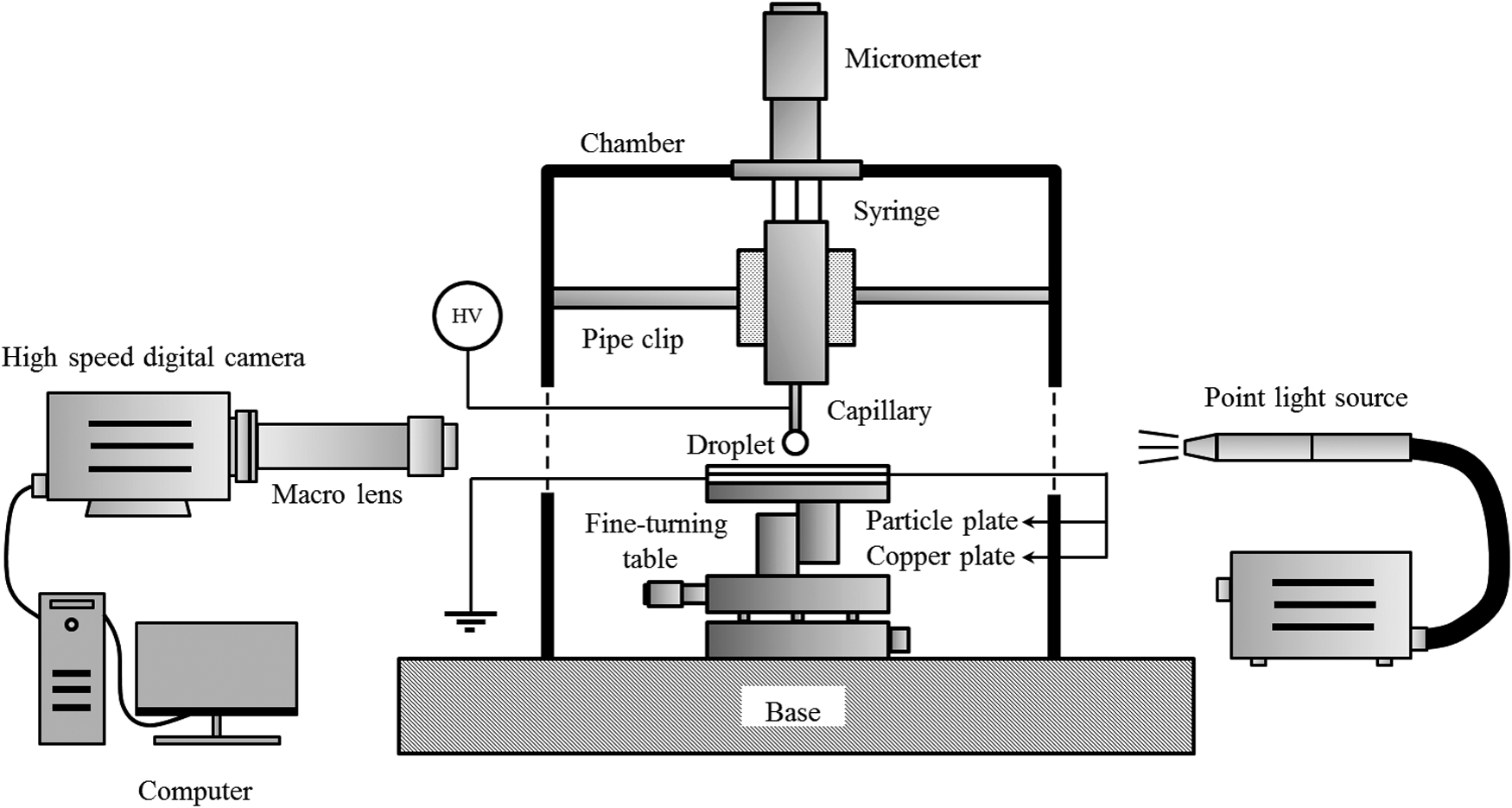
Schematic of experimental setup.
Results and Discussion
Motion of particles in gas phase
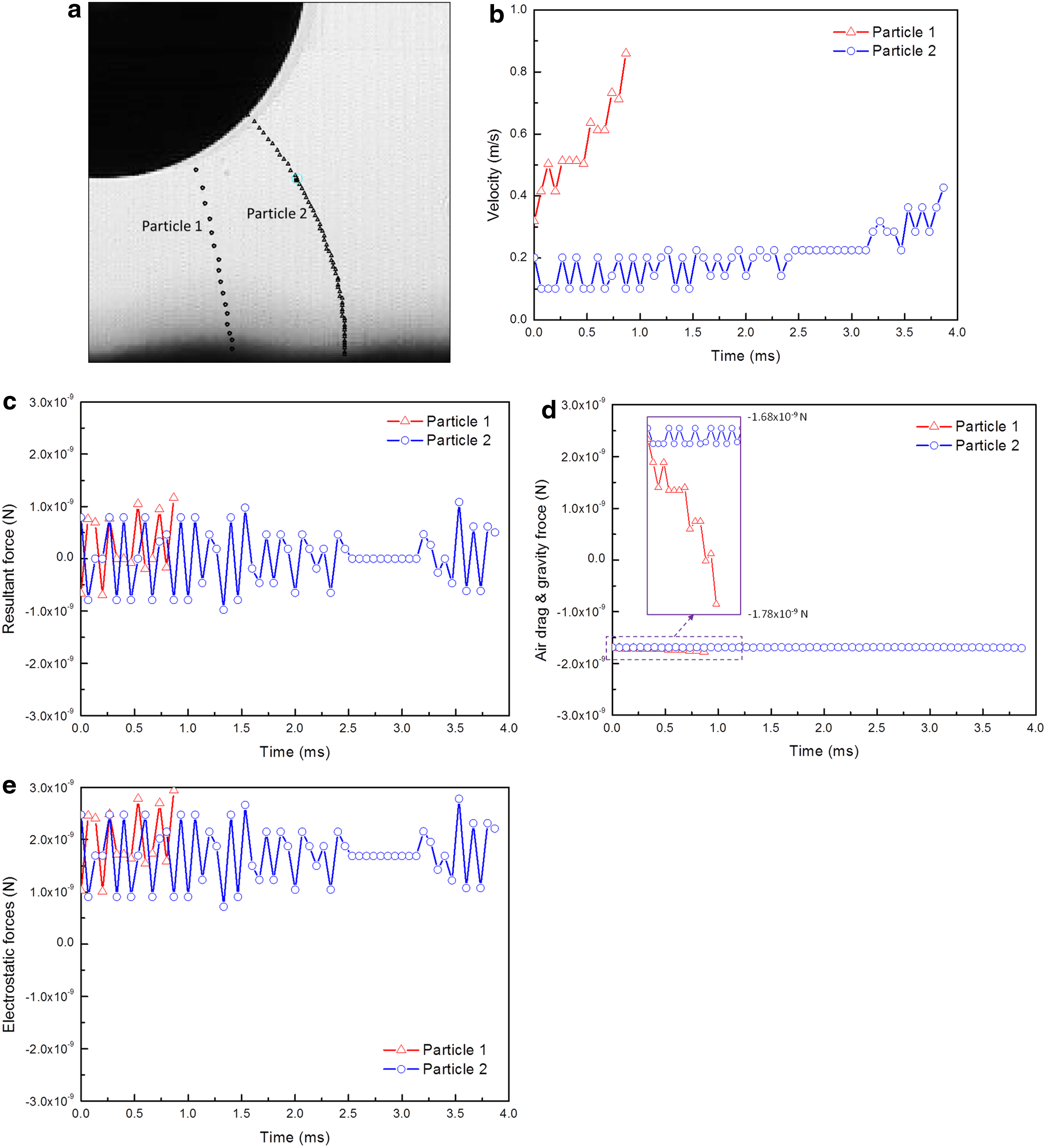
Particles on the plate are charged to the opposite polarity of the droplet, the induced electrostatic forces drive them toward the charged droplet as shown in Fig. 2. The trajectories of particles in different takeoff points of the plate are drawn in Fig. 3a. The electrostatic attractions are closely related to the distance between the charged droplet and particles. Different location of particles on the plate means different initial attractions exerted on the particles. This is revealed by the particle velocities as shown in Fig. 3b (For comparison, the time axis is returned to zero).

Motion of particles induced by a pendant charged droplet.
Particles deposit on surface of charged droplet (experimental data).
Motion of particles in the gas phase can be described by the following Newton equation:
where t is the time and up and ug are the particle and gas velocity, respectively, in which ug ≈ 0. fD is the drag force coefficient of per unit particle mass and can be expressed as Equation (2). g is the gravitational acceleration, ρp and ρg are particle and gas density, respectively, and fe is the electrostatic force per unit mass.
where μg is the gas viscosity and dp is the particle diameter. CD is the drag coefficient and is determined in Morsi and Alexander, 1972. Re is the Reynolds number:
The left side of Equation (1) is the particle acceleration ap and can be obtained by the following equation:
where the subscript i indicates the trajectory points in Fig. 3a. The resultant force mpap exerted on the particles is presented in Fig. 3c. Although particles with different takeoff points on the plate have different velocities, the resultant forces acting on them are close to each other. The first and the second term on the right side of Equation (1) are the stresses of air drag and gravity, respectively. Such forces on the particles in Fig. 3a are shown in Fig. 3d (the change of gravity force mpg along the velocity direction is neglected). Obviously, they fluctuate in a very limited range. Based on the obtained stresses in Equation (1), the electrostatic forces mpfe are calculated as shown in Fig. 3e. mpfe represents the forces related to the electrostatic field, for instance, Coulomb force, image forces, and gradient force. The effect of the image forces strongly depends on the distance between the particle and the charged droplet and is only important when they are sufficiently close. The gradient force can be expressed in Equation (5). It is related to the variation of the electric field intensity. Particle 2 moving off the plate perpendicularly in Fig. 3a is owing to the effect of gradient force. Except the two limiting circumstances, particle motion is predominated by the Coulomb force. It should be mentioned that the evaporation of the droplet can be strengthened by the electrostatic field (Takano et al., 1994; Bajgai et al., 2006), which intensifies the ion emission from the droplet. Free ions condensing onto the particles weaken the effect of electrostatic attractions. This is probably a reason causing the fluctuation of electrostatic forces in Fig. 3e.
where ɛ is the permittivity of the particle and ɛ0 is the vacuum permittivity. rp is the radius of the particle and E is the electrical field intensity.
Rebound of particles
Particles physically contact the droplet after the motion in gas phase. However, not all the particles are captured by the charged droplet: a part of them bounces off the droplet surface after impaction. This phenomenon is shown in Fig. 4 (also see Supplementary video available at www.liebertpub.com/ees). The interactions with droplet surface determine the motion behaviors of the particle: capture or rebound. According to the study of Wang et al. (2015), a 10 μm particle can bounce off the liquid surface, while the impact velocity is as high as several meters per second. However, the impact velocity of Particle 3 in Fig. 4 is ∼0.23 m/s, too small to cause rebound. Moreover, particles with lager charge relaxation time, τE = ɛpɛ0Pp, are more likely to be captured (Sumiyoshitani et al., 1984), where ɛp and Pp are permittivity and resistivity of the particle, respectively. In other words, the electrostatic attraction can last for a considerable time after the particle physically contacting the charged droplet due to its leaky dielectric characteristic. For glass beads used in our work, τE is >3.3 s (ɛp ≈ 3.7, Pp > 1011 Ω/m), which is a remarkable interval to extend the effect of electrostatic attraction. Although the particles have low velocity and large relaxation time, they bounce off the droplet surface.
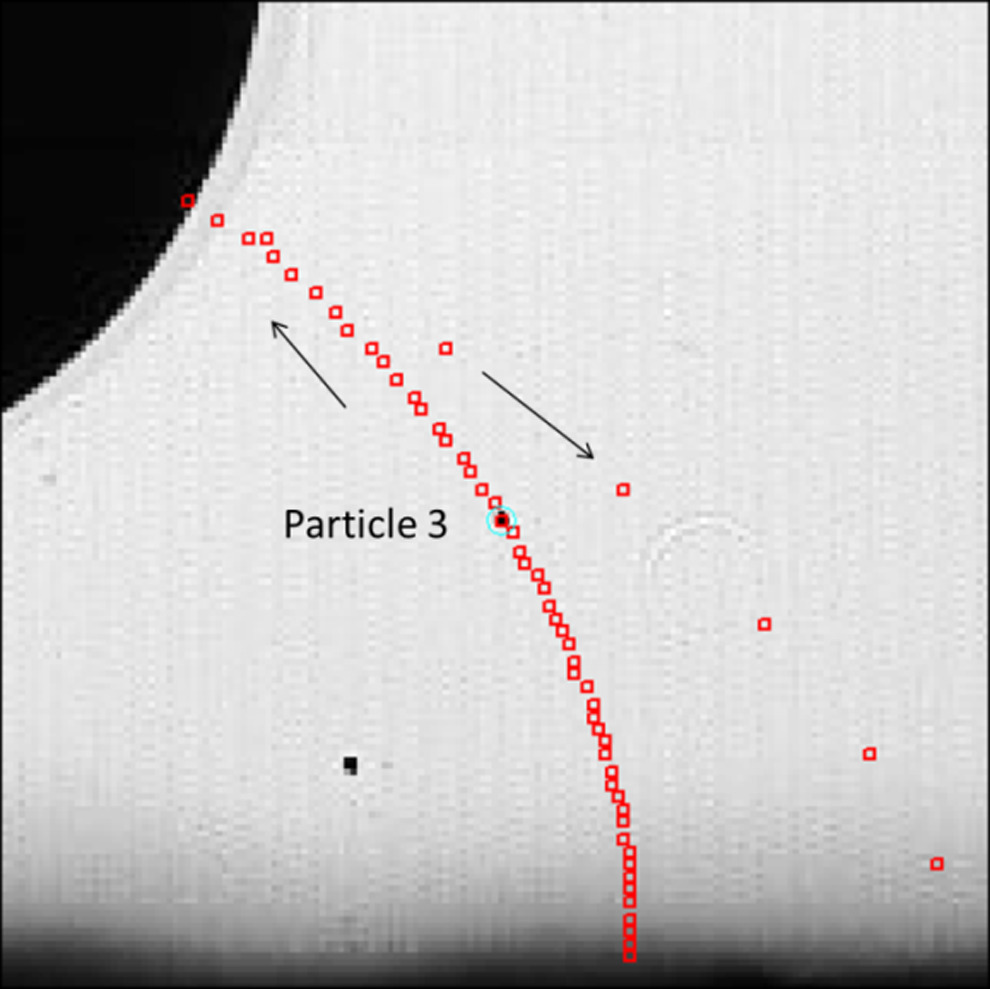
Rebound of particle.
The capture/rebound criterion proposed by Wang et al. (2015) is based on the normal impact of particle onto the liquid surface. In fact, an inclined impact is a more general collision form. The impact angle of Particle 3 in Fig. 4 is measured as shown in Fig. 5a. Obviously, it impacts the droplet surface with the impact angle of 84°. For comparison, Particle 2 impacts the interface perpendicularly in Fig. 5a (or in Fig. 3a) and it is captured. An inclined impact leads to the tangential velocity of the particle along the interface. The existence of tangential velocity could substantially reduce the adhesion, and therefore, the particles are more likely to rebound. The effect of impact angle on the motion behaviors of the particles is shown in Fig. 5b. The impact position of the particles on the surface of the charged droplet is defined as the location angle, as shown graphically in the insert of the figure. In Fig. 5b, the rebound particles account for 11% (11/100) of the sample size, among which, the proportion that the impact angle of particles γ ≤ 85° accounts for 82% (9/11). On the other hand, 3% (2/81) of the particles rebound as their impact angle γ > 85°, while it is 47% (9/19) for γ ≤ 85°, which means nearly half of the particles rebound when their impact angle is ≤85°. Smaller impact angle could cause higher probability of rebound. However, the impact angle smaller than 80° has not been observed. For the location angle, the rebound hardly appears when it is smaller than −70°, indicating that such region of the charged droplet is the most effective area to capture the particles.

Effect of impact angle on motion behaviors of particles.
Motion of particle clusters
Part of the particles on the plate coalesces to clusters due to electrostatic forces and air humidity. These particle clusters move toward the charged droplet mingling among the monodispersed particles. Compared to single particles, particle clusters have a larger volume, but a looser structure. Most particle clusters disintegrate when they impact the surface of the charged droplet, as shown in Fig. 6a. Some child particles bouncing off the interface forms the reentrainment. Remarkably, several particle clusters pass the charged droplet without physical contact, which is exhibited in Fig. 6b. This is related to the free irons in gas phase. Besides partial discharging of gas phase, the evaporation of droplet strengthened by the electrostatic field emits free irons as well. The larger volume of particle clusters enables them to capture more free charges during their motion, which even offset their initial polarity and repulsion by the charged droplet. The velocity variation of the cluster in Fig. 6b is shown in Fig. 6c, the significant decline of the velocity appears at 1.067–2 ms, which indicates that the Coulomb repulsion affects the motion of the particle cluster.
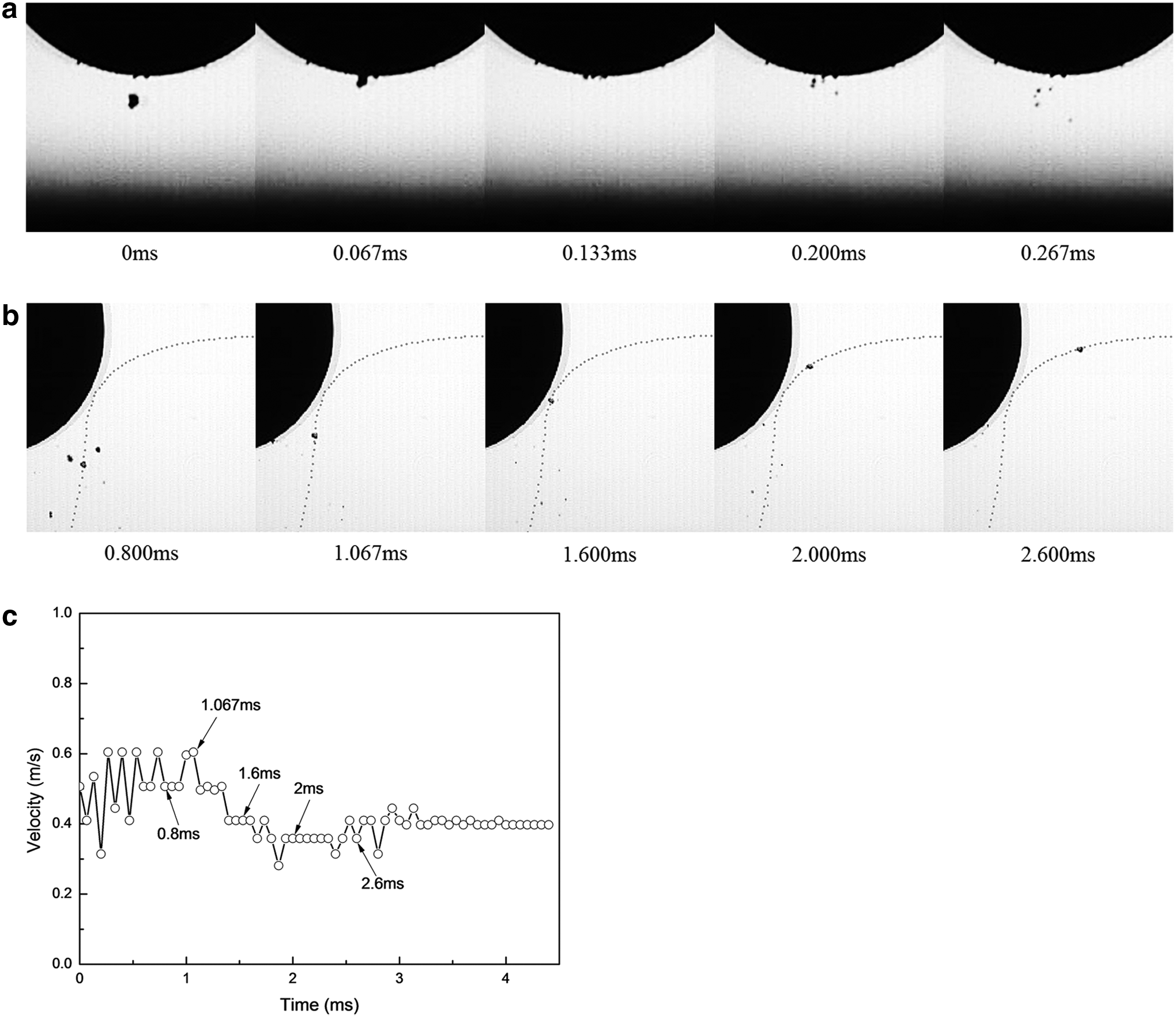
Motion behaviors of attracted particle clusters.
Motion of particles influenced by gas flow
The impact angle of the particles observed in the experiments is >80°. However, it can be affected by air flow in electroscrubbing. To estimate impact angle of the particles influenced by the air flow, a 2D numerical model is established, in which a spherical collector is fixed in the particle-laden gas flow to intercept the particles as show in Fig. 7 (considering that the droplet is set as solid boundary, it is named collector in the simulation section). A locally refined triangular mesh is adopted with about 210,000 grids. The numerical algorithm traces the movement of the particles in gas phase without considering the interactions between the particles. The gas flow is assumed laminar, Newtonian, and incompressible. The basic governing equations of gas flow are the equations of mass and momentum conservation:
where p is the pressure.

Simulation domain of model.
Trajectories of the particles are traced by solving Equation (1). It is considered that both the particles and the collector are charged oppositely. The electrostatic forces on a charged particle, including Coulomb force and image forces, can be calculated from the following formula:
where Qp and Qc are charge of the particle and collector, respectively, rp and rc are radius of the particle and collector respectively, and r is the distance from collector to attracted particle.
The first term on the right side of Equation (8) is Coulomb force, the second and third terms are image forces from collector to particle and particle to collector, respectively. The image forces are only important when the droplet and the particle are sufficiently close. Considering the momentum of the particle, the effect of image forces on the impact angle is not obvious. In this simulation, the image forces are neglected (Adamiak et al., 2001).
The particle trajectories are mainly affected by two nondimensional parameters: Stokes number St and Coulomb number Kc. The inertial deposition is proportional to the St number:
where u0 is the initial velocity of the gas flow and Cc is the Cunningham slip correction factor and approximately equals to 1. The importance of the electric force is expressed by the Kc number (Adamiak et al., 2001):
The inertia effect of the particle increases as the St number increases. The influence of St number on the impact angle of the particle is shown in Fig. 8a. It is obvious that the impact angle decreases sharply as St number increases from 0.1 to 1. Particularly, the impact angle drops to 0°, while the location angle is larger than −13° in the case of Kc = 1 and St = 10, which means no particles impact such region of the collector (the related impact angle and location angle are defined in Fig. 8c). In other words, the collection efficiency on the windward of the collector is becoming prominent, while the leeward quits collecting particles. In contrast, the effect of electrostatic attraction is promoted by the increase of Kc number. The influence of Kc number on the impact angle of the particle is shown in Fig. 8b. The impact angle increases as the Kc number increases, especially at the windward of the collector (λ < 0°).
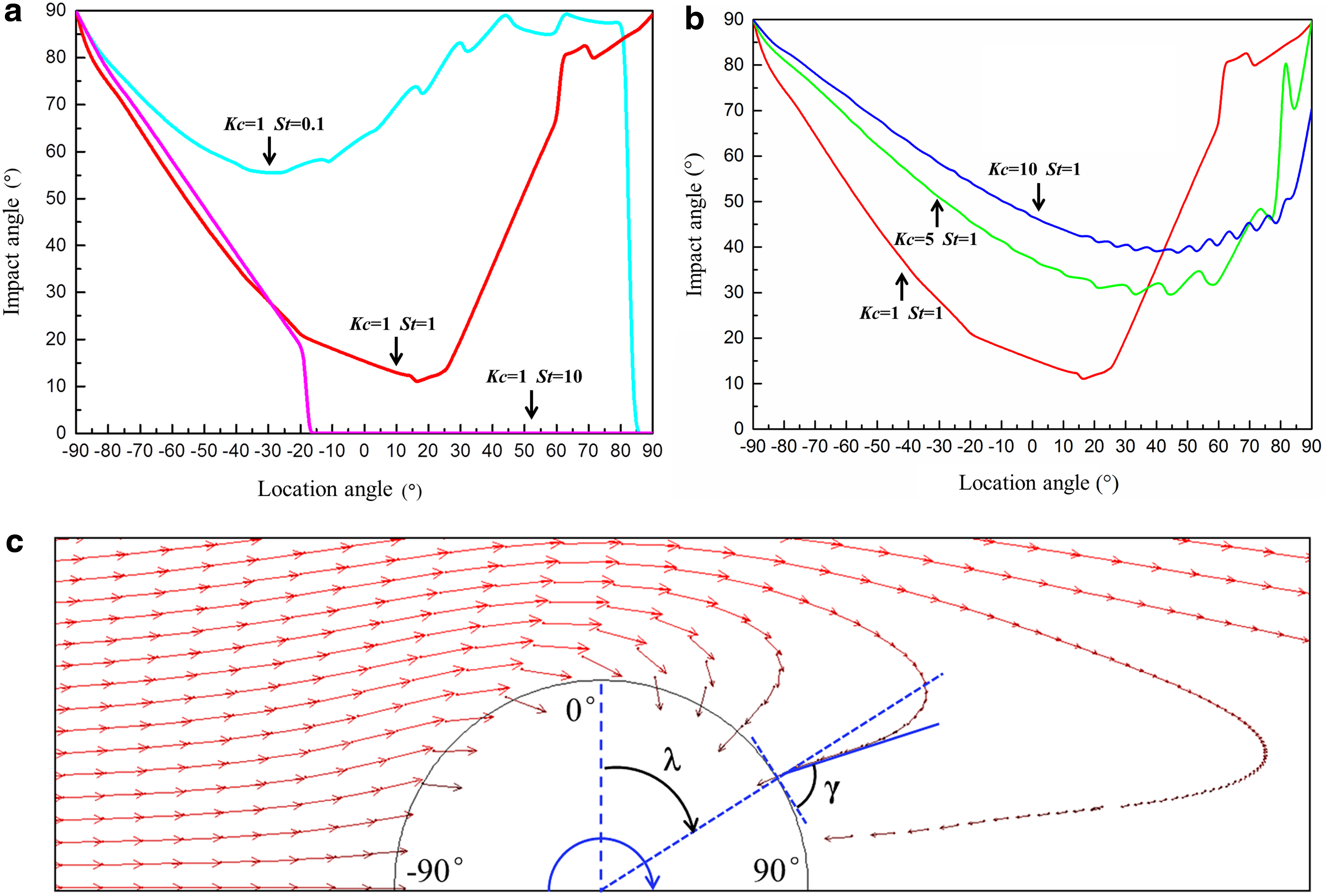
Effect of St number and Kc number on impact angle of particles.
Experimental observations show that particle rebound is a random event, which is closely related to their impact angle. Nearly half of them bounce off the surface of charged droplet when their impact angle is <85°. For simulations, suppose that particle rebound would happen for certain, while its impact angle is <85°, the predicted collection efficiency of the droplet will be lower than actual conditions. That means, the criterion of 85° rebound is the lower limit for numerical prediction and the actual collection efficiency must be higher than it. In addition, if the impact angle of the particle is <45°, the tangential component velocity is larger compared with the normal component, which means the adhesion of particle on the droplet surface is overwhelmed by the tangential component momentum (inertia force) and is hardly to be captured. Therefore, the criterion of 45° rebound can be considered the upper limit, which means the particle rebounds when its impact angle is <45° in the simulations; the predicted collection efficiency of the droplet will probably be higher than actual conditions. Briefly, the actual collection efficiency of the charged droplet will probably locate between the two criteria predicted by the simulations.
The definition of collection efficiency for the numerical simulations has not reached a consensus (Nielsen and Hill, 1976; Metzler et al., 1997; Jaworek et al., 2002). In this study, the collection efficiency η is presented in Equation (11), which is more suitable for our simulations. Physically, η characterizes the capture capacity of the particle deposition when the collectors with the diameter of d line up normal to the projection direction of the injection boundary as shown in Fig. 9a.
where, Nc is the number of captured particles in unit interval. It is a mean value calculated from the last 10 time steps when the trajectories of particle maintain quasistatic. Nin is the number of injected particles in unit interval. D is the length of injection boundary.
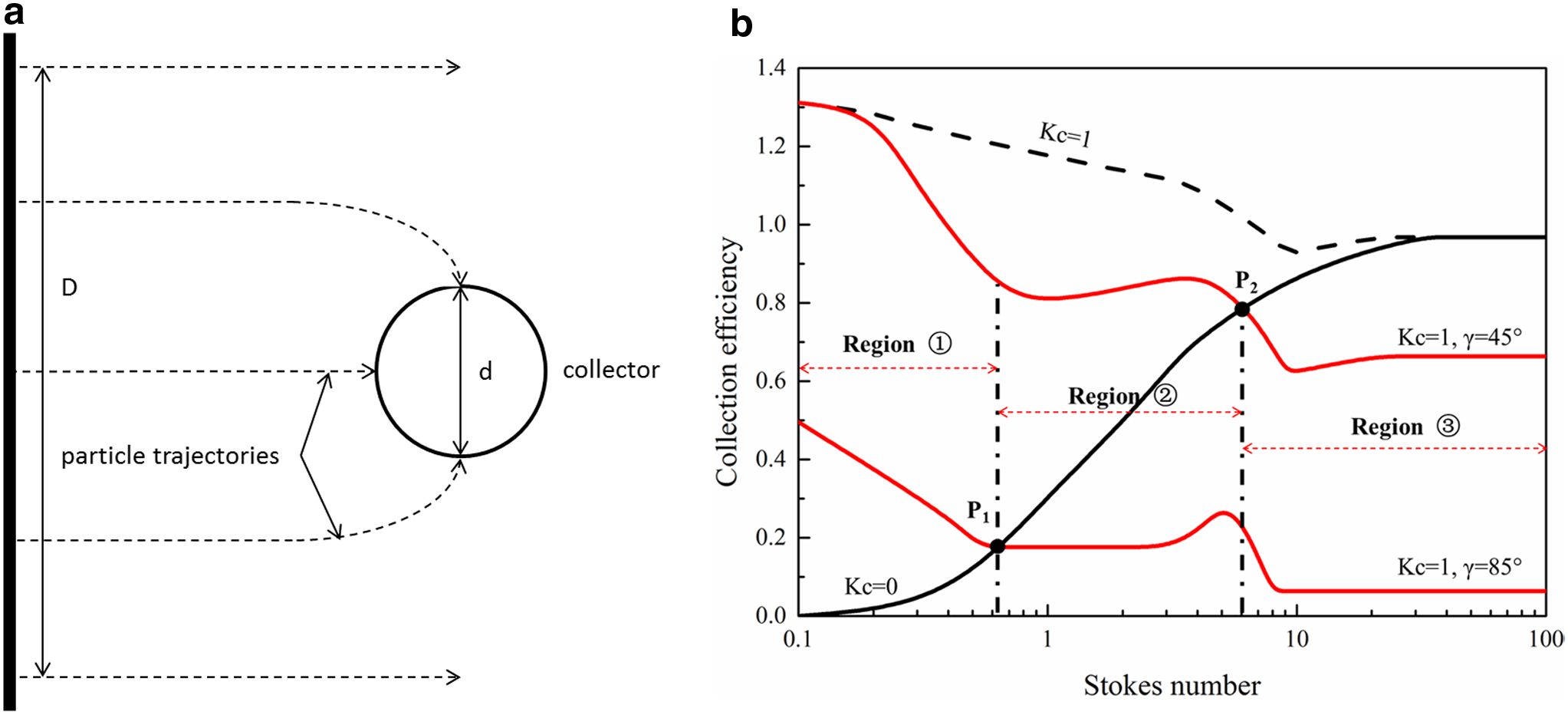
Collection efficiency of particles on a charged collector.
Effects of St and Kc number on the collection efficiency is exhibited in Fig. 9b. The figure consists of four curves: the lines of Kc = 0 and Kc = 1, both without consideration of the rebound; the lines of Kc = 1, γ = 45° and Kc = 1, γ = 85°, the critical impact angle of rebound are 45° and 85°, respectively. The lines of Kc = 1, γ = 85° and Kc = 1, γ = 45° intersect with the line of Kc = 0 at the points of P1 (St = 0.63) and P2 (St = 6.1) in the figure. The dot-dash lines crossing the two points divide the area enclosed by lines of Kc = 1, γ = 45° and Kc = 1, γ = 85° into three subdomains: region 1, region 2, and region 3. Region 1 implies that if St < 0.63, the collection efficiency of a charged collector (Kc = 1), must be higher than the uncharged one; correspondingly, the collection would be less effective when St > 6.1 in Region 3. Region 2 is the transition area that the higher collection efficiency between the charged and uncharged collector is obscure, which results from the uncertain probability of the rebound.
From Figs. 8a and 9b, the collection efficiency of the charged droplet declines with the increase of St number. However, a proper St number is beneficial for the transport of the particles approaching the collector. In practice, the St number of the electrostatic wet scrubbing is suggested to be located in region 1 of Fig. 9b, while an acceptable flux of particle-laden gas is guaranteed.
Conclusions
Motion of particles induced by a charged droplet is investigated both experimentally and numerically. The forces exerted on the particles moving in the gas phase such as drag force and electrostatic forces are analyzed quantitatively. The experimental observations show that particles with smaller impact angles more likely bounce off the surface of charged droplet after physical contact. Especially, the probability of rebound is as high as nearly 50% when the impact angle of the particles is <85°. For particle clusters, due to lager volume, but looser structure, most of them disintegrate when they impact the surface of the charged droplet or move pass the droplet by absorbing excess free irons, which reveals that the charged droplet is inefficient to capture particle clusters.
A 2D numerical model is established to estimate the deposition efficiency of particles on a charged collector by considering the effect of impact angle. The numerical results show that the impact angle on both windward and leeward of the charged collector increases by increasing the Coulomb number or decreasing the Stokes number. It also exhibits that the collection efficiency of a charged droplet is lower than an uncharged case when Stokes number St > 6.1 and Coulomb number Kc = 1.
Footnotes
Acknowledgments
We thank the Natural Science Foundation of China (NSFC) (No. 51376084) and the Postgraduate Scientific Research and Innovation Project of Jiangsu (PSRIPJ) (No. KYLX_1037) for support.
Author Disclosure Statement
No competing financial interests exist.
References
Supplementary Material
Please find the following supplemental material available below.
For Open Access articles published under a Creative Commons License, all supplemental material carries the same license as the article it is associated with.
For non-Open Access articles published, all supplemental material carries a non-exclusive license, and permission requests for re-use of supplemental material or any part of supplemental material shall be sent directly to the copyright owner as specified in the copyright notice associated with the article.
